💥UPSC 2026, 2027, 2028 UAP Mentorship (March Batch) + Access XFactor Notes & Microthemes PDF

Search results for: “”

  • Announcement: All India Open Prelims test on 28th February|| To Register Enroll in Phase B: Nikaalo Prelims, Our Free Group Study Telegram Initiative ||Want to Know How Students Have Improved So Far in Phase A of Nikaalo Prelims?|| Read Now

    Dear 2022 UPSC Aspirants,

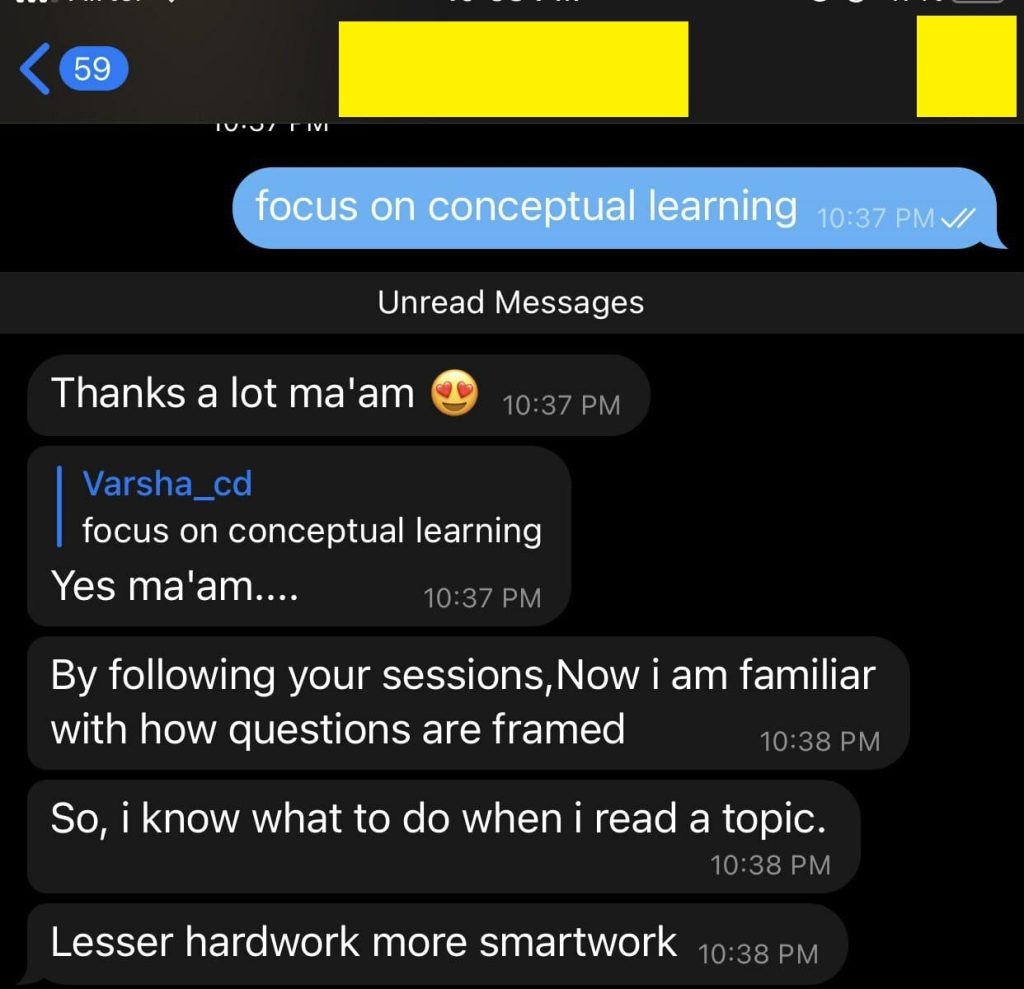
    Phase A of Nikaalo Prelims just concluded, and we are happy that it has had a positive impact on many students. Those who joined our free telegram channel experienced a community of like-minded UPSC aspirants who were mentored by Varsha Ma’am. Varsha Ma’am was able to get regularity lacking in their preparation with her morning and evening sessions.

    As a result of which, students felt their scores improving, found a renewed interest to follow the timetable and study, took inspiration from their peers on the group and also got access to sources that simplified concepts for them.

    Join Nikaalo Prelims and get prelims spotlight notes, follow daily timetable, solve subject-wise mcqs & clarify your doubts with mentors.

    Here are the Testimonials of Students Who Benefitted from Nikaalo Prelims: Phase A

    What have we covered in Nikaalo Prelims Phase A So Far

    1. In the last 15-16 days we have covered World Geography, Indian Geography, Indian Polity through daily 15-20 MCQs.

    2. We have also covered previous year questions of the respective subjects.

    3. In CSAT we have covered Number System, Average, Percentage, Profit & Loss, and Some portion of Reasoning

    .4. We conducted strategy sessions on CSAT, Prelims GS-1.

    What will be covered in Nikaalo Prelims Phase B?

    1. Detailed daily time table

    2. Daily sessions on specific topics

    3. Daily mcqs

    4. Notes 

    5. All India open test

    6. Morning and Evening Sessions (12PM and 7PM) conducted by Varsha Ma’am who will explain the logic behind the test answers.

    What is new in Nikaalo Prelims 4.0?

    1. This time the program is divided into 3 parts.

    2. Part-A: It will continue till February 28, 2022. Under part A, we will cover the Syllabus along with conceptual understanding and better subject wise clarity. There will be daily MCQ based sessions along with Doubt Clearing Sessions.

    3. Part-B: It will start from March 1, 2022. Part B includes- daily sessions, daily Prelims Intensive spotlights notes, daily MCQs based quiz, All India test, Doubt Sessions.

    4. CSAT: There will be one session dedicated to CSAT.

    How to Join Civilsdaily Telegram Channel?

    Join via the below link or scan the QR Codehttps://t.me/+Ue3sJymgwXDQq1fj

  • MEETING LINK INSIDE, REGISTER & JOIN NOW| What are the 5 Methods to Maintain Daily Consistency in Current Affairs, Optional & GS Preparation?|| What are the 4 Factors you Need to Work on if you can’t Study Regularly?|| Free Live Webinar by UPSC-CSE 2020 IPS Officer Rishabh Sharma|| Limited Slots Available, Register Now

    MEETING LINK INSIDE, REGISTER & JOIN NOW| What are the 5 Methods to Maintain Daily Consistency in Current Affairs, Optional & GS Preparation?|| What are the 4 Factors you Need to Work on if you can’t Study Regularly?|| Free Live Webinar by UPSC-CSE 2020 IPS Officer Rishabh Sharma|| Limited Slots Available, Register Now

    Civilsdaily Team is inviting you to a scheduled Zoom meeting.

    What are the 4 Factors you Need to Work if you can’t Study Regularly? || by IPS Rishabh Sharma || UPSC-CSE 2020 Topper

    Date & Time: Feb 11, 2022 @07:00 PM (log in begins @ 06:45 PM) India


    Join Zoom Meetinghttps://zoom.us/j/99118719471?pwd=SHh2alE0aW1Nd0dlU1RsK3JhV0xXdz09

    Meeting ID: 991 1871 9471

    Passcode: 911266

    Since its inception, UPSC-CSE has had toppers from various academic and socio-economic backgrounds who have cracked the exam with flying colours. It’s clear that one doesn’t have to go to Delhi or a coaching centre to crack UPSC-CSE.

    If education, geographical and economic background doesn’t matter, then what does? Attitude, or precisely consistency. If you are persistent and adamant to clear UPSC- CSE and have given more than two attempts till now, then you must replace that with consistency. Because, being persistent might lead you to the door, but it’s consistency that unlocks it.

    In last month’s Samanvaya 1-on-1 counselling sessions, our expert Civilsdaily mentors reached out to aspirants to address their concerns regarding UPSC-CSE preparation. These are the responses they often heard from them —

    How do I start preparing after a gap of 3-4 months?

    It’s easy for me to maintain consistency in GS Preparation but not Revision

    I study daily, but can only remain focused for 2-3 hours. How do I improve?

    My long working hours don’t allow me to study daily.

    Why am I losing interest in completing a subject? It’ s easier to read a new subject everyday.

    Open to All, Free Live Webinar by IPS Officer Rishabh Sharma sir

    This prompted us to reach out to one of our students who is currently an IPS officer, Rishabh Sharma. He cleared the exam in 2020 with AIR 454. After his first attempt, Rishabh had enrolled in Smash Mains program under Sajal sir and also attended our free interview program. Cracking the mighty UPSC-CSE the second time, Rishabh explains what consistency means to him —

    UPSC doesn’t just test your intellect. It tests your patience, mental strength, your emotions, the very character of yours . As far as the journey of CSE is concerned you might know when to start, but you never know when the journey will come to an end. So be consistent and enjoy the journey.

    Every topper follows a plan, a method or strategy that makes it easier for them to study on a daily basis and complete the traget modules of the day. In this free live webinar, Rishab Sharma IPS will be explaining the many ways he ensured that he never faltered on his preparation.

    What you will be learning from Rishab Sharma IPS in this webinar?

    1. The difference between a consistent study pattern v/s an inconsistent one. How did UPSC-CSE become easier for Rishab Sharma IPS due to consistency?

    2. Social media distraction. How did Rishabh Sharma IPS avoid spending long hours on social media?

    3. Number of ideal breaks everyday. Why is it necessary to reward yourself with a short break from time to time?

    4. Did Rishabh Sharma IPS plan his timetable in advance? Why daily timetable should not be rigid but yearly timetable should be well defined?

    5. How to remain consistent when you are not opting for coaching? Rishabh Sharma answers.

    6. What are the practical methods to maintain regularity in studies. Tips to sustain the fire and passion for studies by Rishab Sharma IPS

    7. Why using Public Libraries is a way to remain consistent in UPSC-CSE preparation? How helpful is it according to Rishabh Sharma?

    8. What are the 4 factors that determine if you can remain consistent for a year? If not, then why should you work on them first before starting UPSC-CSE preparation?

    Webinar Details

    It’s understandable we are humans and not programmable robots who can maintain the same level of interest everyday. However, maintaining an overall consistency throughout our preparation is neccessary to clear this competitive and vast exam.

    We hope this webinar by Rishabh Sharma IPS will give you a fresh and clear start to prepare for UPSC-CSE 2022-23

    Date: 11 February, 2022 (Friday)

    Time: 7PM

  • An MSP scheme to transform Indian agriculture

    Context

    The MSP must look especially into the requirements of farmers and the landless.

    Background of price stabilisation for food grain

    • The Essential Commodities Act in 1955 sought to counter price rise due to speculative private trading and then MSP in the 1960s.
    • A buffer stock policy was developed over time to involve different kinds of mechanisms such as:
      a) setting cost-based minimum procurement price, paying the difference between procurement price and market price.
      b) storing the procured surplus for sale through the Public Distribution System (PDS) at issue price, and market intervention to stabilise price when deemed necessary.
    • This task required interlinking procurement, storage and distribution with more centralised investment and control of each of these tasks.

    3 Purposes MSP could serve

    MSP could serve, in principle, three purposes:

    • Price stabilisation in the food grains market.
    • Income support to farmers, and
    • As a mechanism for coping with the indebtedness of farmers.

    Advantages of wide coverage

    • Fulfilling three objectives: In this way, the objectives of income support to farmers, price stabilization, food security, and inducing more climate-friendly cropping patterns can be combined to an extent.
    • Solution to debt problem: A real breakthrough in the recurring problem of agricultural debt can be made by the linking of selling of grains under MSP to the provision of bank credit particularly for small farmers.
    • The farmer can get a certificate selling grains at MSP which would be credit points proportional to the amount sold; this will entitle them to a bank loan as their right, and calibrate the fluctuations between good and bad harvest years by storing the certificates for later use.

    Issues with MSP in current form

    • Low accessibility and awareness of the MSP regime: A survey highlighted that 81% of the cultivators were aware of MSP fixed by the Government for different crops and out of them only 10% knew about MSP before the sowing season.
    • Arrears in payments: More than 50% of the farmers receive their payments of MSP after one week.
    • Poor marketing arrangements: Almost 67% of the farmers sell their produce at MSP rate through their own arrangement and 21% through brokers.
    • Partial coverage resulting in skewed cropping pattern: This partial MSP coverage skewed the cropping pattern against several coarse grains and millets particularly in rain-fed areas.

    Way forward

    • Flexible arrangement of MSP: Each crop within a band of maximum and a minimum price depending on harvest conditions i.e. higher price in a bad and lower price in a good harvest year in general will have its price set in the band.
    • High MSP for coarse grains: The price of some selected coarse grains can be fixed at the upper end of its band to encourage their production in rain-fed areas.

    Conclusion

    Greater coverage of all 23 crops under MSP is a way of improving both food security and income support to the poorest farmers in rain-fed regions.

    UPSC 2022 countdown has begun! Get your personal guidance plan now! (Click here)

  • Free Live Webinar @ 7PM Today, Registrations Closing in 1 Hr|| What are the 5 Methods to Maintain Daily Consistency in Current Affairs, Optional & GS Preparation?|| What are the 4 Factors you Need to Work on if you can’t Study Regularly?|| Free Live Webinar by UPSC-CSE 2020 IPS Officer Rishabh Sharma|| Limited Slots Available, Register Now

    Free Live Webinar @ 7PM Today, Registrations Closing in 1 Hr|| What are the 5 Methods to Maintain Daily Consistency in Current Affairs, Optional & GS Preparation?|| What are the 4 Factors you Need to Work on if you can’t Study Regularly?|| Free Live Webinar by UPSC-CSE 2020 IPS Officer Rishabh Sharma|| Limited Slots Available, Register Now

    Since its inception, UPSC-CSE has had toppers from various academic and socio-economic backgrounds who have cracked the exam with flying colours. It’s clear that one doesn’t have to go to Delhi or a coaching centre to crack UPSC-CSE.

    If education, geographical and economic background doesn’t matter, then what does? Attitude, or precisely consistency. If you are persistent and adamant to clear UPSC- CSE and have given more than two attempts till now, then you must replace that with consistency. Because, being persistent might lead you to the door, but it’s consistency that unlocks it.

    In last month’s Samanvaya 1-on-1 counselling sessions, our expert Civilsdaily mentors reached out to aspirants to address their concerns regarding UPSC-CSE preparation. These are the responses they often heard from them —

    How do I start preparing after a gap of 3-4 months?

    It’s easy for me to maintain consistency in GS Preparation but not Revision

    I study daily, but can only remain focused for 2-3 hours. How do I improve?

    My long working hours don’t allow me to study daily.

    Why am I losing interest in completing a subject? It’ s easier to read a new subject everyday.

    Open to All, Free Live Webinar by IPS Officer Rishabh Sharma sir

    This prompted us to reach out to one of our students who is currently an IPS officer, Rishabh Sharma. He cleared the exam in 2020 with AIR 454. After his first attempt, Rishabh had enrolled in Smash Mains program under Sajal sir and also attended our free interview program. Cracking the mighty UPSC-CSE the second time, Rishabh explains what consistency means to him —

    UPSC doesn’t just test your intellect. It tests your patience, mental strength, your emotions, the very character of yours . As far as the journey of CSE is concerned you might know when to start, but you never know when the journey will come to an end. So be consistent and enjoy the journey.

    Every topper follows a plan, a method or strategy that makes it easier for them to study on a daily basis and complete the traget modules of the day. In this free live webinar, Rishab Sharma IPS will be explaining the many ways he ensured that he never faltered on his preparation.

    What you will be learning from Rishab Sharma IPS in this webinar?

    1. The difference between a consistent study pattern v/s an inconsistent one. How did UPSC-CSE become easier for Rishab Sharma IPS due to consistency?

    2. Social media distraction. How did Rishabh Sharma IPS avoid spending long hours on social media?

    3. Number of ideal breaks everyday. Why is it necessary to reward yourself with a short break from time to time?

    4. Did Rishabh Sharma IPS plan his timetable in advance? Why daily timetable should not be rigid but yearly timetable should be well defined?

    5. How to remain consistent when you are not opting for coaching? Rishabh Sharma answers.

    6. What are the practical methods to maintain regularity in studies. Tips to sustain the fire and passion for studies by Rishab Sharma IPS

    7. Why using Public Libraries is a way to remain consistent in UPSC-CSE preparation? How helpful is it according to Rishabh Sharma?

    8. What are the 4 factors that determine if you can remain consistent for a year? If not, then why should you work on them first before starting UPSC-CSE preparation?

    Webinar Details

    It’s understandable we are humans and not programmable robots who can maintain the same level of interest everyday. However, maintaining an overall consistency throughout our preparation is neccessary to clear this competitive and vast exam.

    We hope this webinar by Rishabh Sharma IPS will give you a fresh and clear start to prepare for UPSC-CSE 2022-23

    Date: 11 February, 2022 (Friday)

    Time: 7PM

  • Free Live Webinar @ 7PM Today, Registrations Closing in 3 Hrs|| What are the 5 Methods to Maintain Daily Consistency in Current Affairs, Optional & GS Preparation?|| What are the 4 Factors you Need to Work on if you can’t Study Regularly?|| Free Live Webinar by UPSC-CSE 2020 IPS Officer Rishabh Sharma|| Limited Slots Available, Register Now

    Free Live Webinar @ 7PM Today, Registrations Closing in 3 Hrs|| What are the 5 Methods to Maintain Daily Consistency in Current Affairs, Optional & GS Preparation?|| What are the 4 Factors you Need to Work on if you can’t Study Regularly?|| Free Live Webinar by UPSC-CSE 2020 IPS Officer Rishabh Sharma|| Limited Slots Available, Register Now

    Since its inception, UPSC-CSE has had toppers from various academic and socio-economic backgrounds who have cracked the exam with flying colours. It’s clear that one doesn’t have to go to Delhi or a coaching centre to crack UPSC-CSE.

    If education, geographical and economic background doesn’t matter, then what does? Attitude, or precisely consistency. If you are persistent and adamant to clear UPSC- CSE and have given more than two attempts till now, then you must replace that with consistency. Because, being persistent might lead you to the door, but it’s consistency that unlocks it.

    In last month’s Samanvaya 1-on-1 counselling sessions, our expert Civilsdaily mentors reached out to aspirants to address their concerns regarding UPSC-CSE preparation. These are the responses they often heard from them —

    How do I start preparing after a gap of 3-4 months?

    It’s easy for me to maintain consistency in GS Preparation but not Revision

    I study daily, but can only remain focused for 2-3 hours. How do I improve?

    My long working hours don’t allow me to study daily.

    Why am I losing interest in completing a subject? It’ s easier to read a new subject everyday.

    Open to All, Free Live Webinar by IPS Officer Rishabh Sharma sir

    This prompted us to reach out to one of our students who is currently an IPS officer, Rishabh Sharma. He cleared the exam in 2020 with AIR 454. After his first attempt, Rishabh had enrolled in Smash Mains program under Sajal sir and also attended our free interview program. Cracking the mighty UPSC-CSE the second time, Rishabh explains what consistency means to him —

    UPSC doesn’t just test your intellect. It tests your patience, mental strength, your emotions, the very character of yours . As far as the journey of CSE is concerned you might know when to start, but you never know when the journey will come to an end. So be consistent and enjoy the journey.

    Every topper follows a plan, a method or strategy that makes it easier for them to study on a daily basis and complete the traget modules of the day. In this free live webinar, Rishab Sharma IPS will be explaining the many ways he ensured that he never faltered on his preparation.

    What you will be learning from Rishab Sharma IPS in this webinar?

    1. The difference between a consistent study pattern v/s an inconsistent one. How did UPSC-CSE become easier for Rishab Sharma IPS due to consistency?

    2. Social media distraction. How did Rishabh Sharma IPS avoid spending long hours on social media?

    3. Number of ideal breaks everyday. Why is it necessary to reward yourself with a short break from time to time?

    4. Did Rishabh Sharma IPS plan his timetable in advance? Why daily timetable should not be rigid but yearly timetable should be well defined?

    5. How to remain consistent when you are not opting for coaching? Rishabh Sharma answers.

    6. What are the practical methods to maintain regularity in studies. Tips to sustain the fire and passion for studies by Rishab Sharma IPS

    7. Why using Public Libraries is a way to remain consistent in UPSC-CSE preparation? How helpful is it according to Rishabh Sharma?

    8. What are the 4 factors that determine if you can remain consistent for a year? If not, then why should you work on them first before starting UPSC-CSE preparation?

    Webinar Details

    It’s understandable we are humans and not programmable robots who can maintain the same level of interest everyday. However, maintaining an overall consistency throughout our preparation is neccessary to clear this competitive and vast exam.

    We hope this webinar by Rishabh Sharma IPS will give you a fresh and clear start to prepare for UPSC-CSE 2022-23

    Date: 11 February, 2022 (Friday)

    Time: 7PM

  • 11th February 2022| Daily Answer Writing Enhancement(AWE)

    Topics for Today’s questions:

    GS-1     Social empowerment, communalism, regionalism & secularism.

    GS-2    Parliament and State legislatures—structure, functioning, conduct of business, powers & privileges and issues arising out of these.

    GS-3    Major crops-cropping patterns in various parts of the country, – different types of irrigation and irrigation systems storage, transport and marketing of agricultural produce and issues and related constraints; e-technology in the aid of farmers.

    GS-4    Case Studies

    Question 1)


    Q.1 Regional movements are often conservative in orientation, supported by traditional social classes and religious groups and oppose social change imposed by modernity. Critically discuss in the context of India. (15 Marks)


    Question 2)

    Q.2 Reservation for women in the Panchayati Raj Institutions (PRIs) has not translated into corresponding increase in women’s representation in India’s state legislatures. Bringing out the reasons for the same, discuss how under-representation of women in the state legislatures can be corrected. (10 Marks)

    Question 3)

    Q.3 The decision to grow a particular crop by a farmer is affected by various factors other than the yield of a crop. Discuss this statement and assess the need for bringing a change in the cropping pattern in India. (10 Marks)

    Question 4)  

    Q.4 You are working as the Head of Ethics and Compliance in a big mobile manufacturing company that is known for its innovation and quality products. Both the customers and the shareholders are pleased with the performance of the company as they get value for their money and high returns on their investments respectively. Tin is a major component in the products manufactured by your company. It was recently brought to your attention that workers – many of them children – are working in unsafe conditions, digging tin out by hand in mines prone to landslides that could bury them alive. About 70% of the tin used in smartphones manufactured by the company comes from these more dangerous, small-scale mines. The company defends its practices by saying it only has so much control over monitoring and regulating its component sources. The justification advanced of its sourcing practices is that it is a complex process, with tens of thousands of miners selling tin, many of them through middle-men or third-party contractors. Based on the above case, answer the following questions: (a) What are the ethical issues in the above case? (b) Can customers of the company be expected to take into account such practices before buying any product of the company? (c) If the management were to seek your opinion on the matter, what course of action will you suggest? (20 Marks)


    HOW TO ATTEMPT ANSWERS IN DAILY ANSWER WRITING ENHANCEMENT(AWE)?

    1. Daily 4 questions from General studies 1, 2, 3, and 4 will be provided to you.

    2. A Mentor’s Comment will be available for all answers. This can be used as a guidance tool but we encourage you to write original answers.

    3. You can write your answer on an A4 sheet and scan/click pictures of the same.

    4.  Upload the scanned answer in the comment section of the same question.

    5. Along with the scanned answer, please share your Razor payment ID, so that paid members are given priority.

    6. If you upload the answer on the same day like the answer of 11th  February is uploaded on 11th February then your answer will be checked within 72 hours. Also, reviews will be in the order of submission- First come first serve basis

    7. If you are writing answers late, for example, 11th February is uploaded on 13th February , then these answers will be evaluated as per the mentor’s schedule.

    8. We encourage you to write answers on the same day. However, if you are uploading an answer late then tag the mentor like @Staff so that the mentor is notified about your answer.

    *In case your answer is not reviewed, reply to your answer saying *NOT CHECKED*. 

    For the philosophy of AWE and payment: 

  • Free Live Webinar @ 7PM Today, Registrations Closing Soon|| What are the 5 Methods to Maintain Daily Consistency in Current Affairs, Optional & GS Preparation?|| What are the 4 Factors you Need to Work on if you can’t Study Regularly?|| Free Live Webinar by UPSC-CSE 2020 IPS Officer Rishabh Sharma|| Limited Slots Available, Register Now

    Free Live Webinar @ 7PM Today, Registrations Closing Soon|| What are the 5 Methods to Maintain Daily Consistency in Current Affairs, Optional & GS Preparation?|| What are the 4 Factors you Need to Work on if you can’t Study Regularly?|| Free Live Webinar by UPSC-CSE 2020 IPS Officer Rishabh Sharma|| Limited Slots Available, Register Now

    Since its inception, UPSC-CSE has had toppers from various academic and socio-economic backgrounds who have cracked the exam with flying colours. It’s clear that one doesn’t have to go to Delhi or a coaching centre to crack UPSC-CSE.

    If education, geographical and economic background doesn’t matter, then what does? Attitude, or precisely consistency. If you are persistent and adamant to clear UPSC- CSE and have given more than two attempts till now, then you must replace that with consistency. Because, being persistent might lead you to the door, but it’s consistency that unlocks it.

    In last month’s Samanvaya 1-on-1 counselling sessions, our expert Civilsdaily mentors reached out to aspirants to address their concerns regarding UPSC-CSE preparation. These are the responses they often heard from them —

    How do I start preparing after a gap of 3-4 months?

    It’s easy for me to maintain consistency in GS Preparation but not Revision

    I study daily, but can only remain focused for 2-3 hours. How do I improve?

    My long working hours don’t allow me to study daily.

    Why am I losing interest in completing a subject? It’ s easier to read a new subject everyday.

    Open to All, Free Live Webinar by IPS Officer Rishabh Sharma sir

    This prompted us to reach out to one of our students who is currently an IPS officer, Rishabh Sharma. He cleared the exam in 2020 with AIR 454. After his first attempt, Rishabh had enrolled in Smash Mains program under Sajal sir and also attended our free interview program. Cracking the mighty UPSC-CSE the second time, Rishabh explains what consistency means to him —

    UPSC doesn’t just test your intellect. It tests your patience, mental strength, your emotions, the very character of yours . As far as the journey of CSE is concerned you might know when to start, but you never know when the journey will come to an end. So be consistent and enjoy the journey.

    Every topper follows a plan, a method or strategy that makes it easier for them to study on a daily basis and complete the traget modules of the day. In this free live webinar, Rishab Sharma IPS will be explaining the many ways he ensured that he never faltered on his preparation.

    What you will be learning from Rishab Sharma IPS in this webinar?

    1. The difference between a consistent study pattern v/s an inconsistent one. How did UPSC-CSE become easier for Rishab Sharma IPS due to consistency?

    2. Social media distraction. How did Rishabh Sharma IPS avoid spending long hours on social media?

    3. Number of ideal breaks everyday. Why is it necessary to reward yourself with a short break from time to time?

    4. Did Rishabh Sharma IPS plan his timetable in advance? Why daily timetable should not be rigid but yearly timetable should be well defined?

    5. How to remain consistent when you are not opting for coaching? Rishabh Sharma answers.

    6. What are the practical methods to maintain regularity in studies. Tips to sustain the fire and passion for studies by Rishab Sharma IPS

    7. Why using Public Libraries is a way to remain consistent in UPSC-CSE preparation? How helpful is it according to Rishabh Sharma?

    8. What are the 4 factors that determine if you can remain consistent for a year? If not, then why should you work on them first before starting UPSC-CSE preparation?

    Webinar Details

    It’s understandable we are humans and not programmable robots who can maintain the same level of interest everyday. However, maintaining an overall consistency throughout our preparation is neccessary to clear this competitive and vast exam.

    We hope this webinar by Rishabh Sharma IPS will give you a fresh and clear start to prepare for UPSC-CSE 2022-23

    Date: 11 February, 2022 (Friday)

    Time: 7PM

  • Governor and Related issues

    Last week, West Bengal CM blocked its Governor on Twitter. Days earlier, the Tamil Nadu government had taken exception to Governor’s R-Day speech articulating the benefits of NEET.

    These are two of many examples of bitterness between states and Governors.

    Who is a Governor?

    • Parallel to President: The Governors of the states of India have similar powers and functions at the state level as those of the President of India at the Central level.
    • Nominal head: The governor acts as the nominal head whereas the real power lies with the Chief Ministers of the states and her/his councils of ministers.
    • Similar offices: Governors exist in the states while Lieutenant Governors or Administrators exist in union territories including National Capital Territory of Delhi.
    • Non-local appointees: Few or no governors are local to the state that they are appointed to govern.

    Governor-State Relations

    • Acting on aid and advice: Although envisaged as an apolitical head who must act on the advice of the council of ministers, the Governor enjoys certain powers granted under the Constitution.
    • Discretion: He has monopoly for giving or withholding assent to a Bill passed by the state legislature, or determining the time needed for a party to prove its majority, or which party must be called first do so, generally after a hung verdict in an election.
    • Apparatus of interaction: There are no provisions laid down for the manner in which the Governor and the state must engage publicly when there is a difference of opinion. The management of differences has traditionally been guided by respect for each other’s boundaries.

    Various friction points

    In recent years, these have been largely about:

    1. Selection of the party to form a government
    2. Deadline for proving majority
    3. Sitting on Bills
    4. Passing negative remarks on the state administration

    Recent contentious case

    • J&K: In November 2018, then J&K Governor dissolved the Assembly amid indications that various parties were coming together to form the government.
    • Maharashtra: In 2019, after a hung verdict in Maharashtra Governor quietly invited a party leader and administered him oath as CM at 6am early morning. This government lasted just 80 hours.
    • Nagaland: Governor has criticised affairs of the state and allegedly interfered in administration.

    Is such friction recent?

    • Allegations of the Centre using the Governor’s position to destabilise state governments have been made since the 1950s.
    • In 1959, Kerala’s government was dismissed merely based on a report by the Governor.
    • Several state governments have been dismissed since then, including 63 through President’s Rule orders issued by Governors between 1971 and 1990.

    Why does this happen?

    • Political appointment: This is because Governors have become political appointees. Politicians become Governors and then resign to fight elections.
    • Nature of appointment: In the Constitution, there are no guidelines for exercise of the Governor’s powers, including for appointing a CM or dissolving the Assembly.
    • Defying constituent assembly: The Constituent Assembly envisaged governor to be apolitical.
    • Nature of appointment: The CM is answerable to the people. But the Governor is answerable to no one except the Centre.
    • Constitutional vacuum: Once can sugercoat it with ideas of constitutional morality and values, but the truth is there is a fundamental defect in the Constitution.
    • Security of Tenure: There is no provision for impeaching the Governor, who is appointed by the President on the Centre’s advice. While the Governor has 5-year a tenure, he can remain in office only until the pleasure of the President.
    • Powers in legislation: There is no limit set for how long a Governor can withhold assent to a Bill.

    What reforms have been suggested?

    • From the Administrative Reforms Commission of 1968 to Sarkaria Commission of 1988 and the one mentioned above, several panels have recommended reforms, such as:
    1. Selection of the Governor through a panel comprising the PM, Home Minister, Lok Sabha Speaker and the CM,
    2. Fixing his tenure for five years
    3. Provision to impeach the Governor by the Assembly
    • No government has implemented any of these recommendations.


    UPSC 2022 countdown has begun! Get your personal guidance plan now! (Click here)

  • What is a Ratings Agency and why do they matter?

    Finance Secretary has accused rating agencies of “double standards” when assessing emerging markets and developing economies.

    What is the news?

    • Fitch, a rating agency, has termed India as the most indebted emerging market.
    • It claimed that the latest budget did not provide clarity on fiscal consolidation plans.

    What is a Rating Agency?

    • Rating agencies assess the creditworthiness or potential of an equity, debt or country.
    • Their reports are read by investors to make an informed decision on whether or not to invest in a particular country or companies in that geography.
    • They assess if a country, equity or debt is financially stable and whether it at a low/high default risk.
    • In simpler terms, these reports help investors gauge if they would get a return on their investment.

    What do they do?

    • The agencies periodically re-evaluate previously assigned ratings after new developments geopolitical events or a significant economic announcement by the concerned entity.
    • Their reports are sold and published in financial and daily newspapers.

    What grading pattern do they follow?

    • The three prominent ratings agencies, viz., Standard & Poor’s, Moody’s and Fitch subscribe to largely similar grading patterns.
    • Standard & Poor’s accord their highest grade, that is, AAA, to countries, equity or debt with the exceedingly high capacity to meet their financial commitments.
    • Its grading slab includes letters A, B and C with an addition a single or double letter denoting a higher grade.
    • Moody’s separates ratings into short and long-term definitions. Its longer-term grading ranges from Aaa to C, with Aaa being the highest.
    • Fitch, too, rates from AAA to D, with D being the lowest. It follows the same succession scheme as Moody’s and Fitch.

    Criticism of rating agencies

    • Popular ratings agencies publicly reveal their methodology, which is based on macroeconomic data publicly made available by a country, to lend credibility to their inferences.
    • However, credit rating agencies were subjected to severe criticism for allegedly spurring the financial crisis in the United States, which began in 2017.
    • The agencies underestimated the credit risk associated with structured credit products and failed to adjust their ratings quickly enough to deteriorating market conditions.
    • They were charged for methodological errors and conflict of interest on multiple counts.

    Do countries pay attention to ratings agencies?

    • Lowered rating of a country can potentially cause panic selling or offloading of investment by a foreign investor.
    • In 2013, the European Union opted for regulating the agencies.
    • Over reliance on credit ratings may reduce incentives for investor to develop their own capacity for credit risk assessment.
    • Ratings Agencies in the EU are now permitted to issue ratings for a country only thrice a year, and after close of trade in the entire Union.


    UPSC 2022 countdown has begun! Get your personal guidance plan now! (Click here)

More posts