The Union Women and Child Development Ministry aims to establish 17,000 creches in Anganwadi centres across the country out of which 5,222 have been approved to date under the ‘Palna’ scheme.
What is Palna Scheme?
Details
Objective
To provide quality childcare facilities through Anganwadi-cum-Crèches, enabling women’s participation in the workforce
Integration
Part of the Samarthya sub-component of Mission Shakti, starting from April 2022
National Creche Scheme (NCS) was revised and subsumed as part of the ‘Palna’ scheme under Mission Shakti.
Focus
Establishing combined Anganwadi and crèche facilities for comprehensive childcare
Target Demographic
Primarily urban areas where family-based childcare support is less available
Standard Operating Procedure
SOP released to outline administrative framework, roles, responsibilities, and monitoring mechanisms
About National Crèche Scheme (NCS)
Details
Launch
Rajiv Gandhi National Crèche Scheme (RGNCS) launched in 2006;
From 2017, implemented as the National Crèche Scheme (NCS).
Legal Provisions
MGNREGA;
Maternity Benefit (Amendment) Act 2017.
Objective
To provide daycare facilities for children aged 6 months to 6 years of working mothers
Target Group
Children of working mothers, especially from economically weaker sections of society
Childcare Services
Daycare, supplementary nutrition, early childhood education, health check-ups
Operational Hours
Typically 7 to 8 hours a day, 26 days a month
Age Group
Children aged 6 months to 6 years
Administration
Ministry of Women and Child Development, Government of India
Execution
Through state governments, NGOs, and community-based organizations
Try this PYQ from CSP 2019:
Which of the following statements is/are correct regarding the Maternity Benefit (Amendment) Act, 2017?
Pregnant women are entitled for three months pre-delivery and three months post-delivery paid leave.
Enterprises with creches must allow the mother minimum six creche visits daily.
Women with more than two children get reduced entitlements.
Select the correct answer using the code given below.
(a) 1 and 2 only
(b) 2 only
(c) 3 only
(d) 1, 2 and 3
[wpdiscuz-feedback id=”9dvaju3ugn” question=”Please leave a feedback on this” opened=”1″]Post your answers here.[/wpdiscuz-feedback]
Advanced Mains Preparation with Smash Mains Program: Now Unlocked for UPSC Beginners!
Turn Your First or Second UPSC Attempt into a Rank-Clinching Success with Personal Mentorship
Trusted by Rankers, Acknowledged by The Hindu
The Program that Even ‘The Hindu’ Couldn’t Ignore
Recognized by The Hindu newspaper for its remarkable success rate, the Smash Mains Program has been nothing short of revolutionary. In 2022, it boasted an astounding 85% success rate, turning dedicated aspirants into UPSC rank holders within the top 200.
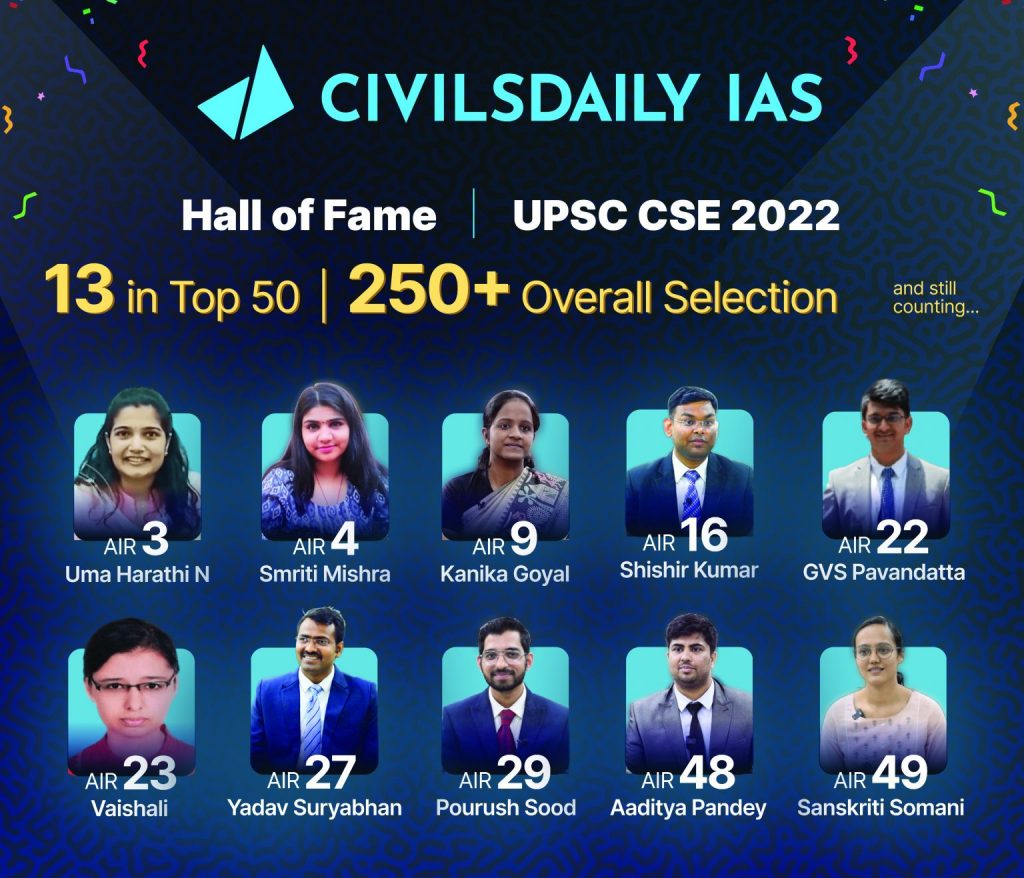
85% of Smash Mains students under cracked a top-200 rank in UPSC CSE 2022 (13 in Top 50)
Previously a well-guarded secret exclusive to UPSC veterans, this super-successful program is now open to beginners as well. This is a golden opportunity for those committed to cracking UPSC in their first or second attempt.
Share your Answer Copies at staff@civilsdaily.com
Get 1-on-1 Mentorship by Arvind sir (mentor of 100+ IAS rankers)
The overwhelming demand and positive feedback from our students have encouraged us to make this exception. We strive to provide the ‘Be Mains Ready’ Program and support to all our students.
About Smash Mains 2024-25 Beginner’s Batch
It is a highly personalized and intensive handholding program for the dedicated and crème-de-la-crème (earlier exclusive to UPSC veterans) amongst UPSC aspirants (the intake is 50 students only).
AIR 16 Shishir, UPSC 2022 thanking Civilsdaily’s mentorship
What Makes Smash Mains Unique?
Invite/Register-Only: Ensuring that you’re not just a face in the crowd but a name and a mission for us.
Personalized Attention: Tailor-made guidance with one-to-one interactions with senior IAS mentors themselves.
Focused Strategy: No more generic study plans. Get a blueprint crafted just for you.
In-Depth Analysis: Our seniormost faculty will meticulously analyzing your Mains scorecards and test copies to fill in those critical gaps in your preparation.
Multi-level guidance: Arvind sir, Parth sir, Swatantra sir, Sumit sir, Shubham sir and IAS-IPS rankers, will ensure your answer writing is top-notch.
With over 85% of enrolled students in 2022 becoming UPSC Top rankers, Smash Mains 2024 for UPSC Beginners is here. Also, what we have noticed is about 85% of questions in the UPSC Mains paper are from the Smash Test Series.
As an aspirant, if you are yet to gain confidence in answer writing and Mains prep, then this program is for you!
How has Smash Mains helped 2022-2023 Aspirants in Preparing for UPSC?
What do aspirants need in their UPSC preparation journey? They need a senior who will give them moral support and the required logistics to prepare for the tough exam in a simplified manner.
You can clear the exam only with confidence and consistency. And to achieve both, you require a personalized mentor. Many aspirants feel that just attending classes or tests is not beneficial for them. So we tweaked our program to include mentorship both in our tests series and classes. Aspirants feel they can reach out to us anytime with their concerns and we are available to sort them out.
Message from CD Mentors
Dear Students,
For some of you, prelims have never been a challenge for you. You have been missing the main cut-off with a small margin (repeatedly). This means that there are some fundamental issues with your approach. You might be aware or not of this. But just realization is not enough, you have to work on its execution as well. And bringing that to fruition will be possible through a guided process under a meticulously designed plan.
Note: The Entry is Restricted to those who have appeared in UPSC interviews in the past 2 years or have missed the mains cut-off by a whisker.
The focus is on identifying and highlighting the issues with your preparation (information/analysis/utilization). According to your strength and weaknesses, a tailor-made strategy is developed. Under Arvind sir and core mains teams’s strict monitoring, incremental improvements are aimed every day, after every session.
Key Takeaways About Smash Mains 2024-25
Your mentor, Arvind sir has mentored AIR 16, 22 and 100+ IAS rankers. Other IAS mentors like Swatantra sir, Parth sir, Shubham sir and Sumit sir have personally mentored 400+ IAS rankers in the past couple of years.
You don’t have to waste more time finding the strategy (value-added notes, test series, or timetable ) for the next months. You will get the guidance for it.
You will gain access to Civildaily’s Samachar Manthan – For holistic and comprehensive coverage of Current Affairs.
Progression of Smash Mains 2024-25
After completing the Mains Test series, you will have a one-to-one detailed and in-depth interaction with Arvind sir and core mains team. Final refinements are done to every answer. Value addition material, as well as pointers, will be provided here. We will work with you to ensure you have enough material for value addition. Our focus will be on providing tips that add the missing X factor to your answers.
Why is Smash 2023 the best way to prepare for Mains?
Individual attention and approachability are the USPs of this program. Listen to what our Smash Mains 2022 student and topper Sanskriti Somani (AIR 49) says about the program.
Pooja Gupta (AIR 42) UPSC 2020 says about the program.
Not putting Penguins among the Fowls – You already know how to write an average answer (you’re missing it by a few marks actually). You want to know how to increase your score from 90 to 110-115. The approach followed by other institutes in their Test series is the same for a veteran and a complete newbie and here lies the problem. Without personalizedone-to-one interaction, it will be difficult for you to rectify these minute yet very important shortcomings.
Evaluation is a strength of this program and we put it on a high priority. Arvind sir himself is involved in the process, unlike other institutes where evaluation is outsourced to those who themselves might not have appeared for mains (It’s bizarre). It shouldn’t be based on ‘model answers’ as there are 3-4 ways of approaching an answer. Only a seasoned player will be able to go beyond these model answers and be able to appreciate your approach (If it’s innovative) even if it differs from the model answers provided.
Test copies get checked in a time-bound manner. The questions, answers, and material provided are of the highest quality.
Emphasis on execution and utilization of knowledge – Mains is not only about knowledge but how you express the relevant knowledge optimally.
Arvind sir’s interventions are highly specific and not generalized. Sitting right in front of you he walks you through each and every question. He is always there, he will not let you lose your focus.
AIR 148 UPSC 2020 topper and our Civilsdaily student, Ponmani explains why answer writing with mentorship is necessary for Mains.
The article explores the challenges and triumphs of Indian women athletes, particularly runners, revealing their resilience against societal norms and discriminatory practices. Sohini Chattopadhyay’s book, “The Day I Became a Runner,” serves as a powerful narrative, intertwining the stories of champion women runners with India’s political and cultural evolution.
Key Highlights:
The article explores the challenges and triumphs faced by Indian women athletes, particularly runners, navigating societal norms, laws, and personal obstacles.
Sohini Chattopadhyay’s book, “The Day I Became a Runner,” serves as a lens to understand the history of Indian women through the narratives of champion runners.
The stories of Mary D’Souza, Kamaljit Sandhu, P T Usha, Santhi Soundarajan, Pinki Pramanik, Dutee Chand, Lalita Babar, and others are intricately woven into the fabric of India’s political and cultural landscape.
Key Challenges:
Gender norms and societal restrictions circumscribing outdoor activities for women in India.
Struggles against patriarchy, poverty, identity, caste, and even controversial “sex tests” faced by women athletes.
The need for safe public spaces, established training programs, and a cultural shift encouraging women’s participation in sports.
Key Terms:
Sex test: A controversial practice involving the testing of biological parameters to define a woman athlete’s gender.
Patriarchy: The social system where men hold primary power and predominate in roles of political leadership, moral authority, and social privilege.
Stigma: Negative perceptions and attitudes associated with women athletes facing controversial tests or challenges.
Key Phrases:
“A women’s history of India through the lens of sport”: Describes the book’s focus on portraying Indian women’s history through the stories of athletes.
“To be a woman runner in India means to persevere in the face of tremendous odds”: Highlights the resilience required by women athletes to overcome societal barriers.
Key Quotes:
“The book is both gripping and tough — gripping, so you don’t want to put it down, and tough, since the lives written up have been hard ones.”
“The landmark verdict underlined that the World Athletics rules for female athletes discriminated against women by setting a threshold for testosterone.”
Anecdotes:
Chattopadhyay’s own experiences as a woman runner, facing challenges of being the only woman in parks or roads.
Stories of champion athletes like Mary D’Souza, P T Usha, and others, illustrating their resilience and achievements.
Key Statements:
“There is no fairy-tale running story. And the training program is not what makes these lives harsh. It’s the many obstacles that these women must clear to simply do what they love — to run.”
“Running requires safe public spaces, well-established training programs, and a culture that encourages women to occupy space in our streets and parks.”
Key Examples and References:
Instances of women athletes facing hurdles such as the controversial “sex test” and societal stigmas.
The case of Dutee Chand challenging and winning against discriminatory rules for female athletes.
Critical Analysis:
The article critically analyzes the societal and cultural barriers that women athletes face in India.
It emphasizes the significance of running as a sport that requires substantial investment, including safe spaces and supportive cultural attitudes.
Way Forward:
Advocate for gender-inclusive sports culture, encouraging more women to participate in running and other athletic activities.
Promote awareness and challenge discriminatory practices like the controversial “sex tests” to create a more equitable sports environment for women.
Continue to document and celebrate the stories of champion women athletes as a means of inspiration and advocacy for gender equality in spor
The article highlights the evolution of leaders within India’s parliamentary democracy, contrasting them with those from dynastic politics. It celebrates Atal Bihari Vajpayee as a prime example, emphasizing his journey from an activist to a mature statesman. The central theme underscores the virtues of leaders emerging organically through democratic processes and the challenges posed by dynastic political practices.
Key Highlights:
The article discusses the evolution of leaders within India’s parliamentary democracy and contrasts them with those from dynastic politics.
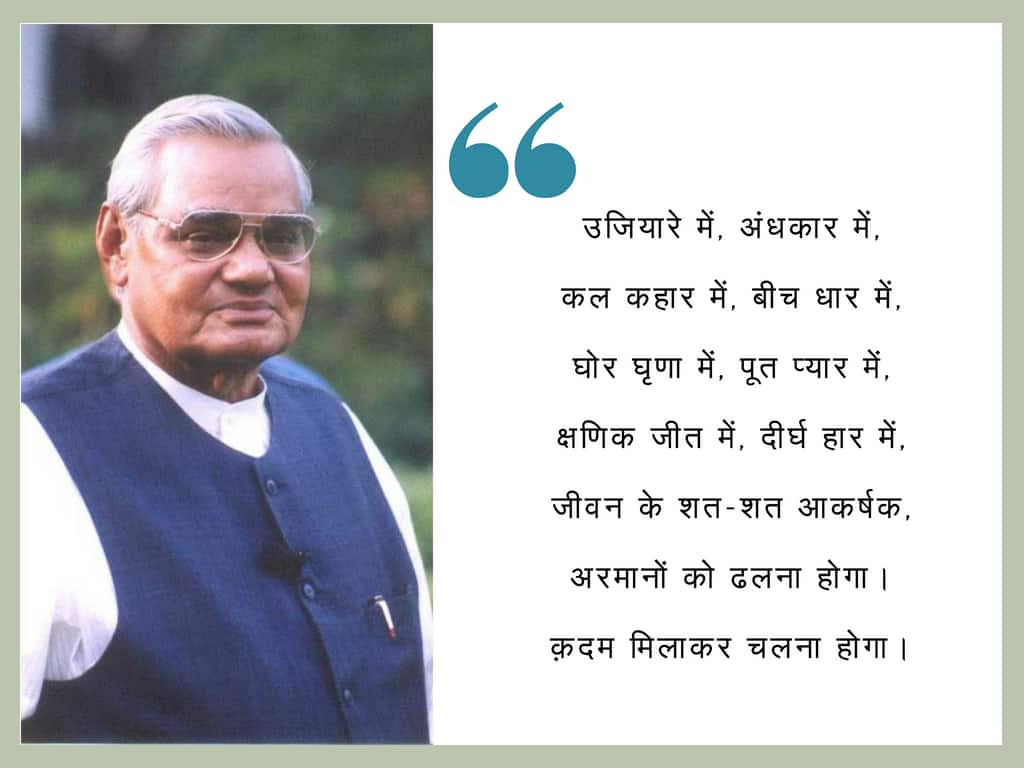
Atal Bihari Vajpayee is highlighted as an exemplary product of Indian parliamentary democracy, having entered politics as an activist and evolved into a mature statesman.
Vajpayee’s role in the BJP’s rise from the fringes to the mainstream during the Congress-dominated era is emphasized.
The article underscores Vajpayee’s oratorical skills, his role in consensus politics, and his commitment to national interests.
Key Challenges:
Critique of dynastic politics in the Congress party post-Nehru, seen as a hindrance to embodying leadership values of parliamentary democracy.
The challenge of maintaining decorum in political discourse, contrasting it with the current cheap antics of the Opposition.
Key Terms:
Dynastic politics: The practice of political leadership being passed down through family lines.
Consensus politics: The approach of seeking agreement among diverse political parties for effective governance.
Oratorical skills: The ability to deliver powerful and persuasive speeches.
Key Phrases:
“Leaders are born, they are not made”: Expresses the perspective on the natural emergence of leadership qualities.
“Evil of dynastic politics”: Describes the negative impact of hereditary political leadership.
“Teflon-coated Hindutva-vadi”: Term used to describe Atal Bihari Vajpayee, suggesting resilience in the face of criticism.
Key Quotes:
“Leaders are born, they are not made.”
“Dynasts can never fully appreciate and demonstrate the leadership values and principles of parliamentary democracy.”
“Atal ji’s greatness is not limited to his prime ministership.”
Anecdotes:
Vajpayee’s witty remark to Nehru about having a “split personality” and an “inverted vision.”
Jaitley’s mention of Vajpayee’s obituary address for Nehru as a quality tribute to a political adversary.
Key Statements:
“Leaders born into political families struggle to fully appreciate and demonstrate the leadership values of parliamentary democracy.”
“Vajpayee’s commitment to consensus politics is noted, even during the challenges of leading a 23-party coalition.”
“Vajpayee’s role as an ideal opposition leader is praised, emphasizing his support for the government during crucial times.”
Key Examples and References:
Vajpayee’s journey from a young activist to a mature statesman within the parliamentary system.
His criticism of Nehru’s policies and the BJP’s rise during the Congress-dominated era.
Instances of Vajpayee’s leadership during events like the nuclear tests in 1998 and the Kargil War.
References:
Arun Jaitley’s memorial address for Vajpayee, highlighting his oratory skills and leadership in opposition.
Jaitley’s mention of Vajpayee’s best orations occurring when he was on the opposition benches.
Critical Analysis:
The article critically analyzes the impact of dynastic politics on embodying democratic leadership values.
Vajpayee is portrayed as an exemplary leader, emphasizing his oratorical skills, commitment to consensus politics, and prioritization of national interests.
Way Forward:
Encourage a departure from dynastic politics and foster leadership emerging through democratic processes.
Advocate for a return to decorum in political discourse and a focus on consensus politics for effective governance.
Learn from Vajpayee’s legacy, striving for political environments that prioritize national interests over partisan considerations.
The article critiques the recently passed Telecom Bill, emphasizing its nationalistic undertones, potential authoritarian features, and the failure to address the digital divide effectively. It questions the rushed parliamentary process and highlights concerns about corporate favoritism, symbolized by the renaming of the Universal Services Obligation Fund.
Key Highlights:
The tweet by Union Minister Ashwini Vaishnav announces the passage of the Telecommunications Bill, 2023, and the repeal of The Indian Telegraph Act, 1885.
The use of the term “Bharat” instead of “India” and crediting the PM’s individual vision are intentional for cultural nativism.
Key Challenges:
The Telecom Bill is criticized for ignoring the persisting digital divide and lacking fresh ideas to address it.
Provisions favoring select private firms and potential misuse of regulatory power are highlighted.
State control and surveillance powers without defined safeguards raise concerns about privacy and freedom.
Key Terms and Phrases:
“Digital Bharat Nidhi”: Renaming of Universal Services Obligation Fund (USOF) in the Telecom Bill.
“Regulatory sandboxes”: Provisions likely to benefit large corporations in the telecom sector.
“Authorisation” vs. “Licensing”: The change in terminology with increased severity in the Telecom Act.
Key Quotes:
“Bharat moves on…” – Tweet by Union Minister Ashwini Vaishnav.
“Guess who will soon step into Mobile Satellite Services from India?” – MP Priyanka Chaturvedi on potential favoritism towards private firms.
Key Statements:
The Telecom Bill is criticized for distracting from the digital divide issue and lacking innovative solutions.
Concerns raised about potential misuse of regulatory powers and selective favoritism toward private corporations.
Key Examples and References:
Mention of the renaming of USOF as “Digital Bharat Nidhi” in the Telecom Bill.
Reference to the allocation of satellite spectrum benefiting the Adani Group.
Key Facts and Data:
Stagnation in new telecom users and contraction in smartphone sales, as reported by the Telecom Regulatory Authority of India and International Data Corporation.
A legal penalty of ₹25,000 for providing false particulars or failing to share information as required by the Telecom Act.
Critical Analysis:
The Telecom Bill is criticized for maintaining colonial architecture, vague definitions, and potential threats to privacy.
The rushed passage of the bill without addressing raised concerns reflects an unconstitutional concentration of power.
Way Forward:
Advocate for a thorough review of the Telecom Bill by a Standing Committee to address concerns.
Emphasize the need for policies that genuinely bridge the digital divide and promote fair competition in the telecom sector.
Encourage transparency, public participation, and safeguards to protect individual rights in telecommunications legislation.
The Bharatiya Nyaya Sanhita (BNS) Bill, 2023, introduces significant reforms to replace the Indian Penal Code.
The bill addresses terrorism, organized crime, gender neutrality, and repeals outdated laws like Section 377.
Major Provisions in the BNS Bill
[1] Promise to Marry (Clause 69)
Targeting ‘Love Jihad’: Criminalizes deceitful promises to marry, potentially addressing the ‘love jihad’ narrative.
Criminalization of Consensual Sexual Activity: Broadens the scope to include consensual sexual acts under certain deceitful circumstances.
[2] Mob Lynching
Codification of Offences: Introduces specific provisions for mob lynching and hate-crime murders.
Punishment: Ranges from life imprisonment to the death penalty.
[3] Organized Crime
Inclusion in Ordinary Law: For the first time, organized crime is addressed under ordinary criminal law.
Punishment Criteria: Distinction based on whether the crime results in death, with varying degrees of punishment.
[4] Terrorism
Integration into Ordinary Law: Adopts definitions from stringent acts and international laws, broadening the scope of terror financing.
[5] Attempt to Suicide
New Provision: Criminalizes suicide attempts aimed at compelling public servants, with potential implications for protests.
Significant Deletions and Repeals
[a] Section 377 (Unnatural Sexual Offences)
Repeal: Decriminalizes homosexuality, but raises concerns about addressing non-consensual acts.
[b] Adultery
Omission: Following the Supreme Court’s ruling, adultery is no longer criminalized.
[c] Thugee/Thugs (Section 310 IPC)
Removal: Eliminates colonial-era notions of criminality associated with certain tribes.
Gender Neutrality in Laws
Child-Related Offences: Makes laws about children gender-neutral.
Adult Offences: Extends gender neutrality to crimes like outraging modesty and voyeurism.
Other Notable Changes
Fake News: Introduces provisions against publishing false and misleading information.
Sedition (‘Deshdroh’): Renames and broadens the definition to include financial support for subversive activities.
Mandatory Minimum Sentences: Limits judicial discretion, raising concerns about fairness in considering mitigating circumstances.
Public Property Damage: Implements fines corresponding to the extent of damage caused.
What was the need for new bills?
Colonial legacy
From 1860 to 2023, the country’s criminal justice system functioned as per the laws made by the British.
The laws were drafted during colonial times and contain archaic language and concepts that might not accurately reflect current social norms, values.
Advances in Technology
This has introduced new dimensions to crime, evidence, and investigation.
Simplification and Streamlining
The laws have become complex over time, leading to confusion among legal practitioners, law enforcement agencies, and the general public.
Simplifying and streamlining the legal framework can enhance transparency and understanding.
Evidence Collection and Presentation
The Indian Evidence Act was enacted before the advent of modern forensic science and technological tools.
Various reports highlighted the need for reforms in criminal laws
The department-related Parliamentary Standing Committee on Home Affairs in its 146th report had recommended that there is a need for a comprehensive review of the criminal justice system of the country.
It was also pointed out that the Parliamentary Standing Committee in its 111th and 128th reports had also highlighted the need for reforms in criminal laws.
Conclusion
Reformative Approach: The BNS Bill represents a significant overhaul of India’s penal system, addressing contemporary issues and societal changes.
Judicial Implications: While it introduces necessary reforms, the bill’s impact on judicial discretion and fairness in sentencing warrants careful consideration.