💥UPSC 2026, 2027, 2028 UAP Mentorship (March Batch) + Access XFactor Notes & Microthemes PDF

Search results for: “”

  • CIVIL SERVICES REFORMS : Can Indic Principles address the modern governance challenges ?

    Note4Students:

    India’s civil services, long considered the “steel frame” of governance, are now under increased scrutiny for their ability to adapt to contemporary challenges. This article equips you with a robust framework to address such questions by covering critical themes like politicization, inefficiency, and centralized governance, supported by case studies, Supreme Court judgments, and government initiatives. While aspirants typically mention reforms like Mission Karmayogi or lateral entry, they often neglect analysis of deeper systemic issues such as Politicization and Frequent Transfers. The Back2Basics section serves as a quick reference for essential components of civil services reforms. It breaks down critical aspects like recruitment, performance appraisals, capacity building, and accountability, along with the initiatives undertaken by the government (e.g., 360-degree appraisals, Citizen Charters, and Digital India). This concise and structured content helps aspirants connect static and current dimensions effortlessly.

    PYQ Anchoring

    1. GS 2: “Institutional quality is a crucial driver of economic performance”. In this con text suggest reforms in Civil Service for strengthening democracy. (2020)
    2. GS 2:  Initially Civil Services in India were designed to achieve the goals of neutrality and effectiveness, which seems to be lacking in the present context. Do you agree with the view that drastic reforms are required in Civil Services. Comment. (2017)

    Microthemes: Civil Services

    The government has launched initiatives such as Mission Karmayogi, highlighting efforts to reform India’s bureaucratic system, often referred to as the “steel frame” of governance.

    Critical challenges of India’s bureaucratic structure

    India’s bureaucratic framework, particularly the Indian Administrative Service (IAS), faces several critical challenges:

    • Politicization: Frequent transfers and promotions based on political loyalty rather than merit have eroded professionalism and morale. Lack of time to specialize due to frequent departmental rotations hampers the development of domain expertise.
    • Corruption and Inefficiency: India ranks moderately on the World Bank’s Government Effectiveness Index, signaling persistent issues in policy implementation and governance.
    • Centralized Governance: Power has increasingly been centralized in the Prime Minister’s Office (PMO), reducing the autonomy of civil servants and creating implementation bottlenecks.
    Impact of Centralized Governance

    Reduced Autonomy: Senior bureaucrats lose independence, leading to a culture of compliance over innovation.

    Implementation Bottlenecks: Concentrating decisions at the top slows responses to emerging challenges and reduces efficiency.

    Neglect of Expertise: Over-reliance on top-down directives sidelines bureaucratic insights, impacting policymaking and governance outcomes.

    Ancient Indic Principles for Enhancing Modern Governance

    Ancient Indic principles provide timeless wisdom that can address contemporary governance challenges. These principles emphasize ethical leadership, inclusivity, sustainability, and active citizen participation. By integrating these values into modern frameworks, governance can become more effective, equitable, and aligned with the needs of society.

    PrincipleDescriptionContemporary Examples
    Ethical Leadership and Accountability (Raj Dharma)Leaders must prioritize justice, fairness, and the public good, upholding values of transparency and responsibility.Implementation of Lokpal and Lokayukta Acts to tackle corruption; PM’s emphasis on “minimum government, maximum governance.”
    Inclusive Development (Antyodaya)Ensures the upliftment of the most marginalized, promoting equity in resource distribution and opportunities.Ayushman Bharat for healthcare access; Aspirational Districts Programme targeting backward regions.
    Sustainability and Environmental Harmony (LiFE & Karmayogi)Advocates sustainable practices and continuous skill development among public servants to address environmental and societal challenges.India’s “Mission LiFE” for sustainable lifestyles; National Programme for Civil Services Capacity Building (NPCSCB).
    Participative Governance (Sab Ka Prayas)Encourages citizen involvement in policymaking and implementation through collective effort and shared responsibility.Swachh Bharat Abhiyan’s success through community participation; MyGov platform for public policy feedback.
    Empathy and Responsibility (P2G2)Promotes a governance model based on empathy, inclusiveness, and shared responsibility between the state and citizens.COVID-19 crisis management with active public participation; “Har Ghar Jal” campaign for clean water access.

    Efforts taken to reform the bureaucracy in India

    • Commission Recommendations:
      • 1st Administrative Reforms Commission (1966): Advocated specialization within the IAS for efficiency.
      • 2nd Administrative Reforms Commission (2005): Suggested lateral entry for domain experts, mandatory training, and establishing a National Institute of Public Administration.
    • Central Government Initiatives:
      • Mission Karmayogi (2020): Aims to create a future-ready civil service with continuous learning through digital platforms.
      • Lateral Entry Reforms: Introduced to bring domain expertise into senior roles.
    • Supreme Court Judgments:
      • T.S.R. Subramanian v. Union of India (2013): Prohibited civil servants from following oral political directives; mandated a Civil Services Board.
      • Delhi Government Services Case (2023): Reinforced federalism by upholding Delhi’s legislative authority over services.

    Way Forward

    1. Empower Decentralized Governance: Strengthen local and state-level administrative autonomy to reduce over-centralization.
    2. Implement Performance-Based Reforms: Institutionalize meritocracy with performance-linked promotions and lateral entry mechanisms.
    3. Adopt Global Best Practices:Learn from initiatives like the proposed Department of Government Efficiency (DOGE) in the USA to streamline India’s bureaucracy.
    4. Efficient Capacity Building: Expand programs like Mission Karmayogi to ensure civil servants are equipped with modern governance skills.

    #BACK2BASICS : CIVIL SERVICES REFORMS
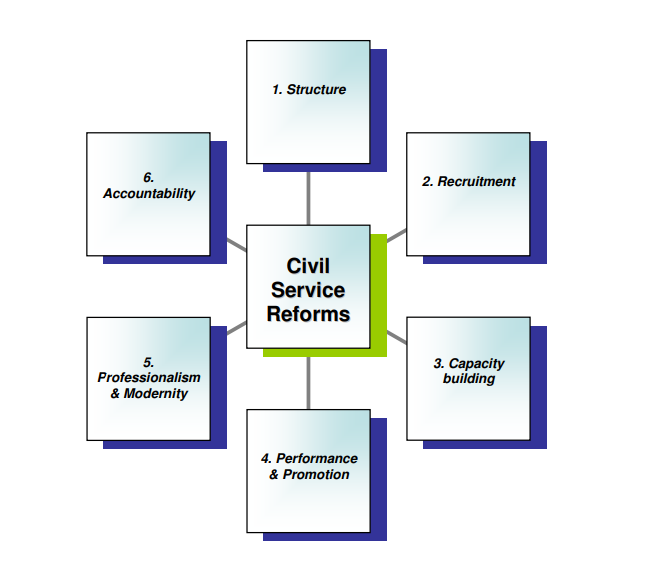
    Components of Civil Services Reforms and Indian Government Initiatives

    ComponentKey AspectsReforms Undertaken by Indian Government
    1. Size and Structure– Rationalize ministries, departments, and officials to reduce redundancy.Rightsizing of Ministries: Streamlining ministries to avoid overlaps.
    – Focus on core governance functions and eliminate duplication.– Creation of Mission Karmayogi (2020) to redefine roles and responsibilities.
    2. Recruitment– Merit-based recruitment with reduced political patronage.– Adoption of Lateral Entry: Specialists from the private sector inducted into senior positions.
    – Incorporate specialized skills and foster public-private mobility.Simplification of UPSC Syllabus to focus on domain expertise and leadership skills.
    3. Capacity Building– Upgrade training programs to align with emerging challenges in technology and governance.Mission Karmayogi Digital Platform: Continuous learning and skill-building for civil servants.
    – Emphasize HR development and advanced training modules.Induction Programs for IAS, IPS, and IFS officers to introduce modern governance tools.
    4. Performance and Promotion– Reform appraisal systems like ACR to make them transparent and performance-driven.– Introduction of 360-Degree Appraisal Mechanism to ensure holistic evaluation of officers’ performance.
    – Link promotions and incentives to quantifiable outcomes.Mid-Career Training Programs introduced to encourage specialization and leadership skills.
    5. Professionalism and Modernity– Ensure neutrality and reduce political interference.Ethics Training Modules introduced as part of IAS training to instill impartiality and integrity.
    – Promote e-governance for transparency and accountability.Digital India Program leveraged to introduce e-governance across ministries.
    6. Accountability– Strengthen reporting mechanisms and ensure transparency through legislation.– Implementation of the Right to Information (RTI) Act for citizen empowerment.
    – Introduce citizen charters and grievance redressal systems.– Introduction of Citizen Charters in key government departments for service delivery standards.
  • Four new sites to get Ramsar Tag

    Why in the News?

    Ahead of World Wetlands Day (February 2nd), the Environment Ministry announced the inclusion of four new Ramsar sites, bringing India’s total to 89.

    The newly designated sites are Sakkarakottai Bird Sanctuary and Therthangal Bird Sanctuary in Tamil Nadu, Khecheopalri Wetland in Sikkim, and Udhwa Lake Bird Sanctuary in Jharkhand.  With this, Tamil Nadu now has 20 Ramsar sites, the highest in the country, followed by Uttar Pradesh with 10 sites.

    About the Newly Added Ramsar Sites: 

    Description
    Sakkarakottai Bird Sanctuary, Tamil Nadu
    • Location: Ramanathapuram District, Tamil Nadu.
    • Originally an irrigation tank, now a designated bird sanctuary.
    • Recharged by northeast monsoon (Oct-Jan).
    • Supports 42+ bird species, including Spot-billed Pelican, Grey Heron, Little Cormorant, and Black Kite.
    Therthangal Bird Sanctuary, Tamil Nadu
    • Location: Theerthangal Village, Ramanathapuram District, Tamil Nadu.
    • A freshwater ecosystem and an important breeding ground for waterbirds.
    • Recorded 96 bird species across 18 orders and 44 families.
    • Notable species include Oriental Darter, Black-headed Ibis, Asian Woolly-necked Stork, and Spot-billed Pelican.
    Khecheopalri Wetland, Sikkim
    • Location: West Sikkim, near Khecheopalri Village.
    • A sacred lake revered by Buddhists and Hindus.
    • Part of a temperate Himalayan peatland ecosystem, surrounded by broad-leaved mixed temperate forests.
    • Flora: Rich in macrophytes, phytoplankton, and zooplankton.
    • Fauna: Supports fish species like Cyprinus carpio, Danio aequipinnatus, and various migratory birds (Common Merganser, Tufted Duck).
    Udhwa Lake Bird Sanctuary, Jharkhand
    • Location: Sahebganj District, Jharkhand.
    • Comprises two interconnected lakes: Pataura (155 ha) and Berhale (410 ha).
    • Connected to the Ganga River via the Udhuwa Nala (25 km stretch).
    • Pataura Lake depth: ~2 meters; Berhale Lake depth: ~70 cm, covered with aquatic vegetation.
    • Flora: Home to 42 algae species and 36 aquatic macrophytes.
    • Fauna: Habitat for 83 bird species, including the Near Threatened Black-necked Stork and 22 commercially valuable fish species.


    PYQ:

    [2019] Consider the following statements:

    1. Under Ramsar Convention, it is mandatory on the part of the Government of India to protect and conserve all the wetlands in the territory of India.
    2. The Wetlands (Conservation and Management) Rules, 2010 were framed by the Government of India based on the recommendations of Ramsar Convention.
    3. The Wetlands (Conservation and Management) Rules, 2010 also encompass the drainage area or catchment regions of the wetlands as determined by the authority.

    Which of the statements given above is/are correct?

    (a) 1 and 2 only

    (b) 2 and 3 only

    (c) 3 only

    (d) 1, 3 and 3

  • Cannabis Cultivation in India

    Why in the News?

    The Himachal Pradesh Cabinet has approved a pilot study for the controlled cultivation of cannabis for medicinal and industrial purposes.

    Legal Status of Cannabis Cultivation in India:

    • Prohibited for recreational use under the Narcotic Drugs and Psychotropic Substances (NDPS) Act, 1985.
    • Section 2 of the NDPS Act bans the cultivation, production, and sale of cannabis resin and flowers.
    • Section 10 allows state governments to regulate cannabis cultivation for medicinal and scientific purposes.
    • Section 14 grants the Central Government authority to permit cultivation for industrial uses (fiber and seed extraction).

    Why Himachal Pradesh Could Soon Allow Controlled Cannabis Cultivation?

    • The Himalayan region’s soil and climate are ideal for cultivating low-THC hemp varieties, making Himachal Pradesh a prime location for controlled cannabis farming.
    • The government sees controlled cultivation as a way to generate revenue, create employment opportunities, and support local farmers, particularly in Kullu, Chamba, Mandi, Solan, Kangra, and Sirmaur.
    • Cannabis cultivation will be restricted to industrial and pharmaceutical uses, such as:
      • Pain relief medications
      • Textile and paper production
      • Biofuel and cosmetics
      • Hemp-based food products
    • The Kullu and Malana regions are known for illegal narcotic cannabis cultivation. Regulating the sector could reduce illegal activities and ensure legal trade.
    • The Narcotic Drugs and Psychotropic Substances (NDPS) Act, 1985 allows state governments to permit and regulate cannabis cultivation for scientific, medicinal, and industrial purposes under strict conditions.

    Which are the other States to allow Controlled Cannabis Cultivation in India?

    • Uttarakhand (2018):
      • First state to legalize industrial hemp cultivation.
      • Managed by the Centre for Aromatic Plants (CAP), Selaqui.
      • Challenges include maintaining THC levels below 0.3% and seed availability.
    • Madhya Pradesh (2023):
      • Approved medicinal cannabis research but commercial cultivation is yet to start.
      • Sai Phytoceuticals (Pvt. Ltd.) received the first license for cannabis-based medicine production.
    • Jammu & Kashmir (2021):
      • India’s first medicinal cannabis pilot project launched by CSIR-Indian Institute of Integrative Medicine (IIIM), Jammu.
      • Conducted in Public-Private Partnership (PPP) mode with a Canadian firm.
      • Research focuses on cannabis-based cancer and epilepsy treatments.

    PYQ:

    [2018] India’s proximity to the two of the world’s biggest illicit opium-growing states has enhanced her internal security concerns. Explain the linkages between drug trafficking and other illicit activities such as gunrunning, money laundering and human trafficking. What counter-measures should be taken to prevent the same?

  • China’s Artificial Sun creates Record in Fusion Research

    Why in the News?

    China’s Experimental Advanced Superconducting Tokamak (EAST), commonly referred to as the Artificial Sun, has set a new world record by sustaining a high-confinement plasma operation for 1066 seconds. The artificial sun reached an extreme temperature of 100 million degrees Celsius, surpassing its own previous record of 403 seconds.

    What is the EAST Project?

    • EAST is a nuclear fusion research facility developed by the Chinese Academy of Sciences (ASIPP) in 2006.
    • It aims to replicate solar fusion reactions to create a sustainable, clean energy source for future power generation.
    • The project serves as a global research platform for fusion experiments and advancing magnetic confinement technology.
    • It uses superconducting magnets to contain ultra-hot plasma, necessary for fusion.

    Comparison with Other Fusion Projects

    • China’s EAST (Experimental Advanced Superconducting Tokamak):
      • Record: 1066 seconds at 100 million degrees Celsius (2025).
      • Previous Record: 403 seconds at high confinement mode.
      • Goal: Develop a commercial fusion power plant.
    • Korea’s KSTAR (Superconducting Tokamak Advanced Research):
      • Record: 100 million degrees Celsius for 20 seconds (2020).
      • Goal: Sustain a longer plasma confinement period.
    • France’s ITER (International Thermonuclear Experimental Reactor):
      • Largest global fusion project, involving 35 nations.
      • Expected to achieve plasma ignition by 2035.
      • Focuses on demonstrating large-scale fusion feasibility.

    Significance of This Achievement

    • Record-Breaking Fusion Operation: EAST sustained plasma at 100 million°C for 1066 seconds, surpassing its previous record of 403 seconds.
    • Progress Toward Fusion Power Plants: Prolonged plasma confinement is crucial for achieving continuous, self-sustaining fusion reactions.
    • Potential for Clean Energy: Fusion produces zero carbon emissions and could serve as an unlimited energy source once commercially viable.
    • Global Competition: Other projects like ITER (France) and KSTAR (Korea) are also advancing fusion research, aiming for similar breakthroughs.

    Challenges in Nuclear Fusion

    • Extreme Temperatures: Plasma must be sustained at over 100 million°C, requiring high-energy input.
    • Material Limitations: Reactor components must withstand intense heat and radiation, yet no material can do so indefinitely.
    • Energy Input vs. Output: Current reactors consume more energy than they generate, preventing commercial viability.
    • Magnetic Confinement Issues: Plasma instability can disrupt reactions, making sustained fusion difficult.
    • High Costs: Fusion research requires expensive superconductors, cryogenics, and containment systems.

    Difference between Nuclear Fusion and Fission

    Nuclear Fusion Nuclear Fission
    Process Combines atomic nuclei to release energy. Splits heavy nuclei to release energy.
    Energy Output Much higher than fission. Comparatively lower.
    Fuel Source Hydrogen isotopes (Deuterium, Tritium)—abundant in seawater. Uranium-235, Plutonium-239—limited supply.
    Waste Production Minimal radioactive waste (helium byproduct). Produces long-lived radioactive waste.
    Environmental Risk No meltdown risk, completely safe. Risk of radiation leaks (e.g., Chernobyl, Fukushima).
    Current Feasibility Still experimental, not yet commercially viable. Commercially used in nuclear power plants.
  • In news: Palar River

    Why in the News?

    The British-era Palar River Anaicut, a masonry check dam built in 1858, is undergoing a major restoration following severe structural damage caused by the 2021 floods.

    Supreme Court’s Directives:

    • The Supreme Court (SC) has directed that all restoration activities must adhere to environmental protection laws and sustainable development principles.
    • The WRD must ensure that the restored structure can withstand future floods and water releases.
    • The SC emphasized local farmers’ involvement in decision-making, considering the impact on irrigation and water availability.

    In news: Palar River

    About Palar River

    • The Palar River originates in the Nandi Hills of Karnataka, at an altitude of 1,400 meters above sea level.
    • It flows through Karnataka, Andhra Pradesh, and Tamil Nadu, covering a total length of 348 km before emptying into the Bay of Bengal near Vayalur, Tamil Nadu.
    • Important tributaries include Cheyyar, Ponnai, Malattar, and Kosasthalaiyar rivers.
    • The river has been a lifeline for agriculture, supporting ancient civilizations and irrigation networks in South India.
    • Geographical Features: 
      • It is rain-fed, experiencing seasonal variations—it remains dry for most of the year but carries heavy flows during monsoons.
      • Its basin consists of alluvial, red, and black soil, supporting paddy, sugarcane, and groundnut cultivation.
      • It is heavily dammed, leading to reduced flow, sand mining concerns, and groundwater depletion.
      • The Palar Anaicut and various reservoirs distribute water to agricultural lands in Tamil Nadu, ensuring water security for farmers.

    PYQ:

    [2016] Recently, which of the following States has explored the possibility of constructing an artificial inland port to be connected to sea by a long navigational channel?

    (a) Andhra Pradesh

    (b) Chhattisgarh

    (c) Karnataka

    (d) Rajasthan

  • [31st January 2025] The Hindu Op-ed: An opportunity to settle Sri Lanka’s ethnic problem

    PYQ Relevance:

    Q) ‘India is an age-old friend of Sri Lanka.’ Discuss India’s role in the recent crisis in Sri Lanka in the light of the preceding statement. (UPSC CSE 2022)


    Mentor’s Comment: UPSC mains have always focused on India is an age-old friend of Sri Lanka (2022), and India — Sri Lanka relations ’ (2013).

    Over the past 40 years, India’s role in Sri Lanka’s ethnic conflict evolved from mediator to active player, leading to the 1987 Indo-Lanka Accord and the 13th Amendment, which introduced Provincial Councils. The JVP opposed it, calling it an Indian imposition. The LTTE also rejected it and demanded a separate Tamil Eelam, which India never supported.

    Today’s editorial talks about the India Srilanka relation. This content would help in GS Paper 2 International relations.

    _

    Let’s learn!

    Why in the News?

    Recently, India’s decision to name the Jaffna Cultural Centre after Tamil poet-philosopher Thiruvalluvar is a symbolic way to strengthen its deep ties with Sri Lanka.


    What are the historical roots of the ethnic conflict in Sri Lanka?

    • Colonial Legacy: British colonial rule (1815-1948) favoured the Tamil minority in administration and education, causing resentment among the Sinhalese majority.
    • Sinhala-Only Act (1956): The official adoption of Sinhala as the sole national language marginalized Tamil speakers and led to widespread Tamil discontent.
    • Discrimination in Education & Employment: Policies like the standardization of university admissions (1970s) made it harder for Tamils to access higher education and government jobs.
    • Ethnic Violence & Riots: The 1983 anti-Tamil pogrom (Black July) led to mass violence against Tamils, intensifying the demand for Tamil autonomy.
    • Rise of the LTTE: The Liberation Tigers of Tamil Eelam (LTTE) emerged as the dominant militant group demanding an independent Tamil Eelam, leading to a brutal civil war (1983-2009).
    • Indo-Lanka Accord (1987) & 13th Amendment: This attempt at devolution through Provincial Councils failed to fully address Tamil aspirations, leading to continued tensions.

    How can the new government address Tamil aspirations and rights?

    • Full Implementation of the 13th Amendment: The government should prioritize the effective implementation of the 13th Amendment to the Constitution, which allows for provincial councils and limited autonomy for Tamil-majority regions. This step is crucial for addressing Tamil political representation and governance.
    • Engagement in Inclusive Dialogue: Establishing a direct and inclusive dialogue with Tamil political leaders and communities is essential. This dialogue should focus on addressing historical grievances, ensuring that Tamil voices are heard in national policy-making, and fostering reconciliation.
    • Address Land Rights and Resettlement Issues: The government must take action to return lands occupied by the military to their rightful Tamil owners and halt any ongoing land grabs that threaten Tamil communities. Ensuring land rights is vital for restoring trust and dignity among Tamils.
    • Commitment to Human Rights Accountability: The new administration should commit to addressing past human rights violations during the civil war, including accountability for wartime atrocities. This includes repealing repressive laws like the Prevention of Terrorism Act (PTA) that disproportionately affect Tamils.
    • Cultural Recognition and Language Rights: Promoting Tamil culture and ensuring that Tamil is recognized as an official language alongside Sinhala would help foster a sense of inclusion and respect for Tamil identity within the broader national framework, enhancing community cohesion.

    What role does international support play in resolving Sri Lanka’s ethnic issues?

    • Mediation and Pressure: Countries like India have historically acted as mediators in Sri Lankan affairs. Their support can encourage the government to adhere to commitments regarding Tamil rights and autonomy.
    • Development Assistance: International aid can facilitate economic development in Tamil areas, addressing disparities that fuel ethnic tensions. India’s financial assistance for infrastructure projects is an example of how external support can aid reconciliation efforts.
    • Monitoring Human Rights: International organizations can monitor human rights conditions in Sri Lanka, advocating for accountability and justice for past atrocities against Tamils, which is essential for building trust and moving towards lasting peace.

    Way forward:

    • Strengthen Political and Constitutional Reforms: Ensure full implementation of the 13th Amendment, conduct Provincial Council elections, and explore further constitutional reforms to enhance Tamil political representation and autonomy.
    • Promote Inclusive Economic Development and Reconciliation: Invest in infrastructure, employment, and education in Tamil-majority areas while advancing truth, justice, and reconciliation initiatives to address past grievances and build long-term social cohesion.
  • Cabinet approves Mechanism for procurement of ethanol by Public Sector Oil Marketing Companies (OMCs) under EBP Programme

    Why in the News?

    The Cabinet Committee on Economic Affairs (CCEA) has approved a revision in the ethanol procurement price for Public Sector Oil Marketing Companies (OMCs) for the Ethanol Supply Year (ESY) 2024-25.

    What is the significance of the Price Revision?

    The recent revision of the ethanol procurement price for Public Sector Oil Marketing Companies (OMCs) is significant for several reasons:

    • Price Stability and Remuneration: The increase from ₹56.58 to ₹57.97 per litre ensures price stability and provides a more remunerative rate for ethanol suppliers, which is crucial for maintaining a steady supply of ethanol.
    • Support for Sugarcane Farmers: The separate payment of Goods and Services Tax (GST) and transportation charges will benefit sugarcane farmers, enhancing their income and encouraging production.
    • Meeting Blending Targets: The 3% increase in the price is aimed at ensuring adequate availability of ethanol to meet the ambitious blending target of 20% by 2025-26, advancing from the original target of 2030.
    • Reducing Crude Oil Dependency: This initiative is part of a broader strategy to reduce India’s dependency on crude oil imports, leading to substantial foreign exchange savings and environmental benefits.

    What is Ethanol Blended Petrol (EBP)?

    The Ethanol Blended Petrol (EBP) Programme is a government initiative aimed at promoting the blending of ethanol with petrol to create a more sustainable and environmentally friendly fuel option.

    • OMCs are currently blending up to 20% ethanol with petrol, which helps reduce reliance on imported crude oil and lowers carbon emissions.
    • Ethanol blending has dramatically increased from 38 crore litres in the Ethanol Supply Year (ESY) 2013-14 to 707 crore litres in ESY 2023-24, achieving an average blending rate of 14.60%.
    • The programme has resulted in estimated savings of over ₹1,13,007 crore in foreign exchange and has substituted approximately 193 lakh metric tonnes of crude oil over the past decade.

    What are other initiatives taken to promote biofuels?

    • National Policy on Biofuels (2018): This policy aims to reduce dependency on fossil fuels and promote sustainable development by encouraging the production and use of biofuels from various feedstocks such as sugarcane, broken rice, and maise.
    • Pradhan Mantri JI-VAN Yojana: This initiative focuses on accelerating the development of second-generation (2G) ethanol capacity in India, providing viability gap funding to support the establishment of 2G ethanol projects.
    • Global Biofuels Alliance (GBA): Launched in September 2023, this alliance aims to accelerate the global adoption of cleaner fuels and support decarbonization goals. It involves collaboration with multiple countries to enhance biofuel deployment.
    • Repurpose Used Cooking Oil (RUCO) Initiative: Launched by the Food Safety and Standards Authority of India (FSSAI) in 2018, this initiative aims to convert used cooking oil into biofuel, thereby preventing its reuse in food preparation and promoting sustainability.
    • Biodiesel Production Targets: India has set a biodiesel blending target of 5% by 2030. The government is mobilizing production through policies that support feedstock availability, including used cooking oil and non-edible industrial oils.
    • Sustainable Aviation Fuel (SAF) Initiatives: The National Biofuel Coordination Committee has established targets for blending SAF in domestic flights, aiming for 1% by 2025 and 5% by 2030.
    • Ethanol Blending Advancements: The target for ethanol blending has been advanced from 2030 to 2025, with plans to achieve 20% blending. This includes signing long-term off-take agreements with dedicated ethanol plants to ensure a steady supply.

    Way forward: 

    • Strengthen Feedstock Supply Chain: Enhance agricultural productivity and diversify feedstock sources including maize and non-food biomass, to ensure a stable and sustainable ethanol supply.
    • Expand Infrastructure and Investments: Develop ethanol storage, blending, and distribution networks while encouraging private sector participation through financial incentives and policy support.

    Prelims PYQ:

    [2013] With reference to the usefulness of the by-products of the sugar industry, which of the following statements is/are correct?

    1. Bagasse can be used as biomass fuel for the generation of energy.
    2. Molasses can be used as one of the feedstocks for the production of synthetic chemical fertilizers.
    3. Molasses can be used for the production of ethanol.

    Select the correct answer using the codes given below.

    (a) 1 only

    (b) 2 and 3 only

    (c) 1 and 3 only

    (d) 1, 2 and 3

  • The science is clear, crowd disasters are preventable

    Why in the News?

    This week in India, a tragic crowd crush at the Maha Kumbh claimed the lives of 30 people.

    What scientific evidence supports the prevention of crowd disasters?

    • Crowd Density Studies: Research indicates that crowd crushes become dangerous at densities of five persons per square meter, with serious risks emerging at seven persons per square meter or more. This evidence underscores the need for effective crowd management to prevent dangerous overcrowding.
    • Predictability of Crowd Behavior: Scientific studies have shown that crowd dynamics can be predicted and managed. By understanding how crowds behave in different environments, planners can implement strategies to avoid conditions that lead to crushes.
    • Historical Data on Past Incidents: Analysis of previous crowd disasters reveals common factors leading to fatalities, such as inadequate space and poor crowd control measures. Lessons learned from these incidents can inform better practices for future events.

    How can effective crowd management practices be implemented at large events?

    • Strategic Planning: Event organizers should create a comprehensive plan that includes crowd flow evaluation, risk assessment, and clearly marked exits and entrances. This planning should involve local officials to ensure safety measures are adequate.
    • Staggered Entry and Exit Times: To reduce peak crowd density, organizers can stagger arrival and departure times for attendees, allowing for a more manageable flow of people into and out of the venue.
    • Use of Barriers: Implementing physical barriers can help segment crowds into smaller groups, reducing the likelihood of dangerous surges. Barriers should be designed to allow for emergency exits if needed.
    • Crowd Monitoring Systems: Utilizing technology for real-time monitoring of crowd density and behaviour can help event staff respond quickly to potential dangers. Mass notification systems can alert staff about growing concerns, enabling timely interventions.
    • Staff Training and Communication: Ensuring that all staff and security personnel are trained in crowd management techniques is essential. Clear communication protocols should be established to relay information quickly during an event.

    What role do policies and regulations play in enhancing crowd safety?

    • Mandatory Safety Regulations: Governments should introduce regulations requiring event organizers to adhere to safety standards that limit crowd density and ensure adequate emergency planning. Such policies can hold organizers accountable for crowd safety.
    • Economic Incentives for Compliance: While event organizers often prioritize profit over safety, regulations can create incentives for them to implement safer practices, such as limiting ticket sales based on venue capacity.
    • Post-Incident Reviews and Accountability: Establishing a framework for reviewing crowd disasters can lead to improved regulations and practices in the future. Accountability measures can encourage compliance with safety standards among event planners and local authorities.
    • Public Awareness Campaigns: Governments can promote awareness about crowd safety among the public, educating attendees on how to behave in crowded situations and the importance of following safety protocols during events.

    What are the steps taken by the government?

    • National Disaster Management Authority (NDMA) Guidelines: The NDMA has formulated guidelines to ensure safe crowd management during mass gatherings. These guidelines include regulating traffic, using barricades, and ensuring adequate police presence to manage crowds effectively.
    • Capacity Evaluation: Before hosting large events, there is a requirement for proper evaluation of the venue’s capacity. This ensures that the infrastructure can handle the expected crowd size without leading to dangerous overcrowding.
    • Use of Technology: The government encourages the deployment of advanced technologies such as CCTV surveillance, drones for aerial monitoring, and public address systems to enhance crowd management and safety.
    • Traffic Management: Effective traffic management strategies are implemented, including displaying route maps, managing unauthorized parking, and controlling pedestrian flow around event venues to prevent bottlenecks.

    Way forward: 

    • Strengthen Regulatory Framework – Governments should enforce stricter crowd safety regulations, mandating capacity limits, emergency preparedness, and real-time crowd monitoring for all large events.
    • Enhance Technological Integration – Deploy AI-based crowd analytics, drone surveillance, and real-time alert systems to monitor crowd density and movement. Training event staff in using these technologies will improve response times and prevent disasters.

    Mains PYQ:

    Q Discuss the recent measures initiated in disaster management by the Government of India departing from the earlier reactive approach. (UPSC IAS/2020)

    Q How important are vulnerability and risk assessment for pre-disaster management? As an administrator, what are key areas that you would focus on in a Disaster Management System? (UPSC IAS/ 2013)

  • India approves Mutual Credit Guarantee Scheme for MSME manufacturers

    Why in the News?

    The government approved a Mutual Credit Guarantee Scheme  (MCGS)  for micro, small, and medium enterprises (MSMEs).

    What is MCGS-MSME?

    • The Mutual Credit Guarantee Scheme for MSMEs (MCGS-MSME) is a government initiative aimed at enhancing financial accessibility for micro, small, and medium enterprises in India.

    What are the Provisions and Salient Features of MCGS-MSME?

    • Eligibility and Loan Coverage: The MCGS-MSME is available to MSMEs with a valid Udyam Registration Number, providing loan guarantees of up to Rs 100 crore for purchasing equipment and machinery.
    • Guarantee Coverage: The scheme offers 60% guarantee coverage by the National Credit Guarantee Trustee Company Limited (NCGTC) for loans sanctioned to Member Lending Institutions (MLIs).
    • Project Cost Requirements: While the guaranteed loan amount is capped at Rs 100 crore, the total project cost can exceed this amount, provided that at least 75% of the project cost is allocated for equipment or machinery.
    • Repayment Terms: Loans up to Rs 50 crore have a repayment period of up to 8 years, including a moratorium of up to 2 years on principal repayments. For loans above Rs 50 crore, longer repayment schedules may be considered.
    • Scheme Duration and Fees: The MCGS-MSME will be in effect for four years from the issuance of operational guidelines or until cumulative guarantees of Rs 7 lakh crore are issued. The initial guarantee fee is waived for the first year, followed by a fee of 1.5% per annum for the next three years, and then reduced to 1% per annum thereafter.

    What are the other steps taken to ease access to Credit for MSMEs?

    In addition to the MCGS-MSME, several other measures have been implemented to facilitate easier access to credit for MSMEs:

    • Credit Guarantee Fund Trust for Micro and Small Enterprises (CGTMSE): This scheme provides collateral-free loans up to Rs 2 crore, offering up to 85% guarantee coverage, thereby reducing lender risk.
    • Raising and Accelerating MSME Performance (RAMP) Program: This initiative involves an investment of Rs 6,000 crore over five years, aimed at enhancing MSME growth and performance.
    • Trade Receivables Discounting System (TReDS): An online platform that enables MSMEs to receive faster payments from larger companies, improving cash flow and liquidity.
    • Emergency Credit Line Guarantee Scheme (ECLGS): Introduced during COVID-19, this scheme provided a Rs 3 lakh crore relief package, offering a 100% government-backed guarantee for loans.
    • Priority Sector Lending (PSL) Norms: These regulations require banks to allocate a portion of their loans specifically for MSMEs, ensuring that they receive necessary financial support.

    What are the challenges faced by MSMEs in accessing finance?

    • Access to Finance: One of the most significant challenges faced by MSMEs is obtaining timely and affordable financing. For example, The Bank of Baroda reported that over 50% of MSMEs in India could not access formal credit.
    • Lack of Financial Knowledge: Many MSMEs lack awareness of available financial schemes and products, which restricts their ability to access funding. For example, Many business owners remain unaware of the Shishu, Kishor, and Tarun loan schemes.

    Way forward: 

    • Enhanced Financial Literacy and Awareness Campaigns: There is a need for targeted outreach programs to educate MSMEs about available financial schemes, including loan products and government initiatives like Shishu, Kishor, and Tarun schemes, to ensure they are aware and can leverage them effectively.
    • Streamlined Loan Processes and Collateral-Free Options: Simplifying the loan application process and expanding collateral-free loan schemes like CGTMSE, along with improving credit rating systems, will ensure quicker and easier access to funds, especially for smaller MSMEs.

    Mains PYQ:

    Q  Can the strategy of regional-resource-based manufacturing help in promoting employment in India? (UPSC IAS/2019)

  • The Real Impact of Cash Transfers: What’s Working and What Needs Fixing?

    Why This?

    If you’re gearing up for the UPSC exam, you’ve probably read a lot about cash transfer schemes and their role in welfare. But did you skip over the challenges like financial sustainability or the need for community-driven models? Here’s the deal: UPSC isn’t just about cramming facts, it wants you to dig deeper. It’s not enough to know about PM-Kisan or DBT; understanding the limitations and trade-offs is key. The special part here? The comparison between cash transfer schemes and community-based projects. This insight is crucial for answering those complex GS-2 governance based  questions. Don’t miss out!

    PYQs Anchoring

    • GS 2: Electronic cash transfer system for the welfare schemes is an ambitious project to minimize corruption, eliminate wastage and facilitate reforms. Comment. 2013
    • GS 2: Reforming the government delivery system through the Direct Benefit Transfer Scheme is a progressive step, but it has its limitations too. Comment. 2022

    Microthemes: Welfare and Development Schemes

    In the Maharashtra and Jharkhand Assembly elections, cash transfer schemes for women became a key focus of political campaigns. In August, the Maharashtra government launched the ‘Mukhyamantri Majhi Ladki Bahin Yojana,’ giving ₹1,500 a month to eligible women in their Aadhaar-linked bank accounts. Similarly, the Jharkhand government introduced the ‘Jharkhand Mukhyamantri Maiya Samman Yojana,’ offering ₹1,000 a month to eligible women.

    Reasons for popularity of cash transfer schemes 

    Direct cash transfer schemes are not a new idea in politics. According to Axis Bank, 14 states in India already have such programs, reaching nearly one-fifth of the country’s adult women. Below are the reasons for rising popularity in cash transfer schemes:

    ReasonDescriptionExample
    Increased Voter TurnoutWomen’s participation in elections has significantly risen, reflecting their growing political influence.Women’s voter turnout increased from 47% in 1962 to 66% in 2024, especially in states like Bihar and Uttar Pradesh.
    DBT EfficiencyDirect Benefit Transfers (DBT) eliminate middlemen and reduce corruption, ensuring direct delivery of funds to beneficiaries.The PM-Kisan Scheme directly transfers funds to farmers, cutting delays and middlemen.
    Immediate Political GainsShort-term welfare schemes deliver visible assistance, creating quick political capital compared to long-term projects.Telangana’s KCR Kit Scheme provides financial aid to mothers immediately after childbirth.
    Standardization of WelfareSuccessful welfare models inspire replication in other states, showcasing policy learning and adaptation.Tamil Nadu adopted a maternal welfare scheme modeled after Odisha’s Mamta Scheme.
    Fear of Missing Out (FOMO)States implement similar schemes to remain competitive in garnering electoral support.Rajasthan’s Guaranteed Income Schemes followed Chhattisgarh’s Nyuntam Aay Yojana.
    Addressing Structural IssuesFocused on gender-related challenges like education gaps and child marriage, enhancing targeted social welfare.Madhya Pradesh’s Ladli Laxmi Scheme promotes girl child education and financial empowerment.

    Significance of Bypassing Middlemen

    Direct Cash Transfer (DCT) schemes have revolutionized welfare delivery by ensuring funds reach beneficiaries directly, reducing delays and leakage. They empower individuals to make choices about spending, boosting financial inclusion and local economies. For instance, schemes like PM-KISAN or DBT in LPG subsidies have shown how effective they can be. However, bypassing middlemen is crucial to realizing their full potential. 

    Middlemen often dilute the benefits through corruption or mismanagement. Leveraging technology like Aadhaar-linked accounts and real-time monitoring can eliminate such inefficiencies, ensuring every rupee serves its purpose—uplifting lives without unnecessary hurdles.

    AdvantageDescriptionExample
    Reduction of CorruptionMinimizes corruption by eliminating intermediaries in welfare distribution processes.MGNREGA payments transitioned to DBT, reducing delays and systemic corruption.
    Personalized Political RelationshipsDirect assistance fosters goodwill and loyalty among beneficiaries, enhancing political relationships.West Bengal’s Lakshmi Bhandar Scheme provides monthly stipends to women, building goodwill.
    Immediate ImpactOffers instant financial relief, addressing urgent needs of economically vulnerable populations.Delhi’s Widow Pension Scheme provides immediate support to widowed women in financial distress.
    Enhanced AccountabilityEnsures better tracking and transparency of fund utilization through digital monitoring systems.PM-KISAN transfers are monitored digitally, ensuring timely and accurate disbursements.
    Promotion of Financial InclusionBrings unbanked individuals into the formal financial system, empowering them economically.Jan Dhan-Aadhaar-Mobile (JAM) trinity has enabled access to banking services for millions.

    Key Challenges of Cash Transfer Schemes

    1. Lack of Welfare Innovation
      • Over-reliance on cash transfers hinders the development of diverse, community-based welfare models.
      • Many states replicate cash assistance programs without exploring alternatives such as local empowerment or infrastructure development.
    2. Political Conformity
      • Opposition-controlled states often implement cash transfer schemes to align with central government policies, lacking unique or locally adapted welfare strategies.
      • Even progressive states like Kerala have adopted cash transfers despite previously having strong, distinct welfare systems.
    3. Efficiency vs. State Capacity
      • A focus on cash transfers diverts attention from addressing systemic issues in welfare delivery.
      • Critics argue that schemes like PM-Garib Kalyan Yojana address the symptoms of poverty rather than tackling the root causes, such as employment generation and education reform.
    4. Temporary Solutions
      • Cash transfers offer short-term relief but fail to address long-term solutions to systemic poverty.
      • Programs like Jagananna Ammavodi in Andhra Pradesh provide financial support for education but lack skill-building components necessary for sustainable growth.
    5. Financial Sustainability
      • Relying heavily on cash transfers may strain government finances, especially in the long run.
      • Without regular budgeting adjustments or innovative financing methods, such schemes may face challenges in maintaining financial sustainability.
    6. Exclusion Errors
      • Cash transfer schemes may exclude deserving individuals due to inaccuracies in beneficiary databases or targeting methods.
      • Inaccurate beneficiary lists can lead to marginalized groups being left out of crucial assistance programs.

    Way Forward

    1. Diversification of Welfare Approaches: Move beyond cash transfers by exploring community-based projects and sustainable welfare models.
    2. Improved Targeting and Inclusivity: Enhance the accuracy of beneficiary identification through better data management systems and regular audits.
    3. Focus on Long-term Solutions: Shift the focus from short-term relief to long-term poverty alleviation strategies. Implement programs that include skill-building, job creation, and education reforms alongside cash transfers to address root causes of poverty.
    4. Financial Sustainability and Innovation: Develop innovative financing mechanisms, such as public-private partnerships, to ensure the long-term sustainability of cash transfer programs.Regularly reassess funding strategies to avoid over-reliance on government budgets and ensure that funds are allocated efficiently and sustainably.

    #Back to basics: Cash transfer schemes

    Definition: Direct monetary benefits are transferred to beneficiaries’ bank accounts.

    What is the difference between cash transfer schemes and community based projects?

    ParameterCash Transfer SchemesExample (Cash Transfer)Community-Based ProjectsExample (Community-Based Projects)
    DefinitionDirect monetary benefits transferred to beneficiaries’ bank accounts.PM-Kisan: Income support for farmers.Welfare delivery through community-driven initiatives addressing collective needs.MGNREGA: Employment for public asset creation.
    FocusIndividual financial assistance for immediate relief.Janani Suraksha Yojana: Promotes institutional deliveries.Long-term empowerment through community engagement and infrastructure development.Self-Help Groups (SHGs): Empower rural women to address socio-economic challenges.
    EfficiencyEfficient: Reduces bureaucracy and ensures direct fund transfer.Delhi Widow Pension Scheme: Ensures quick financial relief.Challenging: Requires robust administration and local participation, which can delay implementation.Watershed Development Program: Restores ecosystems for better agriculture.
    Target PopulationTargets specific groups like women, farmers, or low-income households.Ladli Scheme: Promotes girl child welfare.Benefits the entire community, fostering inclusiveness.Amul Cooperative Model: Drives rural economic development through cooperatives.
    SustainabilityLimited: Addresses immediate needs but lacks sustained welfare mechanisms.Rythu Bandhu: Financial aid to farmers for seasonal crops.High: Builds long-term assets like schools, roads, and water resources.Watershed Development Program: Supports sustainable agricultural practices.
    Economic ImpactBoosts consumer spending in the short term.Delhi Widow Pension Scheme: Increases immediate consumption.Improves infrastructure, enhancing productivity and community well-being.Amul Cooperative Model: Rural milk cooperatives boost the economy.
    AccountabilityHigh transparency through DBT but limited public scrutiny of fund utilization.Ladli Scheme: Ensures transparency in fund distribution.Accountability is shared by community members but may face inefficiency or misuse.Sabla Scheme: Empowers adolescent girls through nutrition and education initiatives.
  • [pib] E-Shram Microsites & Occupational Shortage Index (OSI)

    Why in the News?

    Union Minister for Labour & Employment has launched State and Union Territory Microsites under the e-Shram initiative and the Occupational Shortage Index (OSI).

    About E-Shram Microsites

    • E-Shram Microsites are state-specific digital platforms integrated with the national e-Shram database.
    • It is aimed at providing unorganised workers seamless access to both Central and State government welfare programs.
    • These platforms ensure real-time integration between State portals and the e-Shram database, allowing simplified registration of unorganised workers.

    Key benefits includes:

    (1) For Workers:

    • One-stop access to employment opportunities, skilling programs, and social security benefits.
    • Multilingual accessibility, ensuring workers from different regions can navigate the platform in their preferred language.
    • Two-way integration with the e-Shram database, allowing workers to receive real-time updates on welfare schemes and job opportunities.

    (2) For States/UTs:

    • Cost-effective digital infrastructure, reducing the need for separate State-level portals.
    • Real-time analytics dashboards for better policy decision-making and customized tools for specific labour market requirements.

    What is Occupational Shortage Index (OSI)?

    • The OSI is a data-driven tool designed to identify job roles and industries facing labour shortages, improving workforce planning and employment outcomes.
    • It is based on ILO methodology and quarterly Periodic Labour Force Survey (PLFS) data, ensuring an accurate and updated analysis of the job market.
    • It comprise of following 4 sub-indicators:
    1. Hourly Wage Growth
    2. Employment Growth
    3. Growth in Hours Worked
    4. Share of Under-qualified Workers
    • High OSI indicates Shortage/higher demand of workers within a particular occupation, which may result in higher wages, more job opportunities.
    • Low OSI indicates Surplus/less demand of workers, which may lead to lower wages, fewer job opportunities, and increased competition for available positions.

    PYQ:

    [2015] Discuss the changes in the trends of labour migration within and outside India in the last four decades.

  • MoEFCC approves Reconstruction of Teesta Dam despite Safety Concerns

    Why in the News?

    The Union Ministry of Environment, Forest and Climate Change (MoEF&CC) has approved the reconstruction of the Teesta-III Dam, which was destroyed by a Glacial Lake Outburst Flood (GLOF) in October 2023.

    About Teesta River

    • The Teesta River is a transboundary river flowing through India and Bangladesh.
    • Originates from Tso Lhamo Lake, Sikkim, at 5,330 meters in the Himalayas.
    • Major tributary of the Brahmaputra River (Jamuna in Bangladesh).
    • Vital for irrigation, hydroelectric power, and water supply in Sikkim, West Bengal, and Bangladesh.
    • The Teesta Water Dispute remains unresolved, with Bangladesh seeking an equitable share of water.

    Geographical Features:

    • Length: 414 km (309 km in India, 105 km in Bangladesh).
    • Basin Area: 12,159 sq. km in Sikkim and North Bengal.
    • Originates in North Sikkim → flows through West Bengal → enters Bangladesh before merging with the Brahmaputra River.
    • Passes through major towns like Mangan, Kalimpong, Jalpaiguri, and Rangpo.
    • Tributaries:
      • Left-bank: Rangit, Relli, Great Rangit.
      • Right-bank: Lachung, Lachen, Talung.
    • It supports Himalayan biodiversity, crucial for tea plantations and terrace farming.

    Conservation Initiatives:

    • National River Conservation Plan (NRCP): Includes efforts to reduce pollution and improve water quality of the Teesta.
    • Teesta Barrage Project (West Bengal): Aimed at irrigation development and hydroelectric power generation in North Bengal.
    • Hydroelectric Projects in Sikkim: Several Teesta Hydropower Projects (Teesta Stage III, IV, V, VI, etc.) have been established to generate renewable energy while ensuring minimum ecological impact.
    • India-Bangladesh Water Sharing Talks: Ongoing diplomatic negotiations to resolve the Teesta water-sharing dispute, ensuring equitable distribution.
    • Catchment Area Treatment (CAT) Plan: Implemented to prevent soil erosion and siltation, protecting river health.
    PYQ:

    [2017] With reference to river Teesta, consider the following statements:

    1. The source of river Teesta is the same as that of Brahmaputra but it flows through Sikkim.

    2. River Rangeet originates in Sikkim and it is a tributary of river Teesta.

    3. River Teesta falls into Bay of Bengal at the border of India and Bangladesh.

    Which of the statements given above is/are correct?

    (a) 1 and 3 only

    (b) 2 only

    (c) 2 and 3 only

    (d) 1, 2 and 3

  • Asteroid Bennu Samples hold Secrets of Life’s Origins

    Why in the News?

    NASA’s OSIRIS-REx (Origins, Spectral Interpretation, Resource Identification, Security–Regolith Explorer) mission has delivered samples from asteroid Bennu, revealing amino acids, nucleobases, and signs of ancient saltwater, key components in the origins of life.

    Key Findings of the Study:

    • 14 out of 20 amino acids essential for proteins on Earth were found.
    • All five nucleo-bases used in DNA and RNA were detected, indicating prebiotic chemistry beyond Earth.
    • Ammonia & Formaldehyde compounds can react under suitable conditions to form complex organic molecules.
    • It thus supports the idea that asteroids delivered key building blocks for life to early Earth.
    • Calcite, halite, sylvite, and trona were found, indicating prolonged exposure to liquid water.
    • Similar briny conditions have been observed on Ceres and Enceladus, suggesting the solar system had widespread environments suitable for organic chemistry.
    • Life on Earth exclusively uses left-handed amino acids, but Bennu samples show an equal mix, raising questions about why life evolved with this preference.

    About Asteroid Bennu  

    • Asteroid Bennu is a carbon-rich asteroid that orbits between Earth and Mars.
    • It is believed to be a primitive remnant of the early solar system, holding clues to the origins of life.
    • The asteroid is porous, with up to 60% empty space, affecting its collision potential with Earth in the distant future.
    • It periodically ejects material, classifying it as an active asteroid.
    • OSIRIS-REx was NASA’s first asteroid sample-return mission, launched in 2016 to study and collect material from Bennu’s surface.
      • The spacecraft arrived at Bennu in 2018, mapped its surface for two years, and collected samples in 2020.
      • It successfully returned the material to Earth in 2023.
    • The mission aimed to analyze Bennu’s composition, understand its water history, and study the organic molecules that may have played a role in the origin of life.

    Significance of the Study:

    • It strengthens the theory that asteroids contributed to life’s origins by delivering organic molecules and water to early Earth.
    • It confirms that essential ingredients for life were widespread in the early solar system, increasing the possibility of life beyond Earth.
    • It helps refine planetary defense strategies, as Bennu has a small chance of impacting Earth in the future.

    PYQ:

    [2011] What is the difference between asteroids and comets?

    1. Asteroids are small rocky planetoids, while comets are formed of frozen gases held together by rocky and metallic material.
    2. Asteroids are found mostly between the orbits of Jupiter and Mars, while comets are found mostly between Venus and Mercury.
    3. Comets show a perceptible glowing tail, while asteroids do not.

    Which of the statements given above is/are correct?

    (a) 1 and 2 only
    (b) 1 and 3 only
    (c) 3 only
    (d) 1, 2 and 3

  • Places in news: Kurdistan Region

    Why in the News?

    India has dispatched a humanitarian aid consignment to the Kurdistan region of Iraq.

    Kurdistan Region

    What is the Kurdistan Region?

    • The Kurdistan Region refers to areas inhabited by ethnic Kurds, primarily in Iraq, Iran, Syria, and Turkey.
    • The Kurdistan Regional Government (KRG) administers Iraqi Kurdistan, an autonomous region in northern Iraq.
    • The Kurds, a distinct ethnic and linguistic group, have long sought independence and greater autonomy.
    • Geographical Significance:
      • Spans across Turkey, Iraq, Iran, and Syria, covering the Zagros Mountains and fertile plains.
      • Rich in oil and natural gas, particularly in Iraqi Kurdistan, making it geopolitically significant.
      • Controls key border regions and trade routes, influencing regional stability.
    • Political Implications:
      • The Kurdish struggle for autonomy has led to tensions with central governments, particularly in Iraq and Turkey.
      • Kurdish forces (Peshmerga) have played a key role in fighting ISIS and maintaining security in northern Iraq.
      • The KRG has diplomatic ties with Western countries but lacks full sovereignty.

    Ongoing Dispute:

    • The Kurdish independence movement faces opposition from Iraq, Turkey, Iran, and Syria, fearing territorial fragmentation.
    • Iraq rejected the 2017 Kurdistan independence referendum, leading to military and economic retaliation.
    • Turkey continues military operations against Kurdish groups, considering them a security threat.
    • The Turkey-ISIS-Kurd relationship remains controversial, with allegations that Turkey indirectly enabled ISIS against the Kurds.


    PYQ:

    [2018] The term “two-state solution” is sometimes mentioned in the news in the context of the affairs of:

    (a) China

    (b) Israel

    (c) Iraq

    (d) Yemen

  • [30th January 2025] The Hindu Op-ed: Bridge the milk divide for a nutritionally secure India

    PYQ Relevance:

    Q.) How far do you agree with the view that the focus on the lack of availability of food as the main cause of hunger takes the attention away from ineffective human development policies in India? (CS Mains 2018)


    Mentor’s Comment: UPSC Mains has always focused on the main cause of hunger (2018) and poverty and hunger in India (2019).

    India’s White Revolution made it the world’s top milk producer, but now the focus should shift to ensuring milk reaches the most vulnerable. Milk is an important source of protein and calcium, especially for children. However, there are significant differences in milk consumption across income groups and regions. Addressing these gaps is crucial for better health outcomes.

    Today’s editorial discusses how milk should be accessible to everyone in India and highlights the differences in milk availability. It looks at how these issues are connected to topics in GS Paper 1, 2, and 3, such as social inequalities, health, and policy solutions. 

    _

    Let’s learn!

    Why in the News?

    The challenge is making sure that the most vulnerable people have fair access to milk, while also controlling how much milk is consumed by wealthier people.

    What is the disparity in milk consumption? 

    • Income-Based Disparities: Households in the top-income decile consume 3-4 times more milk per capita compared to those in the lowest-income decile. Despite increases in milk consumption among lower-income groups, the poorest 30% account for just 18% of India’s milk.
    • Urban vs. Rural and Regional Disparities: Urban households consume ~30% more milk per capita than rural households, despite rural areas being the main milk producers.
      • Additionally, northern states like Rajasthan, Punjab, and Haryana have higher consumption (333g-421g), while eastern states like Chhattisgarh, Odisha, and West Bengal have much lower consumption (75g-171g).
    • Social Group Disparities: Scheduled Tribe households consume 4 litres less milk per capita annually compared to general category households, highlighting social and economic inequalities in milk access.

    What are the nutritional implications of milk consumption in India?

    • Protein Source: Milk is a rich source of high-quality protein. In India, it contributes significantly to daily protein intake, especially for children and adults in rural areas. According to the National Family Health Survey (NFHS), over 70% of children in India consume milk, making it a key protein source.
    • Calcium and Bone Health: Milk provides essential calcium, which is vital for bone health. Around 67% of Indian households consume milk, helping to prevent calcium deficiency, particularly in growing children and elderly populations, which can lead to conditions like osteoporosis.
    • Micronutrients and Vitamin D: Milk is also a good source of vitamins such as B12 and D, essential for immune function and energy production. The National Institute of Nutrition (NIN) states that milk helps in reducing vitamin D deficiency, which is prevalent in India due to limited sunlight exposure.

    How can policy interventions address disparities in milk production and access?

    • Enhancing Milk Provision: Increase milk availability for vulnerable populations through government schemes like the Pradhan Mantri Poshan Shakti Nirman (POSHAN) and Integrated Child Development Services. States can collaborate with nutrition institutes to align milk products with local dietary preferences.
    • Financial Support: Boost financial allocations for existing schemes to ensure adequate milk provision, especially in states where such programs have been discontinued due to budget constraints.
    • Nutritional Awareness Campaigns: Conduct awareness campaigns focusing on the benefits of milk consumption, targeting women through various community channels. This can help improve dietary diversity within households.

    What strategies can be implemented to promote sustainable dairy practices?

    • Healthy Consumption Awareness: Develop partnerships with healthcare professionals and media to promote balanced diets and moderation in dairy consumption among affluent groups.
      • For example, Campaigns similar to the UK’s Change4Life initiative could serve as effective models for India.
    • Investing in Dairy Infrastructure: The government should continue investing in dairy infrastructure, including animal health care and fodder availability, to ensure sustainable production practices while improving yields.
    • Community Engagement: Engage local communities in sustainable practices through education and training programs aimed at improving animal husbandry practices and enhancing productivity without compromising environmental sustainability.

    What are the steps taken by the government? 

    • Rashtriya Gokul Mission: This initiative focuses on enhancing the genetic quality of bovine animals through the identification and use of high-quality bulls for breeding, in-vitro fertilization (IVF) technology, and genomic selection. It aims to improve milk production by covering millions of livestock and providing better healthcare services for animals.
    • National Dairy Plan (NDP): The NDP supports the establishment of dairy cooperatives and processing facilities to enhance milk marketing and value addition. It includes financial assistance for creating dairy processing infrastructure, thereby improving the overall efficiency and competitiveness of the dairy sector.
    • Kisan Credit Card (KCC) Facility: This scheme offers credit support to farmers for various agricultural activities, including dairy farming. By providing financial assistance, the KCC aims to empower smallholder farmers to invest in their livestock and improve milk production capabilities.

    Way forward: 

    • Increase Access for Vulnerable Groups: Expand milk distribution through government schemes (e.g., POSHAN and ICDS) and ensure adequate funding to cover vulnerable populations.
    • Regional and Social Equity: Implement targeted interventions to reduce regional, income, and social disparities in milk access, such as milk coupons or subsidies for underserved areas.
  • How can the Budget arrest growth decline?

    Why in the News?

    The growth rate is lower than what the government had expected. Looking at past trends, the 2004-2011 period had high growth and poverty reduction, supported by welfare programs and government interventions.

    Context: 

    • The World Bank forecasts India’s GDP growth to soften to 6.5% for the fiscal year 2024-25, down from previous expectations of 7%. This reflects a slowdown in investment and weak manufacturing growth.
    • The International Monetary Fund (IMF) has also revised its growth forecast for India to 7% for FY24 and 6.5% for FY25, citing robust domestic demand but acknowledging challenges ahead

    How did the period from 2004 to 2011 have a consistently high growth rate?

    • State Intervention and Welfare Programs: This period saw a revival of state interventions through rights-based legislation and welfare schemes, which contributed to economic growth and reduced absolute poverty.
      • Notably, programs like the National Rural Employment Guarantee Act (NREGA) provided jobs and set higher wage floors, benefiting the rural poor.
    • Rising Consumption Among Lower Income Groups: Despite increasing income inequality, the consumption share of the bottom 80% of the population grew faster than that of the richest 20%. This was facilitated by targeted fiscal policies that favoured lower-income groups, enhancing their consumption capacity.

    • Increased Fiscal Expenditure on Social Services: There was a significant rise in social services and developmental expenditures during this time, which directly impacted consumption patterns positively across various commodity categories for lower-income groups.

    Does the nature of fiscal expenditure also matter when it comes to private consumption? 

    • Capital Expenditure vs. Revenue Expenditure:
      • Capital Expenditure (Capex) (e.g., infrastructure projects) primarily benefits high-income groups and corporations, with a lower short-term impact on consumption.
      • Revenue Expenditure (e.g., social welfare, wages, and pensions) immediately boosts demand by increasing disposable income among lower-income groups.
    • Leakages in Capex: Large-scale projects often involve imports (e.g., heavy machinery), leading to capital outflows instead of stimulating the domestic economy.
    • Higher Consumption Propensity of Lower-Income Groups: Money spent on welfare programs reaches people with a higher tendency to spend, leading to a larger multiplier effect on domestic demand.

    How would an increase in revenue expenditure, particularly in the social sector, help? (Way forward)

    • Higher Incomes for Workers: By providing better wages and job opportunities through social programs, disposable income among lower-income populations would rise, thereby boosting overall consumption levels.
    • Stimulating Private Investment: Enhanced consumer demand can create a conducive environment for businesses to invest. As workers have more income to spend, businesses may respond by increasing production capacity, leading to a cycle of investment and growth.
    • Reversing Economic Slowdown: A strategic shift towards increasing revenue expenditure can help combat the current economic slowdown by fostering a more inclusive growth model that benefits a broader segment of society.

    Mains PYQ:

    Q “Industrial growth rate has lagged behind in the overall growth of Gross-Domestic-Product (GDP) in the post-reform period” Give reasons. How far the recent changes in Industrial Policy are capable of increasing the industrial growth rate? (UPSC IAS/2015)

  • ISRO’s 100th launch: why this is significant?

    Why in the News?

    In its first launch of 2025, the Indian Space Research Organisation achieved the milestone of 100 launches.

    What does the 100th launch signify for India’s space capabilities?

    The 100th launch underscores ISRO’s growth since its establishment in 1969, showcasing its evolution into a reliable launch partner for both domestic and international satellites. 

    • Technological Advancement: This launch utilized an indigenous cryogenic engine, highlighting India’s advancements in rocket technology. The GSLV series has been instrumental in increasing payload capacity and efficiency during satellite launches, contributing to ISRO’s reputation as a formidable player in the global space arena.
    • Contribution to Navigation Systems: The NVS-02 satellite is part of India’s Navigation with Indian Constellation (NavIC) system, which enhances India’s capabilities in terrestrial, aerial, and maritime navigation.
      • This satellite will replace the IRNSS-1E satellite and improve the accuracy and reliability of navigation services across India and surrounding regions.

    What are the future plans for ISRO following this milestone?

    • Ambitious Missions: Following this milestone, ISRO aims to undertake several high-profile missions, including a sample return mission from the Moon, a mission to Venus, and the establishment of an Indian space station. These initiatives are part of ISRO’s broader goal to expand its capabilities and presence in space exploration.
    • Next Generation Launch Vehicle (NGLV): ISRO is developing a heavier rocket called the NGLV, which will be capable of carrying up to 30,000 kg to low Earth orbit. This vehicle will feature a reusable first stage to enhance cost-effectiveness in launches.
    • Expansion of Infrastructure: Plans are underway to build a third launch pad at Sriharikota to accommodate increased launch frequency and support human spaceflight missions alongside commercial launches.

    How will private sector involvement shape ISRO’s future missions?

    • Collaboration and Innovation: The PSLV-C60 mission exemplified successful collaboration between ISRO and private startups, allowing non-government entities to deploy payloads for in-orbit experiments.
      • This initiative fosters innovation by enabling startups to test their technologies using ISRO’s infrastructure, thereby reducing costs and encouraging diverse contributions to India’s space capabilities.
    • Transitioning Operational Responsibilities: ISRO aims to transfer more operational tasks to private companies, allowing them to manage activities traditionally handled by the agency.
      • This shift is intended to increase efficiency and scalability within the space sector, empowering private entities to take on significant roles in satellite launches and other space activities, thus expanding India’s overall capabilities.
    • Commercialization of Space Activities: The government has focused on increasing India’s share of the global space economy from 2% to 10% over the next decade through public-private partnerships.

    Way forward: 

    • Strengthening Public-Private Synergy: ISRO should continue fostering collaboration with private players by expanding access to launch infrastructure, streamlining regulatory frameworks, and incentivizing innovation through initiatives like IN-SPACe and NSIL.
    • Focus on Heavy-Lift and Reusability: Prioritizing the development of the Next Generation Launch Vehicle (NGLV) with reusable technology will enhance cost-effectiveness, positioning India as a competitive player in the global commercial space sector.

    Mains PYQ:

    Q India has achieved remarkable successes in unmanned space missions including the Chandrayaan and Mars Orbiter Mission, but has not ventured into manned space mission. What are the main obstacles to launching a manned space mission, both in terms of technology and logistics? Examine critically. (UPSC IAS/2017)

  • Only a radical policy shift can lift farmers from widespread distress

    Why in the News?

    Agriculture has been given little attention, even though the National Crime Records Bureau (NCRB) data shows that 1,00,474 farmers and agricultural workers took their own lives between 2015 and 2022.

    What are the root causes of the current agrarian distress faced by farmers in India?

    • Unmet Minimum Support Price (MSP) Promise: Despite repeated promises, the government has failed to implement the MSP at the rate of C2+50% (one-and-a-half times the comprehensive cost of production) as recommended by the M.S. Swaminathan Commission.
    • Rising Input Costs and Economic Burden: The cost of agricultural inputs such as fertilizers, seeds, insecticides, diesel, water, and electricity has been steadily rising.
    • Inadequate Government Support and Infrastructure: Government allocations to agriculture and allied sectors have been declining, from 5.44% of the total budget in 2019 to just 3.15% in 2024.
      • At the same time, public investment in irrigation and power infrastructure has decreased, leading to water scarcity and unreliable electricity supply.

    How can policy reforms effectively address the challenges faced by farmers?

    • Implementation of MSP: Establishing a statutory MSP at C2+50% is essential to ensure that farmers receive fair compensation for their produce. This reform would help alleviate financial distress and reduce the incidence of farm suicides.
    • Subsidy Increases and Cost Controls: The government should raise subsidies for agricultural inputs and impose strict controls on prices charged by private corporations for fertilizers and seeds. Supporting public sector production can help stabilize prices and ensure availability.
    • Comprehensive Loan Waiver: A one-time loan waiver for farmers can provide immediate relief from debt burdens. This measure should be coupled with long-term strategies to prevent future indebtedness through better financial management and support systems.

    What role do government support and institutional frameworks play in alleviating farmer distress?

    • Financial Assistance and Subsidies: Government support through subsidies for fertilizers, seeds, and irrigation systems helps reduce the financial burden on farmers. For example, the Pradhan Mantri Kisan Samman Nidhi (PM-KISAN) provides direct income support to farmers, aiding those facing economic hardship.
    • Crop Insurance and Risk Mitigation: Institutional frameworks such as the Pradhan Mantri Fasal Bima Yojana (PMFBY) offer insurance schemes to protect farmers against crop losses due to natural disasters, thereby reducing the risk of distress when unforeseen events occur.
    • Market Access and Price Support: The government ensures fair prices and stable markets through Minimum Support Price (MSP) and procurement schemes. The Food Corporation of India (FCI) buys surplus crops like wheat and rice from farmers at MSP, offering a safety net during market fluctuations.
    • Agricultural Credit and Loans: Institutional frameworks like the NABARD (National Bank for Agriculture and Rural Development) and other banks offer affordable loans to farmers, allowing them to invest in better farming techniques or recover from losses, thus mitigating financial stress.
      • For example, Kisan Credit Cards (KCC) provide short-term credit to meet the farmers’ needs for inputs and daily expenses.

    Way forward: 

    • Strengthen Infrastructure and Support Systems: Invest in reliable irrigation, power supply, and crop insurance schemes, ensuring farmers have access to resources that help them cope with climate-related challenges and reduce dependency on private traders.
    • Enhance Financial Accessibility and Risk Management: Expand access to affordable credit, implement statutory MSP at C2+50%, and provide better financial literacy programs to help farmers manage debts and reduce vulnerability to market fluctuations.

    Mains PYQ:

    Q Explain various types of revolutions, took place in Agriculture after Independence in India. How these revolutions have helped in poverty alleviation and food security in India? (UPSC IAS/2017) 

  • [Burning Issues] Indian State of Forests Report: Growing Green or Losing Ground?

    NOTE4STUDENTS:

    Among the topics that often get overlooked, biodiversity and forest conservation are crucial for GS Paper 3 but tend to be neglected. In this article, we dive into the key findings from the India State of Forest Report (ISFR) 2023, along with government initiatives under Back2Basics, to offer insights that could make a big difference in your exam preparation. The Article also defines important terms, like forest cover, tree cover, and mangrove cover, giving you the terminology you need to sound knowledgeable and precise in your answers. While most candidates rush through data-heavy content, this article emphasizes the value of information such as the loss of forest cover in the Western Ghats or the expansion of bamboo areas, which can directly be used to answer questions on environmental policy and its effects. It’s the type of content that often gets left out, but is exactly what the UPSC is looking for—real facts and figures.

    PYQ ANCHORING

    GS 3: How does biodiversity vary in India? How is the Biological Diversity Act, 2002 helpful in conservation of flora and fauna? (2018)

    MICROTHEMES : Biodiversity

    Recently, the India State of Forest Report (ISFR) 2023 has been released by the Minister for Environment, Forest, and Climate Change, at the Forest Research Institute, Dehradun. The report, published biennially by the Forest Survey of India (FSI) since 1987, provides an in-depth assessment of forest and tree resources based on remote sensing data and field surveys. The recently released report is the 18th report in the series. 

    India State Of Forest Report

    The report provides comprehensive data on forest cover, tree cover, mangroves, growing stock, carbon stock, forest fires, and agroforestry.

    KEY TERMS

    TermDefinition
    Recorded Forest AreaArea officially recorded as forest in Government records.
    Forest CoverLand with a tree canopy density exceeding 10%, regardless of ownership and legal status, including orchards, bamboo, and palm plantations covering at least one hectare in area.
    Tree CoverPatches of trees outside the Recorded Forest Area, smaller than 1 hectare in size, irrespective of canopy density.
    Dense ForestAreas with a canopy density of 40% and above.
    Very Dense Forests (VDF)Lands with forest cover having a canopy density of 70% and above.
    Open Forests (OF)Lands with forest cover having a canopy density between 10-40%.
    Trees Outside Forest (TOF)All trees growing outside Recorded Forest Areas, irrespective of patch size.

    FINDINGS OF THE REPORT

    CategoryDetails
    Forest and Tree CoverThe total cover is 8,27,357 sq. km, accounting for 25.17% of India’s geographical area. Forest cover: 7,15,343 sq. km (21.76%), Tree cover: 1,12,014 sq. km (3.41%).
    Increase in Forest and Tree CoverIncrease of 1,445 sq km compared to 2021: Forest cover increased by 156 sq km, Tree cover increased by 1,289 sq km. Top states: Chhattisgarh (684 sq km), UP (559 sq km), Odisha (559 sq km), Rajasthan (394 sq km).
    States with Maximum Forest IncreaseMizoram (242 sq km), Gujarat (180 sq km), Odisha (152 sq km).
    Largest Area under Forest and Tree CoverMadhya Pradesh (85,724 sq km), Arunachal Pradesh (67,083 sq km), Maharashtra (65,383 sq km). Forest only: Madhya Pradesh (77,073 sq km), Arunachal Pradesh (65,882 sq km), Chhattisgarh (55,812 sq km).
    Highest Percentage under Forest Cover19 states/UTs exceed 33%, with 8 states/UTs exceeding 75%: Lakshadweep (91.33%), Mizoram (85.34%), Andaman & Nicobar Islands (81.62%).
    Mangrove CoverTotal mangrove cover: 4,992 sq km.
    Growing StockTotal stock: 6,430 million cum (4,479 million cum inside forests, 1,951 million cum outside). Increased by 262 million cum: +91 million cum in forests, +171 million cum outside forests.
    Increase in Bamboo Bearing AreaTotal bamboo area: 1,54,670 sq km, an increase of 5,227 sq km since 2021.
    Additional Carbon SinkIndia achieved 2.29 billion tonnes of additional carbon sink (base year: 2005), nearing the 2030 target of 2.5–3.0 billion tonnes.

    Concerns Highlighted

    1. Loss of Forest Cover in the Western Ghats: For the first time, the 2023 forest report assessed forest cover in the Western Ghats. Shockingly, eco-sensitive zones in this region have lost 58.22 sq km of forest since 2013.
    2. Decline in Dense Forests: India has lost around 24,651 sq km of dense forests since 2003, about 6.3% of their total area. From 2021 alone, 3,913 sq km of dense forests were lost—an area larger than Goa.
    3. Shrinking Mangroves: Mangrove forests, known for their resilience to disasters, decreased by 7.43 sq km compared to 2021. Gujarat saw the largest loss at 36 sq km, followed by Andaman and Nicobar Islands losing 4.65 sq km.
    4. Decline in Northeast Forests: Forest cover in Northeast India continues to decline, with a loss of 327.30 sq km in 2023.
    5. Falling Short of National Forest Goals: The 1988 National Forest Policy set a goal of having one-third (33%) of India’s land under forest or tree cover. Currently, the figure is just 25.17%, leaving much to be achieved.
    6. The Plantation vs. Natural Forest Debate:While plantation areas are growing, they often consist of single-species trees, making them prone to pests, fires, and diseases. Natural forests, by contrast, are rich in biodiversity, store more carbon, and stabilize ecosystems. Experts warn against depending too much on plantations as a substitute for natural forests.

    Key Reasons Behind India’s Growing Forest Cover

    The India State of Forest Report 2023 highlights several factors that have contributed to the rise in forest cover across the country:

    1. Afforestation Programs:
      Large-scale tree-planting drives under schemes like the National Afforestation Programme (NAP) and Green India Mission (GIM) have played a major role in expanding forest areas.
    2. Agroforestry Practices:
      Farmers are increasingly growing trees alongside crops through programs like the Sub-Mission on Agroforestry (SMAF), which has boosted tree cover.
    3. Community Efforts:
      Local communities actively participate in reforestation through Joint Forest Management Committees (JFMCs), strengthening conservation efforts.
    4. Advanced Technology:
      Remote sensing and forest monitoring tools have improved forest management and helped restore degraded areas efficiently.
    5. Awareness and Ecotourism:
      Rising awareness about biodiversity and climate change, along with CSR-driven afforestation initiatives, has encouraged more people to join conservation programs, adding to the country’s green cover.

    Way Forward

    1. Incentives for Tree Planting:
      Financial support, tax breaks, and subsidies can encourage individuals and organizations to plant trees. For example, China’s Grain-for-Green Program pays farmers to convert agricultural land into forests.
    2. Restoring Degraded Land:
      Degraded areas can be revitalized through techniques like soil improvement and watershed management. Ethiopia’s Tigray Reforestation Project demonstrates how terracing and tree planting can transform arid land.
    3. Public-Private Partnerships (PPP):
      Collaborating with businesses and NGOs can bring funding and expertise to green projects. Japan’s Toyota Green Wave Project supports forest restoration efforts through such partnerships.
    4. Seed Banks and Nurseries:
      Setting up seed banks and nurseries ensures access to high-quality planting materials. The UK’s Millennium Seed Bank Project preserves seeds for future reforestation needs.

    The India State of Forest Report (ISFR) 2023 offers essential data on forest conservation and helps policymakers, researchers, and environmentalists support sustainable natural resource management.

    #BACK2BASICS : STEPS TAKEN BY INDIA OVER THE YEARS

    Scheme/InitiativeDetails
    National Mission for a Green India (GIM)Launched in 2014 to enhance forest cover through protection, restoration, and expansion. Rs. 944.48 crore allocated for 17 States and 1 UT, focusing on plantations and eco-restoration via Joint Forest Management Committees (JFMCs).
    Nagar Van Yojana (NVY)Initiated in 2020 to develop green spaces in urban and peri-urban areas. Rs. 431.77 crore allocated for 546 projects across 31 States/UTs to promote urban greenery.
    School Nursery Yojana (SNY)Aimed at raising awareness about plant importance by involving schools in tree-planting initiatives. Rs. 4.80 crore allocated for 743 projects across 19 States/UTs.
    Mangrove Initiative for Shoreline Habitats & Tangible Incomes (MISHTI)A five-year initiative (2023-2028) focusing on mangrove restoration along India’s coastline. Rs. 17.96 crore allocated for states like Andhra Pradesh, Gujarat, Kerala, Odisha, West Bengal, and U.T. of Puducherry.
    Conservation of Mangroves and Coral Reefs (National Coastal Mission)Provides financial support to 9 coastal states and 1 Union Territory to protect and conserve mangroves and coral reefs, aiming to safeguard vital coastal ecosystems.
    National Plan for Conservation of Aquatic Ecosystems (NPCA)Supports wetland conservation and management on a cost-sharing basis between Central and State Governments to promote sustainable practices.
    Ek Ped Maa Ke NaamLaunched in 2024 to encourage citizens to plant trees in honor of mothers, fostering a personal connection to nature and sustainability.
    Compensatory Afforestation Fund Management and Planning Authority (CAMPA)Compensates for the loss of forest cover due to land diversion for non-forestry purposes under the Van Sanrakshan Evam Samvardhan Adhiniyam, 1980.
    Afforestation Targets under the Twenty-Point ProgrammeAnnual targets set for afforestation in states/UTs, utilizing Central/State schemes and efforts by NGOs, private entities, and civil society.
    Awareness and Mass Plantation DrivesPromotes tree planting through events like Van Mahotsav and Wildlife Week and raises awareness with conferences, workshops, and campaigns.
    Indian Forest Management StandardIntroduced as part of the National Working Plan Code (2023) to establish sustainable forest management criteria and frameworks, benefiting small-scale timber producers.
    National Action Plan on Forest FireLaunched in 2018 to prevent forest fires, build community resilience, and enhance fire control capacity.
    Joint Forest Management and Eco Development CommitteesEncourages community involvement in forest and wildlife protection as per the 1988 National Forest Policy, ensuring local participation in conservation.
  • [pib] DGFT launches enhanced eCoO 2.0 System

    Why in the News?

    The Directorate General of Foreign Trade (DGFT) has launched the enhanced Certificate of Origin (eCoO) 2.0 system, a major upgrade aimed at simplifying export certification and improving trade efficiency.

    What is eCoO 2.0 System?

    • The eCoO 2.0 system is a digital platform launched by the Directorate General of Foreign Trade (DGFT) to simplify and streamline the issuance of Non-Preferential Certificates of Origin (CoO).
    • Effective January 1, 2025, exporters must electronically file CoO applications through this platform.
    • It aligns with India’s Ease of Doing Business initiative by improving trade facilitation, digital authentication, and document processing.

    Key Features of the eCoO 2.0 System

    • Exporters must submit Non-Preferential Certificates of Origin (CoO) online.
    • Allows exporters to authorize multiple users under a single Importer Exporter Code (IEC).
    • Aadhaar-based e-Signing provides an alternative to Digital Signature Tokens, enhancing security and ease of use.
    • Offers real-time access to eCoO services, Free Trade Agreement (FTA) details, trade events, and notifications.
    • Exporters can request In-lieu CoO for rectifications on previously issued CoOs.
    • The system handles 7,000+ eCoOs daily, integrating 125 issuing agencies, 110 chambers of commerce, and 650+ issuing officers.

    Significance of the eCoO 2.0 System

    • Reduces manual paperwork and speeds up export documentation.
    • Digitally signed CoOs prevent fraudulent certifications and ensure traceability.
    • Facilitates smoother re-exports, trans-shipments, and intermediary trade, boosting India’s position in global supply chains.
    • Faster approvals help exporters comply with international trade agreements, enhancing competitiveness.
    • Aligns with India’s push for paperless trade, reinforcing DGFT’s trade facilitation efforts.

    PYQ:

    [2011]  A “closed economy” is an economy in which:

    (a) the money supply is fully controlled

    (b) deficit financing takes place

    (c) only exports take place

    (d) neither exports or imports take place

More posts