This Spotlight is a part of our Mission Nikaalo Prelims-2023.
You can check the broad timetable of Nikaalo Prelims here
Session Details
YouTube LIVE with Parth sir – 7 PM – Prelims Spotlight Session
Evening 04 PM – Daily Mini Tests
Join our Official telegram channel for Study material and Daily Sessions Here
17th Apr 2023
Trans-Pacific Partnership
The Trans-Pacific Partnership (TPP), or the Comprehensive and Progressive Agreement for Trans-Pacific Partnership (CPTPP), is a trade agreement between Australia, Brunei Darussalam, Canada, Chile, Japan, Malaysia, Mexico, New Zealand, Peru, Singapore, the United States (until 23 January 2017) and Vietnam
The TPP began as an expansion of the Trans-Pacific Strategic Economic Partnership Agreement (TPSEP or P4) signed by Brunei Darussalam, Chile, New Zealand, and Singapore in 2005
The TPP contains measures to lower both non-tariff and tariff barriers to trade and establish an investor-state dispute settlement (ISDS) mechanism
The agreement will enter into force after ratification by all signatories if this occurs within two years
APEC members may accede to the TPP, as may any other jurisdiction to which existing TPP members agree. After an application for membership is received, a commission of parties to the treaty negotiates conditions for accession.
BRICS
BRICS is the acronym coined for an association of five major emerging national economies: Brazil, Russia, India, China and South Africa.
Originally the first four were grouped as “BRIC” (or “the BRICs”), before the induction of South Africa in 2010.
The BRICS members are known for their significant influence on regional affairs; all are members of G20.
Since 2009, the BRICS nations have met annually at formal summits. China hosted the 9th BRICS summit in Xiamen on September 2017, while Brazil hosted the most recent 11th BRICS summit on 13-14 November 2019.
New Development Bank and the Fortaleza Declaration
During the sixth BRICS Summit in Fortaleza (2014), the leaders signed the Agreement establishing the New Development Bank (NDB).
In the Fortaleza Declaration, the leaders stressed that the NDB will strengthen cooperation among BRICS and will supplement the efforts of multilateral and regional financial institutions for global development, thus contributing to collective commitments for achieving the goal of strong, sustainable and balanced growth.
The bank was established in July 2015 by the BRICS countries (Brazil, Russia, India, China and South Africa).
The aim of the bank is to mobilize funding for infrastructure and sustainable development.
Its ownership structure is unique, as the BRICS countries each have an equal share and no country has any veto power.
In this sense, the bank is a physical expression of the desire of emerging markets to play a bigger role in global governance.
NDB was created to help fill the funding gap in the BRICS economies and was intended to grow its global scope over time.
The bank, with its subscribed capital base of US$50bn, is now poised to become a meaningful additional source of long-term finance for infrastructure in its member countries.
The Regional Comprehensive Economic Partnership (RCEP) is a trade deal that was being negotiated between 16 countries.
They include the 10 ASEAN members and the six countries with which the bloc has free trade agreements (FTAs) — India, Australia, China, Korea, Japan, and New Zealand.
The purpose of the deal is to create an “integrated market” spanning all 16 countries.
This means that it would be easier for the products and services of each of these countries to be available across the entire region.
RCEP – India
It comprises half of the world population and accounts for nearly 40% of the global commerce and 35% of the GDP. RCEP would have become the world’s largest FTA after finalisation, with India being the third-biggest economy in it.
Without India, the RCEP does not look as attractive as it had seemed during negotiations.
Divided ASEAN – ASEAN has been keen on a diversified portfolio so that member states can deal with major powers and maintain their strategic autonomy. ASEAN member states have tried to keep the U.S. engaged in the region.
Act East policy has been well received. With China’s rise in the region, ASEAN member states have been keen on Indian involvement in the region.
Indo-Pacific – India’s entire Indo-Pacific strategy might be open to question if steps are not taken to restore India’s profile in the region.
Rejected China’s dominance – India signalled that, despite the costs, China’s rise has to be tackled both politically and economically.
Shanghai Cooperation Organisation (SCO)
After the collapse of the Soviet Union in 1991, the then security and economic architecture in the Eurasian region dissolved and new structures had to come up.
The original Shanghai Five were China, Kazakhstan, Kyrgyzstan, Russia and Tajikistan.
The SCO was formed in 2001, with Uzbekistan included. It expanded in 2017 to include India and Pakistan.
Since its formation, the SCO has focused on regional non-traditional security, with counter-terrorism as a priority:
The fight against the “three evils” of terrorism, separatism and extremism has become its mantra.
Today, areas of cooperation include themes such as economics and culture.
India’s entry to the SCO
India and Pakistan both were observer countries.
While Central Asian countries and China were not in favour of expansion initially, the main supporter — of India’s entry in particular — was Russia.
A widely held view is that Russia’s growing unease about an increasingly powerful China prompted it to push for its expansion.
From 2009 onwards, Russia officially supported India’s ambition to join the SCO. China then asked for its all-weather friend Pakistan’s entry.
The Bay of Bengal Initiative for Multi-Sectoral Technical and Economic Cooperation (BIMSTEC)
The Bay of Bengal Initiative for Multi-Sectoral Technical and Economic Cooperation (BIMSTEC) is a regional organization comprising seven Member States lying in the littoral and adjacent areas of the Bay of Bengal constituting a contiguous regional unity. This sub-regional organization came into being on 6 June 1997 through the Bangkok Declaration.
The regional group constitutes a bridge between South and South-East Asia and represents a reinforcement of relations among these countries.
BIMSTEC has also established a platform for intra-regional cooperation between SAARC and ASEAN members. The BIMSTEC region is home to around 1.5 billion people which constitute around 22% of the global population with a combined gross domestic product (GDP) of 2.7 trillion economies. In the last five years, BIMSTEC Member States have been able to sustain an average 6.5% economic growth trajectory despite a global financial meltdown.
SAARC & SAARC Countries
The South Asian Association for Regional Cooperation (SAARC) is a regional intergovernmental organization and geopolitical union in South Asia. Its member states include Afghanistan, Bangladesh, Bhutan, India, Nepal, the Maldives, Pakistan and Sri Lanka. SAARC was founded in Dhaka in 1985.
Its secretariat is based in Kathmandu.
The organization promotes the development of economic and regional integration.
It launched the South Asian Free Trade Area in 2006.
SAARC maintains permanent diplomatic relations at the United Nation as an observer and has developed links with multilateral entities.
Observers Of SAARC: – States with observer status include Australia, China, the European Union, Iran, Japan, Mauritius Myanmar, South Korea and the United States.
Association of Southeast Asian Nations (ASEAN)
The Association of Southeast Asian Nations is a regional intergovernmental organization comprising ten Southeast Asian countries
It promotes Pan-Asianism and intergovernmental cooperation and facilitates economic, political, security, military, educational and socio-cultural integration amongst its members and other Asian countries
It members are Indonesia, Malaysia, the Philippines, Singapore, Thailand, Brunei, Cambodia, Laos, Myanmar, and Vietnam
ASEAN shares land and maritime borders with India, China
ASEAN is an official United Nations Observer.
The Nuclear Suppliers Group (NSG)
The Nuclear Suppliers Group (NSG) is a group of nuclear supplier countries that seeks to contribute to the non-proliferation of nuclear weapons through the implementation of two sets of Guidelines for nuclear exports and nuclear-related exports.
One of the critical elements for inclusion into the NSG is that the member countries need to signatories of the NPT, a proposal which India has categorically disagreed.
However considering India’s history of nuclear non-proliferation, the US and subsequently the NSG have shown some recognition and granted India with the waiver of dealing with other countries for nuclear technology.
Organisation for the Prohibition of Chemical Weapons (OPCW)
OPCW is an intergovernmental organization and the implementing body for the Chemical Weapons Convention, which entered into force on 29 April 1997
The OPCW, with its 193 member states, has its seat in The Hague, Netherlands, and oversees the global endeavour for the permanent and verifiable elimination of chemical weapons
The organization promotes and verifies the adherence to the Chemical Weapons Convention, which prohibits the use of chemical weapons and requires their destruction
Verification consists both of evaluation of declarations by member states and onsite inspections
The OPCW has the power to say whether chemical weapons were used in an attack it has investigated
The organization was awarded the 2013 Nobel Peace Prize “for its extensive efforts to eliminate chemical weapons”
The Australian Group
The Australia Group is a multilateral export control regime (MECR) and an informal group of countries (now joined by the European Commission) established in 1985 (after the use of chemical weapons by Iraq in 1984) to help member countries to identify those exports which need to be controlled so as not to contribute to the spread of chemical and biological weapons
The group, initially consisting of 15 members, held its first meeting in Brussels, Belgium, in September 1989. With the incorporation of India on January 19, 2018, it now has 43 members, including Australia, the European Commission, all 28 member states of the European Union, Ukraine, and Argentina
The name comes from Australia’s initiative to create the group. Australia manages the secretariat
The initial members of the group had different assessments of which chemical precursors should be subject to export control
Later adherents initially had no such controls
Today, members of the group maintain export controls on a uniform list of 54 compounds, including several that are not prohibited for export under the Chemical Weapons Convention but can be used in the manufacture of chemical weapons
In 2002, the group took two important steps to strengthen export control
The first was the “no-undercut” requirement, which stated that any member of the group considering making an export to another state that had already been denied an export by any other member of the group must first consult with that member state before approving the export
The second was the “catch-all” provision, which requires member states to halt all exports that could be used by importers in chemical or biological weapons programs, regardless of whether the export is on the group’s control lists.
Delegations representing the members meet every year in Paris, France
WTO
US, UK and a few other countries set up, an interim organisation about trade named GATT (General Agreement on Tariff and Trade) in 1947
GATT was biased in favourof the developed countries and was called informally as the Rich men’s club.
So, the developing countries insisted on setting up the International Trade Organisation (ITO)
That’s the reason, the United Nations Conference on Trade and Development (UNCTAD) was set up in 1964 as an alternative, on the recommendation of the UN committee
Next development comes in Uruguay Round of GATT, it sought to expand the scope of the organisation by including, services, investment and intellectual property rights (IPR)
Agreements were ratified by the legislatures of 85 member-countries by year-end 1994.
On such rectification, the WTO started functioning from Jan 1, 1995, < Marrakesh Agreement>
Functions of WTO
The WTO deals with regulation of trade in goods, services and intellectual property between participating countries.
It provides a framework for negotiating trade agreements and a dispute resolution process aimed at enforcing participants’ adherence to WTO agreements, which are signed by representatives of member governments and ratified by their parliaments.
G20
Formed in 1999, the G20 is an international forum of the governments and central bank governors from 20 major economies.
Collectively, the G20 economies account for around 85 percent of the Gross World Product (GWP), 80 percent of world trade.
To tackle the problems or the address issues that plague the world, the heads of governments of the G20 nations periodically participate in summits.
In addition to it, the group also hosts separate meetings of the finance ministers and foreign ministers.
The G20 has no permanent staff of its own and its chairmanship rotates annually between nations divided into regional groupings.
Aims and objectives
The Group was formed with the aim of studying, reviewing, and promoting high-level discussion of policy issues pertaining to the promotion of international financial stability.
The forum aims to pre-empt the balance of payments problems and turmoil on financial markets by improved coordination of monetary, fiscal, and financial policies.
It seeks to address issues that go beyond the responsibilities of any one organisation.
Member Countries
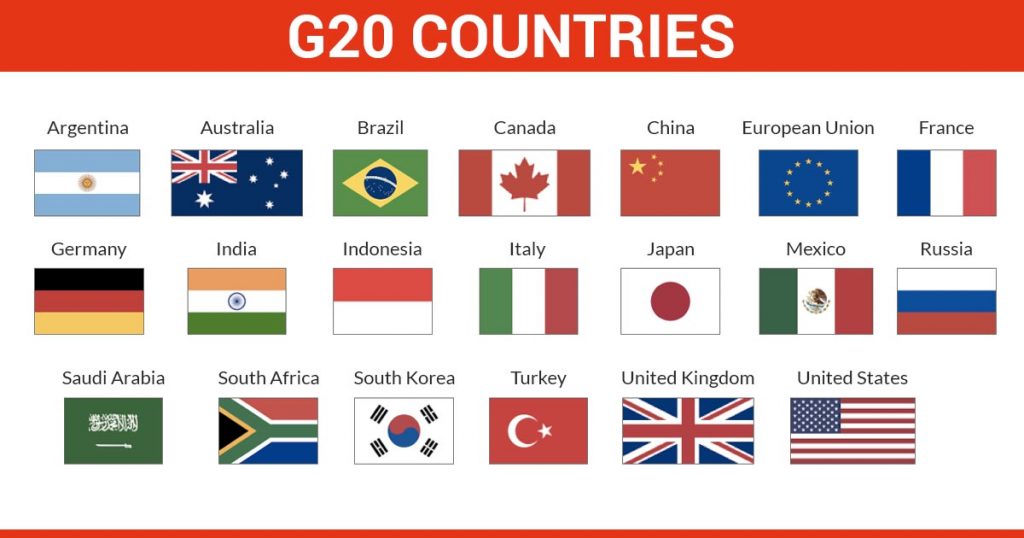
The members of the G20 consist of 19 individual countries plus the European Union (EU).
The 19 member countries of the forum are Argentina, Australia, Brazil, Canada, China, France, Germany, India, Indonesia, Italy, Japan, Mexico, Russia, Saudi Arabia, South Africa, South Korea, Turkey, United Kingdom and the United States.
The European Union is represented by the European Commission and by the European Central Bank.
Who are the G20 Sherpas?
A Sherpa is the personal representative of a head of state or government who prepares an international summit, particularly the annual G7 and G20 summits.
Between the summits, there are multiple Sherpa conferences where possible agreements are laid out.
This reduces the amount of time and resources required at the negotiations of the heads of state at the final summit.
The Sherpa is generally quite influential, although they do not have the authority to make a final decision about any given agreement.
The name is derived from the Sherpa people, a Nepalese ethnic group, who serve as guides and porters in the Himalayas, a reference to the fact that the Sherpa clears the way for a head of state at a major summit.
G7
The G7 or the Group of Seven is a group of the seven most advanced economies as per the International Monetary Fund (IMF).
The seven countries are Canada, USA, UK, France, Germany, Japan and Italy. The EU is also represented in the G7.
These countries, with the seven largest IMF-described advanced economies in the world, represent 58% of the global net wealth ($317 trillion).
The G7 countries also represent more than 46% of the global gross domestic product (GDP) based on nominal values, and more than 32% of the global GDP based on purchasing power parity.
The requirements to be a member of the G7 are a high net national wealth and a high HDI (Human Development Index).
The Supreme Court has announced the formation of a new Constitution Bench headed by Chief Justice of India DY Chandrachud to hear a series of petitions seeking legal recognition of same sex marriages.
What is a Constitution Bench?
The constitution bench is the name given to the benches of the Supreme Court of India.
The Chief Justice of India has the power to constitute a Constitution Bench and refer cases to it.
Constitution benches are set up when the following circumstances exist:
Interpretation of the Constitution: Article 145(3) provides for the constitution of at least five judges of the court which sit to decide any case “involving a substantial question of law as to the interpretation” of the Constitution of India.
President of India seeking SC’s opinion: When the President has sought the Supreme Court’s opinion on a question of fact or law under Article 143 of the Constitution. Article 143 of the Constitution provides for Advisory jurisdiction to the SC. As per the provision, the President has the power to address questions to the apex Court, which he deems important for public welfare.
Conflicting Judgments: When two or more three-judge benches of the Supreme Court have delivered conflicting judgments on the same point of law, necessitating a definite understanding and interpretation of the law by a larger bench.
The Constitution benches are set up on ad hoc basis as and when the above-mentioned conditions exist.
Constitution benches have decided many of India’s best-known and most important Supreme Court cases, such as:
K. Gopalan v. State of Madras (Preventive detention)
Kesavananda Bharati v. State of Kerala (Basic structure doctrine) and
Ashoka Kumar Thakur v. Union of India (OBC reservations) etc.
Why in news now?
The Centre had expressed its concern about the “psychological impact” that same-sex unions could have on children, but refused to link its worries to stigma about same-sex relationships.
The government’s recent affidavit sought to explain how same-sex marriage was antithetical to the view held by many in India that marriage was a “holy union, a sacrament and a sanskar” between a biological man and a woman.
The Ministry of Housing and Urban Affairs has issued a directive to all state governments to ensure that 25% of public toilet seats added in any city or urban unit are “aspirational toilets.”
What are Aspirational Toilets?
The aspirational toilets scheme was launched in September 2022 as part of the Swachh Bharat Mission (SBM) 2.0, with an aim to help make cities open defecation free.
A quarter of all new public restrooms in Indian cities will soon have high-end features such as luxurious bath cubicles, touchless flushing, breast-feeding rooms, and automatic sanitary napkin incinerators.
These will be indicated as “aspirational toilets” on Google Maps.
Focus areas for constructing aspirational toilets
The focus areas for constructing these luxury toilets will be tourist and religious destinations, as well as iconic cities.
High-footfall locations such as markets, railway stations, inter-state bus depots, and national highways will be given priority.
Guidelines have been issued to the states for constructing these toilets. It also includes low-height toilets and basins for children.
Hand-dryers, paper napkins, and vending machines for sanitary napkins are proposed to be made available.
Maintenance and funding patterns
One of the business models being explored for the maintenance of these toilets is attaching them with other public services such as restaurants, shopping malls, libraries, cinema halls, or even medicine shops, to make them self-sustaining.
Experts have cautioned that a proper study must be done on the location and the way these toilets will be maintained before beginning any such project.
Back2Basics: Swachh Bharat Mission (Urban) 2.0
Description
Objective
Make all cities in India “garbage-free”
Period
5 years (1st Oct 2021 – 1st Oct 2026)
Focus
Sustainable solid waste management, sustainable sanitation and treatment of used water, and promoting behavior change through citizen outreach
Segregation of waste
All households and premises required to segregate their waste into “wet waste” and “dry waste”
Collection of waste
Aims to achieve 100% door-to-door collection of segregated waste from each household/premise
Waste management
Aims to achieve 100% scientific management of all fractions of waste, including safe disposal in scientific landfills, remediation of all legacy dumpsites, and the conversion of these sites into green zones
Sanitation
Aims to promote holistic sanitation, with end-to-end solutions, treatment of used water before discharge into water bodies, and maximum reuse of treated used water
Citizen outreach
Aims to create awareness and institutionalize “Swachh” behavior through large-scale citizen outreach
Institutional capacity
Aims to create institutional capacity to effectively implement programmatic interventions to achieve mission objectives
Central idea: The SARS-CoV-2 virus has the ability to evade CD8 T cells, which are important in reducing the viral load and clearing the infection by detecting and killing infected cells.
What is the news?
A recent study has revealed that the SARS-CoV-2 virus has the ability to modulate MHC I expression in host cells.
MHC I is crucial in alerting the immune system to virally infected cells.
The virus has evolved multiple strategies to inhibit MHC I expression, which is not seen in the case of the influenza virus.
What is T Cell Immunity?
Like B cells, which produce antibodies, T cells are central players in the immune response to viral infection.
For your immune system to fight off any kind of invader, such as a virus, you need a kind of white blood cell called a B cell, which makes antibodies, and a similar-looking white blood cell called a T cell.
T cells can play different roles altogether.
They can act as “killer cells”, attacking cells which have been infected with a virus or another kind of pathogen, or they can act as “helper cells” by supporting B cells to produce antibodies.
How do they function?
Alongside antibodies, the immune system produces a battalion of T cells that can target viruses.
Some of these, known as killer T cells (or CD8+T cells), seek out and destroy cells that are infected with the virus.
Others, called helper T cells (or CD4+T cells) are important for various immune functions, including stimulating the production of antibodies and killer T cells.
T cells do not prevent infection, because they kick into action only after a virus has infiltrated the body. But they are important for clearing an infection that has already started.
In the case of COVID-19, killer T cells could mean the difference between a mild infection and a severe one that requires hospital treatment.
India is going to buy 250 more Pralay ballistic missiles for the services to strengthen them on the northern borders, further boosting the firepower of the defence forces.
Pralay Ballistic Missile
Pralay is a tactical missile developed from India’s K-series of submarine-launched ballistic missiles (SLBMs).
It has a range of 150-500 km and can carry warheads weighing between 350 to 700 kg.
The missile is a canisters road-mobile system, which enhances its mobility and allows for quick preparation and launch of the missile.
Pralay has the ability to perform manoeuvres in flight and follows a quasi-ballistic trajectory to maintain high speed, making it difficult for enemy missile defence systems to intercept.
Classification
The Indian Defence Ministry has classified Pralay as a “conventional Surface-to-Surface missile”.
This distinguishes it from the Agni series of missiles, which have the capability to carry either conventional or nuclear warheads.
Testing and launch
The missile was launched on a quasi-ballistic trajectory in one of the two tests, which enhances its effectiveness against enemy missile defence systems.
Satellite imagery of the test shows that Pralay is a canisterised road-mobile system, which adds to its mobility and flexibility in responding to evolving threats.
The controversy over the National Council of Educational Research and Training (NCERT) reducing the content on Mughal history in the school curriculum has sparked a heated debate in the country. While some argue that this move is part of a larger agenda to erase the Mughal legacy, others believe that it is a necessary step towards reducing the burden on students and providing a more balanced approach to teaching Indian history.
NCERT’s changes
The NCERT removed overlapping material from grades 6 to 12 to reduce the burden on students.
Grade 12 has been designed around themes in Indian history. It is divided into three parts spanning over 2,000 years. One theme out of 12 focuses on Kings and Chronicles. It revolves around the significant policies that redefined the landscape and mindset of the people. Akbar’s policies feature in this theme in the rationalized syllabus as well.
This is over and above the extensive coverage they get in the middle school curricula, at the cost of the exclusion of the rest. Mughals have been overrepresented in Indian history books and were an obvious area for right-sizing.
What NCERT has said on omitting chapters?
Part of rationalisation process: According to NCERT director, Chapters on Mughals have not been dropped. There was a rationalisation process last year because due to COVID, there was pressure on students everywhere.
Reducing the burden without affecting the knowledge: The expert committees examined the books from standards 6-12. They recommended that if some sections or this chapter is dropped, it won’t affect the knowledge of the children and an unnecessary burden can be removed.
Transition towards National Education Policy (NEP): NCERT working as per NEP, 2020. This is a transition phase. NEP 2020 speaks of reducing the content load. NCF (National Curriculum Framework) for school education is being formed, it will be finalised soon. Textbooks will be printed in 2024 as per NEP.
Need for a balanced approach
Purpose of studying Indian history: The purpose of studying Indian history should be to understand who we are and how we got here, by understanding the demography, culture, and practices of the various components of India over the last two-and-a-half millennia.
Dive deep into all polities: This requires us to dive deep into all polities that have resided in the subcontinental region for significant periods.
Mughal history is just one part: Mughal history is just one part of just one period (medieval) of Indian history, and there is a lot more to our history that needs attention.
Rich and long history: Indian history is too rich, long, and unwieldy for any curriculum to do justice.
Children needs to have broader understanding: In the age of Wikipedia, we need to expose our children to the broad themes and grand sweep of history, create an understanding of their origins, and equip them with the tools and curiosity to read and research further as they grow.
Step is in good direction: The current reorganization is a good step in that direction.
Conclusion
The real debate should be how to teach 2,500 years of Indian history to children in an engaging and informative manner. Those quibbling over the current rearrangement lack both a perspective on the scale of Indian history and an understanding of the complexities of teaching it. They would be better served by picking up a few history books themselves.
Mains Question
Q. The national education policy speaks of reducing the content load and ensure the understanding in this light discuss the significance of teaching history of India in more rational and comprehensive manner.
The recent comments made by the Supreme Court regarding the independence of constitutional authorities in India is an important issue. The need for independent institutions and a system of checks and balances is essential to prevent the arbitrary use of power by the government. The appointment process of key constitutional positions needs to be safeguarded from the whims of the executive.
Need for Independent Institutions
Executive interference: The Constituent Assembly of India had recognized the need for independent institutions to regulate sectors of national importance without any executive interference.
Constitutional bodies: Various constitutional authorities such as the Public Service Commission, the Comptroller and Auditor General of India (CAG), the Election Commission of India (ECI), the Finance Commission, and the National Commissions for Scheduled Castes (SC), Scheduled Tribes (ST) and Backward Classes (BC) have been set up for this purpose.
Need complete independence: Such constitutional bodies must be provided complete independence to enable them to function without fear or favor and in the larger interests of the nation.
Appointment Process for Constitutional Authorities
Appointments are critical for independence: The appointment of individuals heading these institutions is critical to ensuring their independence.
Safeguarded from the whims of the executive: While empowering the President of India to appoint all constitutional authorities, the Constitution-makers had kept in mind those institutions whose independence is of paramount importance to the country and the manner in which the independence of these authorities could be safeguarded from the whims of the executive
Appointment of Judges and Other Constitutional Positions
The Constitution provides for certain conditions to be fulfilled by those who may be considered for such appointments.
Role of governors: The appointment of Judges of the Supreme Court and the High Court, the CAG of India, and Governors are to be kept free from political or executive pressure.
For instance, appointment of the CAG:
In the draft Constitution, the article for the appointment of the CAG had provided that, there shall be an Auditor General who shall be appointed by the President. The Constituent Assembly further discussed that The Auditor-General should be always independent of either the legislature or the executive.
The process of selecting a person to be appointed as the CAG of India should begin by appointing a committee consisting of the Speaker of the Lok Sabha, the Chief Justice of India, and the Chairman of the Public Accounts Committee to shortlist names to be considered for appointment as the CAG of India; and a panel of three names should be forwarded to the President for him to make the final selection as in Article 148 of the Constitution of India.
Appointment of CEC and EC’s: The Supreme Court has taken an important step in ensuring the independence of the Election Commission of India by divesting the executive of its sole discretion in appointing the Chief Election Commissioner (CEC) and Election Commissioners (ECs) by forming a committee to suggest suitable names to man these constitutional posts.
Appointment of Governors: The Court expressed serious concern over the active role being played by Governors in State politics, observing that Governors becoming part of political processes is disconcerting. The appointment process for Governors needs to be unrestricted and unfettered to ensure that the President is free from the influence of the Legislature.
Conclusion
It is necessary to ensure the independence of constitutional authorities to enable them to function without fear or favor and in the larger interests of the nation. The appointment process for key constitutional positions must be safeguarded from the whims of the executive. The recent comments of the Supreme Court regarding the independence of constitutional authorities in India are a reminder of the need to ensure that the appointment process for such positions is free from political or executive pressure.
Mains Question
Q. The issues over the independence of constitutional authorities in India is often in the headlines. In this light discuss why is it necessary to ensure the independence of constitutional authorities, and what are the implications of failing to do so?
In a surprise move, the Indian central bank decided to pause its consecutive rate hikes and keep the benchmark repo rate at 6.50%.
The decision taken by the monetary policy committee (MPC) is a unanimous one despite inflation still beyond tolerance levels and downside risks from global economic activity.
Thus, this edition of the burning issue will talk about this hike pause and the mechanism of inflation targeting.
Background: Evolution of Inflation Targeting Framework
Phase One: Non-Statutory Inflation Control By RBI
Non-statutory: This Phase was marked by a Non-statutory inflation mechanism by RBI which included changes in several policy rates such as cash reserve ratio, and statutory liquidity ratio to maintain inflation.
Limitation: The mechanism lacked in several points such as lack of transparency in decision-making, uncertainty in the market about rates and inflation etc. Thus, the government shifted to Inflation targeting.
Phase Two- The MPC and The Beginning of the Inflation Targeting Era
What is the Monetary policy committee (MPC)?
Monetary policy refers to the policy of the central bank with regard to the use of monetary instruments under its control to achieve the goals specified in the Act.
Six-member committee: Under Section 45ZB of the amended (in 2016) RBI Act, 1934, the central government is empowered to constitute a six-member Monetary Policy Committee (MPC).
The primary objective: Section 45ZB of RBI Act, 1934 sets the objective of the RBI’s monetary policy to maintain price stability while keeping in mind the objective of growth.
A Monetary policy committee was formed to decide the Key policy rates.
Objective: Further, Section 45ZB lays down that “the Monetary Policy Committee shall determine the Policy Rate required to achieve the inflation target”.
Flexible Inflation Targeting Framework
Now, there is a flexible inflation-targeting framework in India (after the 2016 amendment to the Reserve Bank of India (RBI) Act, 1934).
What is Inflation Targeting?
Inflation targeting is a central banking policy that revolves around adjusting monetary policy to achieve a specified annual rate of inflation.
Inflation targeting was first adopted in New Zealand and subsequently by 33 other countries. India adopted it in 2016.
The amended RBI Act, 1934 provided for the INFLATION TARGET (4% +-2%) to be set by the Government of India, in consultation with the Reserve Bank, once in every five years.
3 Stances of RBI under Inflation Targeting
1.‘Accommodative’
An accommodative stance means the central bank is prepared to expand the money supply to boost economic growth. The central bank, during an accommodative policy period, is willing to cut interest rates. A rate hike is ruled out.
2. ‘Neutral’
A ‘neutral stance’ suggests that the central bank can either cut rate or increase rate. This stance is typically adopted when the policy priority is equal on both inflation and growth.
3. ‘Hawkish’
A hawkish stance indicates that the central bank’s top priority is to keep inflation low. During such a phase, the central bank is willing to hike interest rates to curb the money supply and thus reduce the demand.
How inflation and rate hikes are linked?
When there is a shortage of funds, commercial banks borrow money from the central bank which is repaid according to the repo rate applicable.
The central bank provides these short terms loans against securities such as treasury bills or government bonds.
This monetary policy is used by the central bank to control inflation or increase the liquidity of banks.
The government increases the repo rate when they need to control prices and restrict borrowing.
An increase in repo rate means commercial banks have to pay more interest for the money lent to them and therefore, a change in repo rate eventually affects public borrowings such as home loans, EMIs, etc.
From interest charged by commercial banks on loans to the returns from deposits, various financial and investment instruments are indirectly dependent on the repo rate.
Why RBI hiked rates previously?
Global economic volatility due to the Ukraine war since March 2022 supply chain disruptions for a number of items.
Record high inflation throughout a major period during 2022 has prompted the RBI to make multiple policy rate hikes.
Impact:
The RBI has raised the repo rate by 250 basis points (bps) since May 2022, thereby increasing the External Benchmark Linked Interest Rates, EBLR by 250 bps.
Banks have also raised the lending rate linked to the marginal cost of funds-based lending rate (MCLR) in the past 11 months.
Last year, the Consumer price index (CPI) hit its highest of 7.79% in Apr, and the wholesale price index (WPI) reached 15.88% in May 2022.
Why RBI has now paused hikes?
Decreasing inflation: The country’s retail inflation, which is measured by the consumer price index (CPI), slipped 16-month low of 5.66% in Mar. 2023.
Inflation data on the Wholesale Price Index (WPI), which calculates the overall prices of goods before selling at retail prices, was at 3.85% in Feb. 2023.
May slow down growth and consumption: Concerns over slowing consumption and tepid private investment have been emerging in policy quarters, with many seeing high-interest rates as a crucial factor in dampening demand.
Decrease in crude prices: Also, there has been a decrease in global crude prices and food inflation.
Still risks are there: The RBI underlined risks from protracted geopolitical tensions, tight global financial conditions and global financial market volatility to its monetary policy outlook.
Will this pause be helpful or not?
(1) Yes
The pause by the RBI will help favor the growth-inflation tradeoff towards the former.
An increase in EMIs for different types of loans will also halt helping the middle class to cope with inflation.
(3) No
Rates to remain high: In the backdrop of many global agencies lowering India’s growth forecasts for this financial year amid expectations of global economic slowdown and monetary tightening by other countries.
No relief on debts: The interest rates of debts are already high and a pause on a hike will not bring down these interest rates and thus keep the debt costlier.
Effectiveness of Inflation Targeting
Successes
Average inflation has declined: The average inflation rate measured through the GDP deflator has declined significantly in the inflation targeting regime.
The average inflation, which was 5.69 per cent five years in the pre-inflation targeting period, has declined to 3.47 per cent in the last five years.
CPI declined: Consumer Price Index inflation declined from 8.26 per cent during the 2011-2015 period to 4.99 per cent in 2016-2019, a 3.27 percentage point fall.
This is highest among both inflation-targeting countries as well as those that did not adopt it.
Enhanced transparency: Monetary policy transparency in India has improved after the adoption of the inflation-targeting framework.
Failures
Sole focus of inflation: However, some critics of inflation targeting feel that its sole focus on price stability ignores growth imperatives.
Not much effective in India: In India, the agricultural sector and informal economy have a large share, which is not directly impacted by such rate hikes, thus rendering the hikes less effective.
Way forward
The review committee should try to find out areas of further improvement in the monetary policy framework which will strengthen the MPC to achieve the inflation target.
In the present framework, it is not clear which model the RBI uses to forecast inflation and GDP figures, so it should disclose the models used in forecasting as other inflation-targeting countries do.
Further, the RBI may include a forecast of core inflation in the minutes.
Conclusion
Central banks including the RBI are often accused of falling behind the curve. However, these are challenging times for central banks. Rate hikes operate with a lag. They also lead to a growth slowdown.
Thus, RBI has to walk a tightrope to balance growth-inflation dynamics. The accountability measures incorporated in the inflation targeting framework ensure that the focus on inflation management is not lost.