The 17th Lok Sabha is set to complete its five-year term in 2024. However, with only 230 sitting days so far, it is unlikely to surpass the 331 days of the shortest full-term Lok Sabha since 1952. The latest session, the Budget session, was marked by minimal legislative activity and continuous disruptions, with only one item, the Motion of Thanks on the President’s Address, being discussed.
Low Productivity of the 17th Lok Sabha
The Lok Sabha has functioned for only 33% of its scheduled time (46 hours) during the Budget session, with the Rajya Sabha working for 24% (32 hours).
The second part of the session was even more unproductive, with the Lok Sabha working for only 5% and the Rajya Sabha for 6% of their scheduled time.
The number of Bills introduced and passed has also declined significantly since the first session, with fewer than 10 Bills being introduced or passed in each of the last four sessions.
The latest Budget session was also one of the shortest since 1952, with the Lok Sabha spending only 18 hours on financial business, compared to an average of 55 hours in previous Budget sessions of the 17th Lok Sabha.
Lok Sabha
Term
Total Sitting Days
Bills Introduced
Bills Passed
Average Sitting Days per Year
15th
2009-2014
357
244
181
71
16th
2014-2019
331
247
156
66
17th
2019-2024
Less than 331 (projected)
150 (as of April 2023)
131 (as of April 2023)
58 (projected)
Lack of Debates and Discussions
Short-duration discussions: The Rules of Procedure of both Houses of Parliament provide for various devices that can be used to draw attention to matters of public importance and hold the government accountable. However, in the 17th Lok Sabha, only 11 short-duration discussions and one half-an-hour discussion have been held so far, and none were held during the latest session.
Question Hour: This is despite the fact that the latest session saw the least amount of time spent on questions in the current Lok Sabha. Question Hour functioned for only 19% of the scheduled time in the Lok Sabha and 9% of the scheduled time in the Rajya Sabha.
Why the Lok Sabha’s productivity has been low?
Disruptions and Protests: The 17th Lok Sabha witnessed frequent disruptions and protests from opposition parties, leading to a significant loss of time and decreased productivity. Some of the major issues that led to disruptions include the Citizenship Amendment Act (CAA), National Register of Citizens (NRC), and farm laws.
Lack of Consensus: The ruling party enjoyed a clear majority in the Lok Sabha, but there was still a lack of consensus on many key issues, resulting in a delay in passing important bills and legislation.
COVID-19 Pandemic: The COVID-19 pandemic also contributed to the low productivity of the Lok Sabha as many sessions were delayed or cancelled due to safety concerns.
Speaker’s Decision: The decision of the Speaker of the Lok Sabha to disallow opposition MPs from raising certain issues also resulted in protests and disruptions, further reducing the productivity of the house.
Shorter Sessions: The 17th Lok Sabha had shorter sessions compared to previous Lok Sabhas, which also contributed to lower productivity. Many important bills and issues were left pending as there was not enough time to discuss and debate them thoroughly.
Delay in passing important bills: When the Lok Sabha is unable to function effectively, it can lead to a delay in passing important bills, which may have an adverse impact on the economy and governance. For example, crucial bills related to taxation, infrastructure, and social welfare may get delayed, affecting the overall progress of the country.
Poor quality of legislation: When the Lok Sabha is unable to function effectively, it may lead to poor quality of legislation. There may be a lack of debate and discussion, leading to hasty decision-making and poor-quality laws that may have unintended consequences.
Damage to democratic institutions: When the Lok Sabha is unable to function effectively, it can damage the democratic institutions of the country. It can erode the trust of citizens in the democratic process and lead to a feeling of disenchantment and disengagement among the people.
Wastage of taxpayers’ money: When the Lok Sabha is unable to function effectively, it leads to wastage of taxpayers’ money. The salaries and allowances of Members of Parliament are paid from the public exchequer, and if they are not able to discharge their duties effectively, it amounts to a waste of taxpayers’ money.
Negative impact on investor confidence: When the Lok Sabha is unable to function effectively, it can have a negative impact on investor confidence. Investors may be hesitant to invest in the country, leading to a slowdown in economic growth and development.
Lack of accountability: When the Lok Sabha is unable to function effectively, it may lead to a lack of accountability. Members of Parliament may not be held accountable for their actions, and the executive may be able to push through decisions without proper scrutiny or oversight.
Conclusion
The 17th Lok Sabha has been marked by low productivity and a lack of debates and discussions, despite the availability of mechanisms to hold the government accountable. The upcoming year is unlikely to see a significant increase in the number of sitting days. This lack of productivity and accountability could undermine the role of Parliament in a democracy and the ability of the government to pass important legislation.
Mains Question
Q. What are the reasons for the low productivity of the 17th Lok Sabha? What are the implications of its low productivity, and how might it affect the country’s progress and democratic institutions?
The resurgence of Sikh extremism in the form of the self-styled Sikh extremist preacher Amritpal Singh, modelling himself on Bhindranwale of yore, has raised concerns in areas with a significant Sikh diaspora. The real cause for concern is that the current security dispensation has not learnt from past mistakes and needs to take appropriate action before the situation spirals out of control.
The resemblance of the self-styled Sikh extremist preacher, Amritpal Singh, to Bhindranwale is limited to style and lacks substance.
However, the extremist fringe among Sikh youth, including the Sikh diaspora in Australia, Canada, the UK, and the US, seems to be galvanized by the imposter’s attempts to revive the Bhindranwale mystique.
The links have been established by this ‘core group’ with pro-Khalistan groups such as the Sikhs for Justice (SFJ), the Babbar Khasla, and the Khalistan Liberation Force (KLF).
Lessons from the Past
Inadequate current security dispensation: The current security dispensation does not appear to have learnt the right lessons from past mistakes.
Operation Blue Star: The Bhindranwale phenomenon was not a sudden development, and if it were properly handled, it could have been checkmated well before 1984, and the subsequent violence leading to ‘Operation Blue Star’ and the damage caused to Akal Takht could have been avoided.
What was the Khalistan movement?
Dates to pre-independence era: The Khalistan movement, which started in the 1940s during British rule, calls for establishing a separate nation for Sikhs. When India became independent and Punjab was partitioned, its leaders demanded a special status for the state. However, the Central Government did not pay attention to these demands, and Sikhs felt betrayed, leading to the idea of a separate nation growing substantially.
Rise of Bhindranwale: Many individuals and organizations contributed to the Sikh revivalist movement; however, Jarnail Singh Bhindranwale emerged as a charismatic leader after becoming the head of Damdami Taksal on August 25, 1977.
Failure to fulfil regional demand: Punjabi political parties, such as the Sikh Akali Party, failed to fulfil the regional demands concerning river waters and the transfer of Chandigarh as a capital city to Punjab. The devolution of power gave rise to Bhindranwale’s image among the masses.
Finally Military Operation: The military mission, OBS, was carried out between June 1 to June 10, 1984, to take control of key gurdwaras, including the Golden Temple in Amritsar, from Bhindranwale’s supporters. Bhindranwale was killed during the operation; however, in recent times, his image remains alive and well.
Why is it being revived?
Political instability: Punjab in recent years has witnessed a political crisis leading to a change in governments, ruling political parties and CM’s giving chance for radical outfits to grow.
Economic challenges: Punjab state has a high employment rate (According to data from the Centre’s Periodic Labour Force Survey 2019-20, Punjab’s unemployment rate is higher than the national average). Also, the year-long Farmers’ protest in 2021 and railways blockades have led to the creation of negative sentiments among investors about the state’s investment environment leading to decreasing investments in Punjab and rising unemployment.
Rising communalism: multiple events of blasphemy have taken place in the state which is flaming the fire of communalism among the people of the state.
Provocation from Pakistan: Investigations by security agencies suggest links between Khalistani groups and Pakistan’s Inter-Services Intelligence (ISI) – further increasing the likelihood of feelings of separatism due to drug trafficking and networking through Sikh pilgrimages.
Feeling to of persecuted minority: images of the 1984 anti-sikh riots and the topic of the non-persecution of culprits of the riots are being used to suggest that Sikhs are persecuted minority and thus they must have their own land in form of Khalistan.
Cause of concern
Threat to national security and integrity: the resurgence of the Khalistan movement is a threat to national security similar to the Kashmir and NE insurgency.
May darken Punjab’s future: a poor law and order situation may deter investors to invest in Punjab thus further deteriorating its economy and leading to spillover effects in social and political sectors.
Involvement of diaspora: The idea of forming a separate state for Sikhs has died down in Punjab; however, it has attracted the attention of a large audience in the diaspora who now have settled in other nations for long and thus have lost their affinity with India as their homeland.
Misuse of social media: which defies any international boundary, thus misused by separatists in Pakistan and other nations.
Bilateral relations may be harmed: the Khalistan issue has already harmed Indo- Canada relations and now straining Indo-UK due to the conduction of Referendum 2020 in these countries despite the Indian Government’s objection.
Avoiding Misreading of Sentiments
Wider perspective: Treating all that is happening now as evidence of a foreign conspiracy instead of facing up to the reality that this may be more than a mere emotional outburst of the Sikh extremist fringe is a grave mistake.
Finding the real cause: Blaming the current violence on the drug mafia with links to Pakistan can at best be a proximate, but not the real cause.
Confronting the Threat
Innovative ways: India needs to find ways and means to defeat the ‘siren call’ of radical extremists of every hue, whether they be Khalistanis or other kinds of extremists.
Ensure balance and sense of unity: It needs to steer between the extremes of the right and left and ensure a greater sense of unity within the country, according to individual dignity and human progress, and demonstrating leadership in the comity of nations.
Way ahead
The resurgence of Sikh extremism and the growing insecurity among Sikh youth and discontent prevailing among the Sikh peasantry needs to be addressed to prevent a repeat of the violent events that took place in the late 1970s to the 1990s.
Intelligence analysis should be prioritized to detect the signs of growing insecurity and discontent.
There is need for good intelligence to deal with the situation.
Conclusion
India should not yield to the temptation of resorting to hard measures without understanding the true causes and join the ranks of nations that solely believe in strong-arm methods. India needs to effectively confront the threat posed by radical extremists, such as the Khalistan Liberation Force (KLF) and the Sikhs for Justice (SFJ), while respecting liberal values and ensuring unity within the country.
China’s recent move to rename 11 places in Arunachal Pradesh and standardise those names on the basis of a map is an exercise of the Chinese perspective of international law, which goes against the international law widely adhered to by most members of the United Nations.
China’s claims over disputed territories, such as the South China Sea, are often based on historical records, maps, and cultural relics.
China argues that these territories had been its territory since the Song Dynasty and, therefore, should be considered part of its sovereign territory. However, this approach is not recognized under international law and undermines the basis of the international legal system.
Chinese perspective of international law
Jurisdiction rights: The Chinese perspective of international law is based on its strong stress on the principle of sovereignty. According to this view, sovereign states have an inalienable right to exercise jurisdiction over their territories and their people without interference from other states.
Historic rights: China combines its vision of sovereignty with the historic right to exercise jurisdiction over those territories or maritime areas as well, which were once ruled by a Chinese dynasty in the mediaeval or ancient era.
Undermines international legal system: The historic right approach makes China undermine the basis of the international legal system grounded in the sovereign equality of states and the general rules of international law.
Contravention of international courts and tribunals
Contravenes the decisions of international courts and tribunals: China’s attempt to rename 11 disputed locations on historical and administrative bases contravenes the decisions of international courts and tribunals.
No convincing proofs: The International Court of Justice (ICJ) considers direct evidence of possession and the actual exercise of sovereignty as more convincing proof of title to a territory than indirect presumption from events in history.
Against the principle of uti possidetis juris: China’s renaming exercise goes against the principle of uti possidetis juris, which is the principle that the boundaries of newly independent states should follow those of the previous colonies.
Help of cartographic materials: China tries to buttress its territorial and maritime claims with the support of maps, but cartographic materials do not have any legal value by themselves. They constitute extrinsic evidence of varying reliability that might, depending on the circumstances, be used together with other evidence to establish a fact.
What is the principle of uti possidetis juris?
The principle of uti possidetis juris is a Latin phrase that means as you possess under law.
It is a principle of international law that was developed in the context of decolonization. The principle holds that newly independent states should inherit the territorial boundaries that existed at the time of their independence.
The idea is that the territorial integrity of a new state should be protected and that the boundaries of the state should not be subject to change without the consent of the state.
The principle of uti possidetis juris is meant to prevent disputes over territorial boundaries that could lead to instability or conflict.
Implications of China’s actions
China’s actions in Arunachal Pradesh undermine the international legal system based on the sovereign equality of states and the general rules of international law.
China’s historic right approach to sovereignty over territories and maritime areas is a cause for concern for other countries with territorial disputes with China.
China’s use of maps to support its territorial and maritime claims is not a legally valid argument and undermines the legal basis for resolving territorial disputes.
Conclusion
China’s attempt to rename disputed territories in Arunachal Pradesh goes against established principles of international law and undermines the sovereign equality of states. The use of historical claims and maps to support territorial and maritime claims is not recognized in international law. This renaming exercise is likely to further strain India-China relations and impact regional stability. It is essential to uphold the principles of international law to ensure the independence and stability of new states and prevent challenges to territorial boundaries.
Mains Question
Q. What is the principle of uti possidetis juris? How does China’s attempt to rename territories in Arunachal Pradesh contravene the decisions of international courts and tribunals?
The Union government informed the Supreme Court that a new law, namely the Digital Personal Data Protection Bill, 2022, to enforce individual privacy in online space was “ready”.
Legislation on ‘Data’: A Backgrounder
The personal data protection bill has been in the works for about five years.
The first draft of the Bill was presented by an expert panel headed by Justice B.N. Srikrishna in July 2018, after a year-long consultation process.
Timeline of key events
July 2018: After a year of consultations and deliberations, the PDP Bill, 2018, drafted by an expert committee headed by Justice BN Srikrishna, is presented to MeitY. Subsequently, MeitY begins drafting the next iteration of the Bill.
December 2019: The PDP Bill, 2019, prepared by MeitY, is referred to a Joint Parliamentary Committee (JPC) for review.
December 2021: After multiple extensions, and a leadership change, JPC Chairperson tabled the report of the JPC on the PDP Bill, 2019, as well as the draft Data Protection Bill 2021, in the parliament.
August 2022: On August 3 this year, MeitY withdrew the 2021 Bill, stating that a more “comprehensive legal framework” will be presented soon.
DPDP Bill, 2022 is based on seven principles
According to an explanatory note for the bill, it is based on seven principles-
Lawful use: The first is that “usage of personal data by organisations must be done in a manner that is lawful, fair to the individuals concerned and transparent to individuals.”
Purposeful dissemination: The second principle states that personal data must only be used for the purposes for which it was collected.
Data minimisation: Bare minimum and only necessary data should be collected to fulfill a purpose.
Data accuracy: At the point of collection. There should not be any duplication.
Duration of storage: The fifth principle talks of how personal data that is collected cannot be “stored perpetually by default,” and storage should be limited to a fixed duration.
Authorized collection and processing: There should be reasonable safeguards to ensure there is “no unauthorised collection or processing of personal data.”
Accountability of users: The person who decides the purpose and means of the processing of personal data should be accountable for such processing.
Key features of the bill
(1) Data Principal and Data Fiduciary
The bill uses the term “Data Principal” to denote the individual whose data is being collected.
The term “Data Fiduciary” the entity (can be an individual, company, firm, state etc.), which decides the “purpose and means of the processing of an individual’s personal data.”
The law also makes a recognition that in the case of children –defined as all users under the age of 18— their parents or lawful guardians will be considered their ‘Data Principals.’
(2) Defining personal data and its processing
Under the law, personal data is “any data by which or in relation to which an individual can be identified.”
Processing means “the entire cycle of operations that can be carried out in respect of personal data.”
So right from collection to storage of data would come under processing of data as per the bill.
(3) Individual’s informed consent
The bill also makes it clear that individual needs to give consent before their data is processed.
Every individual should know what items of personal data a Data Fiduciary wants to collect and the purpose of such collection and further processing.
Individuals also have the right to withdraw consent from a Data Fiduciary.
The bill also gives consumers the right to file a complaint against a ‘Data Fiduciary’ with the Data Protection Board in case they do not get a satisfactory response from the company.
(4) Language of information
The bill also ensures that individuals should be able to “access basic information” in languages specified in the eighth schedule of the Indian Constitution.
Further, the notice of data collection needs to be in clear and easy-to-understand language.
(5) Significant Data Fiduciaries
The bill also talks of ‘Significant Data Fiduciaries, who deal with a high volume of personal data.
The Central government will define who is designated under this category based on a number of factors ranging from the volume of personal data processed to the risk of harm to the potential impact on the sovereignty and integrity of India.
(6) Data protection officer & Data auditor
Such entities will have to appoint a ‘Data protection officer’ who will represent them.
They will be the point of contact for grievance redressal.
They will also have to appoint an independent Data auditor who shall evaluate their compliance with the act.
(7) Right to erase data, right to nominate
Data principals will have the right to demand the erasure and correction of data collected by the data fiduciary.
They will also have the right to nominate an individual who will exercise these rights in the event of death or incapacity of the data principal.
(8) Cross-border data transfer
The bill also allows for cross-border storage and transfer of data to “certain notified countries and territories.”
However an assessment of relevant factors by the Central Government would precede such a notification.
(9) Financial penalties
The draft also proposes to impose significant penalties on businesses that undergo data breaches or fail to notify users when breaches happen.
Entities that fail to take “reasonable security safeguards” to prevent personal data breaches will be fined as high as Rs 250 crore.
As per the draft, the Data Protection Board — a new regulatory body to be set up by the government — can impose a penalty of up to ₹500 crore if non-compliance by a person is found to be significant.
What distinguishes this bill from its earlier versions?
Gender neutrality: Significantly, and for the first time in the country’s legislative history, the terms ‘her’ and ‘she’ have been used irrespective of an individual’s gender. This, as per the draft, is in line with the government’s philosophy of empowering women.
Imbibes best global practices: To prepare it, best global practices were considered, including review of data protection legislations of Australia, European Union (EU), Singapore, and a prospective one of the USA.
Comprehensiveness: The draft has outlined six ‘Chapters’ and a total of twenty-five points. The ‘Chapters’ are: ‘Preliminary,’ ‘Obligations of Data Fiduciary,’ ‘Rights and Duties of Data Principal,’ ‘Special Provisions,’ ‘Compliance Framework,’ and ‘Miscellaneous.’
Special emphasis for child protection: If personal data is likely to cause harm to a child, its processing will not be allowed.
Hits of the bills
Widening the scope of data: Narrowing the scope of the data protection regime to personal data protection is a welcome move, as it resonates with the concerns of various stakeholders.
Harnessing economic potential: Now non-personal data could be used to unlock social and economic value to benefit citizens, businesses, and communities in India with appropriate safeguards in place.
Doing away with aggressive push for Data localisation: Relaxing data localisation provisions to notify countries to which data can flow, could aid India in unlocking the comparative advantage of accessing innovative technological solutions from across the globe, which in turn helps domestic companies.
Free flow of data: In addition, the free flow of data will help startups access cost-effective technology and storage solutions, as our research shows.
Allowing data transfers: This will also ensure that India is not isolated from the global value chain, helping businesses stay resilient in production and supply chain management and fostering overseas collaboration.
Some criticisms of the bill
Wordplay: There had been use of open-ended language such as “as necessary” or “as may be prescribed”.
Govt monopoly: The Bill did not seem to work towards protecting people, but ensures that the government retains all power without any checks or balances.
Exemption provisions: The government has been given the power to exempt not only government agencies but any entity that is collecting user data, from having to comply with the provisions of this bill when it is signed into law.
No protection against data breach: The Executive in India has a track record of exploiting to expand its powers. There is no right for compensation to individuals in case of a data breach. They have no right to data portability.
Conclusion
Crafting such crucial legislation is no mean task. It may require some more trial and error to succeed.
Definitely, it will involve some time and deliberation to arrive at a comprehensive legal framework.
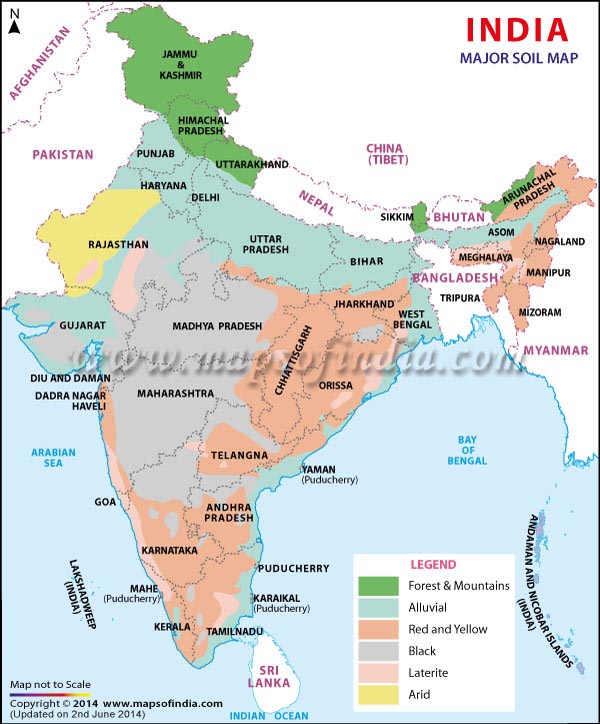
Formation: They are mainly derived from the debris brought down from the Himalayas or the silt left out by the retreating sea. Thus they are azonal soils.
Areas: Alluvial soils are widespread in the northern plains and the river valleys. Through a narrow corridor in Rajasthan, they extend into the plains of Gujarat. In the Peninsular region, they are found in deltas of the east coast and in the river valleys.
Soil texture: The alluvial soils vary in nature from sandy loam to clay. These soils are more loamy and clayey in the lower and middle Ganga plain and the Brahmaputra valley. The sand content decreases from the west to east.
Soil Colour: The colour of the alluvial soils varies from the light grey to ash grey depending on the depth of the deposition, the texture of the materials, and the time taken for attaining maturity.
Other Characteristic Features:
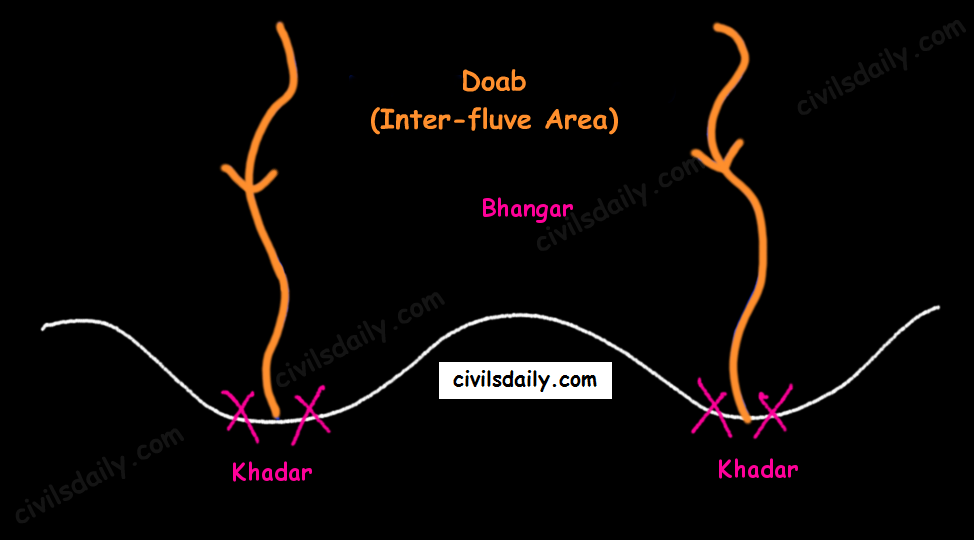
In the Upper and Middle Ganga plain, two different types of alluvial soils have developed, viz. Khadar and Bhangar.
Khadar and Bhangar
Khadar: the newer alluvium deposited by floods annually, enriches the soil by depositing fine silts, light colour, found near river beds, porous in nature. Bhangar: older alluvium, clayey, darker, has lime nodules called Kankars, found in doabs (inter-fluve areas).
Alluvial soils of the northern plains —> transported soils —>, therefore, lack humus —> lack nitrogen [That is why we need to use nitrogenous fertilisers in the northern plains!]. Exception: the Ganga-Brahmaputra delta region is rich in humus.
These soils lack in nitrogen, phosphorus and humus. However, they are generally rich in potash and lime.
The soil profile has no stratification.
Alluvial soils are intensively cultivated.
In certain areas, these soils are covered with unproductive wind-borne soil called Loess.
Limitations:
Allow water to sink into lower strata, and
Lack nitrogen (But these soils are capable of fixing nitrogen very rapidly through leguminous crops (peas, beans, cloves etc.)
These soils are locally known as the ‘Regur Soil’ or the ‘Black Cotton Soil’. Internationally, these are known as ‘tropical chernozems’. These soils are famous for the cultivation of cotton.
Formation: These have mainly formed from the Deccan Trap rocks —> Zonal Soils
Areas: These are found in the Deccan trap region. Black soil covers most of the Deccan Plateau which include parts of:
Maharashtra,
Madhya Pradesh,
Gujarat,
Andhra Pradesh and some parts of
Tamil Nadu.
Soil Texture: Black cotton soil (regur soil) is highly argillaceous i.e. clayey. It is deep and impermeable and thus has high water retention capacity.
Soil Colour: These soils are black in colour due to the presence of iron, aluminium compounds and humus.
Other Characteristic Features:
These soils are rich in minerals and known for their fertility.
The soil depth varies from place to place. It is very thick in lowlands but very thin on highlands. Also, in the upper reaches of the Godavari and the Krishna, and the northwestern part of the Deccan Plateau, the black soil is very deep.
These soils swell and become sticky when wet and develop deep wide cracks when dry. This helps in self-aeration, which leads to the absorption of nitrogen from the atmosphere. Thus, there occurs a kind of ‘self ploughing’. This aeration and oxidisation to deep levels contribute to the maintenance of the fertility of these soils. This continued fertility is favourable in the area of low rainfall for cotton cultivation even without irrigation.
Due to slow absorption and loss of moisture, the black soil retains the moisture for a very long time, which helps the crops, especially, the rain-fed ones, to sustain even during the dry season.
Chemically, the black soils are rich in lime, iron, magnesia and alumina. They also contain potash. But they lack in phosphorous, nitrogen and organic matter.
Suitable Crops: These soils are highly productive and well suited to the cultivation of cotton, pulses, millets, linseed, tobacco, sugarcane, vegetables and citrus fruits.
Note: In the southern and eastern parts of the country where rainfall is heavy, black soils often occur in close proximity to red soils. Black soils occupy valleys and low-level areas whereas the red soils occur on higher slopes and hilltops. Mixed black and red soils occur in Coimbatore, Madurai, Tirunelveli (Tamil Nadu) and Bundelkhand region.
3. Red and Yellow Soils
Locally called ‘Chalka’ in Andhra Pradesh.
Formation: These are derived from granites, gneisses and other metamorphic rocks —> Zonal Soils. These are formed under well-drained conditions.
Areas: Along the piedmont zone of the Western Ghat, a long stretch of area is occupied by red loamy soil. Yellow and red soils are also found in parts of Orissa and Chattisgarh and in the southern parts of the middle Ganga plain. They encircle the black cotton soil zone.
Soil Colour: The soil develops a reddish colour due to a wide diffusion of iron in crystalline and metamorphic rocks. It looks yellow when it occurs in a hydrated form. Often, their upper layer is red and the lower layer is yellow.
Soil Texture: Varies from sand to clay and loam.
Other Characteristic Features:
The fine-grained red and yellow soils are normally fertile, whereas coarse-grained soils found in dry upland areas are poor in fertility.
Have a porous and friable structure.
They are generally poor in nitrogen, phosphorous and humus.
These soils are airy and need irrigation for cultivation.
Intense leaching is a menace in these soil areas.
Suitable Crops: In places where irrigation facilities are available, the crops cultivated are wheat, cotton, pulses, tobacco, millets, oilseeds, potato, maize, groundnut and orchards.
4. Laterite Soil
The word laterite has been derived from the Latin word ‘Later’ which means brick. These soils when wet are as soft as butter but become hard and cloddy on drying. Therefore, these are widely cut as bricks for use in house construction.
Formation: The lateritic soils are particularly found on high flat erosion surfaces in areas of high(>200cm) and seasonal rainfall. The alternating wet and dry seasons lead to the leaching away of the siliceous matter of the rocks leaving behind the compounds of iron and aluminium. These are zonal soils.
Areas: These soils have mainly developed in the higher areas of the Peninsular plateau. The laterite soils are commonly found in Karnataka, Kerala, Tamil Nadu, Madhya Pradesh and the hilly areas of Orissa and Assam.
Soil Colour: Reddish-brown in colour due to the presence of iron oxide.
Other characteristic features:
With rain, lime and silica are leached away, and soils rich in iron oxide and aluminium compound are left behind(thus the reddish-brown colour). Also, the humus content of the soil is removed fast by bacteria that thrive well in high temperature.
These soils represent the end product of decomposition and are generally low in fertility.
The pebbly crust is the important feature of laterites which is formed due to alteration of wet and dry periods.
These soils are acidic in character due to leaching. Application of manures and fertilisers is required for making these soils fertile for cultivation.
These soils are poor in organic matter, nitrogen, phosphate and calcium, while iron oxide and potash are in excess.
Suitable crops: Red laterite soils in Tamil Nadu, Andhra Pradesh and Kerala are more suitable for tree crops like cashew nut. These soils are also suitable for tea plantations.
We discussed in detail alluvial, black, red and laterite soils. Let’s continue the discussion and move on to the next soil types!
Formation: These are derived from the disintegration of adjacent rocks and are largely blown from coastal regions and Indus valley.
Areas: Arid soils are characteristically developed in western Rajasthan, which exhibits characteristic arid topography.
Soil Colour: Arid soils range from red to brown in colour.
Soil Texture: They are generally sandy to gravelly in texture and have a high percentage of soluble salts.
Other characteristic features:
These are saline in nature. In some areas, the salt content is so high that common salt is obtained by evaporating the saline water.
Due to the dry climate, high temperature and accelerated evaporation, they lack moisture and humus.
These soils are deficient in nitrogen and humus. The phosphate and iron content is normal. These soils are rich in minerals but the main limitation is the lack of water.
The soils exhibit poorly developed horizons.
Plants are widely spaced.
Chemical weathering is limited.
Lower horizons of the soil are occupied by ‘kankar’ layers because of the increasing calcium content downwards. The ‘Kankar’ layer formation in the bottom horizons restricts the infiltration of water, and as such when irrigation is made available, the soil moisture is readily available for sustainable plant growth.
Suitable crops: If irrigated these soils give high agricultural returns. The availability of water from the Indira Gandhi canal has transformed the agricultural landscape of desert soils of western Rajasthan. These soils are mainly devoted to bajra, pulses, guar, fodder and less water requiring crops.
6. Saline and Alkaline Soils
They are also known as Usara soils. Various local names for saline soils are Reh, Kallar, and Chopan, Rakar, Thur, Karl etc.
Formation:
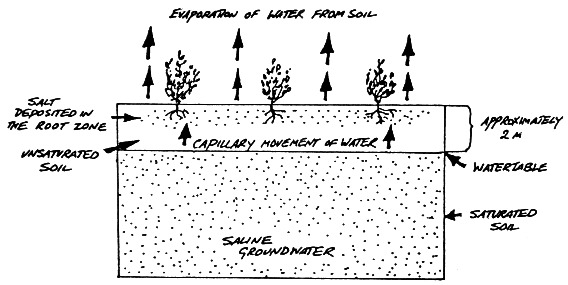
These soils have developed in areas with dry climatic conditions (in areas having a little more rainfall than the areas of desert soils) accompanied by lack of proper drainage. In this situation, salts of sodium, calcium and magnesium are deposited on the upper layer of the soil by capillary action.
In the Rann of Kuchchh, the Southwest Monsoon brings salt particles and deposits there as a crust.
These soils are also formed when saline water spreads on the land at the time of high tide in coastal areas. Also, seawater intrusions in the deltas promote the occurrence of saline soils.
Salinization also occurs because of over-irrigation (canal irrigation/groundwater use) and in areas of the high water table (as in the coastal areas of Maharashtra and Tamil Nadu). Salinity from irrigation can occur over time wherever irrigation occurs. This is because almost all water (even natural rainfall) contains some dissolved salts. When the plants use the water, the salts are left behind in the soil and eventually begin to accumulate. Also, excessive irrigation with dry climatic conditions promotes capillary action, which results in the deposition of salt on the top layer of the soil (See the following figure).
Areas: They occur in arid and semi-arid regions, and in waterlogged and swampy areas. These are more widespread in western Gujarat, deltas of the eastern coast and in Sunderban areas of West Bengal.
Soil Texture: Their texture ranges from sandy to loamy.
Other characteristic features:
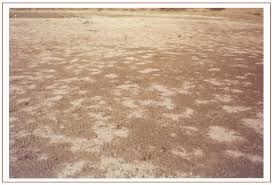
Because of capillary action, the salts are sucked up in solution to the surface and form white encrustations on the surface (See the picture below).
The salt efflorescence of calcium, magnesium and sodium makes these soils infertile.
Saline soils contain an excess of neutral soluble salts of chlorides and sulphates whereas sodic or alkali soils contain sodium carbonates/ sodium bicarbonates.
They lack in nitrogen and calcium and have low water-bearing capacity.
These soils can be reclaimed by improving drainage, by applying gypsum and/or lime, and by cultivating salt-resistant crops like barseem, dhaincha and other leguminous crops.
The saline and alkaline soils may occur in any group of soils.
Crops grown: In coastal areas, coconut trees are found in plenty in these soils. As discussed above, cultivating salt-resistant crops like bar seem, dhaincha and other leguminous crops can help in reclaiming these soils.
Note: In the areas of intensive cultivation with excessive use of irrigation, especially in areas of green revolution, the fertile alluvial soils are becoming saline. In such areas, especially in Punjab and Haryana, farmers are advised to add gypsum to solve the problem of salinity in the soil.
7. Peaty Soils
These soils are locally called Kari in Kottayam and Alleppey districts of Kerala.
Formation: These are marshy soils and are a result of waterlogging and anaerobic conditions (which leads to partial decomposition of organic matter).
Areas: They are found in the areas of heavy rainfall and high humidity, where there is a good growth of vegetation. It occurs widely in the northern part of Bihar, the southern part of Uttaranchal and the coastal areas of West Bengal, Orissa and Tamil Nadu.
Soil Colour and Texture: These soils are normally heavy and black in colour
Other characteristic features:
These soils are characterised by a rich humus and organic content.
There is a presence of iron and varying amounts of organic matter (10-40%). The organic matter in these soils may go even up to 40-50 per cent.
These soils are generally acidic in nature. But at many places, they are alkaline also.
Suitable crops: These are generally submerged during the rainy season and utilised for the cultivation of rice.
8. Forest Soils
Formation: As the name suggests, forest soils are formed in the forest areas where sufficient rainfall is available.
Areas: These are found in the forest areas of Himalayas, Sahyadris, Eastern Ghats and terai region.
Soil colour and texture: The soils vary in structure and texture depending on the mountain environment where they are formed. They are loamy and silty on valley sides and coarse-grained in the upper slopes. Their colour is dark brown.
Other Characteristics:
In the snow-bound areas of the Himalayas, they are acidic with low humus content. This is because humus is rawer at higher levels. Also, these soils are subjected to denudation due to landslides and snowfall.
The soils found in the lower valleys are fertile and rich in organic content.
Owing to sharp differences of hill slopes and climates, these soils may differ greatly even when in proximity. [Recall here the discussion on the impact of topography on soils!]
Also, these soils exist in thin layers because of their development on the mountain slopes.
These soils are poor in potash, phosphorus and lime.
Soil erosion is a major problem in these areas.
Crops grown: The slopes are used for horticulture and plantations crops like tea, coffee, spices, apple, peach etc. Rice and wheat are grown in valleys. Potatoes are grown in mostly all areas.
Drainage
The flow of water through well-defined channels is known as ‘drainage’ and the network of such channels is called a ‘drainage system’.
Types of Drainage Patterns
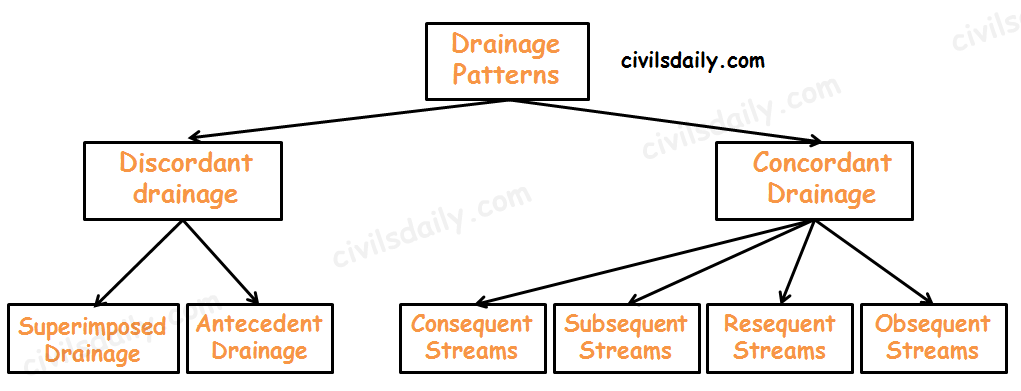
Discordant drainage
A pattern of drainage that bears no relation to the structure of the underlying rock. This may be because:
1. The drainage pattern developed on rock strata that have since been removed by erosion; a process known as superimposition. The drainage pattern thus developed is called superimposed drainage (or Epigenetic or Superinduced Drainage). Examples: The Damodar, the Subarnarekha, the Chambal, the Banas and the rivers flowing at the Rewa Plateau, rivers of eastern USA and southern France.
2. The drainage pattern was already present before a period of uplift and folding that formed the present structure. As the uplift took place, the rivers were able to cut down at approximately the same rate and so maintain their courses. This process is called antecedence and the drainage system thus developed is called antecedent drainage.
Many of the Himalayan rivers have antecedent origin i.e. these rivers existed even before the Himalayan ranges were uplifted. These rivers originate in the Tibetan side beyond the mountain ranges of Himalayas. The Indus, Satluj, Alaknanda, Gandak, Kosi, Brahmaputra all have an antecedent origin. Since these rivers are antecedent, they run transverse to the mountain ranges cutting deep V-shaped, steep-sided valleys (deep gorges).
Concordant Drainage (also called accordant drainage)
The pattern of drainage which arises from and closely follows the trends of the underlying strata is called concordant drainage.
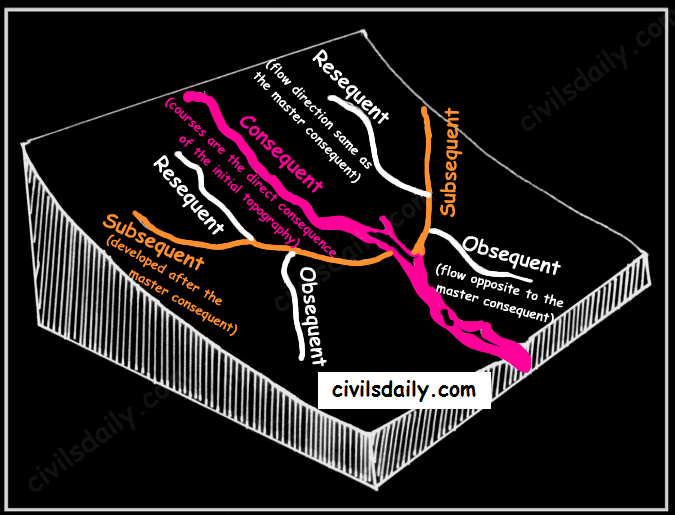
Consequent Streams: Those streams whose courses are the direct consequence of the initial topography are called consequent streams.
Subsequent Streams: These are developed after the master consequent.
Obsequent streams: These flow in opposite direction to the master consequent.
Resequent Streams: A resequent stream flows in the same direction as that of the initial consequent stream, but which develops in response to a new base level formed due to inversion of relief.
Concordant Drainage Patterns
Drainage pattern:
Drainage pattern refers to a design which a river and its tributaries form together from its source to its mouth. The drainage pattern of an area is the outcome of:
The geological time period,
Nature and structure of rocks,
Topography,
Slope,
Amount of water flowing, and
The periodicity of the flow.
Some Important Drainage Patterns:
A combination of several patterns may be found in the same drainage basin.
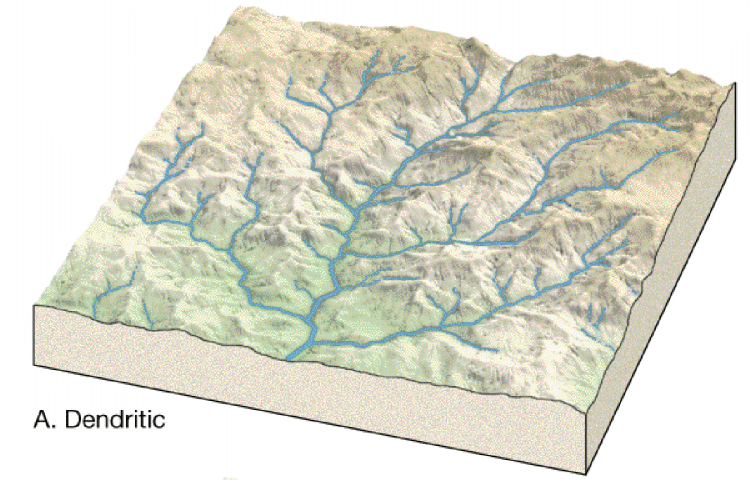
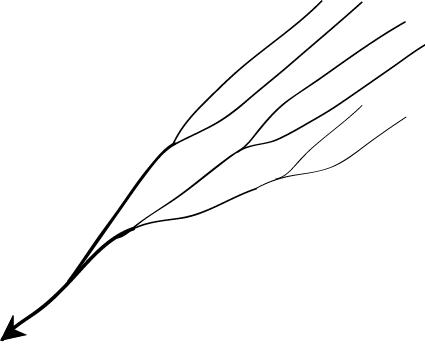
1. Dendritic: The dendritic pattern develops where the river channel follows the slope of the terrain. The drainage pattern resembling the branches of a tree is known as “dendritic” the examples of which are the rivers of northern plain. It is the most common stream pattern. A dendritic pattern develops in a terrain which has uniform lithology, and where faulting and jointing are insignificant.
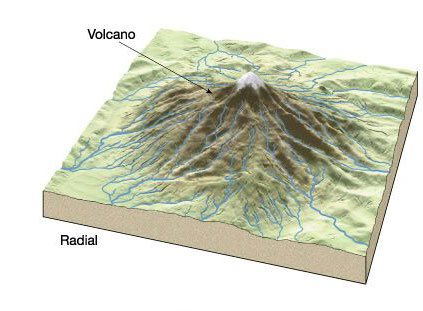
2. Radial: The radial pattern develops when streams flow in different directions from a central peak or a dome-like structure. E.g. the rivers like the Narmada, Son and Mahanadi originating from Maikal Hills flow in different directions and are good examples of a radial pattern.
Radial drainage patterns are also found/in the Girnar Hills (Kathiwar, Gujarat), and Mikir Hills of Assam.
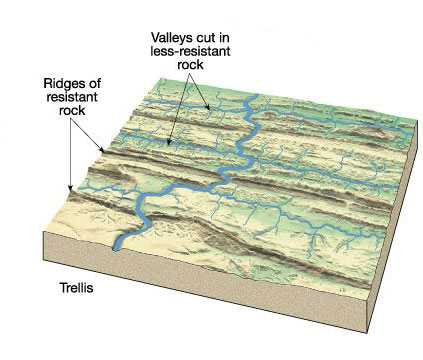
3. Trellis: When the primary tributaries of rivers flow parallel to each other and secondary tributaries join them at right angles, the pattern is known as ‘trellis’. A trellis drainage pattern develops where hard and soft rocks lie parallel to each other. For example, rivers in the upper part of the Himalayan region and in the old folded mountains of the Singhbhum (Chotanagpur Plateau) have drainage of trellis pattern. The trellis drainage pattern can also be seen in the Appalachian region of the U.S.A., where hard and soft rocks occur in parallel bands.
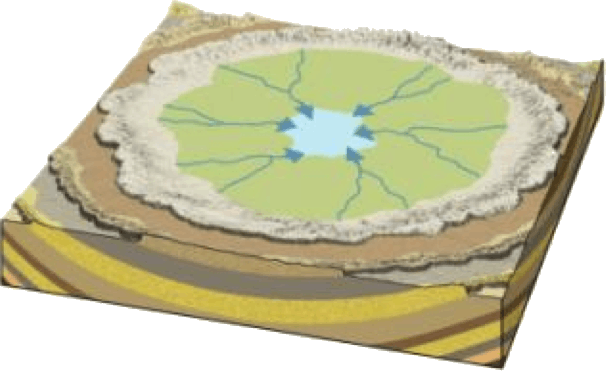
4. Centripetal: When the rivers discharge their waters from all directions in a lake or depression, the pattern is known as ‘centripetal’. This drainage pattern is also called endorheic drainage. For example, Loktak lake in Manipur.
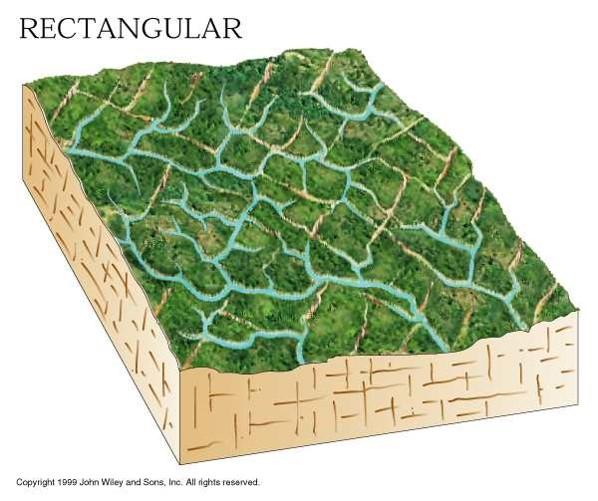
5. Rectangular: In this drainage, both the main stream and its tributaries show right-angled bends. A rectangular drainage pattern develops on a strongly jointed rocky terrain. It differs from trellis pattern drainage, since it is more irregular and its tributary streams are not as long or as parallel as in trellis drainage. Example: Colorado river (USA), streams found is the Vindhyan Mountains of India.
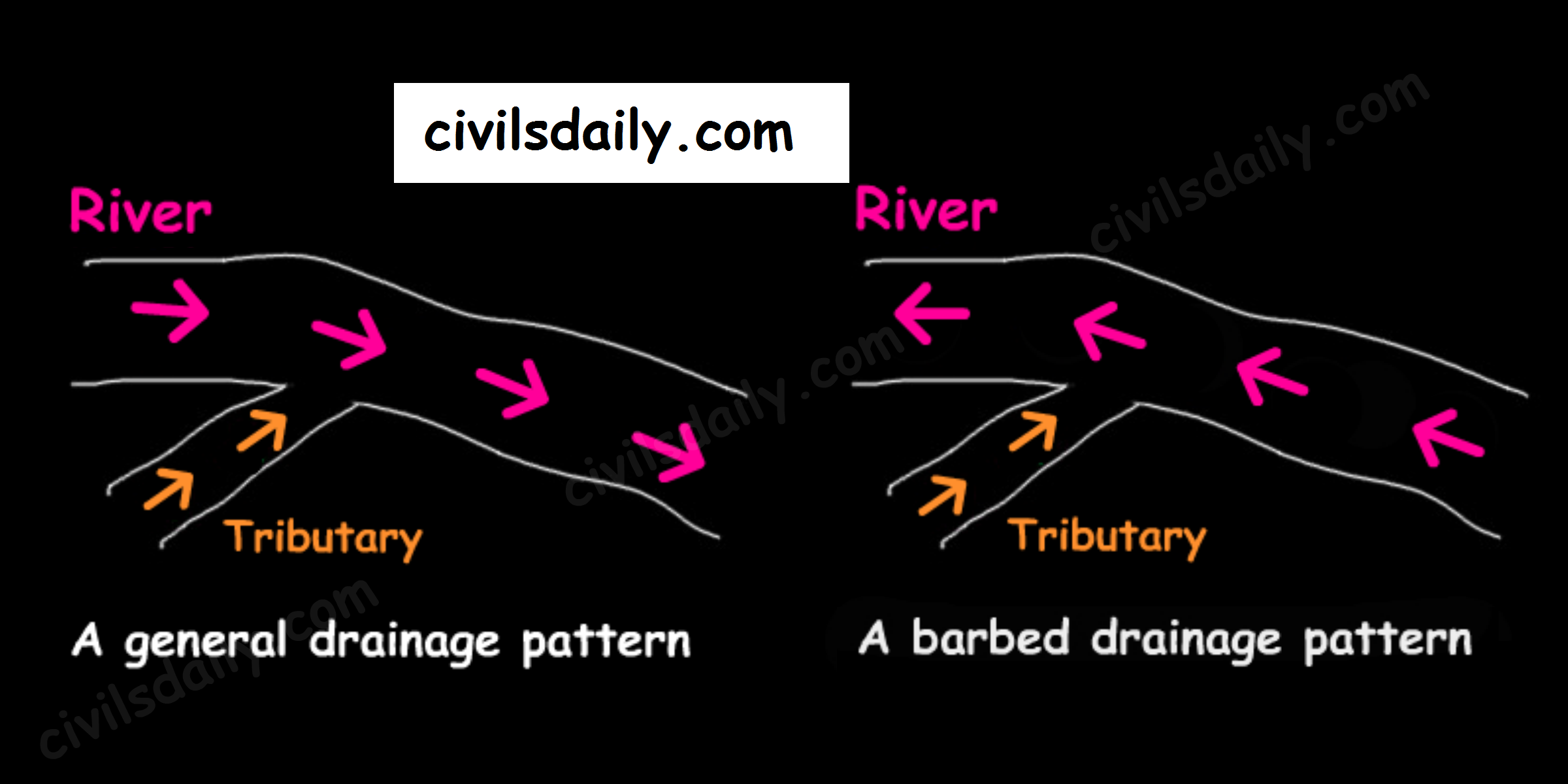
6. Barbed: If you look at the way that tributaries empty into larger rivers, you will notice that most of them flow in the same direction as the rivers they empty into. But quite a large number flow the other way. In fact, you will find stretches of some rivers where every tributary empties into the river in the “wrong” direction! Such an occurrence is known as a barbed drainage pattern.
Most barbed drainage patterns are the result of river-capture which reverses the direction of flow. However, the tributary channels continue to flow in their original direction.
The Arun River (Nepal), a tributary of the Kosi is an interesting example of barbed drainage pattern.
A Barbed Drainage Pattern
7. Annular: Annular pattern represents that part of a drainage pattern in which the subsequent streams follow the curving or arcuate courses before joining the consequent stream. These results from a partial adaptation to an underground circular structure i.e. batholiths. This is not a very common drainage pattern in India. Some examples of this are however found in Pithoragarh (Uttarakhand), Nilgiri Hills in Tamil Nadu and Kerala.
8. Parallel drainage: The drainage pattern in which the rivers flow almost parallel to each other is known as parallel drainage. The small and swift rivers originating in the Western Ghats and discharging their water into the Arabian Sea provide a good example of parallel drainage pattern in India.
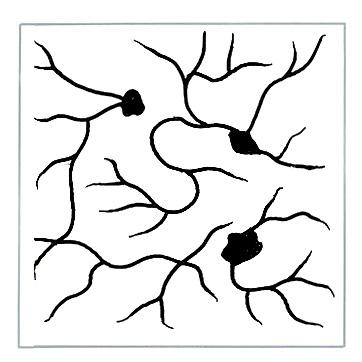
9. Deranged pattern: This is an uncoordinated pattern of drainage characteristic of a region recently vacated by an ice-sheet. The picture is one of numerous water courses, lakes and marshes; some inter-connected and some in local drainage basins of their own. This type of drainage is found in the glaciated valleys of Karakoram.
India’s four-year run of abundant summer monsoon rainfall is likely to end this year, with the India Meteorological Department (IMD) forecasting a 4% shortfall in the coming season.
The monsoon forecast for 2022 is still categorized as “normal” but at 96% of the long-period average (LPA), it is at the lowest end of the range.
El Nino, a cyclical phenomenon of warming in the central Pacific, is believed to be the key factor responsible for the below-normal forecast.
Factors affecting the forecast
El Nino: It has been linked to diminished rainfall in six out of 10 years in India, and 2022 is expected to see its development.
La Nina: It has been influencing the rainfall in India since 2019 and is expected to end this year.
Reduced snow cover in Eurasia: It can have a positive impact on the monsoon forecast, and this year’s snow cover in Eurasia was below normal.
Positive phase of the Indian Ocean Dipole (IOD):IOD could result in more moisture and rainfall over India during August and September, and therefore, have a reduced impact of the El Nino.
IMD’s dynamical monsoon forecast techniques: It involves the simulation of global atmospheric and ocean conditions to forecast climate conditions, which the IMD has started to rely on more heavily in recent years.
What is El Nino and La Nina?
El Nino and La Nina are two opposite phases of the El Nino-Southern Oscillation (ENSO) cycle.
ENSO is a naturally occurring phenomenon that involves the interaction between the ocean and atmosphere in the equatorial Pacific.
Here is a detailed comparison of El Nino and La Nina
El Nino
La Nina
Definition
Warmer-than-normal sea surface temperatures
Cooler-than-normal sea surface temperatures
Frequency
Every two to seven years
Every two to seven years
Duration
Several months to a year or more
Several months to a year or more
Impact on winds
Weakens trade winds, leading to changes in patterns
Strengthens trade winds, leading to changes in patterns
Impact on rains
Reduces rainfall and can cause droughts
Increases rainfall and can cause flooding
Impact on temp.
Warmer-than-average temperatures
Colder-than-average temperatures
Global effects
Droughts in Asia and Africa, floods in Americas
Floods in Asia and Africa, droughts in South America
Impacts on India
El Nino
La Nina
Associated with weak monsoons and drought-like conditions in India
Associated with above-normal rainfall and floods in India
Sea surface temperature in the equatorial Pacific Ocean rises above normal levels
Sea surface temperature in the equatorial Pacific Ocean drops below normal levels
Changes in the atmospheric circulation patterns
Changes in the atmospheric circulation patterns
Shift in the location of the jet stream, affecting the strength and direction of the monsoon winds
Increase in the strength of the monsoon winds, bringing more moisture and rainfall to India
Results in reduced rainfall, dry spells, and heatwaves, leading to crop failures and water scarcity
Excessive rainfall can also lead to floods and landslides, causing damage to crops and infrastructure
Back2Basics:Long Period Average (LPA) study of Monsoon
The IMD predicts a “normal”, “below normal”, or “above normal” monsoon in relation to a benchmark “long period average” (LPA).
The LPA of rainfall is the rainfall recorded over a particular region for a given interval (like month or season) average over a long period like 30 years, 50 years, etc.
LPA refers to the average rainfall recorded from June to September for the entire country, the amount of rain that falls every year varies from region to region and from month to month.
The IMD’s prediction of a normal monsoon is based on the LPA of the 1971-2020 period, during which India received 87 cm of rain for the entire country on average.
It has in the past calculated the LPA at 88 cm for the 1961-2010 period, and at 89 cm for the period 1951-2000.
Amul, the country’s largest dairy player, announced on April 5 that it would supply milk and curd through e-commerce portals in Bengaluru.
The announcement was met with opposition from Kannadigas, who saw it as an attempt to threaten the iconic Nandini milk brand of the Karnataka Milk Federation (KMF).
Political Controversy
The Amul vs. KMF row turned into a political tool in poll-bound Karnataka.
Dissenting sections expressed fears that Amul would eat into the market of Nandini and pose a threat to its business in the state.
The ruling government was accused of attempting to privatize the milk sector and “finish off” a home-grown product.
A quick backgrounder
Both Amul Dairy and KMF are successful examples of adopting the three-tiered ‘Anand’ model of dairy procurement.
Farmers supply milk to dairy cooperatives at the village level, which is then procured by milk unions at the district and state levels.
There are 16 district milk unions in Karnataka supplying milk to the dairy cooperatives.
KMF provides competitive prices to dairy farmers.
KMF corners most of the market share for surplus milk provided by farmers in the state.
Anand Model of Dairy Procurement
It is a system of milk collection and distribution pioneered by the Amul cooperative in Anand, Gujarat, India.
This model has revolutionized the dairy industry in India by providing a fair price to dairy farmers, eliminating the need for middlemen, and improving the quality of milk.
Under the Anand model, farmers are organized into dairy cooperatives, which collect and market their milk.
The cooperatives are managed by the farmers themselves and are supported by the infrastructure and marketing expertise of the Amul cooperative.
The farmers are paid a fair price for their milk, which is based on its quality and quantity, and they receive regular payments for their milk.
Why are people protesting?
Overpricing: The pricing difference between Amul’s toned milk and Nandini’s toned milk was highlighted, with Amul’s milk priced at ₹54 per litre and Nandini’s at ₹39 per litre.
Unhealthy competition: KMF’s online presence in the state could create unhealthy competition with Amul’s online presence, despite the pricing difference, according to the federation.
The turf war
The KMF is the second-largest milk cooperative in India after Amul.
While Amul and KMF compete in neutral regions like Mumbai, Nagpur, Goa, Hyderabad, and Chennai markets, they have not clashed on home turfs.
Karnataka is a milk-excess market that meets the needs of the state and exports surplus to other states.
KMF plans to write to the National Dairy Development Board, requesting it to direct Amul not to venture into the Bengaluru market and concentrate on milk-deficient states.
Clarification by Amul
Amul clarified that it was launching its fresh milk and curd only for a niche market through e-commerce channels and not through the mass market distribution network.