💥UPSC 2027,2028 Mentorship (April Batch) + Access XFactor Notes & Microthemes PDF

Search results for: “”

  • [29th April 2026] The Hindu OpED: The RTE Act and the idea of social inclusion 

    PYQ Relevance[UPSC 2022] The Right of Children to Free and Compulsory Education Act, 2009 remains inadequate in promoting incentive-based system for children’s education without generating awareness about the importance of schooling. Analyse.Linkage: The PYQ directly connects to Section 12(1)(c) by questioning effectiveness vs intent of RTE, especially in inclusion and awareness. The article strengthens this PYQ by showing that the issue is now implementation gaps (costs, compliance, access) rather than policy inadequacy.

    Mentor’s Comment

    The January 2026 judgment of the Supreme Court has reaffirmed the constitutional purpose of Section 12(1)(c) of the Right to Education Act, 2009. This comes at a time when declining enrolment in government schools and rising private schooling had triggered concerns about a silent shift toward privatization. The ruling is significant because it rejects the narrative that the provision dilutes public education and instead frames it as a tool for social integration, not welfare

    What is Section 12(1)(c) of the Right to Education (RTE) Act, 2009?

    It mandates that private unaided and special category schools reserve at least 25% of their entry-level seats (Class I or pre-school) for children from economically weaker sections (EWS) and disadvantaged groups. It ensures free, compulsory elementary education to these students, with states reimbursing schools for costs. 

    Key Details of Section 12(1)(c)

    1. Mandate: Private non-minority schools must reserve 25% of entry-level seats for EWS and disadvantaged group children, such as those from SC/ST, OBC, or with disabilities.
    2. Free Education: The provision covers tuition and fees until the completion of elementary education (typically up to Class 8).
    3. Reimbursement: State governments are responsible for reimbursing private schools for the fees of these students based on their actual cost or government school expenditure, whichever is lower.
    4. Purpose: The provision, often referred to as the “25% quota for weaker sections in private schools” or “RTE inclusion mandate,” seeks to promote social integration and equity, reducing the education gap between the privileged and underprivileged.
    5. Scope: This applies to Class I or pre-school, whichever is the entry point, and lasts throughout the elementary education cycle.

    Why is Section 12(1)(c) seen as a tool of social integration rather than welfare?

    1. Equality of Status: Ensures children from diverse socio-economic backgrounds study together, reducing social segregation.
    2. Shared Learning Spaces: Facilitates interaction across class lines; example, child of a judge studying with a street vendor’s child.
    3. Constitutional Morality: Operationalizes Article 14 and 21A of the Constitution of India through lived equality, not symbolic guarantees.
    4. Non-zero-sum Framework: Integrates public and private schooling systems instead of replacing one with the other.

    Does Section 12(1)(c) dilute the State’s responsibility towards public education?

    1. State Obligation: Retains primary duty to provide free and compulsory education.
    2. Complementary Role: Positions private schools as participants in achieving constitutional goals.
    3. Misplaced Criticism: Declining government school enrolment linked to infrastructure and teacher issues, not RTE
    4. Empirical Evidence: ASER 2006 highlights shift to private schools due to perceived quality gaps.

    What evidence exists on the ground regarding its impact?

    1. Scale of Reach: Over 5 million children benefited since rollout.
    2. Retention Rates: Maintains above 90% retention, indicating sustainability.
    3. Urban Normalisation: Cities like Delhi and Ahmedabad show blended classrooms as standard.
    4. Behavioural Outcomes: Research (Rao, Gautam, 2019) shows reduced discrimination and improved pro-social behaviour.
    5. Academic Neutrality: No negative impact on academic outcomes or classroom discipline observed.

    What are the key implementation challenges?

    1. Private School Resistance: Limits full inclusion and compliance.
    2. Hidden Costs: Uniforms, books, materials create barriers for poor families.
    3. Administrative Gaps: Weak grievance redressal and transparency mechanisms.
    4. Inter-state Variation: Uneven implementation across states.
    5. Awareness Deficit: Limited last-mile outreach reduces access for eligible families.

    What reforms have improved implementation outcomes?

    1. Digital Admissions: State-driven systems ensure transparent allocation (e.g., Rajasthan, Gujarat, Delhi).
    2. Reimbursement Systems: Streamlined financial flows to private schools improve compliance.
    3. Monitoring Mechanisms: Strengthens accountability and reduces discretion.
    4. Policy Clarity: Court judgment removes ambiguity about intent and scope.

    What is the way forward for effective realization?

    1. Cost Elimination: Removes hidden financial burdens on beneficiaries.
    2. Regulatory Enforcement: Strengthens compliance norms for private institutions.
    3. Institutional Accountability: Improves grievance redressal frameworks.
    4. Inclusive Norms: Ensures experiential equality, not just access.
    5. Administrative Focus: Shifts policy debate from ideology to execution.

    Conclusion

    The reaffirmation of Section 12(1)(c) marks a shift from ideological contestation to administrative responsibility. The core challenge lies in ensuring that access translates into meaningful inclusion, thereby fulfilling the constitutional promise of social integration.

  • UAE leaves OPEC and OPEC+ in huge blow to global oil producers’ group

    Why in the News?

    The United Arab Emirates’ decision to exit the Organization of the Petroleum Exporting Countries (OPEC) marks a significant rupture in the cohesion of one of the world’s most influential oil cartels. It is a major development because the UAE is OPEC’s third-largest producer, and its exit reflects growing internal dissent over production quotas. This move contrasts sharply with OPEC’s traditional unity in managing oil supply to influence global prices. The development gains further significance amid already constrained global oil supplies due to geopolitical tensions, including disruptions in the Strait of Hormuz.

    What is OPEC and OPEC plus?

    Organization of the Petroleum Exporting Countries (OPEC)

    1. Formation: Established in 1960 at Baghdad Conference by five founding members, Iran, Iraq, Kuwait, Saudi Arabia, Venezuela.
    2. Headquarters: Locates secretariat in Vienna, Austria.
    3. Membership: Includes 13 members (variable over time) such as Saudi Arabia, Iran, Iraq, Kuwait, UAE, Nigeria, Angola, Algeria, Libya, Congo, Gabon, Equatorial Guinea, Venezuela (Qatar exited in 2019; UAE exiting).
    4. Objective: Ensures coordination of petroleum policies to stabilize oil markets and secure fair prices for producers and reliable supply for consumers.
    5. Production Quotas: Allocates output limits to control global supply and influence prices.
    6. Market Share: Accounts for ~40% of global oil production and a higher share of proven reserves.

    OPEC+:

    1. Origin: Formed in 2016 in response to dropping oil prices and increased U.S. shale production.
    2. Composition: Includes the original OPEC members plus 10 non-OPEC nations, Azerbaijan, Bahrain, Brunei, Kazakhstan, Malaysia, Mexico, Oman, Russia, South Sudan, and Sudan.
    3. Role: Coordinates production cuts with the core OPEC group to manage the global oil market

    Why has the UAE exited OPEC, and what structural tensions does it reflect?

    1. Production Constraints: Indicates dissatisfaction with OPEC quotas limiting output despite expanded capacity; UAE capable of producing ~5 million barrels/day.
    2. Strategic Autonomy: Prioritizes national economic goals over cartel discipline; seeks flexibility to maximize exports.
    3. Internal Frictions: Reflects weakening cohesion after Qatar’s exit (2019) and tensions with Saudi Arabia over quotas.
    4. Energy Strategy Shift: Aligns with long-term diversification and gradual supply increases based on market demand.

    Reflected Structural Tensions:

    1. Saudi Arabia-UAE Rivalry: The departure highlights the growing rift between Riyadh and Abu Dhabi, undermining Saudi Arabia’s leadership within the cartel.
    2. Weakening of OPEC Influence: The loss of a major producer with significant spare capacity is a major blow to OPEC’s ability to manage global supply,. This signals a potential shift towards a more fragmented, less predictable oil market.
    3. Shift in Global Energy Alliances: The move aligns with the UAE building deeper economic ties with non-traditional partners and potentially improving ties with consumers like the US by increasing supply during market shortages. 

    How does UAE’s exit impact OPEC’s global influence and bargaining power?

    1. Reduced Market Share: Weakens OPEC’s control over supply; currently ~40% global output share.
      1. The departure removes approximately 15% of OPEC’s production capacity.
      2. For the broader OPEC+ alliance , the share is projected to fall from 50% to 45%
    2. Depletion of Spare Capacity: The UAE was one of the few members, alongside Saudi Arabia, with significant spare production capacity; the primary tool for responding to supply shocks.
    3. Downward Price Pressure: Free from quotas, the UAE can eventually add up to 1.6 million barrels per day (mb/d) back to the market once shipping through the Strait of Hormuz  stabilizes.
    4. Declining Coordination: Reduces ability to collectively stabilize prices.
    5. Cartel Fragmentation: Signals erosion of unity, reducing effectiveness of production agreements.

    What geopolitical and economic factors shape this development?

    1. Regional Politics: Reflects strained UAE-Saudi relations on economic and political issues particularly over differing agendas in the Yemen civil war.
    2. Iran Conflict Impact: War disruptions led to closure of Strait of Hormuz, affecting ~20% of global oil trade.
      1. Following the outbreak of war in early 2026, the UAE has been a major target of Iranian drone and missile strikes. 
      2. Abu Dhabi criticized fellow Arab states for a “weak” political and military response, making continued membership in a OPEC alongside Iran politically untenable.
    3. Distancing from Russia (OPEC+): The UAE has grown wary of the OPEC+ alliance, noting that Russia has remained a “steadfast partner” for Iran during the conflict.
      1. Exiting allows the UAE to distance itself from Moscow’s influence and strengthen ties with the U.S
    4. US Production Rise: U.S. output exceeds 13 million barrels/day, reducing reliance on OPEC.
    5. Monetizing Spare Capacity: The UAE has invested billions to reach a production capacity of over 5 million barrels per day.
      1. The National leadership wants to sell this oil now, before global demand peaks, to fund its Vision 2030 diversification into technology, tourism, and renewables.

    What are the implications for global oil markets and prices?

    1. Price Volatility: Reduces coordinated supply management, increasing fluctuations.
    2. Supply Expansion: UAE may increase independent production, adding to global supply.
    3. Market Uncertainty: Weakens predictability of production decisions.
    4. Short-term Stability: Limited immediate impact due to already tight supply conditions.

    What are the implications for India’s energy security and economy?

    1. Import Dependence: India imports ~85% of its crude oil; changes in OPEC dynamics directly affect supply security.
    2. Price Volatility Risk: Increased oil price fluctuations impact inflation, fiscal deficit, and current account deficit.
    3. Diversification Opportunity: Weakening OPEC control enables India to diversify suppliers and negotiate better terms.
    4. Strategic Reserves Use: Necessitates stronger use of Strategic Petroleum Reserves (SPR) during volatility.
    5. Energy Transition Push: Reinforces urgency for renewables and alternative energy to reduce import dependence.
    6. Diplomatic Leverage: Enhances India’s engagement with multiple producers beyond OPEC bloc.

    Does this signal a broader transformation in global energy governance?

    1. Resource Nationalism: Countries prioritize domestic economic gains over collective frameworks.
    2. Decline of Cartels: Traditional supply-control mechanisms lose effectiveness.
    3. Multipolar Energy Order: Influence spreads across US, OPEC, Russia, and emerging producers.
    4. Energy Transition Pressure: Long-term shift toward renewables reshapes oil strategies.

    Conclusion

    The UAE’s exit reflects structural changes in global oil governance, weakening cartel cohesion and reinforcing a shift toward decentralized, nationalistic energy strategies with direct implications for energy-importing countries like India.

    PYQ Relevance

    [UPSC 2023] ‘Virus of Conflict is affecting the functioning of the SCO’. In the light of the above statement point out the role of India in mitigating problems. 

    Linkage: The PYQ highlights challenges within international groupings due to internal conflicts and divergent national interests, similar to fragmentation within OPEC. UAE’s exit reflects weakening multilateral cohesion, reinforcing the need to analyze stability, effectiveness, and India’s strategic positioning in global groupings.

  • A recusal test the Delhi High Court failed

    Why in the News?

    A judge of the Delhi High Court refused to recuse herself from hearing the Delhi excise policy case, officially titled Central Bureau of Investigation (CBI) v. Kuldeep Singh and Ors. involving prominent political figures. This is despite allegations of bias raised by the litigant. This marks a departure from established judicial conventions, where even a reasonable apprehension of bias often leads to recusal to preserve institutional trust. The episode is significant because it highlights a tension between the “duty to sit” and the need to ensure fairness, especially in politically sensitive litigation. 

    What is judicial recusal in India?

    1. In India, judicial recusal is the act of a judge stepping away from a case to prevent any real or perceived conflict of interest or bias.
    2. It is rooted in the principles of Natural Justice, specifically the maxim Nemo judex in causa sua, no person should be a judge in their own cause.

    How Recusal Works in India

    1. Uncodified Practice: Unlike some other countries, India has no codified law or statute governing recusal. Instead, it is guided by judicial precedents, ethical norms, and the judge’s oath of office.
    2. Voluntary Process: Recusal is generally a voluntary action taken by the judge based on their own conscience and discretion.
    3. Request by Parties: While a litigant or lawyer can request a recusal, they cannot compel a judge to withdraw; the final decision rests solely with the judge concerned.
    4. Reassignment: If a judge recuses, the case is referred to the Chief Justice (the “Master of the Roster”) to be assigned to a different bench.

    What constitutes judicial recusal and why is it critical to justice delivery?

    1. Judicial Impartiality: Ensures fairness in adjudication by eliminating bias; rooted in natural justice principle nemo judex in causa sua (no one should be judge in their own cause).
    2. Public Confidence: Strengthens legitimacy of courts; justice must not only be done but also seen to be done (R v Sussex Justices, 1923).
    3. Ethical Standards: Aligns with Bangalore Principles of Judicial Conduct emphasizing integrity, propriety, and independence.
    4. Global Practice: Reflects best practices across jurisdictions, including rejection of Victorian-era “duty to sit” doctrine.

    What were the grounds for seeking recusal in the present case?

    1. Prior Adverse Findings: Judge had earlier ruled on related matters, raising concerns of predisposition.
    2. Ideological Association: Attendance at events linked to a particular ideological group (ABAP).
    3. Familial Professional Links: Judge’s children working as panel lawyers for the government.
    4. Political Context: Statement by a Union Minister predicting case outcome heightened apprehension.
    5. Reasonable Apprehension: Litigant argued that these factors cumulatively undermine impartial adjudication.

    How has the Supreme Court defined the legal threshold for recusal?

    1. Reasonable Apprehension Test: Establishes whether a fair-minded observer would suspect bias (P.K. Ghosh case, 1995).
    2. Litigant’s Perception: Recognizes that perception of bias matters, not just actual bias (Ranjit Thakur case, 1987).
    3. Appearance vs Reality: Accepts that even appearance of bias can vitiate proceedings (State of Punjab v Davinder Pal Singh Bhullar, 2011).
    4. Judicial Discretion: Leaves decision to judge’s conscience; no statutory compulsion exists.
    5. Rejection of Duty to Sit: Moves away from obligation to hear all cases (Indore Development Authority case, 2019).
    6. Prevention of “Bench Hunting”: Courts often warn against frivolous recusal pleas used by litigants as a strategy for “forum shopping “, attempting to avoid a specific judge in hopes of getting a more favourable one.

    Why is the present decision considered a deviation from established norms?

    1. Denial of Recusal: Refusal despite multiple grounds contradicts trend favoring caution.
    2. Self-Adjudication: Judge decided on her own alleged bias, raising procedural concerns.
    3. Shift to Actual Bias: Judgment emphasized need to prove actual bias rather than reasonable apprehension.
    4. Dismissal of Concerns: Characterized allegations as unfounded, limiting scope of litigant perception.
    5. Institutional Risk: Weakens the principle that perception of fairness is central to justice.

    What are the broader implications for judicial accountability and fairness?

    1. Erosion of Trust: Reduces confidence in neutrality of judiciary in politically sensitive cases.
    2. Lack of Codification: Absence of clear rules leads to inconsistent application.
    3. Procedural Gaps: No independent mechanism to decide recusal requests.
    4. Politicization Risk: Heightens perception of the judiciary being influenced by external factors.
    5. Legal Vulnerability: Judgments may face challenges due to procedural impropriety.

    What reforms are required to strengthen recusal jurisprudence in India?

    1. Codified Framework: Establishes clear statutory guidelines for recusal standards.
    2. Independent Review: Introduces mechanism where recusal pleas are decided by another bench.
    3. Objective Criteria: Defines conflict of interest, prior involvement, and relational bias thresholds.
    4. Transparency Measures: Ensures reasoned orders in recusal decisions.
    5. Judicial Training: Strengthens ethical awareness regarding perceived bias.

    Conclusion

    The episode underscores the need to reconcile judicial discretion with institutional accountability. Strengthening recusal norms through codification and procedural safeguards is essential to preserve judicial credibility and constitutional morality.

    PYQ Relevance

    [UPSC 2023] Constitutionally guaranteed judicial independence is a prerequisite of democracy. Comment.

    Linkage: Judicial recusal directly operationalizes judicial independence by preventing bias and ensuring impartial adjudication. The Delhi High Court episode highlights how weak recusal standards can undermine public trust, thereby affecting the democratic legitimacy of the judiciary.

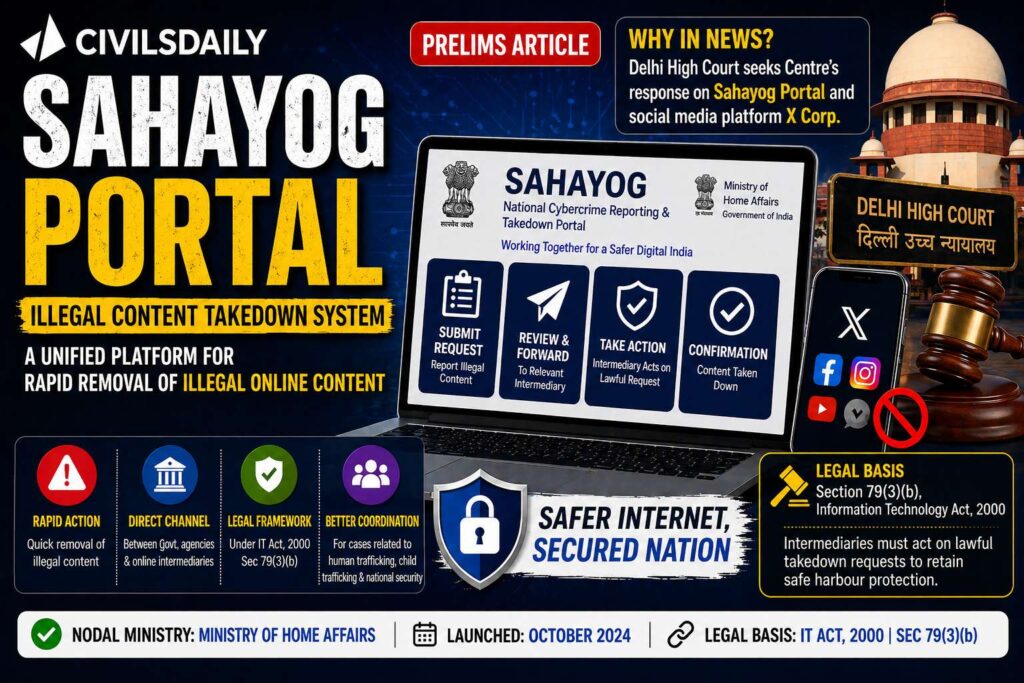
  • Sahayog Portal

    Why in the News

    The Delhi High Court has asked the Union government to clarify whether social media platform X Corp. must participate in the Sahayog Portal for cases related to human trafficking, child trafficking, and national security.

    About Sahayog Portal

    • Launched in October 2024
    • An online platform to enable rapid removal of illegal content from the internet
    • Facilitates direct communication between government agencies and online intermediaries
    • Nodal Ministry: Ministry of Home Affairs

    Legal Basis

    • Operates under Section 79(3)(b) of the Information Technology Act, 2000
    • Ensures intermediaries act on lawful takedown requests
    • Maintains safe harbour protection if due diligence is followed
    [2017] In India, it is legally mandatory for which of the following to report on cyber security incidents?
    1 Service providers 
    2 Data Centres 
    3 Body corporate 
    Select the correct answer using the code given below: 
    (a) 1 only (b) 2 only (c) 1 and 2 only (d) 1, 2 and 3
  • Barbary Macaque

    Why in the News

    Scientists studying the Barbary Macaque population in Gibraltar have observed geophagy (soil eating) behavior. This is believed to help them counter the harmful effects of tourist provided junk food.

    About Barbary Macaque

    • One of the 25 species of macaques worldwide
    • The only macaque species found outside Asia
    • The only non human primate in Europe and North Africa

    Distribution

    • Native range:
      • Atlas Mountains in Algeria and Morocco
    • Introduced population: Gibraltar
    • IUCN Red List: Endangered
    [2013] In which of the following states is lion-tailed macaque found in its natural habitat? 
    1 Tamil Nadu
    2 Kerala 
    3 Karnataka 
    4 Andhra Pradesh 
    Select the correct answer using the codes given below: 
    (a) 1, 2 and 3 only (b) 2 only (c) 1, 3 and 4 only (d) 1, 2, 3 and 4
  • Cyborg Botany

    Why in the News

    Recent research across global institutions is advancing the field of Cyborg Botany, where scientists are transforming plants into living electronic systems capable of sensing and transmitting data.

    What is Cyborg Botany

    • A hybrid system integrating living plants with electronic components
    • Combines:
      • Biology
      • Materials Science
      • Engineering
    • Derived from the term “cyborg” (cybernetic organism)
    • Aim: Merge natural plant processes with artificial electronic functions

    How it Works

    Embedding Nanowires and Transistors

    • Inserted into plant cell walls
    • Act as biosensors
    • Detect biochemical changes in real time

    Conductive Polymers (Living Wires)

    • Example: PEDOT (Poly 3,4 ethylenedioxythiophene)
    • Functions as electrical pathways inside plant tissues
    • Transmits signals from plant cells to external devices

    Key Concept

    • Biosensor: A device that uses biological material to detect changes and produce signals

    Types of Plant Stress (Important for Prelims)

    • Biotic Stress
      • Caused by living organisms
      • Example: pests, diseases
    • Abiotic Stress
      • Caused by environmental factors
      • Example: drought, temperature extremes

    Significance

    • Enables early detection of crop stress before visible symptoms
    • Helps in precision agriculture
    • Reduces water and chemical usage
    • Improves crop productivity and sustainability
    • Supports climate resilient agriculture
    [2020] With reference to carbon nanotubes, consider the following statements: 
    1 They can be used as carriers of drugs and antigens in the human body. 
    2 They can be made into artificial blood capillaries for an injured part of human body. 
    3 They can be used in biochemical sensors. 
    4 Carbon nanotubes are biodegradable. 
    Select the correct answer using the code given below: 
    (a) 1 and 2 only (b) 2, 3 and 4 only (c) 1, 3 and 4 only (d) 1, 2, 3 and 4
  • Industrial Output Growth Hits 5 Month Low 

    Why in the News

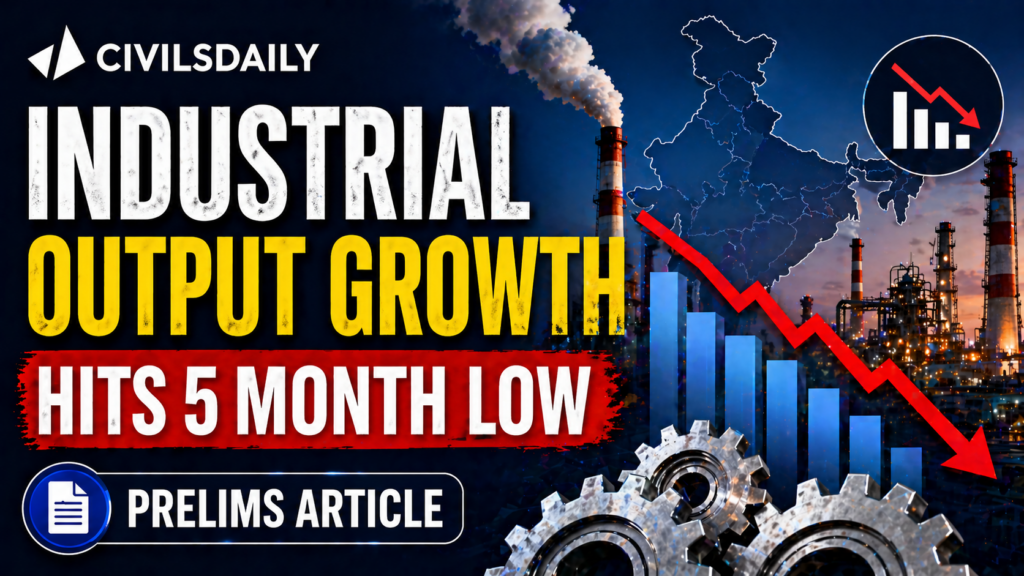
    India’s Industrial Output Growth, measured by the Index of Industrial Production (IIP), slowed to 4.1 percent in March 2026, marking a five month low. The slowdown is linked to weak performance in construction and consumer sectors and the emerging impact of the West Asia crisis.

    What is Index of Industrial Production (IIP)?

    • A composite indicator measuring short term changes in industrial output
    • Released by the Ministry of Statistics and Programme Implementation
    • Base year: 2011 to 12
    • Published monthly

    Components of IIP

    • Primary Goods
    • Capital Goods
    • Intermediate Goods
    • Infrastructure and Construction Goods
    • Consumer Durables
    • Consumer Non Durables

    Key Highlights from Data

    • IIP Growth (March 2026): 4.1 percent
    • Manufacturing Growth: 4.3 percent
    • Capital Goods Growth: 14.6 percent (29 month high)
    • Infrastructure and Construction: 6.7 percent (slowed)
    • Consumer Non Durables: 1.1 percent (weak demand)
    • Core Sector Growth: -0.4 percent (contraction)

    About Core Industries

    • Eight core sectors account for about 40 percent of IIP
    • Includes: Coal, Crude Oil, Natural Gas, Refinery Products, Fertilizers, Steel, Cement, and Electricity.
    [2015] In the ‘Index of Eight Core Industries’, which one of the following is given the highest weight? 
    (a) Coal Production 
    (b) Electricity generation 
    (c) Fertilizer production 
    (d) Steel production
  • UAE Exit from OPEC 

    Why in the News

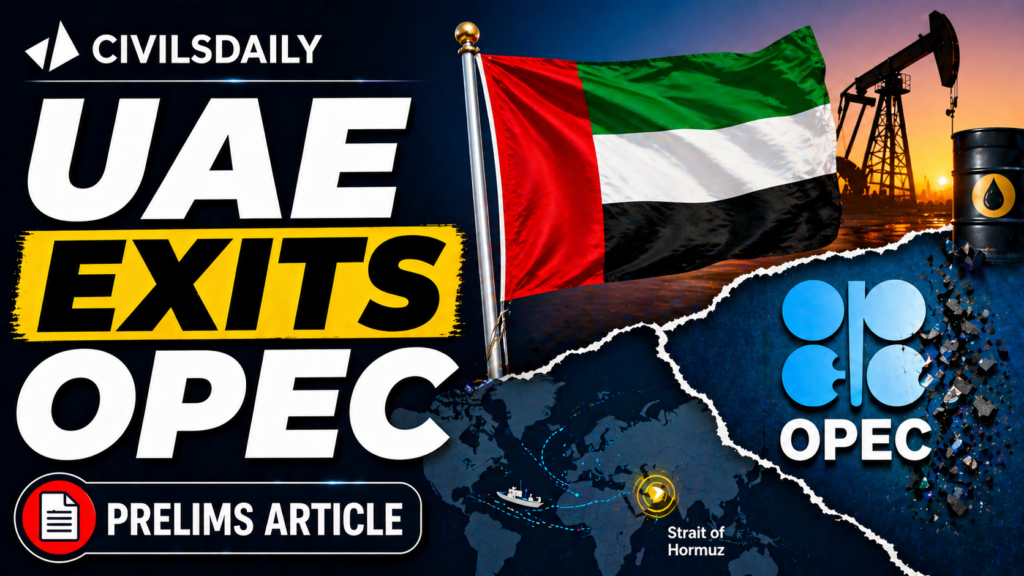
    The United Arab Emirates has announced its decision to exit the Organization of the Petroleum Exporting Countries effective May 1, 2026. The move is significant as the UAE is one of the major oil producers, and its exit is expected to weaken the cartel’s influence over global oil prices.

    About OPEC

    • Established in 1960
    • Headquarters: Vienna, Austria
    • Objective:
      • Coordinate petroleum policies among member countries
      • Stabilize oil markets
      • Ensure fair prices for producers and steady supply
    • As of May 1, 2026, the Organization of the Petroleum Exporting Countries (OPEC) consists of 11 members following the exit of the United Arab Emirates (UAE).
      • The remaining member countries are Algeria, Congo, Equatorial Guinea, Gabon, Iran, Iraq, Kuwait, Libya, Nigeria, Saudi Arabia, and Venezuela
    • Non-OPEC “Plus” Members (10): Azerbaijan, Bahrain, Brunei, Kazakhstan, Malaysia, Mexico, Oman, Russia, South Sudan, and Sudan.

    Key Facts About the UAE’s Exit

    • UAE was the third largest producer in OPEC
    • Producing around 3.4 million barrels per day
    • Production capacity up to 5 million barrels per day
    • Also exiting OPEC+ grouping
    • Joined OPEC in 1967 (via Abu Dhabi)

    Reasons for Exit

    • Disagreement over production quotas
    • UAE wants to increase oil output after heavy investments
    • Strategic economic shift toward maximizing energy exports
    • Geopolitical tensions with Saudi Arabia
    • Weakening cohesion within OPEC (example: Qatar exited in 2019)

    Global Context

    • Ongoing conflict involving Iran has impacted oil supply
    • Closure of the Strait of Hormuz affects global oil transport
    • Brent crude prices above 111 dollars per barrel
    • United States now produces more oil than any OPEC country

    Impact of UAE Exit

    • Reduces OPEC’s spare production capacity
    • Weakens cartel’s ability to control oil prices
    • May lead to greater market volatility
    • Strengthens non-OPEC producers’ influence

    Significance for India

    • India is a major oil importer
    • Changes in oil prices affect:
      • Inflation
      • Fiscal deficit
      • Energy security
    [2009] Other than Venezuela, which one among the following from South America is a member of OPEC? 
    (a) Argentina 
    (b) Brazil 
    (c) Ecuador 
    (d) Bolivia
  • 🔴[UPSC Webinar for 2027] By Rohin Kumar, AIR 39, UPSC CSE 25 | Solve PYQs the Right Way for UPSC Prelims 2026 | Join on 29th April at 7PM

    🔴[UPSC Webinar for 2027] By Rohin Kumar, AIR 39, UPSC CSE 25 | Solve PYQs the Right Way for UPSC Prelims 2026 | Join on 29th April at 7PM

    Register for the session


    Read about Webinar


    Solving PYQs but not seeing improvement in your Prelims score?

    You’re not alone.

    Most aspirants solve PYQs…
    but very few analyse them the right way.

    Learn from me how PYQs can become your strongest tool to crack Prelims.

    Rohin Kumar, AIR 39, UPSC CSE 25

    What I’ll cover in this session:

    1. Why Most Aspirants Misuse PYQs

    • Treating PYQs as practice, not as strategy
    • Solving without identifying patterns
    • Ignoring the “why” behind correct answers

    PYQs are not just questions.
    They are the blueprint of the exam.


    2. The Right Approach to PYQs

    • How to decode the examiner’s mindset
    • Identifying recurring themes and concepts
    • Understanding how questions are framed

    This is where clarity replaces guesswork.


    3. Using PYQs to Improve Accuracy

    • Eliminating wrong options effectively
    • Learning intelligent guessing techniques
    • Reducing negative marking

    Prelims is not just knowledge, it’s decision making.


    4. PYQs + Current Affairs Linkage

    • How to connect PYQs with static subjects
    • Identifying current affairs patterns
    • Building relevance based preparation

    This is how toppers stay ahead.


    5. Turning PYQs into a Daily System

    • How to revise PYQs smartly
    • Integrating PYQs into your daily schedule
    • Building consistency in preparation

    Consistency creates results.


    Who should attend:

    1. Aspirants preparing for UPSC Prelims 2026

    2. Those stuck despite solving PYQs regularly

    3. Candidates looking to improve accuracy and score

    Join us, for a 45 minute live Zoom session on 29th April at 7PM.

    See you in masterclass.


    It will be a 45 minute session, post which we will open up the floor for all kinds of queries which a beginner must have. No questions are taboo and Rohin sir is known to be patiently solving all your doubts.

    Join us for a Zoom session on 29th April at 7 PM. This session is a must attend for you If you are attempting UPSC for the first time or have attempted earlier and now preparing for 2027, then it is going to be a valuable session for you too.

    See you in the session”

    Register for the session for a complete in-depth UPSC Prep


    In this Civilsdaily masterclass, you will get:

    1. A 45-minute deep dive on how to plan your UPSC strategy from the start to the end.
    2. How do first-attempt IAS Rankers get the most out of their one year prep?
    3. Insider tips that only the top IAS and IPS rankers know and apply to get rank.

    By the end, you’ll have razor-sharp clarity and a clear path to crack UPSC with confidence and near-perfect certainty. 

    Join UPSC session on 29th April, at 7 PM

    (Don’t wait—the next webinar/session won’t be until End April’ 26)


    These masterclasses are packed with value. They are conducted in private with a closed community. We rarely open these webinars for everyone for free. This time we are keeping it for 300 seats only.

    Ready to attend the UPSC Webinar?


    Not sure yet?

    We recommend you register here. It takes less than 10 seconds to register.

    • No spam! Once in a while, we’ll only send you high-quality exam-related content. 
    • We will inform you about the upcoming Masterclasses that might benefit you.
    • You can demand one free mentorship call from verified Civilsdaily mentors. 
    • You can always choose to unsubscribe. 
  • [28th April 2026] The Hindu OpED: Electoral roll purges raise constitutional questions

    PYQ Relevance[UPSC 2020] Discuss the role of the Election Commission of India in the light of the evolution of the Model Code of Conduct.
    Linkage: The question examines the scope and limits of ECI’s powers in ensuring free and fair elections. The article highlights concerns of constitutional overreach by ECI in voter roll purges, directly questioning its mandate and procedural fairness.

    Mentor’s Comment

    The issue of electoral roll purges has emerged as a major constitutional concern following the Election Commission of India’s (ECI) Special Intensive Revision (SIR) in states like Assam, Kerala, Tamil Nadu, West Bengal, and Puducherry. What makes this significant is the scale and nature of voter deletion. There are reports of lakhs of genuine voters being removed, including 91 lakh in West Bengal and 64 lakh in Bihar, many categorized under the vague term “logical discrepancy.” This marks a sharp deviation from past practices where revisions were limited, transparent, and conducted well before elections.

    Does the ECI have the constitutional authority to determine citizenship?

    1. Article 324 Limitation: Empowers ECI to conduct elections, not determine citizenship; this power lies with the Union government.
    2. Home Ministry Mandate: Citizenship laws are administered by the Union Home Ministry, which must notify valid documents.
    3. Jurisdictional Overreach: ECI prescribing documents for citizenship proof exceeds its constitutional scope.
    4. Judicial Gap: Supreme Court did not decisively address this separation of powers issue.

    Why is the Special Intensive Revision (SIR) being criticised?

    1. Procedural Deviation: Conducted in election-bound states, violating norms of pre-election summary revisions.
    2. Intensive Nature: SIR requires fresh enumeration instead of updating existing rolls, making it disruptive.
    3. Time Constraints: Conducted within months before elections, compromising thorough verification.
    4. Past Practice Contrast: Earlier revisions were gradual and inclusive; SIR appears abrupt and exclusionary.

    How does the documentation requirement affect voter inclusion?

    1. Document Exclusion: Aadhaar, ration card, voter ID not accepted as proof of citizenship.
    2. Access Barriers: Rural and poor populations lack archival documents; creates systemic exclusion.
    3. Mass Deletions: Example: 91 lakh voters removed in West Bengal due to inability to produce documents.
    4. Administrative Burden: Citizens forced into repeated verification cycles.

    Does the categorisation of “logical discrepancy” violate legal norms?

    1. Undefined Term: No legal basis under Representation of the People Act or Registration of Electors Rules.
    2. Arbitrary Classification: Allows subjective deletion without clear criteria.
    3. Transparency Deficit: Lack of publicly defined parameters reduces accountability.
    4. Impact on Rights: Leads to disenfranchisement without due process.

    Are principles of natural justice being violated?

    1. Denial of Hearing: Deletions reportedly carried out without prior notice or opportunity to respond.
    2. Statutory Violation: Contravenes provisions ensuring verification and objections.
    3. Electoral Fairness: Free and fair elections compromised when voters are excluded arbitrarily.
    4. Judicial Concern: Courts expected to safeguard procedural fairness.

    How does this impact democratic representation?

    1. Mass Exclusion: Large-scale deletions distort electoral outcomes.
    2. Voter Suppression Risk: Marginalized groups disproportionately affected.
    3. Trust Deficit: Reduces confidence in electoral institutions.
    4. Systemic Bias Potential: Selective deletion may influence political outcomes.

    Conclusion

    The electoral roll revision controversy highlights the tension between administrative efficiency and constitutional safeguards. Ensuring inclusion, transparency, and legal compliance remains essential to uphold democratic legitimacy.

More posts