The recent collapse of under-construction bridges in Bihar highlights ongoing quality control challengesin India’s infrastructure sector, despite efforts like PM Gati Shakti and increased capital expenditure in 2024.
Issues of Quality Control and Project Implementation in Infrastructure in India
Quality Control Deficiencies: There are significant gaps in the quality control mechanisms for infrastructure projects. Many projects lack a robust system for monitoring and ensuring quality at every stage, from planning to execution. The absence of comprehensive quality assurance frameworks as evidenced by recent bridge collapses in Bihar.
Need for Modern Project Management Practices: Traditional project management practices are often outdated and ineffective in addressing the complexities of modern infrastructure projects.
Internal Challenges in India’s Infrastructure Sector:
Project Delays and Cost Overruns: Infrastructure projects frequently experience delays and cost overruns, with a report indicating that 431 projects faced a total cost overrun of ₹4.82 lakh crore.
Lack of Comprehensive Planning: Many infrastructure projects, especially in urban areas, suffer from poor planning and project management, with urban local bodies and local self-governments lacking the necessary capacity and expertise.
Multiple Clearances and Bureaucratic Delays: Industrial and commercial activities often require numerous clearances, leading to delays in project conception and commissioning.
Funding and Resource Misallocation: Delayed and poorly managed projects crowd out funding for other essential projects, burdening the government with extra expenditures and increasing procurement costs.
Need to Integrate Modern Tools and Techniques: (Way forward)
Real-time Data Management: Traditional project management methods need an overhaul to incorporate modern tools like real-time data collection and analysis, which can help track progress and make timely interventions.
Global Best Practices in Project Management: The government must adopt international best practices, like the UK’s Infrastructure and Projects Authority model, which emphasizes efficient project delivery.
Program Management Approach: A holistic approach to managing multiple projects systematically, integrating resources, time, and information efficiently, as seen in successful projects like the Shendra-Bidkin industrial corridor.
GIS-Based Platforms: Initiatives like PM Gati Shakti demonstrate the integration of GIS-based platforms for real-time monitoring, enabling better coordination among various stakeholders to meet deadlines and enhance project quality.
Concerns about Prime Minister Modi’s visit to CJI Chandrachud’s residence for the Ganapati puja stem from the 1997 ‘Restatement of Values of Judicial Life’ guidelines on judicial conduct.
What does the ‘Restatement of values of judicial life’ state?
Itis a 16-point code of conduct adopted by the Supreme Court of India in May 1997 to guide the ethical behaviour of judges of the Supreme Court and High Courts.
Impartiality and Credibility: The first tenet emphasizes that judges’ behaviour must reinforce public faith in the judiciary’s impartiality. Any actions that could undermine this perception should be avoided.
Aloofness: Judges are advised to maintain a degree of aloofness that is consistent with the dignity of their office, ensuring they do not engage in relationships that could compromise their neutrality.
Public Awareness: Judges must be conscious of their public image and avoid any conduct seen as unbecoming of their high office.
Political Neutrality: Judges should remain politically neutral and avoid public discussions on political matters or cases pending judicial determination.
Avoiding Conflicts of Interest: Judges must not allow family members of the Bar to appear before them, nor should they engage in speculative financial activities or accept gifts beyond those from close friends and family.
Public Trust: The document underscores the importance of maintaining public trust through ethical conduct and discourages close associations with advocates practising in the same court.
Types of Integrity
Integrity in the judicial context can be categorized into several types:
Personal Integrity: This relates to the character and ethical standards of individual judges, emphasizing honesty and adherence to moral principles.
Institutional Integrity: This refers to the judiciary as a whole, ensuring that the institution operates independently and maintains public confidence.
Procedural Integrity: This involves the adherence to legal processes and standards that uphold justice, ensuring that all actions taken by judges are fair and transparent.
Significance of Maintaining Integrity and Public Confidence through Probity
Trust in the Judiciary: Upholding integrity is crucial for maintaining public confidence in the judiciary, as it reassures citizens that justice is administered fairly and without bias.
Separation of Powers: The judiciary’s integrity is essential for maintaining the constitutional balance between the judiciary and the executive. Any perceived compromise can lead to public skepticism about the independence of judicial decisions.
Ethical Standards: The Restatement serves as a guide for judges to navigate their professional responsibilities while adhering to ethical standards, which is vital for the credibility of the judicial system.
Public Perception: Actions that appear to blur the lines between the judiciary and executive can lead to gossip and speculation, undermining the institution’s integrity. Judges must be mindful of their public image to prevent any erosion of trust.
Way forward:
Strengthen Judicial Training: Implement continuous ethical training for judges, emphasizing the importance of maintaining impartiality, political neutrality, and avoiding conflicts of interest to uphold public confidence.
Establish Oversight Mechanisms: Create robust internal oversight frameworks to monitor and address potential breaches of judicial integrity, ensuring transparency and accountability in judicial conduct.
The Centre has recently approved transferring 256 acres of Mumbai’s salt pan land to DRPPL, a joint venture with Adani Realty, for constructing rental housing for slum residents.
What are Salt Pan Lands?
Salt pan lands are low-lying areas where seawater is allowed to flow in and evaporate, leaving behind salt and other minerals.
These lands are part of an important ecological system that, along with mangroves, helps in flood control by absorbing excess water during heavy rainfall and high tides.
Why are Mumbai’s Salt Pan Lands at Risk?
Development Pressures: Salt pans are valuable as undeveloped land in Mumbai, leading to proposals for various development projects, including affordable housing and infrastructure.
Government Plans: Recent approvals, such as the transfer of 256 acres of salt pan land for the Dharavi Redevelopment Project, have faced criticism due to concerns that such development will encroach on these ecologically sensitive areas.
Legal and Administrative Challenges: Past plans for using saltpan lands for development have been put on hold or altered due to legal and environmental challenges, including those concerning the Coastal Regulation Zone (CRZ) norms.
Why do Salt Pans Matter?
Flood Prevention: Salt pans play a crucial role in preventing flooding in Mumbai’s eastern suburbs by acting as natural reservoirs for excess water during heavy rains and high tides.
During significant rainfall events, such as the July 2005 deluge, salt pans helped mitigate the impact of flooding, emphasizing their importance in urban flood management.
Environmental Protection: They support local biodiversity, including various species of birds and insects. Destroying or altering these lands could disrupt these ecosystems.
Climate Resilience: Salt pans contribute to the city’s climate resilience strategy, making their preservation crucial for managing future climate-related challenges.
National Context:
Across India, approximately 60,000 acres are designated as salt pan lands, distributed among states like Andhra Pradesh, Tamil Nadu, and Maharashtra.
These lands are crucial for local ecosystems and flood management, highlighting the broader importance of preserving such areas from development pressures.
Way Forward:
Strengthen Environmental Regulations: Enhance the enforcement of Coastal Regulation Zone (CRZ) norms and other environmental regulations to safeguard salt pan lands.
Promote Sustainable Land Use Planning: Integrate salt pan lands into urban planning strategies as critical components of flood management and biodiversity conservation.
Q National Human Rights Commission (NHRC) in India can be most effective when its tasks are adequately supported by other mechanisms that ensure the accountability of a government. In light of above observation assess the role of NHRC as an effective complement to the judiciary and other institutions in promoting and protecting human rights standards. (UPSC CSE 2014)
Q The multiplicity of various commissions for the vulnerable sections of the society leads to problems of overlapping jurisdiction and duplication of functions. Is it better to merge all commissions into an umbrella Human Rights Commission? Argue your case. (UPSC CSE 2018)
Prelims: In India, Legal Services Authorities provide free legal services to which of the following type of citizens? 1. Person with an annual income of less than Rs. 1,00,000 2. Transgender with an annual income of less than Rs. 2,00,000 3. Member of Other Backward Classes (OBC) with an annual income of less than Rs. 3,00,000 Select the correct answer using the code given below: (a) 1 and 2 only (b) 3 and 4 only (c) 2 and 3 only (d) 1 and 4 only
Mentor’s Comment: Transgender rights are human rights because all people deserve to be treated with dignity and respect, regardless of their gender identity or expression. Transgender individuals face high rates of discrimination, violence, and marginalization worldwide, which violate their fundamental human rights.
Transgender rights in India and around the world have seen significant advancements, but challenges remain. Legal recognition is crucial for ensuring equal rights, yet many transgender individuals still encounter discrimination and social stigma. Continued advocacy and awareness are necessary to improve the lives of transgender people globally.
_
Let’s learn!
Why in the News?
There are ongoing global discussions about the legal rights and recognition of transgender individuals. Recognizing and affirming transgender identities are a part of the broader human condition.
‘Transgender’ is an umbrella term for people whose gender identity or expression differs from the sex they were assigned at birth. The right to self-determine one’s gender identity is considered a fundamental human right.
The Evolving Landscape of Transgender Rights:
Legal Recognition of Gender Identity: Some countries like Argentina, Denmark, and Malta allow individuals to change their legal gender through self-declaration, without requiring surgery or medical intervention.
In 2014, the Indian SC affirmed the rights of transgender people to determine their own gender identity and be recognized as “third gender”.
Transgender Persons (Protection of Rights) Act, 2019 protects transgender people from discrimination in areas like education, employment, and healthcare.
Discrimination and Violence: Transgender people face high rates of discrimination, violence, and marginalization worldwide.
For example, in the U.S., some states passed laws in 2022-23, restricting transgender rights, such as limiting access to gender-affirming healthcare or banning transgender athletes from participating in sports consistent with their gender identity.
International Human Rights Frameworks: The Yogyakarta Principles outline how international human rights law applies to issues of sexual orientation and gender identity.
The United Nations has called for the decriminalization of gender identity and the prohibition of discrimination based on gender expression.
Present societal attitudes: Public views on transgender issues are complex and evolving, with some arguing progress is too slow while others feel the pace of change is too rapid.
Increasing visibility and representation of transgender people in media and culture has helped raise awareness and acceptance.
Need to understand Gender Identity:
Gender vs. Sex: ‘Sex’ refers to biological attributes like chromosomes and reproductive organs. For instance, someone with XY chromosomes is typically assigned male at birth.
‘Gender’ involves how individuals identify and express themselves, which can differ from their assigned sex. For example, a person may be biologically male but identify as non-binary.
Hence, Gender identity is the internal sense of being male, female, both, neither, or anywhere along the gender spectrum. It may or may not align with the sex assigned at birth.
Gender Expression: This refers to how individuals express their gender through clothing, behavior, and appearance. For example, a person may dress in a way that is traditionally associated with the opposite gender.
Recognition and Rights: Some countries allow individuals to change their legal gender easily, while others impose strict requirements, such as surgery or medical evaluations.
Some cultures too recognize more than two genders, such as the hijra community in South Asia or Two-Spirit identities among some Indigenous peoples in North America.
How Science can help us?
Bringing awareness: Science fiction can help us examine current societal issues by placing them in unfamiliar contexts. For example, in the Star Trek: The Next Generation episode “The Measure of a Man,” a trial questions whether Data, an android, is property or a person.
Need for Data Outlook: The court must decide if data can be dismantled for research without his consent. A key argument is that data should be seen as a person with rights, not just as a machine.
The verdict will reflect who we are as a society and could affect personal freedoms for many.
Conclusion: The real issue lies with those who question the humanity of transgender individuals. To be transgender or gay is a natural part of being human while analyzing their bodies to judge their humanity is a dehumanizing act.
Union Home Minister announced that Port Blair, the capital of the Andaman and Nicobar Islands, will be renamed Sri Vijaya Puram.
On December 30, 2018, three islands in the Andaman and Nicobar archipelago were renamed by the Government of India to honor Netaji Subhas Chandra Bose and to commemorate India’s independence struggle:
Ross Island renamed as Netaji Subhas Chandra Bose Island
Neil Island renamed as Shaheed Dweep
Havelock Island renamed as Swaraj Dweep
Historical Importance of Port Blair
The city was named after Lieutenant Archibald Blair, a British naval officer who served during the early 18th century.
The infamous Cellular Jail, known as Kaala Paani, was established in 1906.
Many prominent freedom fighters, including Veer Savarkar, were incarcerated here under oppressive circumstances.
It is also the place that hosted the first unfurling of our ‘Tiranga’ by Netaji Subhash Chandra Bose.
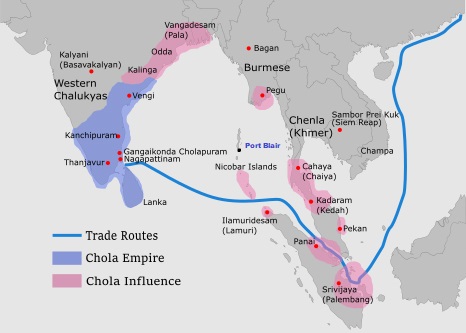
Behind the new name ‘Sri Vijaya Puram’: Chola History
The Chola Empire, under Rajendra Chola I, used the Andaman Islands as a strategic naval base in the 11th century.
He launched a naval expedition to attack the Srivijaya Empire in present-day Indonesia.
His victory over Srivijaya resulted in the capture of the king Sangrama Vijayottunggavarman and looting valuable treasures, further cementing the Chola dominance.
The Thanjavur inscriptions(1050 CE) refer to the islands as Ma-Nakkavaram (great open land), later evolving into the name Nicobar Islands.
PYQ:
[2014] Which one of the following pairs of islands is separated from each other by the ‘Ten Degree Channel’?
OpenAI has introduced OpenAI o1, the first in a series of advanced AI models under its ‘Project Strawberry’ initiative.
This new model is designed for tackling more complex tasks in science, coding, and maths.
About OpenAI o1
This model has been built to approach problems like humans, carefully considering various angles before arriving at an answer.
It improves its performance by learning from different perspectives and checking its output for errors.
In trials, the upcoming version of the o1 model performed on par with PhD students in areas like physics, chemistry, and biology, and excelled particularly in maths and coding.
For instance, it solved 83% of problems in a math contest, compared to earlier versions which solved just 13%.
In coding, the model ranked higher than 89% of participants.
Key Features and Offerings
OpenAI is also releasing OpenAI o1-Mini, an economical version designed for developers, offering similar reasoning capabilities at 80% lower cost compared to the o1-preview version.
The o1 model excels in generating and debuggingcomplex code and is expected to assist in software development, data analysis, and problem-solving tasks.
Safety Measures
OpenAI has introduced new training methods to ensure the safety of these models, improving their ability to follow safety guidelines and prevent AIjail-breaking.
Jailbreaking is a form of hacking that aims to bypass an AI model’s ethical safeguards and elicit prohibited information.
In safety tests, the new version scored 84/100, a significant improvement from the previous 22/100 score.
The company is collaborating with UK and US governments on AI safety and conducting red teaming to identify and address any weaknesses.
Q ‘Constitutional Morality’ is rooted in the Constitution itself and is founded on its essential facets. Explain the doctrine of ‘Constitutional Morality’ with the help of relevant judicial decisions.(UPSC IAS/2021)
Q Do you think that Constitution of India does not accept principle of strict separation of powers rather it is based on the principle of ‘checks and balance’? Explain. (UPSC IAS/2019)
Mentor’s Comment: Presently, in India the issue of punitive demolitions raises significant concerns regarding due process, human rights violations, and the arbitrary exercise of state power, as these actions often target vulnerable communities without legal justification or adherence to established judicial guidelines. In today’s editorial we will observe why the Supreme Court is considering to formulate pan-India guidelines aims to address these systemic issues by ensuring that demolitions occur only in exceptional circumstances, with proper legal procedures and protections for affected individuals.
_
Let’s learn!
Why in the News?
SC has called for suggestions to establish pan-India guidelines addressing extra-legal demolitions, due to the concerns over the arbitrary demolition of properties. It undermines the ‘right to housing’ of an individual and violates the Constitutional principles.
What are the arguments against the use of punitive demolitions?
Violation of Due Process: Demolitions are often carried out without following proper legal procedures and justification, undermining the rule of law. For example, Delhi’s Jahangirpuri case, incidents in Nuh (Haryana), and Khargone (Madhya Pradesh).
A person’s home cannot be demolished solely based on accusations against them or their family members, as this violates Fundamental Rights and due process.
Collective Punishment: Punitive demolitions often affect the individuals for actions they did not commit which is illegal under both national and international law.
This exacerbates social inequalities, leading to further marginalization of already vulnerable populations.
Human Rights Violations: Reports indicate that demolitions are often accompanied by police violence, which constitutes a violation of human rights and can lead to physical and psychological harm for affected individuals.
Political Manipulation: The use of demolitions as a form of political retribution or control undermines democratic principles and can be seen as a tactic to instill fear among communities, particularly in politically sensitive contexts.
What needs to be the Due Process in Legitimate Demolitions?
UN Guidelines: The United Nations Basic Principles and Guidelines on Development-based Evictions and Displacement (2019) provide humanitarian directives, yet court rulings have been inconsistent and piecemeal which needs a comprehensive approach.
Exceptional Circumstances: Demolitions should only occur in exceptional cases and must adhere strictly to established legal processes.
Need for Proposed Phased Procedures:
Pre-Demolition Phase: Provide a reasoned notice with details on land records and resettlement plans, allowing adequate time for responses.
During Demolition Phase: Requires the presence of neutral government officials during demolitions.
Rehabilitation Phase: Need to establish a swift mechanism for affected persons to challenge demolition decisions and seek remedies such as compensation and restitution.
Way Forward – Need to affix Personal Liability:
The widespread demolitions in India highlight a consistent lack of due process and disregard for judicial directives, necessitating the establishment of pan-India guidelines, increased sensitization of law enforcement, and the exploration of personal liability for officials who order forced evictions to ensure accountability and checks on their powers.
The Union Ministry dissolved the Standing Committee on Statistics (SCoS) headed by eminent economist and former chief statistician of the country Pronab Sen citing overlapping roles with the Steering Committee.
Why was the SCoS dissolved?
Overlapping Responsibilities: The primary reason cited for the dissolution of the SCoS was that its functions overlapped with those of the newly formed Steering Committee for National Sample Surveys.
Concerns Raised by Members: Members of the SCoS had consistently questioned the delay in conducting the census, which has been a critical source of data for policymakers.
Lack of Communication: Dr. Pronab Sen, the chair of the SCoS, noted that members were not provided with a specific reason for the committee’s dissolution, which raised concerns about transparency in the decision-making process.
What are the main roles of the new Steering Committee?
Advisory Role: The Steering Committee will advise the Ministry on survey methodologies, including aspects like sampling frames, design, and survey instruments, similar to the SCoS.
Finalizing Tabulation Plans: This will play a crucial role in finalizing the tabulation plans for various national sample surveys, ensuring that the data collected is organized and presented effectively.
Reviewing Methodologies: The committee will review subject results, methodologies, and questionnaires related to national sample surveys, maintaining the continuity of statistical rigor established by the SCoS.
Tenure and Composition: The Steering Committee consists of 17 members, including at least four members retained from the SCoS, and will serve a tenure of two years.
How do the SCoS and the Steering Committee differ?
Composition: The Steering Committee has a higher number of official members compared to the SCoS, which includes several non-official members. This shift may influence the dynamics and perspectives within the committee.
Mandate Overlap: While both committees have similar mandates regarding survey methodologies and data collection, the Steering Committee is positioned to focus more on the operational aspects of national sample surveys, potentially leading to a more streamlined approach.
Response to Criticism: The formation of the Steering Committee appears to be a response to criticisms of the statistical system in India, aiming to address survey-related issues more effectively than the SCoS could.
How does the SCoS’s dissolution impact statistical data quality?
Delay in Census Data: The dissolution of the SCoS amid ongoing delays in conducting the census raises concerns about the availability of reliable and updated data. The last census was conducted in 2011, and reliance on outdated data can negatively affect policy-making and the distribution of welfare benefits.
Quality of Administrative Data: Critics argue that administrative data, which the government has been relying on, may not accurately reflect the employment scenario, as it is often threshold-based and susceptible to manipulation. This could lead to a distorted view of the economic situation.
Need for Comprehensive Data: The census is crucial for providing comprehensive demographic, economic, and social data, which is essential for effective policy formulation. The absence of updated census data can hinder the government’s ability to address issues like employment, poverty, and social welfare effectively.
Way forward:
Reinstate Independent Oversight: Establish an independent statistical body with clear roles to ensure transparency, timely data collection, and oversight of key surveys like the census, addressing concerns of data reliability.
Modernize Data Collection: Leverage technology to streamline and accelerate the census and national surveys, ensuring that updated and accurate data is available for policy-making and welfare distribution.
The rise in jobless growth, driven by automation and AI, has led to growing inequality, prompting discussions on implementing Universal Basic Income (UBI) in many countries.
What does the ILO say on Inflation and unemployment in India?
The ILO reports that 83% of the unemployed population in India are youth, due to the rapidly changing economy influenced by automation and AI.
This trend has exacerbated income inequality, with a 1.6% drop in global labour income share between 2004 and 2024, significantly affecting developing nations like India.
The report indicates that persistent inflation and geopolitical tensions have led to aggressive monetary policies, which could further strain the labor market.
The ILO anticipates a slight increase in global unemployment in 2024, reflecting ongoing structural issues in labor markets.
What will be its implications on Indian growth and development?
Social Implications: Falling living standards and weak productivity due to automation could lead to greater inequality, undermining social justice efforts in India.
The ILO suggests that increasing unemployment and inflation could result in social unrest and political instability without effective social safety nets.
Political Implications: It makes it difficult for the decision making and governance due to the drop in global labour income, prompting India to increase budget allocations for welfare programs.
Economic Implications: The emphasis on generating employment in labor-intensive sectors is crucial. The government policies should prioritize job creation to counteract the effects of automation and ensure that growth benefits a broader segment of the population.
What are the safety nets for India?
Cash Transfer Schemes: Programs targeting farmers and women, as well as cash transfers for unemployed youth, represent existing safety nets that provide some level of income support.
Employment Guarantee Schemes: Initiatives like the Mahatma Gandhi National Rural Employment Guarantee Act (MGNREGA) aim to provide employment and income security to rural households, although funding and implementation have faced challenges.
Universal Basic Social Safety Nets: Experts suggest that rather than a full UBI, India should focus on enhancing existing social safety nets to ensure they are more universal and effective in addressing the needs of the unemployed and underemployed populations.
External Affairs Minister S. Jaishankar visited the replica of the East Gate of Sanchi’s Great Stupa in Berlin.
Aboutthe Great Stupa of Sanchi
Details
Establishment
Commissioned by Emperor Ashoka in the 3rd century BCE.
UNESCO World Heritage Site.
Purpose
Built to enshrine the relics of Buddha and symbolise the Buddhist faith.
Construction
Overseen by Ashoka’s wife, Devi, from Vidisha.
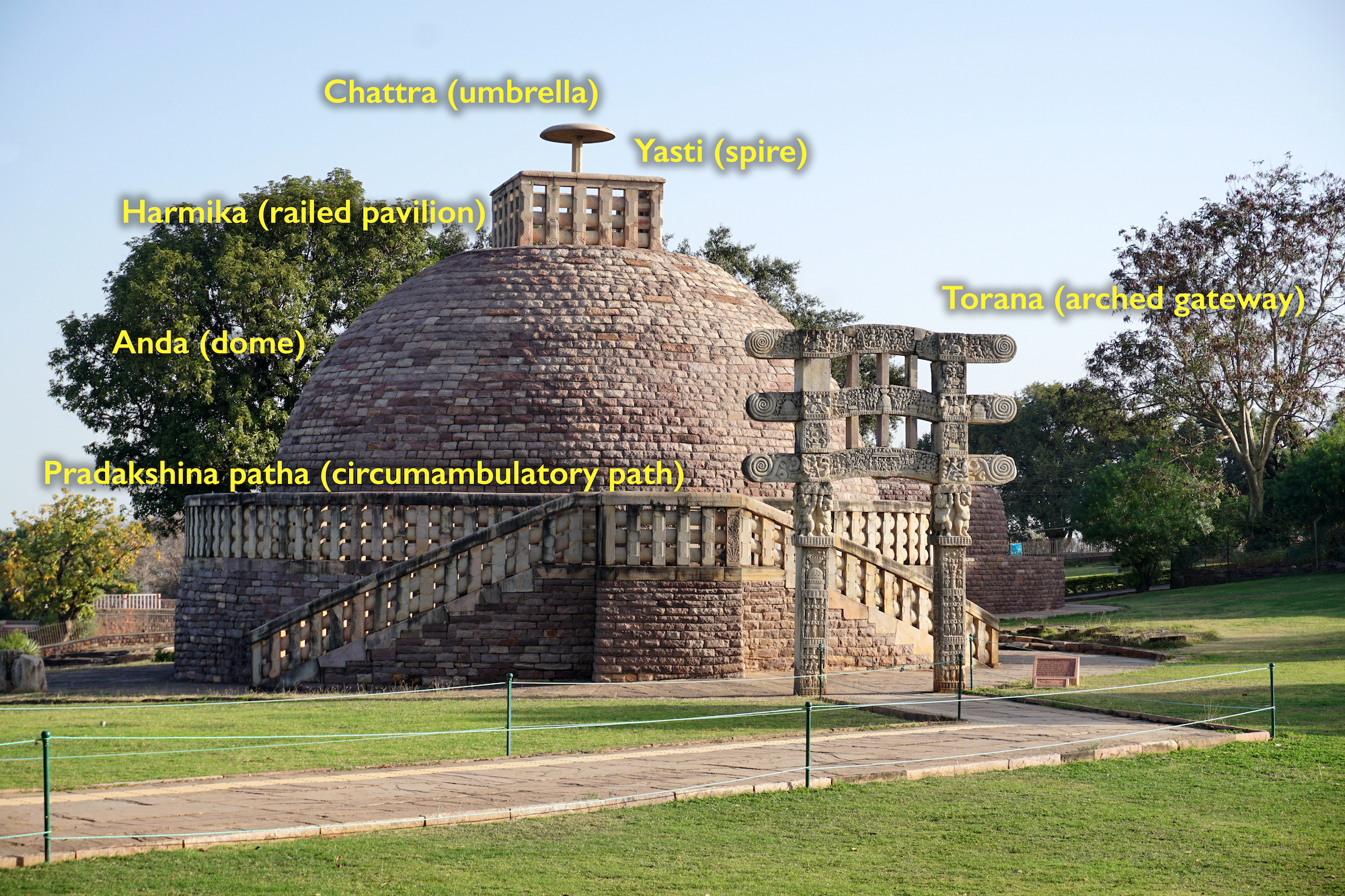
Stupa is a simple hemispherical structure crowned by a chhatra (parasol), symbolizing high rank.
Development of the Sanchi complex was supported by the mercantile community of Vidisha.
Design
Follows a simple hemispherical dome structure.
Later, in the 1st century BCE, under the Satavahana dynasty, 4 ornamental gateways (toranas) were added in four cardinal directions.
Toranas (Gateways)
Each torana consists of 2 pillars supporting 3 architraves, adorned with bas-reliefs depicting scenes from Buddha’s life, Jataka tales, and Buddhist symbols.
Artistic Features
The toranas are famous for their intricate carvings, depicting elephants, winged lions, peacocks, and shalabhanjikas (fertility symbols).
Symbolism
Upper architrave shows seven Manushi Buddhas (previous Buddhas), the middle depicts the Great Departure of Prince Siddhartha, and the lower shows Ashoka’s visit to the Bodhi tree.
Restoration
Rediscovered in 1818 by British officer Henry Taylor and restored by John Marshall (ASI director) in the early 1900s with financial aid from the Begums of Bhopal.
Replica of East Gate
A plaster cast of the East Gate was made in the 1860s by Henry Hardy Cole for the Victoria and Albert Museum.
A replica now stands in front of the Humboldt Forum Museum in Berlin.
PYQ:
[2013] Consider the following historical places:
1. Ajanta Caves
2. Lepakshi Temple
3. Sanchi Stupa
Which of the above places is / are also known for mural paintings?
(a) 1 only
(b) 1 and 2 only
(c) 1, 2 and 3
(d) None
[2016] Early Buddhist Stupa-art, while depicting folk motifs and narratives successfully expounds Buddhist ideals. Elucidate.
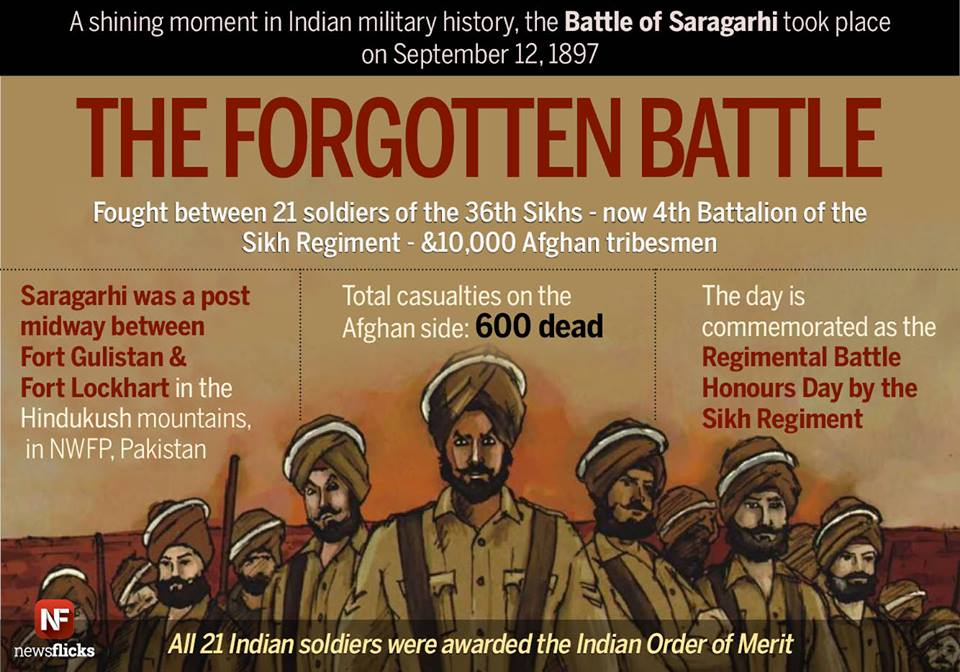
127th Anniversary of the Battle of Saragarhi was observed on September 12.
About the Battle of Saragarhi
The Battle of Saragarhi occurred on September 12, 1897, between 21 Sikh soldiers of the then 36th Sikh Regiment and around 8,000 Afridi and Orakzai tribals.
The soldiers defended a communication post at Saragarhi, connecting Fort Lockhart and Fort Gulistan in the North West Frontier Province (now Pakistan).
Led by Havildar Ishar Singh, the Sikhs fought to the last man, marking one of the greatest last stands in military history.
Despite their bravery, the soldiers were eventually outnumbered and killed.
Their sacrifice gave the British time to strengthen positions at Fort Lockhart and Gulistan, halting enemy advances.
Implication of the Battle
The Sikh soldiers showed extraordinary courage, fighting against overwhelming odds.
The 21 soldiers killed around 200 militants and injured 600, holding the enemy for seven hours.
The British Government posthumously awarded all 21 soldiers the Indian Order of Merit.
The battle highlighted the importance of discipline, leadership, and sacrifice, and underscored the role of Sikh regiments in the British Indian Army.
PYQ:
[2020] Wellesley established the Fort William College at Calcutta because:
(a) He was asked by the Board of Directors at London to do so
(b) He wanted to revive interest in oriental learning in India
(c) He wanted to provide William Carey and his associates with employment
(d) He wanted to train British civilians for administrative purpose in India
Natural geographic separation is happening among Asiatic lion populations in Gujarat, and there is no immediate need to relocate them, says the director general of the International Big Cat Alliance.
About Asiatic Lion
Asiatic Lion, part of the Panthera Leo Leo subspecies, is found only in India, with a distinct belly skin fold.
Once spread across West Asia and India, now limited to Gir National Park, where the population increased in 2020.
Asiatic lions face threats from diseases, natural disasters, poaching and retaliation for livestock attacks.
They are classified as Endangered(IUCN), listed in CITESAppendix I, and protected under Schedule I of the Wildlife Protection Act.
The Asiatic Lion Conservation Project (2018-2021) aims for scientific management and community involvement.
About International Big Cat Alliance (IBCA)
Details
Objective
Protect and conserve 7 big cats: tiger, lion, leopard, snow leopard, puma, jaguar, and cheetah.
Initial Funding
₹150 crore from the Government of India for five years, with additional funding from global agencies.
Membership
Open to 96 range countries with natural big cat habitats.
Key Activities
Advocacy, knowledge sharing, capacity building, eco-tourism promotion, and resource mobilization.
Governance
General Assembly, elected Council, and Secretariat. Secretary General appointed by the Assembly.
Governance Framework
Based on the International Solar Alliance (ISA); finalized by the International Steering Committee.
India’s Role
India is home to 5 of the 7 big cats: tiger, lion, leopard, snow leopard, and cheetah.
India hosts about 70% of the world’s tiger population and has seen steady growth in its Asiatic lion population.
PYQ:
[2012] Consider the following:
Black-necked crane
Cheetah
Flying squirrel
Snow leopard
Which of the above are naturally found in India?
(a) 1, 2 and 3 only
(b) 1, 3 and 4 only
(c) 2 and 4 only
(d) 1, 2, 3 and 4
India will be the exclusive partner for European Hydrogen Week in November 2024.
About European Hydrogen Week
European Hydrogen Week is an annual event organized by the European Commission, Hydrogen Europe, and others.
It serves as a platform to discuss the future of hydrogen technologies, policy developments, and their role in decarbonizing Europe’s economy.
It features conferences, exhibitions, and networking opportunities.
It focuses on the development, deployment, and scaling of green hydrogen as part of the European Green Deal and the EU’s climate-neutrality targets for 2050.
Significance of India’s Partnership
Strengthening Green Energy Goals: Aligns India with global initiatives in decarbonizing industries and energy systems, advancing its commitment to the Paris Agreement and Net Zero 2070 target.
Access to Advanced Hydrogen Technologies: Provides India with cutting-edge hydrogen technologies from Europe, enhancing production, storage, and transportation capabilities for Green Hydrogen.
Boosting Technological Innovation: Facilitates collaborative research and development, allowing India to create cost-effective hydrogen solutions and drive domestic innovation in clean energy.
Building Global Leadership: Establishes India as a global leader in the Green Hydrogen sector, reinforcing its commitment to climate change mitigation and sustainable development.
PYQ:
[2019] In the context of proposals to the use of hydrogen-enriched CNG (H-CNG) as fuel for buses in public transport, consider the following statements:
1. The main advantage of the use of H-CNG is the elimination of carbon monoxide emissions
2. H-CNG as fuel reduces carbon dioxide and hydrocarbon emissions.
3. Hydrogen up to one-fifth by volume can be blended with CNG as fuel for buses.
4. H-CNG makes the fuel less expensive than CNG.
Which of the statements given above is/are correct?
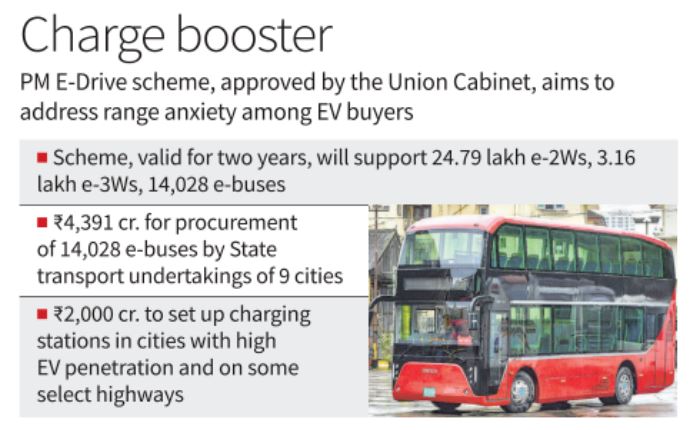
The Union Cabinet approved the PM Electric Drive Revolution in Innovative Vehicle Enhancement (PM E-Drive) Scheme with an outlay of ₹10,900 crore over two years.
About PM E-DRIVE Scheme:
Details
Name
PM Electric Drive Revolution in Innovative Vehicle Enhancement (PM E-DRIVE) Scheme
Total Outlay
₹10,900 crore for two years
Goal
Promote electric mobility, reduce pollution, and enhance fuel security
Reduce range anxiety by providing charging infrastructure in cities and highways.
Incentives
Direct subsidies for e-2Ws, e-3Ws, e-buses, e-ambulances, and e-trucks
Key Components
₹3,679 crore for demand incentives for e-2Ws, e-3Ws, e-ambulances, and e-trucks.
₹500 crore for e-ambulances.
₹4,391 crore for e-buses.
Other components:
E-Vouchers
Aadhaar-authenticated e-voucher for EV buyers;
Signed by both buyer and dealer for claiming incentives.
E-Bus Procurement
₹4,391 crore for 14,028 e-buses in 9 major cities (Delhi, Mumbai, Kolkata, Chennai, Ahmedabad, Surat, Bangalore, Pune, Hyderabad)
Charging Infrastructure
₹2,000 crore for 72,300 public EV charging stations, including fast chargers for e-4Ws, e-buses, e-2Ws, and e-3Ws
Incentivizing E-Trucks
₹500 crore tied to scrapping certificates from MoRTH-approved scrapping centres
Testing and Upgradation
₹780 crore for upgradation of MHI’s test agencies for green mobility technologies
PYQ:
[2019] How is efficient and affordable urban mass transport key to the rapid economic development in India?
Prayas here. I am here to talk to you about something special today.
Something that we specially created to give you the best start for your preparation.
“Everything we do, we do keeping our mentorship program students in mind” is a line you’ve probably come across repeatedly in our posts, webinars, and YouTube videos. It’s so pervasive because it’s the truth; as a pioneer in high-quality and sharp mentorship-driven UPSC prep platform, we can’t afford to be any other way.
But you’ve probably read that sentiment most often in the context of our paid programs, which are meant for our program-enrolled aspirants. The Lacs of free aspirants who’ve signed up with us over these past few years perhaps fade into the background.
A majority of these aspirants did not just sign up for the (occasional) Free GS and current affairs content we post or scholarships, as well as free mock tests. They signed up—and continue to sign up—because they wanted to truly understand what Civilsdaily IAS is and why aspirants and rankers they know and respect – follow and speak highly of us, our content and our mentorship.
Our original free starter kit was designed to give these aspirants a quick taste of this experience: They got daily current affairs on the website, access to ranker sessions, and occasionally, we release original, deeply researched, PYQ-backed content on the website for free.
But as we’ve evolved and rolled out a bunch of new content themes, such as GS micro themes, Essay content, PYQ-based mocks, and more, our current free starter kit has started falling short. It no longer reflects the breadth and depth of the ‘value’ we offer for a rank-worthy UPSC Prep.
Aspirants who start their preparation journey with CD (open to every aspirant) will now be presented with deeply researched, original and carefully curated UPSC Prep content.
Your ‘Free UPSC-CSE Starter Kit’ now includes –
Yearlong Strategy document + Macro Plan
PYQ analysis for pre and mains
Ranker sessions
Pre and Mains workshops
PYQ based – Micro Themes for GS papers (Pre + Mains)
Essay enrichment content with 50+ Intro and Anecdotes From Rankers
Atomic and Flash Notes and much more…
Access to few PYQ-based Mock tests.
One key limitation of our previous free starter plan was the lack of a ‘One 1:1 mentorship call’. As more and more aspirants realise the immense value and impact of CD’s mentorship (Check AIR-2 Animesh Pradhan’s UPSC Journey), they opt for our mentorship programs – UAP and Foundation. But the same was not true for other aspirants. They only occasionally heard about it from others but have yet to experience the CD mentorship.
We want all other aspirants (Who are not part of our mentorship programs) to be able to access ‘1:1 Mentorship’.
It’s still only a tiny fraction of the kind of access our program-enrolled aspirants get. Still, we believe it will give them a taste of our mentorship’s value, at least getting them started on the right path.
This brings us to the – Free UPSC-CSE Starter Kit – Click Here
To schedule your One Free 1:1 Mentorship Call – Click Here
This is where you’ll find all the necessary content—your very own toolkit and guide to help you stay on top of your UPSC-CSE Prep. Remember: We’ll keep updating this folder almost every week so keep checking for new content.
Read about AIR-2 Animesh Pradhan (Civilsdaily UAP Mentorship Student) UPSC and Mentorship Journey
Animesh Pradhan, Age 24, Attempt: 1st, UPSC-CSEAIR 2. A graduate of NIT Rourkela, working as a full-time employee in Indian Oil Corp., he cleared UPSC CSE on his first attempt at the age of 24. He lost his father at an early age and was left with his Mother and elder sister. Unfortunately, his Mother passed away 40 days ago and couldn’t see her Son’s success and cherish it. His sister got married in January last year. He is a very committed, humble, and diligent student with high professional skills in managing work and studies.
AIR 2, Animesh Pradhan at Civilsdaily Delhi Centre Today
Schedule a 1-1 call with Civilsdaily’s Mentorfor focused UPSC Prep.
With all the lows in life, he came with the hope that one day, his mother would see him becoming an IAS officer. Even though one wish in these two remained unachieved, wherever his mother is, her wishes will be with him, and if there is heaven at all, she might be celebrating this in that heaven.
AIR 2, Animesh Pradhan On Call With Civilsdaily Mentor Showing His Gratitude
We hope he achieves much more success and wish him enough grit to achieve whatever he wants in life. We expect him not to stop here and make this a mere small achievement in his list of aspirations.
Why Civilsdaily Mentorship and Programs Are Unique?
The heart of the Civilsdaily platform is the Foundation Program and Ultimate Assessment Program (UAP). For years, aspirants have enrolled here because they couldn’t find such depth and passion towards quality content and Mentorship anywhere. Their search inevitably ends at Civilsdaily. Enrollment in these programs and Mentorship also makes us accountable to aspirants for the value they get.
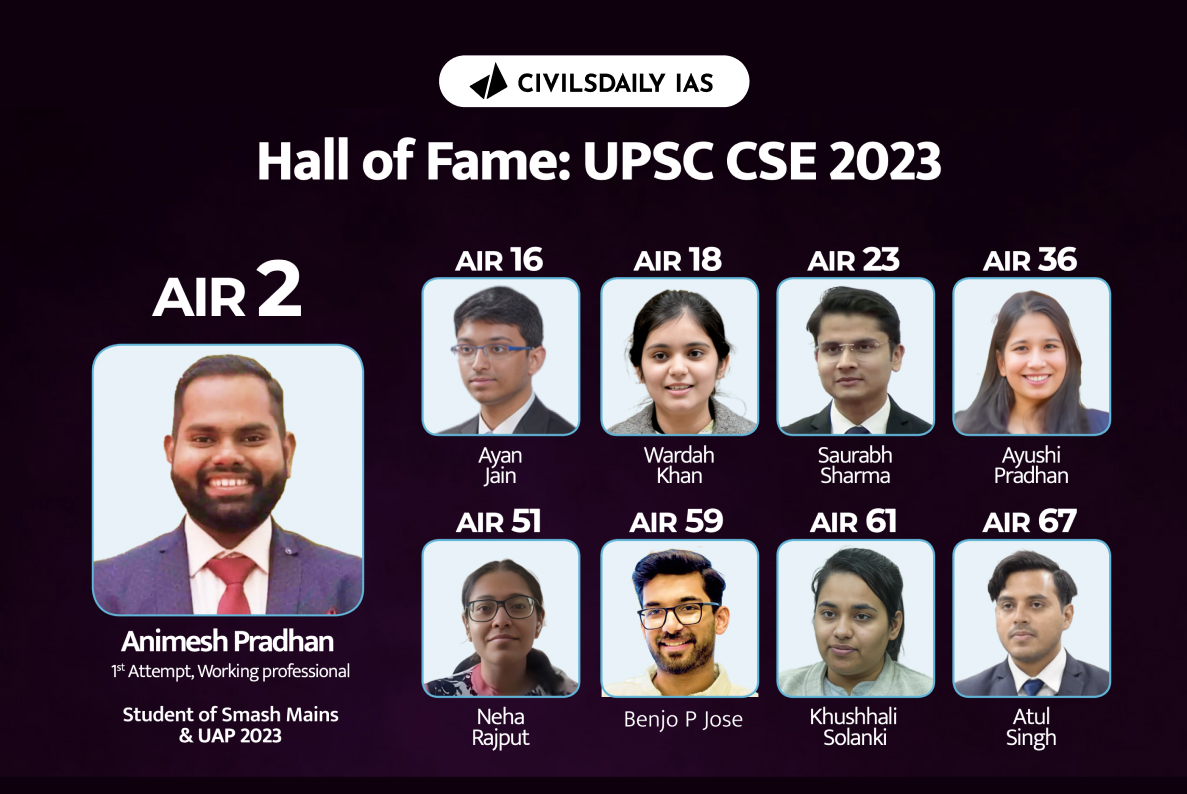
In the past few years, we’ve worked quietly in the background with hundreds of aspirants; many now serve as IAS, IPS, IFS, and more. We are very proud of what we’ve achieved. Here are some of the recent rankers who show us gratitude.
Connect with UPSC mentors today (Free for the next 24 hours)
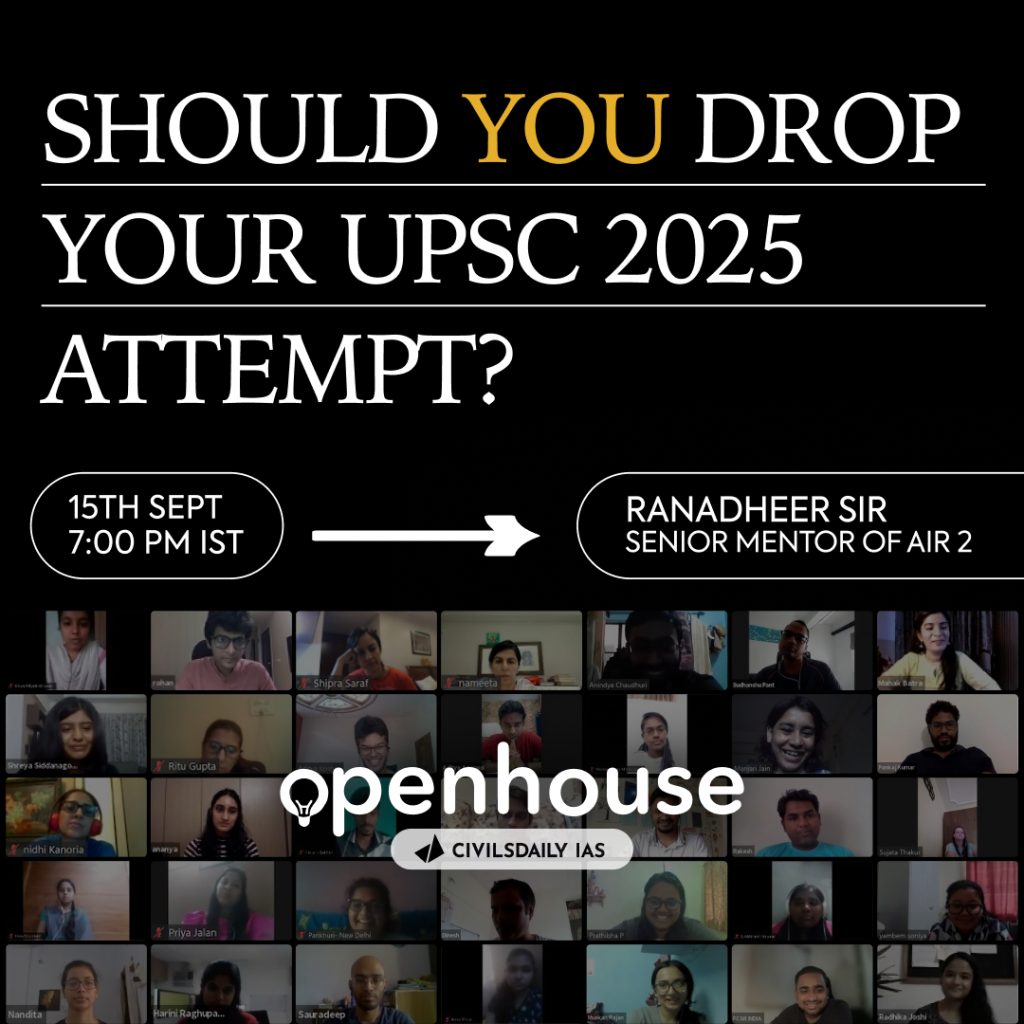
In this session, Ranadheer Sir will help you understand your current level of preparation for UPSC by identifying your strengths and weaknesses in different subjects like General Studies, Optional, and Essay. He will also guide you on how to assess the remaining 8 months for the 2025 attempt and decide if this time is enough to cover the entire syllabus.
Ranadheer Sir will share self-assessment techniques to help you check your knowledge, find gaps in your preparation, and track your progress. He will explain why mock tests, practicing previous years’ questions, and regular revisions are important for building a strong foundation. The session will also cover the factors to consider when deciding whether to attempt the exam in 2025 or wait until 2026, addressing concerns about missing out (FOMO) and managing deadlines.
The session will highlight the importance of mentorship in improving your preparation strategy. Ranadheer Sir will share insights from his vast experience and offer personalized guidance to help you make the right decision. There will also be an interactive Q&A session where attendees can ask questions and clear their doubts, with tailored advice from Ranadheer Sir based on their individual preparation status.
Animesh (AIR 2, UPSC 2023) was preparing with his mentor, Ranadheer Sir and a team of experts who had led AIR 22, AIR 48 to success in UPSC 2022 with UAP Mentorship Program.
While the whole world wakes up to mentorship for the first time in 2024, we have been perfecting the UAP mentorship program for the last 5+ years.
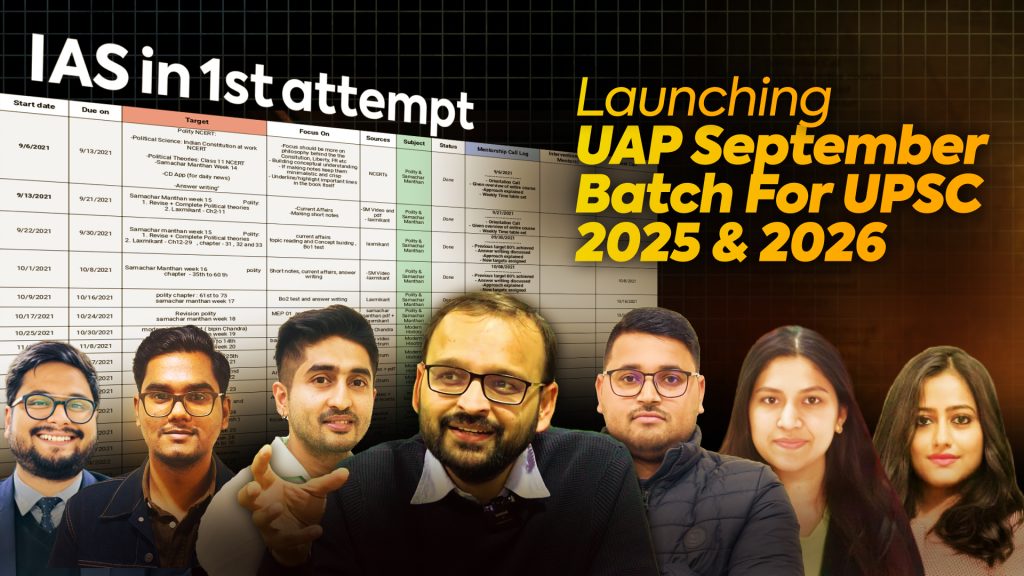
It is with that proven confidence that on 15th Sept, at 7 PM, Ranadheer Sir will be conducting a FREE webinar exclusively for UPSC 2025 and 2026 aspirants giving you a sneak peak of what it takes to perform at the alpha level in your very first attempt.
It will be a practical webinar and here’s what we will be discussing:
How should an absolute beginner start his/ her UPSC 2026 prep? What are the high yielding areas that are quick to conquer and necessary to master
Absolute non-negotiables for every beginner – If you miss mastering these, forget your rank, you will risk even your mental health – so get them right
Actual scans of Animesh’ answer writing attempts with UAP 2023 to show you how an aspirant evolves to become a ranker
LIVE UPSC PYQs attempts to show the difference between a beginner vs. a ranker’s attempt to the same question.
It will be a 45 minute webinar, post which we will open up the floor for all kinds of queries which a beginner must have. No questions are taboo and Ranadheer sir is known to be patiently solving all your doubts.
Here’s what you will be getting after attending the webinar:
Scanned GS Paper PDF Notes of Animesh Pradhan which he made during his student days at Civilsdaily’s UAP 2023 batch
Flash Notes of GS Polity: Ranker approved notes for exam ready revision
Join us for a Zoom session on 15th Sept 2024 at 7:00 p.m. This session is a must-attend for you If you are attempting UPSC for the first time or have attempted earlier and now preparing for next year, then it is going to be a valuable session for you too.
In the session, we will discuss how mentorship works. Why Mentorship is a must when you attempting for the first time.
We will deal with all the aspects for a comprehensive UPSC Preparation.We’ll talk about starting with the basics, and move to advanced level.
At Civilsdaily, we treat Mentorship as a specialization. Not every Mains or interview candidate can be a mentor. Most such mentors will suggest cosmetic changes and will only help you evolve slowly. It is easy to find comfort in sentences like ‘every topper is different’ and’ they have their own path’. Finding what’s different about you and then figuring out your own path is why Mentorship is essential.
We walk the talk by helping you craft your own way of preparation. A method that enhances your probability of qualifying UPSC-CSE in a single attempt. We give you that near-perfect certainty. Delivering this consistently to hundreds of aspirants (now rankers) in the past was challenging. We still stick to it and keep getting better at it with each passing year.
At CD, we understand the science and the art of everything UPSC. If you have a problem, we will sit with you and find a solution. If that doesn’t work, then we try solution 2. Eventually, we will make sure you end up making progress. What’s the point of any content, program, or mentorship without progress? This is precisely why aspirants trust they have the best shot at clearing the exam with Civilsdaily.
We invest a significant amount of time, effort, and energy into creating lectures, notes, and tests, understanding your needs as an aspirant. We take this responsibility seriously because, ultimately, your future depends on it.
The heart of the Civilsdaily platform is the Yearlong Mentorship Program. For years, aspirants have enrolled here because they couldn’t find such depth and passion towards quality content and Mentorship anywhere. Their search inevitably ends at Civilsdaily. Enrollment in these programs and Mentorship also makes us accountable to aspirants for the value they get.
In the past few years, we’ve worked quietly in the background with hundreds of aspirants; many now serve as IAS, IPS, IFS and more. We are very proud of what we’ve achieved.Overwhelmed by quick fixes, content overload and messy timetables which never work? Join us as we take you through a realistic and relatable roadmap for UPSC 2026 preparation.
(Don’t wait—the next webinar won’t be until Oct 24)
These masterclasses are packed with value. They are conducted in private with a closed community. We rarely open these webinars for everyone for free. This time we are keeping it for 300 seats only.
Q “The USA is facing an existential threat in the form of China, that is much more challenging than the erstwhile Soviet Union.” Explain. (UPSC IAS/2021)
Q ‘China is using its economic relations and positive trade surplus as tools to develop potential military power status in Asia’, In the light of this statement, discuss its impact on India as her neighbor. (UPSC IAS/2017)
Q. The China-Pakistan Economic Corridor (CPEC) is viewed as a cardinal subset of China’s larger ‘One Belt One Road’ initiative. Give a brief description of CPEC and enumerate the reasons why India has distanced itself from the same. (UPSC IAS/2018)
Mentor comment:In the Indian context, there is a need for improved infrastructure to support economic growth and facilitate investment, which requires coordinated efforts at both state and national levels. While prioritizing industrial growth, it is essential to balance this with the provision of public services to ensure comprehensive development. We can learn from the experience of our neighbour – China.
China’s decentralized policy has become a threat to itself. China’s decentralized policy initially spurred economic growth. Still, it has now become a source of structural inefficiencies, regional disparities, ineffective investments, and governance challenges that threaten the country’s long-term stability and development.
_
Let’s learn!
Why in the News?
PM urged the states to compete with each other to attract investors. The difference was highlighted with India’s more centralised system where city-level governments account for less than 3% of total spending.
China’s extreme fiscal decentralization (in 1994), with sub-provincial governments accounting for 51% of government spending and having broad qualitative mandates, has turned counter-productive.
What are the challenges faced by the Chinese local government?
Overcapacity as a Structural Issue: Initially, during the Hu Jintao era, the local governments prioritized industrial construction over public services to boost economic growth and political prospects.
This model led to competitive sub-national growth, resulting in structural overcapacity and wasteful investments.
Tipping Point Under Xi Jinping: As the investments made between 2009 and 2013 were ineffective, Xi Jinping focused on strengthening central control and narrowing directives, focusing on specific product lines like semiconductors, which often ignored market demands.
By mid-2024, 30% of industrial firms reported losses, highlighting the negative impact of overcapacity and ineffective local government spending.
Geopolitical Ramifications: Other countries view China’s overcapacity as a national security threat, particularly regarding tech-enabled products, exacerbated by China’s international conduct.
The geopolitical climate has shifted, affecting China’s ability to export excess capacity and creating challenges for local firms reliant on government funding.
What were the effects of this on the Asian region?
Positive Impacts:
In the Southeast Asian Region: These economies have become highly integrated into China’s supply chains, relying on Chinese intermediate inputs to produce goods for export. This has boosted trade and economic growth in the region.
On ASEAN Region: China’s upgraded trade agreements such as the Regional Comprehensive Economic Partnership (RCEP), have strengthened economic ties and trade flows between China and its Asian neighbors.
Negative Impacts:
Over-dependence on China: Southeast Asian manufacturers heavily rely on Chinese components, making them vulnerable to supply chain disruptions.
Increasing Trade Deficits: Growing trade deficits with China concern many Southeast Asian countries as they import more from China than they export.
Increasing Sanctions: Countries like Vietnam, Malaysia, and Indonesia impose anti-dumping measures and tariffs on certain Chinese products to protect domestic industries.
Lessons for Indian States from China’s Experience
•Decentralization of Authority: Meaningful decentralization of budgets and authority to local governments, particularly cities, can enhance political accountability and improve service delivery, akin to China’s local governance model. •Investment in State Capacity: Indian states must invest in building effective governance structures and administrative capacity, ensuring local governments can effectively manage resources and deliver services. • Policy Innovation: Encouraging local innovation and flexibility in policy implementation can lead to tailored solutions for regional challenges, mirroring China’s approach during its economic reforms. •Balancing Central and Local Authority: Finding the right balance between central oversight and local autonomy can help avoid the pitfalls of over-centralization while ensuring accountability and effective governance.
Conclusion:
The overcapacity and export orientation model has now reached its limits due to China’s arrogant approach to international relations and drive towards self-reliance. Though we might see a jump in exports for some sectors, China faces an economic decline if it does not transform its political and economic relations with the world’s major countries.
External Affairs Minister S. Jaishankar, currently in Germany as part of a three-nation tour, met with German Foreign Minister Annalena Baerbock in Berlin. They discussed various defence topics, including Ukraine, Gaza, and the Indo-Pacific region.
Defence Partnership between India and Germany:
Late Engagement: Germany has been late in engaging India’s defence interests compared to France and the U.S., who have stronger partnerships with India.
Opportunity Post-Russia-Ukraine War: With Russia’s industrial capacity focused on the war, Germany sees an opportunity to enhance its defence exports to India.
German defence manufacturers like ThyssenKrupp Marine Systems are already involved in projects like submarine construction for the Indian Navy.
Technology Transfer: Technology transfer is a key condition for India’s defence partnerships, and Germany’s ability to meet this requirement could shape future cooperation.
Complementary Systems: Germany’s Eurofighter and its future replacement by U.S.-made F-35s highlight Germany’s readiness to integrate its defence systems with Western platforms, easing potential interoperability issues for India.
Exercise Tarang Shakti:
Tarang Shakti is one of the most extensive multilateral air exercises hosted by the Indian Air Force (IAF), showcasing India’s commitment to international defence cooperation.
This exercise marked the first time the German Luftwaffe (Air Force)participated in air sorties over Indian skies, symbolizing Germany’s growing defence ties with India.
It would become a biennial exercise, highlighting India’s intent to make such multinational military cooperation a regular feature.
Tarang Shakti was seen as a tryout for the larger Pacific Skies 24 air exercise involving France, Germany, and Spain, further emphasizing the Indo-Pacific’s growing military relevance.
Present Dilemma of China:
Germany’s Strategic Interest in the Indo-Pacific: China’s aggressive actions, such as building artificial islands in the South China Sea, pose a significant threat to regional stability, international shipping, and trade routes, which Germany heavily depends on.
Germany’s Balancing Act: While Germany has clear political positions against China’s actions in the Indo-Pacific, its economic dependence on China complicates the situation. Germany’s increasing defence presence in the region is partly aimed at ensuring free and secure shipping routes.
Europe’s Shift in Focus: Post Russia-Ukraine war, Europe, including Germany, is recalibrating its foreign policy towards the Indo-Pacific, recognizing the region as the future centre of global economic and geopolitical influence, which is driving greater German defence engagement in the region.
Way Forward:
Enhance Defence Collaboration: India and Germany should focus on deepening defense cooperation, particularly in areas like technology transfer, joint military exercises, and advanced systems integration to build long-term strategic partnerships.
Strengthen Indo-Pacific Engagement: Germany and India should align their Indo-Pacific strategies to ensure regional stability, emphasizing free trade routes and countering China’s assertiveness while balancing economic dependencies.
Mains PYQ:
Q To what extent can Germany be held responsible for causing the two World Wars? Discuss critically. (UPSC IAS/2015)
The Prime Minister has reaffirmed the government’s dedication to addressing sickle cell disease, a genetic blood disorder that alters the shape of red blood cells.
About the National Sickle Cell Anaemia Elimination Mission:
The Union Budget 2023-24 announced a mission to eliminate sickle cell anemia by 2047. The mission focuses on awareness and screening programs for people ages 0 to 40.
The mission aims to reduce the burden of sickle cell disease, which primarily affects India’s tribal belt (Odisha, Jharkhand, Chhattisgarh, Madhya Pradesh, Maharashtra).
These include nationwide screening programs and the inclusion of vital medicines like hydroxyurea in the essential medicines list, improving access to treatment.
Challenges faced by the Indian Government:
High Disease Burden: India has the world’s second-largest burden of sickle cell disease, with over a million affected individuals, primarily in tribal areas.
Low Treatment Coverage:Only 18% of those affected receive consistent treatment, with significant drop-offs in screening, diagnosis, and treatment adherence.
Stigma and Misinformation: Social stigma around the disease, myths such as “God’s curse” or “black magic,” and mistrust of public health systems, particularly in tribal areas, result in delayed diagnosis and treatment.
Treatment Adherence Issues: Challenges include inconsistent availability of medicines like hydroxyurea, long travel distances for treatment, and stock shortages at health centers.
Poor Vaccination Coverage: Vaccination, which reduces infection rates and improves quality of life, remains inadequate in many affected regions.
Research and Development: The lack of ongoing research into treatments and understanding of the disease in India, and the unaffordability of emerging therapies like gene therapy, hinder long-term progress.
Financial and Operational Gaps: Health systems in tribal areas require additional funding and operational strengthening to address region-specific health challenges effectively.
What are the WHO recommendations?
Early Identification: Implement newborn screening programs to identify sickle cell disease at birth.
Integration into Health Systems: Sickle cell management should be integrated into national health services. This includes establishing specialized centers for comprehensive care and ensuring that primary healthcare providers are trained in managing sickle cell disease.
Public Education and Awareness: Conduct public education campaigns to raise awareness about sickle cell disease, reduce stigma, and inform communities about genetic risks and prevention strategies.
Genetic Counseling: Provide genetic counselling to families, especially in communities with high prevalence, to inform them about the risks of having children with sickle cell disease and the importance of carrier screening.
Mains PYQ:
Q Stem cell therapy is gaining popularity in India to treat a wide variety of medical conditions including leukaemia, Thalassemia, damaged cornea and several burns. Describe briefly what stem cell therapy is and what advantages it has over other treatments. (UPSC IAS/2017)
![[13th September 2024] The Hindu Op-ed: Putting the brakes on ‘bulldozer justice’](https://www.civilsdaily.com/wp-content/uploads/2024/09/13-SEP-1568x882.jpg)
![[Must Have For UPSC 2026 & 2027 Aspirants] Introducing Civilsdaily’s UPSC-CSE Starter Kit || Register To Access Now, For Free](https://www.civilsdaily.com/wp-content/uploads/2024/09/SK_final-1568x882.jpg)

![[UPSC Openhouse] By Ranadheer Sir, Senior Mentor of AIR 2 | Should You Drop Your UPSC 2025 Attempt? | How To Self-Evaluate and Plan for Your Next Attempt || Join on 15th Sept 2024, 7 PM.](https://www.civilsdaily.com/wp-content/uploads/2024/09/Ranadheer__thumb-1568x882.jpg)

![[12th September 2024] The Hindu Op-ed: Perils of decentralization with Chinese characteristics](https://www.civilsdaily.com/wp-content/uploads/2024/09/12-SEP-1568x882.jpg)