💥UPSC 2026, 2027, 2028 UAP Mentorship (March Batch) + Access XFactor Notes & Microthemes PDF

Search results for: “”

  • 13 August 2018 | Prelims Daily with Previous Year Questions

    Q.1) Consider the following statement about Parker Solar Probe:

    1. It is aimed to study the sun’s outer atmosphere, or corona, which is much hotter than the solar surface.

    2. The Solar Probe Cup is a sensor that will extend beyond the heat shield to take samples of the Sun’s atmosphere.

    3. The mission will be orbiting the sun until the end of the solar system.

    Which of the given statements is/are not correct?

    a) 1 and 3

    b) 2 and 3

    c) Only 3

    d) All are incorrect

    Inspired by: Parker, world’s first mission to Sun lifts off

    https://www.civilsdaily.com/news/parker-worlds-first-mission-to-sun-lifts-off/

    Q.2) Solar Orbiter or SolO, is solar mission of which of the following states?

    a) Germany

    b) France

    c) UK

    d) Australia

    Inspired by: Parker, world’s first mission to Sun lifts off

    https://www.civilsdaily.com/news/parker-worlds-first-mission-to-sun-lifts-off/

    Q.3) Tropical Tasar, Multivoltine x Bivoltine and Eri are breeds of which of the following?

    a) Bovines

    b) Goats

    c) Silkworm

    d) Sheep

    Inspired by: [pib] Central Silk Board Notifies Recently Developed Races of Silk Worm Seed

    https://www.civilsdaily.com/news/pib-central-silk-board-notifies-recently-developed-races-of-silk-worm-seed/

    Q.4) PEGylated Streptokinase, a clot buster developed by CSIR-Institute of Microbial Technology (CSIR-IMTECH), Chandigarh is used for the treatment of which of the following disease?

    a) Ischemic strokes

    b) Brain Hemorrhage

    c) Cardiac Arrest

    d) Gangrene

    Inspired by: [pib] CSIR’s new patented Clot buster, PEGylated Streptokinase set to revolutionize the treatment of Strokes

    https://www.civilsdaily.com/news/pib-csirs-new-patented-clot-buster-pegylated-streptokinase-set-to-revolutionize-the-treatment-of-strokes/

    Q.5) Harsh Mander v. Union of India and Karnika Sawhney v. Union of India Judgments are related to which of the following issue?

    a) De-criminalizing begging

    b) SC/ST reservations in Promotion

    c) Continuance of Reservation for SCs and STs

    d) Against Mob Lynching

    Inspired by: [op-ed snap] Undoing a legacy of injustice

    https://www.civilsdaily.com/news/op-ed-snap-undoing-a-legacy-of-injustice/


    For Solutions – Click Here

    Prelims Daily Archive – Click here


  • [Burning Issue] Special Category States (SCS)

    Image result for Special Category States (SCS)


    Meaning and history of the term SCS

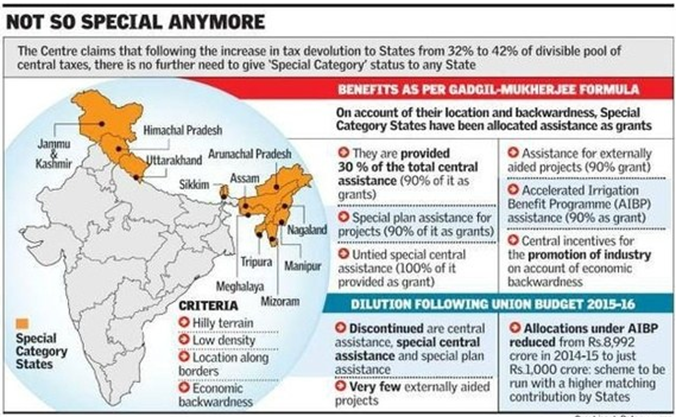
    • SCS is a classification given by Centre to assist in the development of those states that face geographical & socio-economic disadvantages like hilly terrains, strategic international borders, economic & infrastructural backwardness and non-viable state finances.
    • Introduced in 1969.
    • 5th Finance Commission sought to provide certain disadvantaged states with preferential treatment in the form of central assistance and tax breaks.
    • National Development Council grants the status of Special Category States.
    • Initially three states Assam, Nagaland and Jammu & Kashmir.
    • Since then eight more have been included – Arunachal Pradesh, Himachal Pradesh, Manipur, Meghalaya, Mizoram, Sikkim, Tripura and Uttarakhand.
    • Direct transfers subsequently abolished in 2013–14.
    • In 2013, Centrally Sponsored Schemes (CSS) were restructured into 66 schemes, including 17 flagship programmes with significant outlays.
    • In 2016, CSS restructured into only 28 schemes.
    • From 2017–18, the distinction between plan and non-plan expenditure removed,
    • Therefore the Gadgil formula is a thing of the past

    Related image

    The criteria for granting special status:

    • Hilly and difficult terrain
    • Low population density or sizeable share of tribal population
    • Strategic location along borders with neighbouring countries
    • Economic and infrastructural backwardness
    • Non-viable nature of state finances.

    Advantages of getting special category status

    • Preferential treatment in federal assistance and tax break
    • Significant excise duty concessions.
    • An interest-free loan with a rationalization of public expenditure based on the growth enhancing sectoral allocation of resources.
    • SCS don’t have a hard budget constraint as the central transfer is high.
    • SCSs avail the benefit of debt swapping and debt relief schemes (through the enactment of Fiscal Responsibility and Budget Management Act) which facilitate reduction of the average annual rate of interest.
    • 30% of the Centre’s gross budget goes to the SCSs.
    • In centrally sponsored schemes and external aid special category states get it in the ratio of 90% grants and 10% loans.
    • Income tax holidays for 10 years for setting up new industries, extendable by a further period of five years upon “substantial expansion” of the existing units.
    • Unspent money does not lapse and gets carry forward.

    Concerns regarding SCS

    • In the absence of the market, infrastructure, especially power, entrepreneurial skills and local resources, these incentives had hardly helped these states to industrialise.
    • Not much economic progress has been noticed among SCS.
    • Overwhelmingly dependent on central funding.
    • Benefits flow regularly without any accountability or performance monitoring of the states.
    • The amount of proceeds that states receive has increased after the 14th finance commission. So the structure does not seem to have any specific relevance in present context.
    • SCS has been reduced to a political rallying point.
    • Benefit of SCS may act as a stimulus but rest depends on the individual state policy.

    14th Finance Commission on SCS

    • The 14th FC does not make any mention of SCS.
    • Its recommendations have been inferred as removing SCS.
    • FC provided a fixed share of states in the net proceeds of the shareable central taxes at 42%.
    • It has been interpreted as removing the distinction between general states and SCS and grant funds on the basis of backwardness of states.
    • The interstate inequalities to be addressed through adequate tax devolutions and grants.
    • Only SCS status was restricted to the states of North-east and three hill states.
    • Under FC, some states to receive revenue deficit grants.
    • States now have much more fiscal space to spend on their own priorities, instead of depending on the centre.

    Fiscal Cooperative Federalism

    • The taxes are divided among the states on the principles of equity and efficiency.
    • From the 6th FC onwards, the FCs recommended only non-plan grants.
    • The plan component was under the Planning Commission.
    • Most of the discretionary transfers were made via the centrally sponsored schemes (CSS)
    • Large part of the total transfers were made outside the state budgets, by direct transfer of funds from the Consolidated Fund of India to the implementing agencies in the states.
    • Discretionary direct transfers have been abolished now.
    • CSS reduced in number and restructured
    • The distinction between plan and non-plan expenditure is no more.
    • The NCA has also since been done away with.

    Criticism received by the 14th FC

    • The 14th FC attracted severe criticisms on grounds of equity and efficiency.
    • Equalisation, equity and efficiency have always guided FC transfers
    • It ensured that same standards of delivery of public services extended to all states
    • This practice was aimed to prevent economic migrations across states.
    • But there are now no efficiency criteria for the transfers.
    • States, especially poor states, that have kept within their Fiscal Responsibility and Budget Management Act (FRBM) limits, have been made to suffer a cut in their shares instead of being rewarded for maintaining fiscal discipline.
    • Even when these states controlled spending at the cost of limiting their capital
      borrowings despite huge infrastructure deficits.
    • But there were no rewards for resisting populism.

    But are SCSs really suffering?

    • Whether there has been a reduction in the resources of SCSs?
    • Whether SCSs have managed to retain their relative advantages vis-a-vis other states?
    • For the SCSs as a whole, the total transfers during the first year under the XIV-FC over the previous year had actually increased by 24.7%, more than most other states.
    • The tax devolutions for the SCS increased by almost 90%.
    • The shares of SCS did not suffered any cut.
    • They had in fact registered much higher increases than under the previous commissions
    • Regarding the relative advantages enjoyed by the SCS, the latest restructuring of the CSS had made an important distinction between these and the other states, in terms of the funding pattern of these schemes.
    • For the “core of the core” schemes, it envisaged that the existing funding patterns would continue, which is 90:10 for the SCS between the centre and states, while other states have to bear a higher proportion of expenditure on their own.
    • For the “core” schemes, the restructured CSS states that the 90:10 formula between the centre and states would apply “for the 8 North Eastern States and 3 Himalayan States,” while it would be 60:40 for the other states.
    • Thus, the SCS continue to retain their relative advantages over the other states.
    • In other words, the category is far from being a thing of the past.

    Revisiting Special Category

    • The benefits of SCS are still there
    • Therefore it is important to correct the flaws in the mechanism.
    • There is a need to address the deep-rooted structural weaknesses that afflicted SCSs.
    • Re-examine the continuation of the SCS a state in perpetuity.
    • Adopting a target-based, time-bound arrangement that is focused on accountability, performance, and monitoring of achievements, with specific performance goals to be achieved by the beneficiary states for the benefits to continue.
    • We need a strategy in which funding would be just one essential element and not the most important part.
    • SCSs need supporting institutional set-up adequate to guide them towards predefined goals.
    • Monitoring and accountability and granting of the SCS to a state should be through performance expectation.
  • 11 August 2018 | Prelims Daily with Previous Year Questions

    Q.1) Consider the following statements about SCO Peace Mission Exercise, 2018:

    1. The exercise will be held in Chengdu, China.

    2. It will involve tactical level operations in an international counter-insurgency or counter-terrorism environment under SCO Charter.

    3. Indian and Pak Army will participate together for the first time in missions other than UN Peacekeeping.

    Which of the given statement is/are correct?

    a) Only 1

    b) 1 and 3

    c) 2 and 3

    d) All are incorrect

    Inspired by: [pib] Exercise SCO Peace Mission 2018

    https://www.civilsdaily.com/news/pib-exercise-sco-peace-mission-2018/

    Q.2) Consider the following statements about India Science Technology and Innovation portal:

    1. It is developed by Union HRD Ministry.

    2. The portal allows access to students about various fellowships, scholarships and funding and startup opportunities that India puts on their plate.

    Which of the given statements is/are correct?

    a) Only 1

    b) Only 2

    c) Both 1 and 2

    d) None of the above

    Answer: (b)

    Inspired by: Centre launches portal for scientific research, funding

    https://www.civilsdaily.com/news/centre-launches-portal-for-scientific-research-funding/

    Q.3) Consider the following statements about PARIVESH portal:

    1. It is developed by MoEFCC and NIC.

    2. It will use Geographic Information System (GIS) interface.

    3. The portal automates the entire process of submitting the application and tracking the status of such proposals at each stage of processing.

    Which of the given statements is/are correct?

    a) 1 and 2

    b) 2 and 3

    c) 1 and 3

    d) All are correct

    Inspired by: [pib] “PARIVESH” – an environmental single window hub for Environment, Forest, Wildlife and CRZ clearances launched

    https://www.civilsdaily.com/news/pib-parivesh-an-environmental-single-window-hub-for-environment-forest-wildlife-and-crz-clearances-launched/

    The facility of Geographic Information System (GIS) interface will help them in analyzing the proposal efficiently, automatic alerts (via SMS and emails) at important stages to the concerned officers, committee members and higher authorities to check the delays if any.

    Q.4) Hoplobatrachus tigerinus is a scientific name of which of the following species?

    a) Royal Bengal Tiger

    b) Tiger Shark

    c) Bullfrog

    d) Tasmanian Tiger

    Inspired by: Indian bull frog: the Andamans’ new colonizers

    https://www.civilsdaily.com/news/indian-bull-frog-the-andamans-new-colonisers/

    Q.5) Giant Metrewave Radio Telescope (GMRT) is located in which of the following Indian city?

    a) Pune

    b) Jaipur

    c) Surat

    d) Sriharikota

    Inspired by: Indian telescope spots distant radio galaxy

    https://www.civilsdaily.com/news/indian-telescope-spots-distant-radio-galaxy/


    For Solutions – Click Here

    Prelims Daily Archive – Click here


  • 13 August 2018 | High Relevance vs Low Relevance News

    Reading News for UPSC is utmost important and rising number of questions year on year in UPSC Prelims is a testimony of this

    We are starting a daily series where we will analyze news covered in The Hindu, Indian Express and other newspapers which are important from exam perspective and which are not

    Important news would have been covered in our daily news coverage in form of newscards.

    Unimportant ones will be mentioned here and a short description regarding why it is not relevant for the exam

    Click on news headlines to read the full news

    High relevance news

    More banks report tightening of credit standards, shows survey

    https://www.civilsdaily.com/news/more-banks-report-tightening-of-credit-standards-shows-survey/

    More and more banks are now coming in the ambit of NPA resolution process and the results can be seen in tightening of lending rules. Note important points for Mains.

    ISRO set to launch its TV channel

    https://www.civilsdaily.com/news/pib-isro-set-to-launch-its-tv-channel/

    A necessary step in order to promote science education in India. Note details about the channel. Can be asked in Prelims.

    Bill to allow proxy voting by NRIs passed by Lok Sabha

    https://www.civilsdaily.com/news/bill-to-allow-proxy-voting-by-nris-passed-by-lok-sabha/

    Till now, proxy voting was only available to service personnel. This demand was pending for a long time as people were unable to use their right to vote due to their settlement/work in foreign countries. Know important provisions as well as the pros and cons of the bill for Mains.

    [op-ed snap] Undoing a legacy of injustice

    https://www.civilsdaily.com/news/op-ed-snap-undoing-a-legacy-of-injustice/

    Delhi HC has given a historic decision by scrapping Begging Act. The editorial sums up all facts related to it. Must read for Mains.

    Low Relevance News

    CJI changes subject-wise roster in Supreme Court

    The Chief Justice of India has changed the subject-wise roster for judges in the Supreme Court

    The subject-wise roster was first implemented from February 5 this year after a press conference by four seniormost Supreme Court judges over “selective” allocation of cases to certain Benches by recent CJIs

  • [Burning Issue] 5G Technology

    Image result for 5g technology in india

    Why in News?

    In June 2018, The 5G committee of the Telecom Ministry recommended that 6,000 MHz of spectrum can be made available without delay for the next generation 5G mobile service

    About 5G

    • 5G is the fifth generation mobile network.
    • It’s a unified platform which is much more capable than previous mobile services with more capacity, lower latency, faster data delivery rate and better utilisation of spectrum.
    • The standards for the usage of 5G are defined and driven by 3rd Generation Partnership Project (3GPP).

    Timeline: Evolution from 1G to 5G

    • 1G: Launched in the 1980s. Analog radio signals and supported only voice calls.
    • 2G: Launched in the 1990s. Uses digital radio signals and supported both voice and data transmission with a BandWidth(BW) of 64 Kbps.
    • 3G: Launched in the 2000s. With a speed of 1 Mbps to 2 Mbps it has the ability to transmit telephone signal including digitised voice, video calls and conferencing.
    • 4G: With a peak speed of 100 Mbps-1 Gbps it also enables 3D virtual reality.
    • 5G: with a speed of more than 1Gbps,it is capable of connecting entire world without limits.

    Salient features

    • Capability: 5G will provide much faster mobile broadband service as compared to the previous versions and will provide support to previous services like mission critical communication and the massive Internet Of things(IoT).
    • Speed: With peak delivering rate of up to 20 Gbps and an average of 100Mbps, it will be much faster as compared to its predecessors.
    • Capacity: There will be up to 100 x increase in traffic capacity and network efficiency.
    • Spectrum usage: Will provide better usage for every bit of spectrum, from low bands below 1 GHz to high bands.
    • Latency: It’s expected to have lower latency with better instantaneous, real-time access of the data.
    • The 5G, like 4G LTE, also uses Orthogonal Frequency Division Multiplexing(OFDM) but the new 5G NR(New Radio)air interface will enhance OFDM and provide better flexibility in data delivery.

    Applications Of 5G technology

    • High-Speed mobile network: 5G will revolutionize the mobile experience with supercharged wireless network. Compared to conventional mobile transmission technologies, voice and high-speed data can be simultaneously transferred efficiently in 5G
    • Entertainment and multimedia : 5G can provide 120 frames per second, high resolution and higher dynamic range video streaming without interruption. Audiovisual experience will be rewritten after the implementation of the latest technologies powered by 5G wireless. Augmented Reality and virtual Reality services will be better experienced over 5G.
    • Internet of Things : IoT applications collects huge amount of data from millions of devices and sensors and thus requires an efficient network for data collection, processing, transmission, control and real-time analytics which 5G network is a better candidate.
    • Smart cities : Smart city application like traffic management, Instant weather update, local area broadcasting, energy management, smart power grid, smart lighting of street, water resource management, crowd management, emergency response etc can use a reliable 5G wireless network for its functioning.

    • Smart farming : 5G technology will be used for agriculture and smart farming in the future. Using smart RFID sensors and GPS technology, farmers can track the location of livestock and manage them easily. Smart sensors can be used for irrigation control, access control and energy management.

    • Mission critical applications : Like telemedicine services, remote control of critical infrastructure and vehicles. It has the potential to transform industries with highly reliable, low latency link.

    High-Level 5G India 2020 forum

    Government has constituted High-Level 5G India 2020 Forum with three Secretaries of key Ministries/Departments Telecom, Meity and DST, and also comprising renowned experts. The primary aims of the forum are:

    • early deployment of 5G in India.
    • A globally competitive product development and manufacturing ecosystem targeting 50% of India market and 10% of global market over next 5 to 7 years.

    Conclusion

    The new 5G technology is expected to launch at the beginning of 2019. With the government push for Digital India, the 5G technology can be a game changer. It can help in better service delivery, faster access to services and deeper penetration of digital services

  • Batch 3: CD Prime Test Series for Prelims 2019

    We are now accepting admissions for Batch 3

    Join Batch 3 of Test series here: Click2Join

    Click2View the detailed schedule of test series with complete booklist to be followed.


    We will be extending the discount on this batch till 2nd September (the date for the first test of this batch) keeping in mind interest of students who were awaiting prelims results to decide further course of action and now want to join a test series for Prelims 2019. This is also to ensure that students join before tests start and they stay regular with the schedule

    UPDATE #2

    We are upgrading the program further to provide you more Comprehensive Preparation

    Apart from the static subject videos, now we will also provide Economic Survey & Budget Analysis Videos covering key concepts and important terms for Prelims 2019.  Economic Survey analysis will be available from 2016 to 2018 covering trends in Indian Economy as well as key issues related to it.

    That makes the total video lectures to be 75 hours

    UPDATE  #1

    Demolish UPSC series
    We are releasing 60+ Hours of Advanced Video Lectures on Static subjects – Polity, History, Geography, Economy

    These cover the most important topics from prelims perspective

    Basic knowledge will be helpful in understanding these though it’s not mandatory
    CD remains committed to its students’ success. We are ready to go the extra mile to turn your dreams into reality.

    Join Batch 3 of Test series here: Click2Join


    Here is the detailed schedule of lectures:

    Importance of Economic Survey and Budget

    Economic Survey and Budget are the 2 most important documents that you will go through in your exam preparation.

    • Economic Survey discusses all the major government initiatives with the explanation.
    • If we go by the trend, every year around 20 questions in prelims and 7-8 questions in mains are directly related to the Economic Survey and Budget.
    • Questions in prelims paper stress on important phrases, key analysis, and technical terms. Hence they have to be thoroughly studied.
    • Almost mandatory to imbibe actual phrases used in Economic Survey to frame answers for Main Examination. for example, if a Question is asked on Banking sector problems in the mains exam, you can always quote the 4R recommendations of the 2016th economic survey.
    • Adding the important and relevant facts and figures significantly enhance your marks in General Studies Paper-III.
    • Deep knowledge of the current policies and programs of the government also help an aspirant to write meaningful Essays in UPSC Civil Services Main Examination. For example, Wiping every tear from every eye “Twin balance sheet problem”, “translating potential into actuality” “ Chakravuyh challenge” etc.
    • According to the new trend economy and the environment is going hand in hand. So questions can come from that perspective also.
    • Many statistics and schemes are now being asked in Prelims

    Watch the video to know how we ensure you get 120+ score in Prelims

    The only TS that is supervised by top rankers and provides personalized attention to students. Check out the 7 points that make it the best in the market.

    Follow the video below to understand what makes the TS unique. Our planning and execution remains perfect.

    https://www.youtube.com/watch?v=QWUJ-nQWqkE


    It goes without saying that Civilsdaily’s Flagship Test Series Program has created a name for itself. It is preferred among students in their advanced stages of preparation.
    Here is what ABHILASH BARANWAL, AIR 44, CSE-2017 had to say about CD

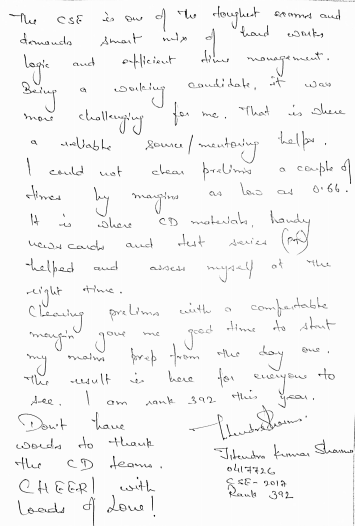
    Here is what  JITENDRA KUMAR SHARMA, AIR 392, CSE-2017 had to say –
    This year, we have upgraded the program to make it the best offering in the market.

    Introducing CD Prime TS 2019

    1. One comprehensive program – Our TS is a full-fledged course in itself! With a mix and match of various kinds of questions and detailed explanation wherever need. It is a very effective way of both, starting a subject and revising one.

    2. Telegram Groups moderated by to Toppers.  Mentorship taken to a whole new level. You will be helped at every step of the way.

    3. Introducing questions-types – Judging the quality of any TS is very subjective. While some will say its great, others will say its quality has decreased over time. That is why we have introduced the concept of question-types. They ensure consistency in quality. How? We have explained that in the end.

    4. Dedicated monthly CA Tests – Exclusive focus on Current Affairs(CA) by having dedicated monthly CA tests. Besides, exhaustively preparing for CA questions, it has helped students precisely figure out what their weaknesses are.  

    5. Tikdams and mastering the art of intelligent guesses – Tikdam Technique is an innovation by Dr. V(AIR 20) and has helped students gain additional marks. Our TS is the only TS that puts a conscious effort to build student’s risk-taking appetite.

    6. Subject and sub-subject Level Tagging – These tags will help you understand the importance of themes and revise other questions from them.

    7. Two-tier quality check  – Our questions pass through a rigorous true stage assessment criteria. The first being done by CD’s core content team with the final approval from a coterie of rankers.


    What are questions types 

    Wherever applicable, we will try to stick to the format decided below. It standardizes questions to a decent extent.

    A. Consolidation Questions
    These questions consolidate information from different topics to help you see concepts holistically and also aid retention.
    Eg. Consider this question. You would not have studied all the ‘Majorities’ together but under separate topics. This question will help you understand the concept in entirety.

    Consider the following questions on the types of Majority
    1. Special Majority of not less than 2/3 of the Members present and voting is required in the passage of a resolution under Art. 249 and Art. 312ONLY.
    2. Impeachment of the President requires Not less than 2/3 of the Members present and voting along with Majority of the Total Strength of the House.

    Which of the statements given above is/are correct?
    a)1
    b)2
    c)Both
    d)None

    Explanation – A very detailed account of the types of Majority is given here https://www.civilsdaily.com/types-of-majorities/
    Statement 1 is correct despite having ‘ONLY’ in it.

    B. Comparative Questions
    Comparative questions help you understand the relative differences between related topics. Consider the question below. Instead of asking a question on HC or SC separately, we have clubbed it together.

    Consider the following statements with respect to the appointment of judges of High Court & Supreme Court
    1. The minimum qualifications prescribed in the Constitution is same for judges of HC & SC.
    2. While SC judges are appointed by the President, HC judges are appointed by the SC.
    Which of the following is/are incorrect?
    a) 1 only
    b) 2 only
    c) Both 1 and 2
    d) None

    Explanation – 3 qualifications are common to both judges of HC and SC
    1. Citizen of India
    2. Judge of HC for 5 years
    3. Advocate in HC for 10 years
    In case of judges of SC, there is an additional qualification – If he/she is a distinguished Jurist in the opinion of the President. Judges of HC are also appointed by the President. The controversy around appointments has been in news very frequently. Please read – https://www.civilsdaily.com/story/judicial-appointments-conundrum-post-njac-verdict/

    C. Interactive Questions
    These questions will ask you to go through a concept/related concepts and reply back with comments. This will help you re-visit the entire concept rather than simply answer one specific aspect of the topic.

    Eg., consider the following question –
    The conversion of Ammonia (NH3) to nitrite (NO2-) and then to nitrates (NO3-) is called

    a) Nitrification
    b) Ammonification
    c) Assimilation
    d) Denitrification
    Answer A

    Explanation
    Nitrification
    In this process, the ammonia is converted into nitrate by the presence of bacteria in the soil. Ammonia is oxidized to form nitrites by bacteria such as Nitrosomonas species. Nitrates are converted into nitrates by Nitrobacter. This conversion is very important as ammonia gas is toxic for plants.
    Make a note of all the processes involved in the Nitrogen Cycle – nitrogen fixation, assimilation, ammonification, nitrification, and denitrification process.
    Leave their definitions/organisms involved in the comments.

    D. Star-marked/special questions
    These are advanced questions that are not from standard sources but relevant for the exam. These questions will help you build additional knowledge without going through specialized books.
    Eg. Questions on books by freedom-fighters, News not covered by the Hindu, IE, PIB but of very high importance in world affairs.

    Besides these, questions indirectly related to CA will also be asked. 

    Do I need to join a TS for prelims at all?

    Despite UPSC being unpredictable, prelims TS is the only program that can help you assess how your preparation is. Besides few questions that are directly asked from TS, it helps in developing a good understanding of how to prepare/what to prepare/what to prioritize and so on.

    In today’s hyper-competitive exam scenario, it’s almost impossible to clear the exam without a good TS in hand.

    Join Batch 3 of Test series here: Click2Join
  • 11 August 2018 | High Relevance vs Low Relevance News

    Reading News for UPSC is utmost important and rising number of questions year on year in UPSC Prelims is a testimony of this

    We are starting a daily series where we will analyze news covered in The Hindu, Indian Express and other newspapers which are important from exam perspective and which are not

    Important news would have been covered in our daily news coverage in form of newscards.

    Unimportant ones will be mentioned here and a short description regarding why it is not relevant for the exam

    Click on news headlines to read the full news

    High relevance news

    [op-ed snap] Decoding the DNA Bill

    https://www.civilsdaily.com/news/op-ed-snap-decoding-the-dna-bill/

    The editorial discusses all issues related to DNA profiling bill. Read and make notes for Mains.

    NASA poised to blast off first spacecraft to explore Sun

    https://www.civilsdaily.com/news/nasa-poised-to-blast-off-first-spacecraft-to-explore-sun/

    Any news of new space mission by either ISRO or NASA is very important for Prelims. Now space missions are also being asked in Mains.

    [pib] “PARIVESH” – an environmental single window hub for Environment, Forest, Wildlife and CRZ clearances launched

    https://www.civilsdaily.com/news/pib-parivesh-an-environmental-single-window-hub-for-environment-forest-wildlife-and-crz-clearances-launched/

    Important from prelims perspective.

    [pib] Exercise SCO Peace Mission 2018

    https://www.civilsdaily.com/news/pib-exercise-sco-peace-mission-2018/

    A match the column type question on various bilateral exercises might appear in Prelims 2019. Remember these exercises.

    Low Relevance News

    Centre issues new order on cantonment roads

    The Defence Ministry issued a fresh statement on the closure of cantonment roads, reiterating most of what it had said in its previous orders

    No important points from exam perspective.


  • 10 August 2018 | Prelims Daily with Previous Year Questions

    Q.1) One District One Product is an initiative of which of the following state?

    a) Madhya Pradesh

    b) Rajasthan

    c) Uttar Pradesh

    d) Kerala

    Inspired by: [pib] One District One Product

    https://www.civilsdaily.com/news/pib-one-district-one-product/

    Q.2) Consider the following statements about Train Captain Service:

    1. Train Captain will be the single person/leader responsible for coordinating the entire team and facilitating all services during the complete journey of the train.

    2. They will provide services only on selected trains like Rajdhani/ Shatabdi/ Duronto.

    3. Mostly Travelling Ticket Examiner (TTE) will be assigned charges of Train Captain Service.

    Which of the given statements is/are correct?

    a) Only 1

    b) 1 and 2

    c) 1 and 3

    d) All are incorrect.

    Inspired by: [pib] Train Captain Service

    https://www.civilsdaily.com/news/pib-train-captain-service/

    Q.3) Which of the given statements is/are correct about Global Innovation Index?

    1. It is released by World Economic Forum.

    2. It is based on data derived from several sources, including the International Telecommunication Union, the World Bank and the World Economic Forum.

    3. India’s rank on the Global Innovation Index (GII) has improved from 60 in 2017 to 57 in 2018.

    Select the correct codes from the following options.

    a) Only 1

    b) 1 and 2

    c) 2 and 3

    d) All are correct

    Inspired by: [pib] NITI Aayog to join hands with CII to develop a roadmap for Global Innovation Index

    https://www.civilsdaily.com/news/pib-niti-aayog-to-join-hands-with-cii-to-develop-a-roadmap-for-global-innovation-index/

    Q.4) Consider the following statement about Serious Fraud Investigation Office:

    1. It is the office under Ministry of Home Affairs.

    2. It is the co-ordinating agency with the Income Tax Department and the Central Bureau of Investigation.

    3. It is a multi-disciplinary organization having experts from financial sector, capital market, accountancy, forensic audit, taxation, law, information technology, company law, customs and investigation.

    4. It is based on the recommendation of Naresh Chandra Committee.

    Which of the given statements is/are correct?

    a) 1, 2 and 3

    b) 2, 3 and 4

    c) 1, 3 and 4

    d) All are correct.

    Inspired by: [pib] Serious Fraud Investigation Office

    https://www.civilsdaily.com/news/pib-serious-fraud-investigation-office/

    Q.5) Global Slavery Index is released by which of the following organisation?

    a) UNHCR

    b) UN-ECOSOC

    c) Walk Free Foundation

    d) Bill and Melinda Gates Foundation

    Answer: (c)

    Inspired by: [op-ed snap] The anti-trafficking Bill is necessary

    https://www.civilsdaily.com/news/op-ed-snap-the-anti-trafficking-bill-is-necessary/


    For Solutions – Click Here

    Prelims Daily Archive – Click here

  • 10 August 2018 | High Relevance vs Low Relevance News

    Reading News for UPSC is utmost important and rising number of questions year on year in UPSC Prelims is a testimony of this

    We are starting a daily series where we will analyze news covered in The Hindu, Indian Express and other newspapers which are important from exam perspective and which are not

    Important news would have been covered in our daily news coverage in form of newscards.

    Unimportant ones will be mentioned here and a short description regarding why it is not relevant for the exam

    Click on news headlines to read the full news

    High relevance news

    [pib] NITI Aayog to join hands with CII to develop a roadmap for Global Innovation Index

    https://www.civilsdaily.com/news/pib-niti-aayog-to-join-hands-with-cii-to-develop-a-roadmap-for-global-innovation-index/

    Read about GII and its details. Can be asked in Prelims.

    Explained: Thermal Battery

    https://www.civilsdaily.com/news/explained-thermal-battery/

    A first of its kind plant in the world has been set up in India and this itself makes the news important. Read about the thermal battery and all related details. Can be asked in Pre as well as Mains.

    [op-ed snap] Time for economic policy vigilance

    https://www.civilsdaily.com/news/op-ed-snap-time-for-economic-policy-vigilance/

    Indian economy is facing challenges from domestic as well as international front. The editorial discusses all these in detail and also recommends solutions to attain fiscal stability. Read and make notes for Mains.

    Low Relevance News

    Monsoon session: Most productive for Lok Sabha since 2000

    The Monsoon session of Parliament, which ended on Friday, was the “most productive” for Lok Sabha since 2000. The Lok Sabha worked for 110 per cent of the scheduled hours.

    No important details in news except the work done in the monsoon session.

  • 9 August 2018 | Prelims Daily with Previous Year Questions

    Q.1) Khangchendzonga Biosphere Reserve lies in which of the following state(s)?

    1. Sikkim

    2. Arunachal Pradesh

    3. Manipur

    4. Assam

    Select the correct codes:

    a) 1 and 2

    b) 2 ,3 and 4

    c) 2 only

    d) 1 only

    Inspired by: [pib] Khangchendzonga Biosphere Reserve becomes 11th Biosphere Reserve from India to be included in the World Network of Biosphere Reserves

    https://www.civilsdaily.com/news/pib-khangchendzonga-biosphere-reserve-becomes-11th-biosphere-reserve-from-india-to-be-included-in-the-world-network-of-biosphere-reserves/

    Q.2) Consider the following statements about Niryat Mitra Mobile App:

    1. It is developed by National Informatics Center.

    2. It provides wide range of information required to undertake international trade right from the policy provisions for export and import, applicable GST rate, available export incentives, tariff etc.

    Which of the given statements is/are correct?

    a) Only 1

    b) Only 2

    c) Both 1 and 2

    d) None of the above

    Inspired by: [pib] Mobile App Niryat Mitra

    https://www.civilsdaily.com/news/pib-mobile-app-niryat-mitra/

    Q.3) Which of the given statements about Discovered Small Fields Policy is not correct?

    a) It is aimed at extracting the Oil, Natural gas from the un-monetized small oil/gas discoveries that are available in the country.

    b) It provides an easy investment option for new and existing players with minimal risk.

    c) ONGC is the nodal agency to see its implementation.

    d) It provides for Easy bidding process; minimum requirements; transparent award; swift processing of approvals.

    Inspired by: [pib] Bid round –II under ‘Discovered Small Field Policy’

    https://www.civilsdaily.com/news/pib-bid-round-ii-under-discovered-small-field-policy/

    Q.4) Cosider the following statements about the Open Defecation Protocols under Swachh Bharat Missions:

    1. The SBM ODF+ protocol focuses on sustaining community/ public toilet usage by ensuring their functionality, cleanliness and maintenance.

    2. The SBM ODF++ will focus on achieving sanitation sustainability by addressing complete sanitation value chain, including safe containment, processing and disposal of fecal sludge and septage.

    Which of the given statements is/are correct?

    a) Only 1

    b) Only 2

    c) Both 1 and 2

    d) None of the above

    Inspired by: [pib] Swachh Survekshan 2019, ODF+ & ODF ++ Protocols and Swachh Manch Web Portal

    https://www.civilsdaily.com/news/pib-swachh-survekshan-2019-odf-odf-protocols-and-swachh-manch-web-portal/

    Q.5) A gradual, continuous change in the species composition between two ecosystems or communities of organisms across an environmental gradient is called as-

    a) Ecotype

    b) Ecocline

    c) Ecozone

    d) Ecotone

    Inspired by: [pib] Khangchendzonga Biosphere Reserve becomes 11th Biosphere Reserve from India to be included in the World Network of Biosphere Reserves

    https://www.civilsdaily.com/news/pib-khangchendzonga-biosphere-reserve-becomes-11th-biosphere-reserve-from-india-to-be-included-in-the-world-network-of-biosphere-reserves/


    For Solutions – Click Here

    Prelims Daily Archive – Click here


More posts
