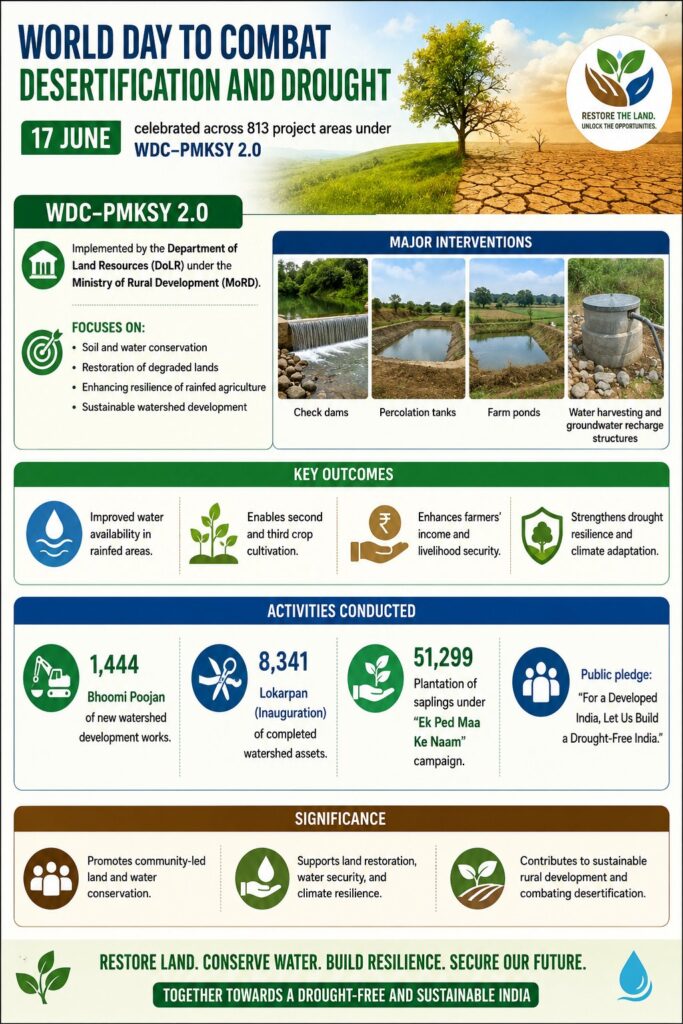
The World Day to Combat Desertification and Drought (17 June) was celebrated across 813 project areas under the WDC–PMKSY 2.0 (Watershed Development Component of Pradhan Mantri Krishi Sinchayee Yojana 2.0).
WDC–PMKSY 2.0
Implemented by the Department of Land Resources (DoLR) under the Ministry of Rural Development (MoRD).
Focuses on:
Soil and water conservation.
Restoration of degraded lands.
Enhancing resilience of rainfed agriculture.
Sustainable watershed development.
Major Interventions
Check dams, Percolation tanks, Farm ponds, Water harvesting and groundwater recharge structures
Key Outcomes
Improved water availability in rainfed areas.
Enables second and third crop cultivation.
Enhances farmers’ income and livelihood security.
Strengthens drought resilience and climate adaptation.
Activities Conducted
Bhoomi Poojan of 1,444 new watershed development works.
Lokarpan (Inauguration) of 8,341 completed watershed assets.
Plantation of 51,299 saplings under “Ek Ped Maa Ke Naam” campaign.
Public pledge: “For a Developed India, Let Us Build a Drought-Free India.”
Significance
Promotes community-led land and water conservation.
Supports land restoration, water security, and climate resilience.
Contributes to sustainable rural development and combating desertification.
[2016] What is/are the importance/importances of the ‘United Nations Convention to Combat Desertification’?
1. It aims to promote effective action through innovative national programmes and supportive international partnerships.
2. It has a special focus on South Asia and North Africa regions, and its Secretariat facilitates allocation of major portions of financial resources to these regions.
3. It is committed to a bottom-up approach, encouraging participation of local people in combating desertification.
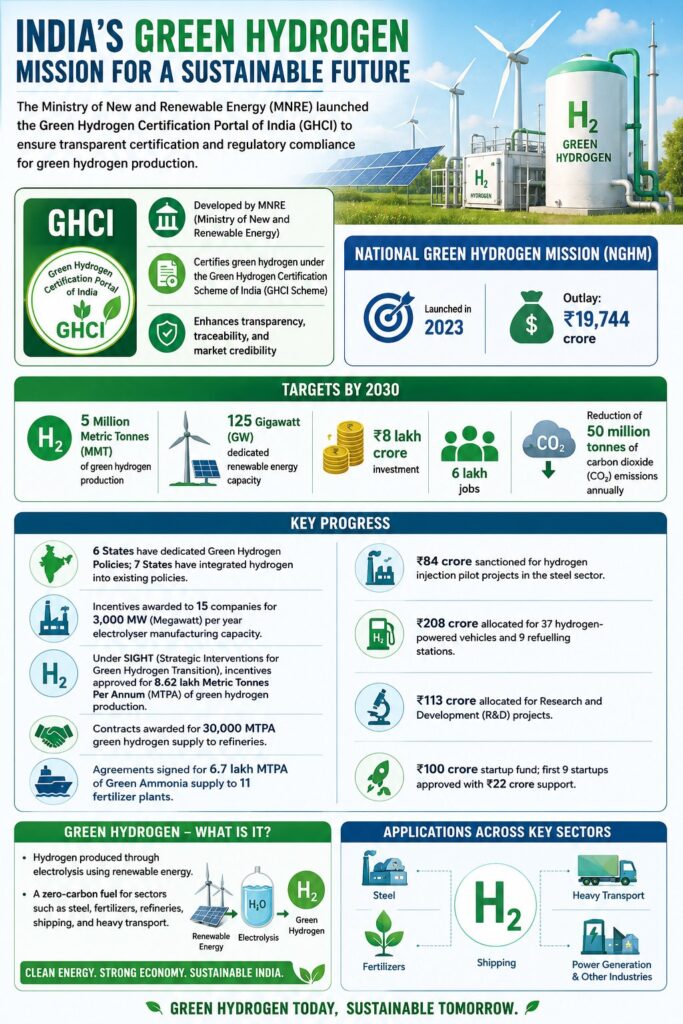
The Ministry of New and Renewable Energy (MNRE) launched the Green Hydrogen Certification Portal of India (GHCI) to ensure transparent certification and regulatory compliance for green hydrogen production.
GHCI
Developed by MNRE (Ministry of New and Renewable Energy).
Certifies green hydrogen under the Green Hydrogen Certification Scheme of India (GHCI Scheme).
Enhances transparency, traceability, and market credibility.
National Green Hydrogen Mission (NGHM)
Launched in 2023.
Outlay: ₹19,744 crore.
Targets by 2030
5 Million Metric Tonnes (MMT) of green hydrogen production.
125 Gigawatt (GW) dedicated renewable energy capacity.
₹8 lakh crore investment.
6 lakh jobs.
Reduction of 50 million tonnes of carbon dioxide (CO₂) emissions annually.
Key Progress
6 States have dedicated Green Hydrogen Policies; 7 States have integrated hydrogen into existing policies.
Incentives awarded to 15 companies for 3,000 MW (Megawatt) per year electrolyser manufacturing capacity.
Under SIGHT (Strategic Interventions for Green Hydrogen Transition), incentives approved for 8.62 lakh Metric Tonnes Per Annum (MTPA) of green hydrogen production.
Contracts awarded for 30,000 MTPA green hydrogen supply to refineries.
Agreements signed for 6.7 lakh MTPA of Green Ammonia supply to 11 fertilizer plants.
₹84 crore sanctioned for hydrogen injection pilot projects in the steel sector.
₹208 crore allocated for 37 hydrogen-powered vehicles and 9 refuelling stations.
₹113 crore allocated for Research and Development (R&D) projects.
₹100 crore startup fund; first 9 startups approved with ₹22 crore support.
Green Hydrogen
Hydrogen produced through electrolysis using renewable energy.
A zero-carbon fuel for sectors such as steel, fertilizers, refineries, shipping, and heavy transport.
[2023] With reference to green hydrogen, consider the following statements: 1. It can be used directly as a fuel for internal combustion. 2. It can be blended with natural gas and used as fuel for heat or power generation. 3. It can be used in the hydrogen fuel cell to run vehicles. How many of the above statements are correct?
PYQ Relevance[UPSC 2024] Discuss the implications of India’s ‘Look West Policy’ on its energy security, economic and strategic interests.Linkage: The question focuses on India’s engagement with West Asia through the lens of energy security, connectivity, and strategic interests. The article argues that instability in the Gulf, threats to the Strait of Hormuz, and growing Chinese influence directly affect India’s energy supplies, trade routes, diaspora interests, and regional strategy.
Mentor’s Comment
The U.S.-Iran ceasefire and the framework of a new diplomatic deal have shifted West Asia from the brink of a wider regional war toward negotiations. This is significant because, after months of direct military exchanges, attacks on strategic assets, and fears of disruption in the Strait of Hormuz, both sides have accepted that military force alone cannot produce a stable outcome. At the same time, this deal has not resolved the deeper geopolitical problem: the absence of an inclusive regional security architecture that accommodates Iran and balances competing ambitions of Israel, the Gulf states, the U.S., China, Russia, Pakistan, and India.
Why has military escalation failed to produce a durable settlement in West Asia?
Military Limits: Recent conflicts in Ukraine, Gaza, Lebanon, Sudan, and Iran demonstrate that military force cannot create a sustainable political settlement.
Strategic Stalemate: The U.S. faced setbacks on both strategic and political fronts, making continuation of full-scale war increasingly costly.
Iranian Resilience: Iran endured military, economic, and leadership pressures but remained capable of resisting attempts at coercion.
Political Necessity: Both sides ultimately accepted negotiations because neither could achieve decisive victory.
Historical Pattern: Major powers repeatedly supported conflicts through arms supplies and financial assistance instead of pursuing negotiations, prolonging instability.
Why did both the United States and Iran become willing to negotiate despite deep hostility?
American Constraints: Strategic and political setbacks reduced Washington’s capacity to sustain escalation.
Iranian Constraints: Military reverses, economic stress, and leadership pressures compelled Tehran to consider negotiations.
Hormuz Guarantee: Reports indicate that Iran agreed to keep the Strait of Hormuz open unconditionally.
Regional De-escalation: The proposed arrangement halts conflict across multiple fronts, including Lebanon.
Sanctions Relief: The framework reportedly includes lifting Iranian oil sanctions and unfreezing Iranian assets.
Nuclear Commitment: Iran commits not to produce nuclear weapons under the emerging understanding.
Future Negotiations: Discussions on nuclear enrichment are expected over the next 60 days, potentially reviving elements of the 2016 Joint Comprehensive Plan of Action (JCPOA).
Does the emerging deal resolve the Iran challenge or merely manage it?
Persistent Regional Influence: Iran remains a major strategic actor in West Asia despite the ceasefire.
Proxy Networks: Hezbollah, the Houthis, and Iraqi militias continue to provide Iran with regional leverage.
Missile Capability: Iran is expected to replenish its missile arsenal.
Strategic Geography: Iran retains the ability to threaten the Strait of Hormuz and conduct strikes against regional adversaries.
Unresolved Rivalries: The region is unlikely to return to the pre-conflict status quo.
Long-Term Contestation: Iran will continue to be viewed as a disruptive force by several regional actors.
Why does the ceasefire expose a fundamental contradiction between American diplomacy and Israeli strategy?
Regime Change Objective: Israel supported a strategy that sought outcomes closer to regime change in Iran.
American Pragmatism: The U.S. shifted toward a negotiated settlement once military escalation became unsustainable.
Abraham Accords Logic: President Donald Trump’s broader objective was to encourage Saudi Arabia, Qatar, and other states to normalize relations with Israel.
Interrupted Normalisation: Israeli military actions in Gaza, the West Bank, and Lebanon undermined regional support for normalization.
Israeli Distrust: Israel fears that the U.S. could abandon the deal after future negotiations or a Hezbollah-related crisis.
Mutual Accusations: Israel has accused the U.S. of compromising its objectives, despite having encouraged Washington’s involvement in the conflict.
West Bank Expansion: Israel has vowed to retain territories captured in Lebanon and expand settlements in the occupied West Bank.
How has the conflict exposed the fragility of Gulf security and regional alignments?
Security Dependence: Gulf states relied heavily on the American security umbrella.
Abraham Accords Participation: Several Gulf countries deepened engagement with Israel through bilateral agreements.
Economic Transformation: States such as Saudi Arabia invested heavily in technology-driven economic futures.
Global Ambitions: Gulf countries joined influential groupings such as BRICS and pursued greater middle-power roles.
Strategic Miscalculation: Gulf states overestimated their collective economic strength and underestimated internal divisions.
Regional Fragmentation: The Iran conflict revealed deep rivalries among Gulf monarchies.
Energy Vulnerability: The possibility of a Strait of Hormuz blockade exposed weaknesses in regional supply chains.
Saudi-UAE Divergence: Saudi Arabia and the UAE have pursued competing policies in Yemen, Sudan, and Somalia.
OPEC Frictions: The UAE’s actions have weakened cohesion within the Organization of the Petroleum Exporting Countries (OPEC).
Policy Reassessment: Gulf states are reconsidering regional security arrangements because the conflict divided rather than united them.
Why is the absence of an inclusive regional security architecture the central unresolved problem?
Exclusion of Iran: Existing security arrangements are built around containing Iran rather than integrating it.
Historical Lesson: The collapse of deterrence against Iran demonstrates that exclusionary security systems remain unstable.
European Parallel: NATO’s expansion toward Russia without creating a broader security framework contributed to the Ukraine conflict.
Security Deficit: No Gulf country can achieve lasting security without incorporating Iran into a regional order.
Repeated Instability: Cycles of conflict persist because underlying security concerns remain unresolved.
Institutional Gap: West Asia lacks a durable multilateral mechanism capable of managing rivalries and crises.
How are China and Russia positioned to benefit from the post-conflict regional order?
Strategic Advantage: China and Russia benefit when the U.S. becomes entangled in costly regional conflicts.
Chinese Assessment: Beijing views a weakened Trump administration as easier to manage.
Taiwan Implications: The Iran conflict provides China insights into responses to potential crises involving Taiwan.
Regional Ambitions: China seeks a larger strategic role in West Asia.
Gulf Constraints: Deep Gulf economic and security links with the U.S. limit the scope for immediate Chinese replacement.
Pakistan Factor: China is likely to strengthen ties with Pakistan because of its strategic geographic position.
Russian Continuity: Russia has long applied geopolitical logic that rewards states occupying critical strategic locations.
Why does the emerging regional order create new strategic challenges for India?
Initial Alignment: India initially appeared closer to Israel and the U.S. during the crisis.
Strategic Recalibration: India adopted a more balanced position when threats emerged to the Strait of Hormuz and maritime trade.
Energy Security: Stability in ties with Iran remains critical for India’s energy interests.
Maritime Dependence: Indian trade relies heavily on uninterrupted regional sea lanes.
Strategic Autonomy: India requires a balanced regional approach rather than alignment with any single bloc.
Economic Stakes: Gulf slowdown would affect Indian investments, employment opportunities, and remittance flows.
Chinese Expansion: A permanent Chinese maritime foothold in the region would weaken India’s strategic position.
American Accommodation Problem: U.S. inability to accommodate India’s broader regional interests creates policy challenges.
Pakistan’s Rising Relevance: Pakistan’s increasing importance to both China and the U.S. could complicate India’s regional diplomacy.
Dialogue Pressure: Growing U.S.-Pakistan proximity may generate pressure on India to resume unconditional engagement with Islamabad.
Conclusion
The ceasefire marks the end of an unsustainable phase of military confrontation, not the resolution of West Asia’s strategic crisis. The core problem is the absence of an inclusive regional security framework that accommodates Iran while balancing the interests of regional and external powers. Until that architecture emerges, every diplomatic breakthrough will remain vulnerable to renewed conflict, shifting alliances, and great-power competition.
Major Indian cities such as Delhi, Chennai, Bengaluru and Hyderabad experienced severe water shortages in the summer of 2026. India’s urban water crises persist not because cities lack water sources, but because governance continues to prioritize creating new supplies over fixing leakages, regulating groundwater, managing demand, ensuring transparency, and reusing wastewater. The problem is not a knowledge deficit; it is an execution deficit.
Why have seasonal water shortages evolved into a chronic urban governance crisis?
Recurring Emergencies: Urban water emergencies have become a regular feature rather than an exceptional summer event
Widespread Impact: Similar shortages were reported across Delhi, Chennai, Bengaluru and Hyderabad.
Severe Scarcity: In parts of New Delhi, large families survived on a single 20-litre water can per day.
Emergency Dependence: Delhi Jal Board deployed more than 1,000 tankers to manage shortages.
Systemic Failure: Long queues, tanker dependence, anxiety and protests indicate structural weaknesses rather than temporary disruptions.
Persistent Vulnerability: The same pattern repeats every year despite advance awareness of summer demand pressures.
Why are cities becoming more water-insecure despite having access to multiple water sources?
Multiple Sources: Cities obtain water from reservoirs, groundwater and interconnected supply systems.
Groundwater Depletion: Urban populations extract groundwater faster than aquifers can naturally replenish.
Local Buffer Erosion: Rivers, lakes and ponds that previously moderated water stress have deteriorated.
Encroachment: Urban water bodies have been occupied and degraded by expanding settlements.
Infrastructure Decay: Existing supply networks suffer from leakages and maintenance deficits.
Demand Expansion: Rapid urbanisation has increased consumption beyond the capacity of existing systems.
How does climate variability expose weaknesses that already exist in urban water systems?
Dual Extremes: Cities increasingly experience floods and droughts within the same annual cycle.
Reduced Storage Capacity: Urban ecosystems cannot retain water for future use.
Illustrative Example: Bengaluru experienced flooding after intense rains and tanker dependence a few weeks later.
Infrastructure Stress: Climate shocks reveal weaknesses that already exist in water governance systems.
Declining Resilience: Urban water systems have lost their capacity to absorb environmental fluctuations.
Why does the crisis persist even when cities know what the problem is?
Execution Deficit: Policymakers understand the causes of water stress but fail to implement corrective measures consistently.
Maintenance Neglect: Authorities search for new sources instead of repairing existing systems.
Regulatory Weakness: Groundwater extraction remains inadequately regulated and enforced.
Institutional Fragmentation: Urban planning, water supply and wastewater management operate in separate administrative silos.
Policy Bias: Infrastructure expansion receives greater attention than system efficiency.
Short-Term Responses: Crisis management frequently substitutes for long-term planning.
How can Indian cities shift from crisis-driven water management to long-term urban water security?
Solution
Key Measures Suggested
Problem Addressed
Transparent Emergency Planning
Prepare city-level water emergency plans; identify vulnerable areas; publicly disclose supply schedules, duration of shortages and distribution plans; provide regular updates.
Panic, uncertainty, poor crisis management and lack of public trust.
Recover Water Already Available
Detect and repair leakages; conduct ward-level audits; reduce Non-Revenue Water (NRW); set targets for loss reduction.
Massive distribution losses; article notes nearly 30% of water is lost before reaching consumers.
Demand Management and Conservation
Conduct water audits in campuses and commercial complexes; repair internal leaks; restrict non-essential consumption during peak months; promote community-led conservation.
Rising urban demand, wastage and unsustainable consumption patterns.
Equity-Centred Emergency Response
Regulate tanker supply and pricing; ensure minimum water access for vulnerable groups; provide temporary treatment support; spread awareness on safe storage and usage.
Unequal access, exploitation during shortages and disproportionate burden on low-income households.
Wastewater Reuse and Sewerage Reform
Upgrade sewage treatment plants; improve aeration, de-weeding and desludging; reduce sewer leakages; recycle treated wastewater; support groundwater recharge.
Water pollution, untreated wastewater discharge and underutilisation of recycled water.
Is the real challenge water scarcity or the absence of transparent and accountable management?
Information Deficit: Residents often receive little information regarding duration, frequency and extent of supply disruptions.
Uncertainty Costs: Lack of communication increases panic, rumours and public distrust.
Emergency Planning Gap: Cities lack clear and publicly available water emergency plans.
Vulnerability Mapping: Authorities rarely identify the most affected neighbourhoods before crises emerge.
Public Accountability: Regular public updates improve trust and strengthen compliance with conservation measures.
Governance Failure: Scarcity becomes more disruptive when management systems fail to communicate and coordinate effectively.
Why does recovering lost water offer greater returns than creating new water sources?
Non-Revenue Water: Nearly 30% of water is lost before reaching consumers.
Leakage Reduction: Repairing pipelines immediately increases available supply.
Cost Efficiency: Water recovery is often cheaper than developing new infrastructure.
Targeted Audits: Authorities can identify high-loss zones through local leak detection exercises.
Virtual Source Creation: Saved water functions as a new source without requiring new extraction.
Supply Reliability: Efficient distribution reduces dependence on emergency tanker operations.
Why must urban water policy shift from supply augmentation to demand management?
Large Consumers: Campuses and commercial complexes consume significant volumes of urban water.
Water Audits: Internal audits can identify avoidable wastage.
Basic Maintenance: Leak repairs generate substantial water savings.
Consumption Norms: Cities should establish clear limits during peak-demand months.
Community Participation: Resident welfare groups can promote conservation practices.
Behavioural Change: Demand reduction lowers pressure on stressed water systems.
Non-Essential Use Restrictions: Limiting discretionary consumption preserves supplies during emergencies.
Why does equitable crisis management matter as much as water availability?
Distributional Justice: Water shortages disproportionately affect low-income households.
Tanker Regulation: Authorities must regulate tanker pricing and distribution.
Basic Water Security: Emergency systems should guarantee minimum water access.
Temporary Treatment Support: Areas facing contamination require interim treatment facilities.
Safe Storage Communication: Public guidance reduces health risks during shortages.
Equity Imperative: Urban water security depends on access as much as availability.
Why is wastewater reuse the missing link in urban water security?
Resource Recovery: Treated wastewater can augment urban water supplies.
Sewerage Integrity: Leak detection prevents contamination and water quality deterioration.
Conclusion
India’s urban water crisis reflects a governance failure more than a resource shortage. Cities already possess the technical knowledge required to address leakages, groundwater depletion, excessive demand and wastewater mismanagement. Water security requires a shift from emergency tanker-driven responses to transparent planning, institutional accountability and efficient management of existing resources.
UPSC Relevance
[UPSC 2023] Why is the world today confronted with a crisis of availability of and access to freshwater resources?
Linkage: PYQ examines the structural causes behind freshwater scarcity and unequal access, which lie at the core of India’s recurring urban water crises. The article argues that urban water shortages stem not merely from inadequate water availability but from multiple reasons.
The National Council of Educational Research and Training (NCERT) restored the original image of the iconic Mohenjo-daro bronze figurine in a Class 9 textbook after an earlier version had shaded its bare torso, reviving debates over cultural representation and historical interpretation.
About the Figurine
A bronze statuette discovered at Mohenjo-daro (1926), dating to the Indus Valley Civilization (c. 2500 BCE).
About 10.5 cm tall, created using the lost-wax casting technique.
Depicts a young female figure adorned with numerous bangles and ornaments.
Why is its Identity Contested?
Archaeologist John Marshall identified it as a “nautch girl” (dancing girl) based on posture and appearance.
However, scholars argue there is no archaeological evidence that she was a professional dancer.
Historian Upinder Singh notes that the figure “may not have been dancing at all.”
Archaeologist Gregory L. Possehl also questioned the dancer interpretation.
Partition and Ownership Debate
After Partition, around 12,000 Harappan artefacts in Delhi became subjects of dispute between India and Pakistan.
Both countries agreed to a 50:50 division of artefacts from Mohenjo-daro and Chanhu-daro.
Pakistan chose the “Priest King” figurine over the Dancing Girl, reportedly due to concerns over the latter’s nudity.
The Dancing Girl remains in India and is viewed by many scholars as part of the shared heritage of South Asia.
Significance
Demonstrates the advanced metallurgical skills of the Indus Valley Civilization.
Highlights how colonial interpretations and contemporary moral values shape our understanding of the past.
Reflects debates on heritage ownership, gender, modesty, and cultural identity.
Value Addition
Lost-Wax Casting Technique: A metal casting process in which a wax model is covered with clay; molten metal replaces the melted wax to create the final sculpture.
The Dancing Girl is one of the most iconic artistic representations of the Indus Valley Civilization.
[2025] The famous female figurine known as ‘Dancing Girl’, found at Mohenjo-daro, is made of
Researchers from India and Japan used the Gamma Ray Astronomy PeV EnergieS phase-3 (GRAPES-3) telescope to analyse 22 years of muon data, enabling real-time monitoring of changes in the Earth’s upper atmosphere.
What is GRAPES-3?
GRAPES-3 (Gamma Ray Astronomy PeV EnergieS phase-3) is a muon telescope and cosmic-ray observatory located at Ooty, Tamil Nadu.
It detects muons, rather than visible light.
It is designed to study Cosmic rays, Solar magnetic fields, Space weather, and Atmospheric processes.
What are Muons?
Muons are high-energy subatomic particles produced when cosmic rays collide with atoms in the Earth’s upper atmosphere.
They can penetrate deep into the Earth’s surface due to their high energy.
How does GRAPES-3 Work?
Comprises 16 detector modules.
Each module contains 232 proportional counters filled with argon-methane gas and a tungsten wire.
Passing muons generate electrical pulses, recorded as “hits.”
Four layers of detectors arranged at right angles help determine the trajectory and angle of incoming muons.
Reinforced concrete layers filter out low-energy particles, allowing only high-energy muons to be detected.
Significance
Enables real-time monitoring of upper atmospheric temperature changes.
Helps study the Sun’s magnetic field and space weather.
Improves understanding of cosmic-ray interactions with Earth’s atmosphere.
Contributes to research in astroparticle physics and atmospheric science.
Value Addition
Cosmic Rays: High-energy charged particles originating from outer space.
Space Weather: Variations in the space environment caused by solar activity that can affect satellites, communication systems, and power grids.
[2017] The terms ‘Event Horizon’, ‘Singularity’, ‘String Theory’ and ‘Standard Model’ are sometimes seen in the news in the context of
[A] Observation and understanding of the Universe
[B] Study of the solar and the lunar eclipses
[C] Placing satellites in the orbit of the Earth
[D] Origin and evolution of living organisms on the earth
India’s southwest monsoon rainfall deficit widened to 35%, with Central India recording a 61% deficit, as the monsoon stalled before reaching Mumbai. The Centre has placed around 150 to 200 districts under priority monitoring and directed States to prepare crop-wise contingency plans.
Key Highlights
All-India rainfall deficit: 35%.
Regional deficits: Northwest India: +5%, East & Northeast India: -43%, Central India: -61%, and Southern Peninsula: -14%
Monsoon reached Kerala on 4 June, but its advance weakened near Mumbai.
Around 150 to 200 districts under priority monitoring.
Government encouraging a shift towards cotton and pulses.
Reservoir storage stood at 30.4% of capacity, compared to 25.1% average during previous El Niño years.
Why has the Monsoon Stalled?
Anticyclonic circulation north of Mumbai blocked monsoon progression.
Influence of mid-latitude westerly systems.
Madden-Julian Oscillation (MJO) is currently in an unfavourable phase.
Next monsoon pulse may strengthen with a low-pressure system over the Bay of Bengal.
El Niño Concerns
El Niño: Periodic warming of the central and eastern Pacific Ocean that generally suppresses the Indian monsoon.
U.S. National Oceanic and Atmospheric Administration (NOAA): Issued El Niño advisory on 11 June. 63% probability of a very strong El Niño by winter.
World Meteorological Organization (WMO):80% probability of El Niño developing between June and August.
India Meteorological Department (IMD):
Seasonal rainfall forecast revised from 92% to 90% of the Long Period Average (LPA).
Assigned a 60% probability of a deficient monsoon, the most pessimistic pre-season forecast since 2015.
No positive Indian Ocean Dipole (IOD) expected to offset El Niño effects.
Significance
Threatens kharif sowing and agricultural output.
May increase food inflation and rural distress.
Necessitates timely contingency planning and climate-resilient agriculture.
Highlights the need for improved water management and drought preparedness.
Value Addition
Long Period Average (LPA): Average rainfall during 1971-2020, used as the benchmark for monsoon forecasts.
Indian Ocean Dipole (IOD): Difference in sea surface temperatures between the western and eastern Indian Ocean that can influence Indian monsoon rainfall.
[2017] With reference to ‘Indian Ocean Dipole (IOD)’ sometimes mentioned in the news while forecasting Indian monsoon, which of the following statements is/are correct? 1. IOD phenomenon is characterised by a difference in sea surface temperature between tropical Western Indian Ocean and tropical Eastern Pacific Ocean. 2. An IOD phenomenon can influence an El Nino’s impact on the monsoon. Select the correct answer using the code given below:
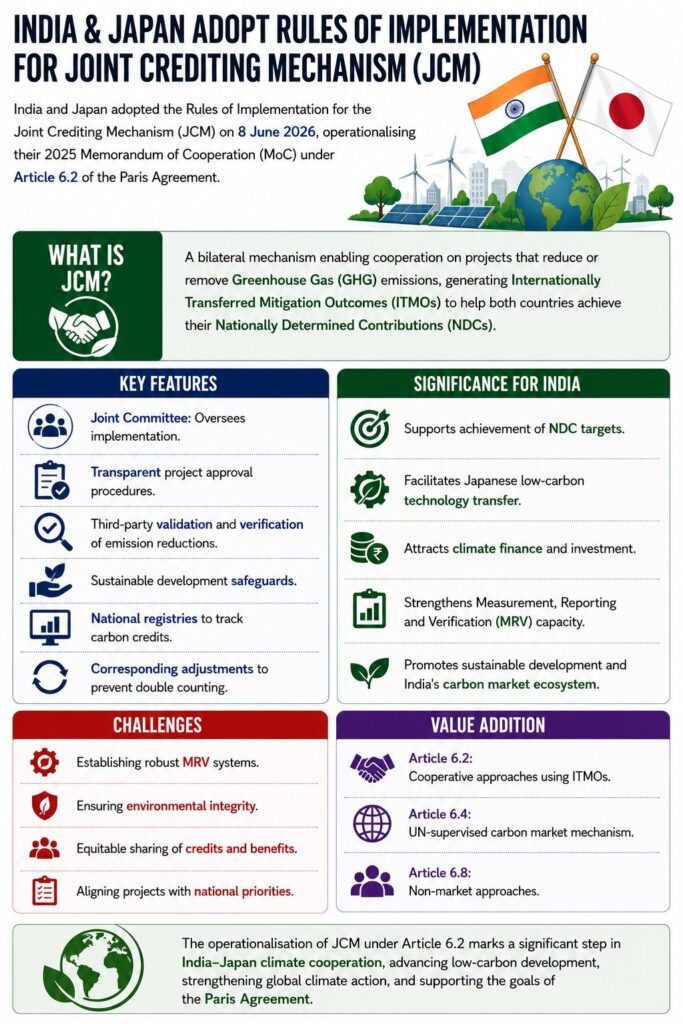
India and Japan adopted the Rules of Implementation for the Joint Crediting Mechanism (JCM) on 8 June 2026, operationalising their 2025 Memorandum of Cooperation (MoC) under Article 6.2 of the Paris Agreement.
What is JCM?
A bilateral mechanism enabling cooperation on projects that reduce or remove Greenhouse Gas (GHG) emissions, generating Internationally Transferred Mitigation Outcomes (ITMOs) to help both countries achieve their Nationally Determined Contributions (NDCs).
Key Features
Joint Committee: Oversees implementation.
Transparent project approval procedures.
Third-party validation and verification of emission reductions.
Sustainable development safeguards.
National registries to track carbon credits.
Corresponding adjustments to prevent double counting.
Significance for India
Supports achievement of NDC targets.
Facilitates Japanese low-carbon technology transfer.
Attracts climate finance and investment.
Strengthens Measurement, Reporting and Verification (MRV) capacity.
Promotes sustainable development and India’s carbon market ecosystem.
[2025] Consider the following statements: Statement I: Article 6 of the Paris Agreement on climate change is frequently discussed in global discussions on sustainable development and climate change. Statement II: Article 6 of the Paris Agreement on climate change sets out the principles of carbon markets. Statement III: Article 6 of the Paris Agreement on climate change intends to promote inter-country non-market strategies to reach their climate targets. Which one of the following is correct in respect of the above statements?
[A] Both Statement II and Statement III are correct and both of them explain Statement I
[B] Both Statement II and Statement III are correct but only one of them explains Statement I
[C] Only one of the Statements II and III is correct and that explains Statement I
[D] Neither Statement II nor Statement III is correct
Most aspirants don’t fail in Mains because they lack content.
They fail because they keep repeating the same mistakes in answer writing, mistakes that silently reduce marks across every GS paper.
The problem is that these mistakes often go unnoticed.
You write more answers. You attend more tests. You work harder.
But your scores remain average.
In this session, I will break down the 5 most common answer writing mistakes that keep aspirants stuck in the average range and explain how to fix them systematically.
What I will cover
1. Why Good Content Doesn’t Always Translate Into Good Marks
• The gap between preparation and presentation • Why knowledgeable aspirants often score average marks • Understanding what evaluators actually reward
2. The Fatal 5 Mistakes in UPSC Answer Writing
Including:
• Not addressing the exact demand of the question • Weak introductions and generic conclusions • Poor structure and flow of arguments • Using content as filler instead of analysis • Mismanaging time and space across answers
These are mistakes that cost marks irrespective of how much you’ve studied.
3. How to Diagnose Your Own Answer-Writing Problems
• Identifying patterns in low-scoring answers • Understanding where marks are being lost • Building awareness of recurring mistakes
Most improvement begins with correct diagnosis.
4. Simple Fixes That Create Visible Score Improvement
• Better structuring techniques • Improving clarity and articulation • Writing more examiner-friendly answers • Converting the same content into higher-scoring responses
Small changes can create surprisingly large gains.
5. Building Better Answer-Writing Habits
• What to focus on during daily practice • How to improve without writing hundreds of answers • Developing a process-oriented approach to Mains preparation
Because answer writing is a skill, and skills can be improved systematically.
Who Should Attend :
• Aspirants preparing for UPSC Mains 2026
• Candidates whose answer writing scores have plateaued
• Students looking to improve GS marks through better execution
It will be a 45 minute session, post which we will open up the floor for all kinds of queries which a beginner must have. No questions are taboo and Vijaya Ma’am is known to be patiently solving all your doubts.
Join us for a Zoom session on 17th June at 5PM. This session is a must attend for you If you are attempting UPSC for the first time or have attempted earlier and now preparing for 2027, then it is going to be a valuable session for you too.
See you in the session”
Register for the session for a complete in-depth UPSC Prep
(Don’t wait—the next webinar/session won’t be until End June’26)
These masterclasses are packed with value. They are conducted in private with a closed community. We rarely open these webinars for everyone for free. This time we are keeping it for 300 seats only.
The Allahabad High Court’s ruling in Chander Pal Singh v. State of Uttar Pradesh has revived debate on the misuse of preventive detention and preventive proceedings in India. The judgment is significant because it directly questions the routine use of extraordinary executive powers against citizens without substantive criminal charges.
Why has the Allahabad High Court judgment become a significant intervention in preventive detention jurisprudence?
The Allahabad High Court, in Chander Pal Singh, criticized the routine misuse of preventive proceedings by police and executive magistrates in Uttar Pradesh. The Court observed that powers intended to prevent threats to public order were being employed to detain individuals without substantive criminal charges, resulting in unjustified deprivation of personal liberty. The judgment seeks to strengthen accountability mechanisms and reaffirm constitutional safeguards against arbitrary state action.
Judicial Intervention: The Court simultaneously addressed an individual case and a broader systemic problem involving preventive proceedings.
Liberty Concerns: The judgment described the situation as a “highly irresponsible” deprivation of personal liberty.
Structural Reform: It proposed guidelines to regulate preventive powers and strengthen accountability.
Constitutional Significance: It re-emphasized Article 21 protections against arbitrary deprivation of liberty.
First Major Pushback: The ruling attempts to impose personal accountability on officials responsible for unlawful detention, a relatively rare judicial approach.
How are preventive powers intended to function and how are they allegedly being misused?
Preventive Purpose: Preventive powers allow the State to intervene before a crime occurs when there is reasonable apprehension of threat to public order.
Exceptional Nature: Such powers are intended for extraordinary situations involving potential disturbances.
Routine Application: The Court observed that authorities increasingly employ these powers as routine administrative tools.
Absence of Criminal Charges: Individuals are often detained without substantive criminal accusations.
Minor Disputes: Authorities reportedly invoke preventive proceedings even in neighbourhood and property disputes.
Executive Overreach: Police officers and executive magistrates allegedly use preventive provisions based on weak or speculative apprehensions.
What constitutional principles are involved in the debate on preventive detention?
Article 21: Ensures protection of life and personal liberty except according to procedure established by law.
Article 22: Provides safeguards against arbitrary arrest and detention while permitting preventive detention under specific circumstances.
Rule of Law: Requires legality, reasonableness and non-arbitrariness in state action.
Natural Justice: Supports fair hearing and procedural safeguards.
Proportionality: Restricts excessive state action beyond legitimate objectives.
Constitutional Morality: Balances public order with civil liberties and democratic dissent.
What facts in the Chander Pal Singh case exposed systemic concerns?
Petitioner: Chander Pal Singh, a physically challenged Dalit advocate.
Immediate Cause: He was arrested following a petty dispute with a neighbour.
Illustration of Misuse: The Court treated the case as representative of broader misuse of preventive powers.
Administrative Pattern: The judgment highlighted recurring executive reliance on preventive incarceration rather than ordinary criminal procedures.
How serious is the scale of preventive proceedings highlighted by the Court?
Magnitude: Around 2,500 individuals were reportedly subjected to preventive detention proceedings in Ghaziabad between May 2025 and April 2026.
Policy Failure: These actions occurred despite a 2021 State policy intended to guide and regulate such powers.
Systemic Nature: The data indicates that misuse is not isolated but institutional in scale.
Governance Challenge: The figures suggest preventive provisions may have become a substitute for regular legal processes.
What reforms and safeguards did the Court seek to introduce?
Executive Justification: Requires executive magistrates to justify preventive detention decisions.
Constitutional Review: Encourages constitutional challenges against unlawful detention.
Appellate Scrutiny: Promotes higher judicial review of compensation mechanisms.
Compensation Framework: Strengthens remedies available to victims of unlawful detention.
Administrative Accountability: Enables recovery of compensation from salaries of responsible magistrates and/or police officers after disciplinary proceedings.
Deterrence Effect: Seeks to discourage arbitrary use of preventive powers.
How could the ruling affect protest-related and dissent-related detentions?
Communal Tension Claims: The Court criticized reliance on vague references to “communal tensions” to justify incarceration.
Bond Requirements: It questioned the practice of imposing prohibitively expensive bonds for release.
Protection of Dissent: The judgment rejects the notion that maintaining peace can justify silencing dissent.
Sonam Wangchuk Context: Though not directly related to his detention under the NSA, the ruling implicitly critiques similar uses of preventive powers against activists.
Recent Detentions: The principles may apply to persons detained under Sections 126 and 170 of the BNSS without valid grounds.
Democratic Significance: Reinforces that public order cannot become a blanket justification for restricting civil liberties.
What challenges may hinder implementation of the Court’s directions?
Administrative Reluctance: Governments have historically been hesitant to penalize officials for misuse of authority.
Institutional Incentives: Executive magistrates are part of the State administration and often operate within bureaucratic hierarchies.
Career Pressures: Officials may prioritize maintaining “peace” as defined by the State.
Weak Enforcement: Accountability provisions may remain ineffective without sustained judicial monitoring.
Structural Dependence: The executive and law enforcement apparatus often function in close coordination, reducing internal checks.
Value Addition
How does the Constitution regulate preventive detention under Article 22?
Constitutional Architecture: Balances state security concerns with minimum procedural safeguards for personal liberty.
Constitutional Recognition: Article 22(3)-22(7) explicitly permits preventive detention while prescribing safeguards against arbitrary exercise of power.
Exceptional Nature: Preventive detention operates outside ordinary criminal justice procedures because detention occurs based on anticipated threats rather than proven offences.
Suspension of Standard Criminal Procedure Rights
Exemption from Article 22(1) and 22(2): Preventive detainees do not enjoy certain protections available to ordinary arrestees.
Grounds of Arrest: Authorities are not required to provide immediate disclosure in the same manner as ordinary criminal arrests.
Legal Representation: Detainees do not possess an absolute right to consult a lawyer of their choice at the detention stage.
Magisterial Production: Requirement of production before a magistrate within 24 hours does not apply to preventive detention cases.
Procedural Safeguards Retained by Detainees
Communication of Grounds: Article 22(5) requires authorities to communicate grounds of detention as soon as possible.
Representation against Detention: Authorities must provide the earliest opportunity to challenge the detention order through representation.
Natural Justice Principle: Ensures minimum procedural fairness despite the exceptional nature of detention.
State Privilege of Non-Disclosure
Public Interest Exception: Article 22(6) permits withholding information whose disclosure is considered against public interest.
How has the judiciary evolved safeguards against misuse of preventive detention?
Procedural Rigidity: Ensures strict compliance with constitutional safeguards
Technical Compliance: Courts routinely invalidate detention orders for procedural violations.
Delay in Representation: Unreasonable delay in considering detainee representations can render detention unconstitutional.
Burden on State: Authorities must strictly adhere to statutory requirements.
Subjective Satisfaction Doctrine
Credible Material: Executive authorities must rely on relevant and credible evidence.
Genuine Threat Assessment: Detention must be based on actual apprehension of future harm.
Protection against Arbitrariness: Courts reject detention based on vague suspicions or unsupported allegations.
Proximity Principle
Live Link Requirement: Past conduct must have a direct and continuing connection with the present threat.
Stale Incidents Insufficient: Old criminal records alone cannot justify fresh detention orders.
Future-Oriented Assessment: Preventive detention must address imminent risks rather than punish past actions.
Conclusion
Preventive detention may be constitutionally permissible, but its legitimacy depends on strict procedural safeguards and judicial oversight. The Allahabad High Court’s intervention reiterates that public order cannot come at the cost of personal liberty, and that accountability is essential to preserving the rule of law.
![🔴[UPSC Webinar for 2027] By Vijaya Ma’am, Civilsdaily IAS | The Fatal 5 Mistakes That Keep UPSC Mains Answers Average | Join on 17th June at 5PM](https://d18x2uyjeekruj.cloudfront.net/wp-content/uploads/2026/06/VIJAYA-thumb1-1.png)