💥Join UPSC 2027,2028 Mentorship (July Batch) + XFactor Notes & Microthemes PDF

Search results for: “”

  • [Burning Issue] US’s recognition of West Bank settlements


    • The United States no longer thinks Israeli settlements in the West Bank violate international law.
    • This recognition of the Jewish settlements is yet another indication that the two-state solution is dead.

    What are the West Bank settlements?
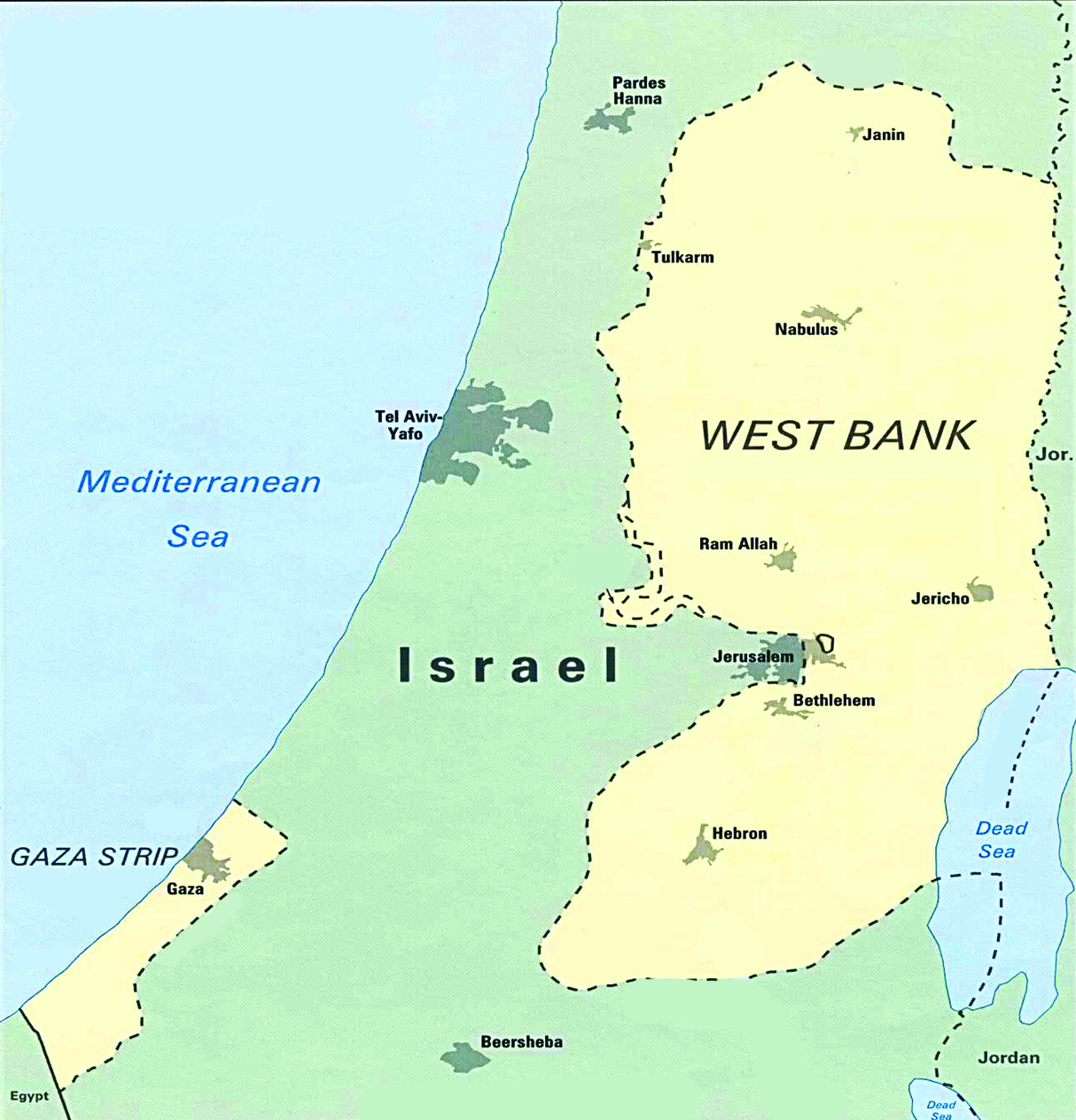
    • The West Bank, a patch of land about one and a half times the size of Goa, was captured by Jordan after the 1948 Arab-Israeli War.
    • Israel snatched it back during the Six-Day War of 1967, and has occupied it ever since.
    • It has built some 130 formal settlements in the West Bank, and a similar number of smaller, informal settlements have mushroomed over the last 20-25 years.
    • Over 4 lakh Israeli settlers many of them religious Zionists who claim a Biblical birthright over this land — now live here, along with some 26 lakh Palestinians.

    Are these Israeli settlements illegal?

    • To the vast majority of the world’s nations, yes.
    • The UN General Assembly, the UNSC, and the International Court of Justice have said that the West Bank settlements are violative of the Fourth Geneva Convention.
    • Under the Oslo Accords of the 1990s, both Israel and the Palestinians agreed that the status of settlements would be decided by negotiations. But the negotiations process has been all but dead for several years now.
    • Israel walked into East Jerusalem in 1967, and subsequently annexed it. For Israel, Jerusalem is non-negotiable.
    • The Palestinians want East Jerusalem as the capital of their future state. Most of the world’s nations look at it as occupied territory.

    What is Fourth Geneva Convention?

    • Under the Fourth Geneva Convention (1949), an occupying power “shall not deport or transfer parts of its own civilian population into the territory it occupies”.
    • Under the Rome Statute that set up the International Criminal Court in 1998, such transfers constitute war crimes, as does the “extensive destruction and appropriation of property, not justified by military necessity and carried out unlawfully and wantonly”.

    American stand on Palestine

    • In 1978, when Jimmy Carter was President, the State Department concluded that the Israeli settlements were “inconsistent with international law”.
    • Soon after taking office in 1981, President Ronald Reagan said he did not agree — even though the establishment of new Israeli communities in Palestinian territory was indeed “unnecessarily provocative”.
    • Thereafter, the United States took the line that the settlements were “illegitimate”, not “illegal”, and repeatedly blocked UN resolutions condemning Israel for them.
    • In 2016, President Barack Obama broke with this policy — and the US did not veto a resolution that called for an end to Israeli settlements.
    • The establishment of Israeli civilian settlements in the West Bank is not per se inconsistent with international law.

    US’s present stand on Palestine

    • Indeed, Trump’s recognition of the settlements means little compared to allowing Israel to build those settlements over a 52-year period.
    • Likewise, the U.S. has continued to provide aid to Israel to the tune of more than $3 billion annually, as well as unflinching military and diplomatic support — including from official sanctions over the settlements at the U.N.
    • The U.S. has also allowed its private citizens to give tax-free donations to charities and organizations that support the settlements.
    • So, while the Trump administration has gone a step further, it is not as drastic a departure from past administrations as it would seem.

    Impacts of the development

    • Those who support the right of Israelis to settle in the West Bank are likely to see the decision as an endorsement.
    • It will boost PM Benjamin Netanyahu, who has promised sweeping annexations in the West Bank.
    • However, Pompeo did not come out as directly backing the settlers.
    • The hard truth is there will never be a judicial resolution to the conflict, and arguments about who is right and wrong as a matter of international law will not bring peace.
    • This is a complex political problem that can only be solved by negotiations.

    Implications for Palestinians

    • What does change in a significant way, however, is what the recognition of settlements means for the status of the territory and of the government that administers it.
    • While the new U.S. policy does not alter the legal status of the Palestinian territories, Israel’s PM welcomed the change and said that it “reflects an historical truth — that the Jewish people are not foreign colonialists” in the West Bank.
    • If it is not military occupation, which undoubtedly prohibits the type of settlement that Israel has engaged in, then it is something else that Israel must clarify its position and intentions over the territory.
    • This puts the onus for fulfilling the political rights of the Palestinians back on Israel.

    India’s stance on Palestine
    • Sticking to its historic stance towards the Palestinian cause India was among 166 nations that endorsed Palestinian “right to self-determination”.
    • According to the MEA website, India’s support for the Palestinian cause is an integral part of the nation’s foreign policy.
    • In 1974, India became the first non-Arab country to recognise Palestine Liberation Organisation (PLO) as the sole and legitimate representative of the Palestinian people.
    • In 1988, India became one of the first countries to recognise the Palestinian State. While, in 1996, India opened its representative office in Gaza, which was later shifted to Ramallah in 2003.
    • India also co-sponsored the draft resolution on “the right of Palestinians to self-determination” during the 53rd session of the UNGA and voted in favour of it.
    • It also voted in favour of UNGA Resolution in October 2003 against construction of the separation wall by Israel.
    • In 2011, India voted for Palestine becoming a full member of the UNESCO.
    • At the Asian African Commemorative Conference in April 2015, India supported the Bandung Declaration on Palestine. It also backed the installation of the Palestinian flag at UN’s premises in September 2015.
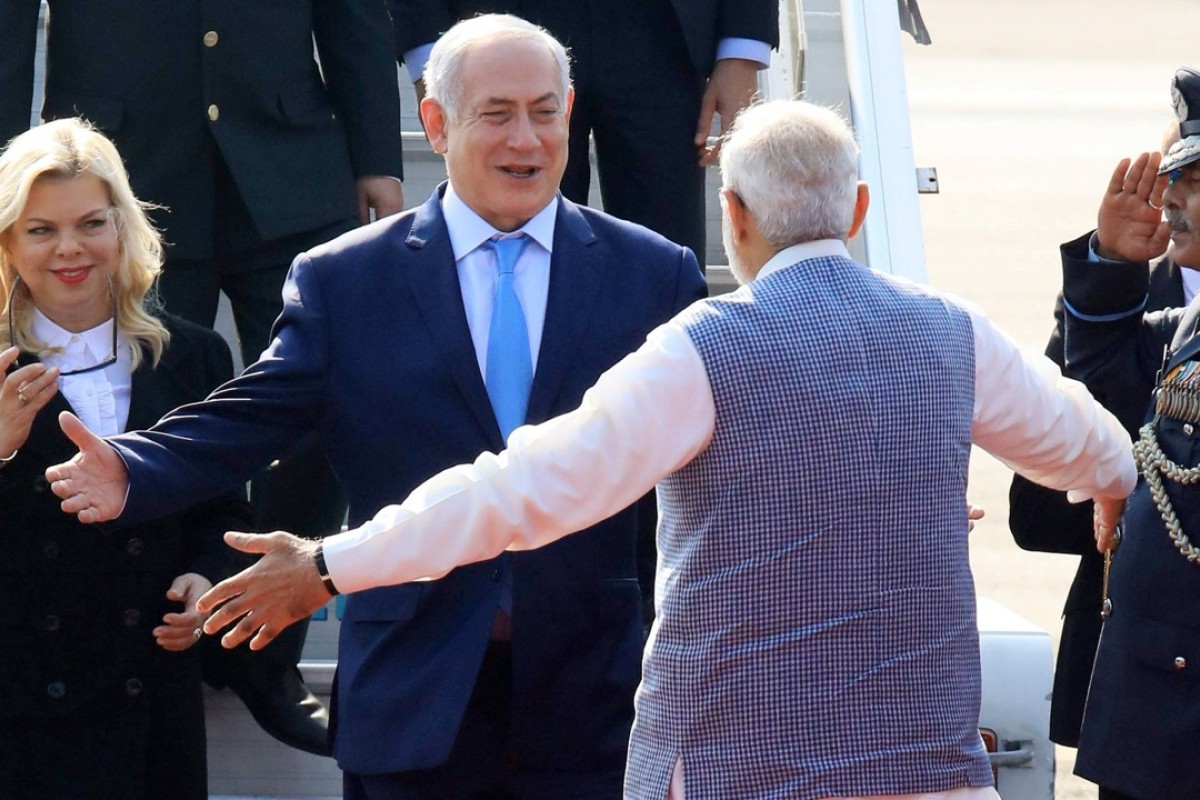
    • PM Modi visited the West Bank in February 2018, which was the first visit by an Indian Prime Minister to the Palestinian territories.

    Why does India support Palestinian cause?

    • India has a considerable number of Muslim Population has been always sympathetic to the Muslim population in Palestine.
    • India did not want to jeopardize the interest of its citizens (more than 7 million) working in Arab countries which are a good source of forex reserves.
    • India is dependent on the Arab nations for its larger oil imports.
    • India’s co-operation with the Soviet Union during cold war era and our desire to counter Pakistan with the support of Arab nations was another reason for our pro-Palestine policy.
    • However, with an increased focus on closer ties with Israel, there is little doubt that India has diluted its support to Palestine.

    Limitations of Cooperation

    • India has so far been successful in building up its level of cooperation with Israel without en­dangering its relations with others.
    • Never­theless, limits to the cooperation are visible, especially in the field of security cooperation, as this remains a somewhat sensitive issue for some Arab states. However, despite its perceived fondness of Israel, India has been cautious.
    • In addition, ties with Israel are an area of potential disagreement between India and the Islamic Republic of Iran.
    • This often manifests in Iranian leaders’ flagging of the issue in Kashmir, a Muslim-majority state claimed by both India and Pakistan.

    Conclusion

    • Mutu­al interests run deeper than mere super­­ficial, short-term cooperation.
    • There is a growing marginalization of the Pales­tin­ian issue. And that has immensely benefited Indo-Israeli relations.
    • The interest-based development of bilateral ties between Israel and India is likely to prevail and result in future cooperation, even if the Pales­tinian issue regains prominence.


    References

    https://indianexpress.com/article/explained/west-bank-what-change-in-us-policy-means-6127732/

    https://www.indiatoday.in/india/story/pm-modi-amit-shah-p-chidambaram-nrc-cab-1630951-2019-12-23

    https://www.brookings.edu/blog/order-from-chaos/2019/11/25/recognizing-israeli-settlements-is-about-sovereignty-and-thats-a-game-changer/

    https://time.com/5732752/israeli-settlements-trump-administration/

  • 24th December 2019 | Daily Answer Writing Enhancement

    The topics covered in the upcoming AWE on 25th December are:

    Q.1) The Freedom Struggle – its various stages and important contributors /contributions from different parts of the country.

    Q.4) Case Studies


    Question 1)

    Discuss the reasons as to why the proposals of the Cripps mission were rejected by the Congress and the Muslim league. (15 Marks)

    Question 2)

    Why India still defends its “developing country” status at the WTO? Explain this dichotomy in India’s development status. (15 Marks)

    Question 3)

    “The need of the hour is a comprehensive review of the GST architecture, addressing, in particular, the issues flagged by the CAG.” What are the limitations of GST as a tax? What other steps do you suggest to improve its efficiency? (15 Marks)

    Question 4)

    You have been asked to devise an advertisement campaign for a development programme to be launched nationally. What are the principles on which you will focus to increase the social influence of your advertisement? Discuss. (15 Marks)

    Reviews will be provided in a week. (In the order of submission- First come first serve basis). In case the answer is submitted late the review period may get extended to two weeks.

    *In case your answer is not reviewed in a week, reply to your answer saying *NOT CHECKED*. If Parth Sir’s tag is available then tag him.

    For the philosophy of AWE and payment, check  here: Click2Join

  • SAMANVAYA: Students Preparing for UPSC 2020 > 6 months study plan.

    SAMANVAYA: Students Preparing for UPSC 2020 > 6 months study plan.

    Click here to fill the form, tell us about your preparation and we will email you a revision plan specifically designed for you.

    Dear Students, 

    Our lectures on paper discussions and posts on solutions and sample structures have received over 20,000 hits collectively.  

    It is time to get serious with your preparation and we have got your back.


    After numerous conversations with so many aspirants, we have started understanding your problems better and standardizing solutions for the same.

    These are being incorporated into our Samanvaya program. It is these practices that will make the program more effective.

    At the core of Samanvaya lies the fact that each one of you will have a unique journey while preparing for the exam. Some will get through on the first attempt without much effort while others will take both more time and more effort. We want to understand you better to help you optimize your journey so you can focus on the right things and not waste time on the wrong ones. We are asking you to tap into the valuable experiences of mentors who underwent the same grind and realize the pitfalls and understand the shortcuts to make it.

    Samanvaya program involves the following –

    1. Identifying your weaknesses

    Over 80% of students who claimed to have revised NCERTs were unable to answer basic questions. Many were not comfortable with at least 1 GS subject and Optional. Many struggled with ‘What went wrong’ after 2-3 years of hard work.

    Our mentors will help you assess your preparedness and suggest accurate strategies.

    2. Strategy and study plan discussions

    Over 90% of students couldn’t stick to a plan. Study plans and strategies are iterative in nature and we want to help you with that. Many are unable to perform in tests despite preparing hard. This could be due to a variety of factors – lack of adequate prep, jitters in the exam hall, inadequate revision, lack of practice of test series or just a bad day at work. Tell us what you think went wrong and we’ll figure out a way to get you over the line next time.

    3. Helping you understand the exam better

    Which books to read, different approaches, etc. Over 60% of students we talked to did not find NCERTs relevant and saw no point in being thorough with them.

    4. Lack of motivation

    We have all had those days when it’s been hard to motivate ourselves to hit the books and just study. It happens to the best of us sometimes and for some of us, it happens more frequently. And it is understandable, Civil Service preparation is a long and often lonely process. Every aspirant, from toppers to those who have quit have been overwhelmed by this process at some point.

    Samanvaya Code of Conduct

    • Be honest with your mentors about your preparation levels and stage.
    • Follow their advice and participate in tests and assignments that they set for you
    • Stay active in the telegram groups, ask doubts, don’t hold yourself back.
    • Don’t expect spoonfeeding. You have to drive the initiative.

    Click here to fill the form, tell us about your preparation and we will email you a revision plan specifically designed for you.

    Here’s the feedback that we got from some of our students:


    Click here to fill the form, tell us about your preparation and we will email you a revision plan specifically designed for you.

  • 23rd December 2019 | Daily Answer Writing Enhancement

    The topics covered in the upcoming AWE on 24th December are:

    Q.1) Modern Indian history from about the middle of the eighteenth century until the present.

    Q.4) Case Studies


    Question 1)

    Indian culture has had an enduring character. Despite major changes and upheavals significant threads of continuity can be traced throughout the course of Indian history right upto the present day.” Discuss. (15 Marks)

    Question 2)

    “The mother tongue lays a strong foundation for the expression of creativity. Every effort must be made to nurture creativity at the formative stage.” Analyse. (15 Marks)

    Question 3)

    Only after the Indian Independence, has fisheries together with agriculture been recognized as an important sector. Examine the scope & challenges of aquaculture in India. (15 Marks) 

    Question 4)

    “Nelson Mandela expanded our capacity to rethink politics in terms of empathy, forgiveness, and values. His life offers many lessons which are of relevance to us more now than ever.” Comment. (15 Marks)

    Reviews will be provided in a week. (In the order of submission- First come first serve basis). In case the answer is submitted late the review period may get extended to two weeks.

    *In case your answer is not reviewed in a week, reply to your answer saying *NOT CHECKED*. If Parth Sir’s tag is available then tag him.

    For the philosophy of AWE and payment, check  here: Click2Join

  • How to Steer Clear of Analysis Paralysis during your IAS Prep

    Image Ref: Link

    “The maxim ‘Nothing avails but perfection’ may be spelled shorter: ‘Paralysis.’” 

    ~Winston Churchill

    Have you ever come across a situation where you over-analyzed a problem, and later saw that all your energy of the forward movement, all the energy of taking action, had dissipated? Well, welcome to the world of analysis-paralysis. 


    What is analysis-paralysis

    There are, generally speaking, two kinds of problems. Let us call one type ‘fixed’ and the other type ‘fluid’. Deep analysis does produce useful results in the case of ‘fixed’ problems, where most of the underlying factors remain the same over time. However, this is not what happens when we over-analyze a situation or problem, which is ‘fluid’, in which many underlying factors change over time. 

    In our search for a solution to such ‘fluid’ situations, we forget that the ground on which our problem is standing is changing all the time. So, no emergent ‘best’ solution remains that way for any duration of time, and we, and our instincts, fall into confusion, feeling dissatisfied with every solution, and eventually, we find ourselves unable to act.

    The problem of over-thinking

    It is usually the intelligent, the competent, and the observant who are trapped by over-thinking. Analysis is an inherent part of their nature and when faced with complex problems of the ‘fluid’ variety their natural reaction is to start thinking about the problem. Looking for possibilities and weighing them for their solution potentials. They can see many more possibilities than the average person, and they begin to construct a decision tree in their minds, composed of possibilities and their solution potentials. 

    What they don’t realize is that they are dealing with a dynamic and fluid situation, that is altering with time. And the only way out, in such situations, is to take quick action, based on a snapshot of the problem at any one moment in time. 

    There is no ‘one solution’ to the problem since the problem itself is not ‘one’. It is, in fact, a series of similar problems linked together by transitions. The solution will only come about in a series of countering actions, each meant to deal with a particular snapshot of the problem. 

    “The most effective way to do it is to do it.”

    ~Amelia Earhart


    How to avoid over-thinking

    #1. As a first step, at the very start of our search for a solution, we should ask ourselves this question:

    • Is this a problem that is based on factors that will remain the same over time, or 
    • Is it a problem where the underlying factors will change with time. 

    #2. If it is of the first type, we can proceed with an analytical approach. However, if it is the second type of problem, we should immediately give up all hope of finding a solution through analysis. 

    #3. Next, we have to understand that the only effective method of solving such problems is iterative actions. With only a brief analysis, we have to swiftly move into action mode. The steps for solving the problem are:

    • Take a snapshot of the problem, 
    • Analyse-it briefly, 
    • Perform the actions necessary to solve this particular snapshot, 
    • Finally, analyse the feedback, and iterate through the steps above again.

    “You don’t have to see the whole staircase, just take the first step.” 

    ~Martin Luther King Jr.

    You will constantly be shown more of your route as you progress down the road. You have to have faith that things will work out when you get there. You may not be able to see the whole staircase, but you can take the first step and begin climbing it. 


    Action-oriented problem solving

    Solving problems, using the techniques given above, enables you to think on your feet and not get bogged down by analysis-paralysis.

    The UPSC Civil Services exam is designed to thoroughly test your ability to handle a variety of problems. 

    The first stage of the exam, the prelims, tests your analytical thinking and problem-solving prowess. Overthinking any options out of the four might make choosing the right answer all the more complex. For instance, if we dive deep into the options, we might find that there are actually no false statements per se. There are statements that don’t fit in the particular context of the stated question. That makes over-analyses detrimental as it then opens channels for connecting unnecessary dots.

    The second stage, the mains, requires quick charting out and representation skills. Any deviation from time limit can cost you the one mark that is ever so important. Just imagine sitting in the examination hall and zoning out amidst that pressure. Nobody would want that right? Yet, over-analyzers are prone to get stuck in the downward spiral of inactivity, unknowingly so, for a long period, in the quest for perfection. 

    The third stage of the exam, the interview, is particularly geared for testing your ability to solve fluid problems. 

    One of the questions asked in a Civil Services interview was: What happened when the wheel was invented? Just imagine the kind of answers that are possible, if you are prone to over-thinking. The range and depth of possible answers is endless. But, the candidate was not given to analysis-paralysis and the rejoinder to this snapshot of a problem was: It caused a revolution. 

    The candidate got through.

    Hence, we can all decide if we want to sit and over analyse everything that UPSC decides to throw our way. Or we can actually shift our focus to a more practical approach of calling a spade, a spade, and believing so. The former approach would make us very knowledgeable and an interesting person to talk to, in time. The latter would turn us into bureaucrats and the future torchbearers of this dynamic country. It’s your choice to make.

    If you’re the one catching yourself over-thinking, it’s time to ask yourself-

    Are you too bothered by analysis-paralysis? What strategies do you use that help you? we’d like to hear from you in the comments. Maybe we could help…


    If you would like to read my inspirational book The Last Alchemist, here is the Amazon link The Last Alchemist by Aditya Joshi.

    ~Vikram Aditya Joshi


    NOTE: Want to speak to a mentor at Civilsdaily for your IAS Prep queries? Please fill out this form, we will call you back [Click2Fill]

  • Boost Your Score by 30+ Marks in UPSC Prelims 2020

    In this short video, Zeeshan sir (Mentor @Civilsdaily UPSC IAS ) will discuss a few Tikdam (Logical solving) techniques with the Aspirants. This technique has helped various aspirants to clear the Prelims exam without much effort. Zeeshan sir has given 5 mains and has consistently scored above 120 marks in Prelims.


    Click here to fill Samanvaya form: http://bit.ly/smnvaya | We will call you

    How IAS Aspirants Can Prepare Joyfully: Click here

  • [Burning Issue] Outcome of the Madrid Climate Talks


    Context

    • The 25th annual talks under the UNFCCC referred to as the Conference of Parties (COP) ended in Madrid.
    • The countries party to the Paris Agreement failed to agree on various important aspects regarding climate change like:
      • rules and procedures to govern a global carbon market
      • finance for losses caused by extreme weather events
      • on meeting the commitments made before the agreement and on raising their ambitions.
    • This two weeks of negotiations in the longest COP ever hence is regarded as a spectacular failure.

    What was the agenda set for Madrid COP?

    • There was only one major agenda for the Madrid talks to negotiate and decide — the rules for a new carbon market to be set up under the Paris Agreement.
    • That would have completed the Paris Agreement rulebook that was finalized in Katowice in 2018, without the provisions related to carbon markets on which countries had major disagreements.
    • Two other issues came to dominate the discussions were:
    1. First, relating to the demand to enhance climate actions being currently taken, and;
    2. Second, to make developed countries accountable to their climate obligations in the pre-2020 period

    What did India pursue?

    • India played a mixed role. It demanded the carryover of the untraded emission reduction certificates held by Indian companies (estimated at 750 million Certified Emissions Reductions or CERs), which they can sell to raise funds.
    • On the question of ‘loss and damage’, India urged developed countries to give financial teeth to the Warsaw International Mechanism on Loss and Damage (WIM).
    • India’s current efforts are already much more compared to even rich and developed countries. Thus, India reiterated its stand for ”Common but Differentiated Responsibilities”.
    • India played a strong role in critiquing the developed world’s continuing poor record on climate action.
    • India also took a lead in calling for more finance for developing countries for climate action, with the minister emphasizing that “not even 2 per cent” of the promised “$1 trillion in the last 10 years” had been delivered.

    Outcomes: An incompetent agreement

    • The first draft of the agreement had these options but was heavily bracketed — each bracket representing a difference of opinion and different option on the table.
    • The revised draft was put before the negotiators on, many of the earlier options had been removed. This triggered angry reactions from whoever was backing those.
    • The European Union, Spain, Bangladesh, Belize, Colombia, Grenada and many others pointed out that the draft text did not strongly ask the countries to raise the “ambition”.

    Lack of ambition

    • This was supposed to be a COP of ambition. However, these ambitions were reflected in nowhere.
    • Countries such as India and China lamented the fact that a provision on creating a work programme to assess the performance of developed countries on their pre-2020 promises had been dropped.
    • The problems we are facing today are not because of lack of intent but because of lack of implementation which is very glaringly visible in the unmet pre-2020 targets.

    The US deviance

    • China had already made it clear that strong provisions on the assessment of pre-2020 actions was “very important for all developing countries”, and needed to be strongly reflected in the final agreement.
    • The United States strongly objected to even a mention of assessment of pre-2020 actions and demanded that it be removed.

    Carbon Markets ignored yet again

    • While all this was being discussed, the draft text on carbon markets had not even been finalised.
    • The provisions related to carbon markets have been deeply contested with India, Brazil, China and some other developing countries.

    The most contested issue: Article 6

    • Ahead of COP25, many expected a key focus to be agreeing rules for “Article 6” carbon markets and other forms of international cooperation.
    • This deals with the question of how to deal with billions of Kyoto-era carbon offset “units”, potentially amounting to more than five billion tonnes of CO2 equivalent.
    • These units were mostly generated under the Clean Development Mechanism, where projects in developing countries created “certified emissions reductions” (CERs) in the developing world.
    • This was the last remaining piece of the Paris regime to be resolved after the rest of its “rulebook” was agreed in late 2018.

    What is it all about?

    • Article 6 contains three separate mechanisms for “voluntary cooperation” towards climate goals, with the overarching aim of raising ambition.
    • Article 6.2 governs bilateral cooperation via “internationally traded mitigation outcomes” (so-called ITMOs), which could include emissions cuts measured in tonnes of CO2 or kilowatt-hours of renewable electricity.
    • If these rules are well-implemented, supporters argue that Article 6 could unlock higher ambition or reduce costs, while drawing in the private sector and spreading finance, technology and expertise around the world.

    ‘OMGE’ for net climate benefits

    • The final major area of Article 6 disagreement was around the idea of securing “overall mitigation in global emissions” (OMGE), a concept introduced in the Paris text for Article 6.4.
    • OMGE is supposed to ensure a net-benefit for the atmosphere, rather than a zero-sum outcome where emissions in one place are offset by reductions elsewhere.
    • Some groups argued that the only way to achieve OMGE was to automatically cancel a portion of any offsets created under Article 6.
    • They argued that applying this cancellation would create an imbalance that could skew the market.

    Few successes to count

    Finance

    • While the main financial matter being discussed at this year’s COP was how to support countries affected by extreme climate impacts, the usual standing items were also being considered.
    • Both the Global Environment Facility (GEF) and the Green Climate Fund (GCF) guidance documents were caught up in the debate around whether to instruct them to start working more specifically on loss and damage.
    • There was also some discussion about the creation of a new climate finance goal, now that the deadline for “$100bn by 2020” (agreed in 2009 at the Copenhagen COP) is almost up.
    • Another issue being considered was long-term climate finance (LTF), a workstream that examines progress and scaling up of climate finance, but which is due to end in 2020.

    Gender action plan

    • A rare success story at this year’s COP was a decision on a new five-year gender action plan (GAP), intended to “support the implementation of gender-related decisions and mandates in the UNFCCC process”.
    • The original plan, agreed at COP20 in Lima, “seeks to advance women’s full, equal and meaningful participation and promote gender-responsive climate policy and the mainstreaming of a gender perspective”.
    • Early negotiations did not go smoothly. Parties initially failed to deliver a text for consideration, owing in part to disagreements about the inclusion of text relating to human rights and just transition.

    What is sought next?

    • A number of countries — mainly the ones most threatened by climate change, such as small island states, some developed countries and civil society organisations — had been demanding that countries take more climate actions.
    • They called upon all the countries to update their climate action plans, called Nationally Determined Contributions or NDCs, with greater commitments by next year.

    Conclusion

    • The Madrid talks were expected to nudge all countries to scale up their commitments under the Paris Pact — Nationally Determined Contributions or NDCs.
    • The developed countries including the EU and US were, however, non-committal when it came to honouring their previous pledges on funds and technology transfers to the developing countries.
    • CoP 25 was an opportunity to answer the questions that have been raised over the UNFCCC’s processes.
    • Unfortunately, the two weeks of negotiations have been an opportunity lost.


    References

    https://indianexpress.com/article/explained/united-nations-climate-change-conference-cop25-madrid-6170239/

    https://indianexpress.com/article/opinion/editorials/cop-25-climate-change-talks-in-madrid-6170500/

    https://www.downtoearth.org.in/news/climate-change/climate-emergency-cop-25-india-s-mixed-role-68449

    https://thewire.in/environment/developed-world-sabotages-un-climate-summit-now-declared-a-failure