💥Mains Ready By December. Smash Mains & Smash PYQ Admissions Open

Search results for: “”

  • Henley Passport Index 2020

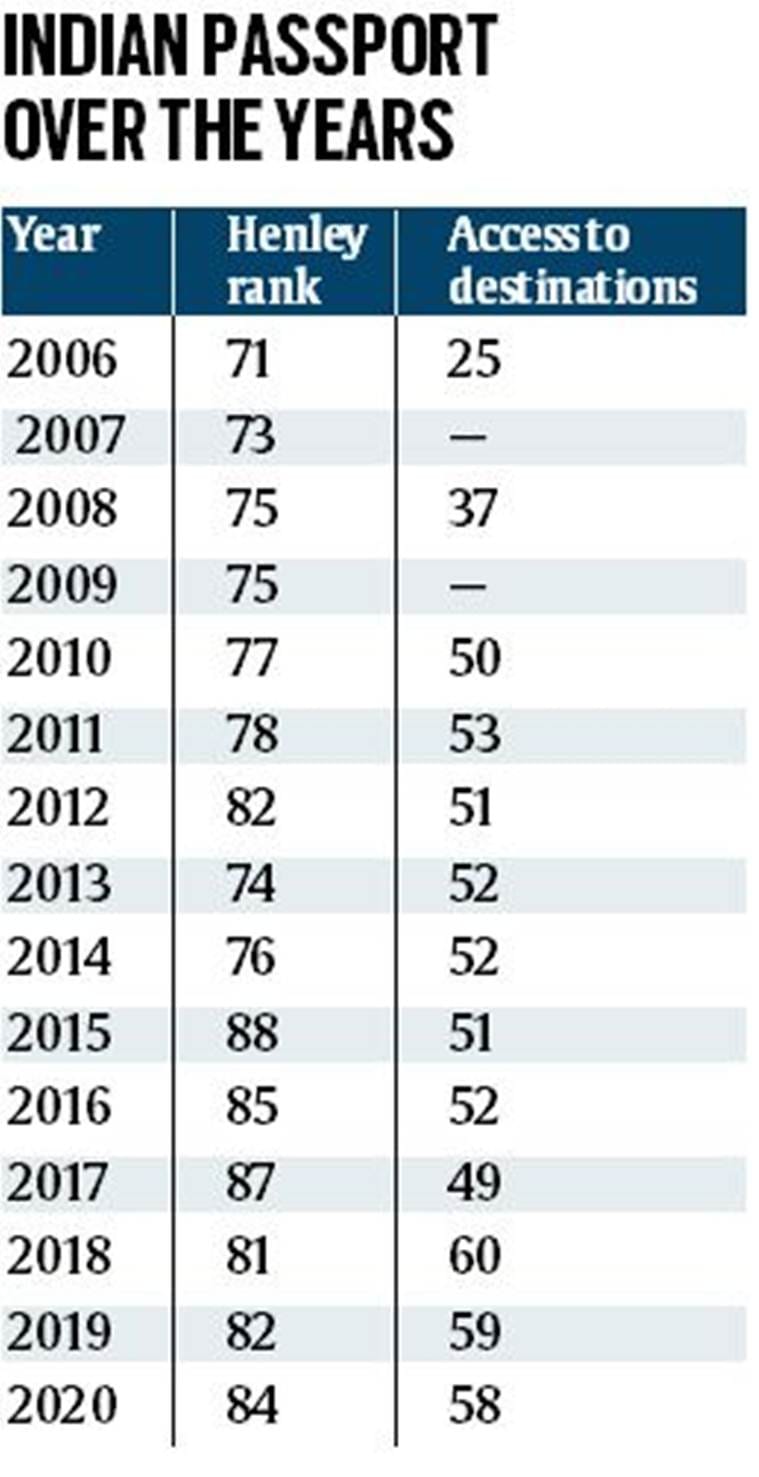
    The Indian passport is closer to the bottom, ranked 84th in the world, according to the 2020 edition of the Henley Passport Index.

    Henley Passport Index

    • According to Henley & Partners publishes the ranking and the Index of the world’s passports “according to the number of destinations their holders can access without a prior visa”.
    • The ranking is based on data from the International Air Transport Association (IATA), a trade association of some 290 airlines, including all major carriers.
    • The index includes 199 different passports and 227 different travel destinations.
    • The data are updated in real time as and when visa policy changes come into effect.

    India’s performance

    • Since the index began in 2006, the Indian passport has ranked in a band of 71st to 88th. (The number of passports ranked has, however, varied from year to year.)
    • The Indian passport’s 2020 ranking of 84th translates into visa-free access to 58 destinations, including 33 which give Indians visas on arrival.
    • It ranked higher in both 2019 (82, with visa-free access to 59 destinations) and 2018 (81, with visa-free access to 60 destinations).
    • Twenty of the 58 visa-free access destinations in the 2020 list are in Africa, and 11 each in Asia and the Caribbean.
    • Serbia is the only European country to which Indian passport holders can travel visa-free. There is no major or developed country to which Indian passport holders have visa-free access.

    Global performance

    • The top 10 most powerful passports this year are ranked in this order: Japan, Singapore, South Korea, Germany, Italy, Finland, Spain, Luxembourg and Denmark.
    • Japan has been topping the Index for three straight years; according to the 2020 index, its citizens are able to access 191 destinations without having to obtain a visa in advance.
    • Afghanistan at rank 107 is the weakest.
    • Singapore, in second place (same as in 2019), has a visa-free/visa-on-arrival score of 190.
    • Germany is No. 3 (same position as in 2019), with access to 189 destinations; it shares this position with South Korea, which dropped from the second place it held a year ago.
    • The US and the UK have been falling consistently over successive Indices.
  • [pib] Indian Digital Heritage (IDH) Initiative


    The Union Ministry of Culture and Tourism launched a month-long special exhibition titled Indian Heritage in Digital Space. This special exhibition showcases the adaptation and infusion of technologies being developed under the Indian Digital Heritage (IDH) initiative.

    Indian Digital Heritage (IDH)

    • This initiative is undertaken by the Department of Science and Technology (DST) in the cultural heritage domain of the country.
    • The exhibition demonstrates the outcome of two flagship projects viz., A digital mini-spectacle to showcase the glory of Hampi and Augmented Reality based interactions with physical models of monuments.
    • The goals of these projects are to create digital installations using 3D laser scan data, AR, holographic projections and 3D fabrication,to provide interactive and immersive experiences showcasing the glory of Hampi and five Indian monuments namely Kashi Vishwanath Temple, Varanasi; TajMahal, Agra; Sun Temple, Konark; Ramachandra Temple, Hampi ; and RaniKiVav, Patan .
    • These projections are driven by cutting-edge technologies such as 3D fabrication, Artificial Intelligence, Augmented, Virtual and Mixed Reality, Holographic Projections and Projection Mapping etc.

    ViRaasat

    A special installation named ‘ViRaasat’, consisting of a scaled-down 3D printed replica shall provide a mixed reality experience to visitors for selected monuments, using laser-scanning, 3D modelling and rendering, 3D printing, computer vision and spatial AR.

  • 16th January 2020| Daily Answer Writing Enhancement

    The topics covered in the upcoming AWE on 17th January are:

    Q.1) Indian culture covering the salient aspects of Art Forms, Literature, and Architecture.

    Q.4) Codes of Ethics, Codes of Conduct, Citizen’s Charters. 


    Question 1)

    Explain the mechanism of sea-floor spreading and briefly mention the characteristic features of the Mid-Atlantic Ridge. (15 Marks)

    Question 2)

    Analyse the importance of Article 131 of the Indian Constitution from the perspective of federalism in India. (15 Marks)

    Question 3)

    Account for the consistent below expected GST revenue collection. Suggest ways to increase it. (15 Marks)

    Question 4)

    Discuss the role played by key stakeholders under the Right to Information Act of India. (15 Marks)

    Reviews will be provided in a week. (In the order of submission- First come first serve basis). In case the answer is submitted late the review period may get extended to two weeks.

    *In case your answer is not reviewed in a week, reply to your answer saying *NOT CHECKED*. If Parth Sir’s tag is available then tag him.

    For the philosophy of AWE and payment, check  here: Click2Join

  • [pib] Saksham Campaign

    ‘Saksham’ Campaign for fuel conservation has been launched.

    ‘Saksham’ Campaign

    • It is an annual one-month long, people-centric fuel conservation mega campaign of Petroleum Conservation Research Association (PCRA) under the aegis of Ministry of Petroleum and Natural Gas.
    • PCRA and Oil & Gas companies carry out various interactive programs during this month-long campaign.
    • Activities like ‘Saksham’ Cycle Day, Cyclothons, Workshops for drivers of commercial vehicles, Seminars for housewives/cooks on adopting simple fuel saving measure.
  • HSN Code


    No imports will be allowed without HSN code into the country clarified the Union Minister of Commerce & Industry.

    What is HSN Code?

    • HSN code stands for “Harmonized System of Nomenclature”.
    • This system has been introduced for the systematic classification of goods all over the world.
    • HSN code is a 6-digit uniform code that classifies 5000+ products and is accepted worldwide.
    • It was developed by the World Customs Organization (WCO) and it came into effect from 1988.
    • The main purpose of HSN is to classify goods from all over the World in a systematic and logical manner. This brings in a uniform classification of goods and facilitates international trade.
  • Interview Guidance Program: Transcend 2019-2020


    This video highlights the details of this year’s Interview Guidance Program of Civilsdaily – Transcend 2019-20.


    Transcend 2019-20 Telegram Group Link

    Need help with filling DAF? Fill this form and we will take it forward from here

  • Exercise ‘Sahyog-Kaijin’

    Exercise ‘Sahyog-Kaijin’

    • Indian and Japanese coast guards participated in a joint exercise ‘Sahyog-Kaijin’ on January 16.
    • The aim behind ‘Sahyog-Kaijin’ is to strengthen the bond between the two countries.
    • One ship of the Japanese Coast Guard and four ships and an aircraft of the Indian Coast Guard participated in the joint exercise.
    • The drill is a five-day event.
  • [op-ed of the day] GST may not have been revenue-neutral

    Context

    In theory, the shift to GST made eminent sense, yet in practice, some of these expectations have been belied.

    Why have GST collections not measured up to expectations?

    • This could be due to a combination of three factors:
    • First:  The tax rates under GST are lower than in the earlier regime-GST was not revenue neutral, to begin with.
    • Second: There has been massive tax evasion due to under-reporting, input credit scams and fake invoices
    • Third: A slowing economy has impacted firm revenues, and thus tax collections.

    GST should have been revenue-neutral but it is not

    • Fitment exercises not carried out: The fitment exercise should have been undertaken in a manner so as to ensure that collections pre and post GST are the same.
      • But, this fundamental principle was not adhered to, and other considerations dominated.
      • Revenue neutrality Vs. Multiple objectives: The GST council began its deliberations not with the single objective of revenue neutrality, but with multiple objectives in mind.
      • Closeness to existing tax: Council wanted to ensure that rates were close to the existing tax incidence (accounting for cascading); to ensure minimal impact on inflation.
      • Not regressive: The council also wanted the proposed rate structure was not regressive in nature.
      • The council wanted that items of mass consumption were not taxed at a higher rate.
      • Achieving all these objectives simultaneously proved a difficult task.

    The issue of tax evasion

    • It is difficult to arrive at firm estimates of the scale of the problem but there are some indications of its size.
    • In West Bengal, it was estimated that the value of goods (July 2017 to March 2018) entering a state appeared to be under-reported by around Rs 50,000 crore.
    • Rs 60,000 crore in Madhya Pradesh, and Rs 1,50,000 crore in Maharashtra.
    • Numerous cases of tax fraud and fake invoice scams have also been detected since then

    Problems involve and possible solutions

    • Invoice matching:  It is argued that invoice matching will help if implemented it from the beginning.
      • It could have helped plug the loopholes.
    • Issue of under-reporting: It is debatable whether invoice matching can end under-reporting (collusion) and fake invoices.
    • Limit of state capacity in handling cases: The Central and state administrations can intervene in only about 3 lakh cases in a year.
      • Their capacity to track lakhs of transactions on a daily basis is questionable.
    • Slowing economy: Already existing structural issues have been compounded by the slowing economy.

    Way forward

    • There are certain options available to the government.
    • First: Either recalibrate the expectation or carry on the efforts to plug the loopholes and the shortcoming in the system.
    • Second: Lower the cut-off for composition scheme. A higher level simply encourages business “splitting”.
    • Third: Reduce exemptions.
    • Fourth: The council must deliberate on the rate structure, bringing it in line with pre-GST levels.
  • [op-ed snap] A rough patch

    Context

    High inflation has reduced the fiscal space available for a rate cut.

    RBI target of 6% breached.

    • CPI at 7.35 %: Retail inflation, as measured by the consumer price index (CPI), has surged to 7.35 per cent in December 2019.
    • Latest inflation data seems to corroborate fears articulated by the Monetary Policy Committee (MPC) in its December meeting.
    • In the meeting, MPC refrained from cutting the benchmark repo rate.

    Consequences for the economy

    • Reduced scope for fiscal slippage: High inflation reduced the space for further easing of policy rates.
      • Even after clarity over the extent of the Centre’s fiscal slippage emerged.
    • Rise in yield for 10-year securities: The 10-year G-sec yields have reacted sharply to these developments, rising to 6.67 on Tuesday.
      • Offsetting operation twist: Rise in yield resulted in offsetting the impact of the RBI’s recent open market operations.
    • Inflation targeting under stress: The combination of weak economic activity and higher than expected supply-side inflationary pressures has put the inflation-targeting regime under test.

    Reasons for the inflation rise and chances of easing

    • Food prices rise: Much of the rise in the headline inflation number can be traced to higher food prices.
      • Food inflation has risen to a near six-year high of 14.12 per cent in December 2019, up from 10.01 per cent in the previous month.
      • Vegetable prices have surged to 60.5 per cent in December, contributing nearly 3.7 percentage points to the headline numbers.
    • Chances of ease in coming months: While vegetable crop cycles tend to be short, and supply-side pressures may ease in the coming months.
      • The stickiness in prices of protein items is likely to provide a floor for food inflation.

    Bleak outlook for inflation easing

    • No short-term return to normal level: Food inflation is unlikely to revert to previous levels in the short term.
    • Household inflation expectations, a key metric in the MPC’s assessment, are more responsive to food inflation, this will further exert upward pressure on MPC.
    • A factor of hostilities in the Middle East: The uncertainty over oil prices on account of hostilities in the Middle East, adds to the bleak outlook for inflation.

    Conclusion

    With limited fiscal space for a meaningful stimulus, the government intends to support the economy during this rough patch, and return growth to a higher trajectory.