A NITI Aayog panel on Innovation headed by Prof. Tarun Khanna submitted its report recommending that the private sector should help fund research and development, including in research labs at universities and startups
It was constituted following the 2015 budget speech of Finance Minister Arun Jaitley, where he allocated 150 crore rupees for Atal Innovation Mission (AIM)
The committee was asked to suggest ways to promote innovation and build an entrepreneur-friendly ecosystem to drive job growth
Recommendations:
It recommended improved tax benefits for investments equivalent to a percentage of corporate profits in research labs in universities and startups
It recommended that all contracts with foreign defence companies above 5 billion dollars should include a clause for five percent of contract value to be directed to establish research-centric universities with strong emphasis on its core product areas
It suggested a Make in universities program which would involve setting up 500 tinkering labs, where aspiring entrepreneurs can experiment to create products that address local problems, with one 3D printer per institute
For these labs, the panel recommends utilisation of half of the 1000 crore rupees fund that Finance Minister Arun Jaitley had set aside for the Self Employed and Talent Utilization (SETU) scheme
It also recommends Grand Prizes approach to find ultra-low-cost solutions to India’s most intractable problems, on the lines of what is followed in some developed countries
It recommends that the AIM budget of 150 crore rupees be used entirely to award up to 12 grand prizes annually. Each challenge should carry a prize of between 10 crore and 30 crore rupees
The panel also pitched for an increase in investment in business incubators with up to 200 crore rupees public spending per year and roping in the private sector for the purpose
Establishing a fund-of-funds (FOF) by the Union Government to seed other early stage venture funds with a corpus of 5000 crore rupees
The Reserve Bank of India (RBI) has released the Report on Medium-term Path on Financial Inclusion submitted by 14-member committee headed by RBI Executive Director Deepak Mohanty
RBI had constituted the committee in July 2015 to examine the existing policy regarding financial inclusion and a five-year (medium term) action plan
It was tasked to suggest plan on several components with regard to payments, deposits, credit, social security transfers, pension and insurance
Key recommendations:
Augment the government social cash transfer in order to increase the personal disposable income of the poor- It would put the economy on a medium-term sustainable inclusion path
Sukanya Shiksha Scheme: Banks should make special efforts to step up account opening for females belonging to lower income group under this scheme for social cash transfer as a welfare measure
Aadhaar linked credit account: Aadhaar should be linked to each individual credit account as a unique biometric identifier which can be shared with Credit information bureau to enhance the stability of the credit system and improve access
Mobile Technology: Bank’s traditional business model should be changed with greater reliance on mobile technology to improve ‘last mile’ service delivery
Digitisation of land records: It should be implemented in order to increase formal credit supply to all agrarian segments through Aadhaar-linked mechanism for Credit Eligibility Certificates (CEC)
Nurturing self-help groups (SHGs): Corporates should be encouraged to nurture SHGs as part of Corporate Social Responsibility (CSR) initiative
Subsidies: Government should replace current agricultural input subsidies on fertilizers, irrigation and power by a direct income transfer scheme as a part of second generation reforms
Agricultural interest subvention Scheme: It should be phased out
Crop Insurance: Government should introduce universal crop insurance scheme covering all crops starting with small and marginal farmers with monetary ceiling of Rs. 2 lakhs
Multiple Guarantee Agencies: Should be encouraged to provide credit guarantees in niche areas for micro and small enterprises (MSEs). It would also explore possibilities for counter guarantee and re-insurance
Unique identification of MSME: It should be introduced for all MSME borrowers and information from it should be shared with credit bureaus
The Chief Economic Advisor Arvind Subramanian led panel submitted its report on Possible Tax rates under Goods and Services Tax (GST) to Finance Minister Arun Jaitley
Union government had set up the committee under chairmanship of CEA Dr. Subramanian in June 2015 to arrive at GST rates by factoring in the economic growth rate, taxpayer base and tax compliance levels
Recommendations:
Standard GST rate of 17-18%- It is the rate at which most products would likely be taxed
Not to specify GST rate in Constitutional Amendment Bill
Revenue-neutral rate of 15-15.5%- It is a single rate at which there will be no revenue loss to the centre and states in the GST regime
Eliminate all taxes on inter-state trade including one per cent inter-state tax on transfer of goods
Two options for states: Single rate of 1% or a range of 17-18%
Allocation to states will depend on revenues raised by Centre and states
Three-tier GST rate structure:
Essential goods will be taxed at a lower rate of 12%
Demerit goods such as luxury cars, aerated beverages, pan masala and tobacco products will be taxed at 40%
Remaining all goods will be taxed at a standard rate of 17-18%
Excluded real estate, electricity and alcohol and petroleum products while calculating tax rates but suggests bringing them under the ambit of GST soon
Chief Justice of India crying, farmers committing suicide, half of India reeling under severe drought, unprecedented rural-urban migration, job growth lowest in six years, 8.32 crore under-age married girls, poor women being trapped and forced into slavery, Kashmir witnessing unrest, tribal women being raped and molested in Chhattisgarh and the list goes on.
Saying Bharat Mata Ki Jai, spending crores to install flags in universities, debating useless nationalism and standing up to national anthem are the most nonsensical things you can do today. Go ahead !
1. A Money bill can be introduced in either house of the Parliament.
2. The President cannot withhold his/her accent to the Money bill.
Which of the above statements is/are correct?
(a) 1 only
(b) 2 only
(c) Both 1 and 2
(d) Neither 1 nor 2
Q2. Which of the following writs can be issued by the Supreme Court to restrain a person from holding a public office to which she/he is not entitled?
(a) Prohibition
(b) Certiorari
(c) Quo Warranto
(d) Mandamus
Q3. The Model Code of Conduct comes into force
(a) forty eight hours before the polling commences
(b) when the Election Commission so declares
(c) after the parties declare the list of their candidates
(d) immediately after the election schedule is announced
Q4. Apart from the nominated members, other members of the Rajya Sabha are indirectly elected by
(a) the elected members of the State Legislative Assemblies
(b) the elected as well as nominated members of the State Legislative Assemblies
(c) the elected members of the Lok Sabha and the State Legislative Assemblies
(d) the elected members of the Lok Sabha
Q5. Consider the following statements:
1. Unlike Lok Sabha, there are no nominated members in a State Legislative Assembly.
2. The Constitutional bench of Supreme Court is always headed by the Chief Justice of India.
Which of the above statements is/are correct?
(a) 1 only
(b) 2 only
(c) Both 1 and 2
(d) Neither 1 nor 2
We have been working to get the best news reading experience for you. The working principle at Civilsdaily has been to get the most relevant news summaries and connect them with its historic detail.
Sometime back, we released the hindi module on our website. Hope you have read the blog release and are actively using the hindi tab (Click to know how)
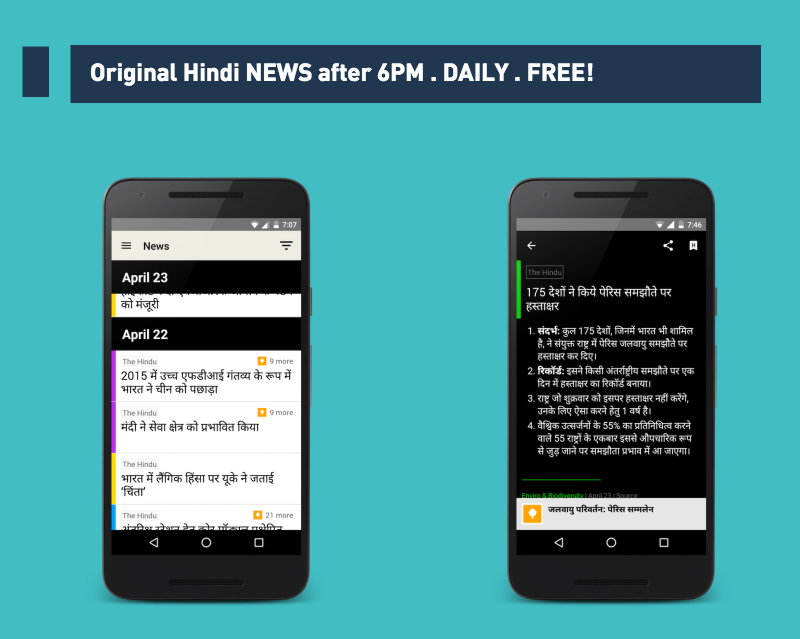
And now, we are releasing the HINDI newscards on the Civilsdaily App. Without further ado, update your app – (Click here to do so)
To make sure that the aspirants of hindi medium are on equal footing we have built the database of news from February 2016 onwards. So go ahead and read the news – bookmark the important ones and revise them offline!
We sincerely hope that our efforts brings renewed push in your preparations. Never before has news from the HINDU, Indian Express so meticulously translated and monitored for the aspirants of civil services exam (IAS/ UPSC). You will feel the difference in your current affairs awareness as you read through!
PLEASE spread the word and share this post AND mail these developments to your aspirants’ group. Take a few minutes show your appreciation towards Team Civilsdaily
Role: A worldwide organization for the protection of the rights of prisoners of conscience
Amnesty International was founded in 1961 by the British lawyer Peter Benenson.
It was originally his intention to launch an appeal in Britain with the aim of obtaining an amnesty for prisoners of conscience all over the world.
Amnesty International is a worldwide human rights organization run by its members. It is independent of all governments and all financial players. It is also independent of political convictions and religious faiths.
Organization’s logo – the lit candle surrounded by barbed wire – from a Chinese proverb,“It is better to light a light than to curse the darkness”.
#2. Commonwealth Human Rights Initiative
Focus: Human Rights
The Commonwealth Human Rights Initiative is an international non-governmental organisation formed to support Human Rights and particularly to support the implementation of the Harare Declaration in the countries of the Commonwealth of Nations.
What was Harare declaration?
The Harare Commonwealth Declaration sets the association’s priorities for the 1990’s and beyond. Strengthened emphasis on Commonwealth contribution to democracy, human rights and equality.
#3. CARE International
Focus: Multiple Interdisciplinary Projects
CARE International is a large humanitarian INGO that is committed to fighting poverty. They take a special interest in empowering poor women because “women have the power to help whole families and entire communities escape poverty”. Explicit goals:
Strengthening capacity for self-help
Providing economic opportunity
Delivering relief in emergencies
Influencing policy decisions at all levels
Addressing discrimination in all its forms
#4. OXFAM
Focus: Multiple Interdisciplinary Projects
Oxfam works on trade justice, fair trade, education, debt and aid, livelihoods, health, HIV/AIDS, gender equality, conflict (campaigning for an international arms trade treaty) and natural disasters, democracy and human rights, and climate change. That’s pretty much everything!
One would hear a lot about Oxfam in news related to Nepal’s earthquake and regeneration efforts. Latest news – Reuters
Greenpeace is a non-governmental environmental organization with offices in over forty countries and with an international coordinating body in Amsterdam, the Netherlands
It uses direct action, lobbying, and research to achieve its goals.
Question: What do we mean by “direct action” of an NGO?
Watch this 3 minute video to know about (pretty interesting) history behind Greenpeace
If we missed an important NGO, do let us know. It is important to know the area of work, HQ and recent focus of important NGOs for IAS Prelims purposes.
Q3. If ABA × BAB = BCDCB, where A, B, C and D are different digits, what are the values of C and D?
(a) C = 6, D = 7
(b) C = 7, D = 6
(c) C = 6, D = 5
(d) C = 5, D = 6
Q4. A man’s present age is equal to the sum of the present ages of his six children. After 10 years his age shall be half of the sum of ages of his children at that time. What is the present age of the man?
(a) 30 years
(b) 40 years
(c) 45 years
(d) Insufficient data
Q5. If the length of a rectangle is reduced by 10% and its breadth increased by 20% then its area
(a) increases by 8%
(b) increases by 12%
(c) decreases by 12%
(d) decreases by 8%
Q1. Who were ‘uparikas’ under the Gupta administration?
(a) Military Commanders
(b) Provincial Governors
(c) Revenue Collectors
(d) Chief spies
Q2. What is ‘Brasilia Declaration’, which has recently been in news?
(a) a IMF backed initiative to curb black money menace.
(b) a WHO co-sponsored agenda on road safety
(c) a WTO initiative to bring down trade barriers
(d) a WIPO authored declaration on intellectual property rights
Q3. Which of the following is/are correctly matched?
Religious Centre : Geographical feature
1. Trimbakeshwar : Tungabhadra River
2. Ujjain : Satmala Hills
3. Shingnapur : Malwa Plateau
Choose the correct alternative using the codes given below.
(a) 2 and 3 only
(b) 1 only
(c) 1 and 2 only
(d) None
Q4. In which one of the following states locals are known to construct their dwellings over floating vegetative masses called ‘phumdis’ for fishing and other livelihood uses?
1. Carbon dioxide and methane are the two most prominent gases that emanate from
land-fill sites.
2. These are produced by the fungal disintegration of the organic waste.
Which of the above statements is/are correct?
(a) 1 only
(b) 2 only
(c) Both 1 and 2
(d) Neither 1 nor 2
Q1. Ecuador and Chile have been hit by high magnitude earthquakes in recent times. What could be the possible explanation for the same?
(a) Large scale extraction of natural gas and oil have induced powerful earthquakes
(b) These countries are situated along a constructive plate boundary
(c) Vulcanicity in the Andean mountains has caused earthquakes in these countries
(d) These countries are situated along a convergent plate boundary
Q2. Which of the following pairs are correctly matched?
1. Niagara Falls : Between Lake Erie and Lake Huron
2. River Vaal : Tributary of Orange River
3. Lake Victoria : Rift Valley Lake
Choose the correct alternative using the codes given below.
(a) 2 and 3 only
(b) 1 and 3 only
(c) 2 only
(d) 1, 2 and 3
Q3. If the revolutionary motion of the earth were to cease which of the following phenomenon shall still be observed?
1. Tides
2. Day and Night
3. Ocean currents
Choose the correct alternative using the codes given below.
(a) 1 and 3 only
(b) 2 and 3 only
(c) 1 and 2 only
(d) 1, 2 and 3
Q4. If you are visiting western Rajasthan, which of the following landforms are you most likely to observe?
1. Fiords
2. Blind Valleys
3. Barchans
Choose the correct alternative using the codes given below.
(a) 2 only
(b) 2 and 3 only
(c) 3 only
(d) 1, 2 and 3
Q5. Which of the following rivers flow through the state of Punjab as well as Haryana?
1. Beas
2. Satluj
3. Yamuna
Choose the correct alternative using the codes given below.
(a) 2 only
(b) 1 and 3 only
(c) 2 and 3 only
(d) None of these