We have started a new initiative & tried to revive CD Discuss for the benefit of the community. The idea is to consolidate our learnings from the NEWS and mix them with static & dynamic portion of the syllabus to ask a few pertinent questions.
Scope of discussion
What is RCEP and how did it come into being? – Prelims & Mains
Why is RCEP Vital for India? – Mains & Interview
With TPP Advancing, India Pins Hopes On RCEP Trade Bloc
Scope of discussion
Maritime challenges & Our new Maritime Security Strategy
Geopolitical aspects of maritime challenges – Fodder for Mains & Essay
Indian maritime agencies – Fodder for Prelims
Diplomatic dimensions – Fodder for Prelims & Interview
Challenges ahead? Mains & Interview
———
You will find some very carefully chosen questions at the bottom of most of these writeups. If you have been writing answers all year long, it should be easy for you to recall and give crisp point wise comments. If you have not been practicing this answer writing – now is a good time to start and contribute.
PS: This initiative is on best effort basis and will be clamped down if we recieve less than viable participation. Just like what happened with daily Q&A a few months back. So please go ahead and spend some time in thinking through these questions
What is RCEP and how did it come into being? – Prelims & Mains
Why is RCEP Vital for India? – Mains & Interview
With TPP Advancing, India Pins Hopes On RCEP Trade Bloc
What is RCEP?
If you have been following our series on International Organisations, we talked about East Asia Summit (EAS) where we briefly touched upon RCEP.
Regional Comprehensive Economic Partnership (RCEP) is a proposed free trade agreement (FTA) between –
The 10 members of ASEAN
Additional members of ASEAN +3 = China, Japan, South Korea
Members with which ASEAN countries have FTA = India, Australia, New Zealand
RCEP includes more than 3 billion people, has a combined GDP of about $17 trillion, and accounts for about 40 percent of world trade. By any means, this is a huge community in making.
What is the significance of RCEP for India?
From India’s point of view, the RCEP presents a decisive platform which could influence its strategic and economic status in the Asia-Pacific region and bring to fruition its “Act East Policy.” It is expected to be an ambitious agreement bringing the 5 biggest economies of the region – Australia, China, India, Japan and South Korea – into a regional trading arrangement.
There are three immediate benefits that its trade policymakers should note-
#1. The RCEP agreement would complement India’s existing free trade agreements with the ASEAN and some of its member countries.
This consolidation can address challenges emanating from implementation concerns vis-à-vis overlapping agreements, which is creating a “noodle bowl” situation obstructing effective utilization of these FTAs.
It will also help achieve its goal of greater economic integration with countries East and South East of India through better access to a vast regional market ranging from Japan to Australia.
source: asiafoundation.org
NOTE: India is not a party to two important regional economic blocs: the Asia-Pacific Economic Cooperation and the Trans-Pacific Partnership. The RCEP would enable India to strengthen its trade ties with Australia, China, Japan and South Korea, and should reduce the potential negative impacts of TPP and TTIP on the Indian economy.
#2. Gets India closer to ASEAN
Clubbing with the ASEAN has been a principal policy priority for both China and India.
At present, while China has clubbed with the ASEAN+1, ASEAN+3 and ASEAN+6,
India is clubbed only under the ASEAN+6 framework
#3. India can leverage its capabilities in IT, Healthcare, Education and services
The RCEP will create opportunities for Indian companies to access new markets
India is well placed to contribute to other countries in RCEP through its expertise in services
Countering TPP with RCEP
New Delhi fears the TPP, although years away from reality, could mean losing some textile and drugs exports to countries like Vietnam, which has embraced both the TPP and the RCEP.
TPP is set to change the landscape of global trade. For India, it is most likely to affect sectors like leather goods, plastics, chemicals, textiles and clothing.
We will discuss more about TPP in a later discussion but suffice to say that RCEP’s realisation is important for India.
Questions for you
What’s the history behind ASEAN+1, ASEAN+3, ASEAN+6 and how is ASEAN+6 related to RCEP?
Apart from RCEP, TPP – there is another arrangement called as Trans-Atlantic Trade and Investment Partnership (TTIP). What do you know about it?
With China not clamping down on its excess steel production, how do you think these FTA arrangement will pan out? Or will they not? What is USA’s stance on this?
It would be worthwhile to investigate the loyalties of the ASEAN nations wrt. China OR India. What are the major countries in ASEAN and who are they friends with. Why would you say so?
(वर्तमान में गेहूं का समर्थन मूल्य लगभग 1,500 रुपये प्रति क्विंटल है. पानी का मात्रात्मक मूल्य वसूल करने से किसान पर 200 रुपये प्रति क्विंटल का अतिरिक्त बोझ पड़ेगा. सरकार को चाहिए कि गेहूं के समर्थन मूल्य में 200 रुपये की वृद्धि कर दे. इस विषय पर एक अच्छा आलेख उपरोक्त लिंक पर पढ़ सकते हैं)
2. भारत-अमेरिकी रक्षा साझेदारी को आगे बढ़ाने की तैयारी
(भारत ने अमेरिका के साथ अपने रिश्तों को अफपाक से अलग देखा है और वह अमेरिकी केंद्रीय कमान के साथ सैन्य समझौते को बढ़ावा दे रहा है. भारत-अमेरिका रक्षा ढांचा समझौता 2025 तक के लिए बढ़ा दिया गया है. और किन क्षेत्रों में क्या विचार किया जा रहा है, आप ऊपर लिंक पर पढ़ सकते हैं)
3. जानिए, क्या है बैंकरप्सी कानून, इकोनॉमी के लिए कैसे है फायदेमंद
(इस बिल के कानून बनने पर इन्सालवेंसी (दिवालिया) से जुड़े मामलों को छह महीनें (180 दिनों) के भीतर निपटाना संभव हो जाएगा. सके अलावा फास्ट ट्रैक अप्लीकेशन को भी 90 दिनों में निपटाना होगा. इस बारे में और अधिक उपरोक्त लिंक पर क्लिक कर जाना जा सकता है)
We received a lot of queries over the forums and over mails on NCERT books & where to download them. Check out this link and download the OLD & NEW NCERTs.
East Asia Summit is a unique Leaders-led forum of 18 countries of the Asia-Pacific region formed to further the objectives of regional peace, security and prosperity.
Why is EAS important?
10 East Asia Summits have been held so far. India has been a part of this process since its inception in 2005. Think of it this way –
EAS has held its annual meetings without fail since its inception
As members – it has 10 ASEAN nations + 8 strategic partners including US, China, India, Japan
This is what our PM said in the 9th EAS – “No other forum brings together such a large collective weight of global population, youth, economy and military strength. Nor is any other forum is so critical for peace, stability and prosperity in Asia-Pacific and the world.”
6 priority areas of regional cooperation within the framework of the EAS
Environment and Energy,
Education,
Finance,
Global Health Issues and Pandemic Diseases,
Natural Disaster Management, and
ASEAN Connectivity
India’s involvement in regional collaboration in these 6 priority areas
#1. Education
At the 4th East Asia Summit (EAS), held in Thailand on 24-25 October 2009, the EAS Leaders endorsed the proposal for the revival of Nalanda University.
source: outlookindia.com
Nalanda was a renowned Buddhist centre of learning, in Ancient India. It taught students in medicine, mathematics, astronomy and politics
The University envisages seven schools located at its campus in Rajgir
Ministry of External Affairs has offered 6 scholarships to students from Cambodia, Myanmar, Lao PDR and Vietnam to pursue higher studies at Nalanda University
Australia and India are co-chairs of the Task Force for Access to Quality Medicines and other Technologies Task Force (AQMTF)
India has also hosted a Round table on Trauma Care and Nursing on 15-16 October 2015, in New Delhi
#3. Natural Disaster Management
2012: India hosted an ‘EAS-India Workshop 2012: Building Regional Framework for Earthquake Risk Management’ in New Delhi
2014: India also hosted the first Meeting of the 24×7 Points of Contact among the National Disaster Response Agencies of East Asia Summit (EAS) countries
Launch of Virtual Knowledge Portal (VKP). What is this?
The Virtual Knowledge Portal (VKP), a web based tool to share knowledge and best practices related to natural disaster risk assessment, mitigation and response among EAS countries. It is hosted by Natural Institute of Disaster Management, New Delhi.
#4. Launch of Regional Comprehensive Economic Partnership (RCEP)
At the 7th EAS in November 2012, the Leaders of 16 EAS participating countries launched the Regional Comprehensive Economic Partnership (RCEP)
What is RCEP?
Regional Comprehensive Economic Partnership (RCEP) is a proposed free trade agreement (FTA) between the 10 member states of the ASEAN and the six states with which ASEAN has existing FTAs (Australia, China, India, Japan, South Korea and New Zealand).
The Gulf Cooperation Council (GCC) is a regional political organisation comprising the energy rich Gulf monarchies – Bahrain, Kuwait, Oman, Qatar, Saudi Arabia, and the United Arab Emirates.
source: middleeasteye
When and why was it founded?
Establishment in Abu Dhabi in 1981 | HQ in Riyadh
The founding charter focused more on issues of social and cultural cohesion, environmental and scientific coordination and economic cooperation
Recently, Morocco and Jordan have applied for the GCC membership which is currently being studied by the GCC Expert Committee
India and GCC: Contours of cooperation
The Gulf constitutes the “immediate” neighborhood of India separated only by the Arabian Sea
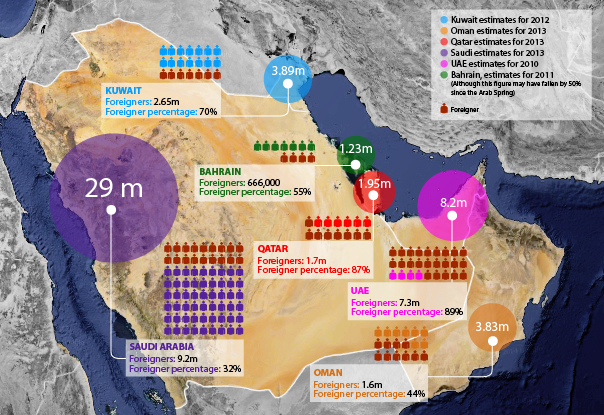
The Gulf, as the principal source of India’s energy requirements, is central to our energy security interests: it meets 75% of our oil needs at present; as our demand increases in coming years, India’s dependence will go up to 90% by 2035.
GCC is India’s largest trading partner as an economic grouping, with two-way trade being more than our ties with the European Union, ASEAN and North America
Four GCC countries figure in India’s top 10 trade partners.
We also have an eight-million strong community in the GCC that remits annually $35 billion to the national exchequer
The India-GCC Free Trade Agreement which is in under negotiation could usher in a new era of trade
Although India and the GCC countries share a strong economic relationship, there is much progress to be achieved on the political front. Let’s have a close look at some of the important dimensions –
#1. Defence Diplomacy
India’s defence diplomacy with countries of the GCC is well reputed.
India has signed a military protocol with Oman which has facilitated joint military exercises
India has also signed a defence cooperation agreement with the UAE
The meteoric rise of the Islamic State of Iraq and the Levant (ISIS) in neighbouring countries like Iraq and Syria pose a huge threat to the peace and stability of the GCC countries.
#3. Maritime Security
Primary maritime security threats include piracy at sea, smuggling of narcotics and arms and the imminent threat of maritime terrorism.
These threats pose major challenges to the Sea Lines of Communication (SLOCs) that India depends heavily on to carry out trade by sea
India’s international trade by sea amounts to about 90% of the foreign trade, and it takes place through 13 major ports and several minor ports
We have an eight-million strong community in the GCC that remits annually $35 billion to the national exchequer
Minor concerns – If you remember, in 2013 Saudi Arabia issues a Nitaqat Law – The ‘Nitaqat’ law makes it mandatory for local companies to hire one Saudi national for every 10 migrant workers
There had been widespread perception that the new policy will lead to denial of job opportunities for a large number of Indians working there.
India had back then proactively conveyed concerns to the Saudi government
(एक अच्छा आलेख. ज़रूर पढ़ा जाना चाहिए. अंग्रेजी वालों को भी. इस आलेख में आप जानेंगे कि सरकार को चिंता है कि ई-रिटेल कंपनियों द्वारा भारी डिस्काउंट दिए जाने से नुक्कड़ की किराना दुकानों का धंधा चौपट हो जाएगा, करोड़ों लोग बेरोजगार हो जाएंगे। सरकार की चिंता वाजिब है, परंतु यह समस्या तमाम रोजगार भक्षक आधुनिक तकनीकों में निहित है)
2. प्राकृतिक आपदाओं के कारण फसलों के भारी नुकसान के बावजूद 2014-15 में 252.02 मिलियन टन अनाज उत्पादन की तुलना में 2015-16 में अनाज उत्पादन बढ़कर 253.16 मिलियन टन हुआ
लिंक- http://pib.nic.in/newsite/hindirelease.aspx
(11 अप्रैल को पीआइबी पर प्रकाशित कृषि मंत्रालय की इस विज्ञप्ति में आप जानेंगे कि सरकार द्वारा 2016-17 के बजट में किसानों की आय दोगुनी करने की जो घोषणा की गई थी, उस लक्ष्य को प्राप्त करने के लिए सरकार किन सात बिन्दु पर कार्य करने का विचार कर रही है)
We have been putting concentrated efforts in finishing off the important GOI schemes of 2015-16. All of them have been compiled and put under the collection of – https://www.civilsdaily.com/collection/government-schemes-programs/
Click to review all of them and let us know if we have missed on any important one.
Maritime challenges & Our new Maritime Security Strategy
Geopolitical aspects of maritime challenges – Fodder for Mains & Essay
Indian maritime agencies – Fodder for Prelims
Diplomatic dimensions – Fodder for Prelims & Interview
Challenges ahead? Mains & Interview
Indian Maritime challenges
India’s maritime geographical position is both an advantage and a challenge. The close proximity of international shipping lanes to India’s coasts attracts other powerful countries too to try to dominate and, thus, create the potential situation of confrontation with India.
India’s own strategic interests made it pay attention to waters beyond its immediate proximity. Late 2015, we released our new edition of Maritime Security Strategy. Contrast the aggressiveness vis a vis the older strategy document released in 2007:
2015 – Ensuring Secure Seas
2007 – Freedom to Use the Seas
source: nausena-bharti.nic.in
This is the third maritime guidance document since 1998 and the most comprehensive account of India’s nautical imperatives, challenges, strengths and opportunities. Here’s why we say so:
#1. India has accepted the concept of “Indo-Pacific” in India’s maritime security. This essentially brings the Indian Ocean and the Western Pacific – theaters of geo-political competition into one strategic arc and broadens our focus.
#2. The latest Maritime Security Strategy (2015) enhanced its definition of primary & secondary areas of maritime interest –
Primary – Coastal areas, islands, EEZ, the Arabian Sea, Bay of Bengal, Andaman Sea, their littorals, Persian Gulf, Gulf of Oman, Gulf of Aden, Red Sea, various choke points and their littorals, SLOCs and energy and resource interests
Secondary – Various seas outside the Indian Ocean Region
South-west Indian Ocean and the Red Sea were formally under the secondary area of interest. In defining the areas of interest, the navy’s intention is to outline the geographic extension of its strategic influence and give an indication of its involvement in those areas.
#3. Aim to become the “net security provider” to island states in the Indian Ocean. What does that mean?
As per the document, the term net security describes the state of actual security available in an area, upon balancing against the ability to monitor, contain, and counter all of these.
#4. The strategy emphasises the importance of maintaining freedom of navigation and strengthening the international legal regime at sea, particularly UNCLOS.
Geopolitical aspects of maritime challenges
Indian strategists are, naturally, paying attention to developments practically in all waters due to the country’s growing international profile
Their growing concern is regarding tensions rising in the East China Sea, the South China Sea and the Mediterranean
The Indian Ocean remains largely peaceful but has an unstable littoral
Pakistan has declared its intention to put its nuclear weapons at sea which raises the prospect of nuclear weapons falling into the hands of Jihadis
We face a mix of the ‘traditional’ and ‘non-traditional’ challenges – IT, biotechnology, race for natural resources etc.
#1. Indian Navy – It aims to be the ‘net security provider’ in the maritime neighbourhood, including deployments for anti-piracy, maritime security, NEO (Non-combatant Evacuation Operations) and HADR (Humanitarian Assistance and Disaster Relief) operations
#2. Coast Guard – The Coast Guard protects India’s EEZ (Exclusive Economic Zone) from criminals, pirates, smugglers, poachers, human-traffickers and foreign subversion.
#3. Coastal police – The role of the coastal police gained prominence following the Mumbai terror attacks of November, 2008. confines its activities to largely coastal waters up to 24 nautical miles.
#4. Ocean affairs – Ministry of Earth sciences (2006) is responsible for development of technology for exploitation and exploration of marine resources, weather services, climate change and geo-hazards
Diplomatic dimensions
India has cooperated well in anti-piracy operations, played a key role in IORA (Indian Ocean Rim Association), launched IONS (Indian Ocean Naval Symposium, 2008) and shaped BIMSTEC and MGC (Click to read)
Prime Minister’s articulation of India’s ‘Security and Growth for All in the Region’ (SAGAR), on 12 March, 2015, highlights both security framework for the Indian Ocean as well as regional integration with emphasis on Ocean Economy
Japan’s inclusion into the MALABAR exercises
Navy has also carried out Non-combatant Evacuation operations in Libya (2011), Kuwait (2014) and Yemen (2015)
Humanitarian Assistance and Disaster Relief (HADR) operations such as cyclone relief (in 2007, 2008, 2013 and 2014)
Did you know:In August 2013, a dedicated communications satellite for the navy, GSAT-7, was launched for surveillance purposes
What are the challenges ahead?
The navy’s fleet is ageing, with an estimated 60% of vessels reported to have reached various stages of obsolescence
The Scorpene-class submarine is the first to be acquired in 16 years, in an attempt to stabilise the fleet’s fast-dwindling numbers
The navy is 16% below strength in officer ranks and 11% below strength in non-commissioned ranks
In August 2013, the navy suffered its worst peacetime accident when an ex-Russian Kilo-class conventional submarine sank in Mumbai’s naval dockyard, killing 18 personnel
Questions for you
Since we are talking about maritime security, comment on the point of convergence and divergence of Project Mausam & Project Sagarmala
“Net security provider” – This term would have crossed your reading sphere in our dealings with US (defence ties) as well. Is India showing promising signs in becoming one? What has been our progress on this front (land, air, sea)
Since we revised our maritime document very recently and increased the ambit of Primary & Secondary areas of interest – find & locate them on the world map (for Prelims’ sake!)