💥Mains Ready By December. Smash Mains & Smash PYQ Admissions Open

Search results for: “”

  • [Video Analysis + Top 10 Ranks] 13 May 2019 | Prelims Daily with Rakesh Sir

    Dear students,

    Here’s a link to the Prelims Daily Quiz Analysis Video. Watch this after you have attempted that day’s Prelims Daily questions [on this link]

    https://youtu.be/Xzdb2Xecb7A

    The full playlist is available here [click2watch]

    [WpProQuiz_toplist 128]


    We need your comments, likes, and shares on these videos. The aim of this series is to help you revise news via questions. PLEASE spread the videos.

    What’s wrong with the student’s study habits?

    Only 5% of our students who read news attempt PD. This beats the purpose of reading the news. Even those 5% who attempt PD are unable to get the most out of the initiative. They are either guessing or doing the tests just as a routing activity without engaging in it.

    What’s CD doing to maximize your efforts?

    Now, we have moved one step further with the launch of analysis videos of Prelims Daily (PD). These videos will reveal the critical nitty-gritty surrounding every PD question. It is an unfortunate reality that no single question can be framed to cover all the possible angles.

    The analysis videos will plug this hitherto inevitable gap, thereby making your preparation more methodical, holistic and foolproof. Nothing can be more valuable than experience, and that is precisely what the PD initiative and the analysis videos offer. These will be valuable for both newcomers and senior players in the field.

    PS: We want to be 100% certain that the time and energy spent on making these videos is helping you in your UPSC Prelims preparation. So, pls click on the videos, like, share and comment and let us know your thoughts

  • [Prelims Spotlight] Defence Exercises

    Name of the Exercise

    PartnerCountry/Countries

    Details

    Surya Kiran XIII Nepal  

    • This exercise was aimed at training on jungle warfare, anti-terrorism combat and disaster response activities.
    Lamitye VIII Seychelles  

    • The focus of the exercise was to conduct counter-insurgency and counter-terrorist operations.
    Shakti IV France  

    • The focus was on high degree of physical fitness, tactical drills, techniques and procedure.
    Vinbax 1 Vietnam  

    • The focus was on cooperation in the maritime domain.
    Hamesha Vijayee Southern Command  

    • It aimed at fine tuning surveillance and destruction mechanisms to support precision strikes and manoeuvres by network enabled forces.
    Ajeya Warrior UK  

    • The aim of the exercise was to build and promote bilateral relations and enhance interoperability.
    Malabar The USA and Japan
    • It’s a joint naval exercise.
    AUSINDEX Australia
    • It’s a joint naval exercise.
    SIMBEX Singapore
    • It’s a joint naval exercise.
    IND–INDO CORPAT Indonesia
    • It’s a joint naval exercise.
    Varuna France
    • It’s a joint naval exercise.
    Nomadic Elephant Mongolia
    • It’s a joint exercise between two armies.
    Surya Kiran Nepal
    • It’s a joint exercise between two armies.
    Al-Nagah Oman
    • It’s a joint army exercise.
    EKUVERIN Maldives
    • It’s a joint military exercise.
    INDRA Russia
    • It refers to joint exercises conducted between army, navy and airforce.
    KONKAN United Kingdom
    • It’s a joint naval exercise.
    Hand in Hand China
    • It’s a joint military exercise.
    SAMPRITI Bangladesh
    • It’s a joint military exercise.
    Mitra Shakti Sri Lanka
    • It’s a joint military exercise.
    Yudh Abhyas The USA
    • It’s a joint military exercise.
     PRABAL DOSTYK Kazakhstan
    • It’s a joint military exercise.
    Maitree Thailand
    • It’s a joint military exercise..
    RIPMAC Around 25 nations, including the USA, the UK, China and France.
    • It’s the world’s largest international maritime exercise.
    Desert Eagle United Arab Emirates
    • It’s a joint air combat exercise.
    Garuda Shakti Indonesia
    • It’s a joint military exercise.
    Lamitye Seychelles
    • It’s a joint military exercise.
    IBSAMAR South Africa and Brazil
    • It’s a joint naval exercise.
    Sahyog-Kaijin Japan
    • It’s a joint exercise between the coast guards of two countries.
    SHAKTI France
    • It’s a joint military exercise.
    SLINEX Sri Lanka
    • It’s a joint military exercise.
    Indradhanush The United Kingdom
    • It’s a bilateral air exercise.
  • Civilsdaily’s Faculty’s article published in Hindu Business Line. A must-read for Civil Services Aspirants.

    Economics is one of the primary Pillars of UPSC preparation. It has substantial weightage in Prelims and also in  GS 3rd paper of mains. To ensure that students build  a strong foundation and  a strong hold over the subject, we at Civilsdaily, have the best and most trusted faculty, Himanshu Arora Sir.

    Credentials of Himanshu Sir-

    • MPhil Economics (JNU)
    • Works at Prime Minister Economic Advisory Council
    • Writes regularly in various famous Indian and international weeklies like Millenium post and Huffington Post.
    • Worked as Assistant Professor in Delhi University.

    Here is the article by Himanshu Sir  that was published today in  Business Line;

    US sanctions have rarely worked

    Instead of punishing ‘errant’ countries, sanctions inflict serious economic damage on other nations

    The US has refused to extend the oil sanction waivers previously extended to seven countries — China, India, Japan, South Korea, Italy, Greece and Turkey — after Donald Trump pulled the US out of the Iran nuclear deal.

    The oil waivers were granted as a short-term measure to substitute oil with alternative energy sources and to avoid a global oil shock.

    The nuclear deal aka Joint Comprehensive Plan of Action (JCPOA), signed in 2015, mandated Iran to reduce its uranium stockpile by 97 per cent, to limit enrichment of uranium only up to 3.67 per cent.

    In return, Iran was supposed to receive relief from the economic sanctions imposed on it. The failure of JCPOA and the subsequent imposition of sanctions on Iran and other countries raise an important question — do sanctions work?

    History of sanctions

    Sanctions were first used in ancient Greece with Pericles Megarian decree of 432 BC in response to the kidnapping of three Aspasian women. Ancient Greece also imposed them during the Peloponnesian War (431-404 BC). However, they failed to have an impact and the Spartans won the Peloponnesian War.

    The US first imposed sanctions on Iran in 1979 in response to the Iranian hostage crisis. The second round of sanctions were imposed in 1983, when an Iranian terrorist group bombed US Marine Corps in Lebanon. The US imposed restrictions on trade particularly oil to weaken Iran’s oil industry and hence its ability to fund terrorists.

    The third round of sanctions was in response to Iran’s nuclear proliferation activities. Iran’s nuclear power programmes to weaponise its army have resulted in the passage of Iran and Libya Sanction Act (ILSA) 1996. Along with other trade and financial restrictions, the ILSA prohibits foreign companies to undertake oilfields investment in Iran.

    But do sanctions fulfil their purpose of dissuading the target countries from taking a particular action?

    To answer that question, we must first understand what sanctions are and how they work. Sanctions are economic instruments that cut off the target country’s economy from rest of the world.

    The US regards sanctions as an important weapon in the geopolitical game and President Woodrow Wilson was the first to impose them.

    The opponents

    But opponents question the efficacy of sanctions especially when imposed unilaterally by a single country. They argue that target countries often shield themselves from the harsh impact and that the costs inflicted on other countries indirectly affected by such sanctions are greater than the benefits derived.

    For example, by unilaterally imposing sanctions on Iran, the US is hurting the economies of India, China, Turkey, South Korea and Japan. These sanctions are likely to increase the global crude oil prices affecting the oil importing countries negatively.

    Evidence supporting the success of sanctions are few as they have mostly failed to alter the behaviour of the targeted country. The US imposed sanctions on Turkey when it invaded Cyprus in 1974. But Turkish troops remained in Cyprus for more than 30 years despite sanctions. When USSR invaded Afghanistan in 1979, the Carter administration imposed sanctions and a food embargo on it. But the sanctions failed as the Soviet troops remained in Afghanistan till 1989. The sanctions imposed on Saddam Hussein tell a similar story.

    Also the US along with Canada, France and Russia had frequently used sanctions in 1970s and 1980s to deter non-nuclear countries from developing nuclear capabilities and force them to comply with nuclear non-proliferation.

    In 1974, Canada imposed sanctions on India and Pakistan to deter them from further nuclear explosions, to apply striker nuclear safeguards and forgo reprocessing capability of nuclear fuel that can be used in developing weapons. The US did the same with South Korea and applied financial sanctions to forestall the purchase of a nuclear reprocessing plant.

    In the subsequent years, the US imposed sanctions on shipments of nuclear fuel and technology to South Africa, imposed sanctions on Brazil, Argentina, India and Pakistan to make them adhere to nuclear safeguards, multilateral surveillance for nuclear facilities and to prevent the acquisition of nuclear technologies. But these sanctions failed to dissuade South Africa, Brazil, India and Pakistan from becoming nuclear powers.

    Multiple episodes of imposition of US sanctions across the world clearly reflect that unilateral sanctions do not really work. Therefore, in the light of historical evidence, the US should rethink its policy of imposing sanctions on Iran given the economic damage it can inflict on nations like India, China, Turkey, South Korea and Japan.


    Here is the link of the original Article

    https://www.thehindubusinessline.com/opinion/us-sanctions-have-rarely-worked/article27119264.ece

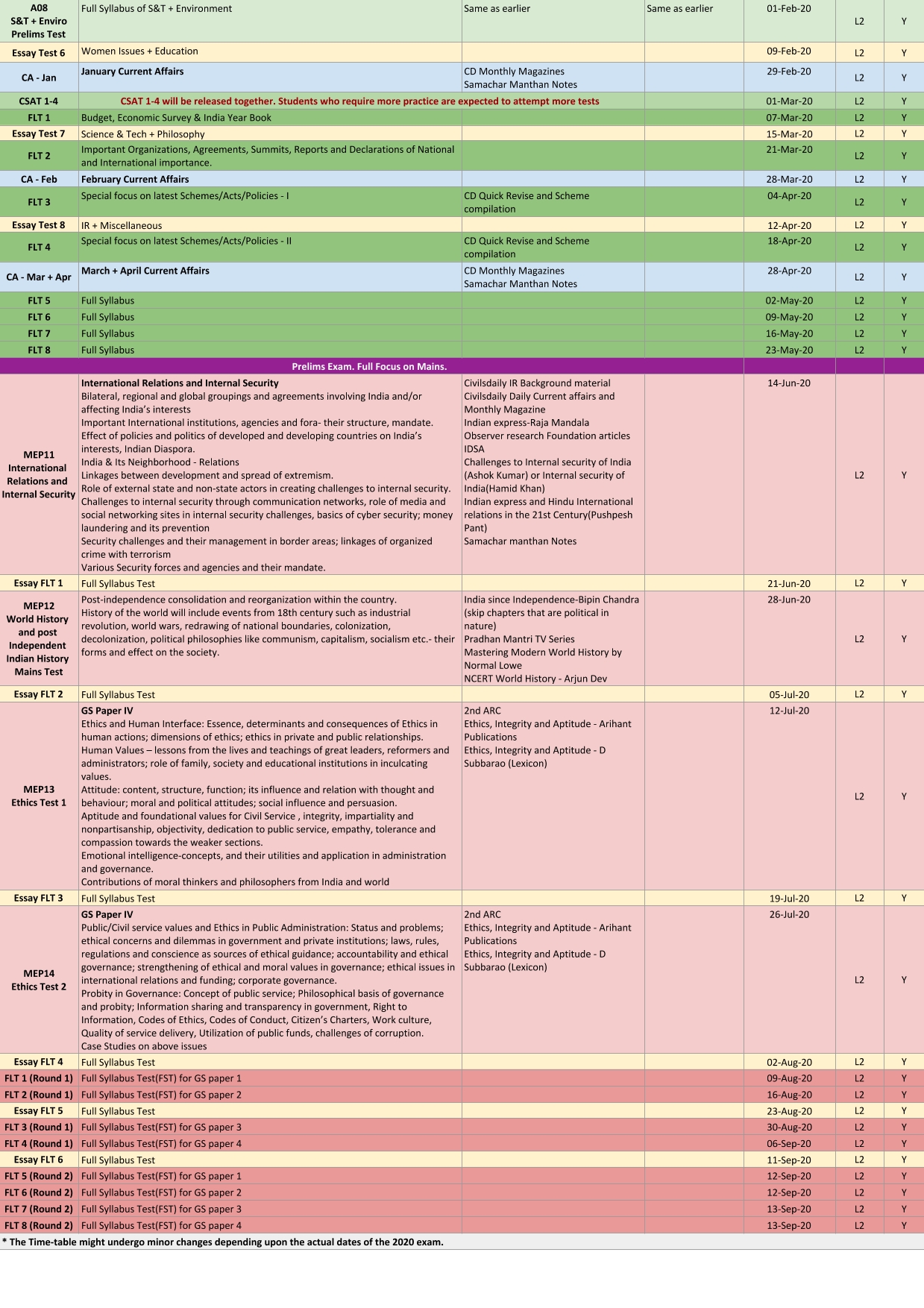
  • Foundation 2020 – Study Plan & Time-Table Released

    Foundation 2020 – Study Plan & Time-Table Released

    Download PDF for better visibility – Foundation 2020 Master Time Table

    Note4Students

    • This post will be followed by Day-wise subject specific plans.
    • The topics given in the time-table are indicative. The list is not exhaustive. students are expected to refer to books for more detail.

    https://youtu.be/r4qG08aBbrs


    Dear students,

    As you are aware, UPSC has an exceptionally vast syllabus. And it is a very complex task to come up with a study-plan/time-time table that harmonizes every element and takes into consideration the return on investment on certain topics.

    We are hell-bent on simplifying things for you. Hence, we have come up with a plan that you will instantly connect with you and give you a vibe that yes you can do it!

    1. Integrated Approach

    Preparation for Prelims and Mains is harmonized. You study a subject, attempt prelims tests and then attempt mains tests for the same. This leads to a solid preparation.

    Many institutes our there will not able to present an integrated approach. They offer separate timetables for prelims and mains confusing the students further. That’s not the case with us!

    2. Simplified Approach

    Our Time-table is the easiest to remember and follow. All tests prelims, mains and Samachar Manthan will be held on the weekend.

    • Prelims Tests are held on the 1st and 3rd Saturday of every month.
    • Monthly Current Affairs Tests are held on the last Saturday of every month.
    • Mains Tests are held on the 1st and 3rd Sunday of every month after the subject is complete.
    • Essay Tests are held on the 2nd Sunday of every month.

    3. Priority-wise Coverage of subjects

    We are starting with the most important subjects from the exam perspective first. These are very predictable + have a very high return on investment. They need to be mastered if one has to have a shot at the exam. Polity, Modern History, and Economics. The lower priority ones follow afterward.

    4. Logical Division of Topics

    Subjects have been divided into topics that logically fit together. Eg. for Polity we ask you to prepare in 2 parts – first, till Central Government and second, from State Government and beyond. This division is not ad-hoc and does not break the flow of your studies.

    5. Base and Advanced Sources

    We have divided the sources into 2 parts, Base Sources, and Advanced Sources. Base sources are those which you have to master. You should come to advanced sources only when you are thorough with the Base Sources.

    Download PDF for better visibility – Foundation 2020 Master Time Table

    We at Civilsdaily are committed to helping you in the process of figuring out your learning personalities and creating the best time table and suggesting most relevant strategies for your IAS Prep. Please take 5 minutes to fill up this Samanvaya Form. We will arrange a mentor call for you once this is done.

  • [Prelims Spotlight] Acts and schemes related to Marginalised Sector

    1Nai Manzil Scheme

    OBJECTIVES –

    • To address educational and livelihood needs of minority communities lagging behind in terms of educational attainments.
    • It aims to provide educational intervention by giving the bridge courses to the trainees and getting them Certificates for Class XII and X from distance medium educational system.
    • It seeks to provide trade basis skill training in four courses at the same time of formal education, in field of (i) Manufacturing (ii) Engineering (iii) Services (iv) Soft skills. It intends to cover people in between 17 to 35 age group from all minority communities as well as Madrasa students.
    • Nodal Ministry –The Union Ministry of Minority Affairs

    2. Nai Roshni

    OBJECTIVES –

    • Empower and install confidence in women of minority communities by equipping them with knowledge, tools and techniques to interact with government systems, banks and intermediaries
    • Nodal Ministry –The Union Ministry of Minority Affairs

    3. USTAAD Scheme

    OBJECTIVES –

    • The scheme aims at preserving and promoting the rich heritage of the traditional arts & crafts of the Minority communities. 2.In the light of globalisation & competitive market, these crafts have gradually lost their employability. 3.It also envisages at boosting the skill of craftsmen, weavers and artisans who are already engaged in the traditional ancestral work.
    • Nodal Ministry –The Union Ministry of Minority Affairs

    4. Hunar Haat

    OBJECTIVES –

    • It is aimed at promoting and supporting artisans from Minority communities and providing them domestic as well as international market for display and sell their products.
    • The Hunar Haat exhibition has been organised by the National Minorities Development & Finance Corporation (NMDFC) under “USTTAD” scheme In it about 184 master artisans from across the country are showcasing their traditional art and skills at about 100 stalls at the international platform.
    • It seeks to provide an excellent platform to artisans belonging to Minority communities from across nation to display their art and skills before domestic and international visitors.
    • Nodal Ministry –The Union Ministry of Minority Affairs

    5.Stanapan Suraksha Scheme

    OBJECTIVES –

    • To promote breastfeeding and keep a tab on “inappropriate” promotion of baby food items. Stanpan Suraksha is first-of-its-kind app deveopled for promoting breastfeeding and baby food promotion reporting mechanism.
    • Using it any person can click a photograph of inappropriate baby food promotion around them and related equipment and send it to BPNI.
    • The app also has a city-wise database of trained breastfeeding counsellor to educate and provide assistance to mothers during antenatal and postnatal period. It has sign up option for mothers who wish to become a breastfeeding counsellor, pledging for petition and donation.
    • Nodal Ministry –Ministry of Tribal Affairs

    6.Eklavya Model Residential Schools

    • Eklavya Model Residential School Scheme was started in 1998
    • First school was started in the year 2000 in Maharashtra.
    • EMRSs have been functioning as institutions of excellence for tribal students.
    • In order to further educational opportunities for more ST children, Government has sought to extend the facility of EMRSs in all the 672 Blocks where ST population is more than 50% of the total population in a span of next five years.
    • Funds for establishing the school are arranged by both Centre and State government together.
    • Nodal Ministry –Ministry of Tribal Affairs

    7. Pre-Matric Scholarship Scheme

    OBJECTIVES –

    • To decrease the dropout rate in the transition from elementary to secondary stage.Given for Class 9th and 10th.
    • Nodal Ministry –Ministry of Social Justice & Empowerment

    8. Babu Jagjivan Ram Chhatrawas Yojana

    OBJECTIVES –

    • Educational empowerment of Scheduled castes.
    • Central assistance is provided to the implementing agencies viz. State Governments/UT Administrations/ Central and State Universities/ Non-Governmental Organisations/Deemed Universities in private sector, for construction of fresh hostels/expansion of existing hostel facilities for Scheduled Castes students.
    • Nodal Ministry –Ministry of Social Justice & Empowerment

    9.National Overseas Scholarship Scheme.

    OBJECTIVES –

    • Financial support to SC and ST students pursuing Master’s level courses and PhD/Post-Doctoral courses abroad.
    • Nodal Ministry –Ministry of Social Justice & Empowerment

    10.Scheme for upgradation of merit of SC students.

    OBJECTIVES –

    • Upgrade the merit of SC students by providing them remedial and special coaching in classes IX to XII.
    • Income Ceiling: Rs. 3.00 Lakh per annum .
    • Nodal Ministry –Ministry of Social Justice & Empowerment

    11.Self Employment Scheme for Rehabilitation of Manual Scavengers (SRMS)

    OBJECTIVES –

    • To rehabilitate all the remaining manual scavengers and their dependents in alternative occupations.The main features of the Scheme include one-time cash assistance, training with stipend and concessional loans with subsidy for taking up alternative occupations.
    • Nodal Ministry –Ministry of Social Justice & Empowerment

    12. Sugmay Bharat abhiyaan.

    OBJECTIVES –

    • The target of this scheme is to make at least fifty government buildings disabled friendly under the campaign in each of the state till end of 2016 and make 25 per cent of the public transport vehicles under government as disabled friendly till mid 2017.
    • A remarkable feature of the scheme is that a website will also be made where the people can put their views on the accessibility of any building.
    • The international airports in the country and railway stations which come under A1, A and B categories will be made fully disabled-friendly.
    • Special set-top boxes will be made available to make watching TV more convenient for the visually impaired. In the next 5 years, almost 200 persons will be trained to speak in sign languages on government TV channels. Government websites will also be made friendlier by using text to speech option.
    • Under the scheme, the Ministry of Social Justice and Empowerment will give free motorized tricycles to persons with 70-90% disability.
    • A Sugamya Bharat mobile app which can provide information on disabled-friendly public facilities in a city, will be launched under the scheme.
    • For awareness, a team of experts will conduct workshops for sensitizing the main parties including builders and activists.
    • Nodal Ministry – Ministry of Social Justice & Empowerment

    13.Disha

    OBJECTIVES –

    • Early Intervention and School Readiness Scheme.
    • This is an early intervention and school readiness scheme for children upto 10 years with the disabilities covered under the National Trust Act.
    • Nodal Ministry –Ministry of Social Justice & Empowerment

    14. VIKAASDay Care

    OBJECTIVES –

    • A day care scheme for persons with autism, cerebral palsy, mental retardation and multiple disabilities, above 10 years for enhancing interpersonal and vocational skills.
    • Nodal Ministry –Ministry of Social Justice & Empowerment

    15. SAMARTH Respite Care

    OBJECTIVES –

    • A scheme to provide respite home for orphans, families in crisis, Persons with Disabilities (PwD) from BPL, LIG families with at least one of the four disabilities covered under the National Trust Act.
    • Nodal Ministry –Ministry of Social Justice & Empowerment

    16.GHARAUNDA

    OBJECTIVES –

    • Group Home for Adults.
    • This scheme provides housing and care services throughout the life of the person with Autism, Cerebral Palsy, Mental Retardation and Multiple Disabilities.
    • Nodal Ministry –Ministry of Social Justice & Empowerment

    17.NIRMAYA Health Insurance Scheme.

    OBJECTIVES –

    • This scheme is to provide affordable Health Insurance to persons with Autism, Cerebral Palsy, Mental Retardation and Multiple Disabilities.
    • Nodal Ministry –Ministry of Social Justice & Empowerment

    18. SAHYOGI Caregiver training scheme

    OBJECTIVES –

    • A scheme to set up Caregiver Cells (CGCs) for training and creating skilled workforce of caregivers to care for Person with Disabilities (PwD) and their families.
    • Nodal Ministry –Ministry of Social Justice & Empowerment

    19.GYAN PRABHA Educational support

    OBJECTIVES –

    • Scheme to encourage people with Autism, Cerebral Palsy, Mental Retardation and Multiple Disabilities for pursuing educational/ vocational courses.
    • Nodal Ministry –Ministry of Social Justice & Empowerment

    20.PRERNA Marketing Assistance.

    OBJECTIVES –

    • A marketing scheme to create viable & wide spread channels for sale of products and services produced by persons with autism, cerebral palsy, mental retardation and multiple disabilities
    • Nodal Ministry – Ministry of Social Justice & Empowerment
  • Topper Testimonial: Jishnu, AIR – 132 CSE 2018, Working Professional

    Topper Testimonial: Jishnu, AIR – 132 CSE 2018, Working Professional

    Jisnu has been a regular student at Civilsdaily. He’s used the stories feature to prepare comprehensive notes on various topics. 


    We have raised the bar high. Check out our foundation 2020 program.

    Foundation 2020: Take a Big Step Towards Comprehensive & Personalised Learning for IAS 2020


    Note from CD:

    We at Civilsdaily are committed to helping you in the process of figuring out your learning personalities and creating the best time table and suggesting most relevant strategies for your IAS Prep. Please take 5 minutes to fill up this Samanvaya Form. We will arrange a mentor call for you once this is done.

  • [Video Analysis + Top 10 Ranks] 11 May 2019 | Prelims Daily with Rakesh Sir

    Dear students,

    Here’s a link to the Prelims Daily Quiz Analysis Video. Watch this after you have attempted that day’s Prelims Daily questions [on this link]

    https://youtu.be/XzLMXytPgLo

    The full playlist is available here [click2watch]

    [WpProQuiz_toplist 127]


    We need your comments, likes, and shares on these videos. The aim of this series is to help you revise news via questions. PLEASE spread the videos.

    What’s wrong with the student’s study habits?

    Only 5% of our students who read news attempt PD. This beats the purpose of reading the news. Even those 5% who attempt PD are unable to get the most out of the initiative. They are either guessing or doing the tests just as a routing activity without engaging in it.

    What’s CD doing to maximize your efforts?

    Now, we have moved one step further with the launch of analysis videos of Prelims Daily (PD). These videos will reveal the critical nitty-gritty surrounding every PD question. It is an unfortunate reality that no single question can be framed to cover all the possible angles.

    The analysis videos will plug this hitherto inevitable gap, thereby making your preparation more methodical, holistic and foolproof. Nothing can be more valuable than experience, and that is precisely what the PD initiative and the analysis videos offer. These will be valuable for both newcomers and senior players in the field.

    PS: We want to be 100% certain that the time and energy spent on making these videos is helping you in your UPSC Prelims preparation. So, pls click on the videos, like, share and comment and let us know your thoughts

  • [Video Analysis + Top 10 Ranks] 10 May 2019 | Prelims Daily with Rakesh Sir

    Dear students,

    Here’s a link to the Prelims Daily Quiz Analysis Video. Watch this after you have attempted that day’s Prelims Daily questions [on this link]

    https://youtu.be/injmGopycmI

    The full playlist is available here [click2watch]

    [WpProQuiz_toplist 126]


    We need your comments, likes, and shares on these videos. The aim of this series is to help you revise news via questions. PLEASE spread the videos.

    What’s wrong with the student’s study habits?

    Only 5% of our students who read news attempt PD. This beats the purpose of reading the news. Even those 5% who attempt PD are unable to get the most out of the initiative. They are either guessing or doing the tests just as a routing activity without engaging in it.

    What’s CD doing to maximize your efforts?

    Now, we have moved one step further with the launch of analysis videos of Prelims Daily (PD). These videos will reveal the critical nitty-gritty surrounding every PD question. It is an unfortunate reality that no single question can be framed to cover all the possible angles.

    The analysis videos will plug this hitherto inevitable gap, thereby making your preparation more methodical, holistic and foolproof. Nothing can be more valuable than experience, and that is precisely what the PD initiative and the analysis videos offer. These will be valuable for both newcomers and senior players in the field.

    PS: We want to be 100% certain that the time and energy spent on making these videos is helping you in your UPSC Prelims preparation. So, pls click on the videos, like, share and comment and let us know your thoughts