💥Mains Ready By December. Smash Mains & Smash PYQ Admissions Open

Search results for: “”

  • 17 October 2018 | High Relevance vs Low Relevance News

    Reading News for UPSC is utmost important and rising number of questions year on year in UPSC Prelims is a testimony of this

    We are starting a daily series where we will analyze news covered in The Hindu, Indian Express and other newspapers which are important from exam perspective and which are not

    Important news would have been covered in our daily news coverage in form of newscards.

    Unimportant ones will be mentioned here and a short description regarding why it is not relevant for the exam

    Click on news headlines to read the full news

    High Relevance News

    How Satyagraha still drives change globally

    https://www.civilsdaily.com/news/how-satyagraha-still-drives-change-globally/

    Read about Mahatma Gandhi’s role in various revolutionary movements. Very important for GS Paper 1 of Mains.

    UPI to facilitate interoperability among prepaid payment instruments

    https://www.civilsdaily.com/news/upi-to-facilitate-interoperability-among-prepaid-payment-instruments/

    Read about interoperability feature of UPI. Questions on UPI and NPCI were prominent in Prelims 2018.

    Indian Navy acquires deep submarine rescue capabilities

    https://www.civilsdaily.com/news/indian-navy-acquires-deep-submarine-rescue-capabilities/

    Read about DSRV & Indian Navy modernisation program. Important for Prelims.

    Low Relevance News

    MHA order on merging police forces in 6 UTs kept in abeyance

    The Union Home Ministry has put in abeyance a notification issued last month to amalgamate senior ranks of police from Chandigarh and five other Union Territories including Delhi

    MHA had last month notified the National Capital Territory of Delhi, Andaman and Nicobar Islands, Lakshadweep, Daman and Diu, Dadra and Nagar Haveli and Chandigarh (Police Service) Rules, 2018 and the postings, which were till now decided by the respective UT administrators were put at the disposal of the Centre

    Since the decision has been kept on hold, it becomes less important for the exam.

  • 16 October 2018 | High Relevance vs Low Relevance News

    Reading News for UPSC is utmost important and rising number of questions year on year in UPSC Prelims is a testimony of this

    We are starting a daily series where we will analyze news covered in The Hindu, Indian Express and other newspapers which are important from exam perspective and which are not

    Important news would have been covered in our daily news coverage in form of newscards.

    Unimportant ones will be mentioned here and a short description regarding why it is not relevant for the exam

    Click on news headlines to read the full news

    High Relevance News

    The land challenge underlying India’s farm crisis

    https://www.civilsdaily.com/news/the-land-challenge-underlying-indias-farm-crisis/

    Shrinking farms are a cause of concern. Read the details and also solutions for this problem. Important for Mains

    Emergency Action Plan for Delhi to kick in

    https://www.civilsdaily.com/news/emergency-action-plan-for-delhi-to-kick-in/

    Note about AQI and Pollution control measures being taken in NCR. Can be asked in Prelims & Mains.

    [op-ed snap] From food security to nutrition security

    https://www.civilsdaily.com/news/op-ed-snap-from-food-security-to-nutrition-security/

    Read about biofortification and harvestplus program. Important for Prelims.

    Low Relevance News

    Regional links are key: China envoy

    India and China are in talks over connectivity projects that pass through Iran, Afghanistan and Pakistan such as the International North-South transport corridor, India-Iran-Afghanistan transit and trade arrangement, and China-Pakistan—Afghanistan cooperation

    Not much relevant details in the news apart from the projects mentioned.

  • [Burning Issue] IL&FS Crisis

    WHY IN NEWS

    IL&FS Group, a vast conglomerate that funds infrastructure projects across the world’s fastest-growing major economy, sent shock waves through credit markets when it began missing debt repayments. That’s caused concern not just for its myriad investors, including private individuals, who had regarded IL&FS debt as rock-solid.

    KEY TERMS

    1. Commercial paper is an unsecured, short-term loan used by a corporation, typically for financing accounts receivable and inventories. It is usually issued at a discount, reflecting current market interest rates. Maturities on commercial paper are usually no longer than nine months, with maturities of between one and two months being the average.
    2. NBFC: A Non-Banking Financial Company (NBFC) is a company registered under the Companies Act, 1956 engaged in the business of loans and advances, acquisition of shares/stocks/bonds/debentures/securities issued by Government or local authority or other marketable securities of a like nature, leasing, hire-purchase, insurance business, chit business but does not include any institution whose principal business is that of agriculture activity, industrial activity, purchase or sale of any goods (other than securities) or providing any services and sale/purchase/construction of immovable property.
    3. SFIO:-The Serious Fraud Investigation Office (SFIO) is a corporate fraud investigating agency in India. It is under the jurisdiction of the Ministry of Corporate Affairs, Government of India. The SFIO is involved in major fraud probes and is the coordinating agency with the Income Tax Department and the Central Bureau of Investigation.

    What is IL&FS?

    • The IL&FS Ltd is an infrastructure finance company registered with the Reserve Bank of India as a ‘Systemically Important Non-Deposit Accepting Core Investment Company’, with over Rs.1,15,000 crore of assets and Rs. 91,000 crore of debt.
    • The IL&FS was the brainchild of the late M.J. Pherwani and was founded in 1987 with equity from Central Bank of India, Unit Trust of India, and Housing Development Finance Co to fund infrastructure projects at a time when peers IDBI and ICICI were more focused on funding corporate projects.

    What is the crisis?

    • To put it simply, IL&FS defaulted on a few payments and failed to service its commercial papers (CP) on the due date—which means the company has run out of cash or it is facing a liquidity crunch.
    • The company piled up too much debt to be paid back in the short-term while revenues from its assets are skewed towards the longer term.
    • IL&FS first shocked markets when it postponed a $350 million bonds issuance in March due to demand for a higher yield from investors.
    • The recent slowdown in infrastructure projects and disputes over contracts locking about Rs 90 billion of payments due from the government have further worsened the condition.
    • IL&FS Financial Services disclosed on September 6 that the commercial papers (CP), which were due on August 28, could not be paid on due date and were settled in full on August 31.
    • IL&FS Financial Services has about $500 million in repayments which are due in the second half of this financial year while it has only about $27 million available.
    • According to a Reuters report, by the middle of September, IL&FS and IL&FS Financial Services had a combined Rs 270 billion of debt rated as junk by CARE Ratings and a further six group companies had suffered downgrades with a negative outlook on another Rs 120 billion of borrowings.

    What are the effects?

    • The company’s default spells trouble for its investors, which include banks, insurance companies, and mutual funds. Investors and traders have been worried over the cascading effects of IL&FS’s defaults.
    • IL&FS sits atop a web of 169 subsidiaries, associates, and joint-venture companies, which makes the default even more worrisome.
    • IL&FS has revealed a series of delays and defaults on its debt obligations and inter-corporate deposits.
    • IL&FS said it was unable to service its obligation towards a letter of credit to IDBI Bank Ltd.
    • This has raised concerns about the possibility of a contagion or spillover, with further defaults hitting mutual funds with exposure to IL&FS and its group companies.

    Why are individual investors affected?

    • Some of the missed payments, which started in late August, were on commercial paper, or short-term unsecured debt.
    • Money managers have marked down holdings of IL&FS debt and one financial company temporarily halted inflows into some affected funds.
    • Banks, mutual and pension fund managers, insurers and individuals are bracing for further losses.
    • Among the concerns for investors is that IL&FS has made loans to its own units. The company is also in default on short-term borrowings known as inter-corporate deposits.

    LATEST DEVELOPMENT

    • The government announced that Kotak Mahindra Bank’s managing director Uday Kotak will serve as chairman of the new IL&FS board. Additionally, the government nominated technocrats with substantial experience in their fields.
    • The Parliamentary panel on finance decided to investigate the IL&FS matter and its members will meet the new board.
    • Separately, India’s Serious Fraud Investigation Office (SFIO) has launched an inquiry into alleged financial irregularities at IL&FS, questioning its top management and searching its offices.
    • Life Insurance Corporation(LIC) has been slated to bail out Infrastructure Leasing & Financial Services Limited (IL&FS) soon.

    Challenges for the new board under Uday Kotak as chairman

    • Infrastructure Leasing and Financial Services (IL&FS) is a season of corporate misgovernance, scams and lack of any CEO-level and board-level accountability.
    • It is shocking that credit rating agencies such as ICRA and CARE should have given a ‘AAA’ rating to IL&FS when information regarding the IL&FS board’s complete neglect of risk management was in the public domain.
    • It would take time to revive the company and the new board need to ensure a fair value for the assets of IL&FS.
    • The company, with Rs 91,000 crore debt, has defaulted on a series of payments due to asset-liability mismatch and its inability to raise funds from the market.
    • The immediate task for the board would be to come up with a roadmap to arrange for the funds and to also re-examine the IL&FS business model of being both a financier and a developer of infrastructure projects.
    • The new board will have to figure a way to unravel the numerous subsidiaries and associate companies, which have over the years burgeoned under the parent IL&FS’s blessings.

    THE WAY AHEAD

    • There may be a freeze on actions like payout of management salaries and payout of dividends that were declared at IL&FS’s annual general meeting.
    • The new board is reportedly considering monetisation of IL&FS’s assets to pay back investors and lenders. It also plans to sell as much as 24 projects to raise around Rs30,000 crore.
    • Besides raising funds, the board may also have to order an audit to identify what went wrong and take action against those found responsible.

    CONCLUSION

    The IL&FS fallout has already roiled stock markets and the government has scrambled to contain the further damage that could undermine confidence in the financial sector.  The need is to restore investors confidence who are worried about leverage at other shadow banks, prompting a surge in volatility among financial stocks.

  • 15 October 2018 | Prelims Daily with Previous Year Questions

    Q.1) Consider the following statements about World Future Council (WFC):

    1. The WFC is a regular body of the United Nations based in Hamburg, Germany.
    2. It includes members active in governmental bodies, civil society, business, science and the arts.
    3. Its primary focus has been climate security, promoting laws such as the renewable energy Feed-in tariff.

    Which of the given statements is/are correct?

    a) All are correct

    b) 1 and 2

    c) 2 and 3

    d) Only 3

    Inspired by: Sikkim’s 100% organic farming wins FAO’s Future Policy Gold Award

    https://www.civilsdaily.com/news/sikkims-100-organic-farming-wins-faos-future-policy-gold-award/

    Q.2) With reference to the IMF Quotas consider the following statements:

    1. Quotas determine maximum amount of financial resources a member is obliged to provide to the IMF.
    2. They determine the voting powers of member in IMF.
    3. It also determines the members share in Special Drawing Rights.

    Which of the given statements is/are correct?

    a) All of the above

    b) 1 and 2

    c) 2 and 3

    d) Only 3

    Inspired by: India urges IMF to introduce quota reforms

    https://www.civilsdaily.com/news/india-urges-imf-to-introduce-quota-reforms/

    Q.3) With reference to the Global Financial Safety Net (GFSN) under the IMF, which of the given statements is/are correct?

    1. The GFSN seeks to provide countries with insurance against crises, financing when shocks hit, and incentives for sound macroeconomic policies.
    2. It is comprised mainly of countries’ own reserves and external public sources of insurance and financing.

    Select the correct codes:

    a) Both 1 and 2

    b) Only 1

    c) Only 2

    d) Neither 1 nor 2

    Inspired by: India urges IMF to introduce quota reforms

    https://www.civilsdaily.com/news/india-urges-imf-to-introduce-quota-reforms/

    Q.4) The Future Policy Award is accorded originally by:

    a) FAO

    b) World Future’s Council

    c) United Nations Office for Disarmament Affairs

    d) Inter-Parliamentary Union

    Inspired by: Sikkim’s 100% organic farming wins FAO’s Future Policy Gold Award

    https://www.civilsdaily.com/news/sikkims-100-organic-farming-wins-faos-future-policy-gold-award/

    Q.5) With reference to the Chandra X-Ray Observatory of NASA, which of the given statements is incorrect:

    a) It is one of the initiatives of the Great Observatories series of NASA.

    b) It is named after Chandrasekar Venkat Raman.

    c) It is a telescope specially designed to detect X-ray emission from very hot regions of the Universe such as exploded stars, clusters of galaxies etc.

    d) It takes 64Hrs to complete its orbit around the Earth.

    Inspired by: NASA Chandra X-ray Observatory space telescope shuts down in orbit

    Indian Express


    For Solutions – Click Here

    Prelims Daily Archive – Click here

  • 13 October 2018 | Prelims Daily with Previous Year Questions

    Q.1) Justice Verma Committee Recommendations are related to:

    a) Quicker Trial and Stringent Punishment for Convicts of Rape

    b) Sexual Harassment at Workplace

    c) Powers and Authority of Internal Complaints Committee

    d) Monetary Compensation to Rape Victim

    Inspired by: Govt steps in to look into issues arising from #MeToo

    https://www.civilsdaily.com/news/govt-steps-in-to-look-into-issues-arising-from-metoo/

    Q.2) Gross Value Added (GVA) is a measure of total output and income in the economy. With reference to the GVA, Consider the following statements:

    1. It provides the rupee value for the amount of goods and services produced in an economy after deducting the cost of inputs and raw materials that have gone into the production of those goods and services.
    2. It also gives sector-specific picture like what is the growth in an area, industry or sector of an economy.
    3. GVA is always greater than GDP.

    Which of the given statements is/are correct?

    a) Only 1

    b) 1 and 2

    c) 2 and 3

    d) All are correct

    Inspired by: Estimates panel wants GDP norms changed

    https://www.civilsdaily.com/news/estimates-panel-wants-gdp-norms-changed/

    Q.3) Recently India is re-elected by the UN General Assembly as a member UN Human Rights Council. With that context, consider the following statements:

    1. India had previously been elected to the Geneva-based Human Rights Council for the 2011-2014 and 2014-2017 terms.
    2. Countries are voted through a secret ballot.
    3. Countries applying under competition-free slates mean that all candidates, regardless of their rights records, are virtually assured seats on the council.

    Which of the given statements is/are correct?

    a) All are correct

    b) 1 and 2

    c) Only 2

    d) Only 3

    Inspired by: India wins election to UNHRC

    https://www.civilsdaily.com/news/india-wins-election-to-unhrc/

    Q.4) The “Economic Losses, Poverty and Disasters” Report is released by:

    a) NDMA (India)

    b) UN Environment

    c) World Conference on Disaster Risk Reduction

    d) United Nations International Strategy for Disaster Reduction

    Inspired by: India lost $79.5 billion due to climate-related disasters in last 20 years: UN

    https://www.civilsdaily.com/news/india-lost-79-5-billion-due-to-climate-related-disasters-in-last-20-years-un/

    Q.5) M20 and DM20 were recently seen in news are :

    a) New artillery guns procured for Indian Army from Israel

    b) Newly discovered Exoplanets

    c) Blended Biofuels

    d) Grades of Anthracite Coal found in India

    Inspired by: [op-ed snap] Turning dirty coal into clean energy

    https://www.civilsdaily.com/news/op-ed-snap-turning-dirty-coal-into-clean-energy/

    For Solutions – Click Here

    Prelims Daily Archive – Click here

  • [Introductory Video] Target 160+ Essay Program under the aegis of VIPUL SHRIVASTAVA, IPS

    Essay Paper in UPSC can be tricky. It requires a mentor with both wide knowledge and a sense of what is expected by UPSC to score high marks.

    Hence, we roped in Vipul Sir. He is serving as an IPS officer presently.

    During his time, he had consistently scored the highest marks in Essay papers in consecutive attempts. He is extremely well read and his proximity to the government helps him identify key focus areas better than others.

    He stays humble and down to earth always willing to help young aspirants achieve their dreams. We couldn’t have asked for a better mentor than him. His video on tips is as follows –


    https://www.youtube.com/watch?v=yWex_2RZshg


    10% discount for all students joining on or before November 15

    30% discount for CD Prime Prelims Test Series Subscribers

    20% discount for other old students of our paid programs

    Join Comprehensive Essay Guidance Program here: Click2Join

    Join Sectional Tests Essay Guidance Program here: Click2Join


    The importance of essays for the exam cannot be underscored.

    While the performance of students is more or less the same in GS papers (especially 1,2,3), they have an excellent shot at scoring over 150+ in essays which could spearhead them to the top

    Practicing essays can also be the best way to consolidate what you’ve read so far and make good revision notes helping you for both prelims and mains GS papers as well

    Writing good essays can be very challenging. Time and again we’ve received many queries from students like

    1. Reviews provide additional points but don’t address the inherent shortcomings and deficiency in my skills

    2. Will reading ready-made sample essays help me prepare for essays?

    3. Don’t know how to start an essay, how to organize one.

    4. Can we do well in essays without practicing by re-using our GS paper knowledge alone?

    5. Is there a universal format that I can stick to?

    That’s why we’ve invested a great deal of energy to create a program the likes of which are offered by no one else

    What are we offering and how is it unique?

    We’ve innovated at every step of the process.

    1. More precise topic selection 

    Our research tells us there are 8 broad themes of essays being asked since 2010.

    1. Economy

    2. Polity

    3. Women Issues

    4. Education

    5. Science & Tech

    6. Philosophy

    7. IR

    8. Miscellaneous

    We plan to develop your competencies in each of these themes so you are extremely well prepared for the exam

    We will have 14 tests in total where you will get to write 28 essays. 8 tests before prelims and 6 tests after prelims. The 8 tests will be theme-wise. So you would’ve covered all the themes before prelims.

    2. An innovative methodology for reviews  

    Our biggest innovation lies in our review methodology.

    Specific portions of your essay will be highlighted with symbols to indicate issues in essay writing

    1. (X) Cross  – FUNDAMENTAL FLAWS like judgments/strong postures which need to be avoided at all costs.

    2. (*)Star -APPRECIATION for uniqueness.

    3. STRUCTURE is not maintained. Issues with Language and expression.

    4. GENERAL SUGGESTIONS for candidates.

    Along with this, Sir will also leave specific reviews on strengths and weaknesses

    Other institutes suggest additional points which can be googled by the student himself or point out superficial flaws like not sticking to the topic. They don’t necessarily highlight the shortcomings in the essay. This adds very little value to students. We go much beyond that and help students fix major flaws in their essays.

    3. Sample Structure, video solutions and personalized attention. 

    Sir will discuss the topic in considerable depth, appropriate structure, pitfalls to avoid, etc.

    Along with that, Sir will also discuss copies presenting different styles in which the essays could be attempted

    This component of the program is the most important.

    Students have an incorrect impression that going through a sample essay will somehow help them write better essays. This is absolutely incorrect

    While this strategy works for GS because there is a good chance of the question being repeated, with essays it is not true. You have to understand that the broader theme of the essay might be similar but the topics are always unique and require to be tackled differently.

    To develop your competency in tackling different topics, you have to be able to come up with appropriate structures This aspect of the program addresses this issue

    The expectation from you would be that you study the solutions in detail and try to address the shortcomings in your essays. Should doubts still persist, contact us and we will help get them resolved.

    4. Good essay copies 

    You will be provided with good essay copies to serve as sample answers. This is a better alternative than sample answers which are hastily written and at times not updated with the latest figures.

    5. Improvement tracking excel

    Your essays will be marked on the following parameters.

    1. Comprehension of the topic
    2. Language and Expression
    3. Structure and Organisation of thought.
    4. Objectivity and Biases. Balance of perception
    5. Attitude whether learner or judgmental
    6. Focus and attention
    7. Content and Source matter, Knowledge and information processing capability
    8. Ability to forge links in an interdisciplinary manner
    9. The simplicity of disposition
    10. Observational Skills

    We’d suggest students maintain a copy of the following excel sheet and keep a track of their performance.  https://docs.google.com/spreadsheets/d/12A0G3ypGls8J4tAzcvvg9bKol3vnqPuEj60Ap0E8yp4/edit?usp=sharing

    6. Besides these, you will be given the following 

    >CD Current Affairs Monthly Magazines.

    >Any additional material that we release for essays.

    What will be the program structure?

    Total of 14 tests (28 essays)

    The program starts on 27th October.

    Paper will be made live every Saturday.

    Before Prelims – 8 Tests (16 essays)

    -The first round of 4 tests will have topics from previous year papers that have relevance even today. This will establish your baseline performance.

    -It is very important that you understand the uniqueness of topics and expectation of the essays. No better way than to attempt previous year questions and get them reviewed.

    -Our reviews will help you deepen your understanding of the Essay Paper.

    The time-table is as follows

    27 Oct
    17 Nov
    8 Dec
    29 Dec
    19 Jan
    2nd Feb
    16 Feb
    2nd Mar

    After Prelims – 6 Tests (12 essays)

    -On topics with the highest probability of appearing in the exam


    We made the decision simpler for you

    10% discount for all students joining on or before November 15

    30% discount for CD Prime Prelims Test Series Subscribers

    20% discount for other old students of our paid programs

    Join Comprehensive Essay Guidance Program here (14k + taxes): Click2Join

    Join Sectional Tests Essay Guidance Program here (8k + taxes): Click2Join

  • App is down for Maintenance

    Hi All,

    Apologies for the inconvenience . The mobile app is down for routine maintenance.

    We will be back in 4-5 hours.

    We request you to please hold on for few hours and use website until we are back.

  • [Batch 2] Samachar Manthan Yearly Program 2018-19

    View the schedule for covering backlog of the previously held tests here: Click2View

    We are delighted to launch Batch 2 of Samachar Manthan Yearly Program for 2018-2019. All the students who were not able to join the first batch of the program and were waiting for next 6 months batch can join this yearly batch and cover up the tests and CA portion already covered and also get in sync with the program schedule. This will also help students get entire year CA at one place instead of two separate batches.

    The course is designed to help you develop a solid command on your newspaper reading and current affairs analyzing skills. Since it builds your core, it is important for both prelims and mains.

    10% discount for all students joining before 25th October (Date of start of yearly batch 2)

    Prime Students get their usual discount of 30%

    Join Batch 2 of Samachar Manthan Yearly 2018-19 (with Answer Writing Module) here: Click2Join

    Join Batch 2 of Samachar Manthan Yearly 2018-19 (only videos and notes) here: Click2Join

    For any queries, mail us on hello@civilsdaily.com or message on Whatsapp on 89299-87787


    What are we offering and how is it unique?

    1. Mentorship and guidance taken to a whole new level 

    Once you enroll, you’ll be assigned a Telegram group headed by Sajal Sir and rankers like Dr. Vipin Garg AIR 20, Swapnil Pawar AIR 525 and others.   Our past students have found this immensely beneficial.

    • A convenient way to resolve your doubts and queries.
    • You’ll be provided with value-added material which is very important.
    • You’ll have an ecosystem to study and learn from.
    • Above all, it will help you stay focused every day.

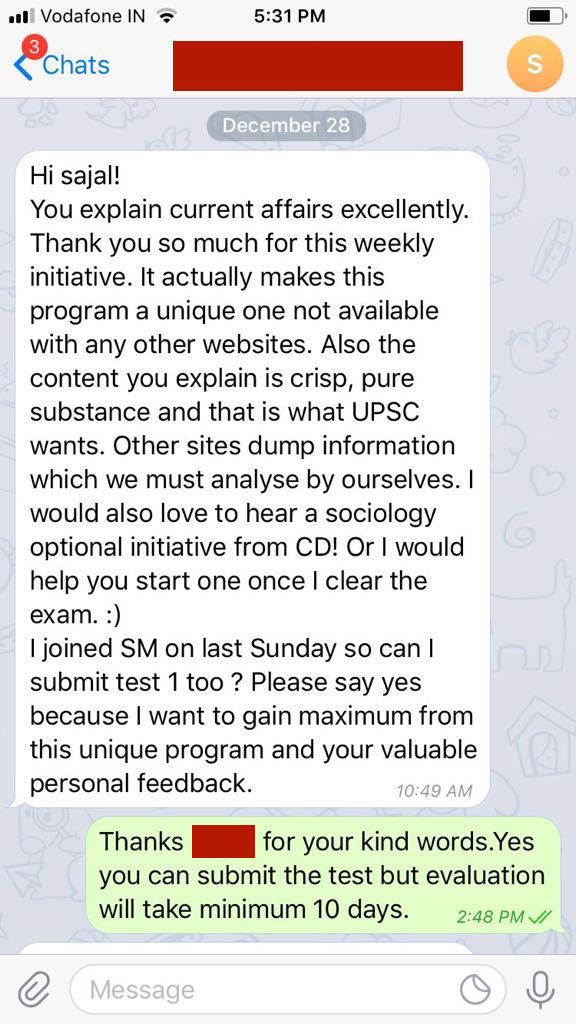
    Here’s what some of our students had to say about our mentorship.    

    2. 4 stage structure of Video->Notes->testing->review to perfect your preparation    The sequence of video->Notes->testing->review is the best way to ensure maximum retention and a rock solid preparation. Each component of the program has been meticulously crafted.

    3. Our video lectures and notes on weekly CA are brief but comprehensive   Packed 2 lectures of 2 hours each on a Weekly basis (1 on Sunday & 1 on Tuesday) which will focus on news and its importance from both prelims and mains perspective. We understand that the UPSC exam is a generalist exam.

    It’s important to cover more issues than to cover one issue in more depth. Hence, we maintain a fine balance of covering cover many important news items and have a detailed discussion on selected topics which require the same. This program will also help you understand how to utilize current affairs in all your prelims and mains papers. This ideology makes this course the best utilization of your time.

    Here’s what some of our students had to say about the lectures.


    4. Guest Lectures on specific issues by UPSC Toppers and other expert faculties   Besides the above, you will have access to our monthly magazines and weekly notes/links to important news/external material. You will have access to all modules included in our Mentorship program – Study-plan, strategy discussion, specific weaknesses, overall guidance. Since our mentors will have information about your performance

    5. Weekly Mains Test and Evaluation by our team of subject experts   The video and notes will be followed by a test released every weekend. It will have 10 high-quality questions. This will complete your study loop and enhance your retention. >Mains level questions with feedback. Sample review is attached.

         > Answer Enhancement We chose the Question & Answer format because it is perfectly aligned with the requirements of the exam. Having information is very different from presenting it in an answer with a proper structure. This will help in better retention of prelims specific information and prepare a solid ground for your mains prep. After every 2nd test you attempt, you can reach out to our mentors for personalized feedback.

       6. Current Affairs Monthly Prelims Test package This was a feedback we received from many students. They wanted appropriate focus on the current affairs program.

    We are also providing 10 Prelims CA tests along with this package.


    Join Batch 2 of Samachar Manthan Yearly 2018-19 (with Answer Writing Module) here: Click2Join

    Join Batch 2 of Samachar Manthan Yearly 2018-19 (only videos and notes) here: Click2Join


    10% discount for all students joining before 25th October (Date of start of yearly batch 2)

    Prime Students get their usual discount of 30%

    For any queries, mail us on hello@civilsdaily.com or message on Whatsapp on 89299-87787

  • [Burning Issue] Internet of Things (IoT)


    What is the meaning of IoT?

    1. The Internet of Things (IoT) is a system of interrelated computing devices, mechanical and digital machines, objects, animals or people that are provided with unique identifiers and the ability to transfer data over a network without requiring human-to-human or human-to-computer interaction.
    2. A thing, in the Internet of Things, can be a person with a heart monitor implant, a farm animal with a biochip transponder, an automobile that has built-in sensors to alert the driver when tire pressure is low — or any other natural or man-made object that can be assigned an IP address and provided with the ability to transfer data over a network.
    3. IoT has evolved from the convergence of wireless technologies, micro-electromechanical systems (MEMS), microservices and the internet. The convergence has helped tear down the silo walls between operational technologies (OT) and information technology (IT), allowing unstructured machine-generated data to be analyzed for insights that will drive improvements.

    Impact of IoT on the day to day life:

    1. Car-Calendar Connection: Say for example you are on your way to a meeting; your car could have access to your calendar and already know the best route to take. If the traffic is heavy your car might send a text to the other party notifying them that you will be late.
    2. Alarm Clock-Coffee Maker Connection: What if your alarm clock wakes up you at 6 a.m. and then notifies your coffee maker to start brewing coffee for you?
    3. IoT and Google’s Driverless Car: The car has multiple devices which track the movement of objects, captures the images surrounding it and processes the information. It has devices on board that can change the speed and direction of movement depending on the feedback it gets from the external environment. The data is then backed-up on a cloud from which it can receive instructions and behave accordingly, right from throttle accelerator to applying brakes.

    Impact of IoT on Governance:

    1. On a broader scale, the IoT can be applied to things like transportation networks: “smart cities” which can help us reduce waste and improve efficiency for things such as energy use; this helping us understand and improve how we work and live.

    Challenges thrown up by the advent of IoT

    • Data Management

    Connected devices are going to produce massive amount of data. Companies need to figure out a way to store, track, analyze and make sense of the vast amounts of data that will be generated.

    • Privacy & Security

    With billions of devices being connected together, what can people do to make sure that their information stays secure? Will someone be able to hack into your toaster and thereby get access to your entire network? The IoT also opens up companies all over the world to more security threats. Then we have the issue of privacy and data sharing.

    IoT in India

    Government of India’s IoT Announcement, has come out with a draft IOT Policy document which focuses on following objectives:

    1. To create an IoT industry in India of USD 15 billion by 2020. It has been assumed that India would have a share of 5-6% of global IoT industry.
    2. To undertake capacity development (Human & Technology) for IoT specific skill-sets for domestic and international markets.
    3. To undertake Research & development for all the assisting technologies.
    4. To develop IoT products specific to Indian needs in all possible domains.

    Recent Initiatives

    1. Government is coming up with a regulatory framework for Internet-of-Things (IoT) along with policies to promote the sector.
    2. Department of Telecom has come out with a machine-to-machine (M2M) roadmap, with an aim to put regulators, industry agencies that develop standards, users and manufacturers on the same page.
    3. The Department of Electronics & Information Technology (DeitY), in its draft policy, targets to create an IoT industry in India of $15 billion by 2020.
    4. Currently, work is going on in the area of numbering schemes for IoT and KYC norms for SIM-embedded M2M devices.
    5. Telecom Standards Society of India too is working on India-relevant standards with respect to the sector.

    Consumer IoT adoption would be slow in India

    Due to various challenges, consumer IoT adoption would be slow in India. Some of these IoT adoptions challenges (data security, lack of standardization, data ownership issues, ROI, etc.) are really not unique to India. Apart from these challenges, IoT in India, especially in the consumer space, would need to reckon with a few other hurdles. These are:

    • Internet availability / bandwidth / reliability

    Even today Internet connectivity is a major challenge in India. For consumer IoT adoption – this would remain a major challenge.

    • Cost of IoT enabled systems and devices

    Even products such as wearable fitness bands are yet to take off in India, and price is a key reason. Indian consumers are very selective in terms of where they would invest when it comes to technology.

    • Lack of vendor activity

    Global vendors, often mistakenly, assume that Indian consumers are “not ready” for advanced products. This is very much evident in the IoT space, with hardly any kind of vendor activity today. This, in turn, has led to low awareness levels of IoT devices and systems among consumers.

    • Overall infrastructure challenges

    Apart from the internet the supporting infrastructure such as smart grids, traffic systems, etc., are far from being ready for IoT.

    Commercial IoT has much better prospects in India

    The challenges listed for consumer IoT adoption becomes less of an issue when it comes to commercial space. It is not that these challenges (especially internet connectivity and cost of IoT) are not there in the commercial space; they can just be more easily addressable by commercial organizations. Even globally, IoT adoption and usage is much higher in the commercial space.

    Some of the areas where commercial IoT adoption can grow in India are:

    • Logistics, fleet telematics
    1. Logistics as a sector is expected to grow rapidly in the coming years in India. Regulatory changes such as GST implementation would drive consolidation and growth. The booming e-commerce sector is another key driver for the logistics industry.
    2. With growth and consolidation, logistics companies would be looking to better leverage technology to drive efficiency in operations and this where IoT could play a key role.
    3. Tata Motors as begun putting sensors into its trucks, so that fleet owners can get information on how the vehicles are used, and even predict potential breakdowns.
    4. Vendor community also sees to be interested in the IoT opportunities in the logistics space.
    5. Cisco and L&T Technologies announced a tie-up in September 2014, to explore IoT opportunities in transportation and other infrastructure sectors.
    • Smart cities and utility services
    1. With the new government coming out with an IoT policy, and the stated plans of developing smart cities, there is significant scope for growth of IoT in multiple government and utility services.
    2. There are signs of some vendor activity also. Tech Mahindra has announced a tie-up with Bosch Software Innovations, to develop an ecosystem to enable innovative solutions for the connected world and connected enterprises.
    • Industrial automation / supply chain / inventory management
    1. Indian manufacturing sector has seen a significant growth in IT adoption.
    2. IoT applications for the manufacturing sector whether it is automation or supply chain management would be a key growth area in India.
    3. Other areas of possible growth include insurance sector, where some of the insurance companies in India have started experimenting with IoT, primarily in the automobile insurance space; and the healthcare sector which is growing very rapidly and modernizing fast.

    Way forward

    1. IoT will continue to evolve in the coming months and one can expect significant growth in the long run.
    2. However, reliable internet connectivity and overall supporting infrastructure will be a key prerequisite for this growth. If things fall into place, IoT has the potential to provide substantial benefits.
  • UPSC Mains 2018 GS Paper 4 – Solutions, Sample Structures and Repeated Questions from CD Mains TS

    In GS 4, close to 9 out of 13 questions from Section A came from our 3 Full-Length-Tests. We obviously couldn’t predict the precise quotes and generic questions, but our students could easily attempt those.

    *These are not solutions but pointers/line of thought to be followed.

    **Please do not look for a precise 1-1 match between the UPSC paper and our Test Series. The comparison is there to help you get a feel of the approach we follow while designing questions in our TS.
    ***In the comments section, let us know interesting points along with the reasons that could enrich these answers.


    Section A
    1) (a) State the three basic values, universal in nature, in the context of civil services and bring out their importance. (150 words) 10
    Various questions have been asked in our tests on a similar theme. We have provided reviews asking students to quote committees, contemporary examples, quotes to highlight the importance and score maximum marks.
    You could easily score 7+ marks if you had gone through our solutions + feedback on answers.
    Round1 GS4
    2. Examine the relevance of the following in the context of civil service citing examples. (10 Marks)
    a)Probity
    b)Taking Accountability
    c)Delegation
    d)Developing Others
    e)Consultation and Consensus Building
    Round2 GS4
    1.a. Accountability is the need of the hour for Civil Servants. Analyze. (10 marks)
    (b) Distinguish between “Code of ethics” and “Code of conduct” with suitable examples.
    Round2 GS4
    5.a. What is the difference between Code of Ethics and Code of Conduct. Should Code of Ethics be preferred over Code of Conduct?  (150 words) 10
    Should Code of Ethics be preferred over Code of Conduct? – asked in our TS directly. Our TS question was more nuanced and required critical analysis. On the contrary, the actual exam question was quite simple. 
    Approach
    Start by defining Code of Conduct first. It is a set of instructions that ensure
    Say it is being governed by All India Services (Conduct) Rules,1968
    https://www.civilsdaily.com/reforms-needed-in-civil-services-2nd-arc-report-and-other-committee-recommendations/
    2) (a) What is mean by public interest? What are the principles and procedures to be followed by the civil servants in public interest? (150 words) 10
    Many case-studies involving a conflict of interest between public interest and private interests. 
    (b) “The Right to Information Act is not all about citizens’ empowerment alone, it essentially redefines the concept of accountability. Discuss. (150 words) 10
    A case study of RTI was asked in our TS. No specific question was asked. 
    3) (a) What is meant by conflict of interest? Illustrate with examples, the difference between the actual and potential conflicts of interest. (150 words) 10
    There are many case studies on conflict of interest across the 3 tests explicitly mentioning the term. This would’ve given you a fair idea of conflict of interest and also helped you come up with very effective examples for both actual and potential conflicts of interest.
    Approach
    Define conflict of interest
    Conflict of interest refers to conflicts between one’s professional responsibilities as a public servant or as a member of an organization and ones private interests as an individual. They are the most obvious examples of an ethical dilemma.
    An actual conflict of interest –
    You are in the interview board of a selection committee. Your family member is appearing for the same interview.
    This scenario represents an actual conflict of interest. Your responsibilities demand you to demonstrate neutrality. However,  with your family member being present it is going to be very difficult to do the same.
    conflict of interest can be managed appropriately by recusal (withdrawal) – that is, by having another official temporarily sit in the interview panel.
    potential conflicts of interest
    A “potential conflict of interest” is different from actual conflict of interest in the sense that they may arise at some time in the future.
    If a person agrees to give a contract to a party without holding competitive budding and justifying it on grounds of superior technology/first come first serve, etc.
    The person might not have gained anything from the contract. The contractor might not be known to the person. But following the above process gives rise to a potential conflict of interest.
    At the same time, many situations might seem like conflicts of interest but are actually not. Eg. If you are a teacher and you see your son cheating, it should seem like a conflict of interest but it is not. Punishing your son, not treating him differently from other students will help him evolve as someone more responsible and aware of what needs to be done.
    (b) “In looking for people to hire, you look for three qualities: integrity, intelligence and energy. And if they do not have the first, the other two will kill you.” – Warren Buffett
    What do you understand by this statement in the present-day scenario? Explain. (150 words) 10
    We asked a question on Probity but not Integrity. Probity is a more difficult term to bluff around, hence we stressed on that. The question talks about the importance of integrity. At the same time, it is asking you to discuss in the present-day context.
    Approach
    Integrity not only means upholding the values of public or private service like honesty, decency, frankness, fairness but also ensuring that consistency is maintained in exercising these values. It ensures reliability and establishes one as trustworthy. If one has acted in a certain manner, then it is more likely that he/she will repeat it. ARC expands the meaning of the concept of the integrity of public servants need to be amplified. While financial integrity is one element of it, functional integrity and a high level of efficiency at work are equally important.
    The above statement highlights the importance of integrity. It says that without it, intelligence and energy can be detrimental to an organization and the person himself.
    An intelligent and energetic man is capable enough to do unethical tasks and tricks a system. Without integrity, he is more likely to do so.
    Take the eg. of Mallya or Nirav Modi. Both intelligent and energetic businessmen who have built their empires. Unfortunately, they lacked integrity and hence it proved dangerous both of them and the country.
    Hence, integrity holds primacy over all other values. Hiring someone smart might seem like the right thing to do in the short run.
    4) (a) “In doing a good thing, everything is permitted which is not prohibited expressly or by clear implication”. Examine the statement with suitable examples in the context of a public servant discharging his/her duties. (150 words) 10
    Approach
    The question focuses on widespread discretion a public servant enjoys and yet they have become more cautious in discharging their duties and taking risks due to the 4Cs – CVC, Courts, CBI, CAG.
    Laws and rulebooks lay down broad-based restrictions. They can neither cover all circumstances as it is impossible to foresee them nor can they be very detailed to become restrictive in scope.
    Hence, everything outside the restrictions is permitted.
    A civil servant should use his good judgment to ensure that he does his public duty and works in the best interest of the public even if it involves the fear of coming under scrutiny by the 4Cs. His aim should not be to keep himself away from any controversy and unforeseen legal hassles.
    Eg. Tamil Nadu IAS officer had pointed out the lapses in urban planning and construction which led to his transfer. Once urban flooding happened, he stood vindicated.
    Similarly, the courts giving relief to upright IAS officers of UP and Bihar in discharging their duties highlight the great work done by them.
    The need of the hour is civil servants taking quick decisions, ensuring that files and proposals are not stuck and evolving effective means for private sector participation.
    (b) With regard to the morality of actions, one view is that means is of paramount importance and the other view is that the ends justify the means. Which view do you think is more appropriate? Justify your answer. (150 words) 10
    The same question with more complex wordings was asked in our test. Go through it and our model answer provided in our TS. We have further left reviews highlighting concepts of Absolutism
    Round 1 GS 4
    6. a. Is it as much of a mistake to define ‘right action’ as to define ‘good consequence’? (10)
    Model Answer for the TS
    The above statement captures the essence of consequentialist and deontological approaches. Consequentialism talks of a good consequence regardless of whether the action was right or wrong. It say ends justify means. Deontological view talks of the right action regardless of the end consequence. Meaning, end is not important, it’s more important to follow the right path. As an eg. – the Utilitarian perspective is consequentialist while Kant’s categorical imperative is deontological. Both theories have their flaws. Utilitarian perspective is only concerned with the greatest happiness of the greatest number. If killing a person gave happiness to 100 other people, it would be just to execute that one person. On the other hand, Kant’s categorical imperative would condemn lying but there are many instances where lying can save one’s life. So it cannot be universally applied.
    From the above, we cannot say that defining ‘right action’ is a mistake and ‘good consequence’ should have primacy. There cannot be a narrative that can be universally applied. Their applicability depends on a case by case scenario. Gandhi was of the opinion that not only are the ends important but so are the means. It is not enough to fight for freedom but to have Dharma on our side which means right action. This implies that the right action and good consequence need not be in contradiction. They cannot be seen in dichotomous terms. A harmonious synthesis of the two is always possible and one should always think of solutions that do justice to both means and ends.
    5) (a) Suppose the Government of India is thinking of constructing a dam in a mountain valley bond by forests and inhabited by ethnic communities. What rational policy should it resort to in dealing with unforeseen contingencies (150 words) 10
    Question on EIA. Elaborate on the points below –
    Screening often results in the categorization of the project and from this a decision is made on whether or not a full EIA is to be carried out. Here I’ll decide that a full EIA is be carried out.
    Scoping is the process of determining which are the most critical issues to study.
    Here I’ll ensure community participation. Come up with a detailed analysis of the impact of constructing the Dam.
    -List of People who are affected by the project will be drawn and they need to hear about it as soon as possible.
    -The impact on the environment, flora, and fauna of the region will have to be laid out.
    -The costs to the government will be communicated.
    If the community agrees with the project design and are ready to accept the terms offered by the government, we will move ahead. Else changes in design of the project, looking at alternate venues will be considered and the same step will be repeated.
    Detailed prediction and mitigation studies follow scoping and are carried out in parallel with feasibility studies.
    The main output report is called an Environmental Impact Statement and contains a detailed plan for managing and monitoring environmental impacts both during and after implementation.
    Finally, an audit of the EIA process is carried out sometime after implementation. The audit serves a useful feedback and learning function.
    (b) Explain the process of resolving ethical dilemmas in Public Administration. (150 words) 10
    Throughout our test series, we have tested on your knowledge of attempting questions around virtue ethics, consequentialist ethics and deontological ethics. Utilitarian, Kantian, Gandhian principles.
    This question primarily wanted to assess your understanding of the above theories and their limitations and understand that they need to be applied on a case by case basis.
    6) What do each of the following quotations mean to you in the present context?
    (a) “The true rule, in determining to embrace, or reject anything, is not whether it has any evil in it; but whether it has more evil than good. There are few things wholly evil or wholly good. Almost everything, especially of governmental policy, is an inseparable compound of the two; so that our best judgement of the preponderance between them is continually demanded. ”Abraham Lincoln ( 150 words)10
    (b) “Anger and intolerance are the enemies of correct understanding. “ _ Mahatma Gandhi (150 words) 10
    Since a question on intolerance has been so common, we tried to ask a more difficult question on dissent.
    Round 2 GS4
    2.a. What do you understand by dissent and why is it important for a democracy. With examples explain why dissent needs more focus in India?
    Approach
    In this question talk about how emotional intelligence is hit if you are angry and intolerance. Hence it distorts our understanding of self and the environment, makes us draw wrong conclusions.
    Provide relevant examples.
    In the model answer, we had provided quotes that could’ve been used here –
    Voltaire had remarked – I might disapprove of what you say but defend to death your right to say so. We as individuals, society and a country have to realise this.
    Such tolerance can help us understand different perspectives to arrive at a more correct, accurate understanding.
    (c) “Falsehood takes the place of truth when it results in unblemished common good.” _ Tirukkural (150 words)10
    Approach
    The above quote is similar to Gita’s quote that one lie spoken to benefit someone is greater than 100 truths.
    Talk of consequentialism. That ends justify the means.
    Counter by proposing deontological ethics.
    Finally saying both means and ends are necessary. Lying to achieve ends might not always be a preferred way.
    Check out GS 1 Solutions here – 
    https://www.civilsdaily.com/upsc-mains-2018-gs-paper-1-solutions-sample-structures-and-repeated-questions/