💥Mains Ready By December. Smash Mains & Smash PYQ Admissions Open

Search results for: “”

  • 12 October 2018 | Prelims Daily with Previous Year Questions

    Q.1) The Global Hunger Index 2018 is released by:

    a) World Economic Forum

    b) International Food Policy Research Institute

    c) WHO

    d) None of these

    Inspired by: 21% Indian children are under-weight: Global Hunger Index

    https://www.civilsdaily.com/news/21-indian-children-are-under-weight-global-hunger-index/

    Q.2) With reference to the Centre for the Fourth Industrial Revolution in India, which of the given statements is/are correct?

    1. It is one of the series of centres established by International Labour Organization.
    2. Ministry of Skill Development and Entrepreneurship will coordinate the partnership on behalf of the Government of India.
    3. The launch of this Centre is the fourth in the world after San Francisco, Tokyo and Beijing.

    Select the correct codes:

    a) All are correct

    b) 1 and 2

    c) Only 2

    d) Only 3

    Inspired by: [pib] Centre for the Fourth Industrial Revolution in India

    https://www.civilsdaily.com/news/pib-centre-for-the-fourth-industrial-revolution-in-india/

    Q.3) The Human Capital Index (HCI) of the World Development Report is released by:

    a) UNDP

    b) IMF

    c) World Bank

    d) World Economic Forum

    Inspired by: [pib] World Bank’s Human Capital Index released

    https://www.civilsdaily.com/news/pib-world-banks-human-capital-index-released/

    Q.4) Which of the following parameter is not an indicator used in determining Global Hunger Index?

    a) Calorie intake

    b) Child Wasting

    c) Child Stunting

    d) Child and Maternal Mortality

    Inspired by: 21% Indian children are under-weight: Global Hunger Index

    https://www.civilsdaily.com/news/21-indian-children-are-under-weight-global-hunger-index/

    Q.5) The Human Development Index (HDI) is released by:

    a) UNDP

    b) IMF

    c) World Bank

    d) World Economic Forum

    Inspired by: [pib] World Bank’s Human Capital Index released

    https://www.civilsdaily.com/news/pib-world-banks-human-capital-index-released/

    For Solutions – Click Here

    Prelims Daily Archive – Click here


  • 11 October 2018 | Prelims Daily with Previous Year Questions

    Q.1) Consider the following statements with reference to the Online Assurances Monitoring System (OAMS):

    1. It is developed by the Union Ministry of Parliamentary Affairs (MPA).
    2. It is aimed to make the information regarding assurances given on the floor of the Houses of Parliament paperless and available in digital format.

    Which of the given statements is/are correct?

    a. Both 1 and 2

    b. Only 1

    c. Only 2

    d. Neither 1 nor 2

    Inspired by: [pib] Online Assurances Monitoring System

    https://www.civilsdaily.com/news/pib-online-assurances-monitoring-system/

    Q.2) Which of the following statements best describes the Environmental flow (Ecological flow) of a river?

    a. It is the quantity, timing, and quality of water flows required to sustain freshwater and estuarine ecosystems and the human livelihoods.

    b. It is the amount of volumetric flow rate required to propel the blades of a turbines.

    c. It is the amount of pure water from a stream or river required to dilute the polluted river water.

    d. It is the downstream flow of river without any obstructions such as dams or canals etc.

    Inspired by: Centre sets ‘minimum river flows’ for the Ganga

    https://www.civilsdaily.com/news/centre-sets-minimum-river-flows-for-the-ganga/

    Q.3) With reference to India’s first ever National Environment Survey (NES), which of the given statements is/are correct?

    1. The National Sample Survey Office is tasked to conduct the nationwide survey.
    2. The NES will rank all the districts on their environmental performance and document their best green practices.
    3. The survey will assess carbon sequestration potential of all the districts across the country.

    Select the correct code:

    a. All are correct

    b. 1 and 2

    c. 2 and 3

    d. 1 and 3

    Inspired by: India’s first ever National Environment Survey to start in Jan 2019

    https://www.civilsdaily.com/news/indias-first-ever-national-environment-survey-to-start-in-jan-2019/

    Q.4) The ‘India for Humanity’ initiative is launched by:

    a. NITI Aayog

    b. Ministry of Home Affairs

    c. Ministry of External Affairs

    d. PMO

    Inspired by: MEA launches ‘India for Humanity’ initiative

    https://www.civilsdaily.com/news/mea-launches-india-for-humanity-initiative/

    Q.5) Justice K.S. Radhakrishnan Committee is constituted for the purpose of study of:

    a. Road Safety in India

    b. State of Malnutrition in India

    c. Ceasefire Violation across LoC

    d. Illegal migration in Assam

    Inspired by: [op-ed snap] Deadly roads in India

    https://www.civilsdaily.com/news/op-ed-snap-deadly-roads-in-india/


    For Solutions – Click Here

    Prelims Daily Archive – Click here
  • 12 October 2018 | High Relevance vs Low Relevance News

    Reading News for UPSC is utmost important and rising number of questions year on year in UPSC Prelims is a testimony of this

    We are starting a daily series where we will analyze news covered in The Hindu, Indian Express and other newspapers which are important from exam perspective and which are not

    Important news would have been covered in our daily news coverage in form of newscards.

    Unimportant ones will be mentioned here and a short description regarding why it is not relevant for the exam

    Click on news headlines to read the full news

    High Relevance News

    [pib] World Bank’s Human Capital Index released

    https://www.civilsdaily.com/news/pib-world-banks-human-capital-index-released/

    21% Indian children are under-weight: Global Hunger Index

    https://www.civilsdaily.com/news/21-indian-children-are-under-weight-global-hunger-index/

    Indexes and reports by international as well as national agencies are important for Pre as well as Mains. Read all the details.

    [pib] Centre for the Fourth Industrial Revolution in India

    https://www.civilsdaily.com/news/pib-centre-for-the-fourth-industrial-revolution-in-india/

    Read about the fourth industrial revolution. A hot topic for Pre as well as Mains in S&T section.

    Draft electronics policy: Govt aims $400-billion electronics manufacturing sector by 2025

    https://www.civilsdaily.com/news/draft-electronics-policy-govt-aims-400-billion-electronics-manufacturing-sector-by-2025/

    Government policies are directly being asked in Mains. Read and make notes.

    Low Relevance News

    NHRC important to achieve sustainable development goals: PM

    In an event in New Delhi to mark the 25th anniversary of the founding of the NHRC, PM Modi said that National Human Rights Commission has an important role to play in government’s efforts to achieve sustainable development goals

    No important points in the news from the exam point of view


  • [Burning Issue] Inter-State River Water Disputes (Amendment) Bill, 2017

    Highlights of the Bill

    1. Dispute Resolution Cmtee (DRC) will try to settle disputes through negotiations within 1 yr, extendable by another 6 months
    2. If the negotiations fail after 18 months (1yr + 6 mths) the dispute will be referred to the Tribunal
    3. Members of DRC will comprise relevant subject matter experts as decided by the centre
    4. The Tribunal
    • the Bill proposes a single permanent Tribunal with multiple benches
    • all the existing tribunals will be merged into it
    • each dispute has to be solved within 4.5 yrs
    • appeal agains the tribunal’s verdict is not allowed. The decision is final and binding.

    For each river basin (at the national level) a dedicated agency will be established by the centre for data collection.

    The system at present (ISWDA, 1956)

    1. A new tribunal has to be formed each time a state approaches the centre with the request and the latter is convinced.
    2. 8 such Tribunals have been formed till date.
    3. The Judiciary does not have jurisdiction over such disputes. It can, however, interpret verdicts of tribunals
    4. The system has had some successes especially with the 1st gen Tribunals (Krishna, Narmada and Godavari)
    5. But in general, the system has struggled to offer equitable awards.
    • Out of the 8, only 3 tribunals'(Krishna, Narmada and Godavari) awards have been accepted by the states.
    • Tribunals like Cauvery and Ravi-Beas have been in existence for over 26 and 30 years respectively without any award.

    Problems with ISWDA, 1956

    1. Protracted proceedings and extreme delays in dispute resolution

    Reasons for delays

    • no time limit for adjudication by a Tribunal
    • no upper age limit for the Chairman or the Members
    • work getting stalled due to the occurrence of any vacancy, and
    • no time limit for publishing the report of the Tribunal
    • politicization of the issue compounds the problem

    eg. recent eruption of Cauvery dispute as an identity issue b/w Tamils and Kannadigas

    • Opacity in institutional framework and guidelines
    1. procedural complexities + India’s messy federal polity (Water – state list ; Regulation and dvpt of inter-state rivers – union list) = muddled adjudication
    • The tribunals have largely failed in ensuring compliance of verdicts, especially in the coalition era.

    eg. Punjab refused to accept the Ravi-Beas Tribunal’s verdict

    1. An absence of authoritative water data makes adjudication difficult.

    The new system (2017 Bill) vs. The existing system (1956 Act)

    • Will address problem 1 (of Delays (see above)) as
    • the Bill proposes defined timelines and qualifications for members, and
    • obviates the need for notification of the award in official gazette by the centre
    • Will NOT address the problem – of Opacity – because of procedural complexities
    • the DRC’s functions sound similar to the current techno-legal procedures of Tribunals
    • India’s messy federal polity will continue to haunt satisfactory resolution
    • as the Bill continues with the extant constitutional arrangement on ‘Water’
    • Will NOT address problem 3 – of Compliance – as
    • today, inter-state water disputes are no longer just about water allocation, public opinion matters too.
    • the Bill lacks a transparent and robust institutional framework to secure public opinion and ensure quick implementation
    • About problem 4 – related to establishment of a data bank and information system
      1. despite a similar provision in the extant law, tenuous centre-state relations have obscured success.
      2. the challenge is not about gathering data and information but more about consensus over the gathered data.
      3. moreover, the capacity to process this data to deliver ‘knowledge’ that could fasten adjudication remains elusive

    Way forward

    • Collaborative, not competitive approach to water disputes
      1. states should be sensitive to each others’ needs
      2. the govt must bring in a comprehensive legislation in place of the River Boards Act, 1956
    • Implementation / Compliance
      1. set up a transparent and robust institutional framework
      2. the SC should restrain itself in accepting the inevitable “Spl Leave Petitions” against the Tribunal’s award
    • Put ‘Water’ in the concurrent list to avoid legal complexities
    • Improve awareness about rising water stress.
    • Adopt a participatory approach (involve the public) to improve water use-efficiency.
    • Incentivize sustainable use of water, especially in agriculture and industry.
  • 11 October 2018 | High Relevance vs Low Relevance News

    Reading News for UPSC is utmost important and rising number of questions year on year in UPSC Prelims is a testimony of this

    We are starting a daily series where we will analyze news covered in The Hindu, Indian Express and other newspapers which are important from exam perspective and which are not

    Important news would have been covered in our daily news coverage in form of newscards.

    Unimportant ones will be mentioned here and a short description regarding why it is not relevant for the exam

    Click on news headlines to read the full news

    High Relevance News

    [op-ed snap] More teeth for NHRC

    https://www.civilsdaily.com/news/op-ed-snap-more-teeth-for-nhrc/

    An important editorial discussing flaws in NHRC and proposed amendments in PHR Act. Read and make notes for Mains.

    India’s first ever National Environment Survey to start in Jan 2019

    https://www.civilsdaily.com/news/indias-first-ever-national-environment-survey-to-start-in-jan-2019/

    Note about National Environment Survey and parameters it will measure. Can be asked in Prelims.

    [pib] Goa Maritime Symposium – 2018

    https://www.civilsdaily.com/news/pib-goa-maritime-symposium-2018/

    Read about GMS 2018. Events like these are now being converted into Prelims CA questions.

    Low Relevance News

    EC issues amended Form-26 for candidates with criminal antecedents

    Pursuant to the recent Supreme Court directive on candidates with criminal antecedents, the Election Commission has released an amended Form 26 for those contesting polls to declare and publicise details of the cases against them

    No important points in the news from the exam perspective

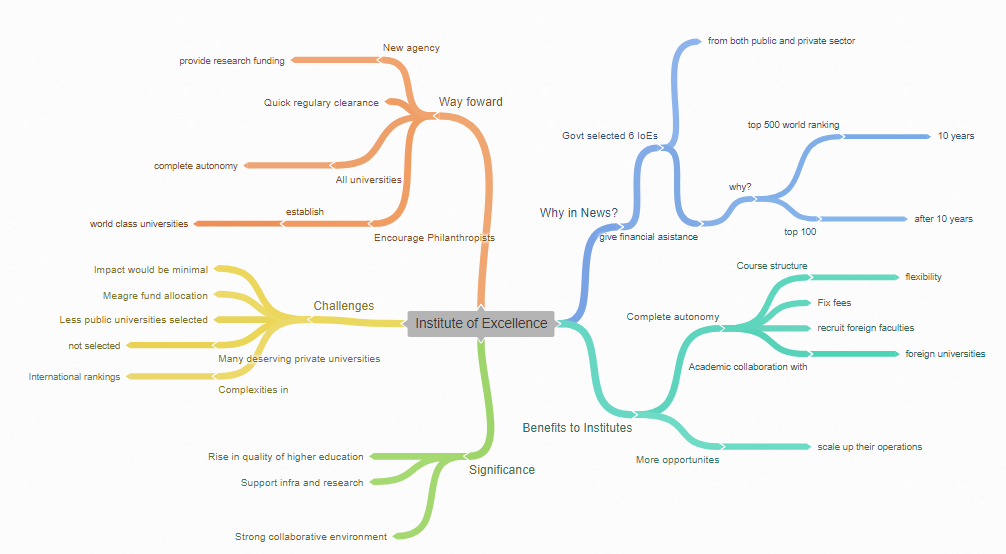
  • [Burning Issue] Institute of Excellence Debate

    Why in news?

    1. The Government has shortlisted Six Institutions of Eminence (IoEs)  including 3 from Public Sector and 3 from Private Sector
    2. It is expected that the above-selected Institutions will come up in the top 500 of the world ranking in 10 years and in top 100 of the world ranking eventually overtime
    3. Each public Institution selected as ‘Institution of Eminence’ will get financial assistance up to Rs. 1000 Crore over the period of five years under this scheme

    What will be the benefit of this decision to institutes?

    1. It will ensure complete autonomy to the selected institutions and facilitate them to grow more rapidly
    2. They will get more opportunity to scale up their operations with more skills and quality improvement so that they become World Class Institutions in the field of education
    3. To achieve the top world ranking, these Institutions shall be provided with:
    • Greater autonomy to admit foreign students up to 30% of admitted students
    • To recruit foreign faculty up to 25% of faculty strength; to offer online courses up to 20% of its programmes
    • To enter into academic collaboration with top 500 in the world ranking Institutions without permission of UGC
    • Free to fix and charge fees from foreign students without restriction
    • The flexibility of course structure in terms of number of credit hours and years to take a degree
    • Complete flexibility in fixing of curriculum and syllabus

    The significance of this step

    • IoEs will have unprecedented freedom to fund activities and customise courses, bringing creativity to higher education
    • It will support infrastructure and research in leading institutions to help them achieve international rankings
    • Under this initiative, there is recognition that education and research require strong collaborative environments with other institutions and people of diverse nationalities, cultures and ideas.

    Criticism/Challenges

    1. Less public universities selected:

    • The committee tasked with recommending Institutes of Eminence (IoE) wanted eight public universities and three private ones to get the tag.
    • This was from a total of 114 universities that applied for the IoE status and scrutinised by a four-member committee.
    • These universities included 74 public, 29 private (brownfield) and 11 private (green field) universities. However, the government mysteriously sanctioned only three public universities.
    • The deserving public ones that missed out are IIT Madras, IIT Kharagpur, Delhi University, Jadavpur University and Anna University

    2. Many deserving Private universities not selected:

    • The deserving private greenfield university applicants that did not make the cut include ISB (Hyderabad), KREA (Raghuram Rajan) and Vedanta. The deserving private universities that did not make the cut include Ashoka University and Amrita University.

    3. Very meagre allocation of funds:

    • The government will give Rs 1,000 crore over five years to each of the three selected public universities.
    • That is a budgetary outlay of Rs 600 crores per year for all the pomp and show. The top 10 universities in the world spend annually an average of Rs 5,800 crore each on research alone.
    • The total endowment funds of top 10 universities on an average should be Rs 1,24,000 crore each

    4. The impact on the majority of Universities would be minimal:

    • India currently has approximately 800 universities, 39,000 colleges and 12,000 standalone institutions and over 34 million young Indians join higher education annually. Given the sheer size and scale of the Indian higher education system, the direct benefits that may accrue from implementing this proposal are likely to be minimal.

    5. Complexities of International rankings:

    • The idea of using global rankings for assessing universities has drawn some well-justified criticism before. What does a focus on rankings mean for education? Such rankings tend to prioritise impact of publications over the quality of research programs, the latter being equally, if not more, important for advancing knowledge.
    • Further, these metrics only speak to individual publications and not the evaluation of research programs or their impact on the communities that they seek to serve.
    • In nations such as India, where there is a need for research that addresses society, the usability and impact of applied research becomes important, which is one of the goals of creating IoE. This calls for newer, more holistic approaches to assessment of research quality

    Way Forward

    With the focus trained just on 6 institutes in this particular proposal, several hundreds of government universities where tens of millions of India’s youth study are being laid to waste by excessive regulation, lack of  leadership, shortage of teaching staff, inadequate funding, lack of infrastructure and maladministration, especially in smaller cities and towns. This ‘bullet-train’ type solution applied to the education field isn’t necessarily bad, but the lack of transparency seems to only benefit a minuscule proportion of the population in more than one way.

    In light of the importance and urgency of transforming India’s higher education system, lessons from around the world, it is clear that there is a better way forward for the nation.

    Following steps are required

    1. To unshackle the higher education system quickly and at scale: integrate the regulatory agencies to create a single-window for establishing new universities, eliminate unnecessary functions of these agencies, and realign their responsibilities.
    2. To spur hundreds of universities and thousands of colleges to improve their level of excellence: give all higher education institutions complete autonomy. Let them all compete and get better. In tandem with increased transparency and accountability on outcomes, all the stakeholders—students, industry, society and nation—will benefit.
    3. Encourage 40-50 philanthropists to establish world-class universities: removing the regulatory hurdles for all at the outset, and letting them earn their eminent status from stakeholders, just like Stanford and all world-class universities have done, is far more effective and equitable.
    4. Create a new agency that provides research funding on merit to faculty members in both public and private universities. This is a well-accepted practice around the world. Peer-reviewed by experts in respective fields, the increased research funding will spur competition between faculty members and institutions, catalyze India’s research and innovation ecosystem, and accelerate solving the nation’s grand challenges.

    Conclusion

    It is time to unshackle India’s higher education system from the British Raj rules, regulations, and mindset. With a tsunami-scale wave of youth at the gates of higher education, India cannot afford to transform the system six Institutes of Eminence at a time. It is time to make urgent and comprehensive reforms. Now.

  • 10 October 2018 | Prelims Daily with Previous Year Questions


    Q.1) With reference to the provisions of bye-elections under Section 151A of the Representation of the People Act 1951, consider the following statements:

    1. It provides for bye-election to be held within a period of six months from the date of the occurrence of the vacancy.
    2. Bye elections can be held when the remainder of the term of a member in relation to a vacancy is less than one year.

    Which of the given statements is/are correct?

    a) Both 1 and 2

    b) Only 1

    c) Only 2

    d) Neither 1 nor 2

    Inspired by: [pib] Section 151A of the Representation of the People Act 1951

    https://www.civilsdaily.com/news/pib-section-151a-of-the-representation-of-the-people-act-1951/

    Q.2) The National Security Council is an agency under:

    a) Ministry of Defence

    b) Ministry of Home Affairs

    c) PMs Office

    d) Ministry of External Affairs

    Inspired by: Strategic Policy Group to assist National Security Council

    https://www.civilsdaily.com/news/strategic-policy-group-to-assist-national-security-council/

    Q.3) With reference to the Environment Pollution Prevention and Control Authority (EPCA), consider the following statements:

    1. EPCA is a Supreme Court mandated body for the National Capital Region under the section 3 of the Environment (Protection) Act, 1986.
    2. It acts only on the basis of complaints made by any individual, representative body or organization functioning in the field of environment.
    3. It is mandated to deal with environmental issues pertaining to the National Capital Region which may be referred to it by the Central Government.

    Which of the given statements is/are not correct?

    a) 2 and 3

    b) Only 1

    c) Only 2

    d) All are correct

    Inspired by: Centre reconstitutes EPCA, the authority tasked with tackling environment pollution in NCR

    https://www.civilsdaily.com/news/centre-reconstitutes-epca-the-authority-tasked-with-tackling-environment-pollution-in-ncr/

    Q.4) Vishaka guidelines are associated with:

    a) Child Rights Abuse

    b) Transgender Rights

    c) Sexual Harassment at Workplace

    d) Triple Talaq

    Inspired by: Explained: When a woman is harassed at work

    https://www.civilsdaily.com/news/explained-when-a-woman-is-harassed-at-work/

    Q.5) The report “Strengthening Forest Fire Management in India” is jointly released by MoEFCC and:

    a) UN Environment

    b) WWF

    c) IMF

    d) World Bank

    Inspired by: Forest fires cost India ₹1,100 crore a year: report

    https://www.civilsdaily.com/news/forest-fires-cost-india-%e2%82%b91100-crore-a-year-report/


    For Solutions – Click Here

    Prelims Daily Archive – Click here


  • [Video] GS 2 & 3 Mains 2018 Paper Analysis and Strategy for 2019 Mains

    Know more about our Mains Guidance Program 2019 and join here: https://www.civilsdaily.com/mains-ts-2019/

  • 9 October 2018 | Prelims Daily with Previous Year Questions

    Q.1) With reference to the sovereign Gold Bond Scheme, which of the given statements is/are correct?

    1. It is issued by the Reserve Bank India on behalf of the Government of India.
    2. Investment limit of the scheme ranges from 1gm to 20kg of Gold.
    3. It will be issued from the nationalized banks for the purpose.

    Select the correct codes:

    a) All are correct

    b) 1 only

    c) 1 and 2

    d) 1 and 3

    Inspired by: [pib] Sovereign Gold Bond Scheme 2018 -19

    https://www.civilsdaily.com/news/pib-sovereign-gold-bond-scheme-2018-19/


    Q.2) Consider the following statements with respect to the International Social Security Association (ISSA):

    1. The ISSA was founded under the auspices of the International Labour Organization (ILO), Geneva.
    2. It promotes excellence in social security administration through professional guidelines, expert knowledge, services and support to enable its Members to develop dynamic social security systems.
    3. The regional office of ISSA is headquartered in New Delhi.

    Which of the given statements is/are correct?

    a) All are correct

    b) Only 1

    c) 1 and 2

    d) 2 and 3

    Inspired by: [pib] ESIC wins ‘ISSA GOOD Practice Award, Asia & the Pacific 2018’

    https://www.civilsdaily.com/news/pib-esic-wins-issa-good-practice-award-asia-the-pacific-2018/

    Q.3) With reference to the Pradhan Mantri Fasal Bima Yojna (PMFBY) consider the following statements:

    1. PMFBY covers damages to crops in wild animal attacks.
    2. Damages to the individual fields due to incidents of local disasters like cloud bursts and fire are taken up now for insurance claims.

    Which of the given statements is/are correct?

    a) Both 1 and 2

    b) Only 1

    c) Only 2

    d) Neither 1 nor 2

    Inspired by: Crop damages in animal attacks put under PMFBY on pilot basis

    https://www.civilsdaily.com/news/crop-damages-in-animal-attacks-put-under-pmfby-on-pilot-basis/

    Q.4) Consider the following statements with reference to the Kuiper Belt:

    1. Kuiper belt is a region of the solar system beyond the planets, extending from the orbit of Neptune.
    2. It consist mainly small bodies or remnants from the solar system’s formation.
    3. It is home to dwarf planets such as Pluto, Haumea and Makemake.

    Which of the given statements is/are incorrect?

    a) 1 and 2

    b) Only 2

    c) Only 3

    d) None of these

    Inspired by: NASA probe to fly by most distant object ever visited by a spacecraft

    https://www.civilsdaily.com/news/nasa-probe-to-fly-by-most-distant-object-ever-visited-by-a-spacecraft/

    Q.5) New Horizon Probe of NASA was launched to study the planetary system of which of the following celestial bodies?

    a) Jupiter

    b) Saturn

    c) Venus

    d) Pluto

    Inspired by: NASA probe to fly by most distant object ever visited by a spacecraft

    https://www.civilsdaily.com/news/crop-damages-in-animal-attacks-put-under-pmfby-on-pilot-basis/


    For Solutions – Click Here

    Prelims Daily Archive – Click here