In Goa, August marks the formation of new rice grains, celebrated through the festival of Konsachem.
Konsachem Festival and Its Traditions
Background: Konsachem, observed by Goan Hindus and Catholics, honors the new rice grains, known as konxeo in Konkani.
Shared Rituals: The first harvested rice sheaves are taken for blessings – to deities by Hindus and to saints by Catholics.
Catholic Celebrations: For Goan Catholics, the festival peaks on August 24, the Feast Day of St. Bartholomew, one of Jesus Christ’s 12 Apostles.
Observances: The celebration includes a procession, ritual cutting of grain, and a thanksgiving mass, with offerings made to St. Bartholomew.
Bartholomew’s Legacy and Christian Faith in India
Missionary Journey: Bartholomew is believed to have landed in Kallianpur and preached along the Konkan coast, reaching as far as Karachi.
Lesser-Known Apostles: While St. Thomas’s mission in Kerala and Tamil Nadu is well-documented, St. Bartholomew’s contributions in India are less known but significant.
Martyrdom and Influence: He is revered for his martyrdom in Azerbaijan and his role in the Christianization of Armenia and Georgia.
Pre-Portuguese Christian Origins: Research by scholars underscores Christianity’s roots in India dating back to the Apostles, reinforcing its integral place in Indian faith traditions.
Historical Surveys: Starting in 1916-17, Gilbert Slater initiated a series of surveys in five Tamil Nadu villages, marking the beginning of a century-long study of rural India.
Unique Village Studies: Palakurichi and Palanpur stand out as unique Indian villages extensively studied over a century and decades, respectively.
Methodology and Evolution of Village Studies
Initial Approach: Slater’s students, natives of the surveyed villages, used questionnaires to understand the socioeconomic conditions of rural households.
Subsequent Surveys: These villages were revisited for studies in subsequent years, including 1936-37, 1964, 1983, 2004, and 2019, providing a longitudinal perspective.
Significance of Longitudinal Studies
Contrast with Cross-Sectional Surveys: Unlike the National Sample Survey Office’s cross-sectional surveys, village studies are longitudinal, focusing on in-depth analysis over time.
Objective: The aim is to trace changes in the specific village over time, providing micro-level insights that complement macro-level data.
Key Findings from Recent Surveys
Economic Shifts: The 2019 survey of Palakurichi revealed a decline in agriculture’s dominance, with only 43.3% of the workforce engaged in farming, down from 85% in 1983.
Diversification of Workforce: Similar trends were observed in Palanpur, with a significant shift from agriculture to non-farm jobs over the decades.
Changing Social Dynamics
Diminished Dominance of Traditional Landholders: In both Palakurichi and Palanpur, traditional upper caste landholders’ power has declined, with middle castes and Dalits gaining more land ownership.
Economic and Social Mobility: These changes reflect broader social and economic mobility within these rural communities.
Policy Implications and Challenges
Land Leasing Practices: As some communities move away from agriculture, land leasing becomes common, often based on oral agreements to avoid legal complications.
Need for Policy Reforms: There’s a need for policies that balance the interests of landowners and tenant farmers, encouraging investment in land improvement.
Sustaining Agricultural Productivity: With rural India becoming less dependent on agriculture, ensuring continued or improved farming practices on existing agricultural lands is crucial.
Conclusion
Insights from Micro-Level Studies: Longitudinal village studies offer valuable insights into the patterns of change in rural India, informing policy and understanding of rural dynamics.
Balancing Agricultural and Non-Agricultural Growth: These studies highlight the need for balanced development policies that support both agricultural sustainability and non-farm employment opportunities.
Researchers have found that a flower species in Paris, the field pansy (Viola arvensis), is evolving rapidly, exhibiting reduced nectar production and smaller flower sizes.
This study aims to understand the impact of these evolutionary changes on plant-pollinator interactions.
Changing Nature of Field Pansy
Decreased Nectar and Size: The wild pansy variety in Paris showed a 20% reduction in nectar production and a 10% decrease in flower size.
Comparative Analysis: Scientists compared current flower growth with seeds from 20-30 years ago, observing notable changes.
Adaptation to Pollinator Decline: The evolution towards self-pollination in field pansies is attributed to the decreasing availability of insect pollinators.
Experimental Design: The study employed the “resurrection ecology” method, planting seeds from the 1990s and 2000s alongside their 2021 descendants.
Implications of Self-Pollination and Evolutionary Shifts
Contrast with Angiosperm Convention: The move towards self-pollination deviates from the typical reliance of angiosperms on insects for pollination.
Long-Term Coevolution: The traditional plant-insect relationship, involving nectar production for pollination, has evolved over 100 million years.
Genetic Analysis: Population genetics analysis revealed a 27% increase in selfing rates, with consistent trait shifts across studied populations.
Concerns and Potential Consequences
Short-Term Benefits, Long-Term Risks: While self-pollination may offer short-term advantages, it poses long-term survival threats to plants amid environmental changes.
Feedback Loop Risks: Reduced nectar production could lead to further declines in pollinator populations, creating a detrimental eco-evolutionary feedback loop.
Network Degradation: The study highlights the degradation of plant-pollinator networks, as observed in previous research.
The Reserve Bank of India (RBI) officials have reported a decreased risk of stagflation in India, now estimated at 1%, down from 3% in August
What is Stagflation?
Details
Definition
An economic condition characterized by stagnant growth, high unemployment, and high inflation.
Indian context
Fluctuating growth rates; periods of slowdown have raised concerns about stagnation.
Inflation Dynamics in India
Historically high at times, often driven by rising food and fuel prices.
Supply Shocks
Vulnerable to global oil price fluctuations and agricultural supply shocks (e.g., monsoon variability).
Past Episodes
Elevated stagflation risks were noted during the Asian Crisis, Global Financial Crisis, taper tantrum, and COVID-19 pandemic.
Methodology for Assessing Stagflation
Two-Pronged Approach: RBI assessment utilized two methods: analyzing periods of low economic growth with high inflation, and employing ‘at-risk’ frameworks, namely “Inflation at Risk” (IaR) and “Growth at Risk” (GaR), using quantile regression.
Determinants of Stagflation: Key factors identified include supply-side shocks, commodity price spikes, tighter financial conditions, and currency depreciation.
Key Risk Factors for India
Financial Conditions and Rupee Depreciation: Financial conditions and the depreciation of the rupee against the U.S. dollar are significant risk factors for stagflation in India.
Empirical Evidence: The integrated IaR and GaR frameworks corroborate these findings, although the impact of crude oil prices on domestic fuel prices has limited predictive power for stagflation.
Global Concerns: Post-pandemic, higher commodity prices and the U.S. dollar’s appreciation raised global stagflation concerns.
Back2Basics: Economic Conditions: Definitions and Concepts
Explanation
Depression
A sustained, long-term downturn in economic activity.
Characterized by significant decline in GDP, high unemployment, low spending, and reduced industrial output.
Deflation
A general fall in the price level of goods and services over some time, indicating negative inflation rates.
Disinflation
A decrease in the rate of inflation, i.e., a slowdown in the rate at which prices increase.
Example: Inflation rate falling from 8% to 6%.
Reflation
Economic measures, such as increasing money supply or reducing taxes, aimed at stimulating the economy to reach its long-term growth trend after a downturn.
Skewflation
A situation where the price of some items rises significantly while others remain stable.
Example: Seasonal rise in the price of onions while other prices are stable.
India seeks to modernize the ASEAN India Trade in Goods Agreement (AITGA) to reduce the significant trade deficit with ASEAN nations in February 2023 with a target to complete the revamp by 2025.
About ASEAN-India Trade in Goods Agreement (AITGA)
Details
Signing Date
August 13, 2009, w.e.f. January 1, 2010.
Objectives
Eliminate tariffs and liberalize trade in goods.
Facilitate economic integration between ASEAN and India.
Key Features
Gradual reduction and eventual elimination of tariffs
Measures to facilitate trade and customs efficiency
Member Countries
ASEAN Members: Brunei, Cambodia, Indonesia, Laos, Malaysia, Myanmar, Philippines, Singapore, Thailand, Vietnam and India.
Economic Impact
Growth in trade between India and ASEAN countries – Diversification of trade basket.
Recent Developments
Discussions on reviewing and upgrading the agreement.
Challenges
Concerns over trade imbalances.
Potential impact on certain domestic industries in India.
Strategic Significance
Part of India’s “Act East” policy.
Step towards broader regional economic integration.
Need for review
Significant Trade Partner: ASEAN countries, including Indonesia, Malaysia, the Philippines, Singapore, Thailand, Brunei, Vietnam, Laos, Myanmar, and Cambodia, accounted for 11.3% of India’s global trade in 2022-23.
Existing Trade Imbalance: The current trade deficit with ASEAN stands at $43.57 billion, a substantial increase from $7.5 billion per annum when the pact was first implemented.
Trade Statistics: In 2022-23, India’s exports to ASEAN were valued at $44 billion against imports of $87.57 billion.
Rebalancing Trade: The primary goal is to address the disproportionate benefits that have favored ASEAN since the agreement’s implementation in 2010.
Modernization of the Agreement: The focus is on updating the FTA to reflect current global trade dynamics and include new elements like product-specific rules and trade remedies.
Key Areas of Negotiation
Rules of Origin (ROO): Modifications in ROO are planned to increase market access for Indian products and prevent the rerouting of goods, particularly from China, through ASEAN countries.
Trade Remedies: A new chapter on trade remedies will aim to protect domestic industries from unfair trade practices and import surges.
Exclusion of New Areas: The agreement will not expand to cover additional areas like labor, environment, MSMEs, or gender to avoid complicating the pact.
Challenges and Industry Perspectives
Need for Concessions: While India seeks to balance the trade deficit, concessions may be necessary to ensure mutual benefits.
Sectoral Focus: Industries such as chemicals, plastics, minerals, leather, textiles, and gems and jewellery are identified for potential growth in exports.
Conclusion
Strategic Approach: India’s efforts to modernize the AITGA reflect a strategic approach to enhance trade relations while protecting domestic interests.
Balancing Act: The challenge lies in negotiating terms that benefit both India and ASEAN members, fostering a more equitable trading environment.
Long-Term Implications: Successful negotiations could significantly impact India’s trade dynamics, potentially reducing the trade deficit and strengthening economic ties with ASEAN nations.
India’s disinvestment process, primarily focusing on minority stake sales rather than full privatisation, is expected to fall short of its fiscal year 2024 target.
The government’s cautious approach, influenced by the upcoming general elections, has led to a slowdown in the privatisation of major public sector undertakings (PSUs).
Disinvestment Performance and Targets
Past Achievements: Over the past decade, disinvestment has generated over ₹4.20 lakh crore, but the current fiscal year’s target appears challenging.
FY24 Target: The government set a disinvestment goal of ₹51,000 crore for FY24, a reduction from the previous year’s estimate.
Major PSUs on Hold: Plans for the privatisation of Bharat Petroleum Corporation Ltd (BPCL), Shipping Corporation of India (SCI), and CONCOR have been deferred.
Progress So Far: Approximately ₹10,049 crore, or 20% of the budgeted amount, has been raised through IPOs and OFS.
Pipeline Projects: Strategic sales of CPSEs like SCI, NMDC Steel Ltd, BEML, HLL Lifecare, and IDBI Bank are planned but face delays due to various procedural hurdles.
Factors Influencing Disinvestment
Political Considerations: Strategic disinvestment decisions are being influenced by the upcoming elections, leading to a cautious approach.
Challenges in Strategic Sales: The sale process involves multiple stakeholders and complex procedures, making it a lengthy affair.
Public and Political Resistance: Certain sectors, particularly defence and shipping, face opposition to privatisation, causing delays and policy reassessments.
Economic Think Tank Views: Observers note a recent slowdown in PSU stake sales, attributed to regulatory processes, global economic volatility, and shifting government priorities.
Historical Context and Government Policy
Post-2014 Strategy: Since 2014, the government has revived its disinvestment policy, focusing on stake sales and listing of PSEs on the stock market.
Union Budget 2023-24: The disinvestment target for FY24 is the lowest in seven years, with the government yet to meet the target for 2022-23.
Reasons for Disinvestment: The government undertakes disinvestment to reduce fiscal burdens, finance deficits, invest in development, and retire debt.
Types of Disinvestment: The process includes minority disinvestment, majority divestment, and complete privatisation, managed by the Department of Investment and Public Asset Management (DIPAM).
Recent Disinvestment Performance
Meeting Targets: The government has met its disinvestment targets only twice since 2014.
Challenges in Execution: Strategic sales have been complicated by various factors, including market volatility and political opposition.
Future of Disinvestment in 2023-24
No New Additions: The government plans to continue with the already announced privatisation of state-owned companies without adding new ones.
Challenges and Vision: Observers suggest that disinvestment should align with the government’s long-term vision for privatisation and sectoral presence, rather than being driven solely by revenue needs.
Conclusion
Strategic Policy Shifts: The government’s disinvestment strategy is evolving, balancing between raising revenues and managing political and public sentiments.
Impact of Upcoming Elections: With general elections approaching, the focus on disinvestment might shift, impacting the progress and priorities of stake sales.
The article discusses the challenge of “jobless growth” in India, where the employment growth rate remains unresponsive despite increased GDP and value-added growth rates. It emphasizes the unique characteristics of India’s jobless growth regime, involving a high Kaldor-Verdoorn coefficient, and calls for a distinct policy focus on employment in addition to the traditional emphasis on GDP growth.
Key Highlights:
The article discusses the distinction between wage employment and self-employment, emphasizing the challenge of inadequate labor demand, particularly for regular wage work in the formal sector.
India’s historical employment scenario includes open unemployment, high levels of informal employment, and a stagnant growth rate of salaried workers in the non-agricultural sector.
The lack of employment opportunities in the formal sector is attributed to factors such as output growth, labor productivity, and the introduction of labor-saving technologies.
Key Challenges:
India faces the challenge of “jobless growth,” where the employment growth rate remains unresponsive despite a rise in GDP growth and value-added growth rates.
The article highlights the connection between labor productivity growth rate and output growth rate, contributing to the phenomenon of jobless growth in India.
The distinct form of jobless growth in India, characterized by a higher than average Kaldor-Verdoorn coefficient, poses a qualitative challenge for macroeconomic policies.
Key Terms:
Kaldor-Verdoorn coefficient: A measure reflecting the responsiveness of labor productivity growth rate to output growth rate.
Dual economy structure: An economic structure characterized by the coexistence of a modern and traditional sector, often seen in developing countries.
Mahalanobis strategy: A development strategy that prioritizes heavy industrialization to overcome the constraints on output and employment.
Key Phrases:
“Jobs generally refer to relatively better-paid regular wage or salaried employment.”
“The lack of opportunities is reflected by a more or less stagnant employment growth rate of salaried workers in the non-agricultural sector.”
“The positive effect of output growth rate on employment fails to counteract the adverse effect of labor-saving technologies in the Indian jobless growth regime.”
Key Quotes for value addition:
“The Indian economy has historically been characterized by the presence of both open unemployment as well as high levels of informal employment.”
“Jobless growth in India makes the macroeconomic policy challenge qualitatively different from other countries.”
Key Examples and References:
Reference to the Mahalanobis strategy focusing on heavy industrialization as a policy for overcoming constraints on output and employment.
Mention of the higher than average Kaldor-Verdoorn coefficient in India’s non-agricultural sector as a distinctive feature of jobless growth.
Key Facts:
India’s employment growth rate in the formal non-agricultural sector has remained unresponsive despite significant increases in GDP and value-added growth rates.
Jobless growth in India is associated with a high Kaldor-Verdoorn coefficient, indicating a strong connection between labor productivity growth rate and output growth rate.
Critical Analysis:
The article critically examines the traditional presumption that increasing the output growth rate would be a sufficient condition for increasing the employment growth rate in the formal sector.
It highlights the need for a separate policy focus on employment, including both demand and supply side components, in addition to the focus on GDP growth.
Way Forward:
Advocate for policies addressing the skills gap and improving the quality of the workforce to make automation less attractive for firms.
Propose direct public job creation as a demand-side component of employment policies.
Suggest reorienting the macroeconomic framework to finance employment-related expenditures, including increasing the direct tax to GDP ratio and improving compliance.
In the last 3 years, a lot of things have changed about UPSC-CSE
Especially the ‘UPSC Main’ examination. Your answer-writing approach must evolve.
No more answer writing is about Introduction-Body-Conclusion
And if you are stuck in 80s marks range in UPSC GS Mains paper
It’s time to look at answer writing from a different perspective
You need to evolve w.r.t your Mains answer writing to go beyond 110+
Civilsdaily Masterclasses allow you to access the real work from those who have done it before
All my ranker students had their preparation system. What’s stopping you?
Never start from scratch on your UPSC mains answer writing
Start like a Topper.
Read what Arvind Agrawal sir has to say about UPSC Mains and answer writing approach
“Hello UPSC aspirants, I’m Arvind Agrawal.
Having evaluated over 1500 Mains answer copies and mentored 100+ rankers including AIR 16, 22, and 48, I’ve seen firsthand how UPSC Mains has evolved.
After having evaluated hundreds of copies of Mains failed candidates I know what fundamental mistakes they commit to which must be avoided.
Staying stuck to these mistakes will keep your mains score restricted in the 80s range in UPSC GS Mains paper, and this is irrespective of your content or answer writing practice.
Join me this Thursday at 6 pm for a FREE LIVE Zoom webinar, where I’ll dissect these 5 fundamental issues with mains failed candidates and their answer writing approach that you must avoid. I will also share 10 best practices followed by UPSC IAS Toppers.
This session is crucial for anyone looking to improve their Mains score dramatically!“
https://youtu.be/311IMVvztFk
Attend FREE Webinar on Mains Answer Writing and Prep Strategy
(Don’t wait—the next webinar won’t be until Feb 24)
These masterclasses are packed with value. They are conducted in private with a closed community. We rarely open these webinars for everyone for free. This time we are keeping it for 300 seats only.
Fee:
Special Access (extra 15 min with Arvind sir) – Free (only for first 100 registrations, register before 27th Dec, 1 pm)
Early Access – Rs. 299 (for the next 100 registrations, register before 27th Dec, 7 PM)
Late Access – Rs. 499 (for last 100 registrations, register before 28th Dec, Post 1 PM)
The recent surge in terrorist activity in the Poonch-Rajouri sector challenges the Indian Army’s historical success in counter-terrorism operations. This shift is attributed to the path of least resistance as Kashmir becomes less conducive, prompting a need for a strategic reassessment and adaptation of deployment and operational strategies to address emerging challenges. Transparent investigations into civilian deaths and a balanced approach in public statements are crucial to maintaining public trust and stability in the region.
Key Highlights:
Recent encounters in the Poonch-Rajouri sector challenge the Indian Army’s historical success in counter-terrorism operations.
Shift of terrorist activity to Poonch-Rajouri is due to the path of least resistance, with Kashmir facing strong counter-terrorism measures.
Dilution of local support, abrogation of Article 370, and focus on Pir Panjal (South) indicate a strategic shift in the region’s dynamics.
Questions arise about the redeployment of formations and potential dilution of optimum deployment in the sector.
Key Challenges:
Losses for the Indian Army in recent encounters raise concerns about the effectiveness of current strategies and the need for potential adjustments.
Shift in terrorist activity to Poonch-Rajouri poses a challenge to the Army’s counter-terrorism efforts.
Allegations surrounding the deaths of three local civilians in suspicious circumstances require thorough investigations and pose a challenge to maintaining public trust.
Key Terms/Phrases:
Poonch-Rajouri sector
Counter-terrorism operations
Proxy hybrid war
Counter-infiltration (CI) and counter-terrorism (CT) grid
Article 370
Pir Panjal (South)
Redeployment
Rashtriya Rifles troops
Key Quotes:
“Terrorism is like water; it takes the path of least resistance.”
“The abrogation of Article 370 has also made Kashmir less conducive to separatist trends.”
“The Indian government’s demonstrated capability for retaliation when an undetermined threshold is crossed will keep Pakistan on tenterhooks.”
Key Statements:
Recent encounters challenge the Indian Army’s historical success in counter-terrorism operations.
The strategic shift of terrorist activity to the Poonch-Rajouri sector necessitates a reassessment of deployment and operational strategies.
Key Examples/References:
Shift in terrorist tactics and focus from Kashmir to the Poonch-Rajouri sector.
Allegations surrounding the deaths of three local civilians.
Key Facts/Data:
Recent encounters in the Poonch-Rajouri sector resulted in more losses for the Army than terrorists.
Redeployment of troops from the Jammu sector since May 2020.
Critical Analysis:
Losses in recent encounters raise questions about the effectiveness of the Army’s current strategies.
Shift in terrorist activity indicates the need for adaptability in response strategies.
Allegations surrounding civilian deaths require transparent investigations to maintain public trust.
Way Forward:
Conduct a thorough review of identified weaknesses in convoy security, vehicle hardening, and reinforcement movements.
Adapt drills, Standard Operating Procedures (SOPs), and minor tactics to address current challenges.
Ensure transparent investigations into civilian deaths, with suitable disciplinary action if mistakes are identified.
Conduct brigade-sized operations in Pir Panjal with drone support, reinforced by strong public outreach to address local sentiments.
Maintain a balanced approach in public statements to prevent speculation and unrest, and continue precautionary measures in the Kashmir Valley.
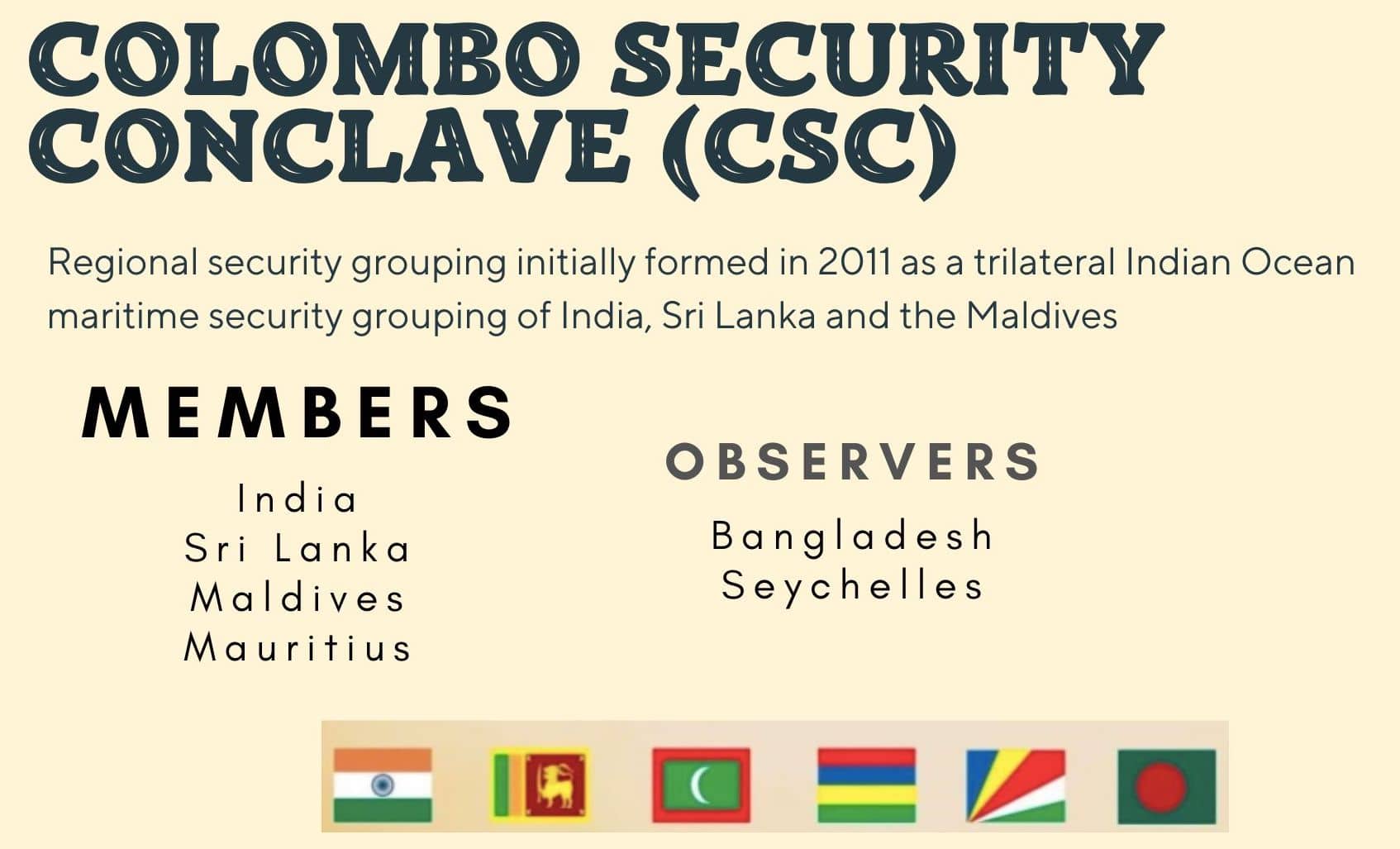
The Colombo Security Conclave (CSC) aims to promote a safe, secure, and stable Indian Ocean, with India playing a leadership role.
The CSC’s revival in 2020, after a standstill since 2014, reflects India’s evolving strategic vision for the Indian Ocean.
India seeks to institutionalize its role in the region, addressing security challenges and emerging threats through the CSC.
China’s growing influence in the Indian Ocean is a significant factor driving the CSC’s revival, with Beijing investing in the Belt and Road Initiative (BRI) and establishing a presence in key locations.
Key Challenges:
Domestic political changes in member-states can impact the CSC’s effectiveness, as seen with the Maldives’ absence from a recent meeting.
The nationalist and pro-China sentiments in member-states may hinder collaboration, affecting the CSC’s ability to address regional challenges.
Despite concerns about China’s actions in the Indian Ocean, some regional countries may not view China as a threat, limiting the CSC’s collective response.
Key Terms/Phrases:
Colombo Security Conclave (CSC)
Indian Ocean
Belt and Road Initiative (BRI)
Maritime security
Regional collaboration
Extra-regional powers
Indo-Pacific
National Security Adviser (NSA)
Key Quotes:
“The lack of capacity of island nations to secure the seas and counter transnational threats has continued to motivate India.”
“China’s outreach to the Indian Ocean is to control crucial sea lines of communication and trade, limiting India’s influence.”
Key Statements:
“The CSC offers India an opportunity to institutionalize its role, shape the regional security architecture, and better address existing and emerging threats.”
“The strategic accommodation and flexibility of the CSC contribute to the security of the Indian Ocean.”
Key Examples/References:
China’s naval capabilities, defense relationships, and infrastructure projects in the Indian Ocean.
Maldives’ absence from a recent CSC meeting due to preferences for a close relationship with China or nationalist sentiments.
Key Facts/Data:
The CSC was revived in 2020, with the inclusion of Mauritius, Seychelles, and Bangladesh.
China’s investments in the Indian Ocean include the Belt and Road Initiative projects and control of Sri Lanka’s Hambantota port.
Critical Analysis:
The vulnerability of the CSC to domestic political changes highlights challenges in maintaining consistent regional collaboration.
The balance between addressing security concerns and managing relationships with China is crucial for the CSC’s success.
Way Forward:
Strengthen institutional mechanisms within the CSC to mitigate the impact of domestic political changes.
Continue to focus on the five pillars of cooperation, addressing maritime security, counter-terrorism, cyber-security, humanitarian aid, and disaster relief.
Enhance efforts to build trust among member-states and address concerns related to nationalist and pro-China sentiments.
Evolution has crafted unique defense mechanisms in the animal kingdom, one of which is the nematocyst.
Understanding Nematocysts
Structural Composition: A nematocyst comprises a capsule with a coiled tubule and a toxin-filled bulbous structure.
Rapid Deployment: Upon stimulation, the nematocyst ejects its tubule at an incredibly high acceleration, comparable to a bullet’s speed.
Fastest Biological Mechanisms: This ejection process is among the quickest in the animal kingdom.
Found in: Nematocysts are particularly prevalent in jellyfish, corals, sea anemones, and hydras, serving as effective tools for hunting and protection.
Role in Cnidarians’ Survival
Cnidarians and Cnidocytes: Cnidarians, a group of animals characterized by cnidocytes (specialized cells), heavily rely on nematocysts for feeding and defense.
Activation Process: Contact with potential prey triggers sensory structures on cnidocytes, leading to the nematocyst’s release and subsequent prey immobilization or toxin injection.
Diversity of Toxins in Nematocysts
Variety of Effects: Nematocyst toxins can be paralytic, halting prey movement, or cytolytic, breaking down cells.
Strategic Use: Cnidarians often employ a mix of toxins to enhance the effectiveness of their predatory and defensive actions.
Contribution to Cnidarians’ Success: The complexity and efficiency of nematocysts play a vital role in the survival and dominance of cnidarians in aquatic habitats.
Formidable Aquatic Predators: The presence of nematocysts makes cnidarians formidable entities in their ecosystems.
The International Organisation for Migration (IOM) introduced Project PRAYAS (Promoting Regular & Assisted Migration for Youth and Skilled Professionals) to facilitate secure and regular migration for Indian workers and students.
What is Project PRAYAS?
Details
Project Name
Project PRAYAS
Introduced By
International Organization for Migration (IOM)
Partnership
Ministry of External Affairs, India
Objective
To facilitate secure and regular migration for Indian workers and students
Key Focus
Enhancing coordination between state and central governments
Addressing India’s growing role in international migration
Providing policy recommendations for migration governance
IOM’s Role
Promoting humane and orderly migration as a United Nations agency
Significance
Represents a consolidation of state-level efforts for well-managed international migration
Focus Areas and Activities
Conducting comprehensive studies on migration trends
Launching awareness programs for safe and orderly migration processes
Back2Basics: International Organisation for Migration (IOM)
Details
Establishment
1951
Initial Purpose
To assist in the resettlement of people displaced by World War II
Current Role
Providing services and advice on migration to governments and migrants, including various displaced persons
Type
Intergovernmental Organization
Membership
173 member states, 8 observer states
Headquarters
Geneva, Switzerland
Key Objectives
Promote humane and orderly migration Emergency response
Link migration with development Health and support for migrants
Facilitate managed labor migration Counter human trafficking
UN Relationship
Became a related organization of the United Nations in 2016
The war between Israel and Hamas in October raised concerns about Hezbollah’s involvement, but the focus shifted when the Houthis in Yemen expanded the conflict to the Red Sea.
Despite tensions, Hezbollah and Israel avoided full-scale war, with Israel concentrating on Gaza.
Houthi Involvement and Shift in Tactics
Initial Actions: The Houthis, aligned with Iran, initially targeted Israel in solidarity with Palestinians, using drones and missiles, which were intercepted.
Change in Strategy: Later, they shifted focus to attacking commercial ships in the Red Sea, threatening global shipping routes.
Understanding the Houthis
Background: The Houthis, known formally as Ansar Allah, are a Shia militia group in Yemen, named after their late leaders Badr al-Din al-Houthi and Hussein al-Houthi.
Iranian Support: They receive direct support from Iran and have significant military capabilities, including drones and ballistic missiles.
Strategic Importance of Bab el-Mandeb Strait
Geographical Significance: The Strait of Bab el-Mandeb is a crucial maritime chokepoint, connecting the Red Sea with the Gulf of Aden and the Indian Ocean.
Impact on Global Shipping: Houthi actions near the strait have led to a significant decrease in Red Sea traffic and increased shipping costs.
Global and Regional Consequences
Effect on Israel: Israel’s southern port traffic, particularly in Eilat, has been severely impacted.
Broader Trade Implications: Approximately 12% of global maritime trade passes through the strait. Disruptions here could exacerbate inflationary pressures worldwide.
Alternative Routes: Shipping companies are rerouting around Africa, significantly increasing travel time and costs.
International Response
US Naval Task Force: The U.S. has established a naval force to counter the Houthi threat.
Arab World’s Stance: Many Red Sea countries, including Egypt, have not joined the U.S. task force, reflecting regional discontent with U.S. policies.
Potential Offensive Measures: The U.S. has not ruled out bombing Houthi targets in response to continued attacks on shipping lanes.
Conclusion
Continued Houthi Threat: The Houthis vow to persist in their actions as long as Israel’s conflict with Gaza continues.
Challenges for Global Trade: The situation underscores the fragility of global shipping routes and the potential for regional conflicts to have far-reaching economic impacts.
Need for Diplomatic Solutions: This complex scenario highlights the importance of diplomatic efforts to resolve regional tensions and protect vital maritime trade routes.
Major textile hubs in India, including Ludhiana, Surat, and Erode, are grappling with the surge in imports of man-made fibre (MMF) fabrics, impacting a sector worth about $60 billion.
Fabric processors and weavers across these hubs express concerns over the influx of cheaper imports, primarily from China, affecting their businesses.
Impact of Imported MMF Fabrics
Market Dominance: Imported fabrics, especially from China, are increasingly found in Indian markets, leading to unsold stocks and production cuts by local weavers.
Price Disparity: Indian weavers face competition from cheaper imported yarns, compelling them to import materials like viscose yarn from China to remain competitive.
Statistical Overview of MMF Fabric Imports
Doubling of Imports: In the last three years, MMF fabric imports have doubled, with a significant portion being knitted synthetic fabrics.
Import Data: Daily imports from China increased from 325 tonnes in 2019-2020 to 887 tonnes in the April-June quarter of the current fiscal year, with a notable drop in average value per kg.
Under-Invoicing and Quality Control Issues
Under-Invoicing Concerns: The practice of under-invoicing imported finished fabrics poses a major challenge, leading to calls for stricter customs regulations.
Quality Control Orders (QCOs): The government’s introduction of QCOs on MMF fibres and products, requiring BIS certification, has impacted the entire value chain.
Consequences for Local Industry and Global Trade
Operational Capacity: The downstream industry is reportedly operating at only 70% capacity due to these challenges.
Export Decline: Exports of man-made yarn, fabrics, and made-ups have seen a year-on-year decline.
Global MMF Trade: India’s share in global MMF trade was 2.7% in 2019, with fabrics and yarn being major export components.
Industry Perspectives and Government Policies
Innovation Gap: Industry experts highlight a lack of innovation in MMF products in India compared to countries like China, Thailand, and Korea.
Impact of QCOs: The introduction of QCOs, particularly at the fibre stage, is criticized for disrupting the industry, with calls for implementing quality controls at the garment stage instead.
Challenges for MSMEs: Small and medium enterprises face financial strain due to declining orders, high prices, and increased operational costs.
GST Issues and Financial Relief Demands
GST Refund Delays: The introduction of GST led to higher taxes on MMF fibre and yarn, with delayed refunds causing financial burdens for weavers.
Refund Controversy: Weavers contend that they are owed significant refunds due to the inverted duty structure, with the government potentially owing around ₹1,000 crore to the sector.
Conclusion
Need for Strategic Measures: Addressing the challenges in India’s textile industry requires a balanced approach, considering both domestic capabilities and global market dynamics.
Government’s Role: Effective policy measures, including rationalizing import duties and quality controls, are essential to support the industry and enhance its competitiveness.
Future Outlook: The textile sector’s resilience and adaptability will be key in overcoming these challenges and capitalizing on potential opportunities in the global market.
The newly elected Madhya Pradesh CM asserted that Ujjain, was the reference for world time 300 years ago, before the Prime Meridian shifted to Paris and then Greenwich.
For UPSC aspirants, understanding these nuances is essential for a comprehensive grasp of India’s scientific heritage and its global context.
Time Measurement and Ujjain’s Role
Ujjain’s Central Meridian: Before Greenwich’s establishment in 1884, Ujjain was the central meridian for time in India, influencing Hindu almanac calculations.
Vedshala Observatory: The Vedshala or Government Jiwaji Observatory in Ujjain offers insights into ancient Indian timekeeping methods.
Ujjain’s Geographical and Astronomical Significance
Surya Siddhanta’s Contributions: This 4th-century astronomical treatise positions Ujjain at the intersection of the zero meridian of longitude and the Tropic of Cancer, highlighting its global importance.
Astronomical Landmarks: Ujjain’s location on the Tropic of Cancer, intersecting significant temples, underscores its historical and religious significance in Hindu cosmogony.
Legacy of Maharaja Sawai Jai Singh II and the Vedshala
Observatory’s Origins: Built between 1725-1730 by Maharaja Sawai Jai Singh II, the Vedshala was inspired by the observatory in Samarkand and predates those in Jaipur, Delhi, Mathura, and Varanasi.
Motivation for Construction: Jai Singh’s initiative to educate the country in astronomy was sparked by a debate in the Mughal court over astronomical calculations.
Ujjain’s Astronomical Heritage and Contributions
Center for Ancient Astronomy: Ujjain was a hub for astronomical and mathematical studies, home to scholars like Varahamihira, Brahmagupta, and Bhaskaracharya.
Vikram Samvat Calendar: King Vikramaditya’s establishment of the Vikram Samvat calendar around 58–56 B.C. further cements Ujjain’s historical importance.
Exploring the Vedshala’s Instruments and Functions
Yantras and Their Uses: The observatory houses various instruments (yantras) for measuring time, celestial altitudes, planetary motions, and eclipses.
Unique Instruments: The Shankhu Yantra, Samrat Yantra, Digansha Yantra, Nadi Valay Yantra, and Bhitti Yantra demonstrate the sophistication of ancient Indian astronomical tools.
Taramandel Shows: The observatory also features a planetarium offering educational shows about celestial bodies.
Ongoing Astronomical Research and Preservation
Renovation and Continuation of Studies: Maharaja Madhav Rao Scindia of Gwalior renovated the observatory in 1923, ensuring the continuation of astronomical research.
Annual Ephemeris Publication: The observatory publishes an ephemeris, detailing the daily positions and movements of planets.
Conclusion
Balancing Historical Pride and Scientific Accuracy: While appreciating Ujjain’s rich astronomical heritage, it’s crucial to distinguish between historical significance and contemporary scientific standards.
Insights for UPSC Aspirants: Understanding Ujjain’s role in ancient timekeeping and astronomy offers UPSC aspirants a nuanced perspective on India’s scientific contributions and cultural heritage.
Enduring Legacy: Ujjain’s astronomical legacy, exemplified by the Vedshala Observatory, continues to be a testament to India’s historical advancements in science and time measurement.
The Supreme Court clarified that tribunals, bound by their governing legislations, cannot compel the government to formulate policy.
It emphasized the separation of powers, stating that policy-making is outside the judiciary’s domain, including quasi-judicial bodies like tribunals.
What are Tribunals?
Details
Nature
Judicial or quasi-judicial institutions established by law
Purpose
Provide faster adjudication compared to traditional courts
Offer expertise on specific subject matters
Functions
Adjudicating disputes
Determining rights between parties
Making administrative decisions
Reviewing existing administrative decisions
Constitutional Recognition
42nd Amendment Act, 1976 introduced Articles 323-A and 323-B in the Constitution
Article 323A
Empowers Parliament to constitute administrative Tribunals for public service matters
Article 323B
Allows Parliament or state legislatures to constitute tribunals for specific subjects like taxation, land reforms
Composition
Comprises expert (technical) members and judicial members
Expert Members
Selected from various fields, including central government departments
Judicial Members
Persons with a judicial background, such as High Court judges or eligible lawyers
Supreme Court’s Stance
Technical members not required if tribunal’s aim is expeditious disposal of matters
Case in Focus: Armed Forces Tribunal (AFT) and Policy Direction
Specific Case Reviewed: The Bench addressed whether the AFT could direct the government to create a policy for appointing the Judge Advocate General (Air).
General Observation: It has been consistently observed that courts cannot mandate the government to enact legislation or develop a policy.
Judicial Analysis and Reasoning
Justice Karol’s Observations: Justice Sanjay Karol noted that the AFT, with powers akin to a civil court, lacks the authority of the Supreme Court or High Courts.
High Courts’ Limitations: Even High Courts, under Article 226 of the Constitution, cannot order the government or its departments to establish specific policies.
Government’s Prerogative: The judgment reinforced that policy creation, especially concerning defense personnel services or their regularization, is exclusively the government’s responsibility.
Implications of the Judgment
Tribunals’ Restricted Powers: Tribunals must operate within the confines of their governing legislation and lack the jurisdiction to influence policy formation.
Judiciary’s Role in Policy Matters: The judgment highlights the judiciary’s limited role in policy-making, even in cases where fundamental rights might be at stake.
Separation of Powers: This ruling underscores the principle of separation of powers, delineating the distinct functions of the legislative, executive, and judicial branches.
Conclusion
Respecting Institutional Boundaries: The judgment serves as a reminder of the importance of respecting the boundaries and roles of different government institutions in a democratic setup.
Broader Implications: This decision has significant implications for how tribunals and courts interact with policy-making processes, emphasizing judicial restraint and adherence to the constitutional framework.
Amid reports that Odisha may create a few more districts before the end of the year, the Orissa High Court has directed the government not to issue any final order in this regard without its permission.
Districts in India
Historical Background: Districts, as local administrative units, are a legacy from the British Raj era.
Administrative Hierarchy: Positioned below the state and territory level, districts are crucial in India’s local governance structure.
Leadership and Responsibilities: A Deputy Commissioner or Collector, often from the Indian Administrative Service (IAS), heads a district, overseeing administration and maintaining law and order.
Subdivision of Districts: Districts are further divided into smaller units like tehsils, talukas, or mandals, varying by region.
Mechanics of Creating New Districts
State Government’s Prerogative: The authority to create, modify, or abolish districts lies with State governments, executed via executive orders or state assembly legislation.
Preferred Methodology: States typically opt for the executive route, issuing official gazette notifications for these changes.
Central Government’s Role in District Reconfiguration
Limited Involvement: The Central government’s role is minimal in district reformation, primarily concerning name changes.
Procedure for Name Changes: For renaming districts or railway stations, State governments seek clearances from central entities like the Home Ministry, Ministry of Earth Sciences, Intelligence Bureau, Department of Posts, Geographical Survey of India, and the Railway Ministry.
Trends in District Formation
Increase in Numbers: India’s district count has risen from 593 in 2011 to 718, as per the Government of India’s Know India website.
Factors Influencing Growth: This increase includes new districts formed between 2001-2011 and the bifurcation of Andhra Pradesh into Andhra Pradesh and Telangana in 2014.
Rationale behind Creating New Districts
Benefits: Districts gain from government investments in local administration and development.
Infrastructure and Economic Development: New districts see enhanced infrastructure, attracting investments and boosting economic activities and employment.
Challenges in District Formation
Limitations and Costs: The financial burden of establishing administrative infrastructure restricts rampant district creation.
Resource Allocation: The process involves setting up offices and deploying officers and public servants, impacting the state’s budget.
Way Forward
Community Engagement: Involving local populations in the decision-making process is vital to align district formation with their aspirations and needs.
Conflict Resolution and Inclusive Growth: This approach can help mitigate conflicts and ensure decisions contribute to the inclusive growth of the state and nation.
Back2Basics: History of Districts in India
Details
Early Administration
Initiated by the British East India Company post-Battle of Plassey (1757) and Battle of Buxar (1764)
Collectorate System
Introduced by Warren Hastings in 1772; District Collector as key revenue, judicial, and administrative authority
Transition to Crown Rule
Post-1857 Revolt, direct British Crown rule led to formalization of district system
Role of District Collector
Central figure in district administration, responsible for revenue, law, and order
Revenue Systems
Implementation of Zamindari, Ryotwari, and Mahalwari systems for land revenue collection
Survey and Settlement
Extensive land surveys for revenue assessment
Judicial Functions
Initially, Collectors (District Magistrate) handled judicial roles; later, separate judicial offices were established
Law Enforcement
Establishment of modern police system with districts as key units
Impact on Indian Society
Centralized control, introduction of bureaucracy
Post-Independence Legacy
Retained district system with evolved role of District Collector


![Burning Issue] Jobless growth in India - Civilsdaily](https://d18x2uyjeekruj.cloudfront.net/wp-content/uploads/2018/10/word-image-13.png)


![Solved] Where is the Pir Panjal Range located?](https://physicalfeaturesindia9d-15-16.weebly.com/uploads/5/2/7/3/52736089/2847490.png)