The article explores the historical journey of the Jat community in India over the past 500 years, tracing their nomadic origins to settled agrarian lifestyles.
Jats, divided into various sub-castes and known for their traditional practices, have faced historical battles and conversions, contributing significantly to agriculture and politics.
Despite internal divisions and religious differences, the Jat community unites on national issues such as farmers’ rights and land legislation, producing prominent leaders like Chaudhary Charan Singh.
Key Challenges:
The Jat community grapples with stereotypes and mockery, facing challenges in reconciling their pride in the past with a desire to assert their qualities in contemporary contexts.
The article highlights the internal divisions among Jats based on religion, turning former clansmen into archrivals despite presenting a united front on national issues.
Modernization of land-related occupations poses concerns about the future of Jats, leading to efforts to reinvent their identities in the face of changing socio-economic dynamics.
Key Terms:
Khap panchayats: Controversial local bodies involved in delivering justice and making decisions on social matters, often criticized for endorsing conservative practices.
Arya Samaj: A reform movement within Hinduism advocating for the worship of the uncreated Supreme Being and rejecting idol worship.
Subaltern: Referring to marginalized or oppressed groups within a society.
Key Phrases for answer enrichment:
“Jats strategically placed their faith in their practice of agrarian work.”
“Jats seem to have missed the understanding of pride with confidence, as they petition the world on their qualities and superiority.”
“With modernisation of land-related occupations and change in the feudal order, Jats are anxious about their future.”
Key Quotes:
“Despite their history, the Jats are mocked and customarily derided among North Indian groups.”
“They have a strong desire to assert without a bona fide avenue.”
“Olympians from the Jat community have brought international fame to their community and their politics.”
Key Examples and References:
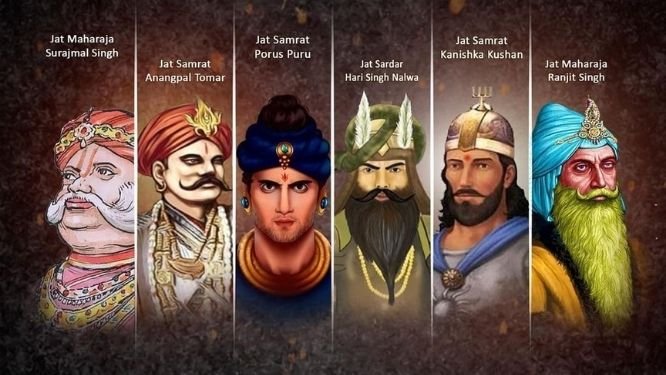
Reference to historical figures like Suraj Mal, Chaudhary Charan Singh, Sir Chhotu Ram, and Raja Mahendra Pratap Singh as notable Jat icons.
Mention of Sikh and Muslim Jats driving a conservative agenda within the regional political landscape.
Olympic athletes Sakshi Malik, Bajrang Punia, and Vinesh Phogat representing the Jat community and holding the government accountable.
Key Facts:
Jats trace their origins to diverse geographies, from Eastern Europe and Central Asia to sea-adjacent plain fields.
Jats have a history of adopting religions en masse, including Buddhism during the spread of the religion.
The Jat community is predominantly found in North India, with diverse sub-castes and internal religious divisions.
Critical Analysis:
The article critically examines the challenges faced by the Jat community, including stereotypes, internal divisions, and concerns about the future in the context of changing socio-economic dynamics.
It highlights the tension between the community’s pride in its history and the desire to assert itself in contemporary contexts.
Way Forward:
Encourage open dialogues within the Jat community to address internal divisions and promote unity.
Advocate for educational initiatives to challenge stereotypes and promote a nuanced understanding of the Jat community’s contributions.
Support initiatives that help the Jat community adapt to modernization while preserving its cultural identity and historical pride.
The article examines the current status of four societal groups poor, youth, women, and farmers coined as ‘castes’ by Prime Minister Modi. Despite government policies, challenges such as poverty, unemployment, gender discrimination, and farmer issues persist, leading to discontent among these groups.
Key Highlights:
The article discusses the impact of India’s traditional caste system and welcomes Prime Minister Modi’s formulation of four ‘castes’ poor, youth, women, and farmers focusing on their current status.
It highlights the persisting challenges faced by these groups, including poverty, unemployment, gender discrimination, and the plight of farmers, despite government policies.
Key Challenges:
Widespread poverty is evident, with UNDP estimating 16% of the population (228 million) living below low poverty bars, facing malnutrition and hunger.
Youth unemployment, particularly among graduates, remains high, leading to internal migration, rising crime, and drug use.
Women face various challenges, including crimes against them, gender disparity in income, and significant workforce exits between 2004-05 and 2011-12.
Farmers continue to grapple with issues such as suicides, small holdings, rising input costs, insufficient MSP, and uncertain market prices.
Key Terms:
Varnas: The four traditional social classes in Hindu society—Brahmin, Kshatriya, Vaishya, and Sudra.
MSP (Minimum Support Price): The price at which the government purchases crops from farmers to support their income.
Caste system: The social hierarchy in India traditionally divided into varnas and numerous castes.
Key Phrases:
“I resent the word ‘caste’” – Expressing displeasure at the term while discussing Modi’s formulation of four ‘castes.’
“Joblessness among youth is a volcano that can erupt at any time” – Highlighting the potential social consequences of high youth unemployment.
“A happy farmer is an oxymoron” – Describing the perpetual challenges faced by farmers despite record-breaking crop production.
Key Quotes:
“Large sections of the four ‘castes’ are poor, unhappy and have little faith in the policies and programmes of the Modi government.”
“Their silence is not approval or acquiescence. It is because they are poor, enjoy little power and live in fear.”
Key Examples and References:
Reference to UNDP’s poverty estimation, NCRB data on crimes against women, and statistics on farmer suicides.
Mention of the government’s claim to create 2 crore jobs a year and the subsequent revelation of vacancies.
Key Facts:
16% of the population, approximately 228 million people, are estimated to be living below the poverty line.
Youth unemployment rate is 10%, and among young graduates, it reaches 42.3%.
Crimes against women rose by 4% in 2022, with 4,45,000 cases registered.
Farmer suicides remained high between 2014 and 2022.
Critical Analysis:
The article critiques the government’s policies, emphasizing the disparity between its favoring the rich and the continued challenges faced by the poor, youth, women, and farmers.
It questions the efficacy of measures like job creation claims and suggests that the silence of these groups is more a result of powerlessness and fear than approval.
Way Forward:
Advocate for policies addressing the root causes of poverty, unemployment, gender discrimination, and farmer issues.
Call for inclusive measures that empower and uplift marginalized sections.
Encourage a more consultative approach by the government, especially in formulating policies that directly impact the livelihoods of these groups.
The central idea revolves around the author’s proposition to reevaluate the effectiveness of caste reservations, questioning whether they have genuinely uplifted the marginalized communities. The author highlights the venomous backlash faced for this stance, prompting a call for a new kind of affirmative action that goes beyond existing policies and involves addressing root causes.
Key Highlights:
The author faced severe backlash, including threats and demands for arrest, after suggesting an end to caste reservations instead of a caste census.
The attack was led by individuals associated with advocacy and sympathy for Dalits, raising questions about their effectiveness in addressing fundamental issues.
Key Challenges:
The author questions the efficacy of reservations, emphasizing the need to examine if they have truly worked for the intended beneficiaries.
The plight of Dalit communities, particularly the musahar community, living in extreme poverty and squalor, highlights the persistent challenges despite reservation policies.
Key Terms:
Caste census: A survey to gather information about the distribution of different castes in a population.
Affirmative action: Policies and initiatives aimed at providing opportunities to marginalized groups, often through reservations.
Key Phrases:
“The time has come to examine how well reservations have worked.”
“Reservations have benefited politicians and Dalit advocacy groups more than the people for whom they were created.”
Key Quotes:
“The vile, malicious abuse I faced from these groups has convinced me that affirmative action of a new kind is needed.”
“Reservations have created a class of people who continue the evil, inhuman exploitation that lower-caste Indians have faced for too long.”
Key Examples and References:
Reference to a Bhumihaar dominant village in Jehanabad district, highlighting the stark contrast between clean prosperity and the squalor of the musahar quarter.
Mention of a challenge from a Dalit advocate based in the United States, raising questions about the commitment to the cause on the ground.
Key Facts:
The Chief Minister of Bihar has already ordered a caste census.
Dalit communities continue to face challenges such as lack of access to decent schools, healthcare, and living in squalid conditions.
Critical Analysis:
The author questions the impact of reservations, arguing that they have benefited politicians and advocacy groups more than the marginalized communities.
The focus on the need for a new kind of affirmative action suggests a call for innovative solutions beyond existing reservation policies.
Way Forward:
Emphasize the importance of addressing the root causes of Dalit marginalization, such as poverty and lack of access to education and healthcare.
Advocate for comprehensive solutions that go beyond reservations, involving community development, education, and healthcare initiatives.
Encourage a constructive debate on the effectiveness of existing policies and the exploration of new approaches to uplift marginalized communities.
Do not be outrageously naive in your interview preparation. Don’t attend junk mock panels that give generic advice on basic etiquette and social niceties.
Save your man-hours from one-on-one sessions that don’t bother to understand your personality but give you static GK gyaan on your DAF. We have a simple PDF for that.
The most dynamic part of this interview stage is YOU. Not current affairs, not your trivial mannerisms, but your core officer-like character. We need to ensure we chisel this out in you for the world to see on the D-Day.
You are going to face the lions of the UPSC board. You need to sit in the mocks of distinguished IAS officers who pushed the boundaries of administrative reforms when they served. You need to be evaluated on your leadership qualities and social sensitivities in your one-on-ones. You need to be updated with the most polarising narratives around the world so that your opinions have some weight.
At Civilsdaily, this is our only focus. Here’s what lies ahead for you in the coming months:
1. Panel mocks headed by Shankar Sir & Aaradhana Maam:
2. One-on-One sessions with deep focus on psyche eval and social sensitivity with Zenden, Kaptaan, and Saket
3. CA sessions with Venus Maam
Panelists for Mock Interviews:
Shri Shankar Aggarwal, IAS (retd.), former Secretary
Mrs. Aradhana Johri, IAS (retd.), former Secretary
Dr. Noor Mohammad, IAS (retd.), former EC
Shri Rajiva Misra, IFS (former Ambassador)
Dr. P.K. Agrawal, IAS (Retd.), former Ch. Secy
Shri T. N. Thakur, IAAS (retd.), former Dy CAG
Prof. U.M. Amin, Jamia Milia University
Mr. S. D. Singh, IFoS (Retd.)
Mr. Kunal Aggarwal, IRS
Mr. Debraj Das, IPS
Book your slot for UPSC Mock interviews (paneled by ex-Secy level IAS)
Get a dedicated mentor, on-call DAF analysis, DAF-based personalized questionnaire, and Situational questionnaire (FREE)
Mock interview this week 28th Dec onwards – (Book your slot)
Time: 10 a.m. – 7 p.m.
Mode:Online/Offline
Do You Know That Civilsdaily Has a 75% Success Rate In UPSC Interview?
Those who have qualified for the UPSC Mains 2023 must join the Civilsdaily Interview Program. You can discuss DAF, interview topics, and other aspects with toppers, in-service officers, and senior mentors and faculties.
Book your slot for UPSC Mock interviews (paneled by ex-Secy level IAS)
Get a dedicated mentor, on-call DAF analysis, DAF-based personalized questionnaire, and Situational questionnaire (FREE)
This year, Civilsdaily’s Interview Guidance Programme (IGP) will host Ghanshyam Gautam, IPS (Kaptaan), and Zenden Lingzerpa, IPS (210 marks, Interview topper) as our sole advisors for 1-on-1 webinar and DAF 2 sessions.
These sessions with Kaptaan, Zenden, and Civilsdaily’s core team will have the sole agenda to help develop your frank opinions into mature perspectives.
There are no shortcuts or hacks for the personality test. You have to ace all factual questions with perfection and develop the social sensitivity befitting an IAS officer.
You have to be able to take sides, provide context and stand your ground when you are grilled by the actual board. And we will help you prepare for all scenarios. The right amount of inquisitiveness, optimum amount of assertiveness, unshakable body language – all will be shared with you in our enrichment sessions.
This will be followed with mock interviews under the aegis of Shankar Sir & Archana Mam, who have been simulating real UPSC-interview-like scenarios in every panel they held. More on that later.
Program inclusion:
DAF Session with IPS, Zenden (UPSC Interview Topper, 210 marks) – Zoom on form submission
Inteview Competency Document: 1000 Qs PDF;
Mock interviews (online/offline);
On call DAF analysis;
Personalized Questionnaire based on your DAF;
Situational and Role-play questionnaire;
Personalized mentorship
We will have LIVE 1-1 session by UPSC interview topper Zenden
The Minister of State for Social Justice and Empowerment recently informed about the Pradhan Mantri Anusuchit Jaati Abhyuday Yojana (PM-AJAY) Scheme during 2023 year-end review.
About PM-AJAY Scheme
Details
Launch
Implemented since 2021-22
Aim
To reduce poverty of SC communities through employment generation, skill development, income generation, and infrastructure development.
Nature
100% Centrally Sponsored Scheme
Components
Development of SC dominated villages into ‘Adarsh Gram’
Grants-in-aid for District/State-level Projects for socio-economic betterment of SCs
Construction of Hostels in Higher Educational Institutions
Merged Schemes
Pradhan Mantri Adarsh Gram Yojana (PMAGY)
Special Central Assistance to Scheduled Caste Sub Plan (SCA to SCSP)
Babu Jagjivan Ram Chatrawas Yojana (BJRCY)
Developments in Grants-in-Aid Component
Financial assistance enhanced from Rs. 10,000 to Rs. 50,000 or 50% of the asset cost, whichever is lesser, for beneficiary/household.
Web-based portal developed for submission, appraisal, approval, and monitoring of Annual Action Plan.
France’s President Emmanuel Macron is set to be the chief guest for India’s 75th Republic Day celebrations.
The invitation extended by Prime Minister Narendra Modi signifies a high diplomatic honor and reflects the strong ties between India and France.
Honor of Republic Day Chief Guest
Ceremonial Significance: Being the chief guest at India’s Republic Day is a top diplomatic honor, involving participation in various ceremonial activities.
Activities and Protocol: The chief guest receives a guard of honor, attends a presidential reception, lays a wreath at Rajghat, and is honored with a banquet and lunch.
Symbolism and Friendship: As per Ambassador Manbir Singh, the visit symbolizes participation in India’s pride and reflects the friendship between the two nations.
Selection Process for the Chief Guest
Advance Planning: The process begins about six months prior, with the Ministry of External Affairs (MEA) playing a central role.
Key Considerations: The decision is driven by political, commercial, military, and economic interests, aiming to strengthen ties with the invitee’s country.
Historical Factors: The Non-Aligned Movement’s legacy has also influenced past selections, with an emphasis on mutual support and nation-building.
Procedure Post-Selection
Approval and Discretion: After MEA’s selection, approvals are sought from the Prime Minister and President, followed by discreet confirmation of the invitee’s availability.
Official Communications and Planning: Post-confirmation, official communications and detailed planning for the visit and ceremonies are undertaken.
Challenges and Contingencies
Potential for Unplanned Events: Organizers prepare for various contingencies, including health issues or weather disruptions.
Protocol Challenges: Incidents like the one recounted by Ambassador Singh, involving the ADC of a chief guest, highlight the importance of strict adherence to protocol.
Broader Implications of the Visit
Ceremonial and Strategic Importance: The role of the Republic Day chief guest blends ceremonial honor with strategic diplomacy, playing a key role in India’s international relations and foreign policy.
Media Coverage and Perception: The visit is closely monitored by international media, influencing perceptions of the guest’s nation.
Cultural and Diplomatic Impact: The hospitality and ceremonies reflect India’s traditions and culture, enhancing diplomatic relations.
Beyond Ceremonial Significance: The visit of the chief guest holds potential for opening new avenues in international relations and advancing India’s global interests.
A recent Bollywood movie ‘Dunki’ addresses the complex issue of immigration.
The term “donkey journey” in the title refers to the perilous routes taken by people lacking legal permits or financial means to immigrate.
The film highlights that the current system of visas and passports is a relatively recent development, dating back about 70 years.
Historical Perspective on Passports
Early Forms of Passports: Passports, serving as identity proofs and travel permits, have existed in various forms for centuries.
Biblical Reference: The Book of Nehemiah mentions King Artaxerxes of ancient Persia providing letters for safe passage, akin to modern passports.
European Documentation: In France and the United Kingdom, systems similar to modern passports were in place well before the French Revolution of 1789.
The French Passport System
Internal and Overseas Passports: France required internal passports for domestic travel and overseas passports for foreign trips.
State Control and Regulation: The system was also used to regulate skilled workers and prevent the entry of potential troublemakers.
Emergence of Modern Passports
Shift in India: Before World War I, India did not issue passports, but the British government introduced mandatory passports under the Defence of India Act (1914 to 1918).
Global Changes Post-World Wars: The need for secure borders during the World Wars led to a global shift in the perception and use of passports.
British Nationality and Status of Aliens Act: This 1914 Act in Britain consolidated laws related to citizenship and introduced modern passport features.
Standardization and Regulation
League of Nations’ Involvement: In 1920, the League of Nations aimed to standardize passport systems, with the British model becoming widely adopted.
US Immigration Laws and Passports: The US introduced passport laws in the 1920s, coinciding with immigration restrictions from Asia.
Public Reception and Cultural Impact
Personal Discomfort: In the US and UK, some people found the detailed physical descriptions and identity verification in passports intrusive.
Media Attention: The requirement for prominent individuals, including President Woodrow Wilson, to have passports garnered significant media interest.
Conclusion
Beyond Wartime Necessity: Initially intended as a wartime tool, passports have become an integral part of modern citizenship and international travel.
Continued Evolution: The history of passports, as explored in ‘Dunki’, reflects the ongoing evolution of identity verification and border control in response to global socio-political changes.
December 22, Ramanujan’s birthday, was declared National Mathematics Day in India by Prime Minister Manmohan Singh in 2012, in recognition of his contributions to the field.
Srinivasa Ramanujan (1887-1920)
Early life: Srinivasa Ramanujan, born on December 22, 1887, in Erode, Tamil Nadu, exhibited extraordinary mathematical abilities from a very young age.
Mathematical Mastery by 14: By age 14, Ramanujan had mastered advanced mathematics, excelling in exams and exploring complex topics.
Difficulties in Other Subjects: His singular focus on mathematics led to poor grades in other subjects, hindering his academic progress.
Scholarship Loss and Hardships: After losing a scholarship at Government College in Kumbakonam due to his academic struggles, Ramanujan faced financial difficulties and limited job opportunities.
Rise in Mathematical Circles
Recognition in Madras: By 1910, Ramanujan had gained recognition in Madras’s mathematical circles for his independent work.
Clerical Job and Research: In 1912, he secured a clerical position at the Madras Port Trust, which afforded him time for mathematical research.
Collaboration with GH Hardy: In 1913, Ramanujan began a correspondence with British mathematician GH Hardy, leading to an invitation to Cambridge University.
Collaboration and Achievements in Cambridge
Journey to Britain: Ramanujan arrived in Britain in 1914 and joined Trinity College, Cambridge.
Work with Hardy and Littlewood: Collaborating with Hardy and JE Littlewood, Ramanujan made significant contributions despite his lack of formal higher education.
Prestigious Honors: He was elected to the London Mathematical Society in 1917 and became a Fellow of the Royal Society in 1918, one of the youngest Fellows in its history.
Health Struggles and Return to India
Declining Health: Ramanujan’s health worsened in the cold British climate, leading to a diagnosis of tuberculosis.
Final Years: He returned to India in 1919 and passed away on April 26, 1920, at the age of 32.
Ramanujan’s Enduring Mathematical Legacy
High Praise from Hardy: GH Hardy ranked Ramanujan’s natural mathematical talent alongside greats like Euler and Jacobi.
Bruce C Berndt’s Analysis: American mathematician Bruce C Berndt extensively studied Ramanujan’s notebooks, emphasizing the depth of his contributions.
Impact on Number Theory: Ramanujan’s work, particularly on the partition function, has had a lasting impact on number theory.
Broad Contributions: His expertise included areas like continued fractions, Riemann series, elliptic integrals, hypergeometric series, and the zeta function.
Legacy of Unpublished Works: Ramanujan left behind notebooks filled with unpublished results that continued to inspire mathematicians for decades.
Try this question from CSP 2016:
A recent movie titled “The Man Who Knew Infinity” is based on the biography of-
The Union Women and Child Development Ministry aims to establish 17,000 creches in Anganwadi centres across the country out of which 5,222 have been approved to date under the ‘Palna’ scheme.
What is Palna Scheme?
Details
Objective
To provide quality childcare facilities through Anganwadi-cum-Crèches, enabling women’s participation in the workforce
Integration
Part of the Samarthya sub-component of Mission Shakti, starting from April 2022
National Creche Scheme (NCS) was revised and subsumed as part of the ‘Palna’ scheme under Mission Shakti.
Focus
Establishing combined Anganwadi and crèche facilities for comprehensive childcare
Target Demographic
Primarily urban areas where family-based childcare support is less available
Standard Operating Procedure
SOP released to outline administrative framework, roles, responsibilities, and monitoring mechanisms
About National Crèche Scheme (NCS)
Details
Launch
Rajiv Gandhi National Crèche Scheme (RGNCS) launched in 2006;
From 2017, implemented as the National Crèche Scheme (NCS).
Legal Provisions
MGNREGA;
Maternity Benefit (Amendment) Act 2017.
Objective
To provide daycare facilities for children aged 6 months to 6 years of working mothers
Target Group
Children of working mothers, especially from economically weaker sections of society
Childcare Services
Daycare, supplementary nutrition, early childhood education, health check-ups
Operational Hours
Typically 7 to 8 hours a day, 26 days a month
Age Group
Children aged 6 months to 6 years
Administration
Ministry of Women and Child Development, Government of India
Execution
Through state governments, NGOs, and community-based organizations
Try this PYQ from CSP 2019:
Which of the following statements is/are correct regarding the Maternity Benefit (Amendment) Act, 2017?
Pregnant women are entitled for three months pre-delivery and three months post-delivery paid leave.
Enterprises with creches must allow the mother minimum six creche visits daily.
Women with more than two children get reduced entitlements.
Select the correct answer using the code given below.
Advanced Mains Preparation with Smash Mains Program: Now Unlocked for UPSC Beginners!
Turn Your First or Second UPSC Attempt into a Rank-Clinching Success with Personal Mentorship
Trusted by Rankers, Acknowledged by The Hindu
The Program that Even ‘The Hindu’ Couldn’t Ignore
Recognized by The Hindu newspaper for its remarkable success rate, the Smash Mains Program has been nothing short of revolutionary. In 2022, it boasted an astounding 85% success rate, turning dedicated aspirants into UPSC rank holders within the top 200.
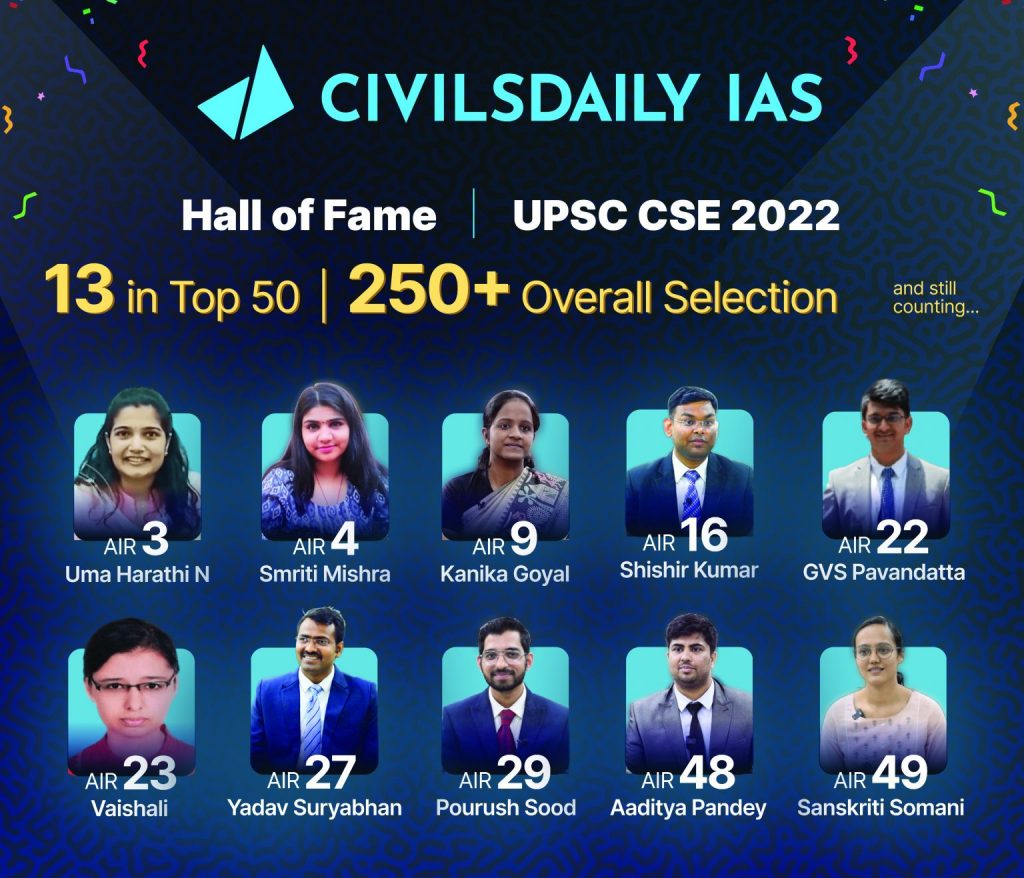
85% of Smash Mains students under cracked a top-200 rank in UPSC CSE 2022 (13 in Top 50)
Previously a well-guarded secret exclusive to UPSC veterans, this super-successful program is now open to beginners as well. This is a golden opportunity for those committed to cracking UPSC in their first or second attempt.
Share your Answer Copies at staff@civilsdaily.com
Get 1-on-1 Mentorship by Arvind sir (mentor of 100+ IAS rankers)
The overwhelming demand and positive feedback from our students have encouraged us to make this exception. We strive to provide the ‘Be Mains Ready’ Program and support to all our students.
About Smash Mains 2024-25 Beginner’s Batch
It is a highly personalized and intensive handholding program for the dedicated and crème-de-la-crème (earlier exclusive to UPSC veterans) amongst UPSC aspirants (the intake is 50 students only).
AIR 16 Shishir, UPSC 2022 thanking Civilsdaily’s mentorship
What Makes Smash Mains Unique?
Invite/Register-Only: Ensuring that you’re not just a face in the crowd but a name and a mission for us.
Personalized Attention: Tailor-made guidance with one-to-one interactions with senior IAS mentors themselves.
Focused Strategy: No more generic study plans. Get a blueprint crafted just for you.
In-Depth Analysis: Our seniormost faculty will meticulously analyzing your Mains scorecards and test copies to fill in those critical gaps in your preparation.
Multi-level guidance: Arvind sir, Parth sir, Swatantra sir, Sumit sir, Shubham sir and IAS-IPS rankers, will ensure your answer writing is top-notch.
With over 85% of enrolled students in 2022 becoming UPSC Top rankers, Smash Mains 2024 for UPSC Beginners is here. Also, what we have noticed is about 85% of questions in the UPSC Mains paper are from the Smash Test Series.
As an aspirant, if you are yet to gain confidence in answer writing and Mains prep, then this program is for you!
How has Smash Mains helped 2022-2023 Aspirants in Preparing for UPSC?
What do aspirants need in their UPSC preparation journey? They need a senior who will give them moral support and the required logistics to prepare for the tough exam in a simplified manner.
You can clear the exam only with confidence and consistency. And to achieve both, you require a personalized mentor. Many aspirants feel that just attending classes or tests is not beneficial for them. So we tweaked our program to include mentorship both in our tests series and classes. Aspirants feel they can reach out to us anytime with their concerns and we are available to sort them out.
Message from CD Mentors
Dear Students,
For some of you, prelims have never been a challenge for you. You have been missing the main cut-off with a small margin (repeatedly). This means that there are some fundamental issues with your approach. You might be aware or not of this. But just realization is not enough, you have to work on its execution as well. And bringing that to fruition will be possible through a guided process under a meticulously designed plan.
Note: The Entry is Restricted to those who have appeared in UPSC interviews in the past 2 years or have missed the mains cut-off by a whisker.
The focus is on identifying and highlighting the issues with your preparation (information/analysis/utilization). According to your strength and weaknesses, a tailor-made strategy is developed. Under Arvind sir and core mains teams’s strict monitoring, incremental improvements are aimed every day, after every session.
Key Takeaways About Smash Mains 2024-25
Your mentor, Arvind sir has mentored AIR 16, 22 and 100+ IAS rankers. Other IAS mentors like Swatantra sir, Parth sir, Shubham sir and Sumit sir have personally mentored 400+ IAS rankers in the past couple of years.
You don’t have to waste more time finding the strategy (value-added notes, test series, or timetable ) for the next months. You will get the guidance for it.
You will gain access to Civildaily’s Samachar Manthan – For holistic and comprehensive coverage of Current Affairs.
Progression of Smash Mains 2024-25
After completing the Mains Test series, you will have a one-to-one detailed and in-depth interaction with Arvind sir and core mains team. Final refinements are done to every answer. Value addition material, as well as pointers, will be provided here. We will work with you to ensure you have enough material for value addition. Our focus will be on providing tips that add the missing X factor to your answers.
Why is Smash 2023 the best way to prepare for Mains?
Individual attention and approachability are the USPs of this program. Listen to what our Smash Mains 2022 student and topper Sanskriti Somani (AIR 49) says about the program.
Pooja Gupta (AIR 42) UPSC 2020 says about the program.
Not putting Penguins among the Fowls – You already know how to write an average answer (you’re missing it by a few marks actually). You want to know how to increase your score from 90 to 110-115. The approach followed by other institutes in their Test series is the same for a veteran and a complete newbie and here lies the problem. Without personalizedone-to-one interaction, it will be difficult for you to rectify these minute yet very important shortcomings.
Evaluation is a strength of this program and we put it on a high priority. Arvind sir himself is involved in the process, unlike other institutes where evaluation is outsourced to those who themselves might not have appeared for mains (It’s bizarre). It shouldn’t be based on ‘model answers’ as there are 3-4 ways of approaching an answer. Only a seasoned player will be able to go beyond these model answers and be able to appreciate your approach (If it’s innovative) even if it differs from the model answers provided.
Test copies get checked in a time-bound manner. The questions, answers, and material provided are of the highest quality.
Emphasis on execution and utilization of knowledge – Mains is not only about knowledge but how you express the relevant knowledge optimally.
Arvind sir’s interventions are highly specific and not generalized. Sitting right in front of you he walks you through each and every question. He is always there, he will not let you lose your focus.
AIR 148 UPSC 2020 topper and our Civilsdaily student, Ponmani explains why answer writing with mentorship is necessary for Mains.
The article explores the challenges and triumphs of Indian women athletes, particularly runners, revealing their resilience against societal norms and discriminatory practices. Sohini Chattopadhyay’s book, “The Day I Became a Runner,” serves as a powerful narrative, intertwining the stories of champion women runners with India’s political and cultural evolution.
Key Highlights:
The article explores the challenges and triumphs faced by Indian women athletes, particularly runners, navigating societal norms, laws, and personal obstacles.
Sohini Chattopadhyay’s book, “The Day I Became a Runner,” serves as a lens to understand the history of Indian women through the narratives of champion runners.
The stories of Mary D’Souza, Kamaljit Sandhu, P T Usha, Santhi Soundarajan, Pinki Pramanik, Dutee Chand, Lalita Babar, and others are intricately woven into the fabric of India’s political and cultural landscape.
Key Challenges:
Gender norms and societal restrictions circumscribing outdoor activities for women in India.
Struggles against patriarchy, poverty, identity, caste, and even controversial “sex tests” faced by women athletes.
The need for safe public spaces, established training programs, and a cultural shift encouraging women’s participation in sports.
Key Terms:
Sex test: A controversial practice involving the testing of biological parameters to define a woman athlete’s gender.
Patriarchy: The social system where men hold primary power and predominate in roles of political leadership, moral authority, and social privilege.
Stigma: Negative perceptions and attitudes associated with women athletes facing controversial tests or challenges.
Key Phrases:
“A women’s history of India through the lens of sport”: Describes the book’s focus on portraying Indian women’s history through the stories of athletes.
“To be a woman runner in India means to persevere in the face of tremendous odds”: Highlights the resilience required by women athletes to overcome societal barriers.
Key Quotes:
“The book is both gripping and tough — gripping, so you don’t want to put it down, and tough, since the lives written up have been hard ones.”
“The landmark verdict underlined that the World Athletics rules for female athletes discriminated against women by setting a threshold for testosterone.”
Anecdotes:
Chattopadhyay’s own experiences as a woman runner, facing challenges of being the only woman in parks or roads.
Stories of champion athletes like Mary D’Souza, P T Usha, and others, illustrating their resilience and achievements.
Key Statements:
“There is no fairy-tale running story. And the training program is not what makes these lives harsh. It’s the many obstacles that these women must clear to simply do what they love — to run.”
“Running requires safe public spaces, well-established training programs, and a culture that encourages women to occupy space in our streets and parks.”
Key Examples and References:
Instances of women athletes facing hurdles such as the controversial “sex test” and societal stigmas.
The case of Dutee Chand challenging and winning against discriminatory rules for female athletes.
Critical Analysis:
The article critically analyzes the societal and cultural barriers that women athletes face in India.
It emphasizes the significance of running as a sport that requires substantial investment, including safe spaces and supportive cultural attitudes.
Way Forward:
Advocate for gender-inclusive sports culture, encouraging more women to participate in running and other athletic activities.
Promote awareness and challenge discriminatory practices like the controversial “sex tests” to create a more equitable sports environment for women.
Continue to document and celebrate the stories of champion women athletes as a means of inspiration and advocacy for gender equality in spor
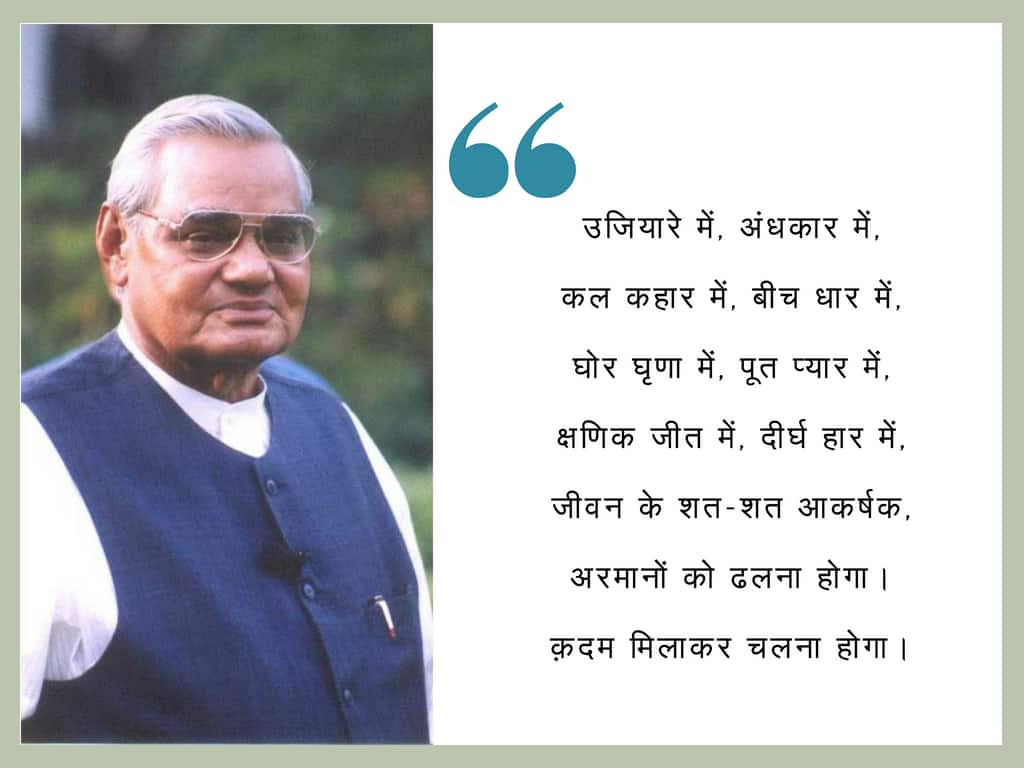
The article highlights the evolution of leaders within India’s parliamentary democracy, contrasting them with those from dynastic politics. It celebrates Atal Bihari Vajpayee as a prime example, emphasizing his journey from an activist to a mature statesman. The central theme underscores the virtues of leaders emerging organically through democratic processes and the challenges posed by dynastic political practices.
Key Highlights:
The article discusses the evolution of leaders within India’s parliamentary democracy and contrasts them with those from dynastic politics.
Atal Bihari Vajpayee is highlighted as an exemplary product of Indian parliamentary democracy, having entered politics as an activist and evolved into a mature statesman.
Vajpayee’s role in the BJP’s rise from the fringes to the mainstream during the Congress-dominated era is emphasized.
The article underscores Vajpayee’s oratorical skills, his role in consensus politics, and his commitment to national interests.
Key Challenges:
Critique of dynastic politics in the Congress party post-Nehru, seen as a hindrance to embodying leadership values of parliamentary democracy.
The challenge of maintaining decorum in political discourse, contrasting it with the current cheap antics of the Opposition.
Key Terms:
Dynastic politics: The practice of political leadership being passed down through family lines.
Consensus politics: The approach of seeking agreement among diverse political parties for effective governance.
Oratorical skills: The ability to deliver powerful and persuasive speeches.
Key Phrases:
“Leaders are born, they are not made”: Expresses the perspective on the natural emergence of leadership qualities.
“Evil of dynastic politics”: Describes the negative impact of hereditary political leadership.
“Teflon-coated Hindutva-vadi”: Term used to describe Atal Bihari Vajpayee, suggesting resilience in the face of criticism.
Key Quotes:
“Leaders are born, they are not made.”
“Dynasts can never fully appreciate and demonstrate the leadership values and principles of parliamentary democracy.”
“Atal ji’s greatness is not limited to his prime ministership.”
Anecdotes:
Vajpayee’s witty remark to Nehru about having a “split personality” and an “inverted vision.”
Jaitley’s mention of Vajpayee’s obituary address for Nehru as a quality tribute to a political adversary.
Key Statements:
“Leaders born into political families struggle to fully appreciate and demonstrate the leadership values of parliamentary democracy.”
“Vajpayee’s commitment to consensus politics is noted, even during the challenges of leading a 23-party coalition.”
“Vajpayee’s role as an ideal opposition leader is praised, emphasizing his support for the government during crucial times.”
Key Examples and References:
Vajpayee’s journey from a young activist to a mature statesman within the parliamentary system.
His criticism of Nehru’s policies and the BJP’s rise during the Congress-dominated era.
Instances of Vajpayee’s leadership during events like the nuclear tests in 1998 and the Kargil War.
References:
Arun Jaitley’s memorial address for Vajpayee, highlighting his oratory skills and leadership in opposition.
Jaitley’s mention of Vajpayee’s best orations occurring when he was on the opposition benches.
Critical Analysis:
The article critically analyzes the impact of dynastic politics on embodying democratic leadership values.
Vajpayee is portrayed as an exemplary leader, emphasizing his oratorical skills, commitment to consensus politics, and prioritization of national interests.
Way Forward:
Encourage a departure from dynastic politics and foster leadership emerging through democratic processes.
Advocate for a return to decorum in political discourse and a focus on consensus politics for effective governance.
Learn from Vajpayee’s legacy, striving for political environments that prioritize national interests over partisan considerations.
The article critiques the recently passed Telecom Bill, emphasizing its nationalistic undertones, potential authoritarian features, and the failure to address the digital divide effectively. It questions the rushed parliamentary process and highlights concerns about corporate favoritism, symbolized by the renaming of the Universal Services Obligation Fund.
Key Highlights:
The tweet by Union Minister Ashwini Vaishnav announces the passage of the Telecommunications Bill, 2023, and the repeal of The Indian Telegraph Act, 1885.
The use of the term “Bharat” instead of “India” and crediting the PM’s individual vision are intentional for cultural nativism.
Key Challenges:
The Telecom Bill is criticized for ignoring the persisting digital divide and lacking fresh ideas to address it.
Provisions favoring select private firms and potential misuse of regulatory power are highlighted.
State control and surveillance powers without defined safeguards raise concerns about privacy and freedom.
Key Terms and Phrases:
“Digital Bharat Nidhi”: Renaming of Universal Services Obligation Fund (USOF) in the Telecom Bill.
“Regulatory sandboxes”: Provisions likely to benefit large corporations in the telecom sector.
“Authorisation” vs. “Licensing”: The change in terminology with increased severity in the Telecom Act.
Key Quotes:
“Bharat moves on…” – Tweet by Union Minister Ashwini Vaishnav.
“Guess who will soon step into Mobile Satellite Services from India?” – MP Priyanka Chaturvedi on potential favoritism towards private firms.
Key Statements:
The Telecom Bill is criticized for distracting from the digital divide issue and lacking innovative solutions.
Concerns raised about potential misuse of regulatory powers and selective favoritism toward private corporations.
Key Examples and References:
Mention of the renaming of USOF as “Digital Bharat Nidhi” in the Telecom Bill.
Reference to the allocation of satellite spectrum benefiting the Adani Group.
Key Facts and Data:
Stagnation in new telecom users and contraction in smartphone sales, as reported by the Telecom Regulatory Authority of India and International Data Corporation.
A legal penalty of ₹25,000 for providing false particulars or failing to share information as required by the Telecom Act.
Critical Analysis:
The Telecom Bill is criticized for maintaining colonial architecture, vague definitions, and potential threats to privacy.
The rushed passage of the bill without addressing raised concerns reflects an unconstitutional concentration of power.
Way Forward:
Advocate for a thorough review of the Telecom Bill by a Standing Committee to address concerns.
Emphasize the need for policies that genuinely bridge the digital divide and promote fair competition in the telecom sector.
Encourage transparency, public participation, and safeguards to protect individual rights in telecommunications legislation.
The Bharatiya Nyaya Sanhita (BNS) Bill, 2023, introduces significant reforms to replace the Indian Penal Code.
The bill addresses terrorism, organized crime, gender neutrality, and repeals outdated laws like Section 377.
Major Provisions in the BNS Bill
[1] Promise to Marry (Clause 69)
Targeting ‘Love Jihad’: Criminalizes deceitful promises to marry, potentially addressing the ‘love jihad’ narrative.
Criminalization of Consensual Sexual Activity: Broadens the scope to include consensual sexual acts under certain deceitful circumstances.
[2] Mob Lynching
Codification of Offences: Introduces specific provisions for mob lynching and hate-crime murders.
Punishment: Ranges from life imprisonment to the death penalty.
[3] Organized Crime
Inclusion in Ordinary Law: For the first time, organized crime is addressed under ordinary criminal law.
Punishment Criteria: Distinction based on whether the crime results in death, with varying degrees of punishment.
[4] Terrorism
Integration into Ordinary Law: Adopts definitions from stringent acts and international laws, broadening the scope of terror financing.
[5] Attempt to Suicide
New Provision: Criminalizes suicide attempts aimed at compelling public servants, with potential implications for protests.
Significant Deletions and Repeals
[a] Section 377 (Unnatural Sexual Offences)
Repeal: Decriminalizes homosexuality, but raises concerns about addressing non-consensual acts.
[b] Adultery
Omission: Following the Supreme Court’s ruling, adultery is no longer criminalized.
[c] Thugee/Thugs (Section 310 IPC)
Removal: Eliminates colonial-era notions of criminality associated with certain tribes.
Gender Neutrality in Laws
Child-Related Offences: Makes laws about children gender-neutral.
Adult Offences: Extends gender neutrality to crimes like outraging modesty and voyeurism.
Other Notable Changes
Fake News: Introduces provisions against publishing false and misleading information.
Sedition (‘Deshdroh’): Renames and broadens the definition to include financial support for subversive activities.
Mandatory Minimum Sentences: Limits judicial discretion, raising concerns about fairness in considering mitigating circumstances.
Public Property Damage: Implements fines corresponding to the extent of damage caused.
What was the need for new bills?
Colonial legacy
From 1860 to 2023, the country’s criminal justice system functioned as per the laws made by the British.
The laws were drafted during colonial times and contain archaic language and concepts that might not accurately reflect current social norms, values.
Advances in Technology
This has introduced new dimensions to crime, evidence, and investigation.
Simplification and Streamlining
The laws have become complex over time, leading to confusion among legal practitioners, law enforcement agencies, and the general public.
Simplifying and streamlining the legal framework can enhance transparency and understanding.
Evidence Collection and Presentation
The Indian Evidence Act was enacted before the advent of modern forensic science and technological tools.
Various reports highlighted the need for reforms in criminal laws
The department-related Parliamentary Standing Committee on Home Affairs in its 146th report had recommended that there is a need for a comprehensive review of the criminal justice system of the country.
It was also pointed out that the Parliamentary Standing Committee in its 111th and 128th reports had also highlighted the need for reforms in criminal laws.
Conclusion
Reformative Approach: The BNS Bill represents a significant overhaul of India’s penal system, addressing contemporary issues and societal changes.
Judicial Implications: While it introduces necessary reforms, the bill’s impact on judicial discretion and fairness in sentencing warrants careful consideration.
India’s Chief Economic Adviser, V Anantha Nageswaran, emphasizes the need for reform in the sovereign credit rating process.
The aim is to accurately reflect the default risk of developing economies and reduce their funding costs.
What are Sovereign Credit Ratings?
A sovereign credit rating is a measure of a country’s creditworthiness, or its ability to meet its financial obligations.
It is an assessment of the credit risk associated with a country’s bonds or other debt securities.
The rating is assigned by credit rating agencies such as Standard & Poor’s, Moody’s, and Fitch Ratings.
S&P and Fitch rate India ‘BBB-‘ and Moody’s ‘Baa3’, all indicative of the lowest possible investment grade, but with a stable outlook.
India’s Pursuit of a Credit Rating Upgrade
Current Rating: India is at the lowest possible investment grade but is seeking an upgrade due to improved economic metrics post-pandemic.
Government Engagement: Continuous efforts are being made to engage with global credit rating agencies for an improved rating.
Challenges in the Current Rating Methodology
Opacity and Impact: CEA points out the opaqueness in rating methodologies and the difficulty in quantifying the impact of qualitative factors.
Bandwagon Effects and Biases: The significant presence of qualitative factors leads to cognitive biases and concerns about the credibility of ratings.
India’s Engagement with Rating Agencies
Meetings with Top Agencies: Finance ministry officials have met with representatives from Fitch Ratings, Moody’s Investors Service, and S&P Global Ratings.
Current Ratings: While S&P and Fitch rate India at BBB, Moody’s rates it at Baa3 with a stable outlook.
Parameters and Issues in Sovereign Rating
Typical Parameters: Agencies consider factors like growth rate, inflation, government debt, and political stability.
Qualitative Component: Over half the ratings are determined by qualitative factors, often non-transparent and perception-based.
Dominance in Ratings: Institutional Quality, often measured by World Bank’s Worldwide Governance Indicators (WGIs), is a significant determinant for developing economies.
Issues with WGIs: These metrics are non-transparent, perception-based, and may not represent a sovereign’s willingness to pay.
CEA’s Recommendations
Need for Transparency: Sovereigns are expected to be transparent; similarly, rating agencies should make their processes clear and avoid untenable judgments.
Potential Benefits: Enhanced transparency could lead to more reliance on hard data and possible credit rating upgrades for many sovereigns.
Access to Private Capital: Improved ratings can help developing countries access private capital crucial for addressing global challenges like climate change.
India’s Export Targets: With initiatives like production-linked incentives and Make in India, India aims for a $2 trillion export target by 2030.
Conclusion
Advocacy for Change: Nageswaran’s comments highlight the need for a more equitable and transparent sovereign credit rating process.
Broader Implications: Such reforms could not only benefit developing economies like India by reducing funding costs but also contribute to a more accurate and fair global financial system.