💥Join UPSC 2027,2028 Mentorship (July Batch) + XFactor Notes & Microthemes PDF

Search results for: “”

  • [Accepting Admissions] UPSC 2026/27–Jan Batch For UAP Mentorship | Connect with Mentor Now

    [Accepting Admissions] UPSC 2026/27–Jan Batch For UAP Mentorship | Connect with Mentor Now

    The Ultimate Assessment Program to ace UPSC CSE.
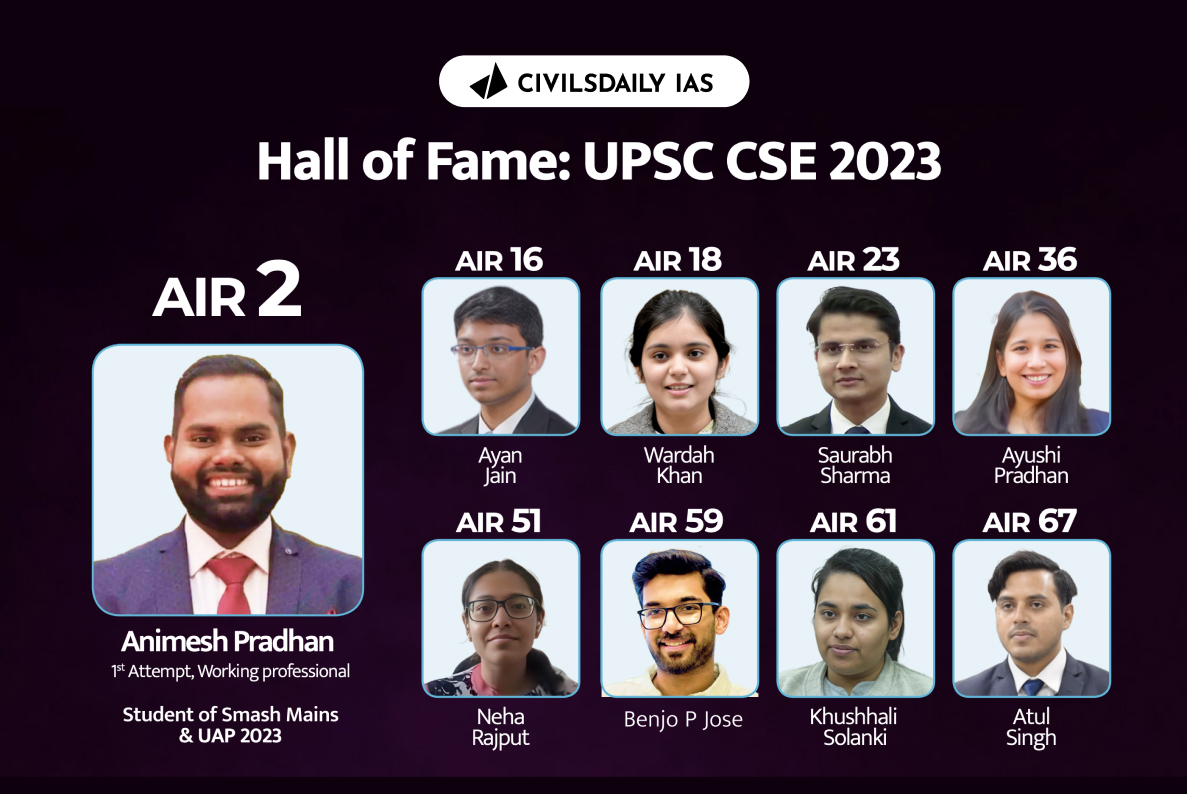
    Trusted and Endorsed by AIR 2, Animesh Pradhan (First Attempt, 473 in GS Mains & 133 in Essay). 

    UPSC 2026

    Schedule a 1-1 call with Civilsdaily’s Mentor for focused UPSC Prep

    Why Civilsdaily’s UPSC Mentorship Program Is Unique?
    UAP is NOT your regular course. This isn’t just a program, it’s an ecosystem built to deliver ranks. The core of UAP is – Fault Finding & Course Correction. While other mentorships feel like blackboxes-random calls, vague advice, zero accountability & mere doubt solving-ours is a precision system built to spot your faults and fix them fast. No fluff, no guesswork. Real mentorship means real corrections.

    We follow 5 steps: The Approach → Weekly Targets → Note-Building → Testing → Test Discussions. Every step sharpens you. Every step pulls you closer to the list.
    From crafting your strategy to squeezing out every last mark in Mains, UAP goes all in. In 2023, AIR 2 came from UAP. Many cleared in their first attempt. Others cracked it in their final shot.


    What’s common? Grind, Focus, Clarity, and UAP. This alone is a strong enough reason why UAP is a unique program.


    The heart of the Civilsdaily is the Ultimate Assessment Program (UAP). For years, aspirants have enrolled here because they couldn’t find such depth and passion towards quality content and Mentorship anywhere.
    Their search for Mentorship inevitably ends at Civilsdaily.

    What You Need to Crack UPSC-CSE in One Attempt

    To succeed in UPSC-CSE in a single attempt, it’s essential to have a well-structured, strategic approach. Here’s a breakdown of the key program inclusions that will help you achieve that:

    • Goal Setting: The Foundation of Preparation Every month, you’ll have a clear timeline of what needs to be covered and by when. This ensures consistent progress, avoids burnout, and keeps you on the right track throughout your preparation.
    • Assessment-Based Approach A comprehensive strategy that focuses on covering the entire syllabus in the shortest time possible, while still allowing room for multiple revisions. This approach ensures you stay on top of every subject while reinforcing your understanding.
    • Concise & Comprehensive Notes Access to crisp, ranker-recommended notes on relevant micro themes, based on trends from previous years’ questions (PYQs). These notes will help you focus on high-priority topics without getting overwhelmed.
    • Practical & Effective Revision Strategy A tailored revision plan focused on one goal: qualifying both Prelims and Mains. This strategy ensures you’re not just learning but retaining information effectively for the exams.
    • Mastering the Theme & Demand of Mains Questions Understand how to approach Mains questions with the right “Theme-Demand” analysis. Build a ready reference of “Intro-Body-Conclusion” structures for repeated themes, helping you develop muscle memory for answering questions efficiently.
    • Sharp Feedback from Mentors Consistent, detailed feedback on every mock test you attempt for Prelims and Mains. The goal is to make all your mistakes during the mocks, so you go into the final exam fully prepared and confident.

    By mastering these elements, you’ll build the skills, mindset, and preparation necessary to clear UPSC-CSE in one attempt.

    Schedule a 1-1 call with Civilsdaily’s Mentor for focused UPSC Prep

    Secondly, Let’s Understand Why Traditional Methods Fall Short

    Relying solely on traditional methods attending 1:many classes, reading model answers, and taking a few mock tests-often creates the illusion that this is the core of Prelims and Mains preparation. In reality, these approaches make up only about 10% of a comprehensive strategy. When your goal is to secure a rank in the least number of attempts, the stakes are even higher. Here’s how UAP Mentorship elevates your preparation to the next level:

    • Personalized Study Plan: Sit down with a mentor to craft a detailed, fortnightly study schedule that covers the syllabus systematically. After each cycle, attempt a mock test to evaluate your progress and identify areas for improvement.
    • Expert Feedback: Practicing mocks is great, but imagine receiving sharp, actionable feedback from a mentor who has guided toppers like AIR 2, 22, 48, and others. Learn how to gain those crucial extra marks for each question and unlock the X-factor in your preparation.
    • Mapping Mains Themes: Solving Prelims and Mains PYQs is just the beginning. With UAP, you’ll work with mentors to map the UPSC syllabus onto key Mains themes, using PYQs to prioritize your revision efforts efficiently.
    • Crafting Concise Notes: Already created your Mains revision notes? Let’s take it further by refining them into concise one-pagers for each theme, complete with updated examples and multiple dimensions for deeper understanding.
    • Actionable Evaluation: Receiving an evaluated mock test copy is crucial-but what’s next? With UAP, we provide clear, actionable points to work on before you attempt your next mock, ensuring continuous improvement.

    If you’re relying on outdated methods, UAP Mentorship might not be for you. But if you’ve tried those approaches and seen their limitations, now’s the time to level up. Apply for UAP Mentorship and experience the difference in your UPSC preparation journey.

    What is the Ultimate Assessment Program (UAP)?

    UAP is far from your typical course-it’s a complete ecosystem designed to handle every aspect of your UPSC preparation, from refining your strategy to significantly boosting your rank. In 2023, AIR 2 was one of the top ranks produced by UAP, alongside several other rankers. Many of these aspirants cleared the exam in their first attempt, while others succeeded in their final or second-to-last attempts.

    These aspirants not only cleared Prelims with ease but also scored 400+ marks in their GS Mains papers. If your goal is to secure a top rank-be it IAS, IPS, or IFS-scoring 400+ in Mains is essential. To make your rank “interview-proof,” you should aim for nothing less than 450+. This is where UAP truly stands out.

    UAP cuts through the overwhelming chaos of conventional preparation, bringing intense focus and clarity to your journey. With UAP, you’re not just preparing for an exam-you’re setting yourself up for success. The result? Your name on the final list next year.

    Why Choose Civilsdaily’s 1.5-Year Mentorship Program?

    Our program goes beyond generic study plans and superficial guidance. We believe that every aspirant is unique, and so are the challenges they face. Our mentorship is focused on providing personalized support that ensures you remain focused, disciplined, and efficient in your preparation.

    Three Pillars of UAP

    1. Mentorship:

    Each student will be assigned a dedicated mentor who will track your progress, understand your strengths and weaknesses, and design a roadmap specific to your needs. Your mentor will provide continuous monitoring, regular check-ins, and feedback, helping you stay on track with your goals. Whether it’s time management, overcoming distractions, or mastering specific subjects, our mentors will be there to guide you.

    Year-long Mentorship that’s all encompassing

    • Ensure you hit your next milestone
    • Subject strategy, target setting –
      providing base schedule.
    • Post test discussion

    Phases of Mentorship

    • One-on-one mentor calls every week to provide the target and planner for the first 2 months. Mentor calls will thereafter be held every 10 days after that.
    • Weekly Report Card
    • Macro-strategy & macro targets for every three
      months
    • Test-related 1-on-1 detail disucssion.
    • Philosophy: Every Student Is A Batch

    2. Core Programs:

    Five Core Programs that are industry standards in themselves:

    • Samachar Manthan
    • Prelims Test Series
    • Mains Test Series
    • Essay Test Series
    • Dominate Prelims Crash Course

    3. Pre-Acceleration Phase

    We combine the knowledge and best practices from all rankers and present the learning in the prep acceleration sessions. This includes

    • PYQ Mains Smash Lectures
    • Rich content including X-factor notes, Burning Issues, Flash Notes, Annotated NCERT etc

    Program Inclusion

    1. Prelims Test Series

    It includes the following deliverables.

    • Prime TS (124 Tests) : 32(PT) +24(Core Tests) +24(CA) +12(Advanced) + 12(CSAT)+ 20(FLT)
    • ÜłDedicated Monthly CA Test: Focus on Risk-Taking, Logical Problem Solving
    • Monthly CA Magazines (News, Op-Ed,PIB, Govt. Reports)
    • ÜłDetailed Explainations
    • ÜłAll India Rankings

    2. Samachar Manthan:

    Civilsdaily is renowned for its Samachar Manthan Program, an intensive current affairs initiative that will ensure you are fully prepared to tackle the dynamic aspects of the UPSC syllabus. With expert analysis, structured explanations, and discussions on major national and international issues, you’ll be equipped to handle both Prelims and Mains questions related to current affairs with confidence.

    • Üł Weekly News Analysis (Video + Notes)
    • Üł Mains Level Q&A Evaluation To Compliment The Lectures
    • Üł Checked Copy Discussion On Phone/In-Person

    3. Mains TS

    Mock tests are crucial for success, and our test series is designed to simulate the actual exam environment. From day one, you’ll have access to a structured test series, including:

    • With detailed feedback on every answer you write, ensuring you develop a strong, exam-oriented answer writing style.
    • Custom Test Plans tailored to your progress, providing just the right amount of challenge to improve performance steadily.
    Details:
    • 60 Tests: 16(Core Tests) + 20 (Advanced/Sectional)+24 (FLT)
    • ÜłSample Structure, Solutions
    • ÜłPersonalized Evaluation
    • Üł1-1 Checked Copy Discussion
    • ÜłSharing Best GS Copy (Real Time)
    • ÜłImprovement Tracking Excel

    4. Essay TS:

    In-depth sessions on mastering the Essay paper, a scoring section that often determine success in the UPSC Mains. The program includes:

    • 20 Tests: 10 (Before Pre) + 10(After Pre)
    • ÜłSample Structure, Solutions
    • ÜłPersonalized Evaluation
    • Üł1-1 Checked Copy Discussion
    • ÜłSharing Best Essay Copy (Real Time)
    • ÜłImprovement Tracking Excel

    5. Dominate Prelims:

    It is a crash course for the prelims. Includes following deliverables.

    • Static + CA Lectures
    • ÜłCreative Paper Solving Sessions
    • Exclusive Notes on
    • Predictable Themes
    • Test Series

    Program Features at a Glance:

    • Dedicated 1:1 Mentorship from experienced UPSC mentors
    • Customizable Study Plans designed to suit your pace of learning
    • Weekly and Monthly Progress Monitoring to ensure you’re on track
    • Prelims and Mains Integrated Preparation, including full-length mock tests
    • Samachar Manthan for mastering current affairs
    • Dominate Prelims: Crash Course for the prelims
    • Intensive Answer Writing practice with continuous feedback
    • Essay and Ethics Guidance for high-scoring papers
    • Exclusive Access to Civilsdaily’s Premium Resources, including Flash Notes, X-Factor Notes, Burning Issues, Atomic Notes, Samachar Manthan magazine etc.

    Why Early Preparation is Key for UPSC CSE 2026/27

    Starting early gives you an undeniable edge. By beginning your preparation now, you’ll:

    • Build conceptual clarity on the vast UPSC syllabus without time pressure
    • Have ample time for multiple revisions, strengthening your retention and recall
    • Benefit from early answer writing practice, which is crucial for Mains
    • Tackle current affairs in a systematic and organized manner, instead of last-minute cramming

    Schedule a 1-1 call with Civilsdaily’s Mentor for focused UPSC Prep

    Enroll Now and Secure Your Future

    Civilsdaily’s Mentorship Program for UPSC CSE 2026/27 is your ticket to success in this prestigious exam. Limited seats are available, ensuring each student gets personalized attention and mentorship. Enroll today to kickstart your journey toward becoming a future civil servant.

    Schedule a 1-1 call with Civilsdaily’s Mentor for focused UPSC Prep

  • Candida auris

    Why in the News?

    An Indian led study has warned that Candida auris, a drug resistant fungal pathogen, is becoming more virulent and spreading globally, with high mortality rates even after treatment, raising serious public health concerns.

    About Candida auris

    • Candida auris is a multidrug resistant fungal pathogen.
    • It causes severe invasive infections, particularly in hospitalised and immunocompromised patients.
    • First identified in 2009.
    • Classified as an emerging global health threat due to frequent treatment failure and high fatality.

    Transmission

    • Spreads through direct contact with infected or colonised individuals, including asymptomatic carriers.
    • Transmitted via Contaminated surfaces, Medical equipment and Invasive devices like catheters and ventilators

    Prelims Pointers

    • Candida auris is a fungus, not a bacterium or virus
    • Primarily a hospital acquired infection
    • Difficult to detect due to sepsis like symptoms
    • Major concern due to antifungal resistance and high mortality
    [2019] Which of the following are the reasons for the occurrence of multi-drug resistance in microbial pathogens in India? 

    1. Genetic predisposition of some people 

    2. Taking incorrect doses of antibiotics to cure diseases 

    3. Using antibiotics in livestock farming 

    4. Multiple chronic diseases in some people 

    Select the correct answer using the code given below: 

    (a) 1 and 2 (b) 2 and 3 only (c) 1, 3 and 4 (d) 2, 3 and 4

  • PathGennie Software

    Why in the News?

    The Ministry of Science and Technology has announced the development of PathGennie, a new open-source computational software that can significantly speed up drug discovery by accurately simulating drug–protein unbinding, a crucial step in understanding drug efficacy and safety.

    What is PathGennie?

    • PathGennie is an open-source computational framework designed to simulate rare molecular events, especially the unbinding of drugs from protein targets.
    • It helps in predicting drug residence time, a key parameter that determines how long a drug remains effective inside the body.
    • It avoids artificial distortions commonly introduced in conventional simulation methods.

    Developed by

    • Scientists at the S. N. Bose National Centre for Basic Sciences, Kolkata.

    Aim of PathGennie

    • To overcome the limitations of traditional molecular dynamics simulations, which struggle to capture slow and rare molecular transitions.
    • To generate physically accurate pathways for drug–protein interactions.
    • To reduce computational time and cost without compromising accuracy.

    Applications

    • Predicts accurate drug unbinding pathways and residence times
      • Example: Imatinib with Abl kinase
    • Improves understanding of protein–ligand kinetics for better drug design
    • Applicable beyond drug discovery in: Chemical reactions, Catalysis, Phase transitions and Molecular self-assembly

    Prelims Pointers

    • PathGennie is open-source and computational in nature
    • Focuses on drug unbinding, not just binding
    • Helps estimate drug residence time, a key pharmacological parameter
    • Avoids artificial bias unlike conventional simulation techniques
    • Developed in India under the Ministry of Science and Technology
    [2022] Consider the following: 

    1. Aarogya Setu 

    2. CoWIN 

    3. DigiLocker 

    4. DIKSHA. 

    Which of the above are built on top of open-source digital platforms? 

    (a) 1 and 2 only (b) 2, 3 and 4 only (c) 1, 3 and 4 only (d) 1, 2, 3 and 4

  • Copper

    Why in the News?

    Copper prices touched a record high of over USD 12,000 per tonne in 2025, driven by US tariff uncertainty, global supply disruptions and rapidly rising demand from AI infrastructure, clean energy systems and electric vehicles.

    Characteristics of Copper

    Chemical Characteristics

    • Symbol: Cu
    • Atomic weight: 63.546 amu
    • High resistance to corrosion and oxidation
    • Forms important alloys
      • Brass: Copper plus Zinc
      • Bronze: Copper plus Tin

    Physical Characteristics

    • Excellent electrical and thermal conductivity
    • Highly ductile and malleable, suitable for wiring and shaping
    • Reddish brown in colour, among the few naturally coloured metals

    Unique Properties

    • 100 percent recyclable without loss of quality
    • Antimicrobial in nature, useful in healthcare settings
    • Improves energy efficiency and lowers CO₂ emissions over product life cycles

    Applications of Copper

    Energy and Power Sector

    • Power transmission lines and grids
    • Transformers and substations
    • Renewable energy systems like solar and wind
    • Battery energy storage systems

    Electric Vehicles

    • EVs use more than twice the copper of conventional vehicles
    • Used in motors, batteries, inverters and charging infrastructure

    Digital and AI Infrastructure

    • Data centres and hyperscale AI facilities
    • Power transmission and cooling systems

    Construction and Manufacturing

    • Plumbing and roofing
    • Industrial machinery
    • Electronics and electrical appliances

    Defence and Healthcare

    • Defence electronics and ammunition
    • Antimicrobial medical surfaces and equipment

    India and Copper

    • India has recognised copper as a critical mineral under its resource strategy
    • Over 90 percent dependence on imported copper concentrate
    • Domestic demand expected to rise sharply due to EVs, renewable energy and digital infrastructure expansion

    Major Copper Producing Countries

    • Chile, Peru, Democratic Republic of the Congo, China and the United States

    Prelims Pointers

    • Copper is a critical mineral for energy transition and digital economy
    • EVs and AI driven data centres are major demand drivers
    • Copper is fully recyclable and antimicrobial
    • India is heavily import dependent for copper concentrat
    [2021] Why is there a concern about copper smelting plants? 

    1. They may release lethal quantities of carbon monoxide into the environment. 

    2. The copper slag can cause the leaching of some heavy metals into the environment. 

    3. They may release sulphur dioxide as a pollutant. 

    Select the correct answer using the code given below: 

    (a) 1 and 2 only (b) 2 and 3 only (c) 1 and 3 only (d) 1, 2, and 3

  • Secondary Pollutants

    Why in the News?

    A recent analysis by the Centre for Research on Energy and Clean Air has revealed that secondary pollutants now contribute nearly one third of Delhi’s annual PM2.5 load, highlighting a major shift in the nature of urban air pollution.

    What are Secondary Pollutants?

    • Secondary pollutants are not emitted directly from pollution sources.
    • They are formed in the atmosphere when primary pollutants such as SO₂, NOx and VOCs undergo chemical reactions.
    • These reactions are influenced by sunlight, temperature, humidity and stagnant air conditions.
    • They often accumulate downwind and over time, making monitoring and control more complex than primary pollutants.

    Major Secondary Pollutants

    • Secondary PM2.5: Ammonium sulfate and Ammonium nitrate
    • Ozone (O₃): Formed from nitrogen oxides (NOx) and volatile organic compounds (VOCs) in the presence of sunlight
    • Acids: Sulfuric acid and Nitric acid (contributors to acid rain)
    • Photochemical smog components: Peroxyacetyl nitrates (PANs) and Nitrogen dioxide (NO₂)

    Implications

    Regional and transboundary impact

    • Secondary aerosols can travel hundreds of kilometres
    • Delhi’s air quality is influenced by emissions from coal intensive states beyond the NCR

    Winter smog intensification

    • Moist and stagnant winter air sharply increases secondary PM2.5

    Health risks

    • Fine secondary particles penetrate deep into the lungs
    • Increase risks of respiratory and cardiovascular diseases

    Prelims Pointers

    • Secondary pollutants are formed in the atmosphere, not emitted directly
    • Ammonia plays a key role in secondary PM2.5 formation
    • Winter meteorology is crucial for secondary aerosol build up
    • Air pollution control requires regional coordination, not only city level measures
    [2013] Photochemical smog is a resultant of the reaction among 

    (a) NO₂, O₃ and peroxyacetyl nitrate in the presence of sunlight

    (b) CO₂, O₂, and peroxyacetyl nitrate in the presence of sunlight

    (c) CO, CO₂, and NO₂ at low temperature

    (d) high concentration of NO₂, O₃ and CO in the evening

  • [1st January 2026] The Hindu OpED: India’s space programme, a people’s space journey

    [UPSC 2016] Discuss India’s achievements in the field of Space Science and Technology. How has the application of this technology helped India in its socio-economic development?

    Linkage: The article illustrates India’s progression from landmark space missions to a citizen-centric space ecosystem supporting disaster management, agriculture, infrastructure, and governance.

    Mentor’s Comment

    India’s space programme has entered a decisive phase of transformation, from a state-led scientific endeavour to a people-centric strategic ecosystem. The article captures this transition by mapping India’s journey from symbolic achievements to institutional depth, private participation, and societal integration. It highlights how space has become a tool for governance, economy, national confidence, and global leadership, rather than remaining a niche scientific pursuit.

    Introduction

    India’s space programme is in focus following a series of firsts and institutional shifts that redefine its purpose and scale. From the Prime Minister’s articulation of Amrit Kaal goals to the operationalisation of the Indian Space Policy 2025, the sector is no longer limited to launches and missions. It now underpins disaster management, governance delivery, startup ecosystems, education, and international collaboration. The transformation is significant because it marks India’s shift from a mission-centric model to a citizen-facing, market-enabled, and globally integrated space ecosystem, an evolution rarely achieved by developing economies.

    How did India’s space journey evolve from inspiration to infrastructure?

    1. Foundational Vision: Established scientific self-reliance through indigenous launch vehicles and satellites, creating strategic autonomy in space access.
    2. Mass Participation: Chandrayaan missions generated nationwide engagement, embedding scientific ambition within public consciousness.
    3. Technological Maturity: Achieved precision landing, rover operations, and in-orbit docking, reflecting systemic depth beyond symbolic success.
    4. Societal Integration: Transitioned space assets from elite scientific use to everyday governance and citizen services.

    What milestones redefined India’s credibility as a space power?

    1. Chandrayaan-1: Confirmed presence of water molecules on the Moon, reshaping lunar science understanding.
    2. Chandrayaan-2: Delivered high-resolution lunar data despite partial mission failure, reinforcing learning-based innovation.
    3. Chandrayaan-3: Achieved first-ever soft landing near the lunar south pole, placing India among elite lunar explorers.
    4. Gaganyaan Preparations: Advanced human spaceflight readiness through crew module recovery and test vehicle missions.
    5. Aditya-L1 and SPADEX: Expanded capabilities into solar observation and in-orbit docking for future space stations.

    Why is the space sector being reframed as a national development tool?

    1. Disaster Management: Enables early warning systems, damage assessment, and real-time coordination.
    2. Agriculture and Fisheries: Supports crop estimation, drought monitoring, and marine resource advisories.
    3. Infrastructure and Transport: Enhances railway safety, urban planning, and power grid monitoring.
    4. Democratisation of Access: Positions space-derived data as a public good accessible to citizens and states.

    How is policy reform reshaping India’s space ecosystem?

    1. Indian Space Policy 2025: Institutionalises private sector participation across launch, satellite, and downstream services.
    2. Commercial Scaling: Facilitates startups in satellite manufacturing, launch vehicles, and data analytics.
    3. Economic Expansion: Increased sector valuation from ₹5,615 crore (2013-14) to ₹24,116 crore (2025-26).
    4. Employment Creation: Generates high-skill jobs across aerospace, AI, robotics, and materials science.

    What role do youth, education, and innovation play in this transition?

    1. Capacity Building: Engages over 60,000 students annually through Olympiads and space challenges.
    2. Innovation Platforms: Hackathons and competitions integrate academia with applied research.
    3. Startup Ecosystem: Over 350 startups contribute to satellite systems, launch services, and applications.
    4. Future Workforce: Strengthens STEM education pipeline aligned with emerging space technologies.

    How does India project leadership in global space governance?

    1. Climate Monitoring: Deploys satellites like G-20 Climate Satellite for global environmental observation.
    2. Data Sharing: Collaborates with NASA, ISRO, CNES, and ESA on Earth observation and planetary missions.
    3. Normative Leadership: Advances cooperative space use rooted in Vasudhaiva Kutumbakam.
    4. South-South Outreach: Provides satellite services and training to developing nations.

    Conclusion

    India’s space programme has evolved from a symbol of scientific aspiration into a core pillar of national development and strategic capability. By integrating space technology with governance delivery, economic expansion, private innovation, and global cooperation, India has repositioned space as a public good rather than an elite scientific pursuit. The transition towards human spaceflight, indigenous space infrastructure, and citizen-centric applications reflects a mature ecosystem aligned with the vision of Amrit Kaal. Sustained policy support, institutional coordination, and inclusive access will determine whether this transformation consolidates India’s role as a leading space power serving both national and global interests.

  • Myanmar’s military regime seeks legitimacy through a sham election

    Introduction

    Myanmar’s military regime is conducting elections not as a democratic transition but as an instrument to entrench control under the 2008 Constitution. The polls exclude most opposition forces, occur only in junta-controlled areas, and coincide with intensified violence against civilians. The election mirrors the military’s 2010 strategy but unfolds under far more adverse domestic and international conditions, raising serious questions about legitimacy, sovereignty, and governance.

    Why in the News

    Nearly five years after overthrowing the elected government of Aung San Suu Kyi in February 2021, Myanmar’s military (Tatmadaw) has initiated a tightly controlled, multi-phase election process. The first phase, held on December 28, recorded sparse turnout amid heavy security and active conflict, with subsequent phases scheduled in January. The exercise is significant because it marks the junta’s attempt to manufacture political legitimacy during an ongoing civil war that has killed thousands, displaced millions, and fragmented territorial control.

    How has the military structured the election process?

    1. Phased Elections: Conducted in three phases to manage security risks, with the first phase on December 28 and later phases in January.
    2. Restricted Geography: Held only in areas under junta control, excluding conflict-affected rural regions.
    3. Low Participation: Sparse turnout recorded, indicating limited public acceptance and fear-driven abstention.
    4. Security Enforcement: Conducted under heavy militarisation, including troop deployment and surveillance.

    Why is the election widely considered a sham?

    1. Exclusion of Opposition: National League for Democracy (NLD), which won 90% of seats in 2020, barred from contesting.
    2. Token Political Competition: Military-backed Union Solidarity and Development Party (USDP) dominates candidate lists.
    3. Criminalisation of Resistance: National Unity Government (NUG) and People’s Defence Forces (PDFs) designated as illegal.
    4. Absence of Electoral Integrity: No independent monitoring, free campaigning, or fair media access.

    What constitutional framework enables military dominance?

    1. Structural Power: 2008 Constitution reserves 25% of parliamentary seats for the military.
    2. Legislative Control: Ensures veto power over constitutional amendments.
    3. Emergency Provisions: Enables prolonged emergency rule since the 2021 coup.
    4. Electoral Engineering: Proportional representation favours military-aligned parties.

    How has the civil war altered electoral legitimacy?

    1. Territorial Fragmentation: Junta controls barely half of Myanmar’s townships.
    2. Active Conflict Zones: Elections absent in at least 65 townships where fighting persists.
    3. Civilian Casualties: Bombing of residential areas during polling, including Budalin and Khin-U townships.
    4. Humanitarian Crisis: Over 20 million people require assistance, undermining basic state capacity.

    What role do ethnic armed organisations (EAOs) play?

    1. Military Setbacks: Three Brotherhood Alliance (TBA) forced junta withdrawal from northern Shan and parts of Rakhine.
    2. Expanded Resistance: Kachin, Karen, and Karenni groups intensified operations alongside PDFs.
    3. Urban-Rural Divide: Junta retains urban centres like Sittwe while losing peripheral regions.
    4. Operational Adaptation: Use of Chinese-made drones and paragliders by the military.

    How do external actors influence the conflict and elections?

    1. Strategic Backing: Russia, China, and Belarus provide diplomatic and military support.
    2. China’s Calculus: Tacit approval of rebel advances near border scam centres, followed by ceasefire pressure.
    3. Western Ambivalence: US signals moderation, including sanction relief for some junta-linked firms.
    4. Geoeconomic Interests: Rare-earth minerals and border trade routes shape external engagement.

    Why does the junta persist despite unpopularity?

    1. Fragmented Resistance: Lack of unified command between PDFs and EAOs.
    2. International Paralysis: Absence of coordinated global pressure.
    3. Resource Control: Retention of key economic assets and trade corridors.
    4. Institutional Entrenchment: Constitutional safeguards ensure military primacy regardless of electoral outcomes.

    Conclusion

    Myanmar’s elections represent an exercise in controlled political symbolism rather than democratic renewal. Conducted amid widespread violence, exclusion, and constitutional manipulation, the polls fail to address the fundamental crisis of legitimacy confronting the military regime. The result is strategic stalemate, prolonged instability, and deepening civilian suffering with no political resolution in sight.

    PYQ Relevance

    [UPSC 2022]  ‘India is an age -old friend of Sri Lanka.’ Discuss India’s role in the recent crisis in Sri Lanka in the light of the preceding statement.

    Linkage: This PYQ is relevant to GS-II (International Relations-Neighbourhood) as it examines India’s response to political-economic crises in its immediate neighbourhood. The Myanmar case similarly highlights India’s calibrated engagement amid instability, balancing humanitarian concerns, regional security, and strategic competition, reflecting the same neighbourhood-first and strategic autonomy dilemmas.

  • India’s status as world’s rice leader augurs a water crisis

    Introduction

    Rice production has expanded sharply due to assured procurement, rising subsidies, and export demand. However, groundwater-dependent irrigation has become the dominant mode in northern India. Despite strong monsoons in recent years, extraction rates exceed natural recharge. Government classification of aquifers as “over-exploited” or “critical” signals a structural imbalance between agricultural policy and water resource sustainability.

    Why in the News

    India overtook China to become the world’s largest rice producer in 2023, exporting nearly double the quantity compared to the past decade and producing over 140 million tonnes of rice. While this achievement was politically and economically celebrated, it has intensified groundwater extraction in Punjab and Haryana. Borewell depths have increased from 30-40 feet to 80-200 feet, indicating rapid aquifer depletion. Rice cultivation in India consumes 3,000-4,000 litres of water per kg, 20-60% higher than the global average, turning agricultural success into a water sustainability concern of national scale.

    How did India become the world’s largest rice producer?

    1. Production Expansion: Annual rice output exceeded 140 million tonnes, surpassing China in 2023.
    2. Export Growth: Rice exports nearly doubled in the past decade due to global demand and domestic surplus.
    3. Policy Support: Minimum Support Price (MSP) assurance ensured farmer preference for rice cultivation.

    Why is rice cultivation intensifying groundwater stress?

    1. High Water Requirement: Producing one kilogram of rice requires 3,000-4,000 litres of water, exceeding global norms by 20-60%.
    2. Groundwater Dependence: Punjab and Haryana rice farmers primarily rely on borewell irrigation.
    3. Aquifer Depletion: Groundwater levels declined from 30-40 feet to 80-200 feet, indicating unsustainable extraction.

    What role do subsidies play in water over-extraction?

    1. Electricity Subsidies: Free or low-cost power encourages excessive pumping of groundwater.
    2. Price Incentives: Rice prices increased by ~70% over the past decade, reinforcing crop preference.
    3. Input Distortion: Subsidies discourage transition to less water-intensive crops.

    Why are Punjab and Haryana particularly vulnerable?

    1. Irrigation Pattern: Dominant reliance on groundwater over surface irrigation systems.
    2. Weak Monsoon Resilience: Despite strong rainfall, extraction continues beyond recharge capacity.
    3. Critical Classification: Aquifers in both states fall under “over-exploited” or “critical” categories.

    How does groundwater stress threaten food security?

    1. Farmer Costs: Deeper borewells require higher capital and energy inputs.
    2. Production Risk: Aquifer depletion increases vulnerability to weak monsoons.
    3. Systemic Stress: India produces more rice than domestic requirements, amplifying water stress without proportional food security gains.

    What corrective signals are emerging?

    1. Crop Diversification Incentives: Haryana introduced ₹17,500 per hectare subsidy for switching to less water-intensive crops.
    2. Policy Limitation: Incentives are seasonal and lack long-term assurance.
    3. Institutional Recognition: Government data acknowledges unsustainable groundwater extraction trends.

    Way Forward

    1. Crop Diversification
      1. Shift Incentivisation: Expands cultivation of less water-intensive crops such as pulses and oilseeds through multi-year income assurance.
      2. Procurement Reform: Aligns MSP and assured procurement with water-efficient cropping patterns.
    2. Rationalisation of Subsidies
      1. Power Pricing: Reduces indiscriminate groundwater pumping by restructuring free electricity for agriculture.
      2. Input Targeting: Replaces universal subsidies with direct income support decoupled from water use.
    3. Water-Efficient Irrigation
      1. Micro-Irrigation Expansion: Enhances adoption of drip and sprinkler systems to improve water productivity.
      2. Alternate Wetting and Drying (AWD): Reduces water use in paddy cultivation without yield loss.
    4. Groundwater Governance
      1. Aquifer Management: Strengthens block-level monitoring and annual recharge-extraction audits.
      2. Regulatory Enforcement: Restricts borewell depth expansion in over-exploited zones.
    5. Export Rationalisation
      1. Water Footprint Accounting: Integrates virtual water costs into export policy decisions.
      2. Surplus Management: Aligns export volumes with regional water availability.

    Conclusion

    India’s rise as the world’s largest rice producer reflects policy certainty, farmer responsiveness, and export competitiveness. However, the same policy framework has accelerated groundwater depletion in key agrarian states. Without reorienting incentives toward water-efficient agriculture, food security gains risk becoming ecologically unsustainable. Long-term agricultural resilience requires aligning production, procurement, and irrigation policy with groundwater realities rather than output maximisation alone.

    PYQ Relevance

    [UPSC 2020] What are the major factors responsible for making the rice-wheat system a success? In spite of this success, how has this system become a bane in India?

    Linkage: This question directly links to MSP-led rice expansion, groundwater-intensive irrigation, and subsidy-driven cropping patterns, as highlighted in India’s rise as the world’s largest rice producer.

  • [31st December 2025] The Hindu OpED: A multipolar world with bipolar characteristics

    PYQ Relevance

    [UPSC 2019] “The long-sustained image of India as a leader of the oppressed and marginalised nations has disappeared on account of its new-found role in the emerging global order.” Elaborate.

    Linkage:  The question directly aligns with GS Paper II (International Relations) by examining how the shift from a unipolar to a multipolar-bipolar global order has altered India’s external posture. It links to India’s transition from normative leadership of the Global South to pragmatic strategic hedging amid U.S.-China rivalry and great-power competition.

    Mentor’s Comment

    The article examines the structural transformation of the international system from post-Cold War unipolarity to an emerging multipolar order with distinctly bipolar characteristics. It situates recent U.S. strategic decisions, China’s economic-military rise, and Russia’s revisionist behaviour within a larger reordering of global power, making it directly relevant for GS Paper II (International Relations) and GS Paper III (Security).

    Introduction

    The contemporary global order is undergoing a structural transition. While the United States remains the world’s most powerful military and economic actor, it no longer enjoys uncontested dominance. China’s rapid rise and Russia’s revisionist assertiveness have ended unipolarity, giving rise to a multipolar world that increasingly exhibits bipolar dynamics centred on U.S.-China rivalry, with Russia acting as a swing power.

    Why in the News

    The issue has gained renewed salience following the United States’ largest troop mobilisation in the Caribbean in decades and the release of its 2025 National Security Strategy, which reasserts hemispheric primacy while signalling retrenchment from European security. This marks a sharp departure from the post-Second World War U.S. role as Europe’s primary security guarantor and highlights the limits of the U.S.-led rules-based order amid rising Chinese power and Russia’s continued defiance despite sanctions.

    Is the unipolar moment definitively over?

    1. End of Unipolarity: Confirms the erosion of post-1991 U.S. dominance as China and Russia acquire the capacity to shape geopolitical outcomes independently.
    2. Structural Shift: Demonstrates transition from a single-centre system to dispersed authority across multiple power centres.
    3. Empirical Trigger: Russia’s annexation of Crimea (2014) and sustained resistance to Western sanctions expose limits of the rules-based order.

    Does American dominance still persist despite decline?

    1. Military Primacy: Retains unmatched global force projection and alliance networks.
    2. Economic Weight: Continues as the world’s most powerful economy despite relative decline.
    3. Strategic Constraint: Loses ability to unilaterally determine geopolitical outcomes, particularly in Eurasia.

    Why is China the principal systemic challenger?

    1. Economic Scale: Accounts for ~66% of U.S. GDP, up from 57% Soviet GDP at the Cold War peak.
    2. Growth Trajectory: Continues faster economic expansion, steadily narrowing the power gap.
    3. Military Conversion: Translates economic power into naval dominance, operating the world’s largest navy by ship count.
    4. Regional Ambition: Seeks hegemony in East and Southeast Asia as a pathway to long-term superpower status.

    What role does Russia play in the emerging order?

    1. Relative Weakness: Possesses smaller economy and shrinking sphere of influence.
    2. Strategic Assets: Retains nuclear arsenal, geographic depth, and energy resources.
    3. Revisionist Behaviour: Uses force to reassert primacy in its near abroad, including Georgia (2008) and Ukraine.
    4. Swing Power Role: Operates between the U.S. and China, giving the multipolar system a bipolar character.

    Why is multipolarity still incomplete?

    1. Absence of Blocs: Lacks Cold War-style ideological and economic blocs.
    2. Alliance Uncertainty: Shows strain within U.S. alliances and distrust within Russia-China partnership.
    3. Hedging by Middle Powers: Japan, Germany, India, and Brazil avoid firm alignment amid uncertainty.

    How does U.S. strategy reflect this transition?

    1. Regional Retrenchment: Reduces commitment to European security burden-sharing.
    2. Sphere Reassertion: Reinvokes Monroe Doctrine logic in Latin America and the Caribbean.
    3. China Focus: Prepares for prolonged strategic competition in the Indo-Pacific.

    Does the emerging order resemble the Cold War?

    1. Partial Bipolarity: Displays U.S.-China central rivalry rather than rigid blocs.
    2. Multipolar Complexity: Allows autonomous manoeuvring by middle and regional powers.
    3. Systemic Instability: Remains fluid, unsettled, and structurally incomplete.

    Conclusion

    The contemporary international system no longer reflects a stable unipolar or fully formed multipolar order. It is shaped by enduring U.S. primacy, China’s rapid economic-military rise, and Russia’s disruptive revisionism, producing a multipolar structure with bipolar characteristics. In this fluid and unsettled environment, power politics, spheres of influence, and strategic hedging dominate state behaviour, while the absence of clear blocs or settled norms makes the emerging global order inherently unstable and transitional.

  • Too good to last: The headwinds facing the economy are not going away soon

    Introduction

    Industrial growth in November 2025 presents a paradox. While headline numbers suggest recovery, disaggregated analysis reveals that the drivers are temporary and non-replicable. The data underscores the disconnect between short-term industrial momentum and longer-term macroeconomic constraints such as weak consumption, sluggish investment, and external pressures.

    Why in the News

    India’s Index of Industrial Production (IIP) recorded 6.7% growth in November 2025, the fastest in 25 months, with manufacturing expanding by 8%, also a 25-month high. This marked a sharp reversal from October 2025, when industrial growth fell to a 14-month low. The surge appeared significant as it coincided with rebounds in consumer durables (10.3%), non-durables (7.3%), and mining (5.4%).

    Does the November IIP surge reflect a structural turnaround?

    1. IIP Growth Spike: Recorded 6.7% growth, the fastest in 25 months, reversing October’s slowdown.
    2. Manufacturing Expansion: Grew by 8%, reflecting short-term production acceleration.
    3. Temporal Contrast: October 2025 marked a 14-month low, underscoring volatility rather than trend reversal.

    What factors drove the temporary industrial acceleration?

    1. Seasonal Restocking: Sellers replenished inventories after festive-season depletion.
    2. GST Timing Effect: Government synchronized GST rate reductions with the festive period, creating a demand spike.
    3. Inventory Rebuilding: Festive sales eroded stocks, necessitating replenishment-driven production.

    Which sectors contributed most to the November rebound?

    1. Consumer Durables: Grew 10.3%, the highest in 12 months, driven by festive purchases.
    2. Consumer Non-Durables: Expanded 7.3%, a 25-month high, reflecting short-term consumption.
    3. Mining Sector: Recorded 5.4% growth, rebounding after two months of contraction due to an extended monsoon.
    4. Electricity and Mining Sensitivity: Output remained dependent on weather conditions, limiting sustainability.

    Why is the growth unlikely to be sustained?

    1. Seasonality Constraint: Festive demand is non-recurring; next cycle only in October-November 2026.
    2. Demand Weakness: Consumer demand remains sluggish beyond seasonal effects.
    3. GST Impact Fading: Industry reports indicate the GST-led boost is already ebbing.
    4. Weather Dependence: Mining and electricity outputs remain vulnerable to climatic variability.

    What does long-term data reveal about industrial health?

    1. April-November IIP Growth: Averaged only 3.3%, the weakest in post-pandemic years.
    2. Consumer Non-Durables Contraction: Declined 1% over the same period, signalling weak mass consumption.
    3. Statistical Anomaly: November growth appears as an outlier rather than trend confirmation.

    How do macroeconomic headwinds reinforce the slowdown?

    1. RBI Growth Outlook: Q3 growth projected at 7%, down from 8% average in H1; Q4 projected at 6.5%.
    2. Trade Barriers: 50% U.S. tariffs continue to constrain export competitiveness.
    3. Investment Sluggishness: Private investment remains subdued.
    4. Capital Outflows: Foreign capital withdrawal pressures domestic liquidity.
    5. Currency Depreciation: Weak rupee raises import costs in an import-dependent economy.
    6. Real Wage Stagnation: Wage growth insufficient to support sustained consumption.

    Conclusion

    The November 2025 industrial surge masks deeper structural weaknesses. Seasonal demand, fiscal timing, and weather normalization explain the rebound, while longer-term indicators confirm persistent headwinds. Without revival in consumption, investment, and external demand, industrial growth risks remaining episodic rather than transformational

    PYQ Relevance

    [UPSC 2017]  “Industrial growth rate has lagged-behind in the overall growth of Gross-Domestic-product (GDP) in the post-reform period.” Give reasons. How far are the recent changes in Industrial-policy capable of increasing the industrial growth rate? 

    Linkage: This PYQ directly examines the structural weakness of industrial growth vis-Ă -vis GDP. The editorial highlights this through episodic IIP spikes without sustained demand revival.