India successfully conducted the flight-trial of an advanced Agni missile equipped with a Multiple Independently Targeted Re-entry Vehicle (MIRV) system on May 8, 2026. The test was carried out from Dr. A.P.J. Abdul Kalam Island.
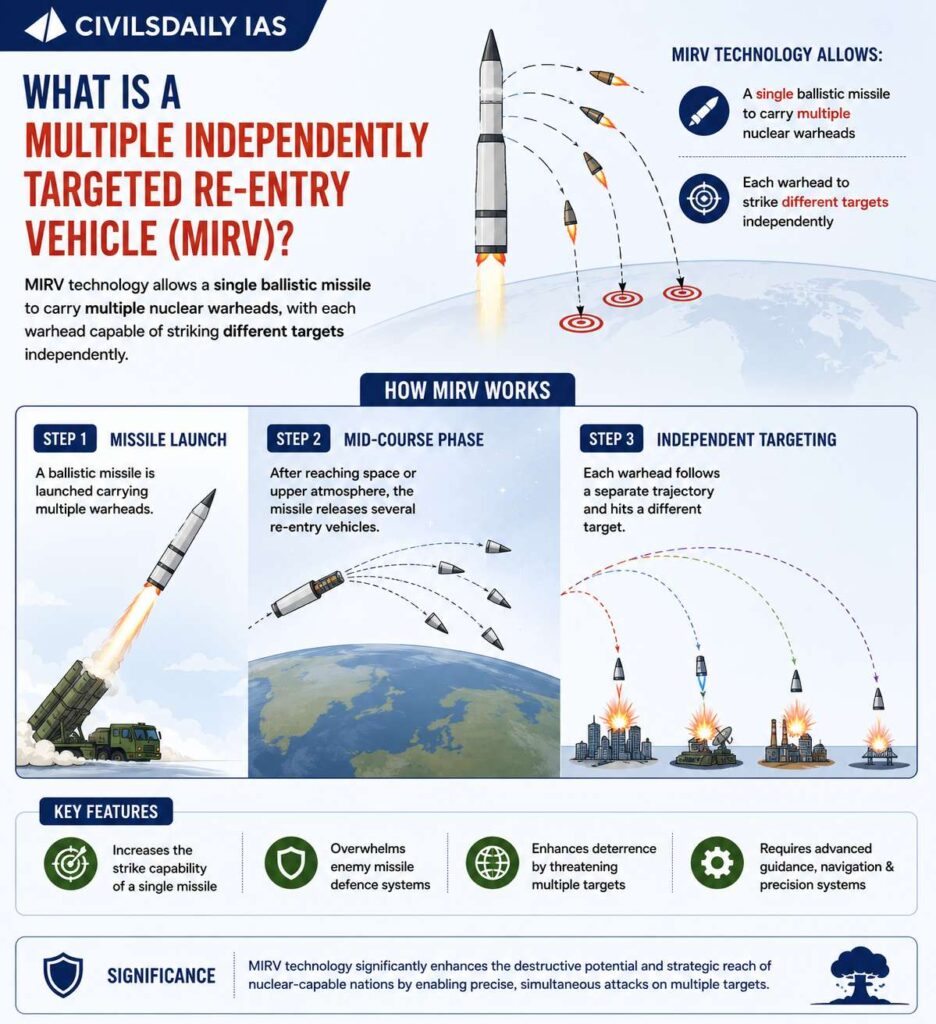
What is a Multiple Independently Targeted Re-entry Vehicle (MIRV)?
MIRV technology allows:
A single ballistic missile to carry multiple nuclear warheads
Each warhead to strike different targets independently
How MIRV Works
Step 1: Missile Launch: A ballistic missile is launched carrying multiple warheads.
Step 2: Mid-course Phase: After reaching space or upper atmosphere:
The missile releases several re-entry vehicles
Step 3: Independent Targeting: Each warhead:
Follows a separate trajectory
Hits a different target
[2026] Consider the following statements 1. Ballistic missiles are jet-propelled at subsonic speeds throughout their fights, while cruise missiles are rocket-powered only in the initial phase of fight. 2. Agni-V is a medium-range supersonic cruise missile, while BrahMos is a solid-fuelled intercontinental ballistic missile. Which of the statements given above is/are correct? [A] 1 only [B] 2 only [C] Both 1 and 2 [D] Neither 1 nor 2
Two cheetahs brought from Botswana were released into the wild at Kuno National Park (MP) after completing quarantine and acclimatisation. With this, India’s total cheetah population has increased to 57, including cubs born in India.
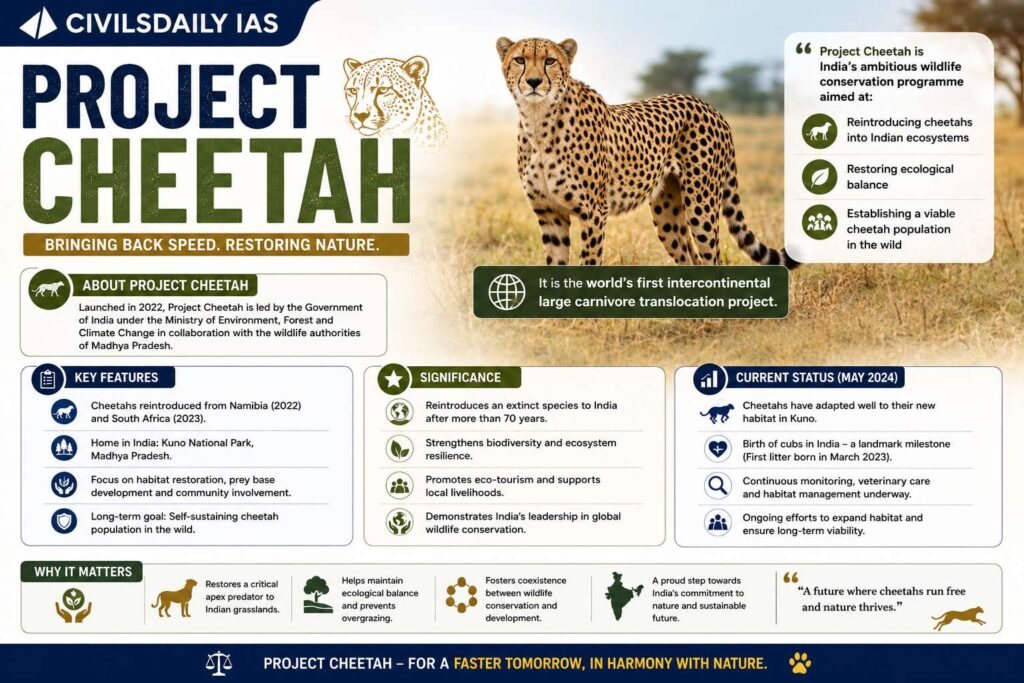
About Project Cheetah
Project Cheetah is India’s ambitious wildlife conservation programme aimed at:
Reintroducing cheetahs into Indian ecosystems
Restoring ecological balance
Establishing a viable cheetah population in the wild
It is the world’s first intercontinental large carnivore translocation project.
Launch of the Project
The project was launched in September 2022 by Narendra Modi at Kuno National Park
Background
Extinction in India: The Asiatic cheetah became extinct in India in 1952
Main reasons: Hunting, Habitat loss, and Decline in prey base
India declared the cheetah extinct officially in 1952.
Source Countries of Cheetahs
Namibia: 8 cheetahs brought in September 2022
South Africa: 12 cheetahs brought in 2023
Botswana: 9 cheetahs brought in 2026
[2024] Consider the following statements: 1. Lions do not have a particular breeding season. 2. Unlike most other big cats, cheetahs do not roar. 3. Unlike male lions, male leopards do not proclaim their territory by scent marking. Which of the statements given above are correct? [A] 1 and 2 only [B] 2 and 3 only [C] 1 and 3 only [D] 1,2 and 3
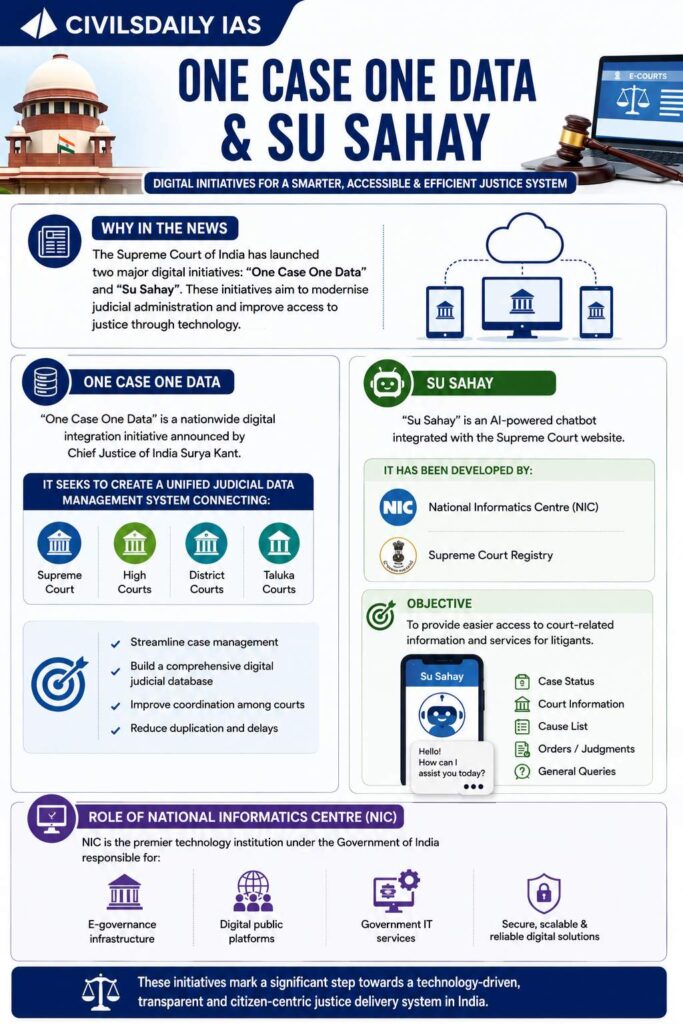
The Supreme Court of India has launched two major digital initiatives: “One Case One Data” and “Su Sahay”. These initiatives aim to modernise judicial administration and improve access to justice through technology.
One Case One Data
“One Case One Data” is a nationwide digital integration initiative announced by Chief Justice of India Surya Kant.
It seeks to create a unified judicial data management system connecting:
Supreme Court
High Courts
District Courts
Taluka Courts
Objective
Streamline case management
Build a comprehensive digital judicial database
Improve coordination among courts
Reduce duplication and delays
Su Sahay
“Su Sahay” is an AI-powered chatbot integrated with the Supreme Court website.
It has been developed by:
National Informatics Centre (NIC)
Supreme Court Registry
Objective: To provide easier access to court-related information and services for litigants.
Role of National Informatics Centre (NIC)
NIC is the premier technology institution under the Government of India responsible for:
E-governance infrastructure
Digital public platforms
Government IT services
[2022] Consider the following: 1. Aarogya Setu 2. CoWIN 3. DigiLocker 4. DIKSHA Which of the above are built on top of open-source digital platforms? (a) 1 and 2 only (b) 2, 3 and 4 only (c) 1, 3 and 4 only (d) 1, 2, 3 and 4
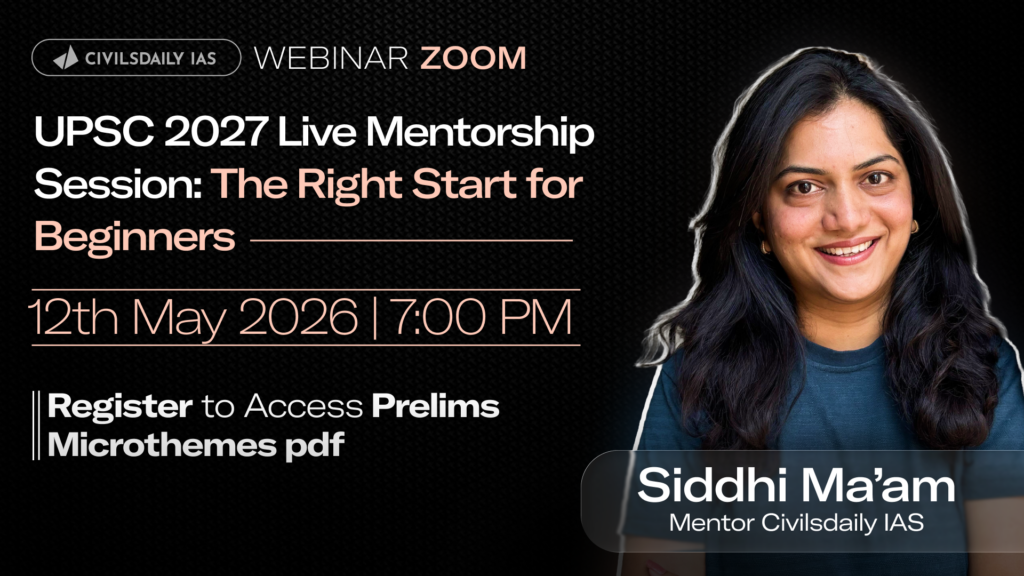
Every year, thousands begin UPSC preparation. Very few begin correctly.
This live mentorship session is designed for serious beginners who want clarity, structure and the right direction from Day One of their UPSC 2027 journey.
If you are confused about where to begin, what to study, how to make notes, or how toppers actually prepare, this session is for you.
Siddhi Ma’am, Mentor, Civilsdaily IAS
What I’ll do in this live session:
• How to start UPSC 2027 preparation in a structured manner
• The biggest mistakes beginners make in the first 6 months
• Understanding the UPSC syllabus, PYQs & microtheme approach
• How to balance Static subjects, Current Affairs & answer writing
• Booklists, note-making and revision strategy for beginners
• How to build consistency without burnout
• What serious aspirants do differently from the beginning
Who should attend: • Beginners targeting UPSC 2027 • College students planning an early start • Working professionals starting preparation alongside work • Aspirants feeling lost or overwhelmed by resources
It will be a 45 minute session, post which we will open up the floor for all kinds of queries which a beginner must have. No questions are taboo and Siddhi Ma’am is known to be patiently solving all your doubts.
Join us for a Zoom session on 12th May at 7 PM. This session is a must attend for you If you are attempting UPSC for the first time or have attempted earlier and now preparing for 2027, then it is going to be a valuable session for you too.
See you in the session”
Register for the session for a complete in-depth UPSC Prep
(Don’t wait—the next webinar/session won’t be until End May’26)
These masterclasses are packed with value. They are conducted in private with a closed community. We rarely open these webinars for everyone for free. This time we are keeping it for 300 seats only.
PYQ Relevance[UPSC 2020] What is the significance of Indo-US defence deals over Indo-Russian defence deals? Discuss with reference to stability in the Indo-Pacific region.Linkage: The PYQ examines India’s evolving strategic and defence partnerships in the Indo-Pacific and the shift toward technology-driven defence cooperation. KIND-X similarly reflects India’s move from traditional procurement to co-development, co-production, and defence innovation partnerships with South Korea.
Mentor’s Comment
India and South Korea launched the Korea-India Defence Accelerator (KIND-X) during the India-South Korea Summit on April 20, 2026. It marks a shift from conventional defence procurement to innovation-led cooperation. For the first time, both countries are institutionalising collaboration among start-ups, universities, investors, and defence firms for co-development and co-production of advanced technologies. The initiative also aligns India’s defence modernisation goals with South Korea’s Defence Innovation 4.0 strategy and may create an India-South Korea defence innovation corridor.
How has India-South Korea defence cooperation evolved over time?
Diplomatic Relations (1973): Established formal bilateral relations, creating the basis for defence and strategic engagement.
Defence Industry Agreement (2005): Signed a MoU on Defence Industry and Logistics, expanding cooperation in procurement, production, research, and development.
Research Collaboration (2010): Concluded separate memoranda on defence cooperation and defence R&D, strengthening institutional engagement.
Technology Partnerships: Expanded cooperation in maritime systems, electronics, and intelligent systems through links between India’s DRDO and South Korean defence firms.
Strategic Upgrade (2015): Elevated ties to a Special Strategic Partnership, widening defence and security cooperation.
Roadmap for Cooperation (2020): Introduced the 2020 Roadmap for Defence Industries Cooperation, covering land, naval, aero, and guided weapon systems, alongside investments and technology transfer.
Industrial Success: Enabled the K9 Vajra-T self-propelled artillery system, manufactured by L&T and Hanwha Aerospace, under the Make in India initiative, resulting in follow-on production contracts.
Why does KIND-X represent a major shift in bilateral defence relations?
Innovation Ecosystem: Connects businesses, innovators, investors, defence start-ups, and universities, shifting cooperation from procurement to joint innovation.
Institutionalisation: Creates a structured bilateral platform similar to INDUS-X (India-U.S.) and FRIND-X (France-India) defence innovation frameworks.
Co-development Model: Enables joint defence R&D, co-production, and technology development, rather than import-dependent defence relations.
Strategic Alignment: Aligns with India’s 2020 Defence Industries Roadmap and South Korea’s Defence Acquisition Program Administration (DAPA) and Defence Innovation 4.0 strategy.
Start-up Integration: Expands defence participation beyond large firms to include MSMEs, start-ups, incubators, and think tanks.
What opportunities can KIND-X unlock for both countries?
Joint Innovation Fund: Facilitates joint grants by India’s DIO/DAPA for start-ups developing defence technologies.
Testing Infrastructure: Ensures access to universities, laboratories, and testing facilities in both countries.
Standardisation: Supports joint certification and standardisation mechanisms, improving defence interoperability.
Technology Transfer: Facilitates licensing arrangements and intellectual property collaboration for co-production.
Investment Linkages: Connects innovators with venture capital and defence investors, strengthening defence start-up ecosystems.
Knowledge Exchange: Supports annual summits, accelerator programmes, incubators, and workshops to navigate export controls and defence funding mechanisms.
Track 1.5 Dialogue: Strengthens policy coordination among government, academia, industry, and think tanks.
How can KIND-X strengthen India’s defence industrial ecosystem?
Co-production: Supports joint manufacturing ventures, using successful templates such as K9 Vajra-T howitzers.
Industrial Corridors: Connects South Korean innovation clusters in Changwon, Daejeon, and Gumi with Indian defence corridors in Tamil Nadu and Uttar Pradesh, and aerospace hubs in Bengaluru, Chennai, and Hyderabad.
Private Sector Participation: Deepens engagement of firms such as Hyundai, L&T, Tata Advanced Systems Limited, Mahindra, Bharat Forge, Hanwha, LIG, and Kangnam.
Indigenisation: Strengthens India’s objective of reducing import dependence under Aatmanirbhar Bharat.
Export Capacity: Enhances defence exports through joint production and access to regional markets.
Which strategic sectors are likely to benefit from KIND-X?
Artificial Intelligence: Supports military AI platforms for decision-making and autonomous systems.
Autonomous Weapons: Facilitates development of robotics and unmanned defence systems.
Space-Based Intelligence: Expands collaboration in satellite surveillance, ISR (Intelligence, Surveillance and Reconnaissance), and Space Situational Awareness (SSA).
Critical Minerals: Enhances supply-chain security for strategic manufacturing.
Navigation and Communication: Supports advanced defence communication systems and secure navigation technologies.
What challenges may limit the success of KIND-X?
Funding Constraints: Requires sustained financing for start-ups and joint defence projects.
Technology Sensitivities: Faces barriers due to IP rights, export controls, and licensing restrictions.
Institutional Coordination: Requires effective coordination among ministries, private firms, universities, and regulators.
Execution Deficit: Success depends on tangible deliverables, measurable timelines, and project continuity.
Geopolitical Risks: Regional strategic tensions in the Indo-Pacific may affect technology-sharing priorities.
How does KIND-X fit into India’s broader strategic objectives?
Aatmanirbhar Bharat: Strengthens indigenous defence manufacturing and technology absorption.
Indo-Pacific Strategy: Diversifies strategic partnerships beyond traditional defence partners.
Defence Modernisation: Accelerates adoption of emerging military technologies.
Export Promotion: Supports India’s ambition of becoming a defence manufacturing and export hub.
Conclusion
KIND-X marks a new phase in India-South Korea defence ties by shifting focus from procurement to joint innovation and co-development. Effective implementation can strengthen defence indigenisation, technological capacity, and strategic resilience. Sustained funding, institutional coordination, and technology-sharing mechanisms will determine its long-term success.
Nearly a decade after demonetisation was projected as a major strike against black money and fake currency, new NCRB and Parliamentary data show that counterfeit currency continues to circulate in India. The issue has become significant because fake ₹500 notes have sharply increased, Gujarat alone accounted for more than half of counterfeit currency seizures between 2017 and 2024, and counterfeit ₹2,000 notes rose despite being introduced after demonetisation.
Why was demonetisation expected to curb fake currency?
Currency Replacement: Demonetisation invalidated old ₹500 and ₹1,000 notes and introduced redesigned currency with enhanced security features.
Financial Disruption: Intended to eliminate counterfeit stock accumulated by criminal and terror networks.
Formalisation of Economy: Encouraged banking transactions and digital payments to reduce cash dependency.
Security Objective: Sought to weaken terror financing channels dependent on fake Indian currency notes (FICN).
Governance Goal: Intended to reduce black money circulation and illicit cash transactions.
What do recent data reveal about counterfeit currency trends?
Persistent Counterfeit Circulation: NCRB data show counterfeit currency seizures worth more than ₹54.61 crore across States.
Peak Seizures in 2022: Fake currency seizures reached ₹382.6 crore, the highest level in recent years and over 85% linked to Gujarat.
Sharp Rise After Demonetisation: Counterfeit ₹2,000 notes nearly doubled compared to 2017 despite being newly introduced after demonetisation.
Continued Fake ₹500 Notes: Fake ₹500 notes seized in 2024 were nearly four times the level recorded in 2016.
Pandemic Disruption: Currency seizures fell temporarily in 2020 (₹92 crore) during COVID-19 restrictions but later surged.
Why does the rise in fake ₹500 and ₹2,000 notes matter?
Security Failure: Indicates criminal networks adapted rapidly even after redesigned currency introduction.
Post-Demonetisation Counterfeiting: Fake ₹2,000 notes, introduced after 2016, emerged in large numbers, questioning technological safeguards.
₹500 Dominance: Fake ₹500 notes formed a major share of seizures because the denomination remained widely used even after the withdrawal of ₹2,000 notes from circulation in May 2023.
Monetary Credibility: Reduces trust in sovereign currency and payment systems.
Banking Burden: Increases costs of verification and counterfeit detection.
Internal Security Threat: Strengthens organised crime and hawala networks.
What measures can strengthen India’s anti-counterfeit framework?
Currency Security Enhancement: Ensures frequent upgrades in watermarking, microprinting, and security threads.
AI-Based Detection: Facilitates real-time identification of counterfeit notes in ATMs and banks.
Border Surveillance: Strengthens monitoring of smuggling routes and cross-border criminal networks.
Financial Intelligence Coordination: Supports coordination among RBI, NCRB, FIU-IND, DRI, NIA, and State police.
Digital Payments Expansion: Reduces excessive cash dependence and counterfeit vulnerability.
Public Awareness: Ensures citizen awareness regarding security features of currency notes.
Conclusion
The persistence of counterfeit currency despite demonetisation indicates that currency replacement alone cannot eliminate the challenge of fake money. While the 2016 exercise disrupted old counterfeit networks temporarily and accelerated digital transactions, rising seizures of fake new-series notes reveal institutional and technological gaps. A sustained strategy based on advanced currency security features, stronger inter-agency coordination, border vigilance, financial intelligence, and reduced cash dependency is necessary to protect monetary credibility and internal security.
PYQ Relevance
[UPSC2022] Give out the major sources of terror funding in India and the efforts being made to curtail these sources. In the light of this, also discuss the aim and objective of the ‘No Money for Terror (NMFT)’ Conference recently held at New Delhi in November 2022.
Linkage: Counterfeit currency is a major source of terror financing, often linked with hawala, organised crime, and cross-border networks. The article directly relates to illicit financial flows and internal security.
The 10th Indian Ocean Dialogue (IOD) of the 23-member Indian Ocean Rim Association (IORA) was held in New Delhi on May 7-8, 2026, under the theme “Indian Ocean Region in a Transforming World.” India, as IORA Chair (2025-27), prioritised maritime security, blue economy, and innovation under its MAHASAGAR vision. The dialogue gains significance amid rising instability in West Asia and disruptions in key sea routes, bringing maritime security to the forefront of regional economic and strategic concerns.
Key Facts about IORA
Establishment: Formed in 1997.
Members: Includes India, Australia, Bangladesh, Indonesia, Kenya, France, UAE, South Africa, Sri Lanka, and others.
Chair: India currently chairs the grouping.
30th Anniversary Summit: Expected in 2027.
What is the significance of the Indian Ocean Rim Association (IORA)?
Regional Cooperation: Strengthens collaboration among 23 member states across the Indian Ocean littoral.
Security Coordination: Facilitates dialogue on maritime safety, disaster response, and blue economy.
Economic Integration: Supports trade, fisheries, tourism, and investment partnerships.
Diplomatic Platform: Provides India a regional forum distinct from SAARC, BIMSTEC, and QUAD.
Strategic Relevance: Enhances India’s role as a net security provider in the Indian Ocean.
What are the major areas of cooperation under IORA?
Maritime Safety: Strengthens regional response against piracy, trafficking, and maritime crime.
Trade and Investment: Facilitates economic connectivity and regional commerce.
Blue Economy: Supports sustainable fisheries, marine resources, and ocean-based economic activities.
Disaster Risk Management: Enhances preparedness against cyclones, tsunamis, and coastal disasters.
Tourism and Cultural Exchange: Encourages people-to-people linkages and regional cooperation.
Institutional Weakness: Lacks enforcement mechanisms compared to stronger regional organisations.
Geopolitical Rivalries: Competing interests among regional powers limit consensus.
Limited Security Role: Functions primarily as a consultative platform rather than a defence grouping.
Unequal Priorities: Member states possess different economic and security concerns.
Fragmented Regionalism: Overlap with organisations such as BIMSTEC, ASEAN, QUAD, and IONS reduces cohesion.
Why has maritime security become a critical concern in the Indian Ocean Region?
Energy Security: Ensures uninterrupted supply of crude oil and LNG imports. India imports nearly 85% of its crude oil, much of which transits through the Indian Ocean.
The region facilitates the transit of roughly 25% of global maritime oil trade.
Trade Dependence: Facilitates movement of global commerce. Nearly 95% of India’s trade by volume and 68% by value moves through maritime routes.
Strategic Chokepoints: Increases vulnerability due to disruptions near the Strait of Hormuz, Bab-el-Mandeb, and Malacca Strait, affecting shipping and insurance costs.
Regional Livelihoods: Supports fisheries and coastal economies. Prolonged conflict affects fishermen’s livelihoods and food security.
Inflationary Pressures: Raises fuel and logistics costs. Shipping disruptions increase prices of fertilizers, fuel, and food commodities.
How has the West Asian conflict altered the maritime security architecture of the IOR?
Red Sea Disruptions: Intensifies risks to global shipping due to attacks on vessels in strategic maritime routes.
Operational Shifts: Major carriers like Maersk initially diverted most traffic around Africa’s Cape of Good Hope, a move that added 3,500 nautical miles and 10-14 days to transit.
Spillover Events: In a striking expansion of the conflict, the U.S. sank the Iranian frigate IRIS Dena near Sri Lanka in March 2026, proving that “distance is no shield” from West Asian tensions.
Hormuz Vulnerability: Creates uncertainty over oil transportation. Any blockade affects global energy markets.
Supply Impact: The closure disrupted 20% of global oil supplies and nearly all international commercial shipping through the strait starting February 28, 2026.
Price Volatility: Brent crude surged 10-13% to over $80-$82 per barrel within days. Analysts at J.P. Morgan and the IMF warning of potential $100 peaks and significant global inflation risks.
Insurance Surge: War-risk premiums for the Strait of Hormuz jumped from 0.2% to as high as 3% of a vessel’s value. For a large oil tanker, this adds tens of crores in cost for a single trip.
Freight Rates: By April 2026, freight rates on Asia-Europe lanes remained 25-40% higher than pre-crisis levels.
Supply Chain Risks: Disrupts movement of fertilizers and agricultural inputs, reducing agricultural productivity.
Fertilizer Crisis: The Strait of Hormuz handles one-third of global seaborne fertilizer trade. Disruptions in 2026 have constricted trade in these inputs, directly threatening food security for IOR nations.
Capacity Squeeze: The diversion around Africa has absorbed 5-7% of global container fleet capacity, creating a global equipment shortage that affects even routes not passing through the conflict zone.
New Security Doctrine: In response, India unveiled its Indian Navy Maritime Security Strategy 2026 (INMSS-2026), moving from a defensive posture to a proactive one focused on safeguarding undersea infrastructure and countering hybrid maritime threats.
How does maritime security align with India’s strategic vision?
SAGAR Doctrine (Security and Growth for All in the Region): Strengthens maritime cooperation and regional stability.
Indo-Pacific Vision: Expands India’s strategic engagement beyond South Asia.
MAHASAGAR Policy: Enhances India’s maritime diplomacy and regional integration.
Act East Policy: Strengthens eastern maritime connectivity.
Defence Partnerships: Expands naval exercises such as MILAN and bilateral maritime cooperation.
What measures are required to strengthen maritime security in the IOR?
Maritime Domain Awareness: Expands satellite surveillance and information-sharing mechanisms.
Naval Cooperation: Enhances coordinated patrols and joint exercises.
Economic Resilience: Diversifies supply chains and shipping routes.
Institutional Strengthening: Expands operational mandate of IORA.
Blue Economy Governance: Ensures sustainable use of marine resources.
Conclusion
Maritime security in the Indian Ocean Region has evolved from a naval concern into a multidimensional economic and geopolitical issue. Regional instability, strategic chokepoints, and supply chain disruptions underline the need for stronger maritime cooperation. India’s leadership in IORA, coupled with its SAGAR vision, positions it as a key stakeholder in ensuring a secure, stable, and inclusive Indian Ocean order.
PYQ Relevance
[UPSC 2022] What are the maritime security challenges in India? Discuss the organisational, technical and procedural initiatives taken to improve maritime security
Linkage: This PYQ directly overlaps with the article’s core theme of maritime security in the Indian Ocean Region (IOR), including threats from geopolitical conflicts, chokepoints, and regional cooperation. It also links to India’s maritime initiatives such as SAGAR, IORA, maritime domain awareness, and naval coordination, which are central to the article.
The debate over electoral roll transparency grew after SIR 2.0 during the West Bengal Assembly elections highlighted problems in voter verification and deletion. Even after ECINet became fully operational in January 2026, concerns arose over lack of transparency, inconsistent procedures, and a large number of disputes, including nearly 34 lakh appeals and around 7 lakh voter deletion appeals. This contrasts with the Election Commission’s claim of “error-free” electoral rolls and raises concerns about fairness, wrongful voter exclusion, and the possible role of AI in improving electoral monitoring.
What is ECINet?
ECINET is the Election Commission of India’s unified digital platform launched in early 2026 to streamline electoral services for over 100 crore voters. It acts as a “single-point” interface, integrating over 40 existing mobile and web applications into one seamless experience. Launched at the India International Conference on Democracy and Election Management (IICDEM) 2026, the platform is designed to enhance transparency, credibility, and public trust in the electoral process. It follows strict cybersecurity protocols and is compliant with the Representation of the People Acts.
Key Features of ECINET
Unified Services: It subsumes previous standalone apps like the Voter Helpline, cVIGIL (for code of conduct complaints), and Saksham (for PwD voters).
Multilingual Support: The platform is available in 22 scheduled Indian languages plus English.
User Benefits: Electors can use it for voter registration, downloading digital IDs (e-EPIC), searching electoral rolls, and tracking application statuses.
Official Tools: It provides dedicated, secure access for over 11 lakh Booth Level Officers (BLOs) and 45 lakh polling officials to manage data and monitor ground-level functions in real-time.
Why did SIR 2.0 expose structural weaknesses in electoral roll management?
Procedural Volatility: Frequent changes in Standard Operating Procedures (SOPs) reportedly excluded millions of genuine voters from electoral rolls and triggered disputes over voter eligibility.
ASDD Criteria: Inclusion of Absent, Shifted, Duplicate, Dead (ASDD) filters intended to improve electoral accuracy reportedly resulted in exclusion of legitimate voters.
Burden of Proof Shift: Responsibility shifted from correcting database defects to voters repeatedly proving eligibility despite long voting histories.
Data Inaccuracies: Legacy SIR 2002-04 databases reportedly contained inaccurate, incomplete, and non-searchable records, creating inconsistencies.
Logical Discrepancies: Variations in logical discrepancy criteria across regions produced non-uniform outcomes for similarly placed voters.
Family Data Errors: Minor mismatches in names, age, or family details reportedly triggered exclusions.
How did selective transparency raise concerns over institutional neutrality?
Incomplete Disclosure: The Election Commission reportedly did not disclose the status of approximately 34 lakh appeals, including 7 lakh deletion appeals, pending before tribunals.
Selective Reporting: One tribunal reportedly disposed of 1,777 appeals, allowing 1,717 citizen appeals while rejecting 60 EC appeals, whereas comparable reports from other tribunals remained unavailable.
Uneven Transparency: Inclusion of only 1,607 voters before polling despite relevant ECINet data availability raised concerns over selective information disclosure.
Constitutional Accountability: Limited public reporting weakened institutional transparency expected from a constitutional authority.
Public Trust Deficit: Perceptions of opacity strengthened concerns regarding neutrality and procedural fairness.
What evidence suggests large-scale disenfranchisement risks?
Pending Appeals: Nearly 34 lakh pending appeals reportedly remained unresolved during the revision process.
Deletion Cases: Around 7 lakh deletion appeals indicated large-scale contestation over voter exclusion.
High Appeal Success Rate: Inclusion appeals reportedly recorded a success rate exceeding 99%, suggesting possible procedural overreach in deletions.
Electoral Consequences: Several excluded individuals reportedly later secured electoral victories, including an elected MLA, raising concerns over accuracy.
Constituency-Level Impact: Around 49 Assembly constituencies reportedly recorded higher vote margins than disputed voter exclusion numbers, raising concerns regarding electoral legitimacy.
How can AI-enabled oversight improve electoral roll governance?
Continuous Monitoring: Integration with ECINet enables real-time oversight of electoral roll revision processes.
Anomaly Detection: AI systems can identify unusual spikes in voter deletions, repeated rejection trends, and geographic inconsistencies.
Pattern Recognition: Monitoring of voter-official interactions facilitates identification of procedural bias or discriminatory practices.
Neutrality Indicators: Real-time dashboards generate metrics related to consistency, efficiency, neutrality, and citizen satisfaction.
Audit Trails: Digital tracking ensures transparency in every procedural decision and voter transaction.
Predictive Alerts: Early-warning systems flag irregularities before escalation into large-scale disenfranchisement.
What specific anomalies can an AI watchdog identify?
Deletion Surges: Detects abnormal spikes in voter deletions across constituencies.
Official-Level Bias: Flags repeated rejection trends linked to specific officials.
Regional Variations: Identifies inconsistencies in SOP implementation across districts and States.
Family Data Mismatches: Recognizes exclusion patterns emerging from minor spelling or demographic discrepancies.
Community-Level Disparities: Detects concentrated deletions affecting specific regions, castes, or communities.
Grievance Delays: Tracks unresolved complaints and procedural bottlenecks.
Communication Gaps: Monitors delays in notifications, circulars, and institutional instructions.
Can AI strengthen institutional neutrality without replacing constitutional authority?
Decision Support: AI functions as an oversight layer rather than a replacement for Election Commission authority.
Transparency Enhancement: Public auditability improves democratic legitimacy.
Administrative Efficiency: Automated analysis reduces grievance pendency and verification delays.
What are the limitations and risks of AI in electoral governance?
Algorithmic Bias: Poorly designed systems may reproduce existing administrative prejudices.
Privacy Concerns: Large-scale voter databases raise risks regarding data misuse.
Opacity Risks: Non-transparent algorithms may weaken public confidence.
Cybersecurity Threats: Electoral databases remain vulnerable to cyberattacks.
Institutional Resistance: Administrative dependence on legacy systems may delay adoption.
Conclusion
Electoral credibility depends not merely on voting but on accurate voter inclusion. SIR 2.0 exposed concerns regarding transparency, consistency, and accountability in electoral roll management. An AI-enabled oversight mechanism integrated with ECINet can strengthen neutrality, improve procedural consistency, and reduce disenfranchisement risks. However, algorithmic transparency, legal safeguards, and constitutional oversight remain essential to preserve democratic legitimacy.
PYQ Relevance
[UPSC 2022] Discuss the role of the Election Commission of India in the light of the evolution of the Model Code of Conduct
Linkage: This article directly relates to the Election Commission’s role in ensuring free, fair, and transparent elections, especially through accurate electoral rolls. It expands the debate by examining AI-based oversight, electoral neutrality, transparency, and accountability in voter verification and deletion processes.
According to the Department of Administrative Reforms and Public Grievances (DARPG), the Department of Financial Services’ Insurance Division topped the Grievance Redressal Assessment and Index (GRAI) rankings in the Group A category for March 2026.
About Grievance Redressal Assessment and Index (GRAI)
The Grievance Redressal Assessment and Index (GRAI) is an evaluation framework developed by Department of Administrative Reformsand Public Grievances to assess the performance of Ministries and Departments in handling public grievances.
The first edition, GRAI 2022, was released on 21 June 2023.
Objective
To measure the effectiveness and efficiency of grievance redressal mechanisms.
To improve accountability and citizen-centric governance.
To evaluate how quickly and effectively ministries resolve grievances through the CPGRAMS platform.
Four Major Dimensions
Efficiency
Feedback
Domain
Organisational Commitment
These dimensions are measured using 11 indicators.
Significance of GRAI
Encourages timely disposal of grievances.
Promotes transparency in administration.
Improves public service delivery.
Creates competition among departments for better governance standards.
Strengthens citizen trust in government institutions.
Centralized Public Grievance Redress and Monitoring System (CPGRAMS)
CPGRAMS is an online grievance redressal platform that allows citizens to lodge complaints regarding public service delivery.
It is Available 24×7
A single integrated portal linked with Central Ministries, Departments, and States
Developed and monitored by: Department of Administrative Reforms and Public Grievances under the Ministry of Personnel, Public Grievances and Pensions.
[2021] With reference to the Union Government, consider the following statements: 1. N. Gopalaswamy Iyengar Committee suggested that a minister and a secretary be designated solely for pursuing the subject of administrative reform and promoting it. 2. In 1970, the Department of Personnel was constituted on the recommendation of the Administrative Reforms Commission, 1966, and this was placed under the Prime Minister’s charge. Which of the statements given above is/are correct? [A] 1 only [B] 2 only [C] Both 1 and 2 [D] Neither 1 nor 2
India witnessed record electricity demand in April 2026, yet large amounts of solar power had to be curtailed due to grid stress, transmission bottlenecks, and surplus daytime generation.
What is Solar Curtailment?
Solar curtailment refers to the reduction of electricity generation from solar plants by grid operators to maintain grid stability and prevent overload.
Even though renewable energy has “must-run” status in India, it can still be reduced under emergency or technical conditions.
Record Curtailment
April 2026 solar curtailment:
693.81 GWh
January to March 2026 combined:
399.34 GWh
This means April alone recorded around 74% higher curtailment than the previous three months combined.
Main Reasons Behind Curtailment
Grid Stability Concerns: Rapid increase in solar generation during daytime created excess electricity supply. The grid struggled to absorb this sudden surge.
Transmission Constraints: Major solar-producing States like Rajasthan and Gujarat Faced:
Transformer overloading
Transmission congestion
Heavy underdrawal of electricity
Demand-Supply Timing Mismatch
Daytime: Electricity prices crashed to nearly ₹1.5/unit
Night-time: Solar unavailable. Prices rose close to ₹10/unit ceiling
This highlights the need for energy storage systems.
What is Emergency TRAS (Tertiary Reserves Ancillary Services)?
It is a mechanism used by the power grid operator to maintain stability during emergency situations.
Under Emergency TRAS:
Renewable energy plants are instructed to reduce generation temporarily.
They receive financial compensation for the lost generation.
[2025] Consider the following statements about ‘PM Surya Ghar Muft Bijli Yojana’: I. It targets installation of one crore solar rooftop panels in the residential sector. II. The Ministry of New and Renewable Energy aims to impart training on installation, operation, maintenance and repairs of solar rooftop systems at grassroot levels. III. It aims to create more than three lakhs skilled manpower through fresh skilling, and upskilling, under scheme component of capacity building. Which of the statements given above are correct? [A] I and II only [B] I and III only [C] II and III only [D] I, II and III
![🔴[UPSC Webinar for 2027] By Siddhi Ma’am, Mentor, Civilsdaily IAS | UPSC 2027 Live Mentorship Session : The Right Start for Beginners | Join on 12th May at 7PM](https://d18x2uyjeekruj.cloudfront.net/wp-content/uploads/2026/05/Siddhi-thumb4.png)