The forest department has launched a comprehensive scientific wildlife census in Binsar Wildlife Sanctuary to assess the population status and movement patterns of major wildlife species.
About Binsar Wildlife Sanctuary
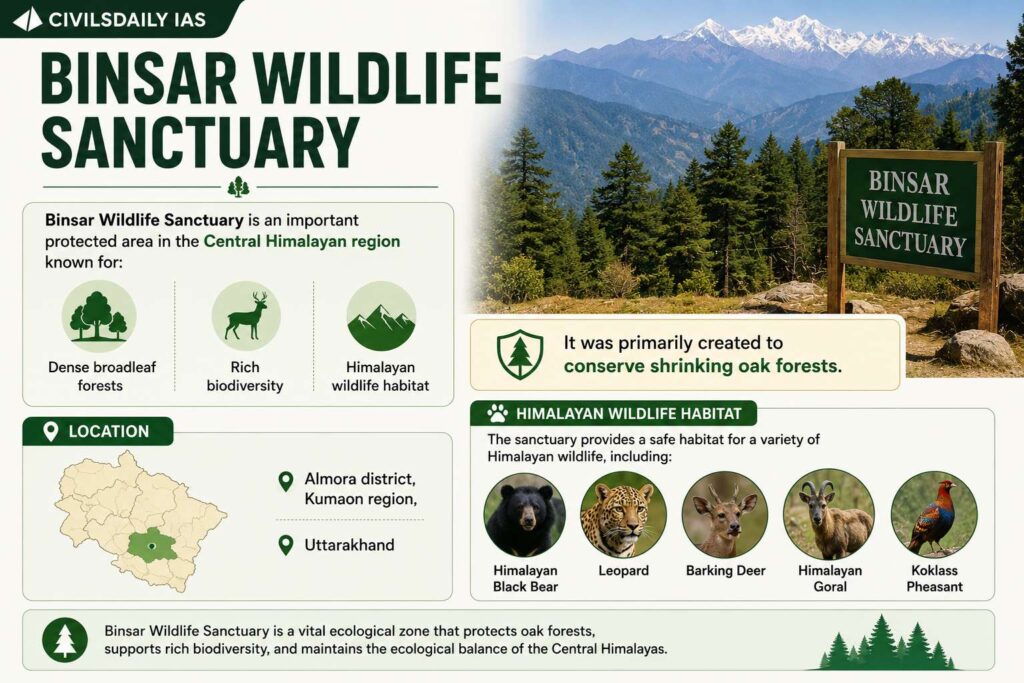
Binsar Wildlife Sanctuary is an important protected area in the Central Himalayan region known for:
Dense broadleaf forests
Rich biodiversity
Himalayan wildlife habitat
It was primarily created to conserve shrinking oak forests.
Location: Almora district, Kumaon region, and Uttarakhand.
[2014] If you travel through the Himalayas, you are Iikely to see which of the following plants naturally growing there? 1. Oak 2. Rhododendron 3. Sandalwood Select the correct answer using the code given below [A] 1 and 2 only [B] 3 only [C] 1 and 3 only [D] 1, 2 and 3
The National Jute Board has expanded the implementation of the Jute Crop Information System (JCIS), a technology-driven platform developed with Indian Space Research Organisation to modernize jute crop monitoring and improve production estimation.
National Jute Board (NJB)
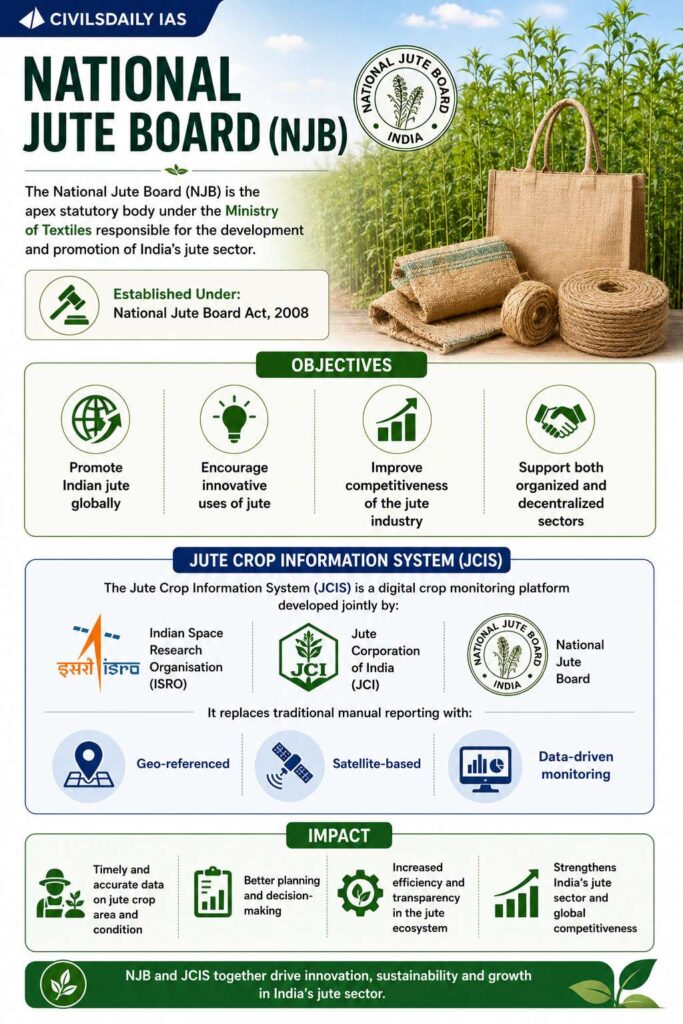
The National Jute Board (NJB) is the apex statutory body under the Ministry of Textiles responsible for the development and promotion of India’s jute sector.
Established Under: National Jute Board Act, 2008
Objective
Promote Indian jute globally
Encourage innovative uses of jute
Improve competitiveness of the jute industry
Support both organized and decentralized sectors
Jute Crop Information System (JCIS)
The Jute Crop Information System (JCIS) is a digital crop monitoring platform developed jointly by:
Indian Space Research Organisation (ISRO)
Jute Corporation of India (JCI)
National Jute Board
It replaces traditional manual reporting with:
Geo-referenced
Satellite-based
Data-driven monitoring
[2022] With reference to the “Tea Board” in India, consider the following statements: 1. The Tea Board is a statutory body. 2. It is a regulatory body attached to the Ministry of Agriculture and Farmers Welfare. 3. The Tea Board’s Head Office is situated in Bengaluru. 4. The Board has overseas office at Dubai and Moscow. Which of the statements given above are correct? [A] 1 and 3 [B] 2 and 4 [C] 3 and 4 [D] 1 and 4
The Union Government launched the SEHAT Mission in New Delhi, marking the first major institutional convergence between India’s agriculture and health sectors to address malnutrition and non-communicable diseases (NCDs).
What is SEHAT Mission?
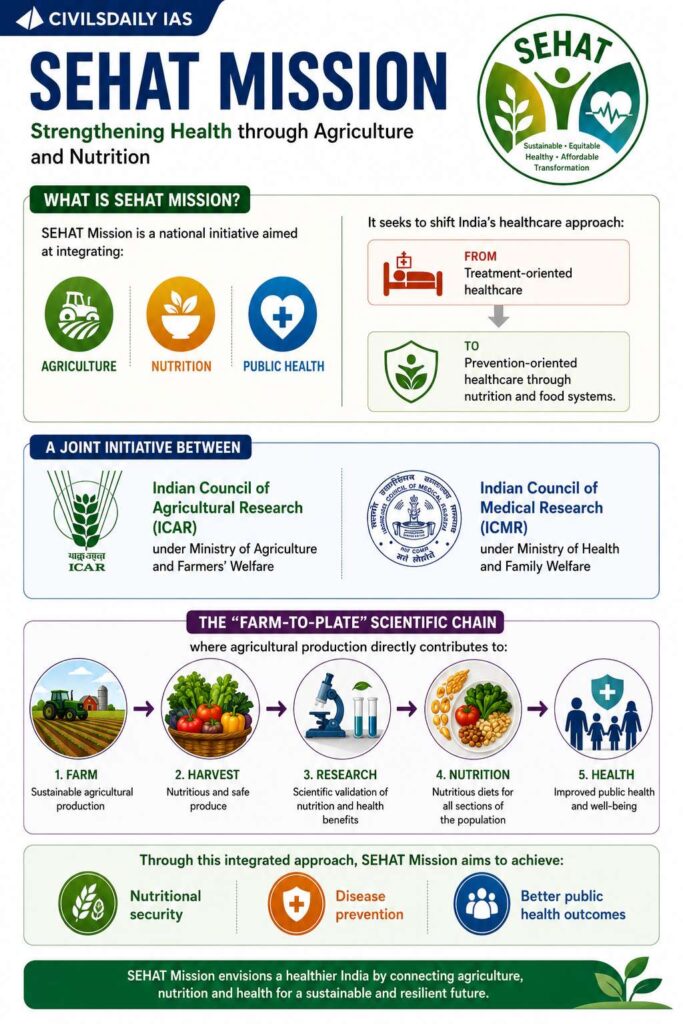
SEHAT Mission is a national initiative aimed at integrating: Agriculture, Nutrition, and Public Health
It seeks to shift India’s healthcare approach:
From treatment-oriented healthcare
To prevention-oriented healthcare through nutrition and food systems.
The mission is a joint initiative between:
Indian Council of Agricultural Research (ICAR) underMinistry of Agriculture and Farmers’ Welfare
Indian Council of Medical Research (ICMR) under Ministry of Health and Family Welfare
“Farm-to-Plate” scientific chain
where agricultural production directly contributes to:
Nutritional security
Disease prevention
Better public health outcomes
[2023] Consider the following statements: Statement-I: India’s public sector health care system largely focuses on curative care with limited preventive, promotive and rehabilitative care. Statement-II: Under India’s decentralized approach to health care delivery, the States are primarily responsible for organizing health services. Which one of the following is correct in respect of the above statements? [A] Both Statement-I and Statement-l are correct and Statement-II is the correct explanation for Statement-I. [B] Both Statement-I and Statement-II are correct and Statement-is not the correct explanation for Statement-l. [C] Statement-l is correct but Statement-II is incorrect. [D] Statement-I is incorrect but Statement-Il is correct.
The Department of Financial Services under the Ministry of Finance launched the Bharat Maritime Insurance Pool (BMIP) worth USD 1.5 billion amid rising geopolitical tensions in West Asia.
About Bharat Maritime Insurance Pool (BMIP)
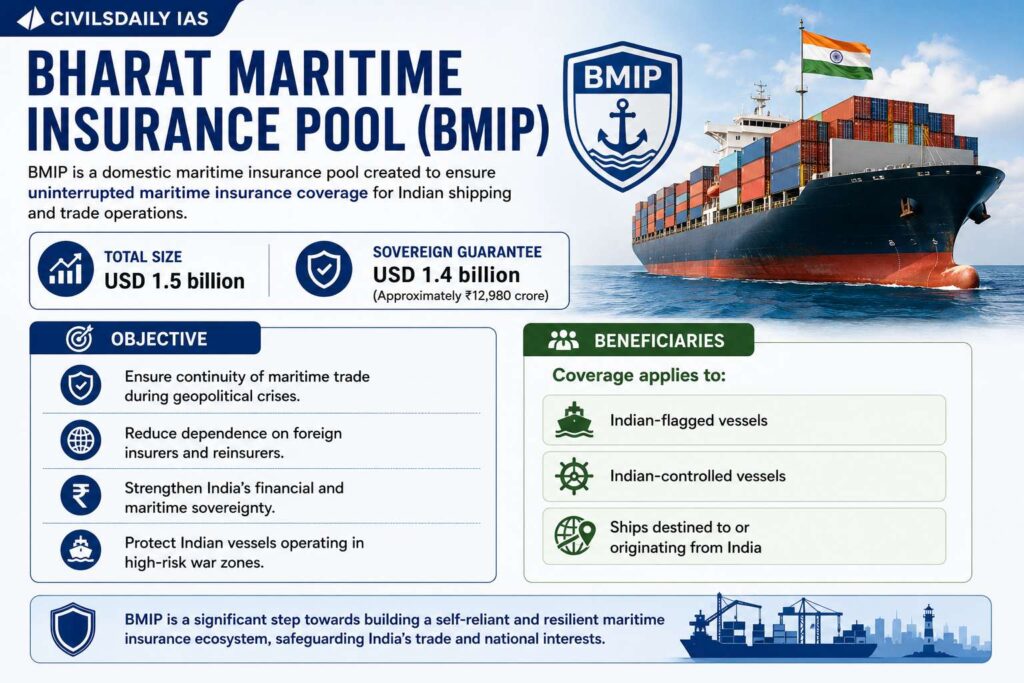
BMIP is a domestic maritime insurance pool created to ensure uninterrupted maritime insurance coverage for Indian shipping and trade operations.
Total Size: USD 1.5 billion
Sovereign Guarantee: USD 1.4 billion
Approximately ₹12,980 crore
Objective
Ensure continuity of maritime trade during geopolitical crises.
Reduce dependence on foreign insurers and reinsurers.
Strengthen India’s financial and maritime sovereignty.
Protect Indian vessels operating in high-risk war zones.
Beneficiaries
Coverage applies to:
Indian-flagged vessels
Indian-controlled vessels
Ships destined to or originating from India
[2024] Consider the following statements: Statement-I Sumed pipeline is a strategic route for Persian Gulf oil and Natural gas shipments to Europe. Statement-II: Sumed pipeline connects the Red Sea with the Mediterranean Sea. Which one of the following is correct in respect of the above statements? [A] Both Statement-I and Statement-II are correct and Statement-II explains Statement-I [B] Both Statement-I and Statement-II are correct, but Statement-II does not explain Statement-I [C] Statement-I is correct, but Statement-II is incorrect [D] Statement-I is incorrect, but Statement-II is correct
PYQ Relevance[UPSC 2013] Discuss the political developments in Maldives in the last two years. Should they be of cause of concern to India?Linkage: The PYQ reflects UPSC’s emphasis on how regional geopolitical developments affect India’s foreign policy and strategic interests. Similarly, India-Vietnam relations must be examined through the lens of regional balancing, maritime security, and Indo-Pacific strategy.
Mentor’s Comment
The state visit of Vietnamese President Tô Lâm to India (May 5-7, 2026) marks an important step in India-Vietnam relations. It shows the growing strength of their Comprehensive Strategic Partnership, established a decade ago. The visit is significant because Vietnam, facing increasing Chinese pressure in the South China Sea, is expanding defence and economic ties with India. At the same time, India is looking for trusted partners in the region to strengthen its Act East Policy and Indo-Pacific strategy.
How has the India-Vietnam strategic partnership evolved into a comprehensive relationship?
India and Vietnam elevated their ties to an Enhanced Comprehensive Strategic Partnership in May 2026, marking 10 years of their previous 2016 partnership. This deepening of relations focuses on intensified defense cooperation, maritime security, trade, digital payments, and critical technology, with a goal of $25 billion in bilateral trade by 2030
Strategic Evolution: India-Vietnam ties have progressed from political goodwill to a Comprehensive Strategic Partnership (CSP) established in 2016, institutionalising defence and security cooperation.
Act East Convergence: Vietnam occupies a central position in India’s Act East Policy, reinforcing India’s diplomatic and economic outreach to Southeast Asia.
Historical Trust: Long-standing diplomatic engagement and political trust have strengthened cooperation in trade, defence, maritime affairs, and capacity-building.
Institutional Mechanisms: Regular high-level exchanges, defence dialogues, naval cooperation, and capacity-building initiatives have deepened bilateral engagement.
Regional Context: China’s increasing assertiveness in the South China Sea has accelerated strategic convergence between India and Vietnam.
Why has defence cooperation emerged as the backbone of India-Vietnam relations?
Defence cooperation constitutes the strongest pillar of bilateral engagement due to shared concerns over maritime security and regional stability.
Lines of Credit: India extended US $225 million in defence credit to Vietnam, facilitating military modernisation.
Naval Cooperation: Maritime engagement includes joint exercises, training assistance, port calls, and maritime cooperation mechanisms.
Cooperation has moved beyond exercises to include joint hydrographic surveys (first conducted in May 2025) and a Mutual Submarine Search and Rescue Agreement.
Defence Capacity Building: India supports training of Vietnamese armed personnel and defence institution-building.
Gifted Assets: India gifted the missile corvette INS Kirpan to Vietnam in 2023.
BrahMos Dimension: Discussions surrounding potential BrahMos supersonic cruise missile exports indicate growing defence trust and a shift in deterrence calculations in the South China Sea.
New Strategic Mechanisms: During the May 2026 visit, both nations agreed to establish a 2+2 Ministerial Dialogue (Foreign and Defence Ministers) to deepen policy coordination.
Strategic Signalling: Defence cooperation strengthens a rules-based maritime order and enhances balancing capacity against coercive regional behaviour.
Logistics & Training: Vietnam signed its first-ever Mutual Logistics Support MoU with India in 2022, facilitating reciprocal access to military bases for replenishment.
How do Indo-Pacific dynamics shape India-Vietnam cooperation?
Shared Strategic Concerns: Both countries support freedom of navigation, maritime security, and peaceful dispute resolution in the Indo-Pacific.
Vietnam formally joined India’s Indo-Pacific Oceans Initiative (IPOI) in 2026. This voluntary initiative focuses on maritime governance, sustainable development, and a rules-based order, directly countering unilateral actions in the South China Sea.
South China Sea Factor: Vietnam faces persistent Chinese assertiveness, creating convergence with India’s emphasis on a stable maritime order.
ASEAN Centrality: Vietnam supports India’s participation in an ASEAN-led regional architecture, ensuring inclusive regional cooperation.To further this, Prime Minister Modi declared 2026 as the ASEAN-India Year of Maritime Cooperation, a move supported by Vietnam to ensure inclusive regional engagement.
Supply Chain Resilience: To reduce dependence on single-country (Chinese) supply chains, the two nations have focused on:
Critical Minerals: An MoU between IREL (India) Ltd. and Vietnam’s ITRRE aims to secure the extraction and processing of rare earth elements essential for high-tech and defence sectors.
Economic Targets: A bilateral trade goal of USD 25 billion by 2030 was established to foster economic stability amid global geopolitical flux.
Minilateral Balancing: India and Vietnam increasingly participate in issue-based strategic partnerships without entering formal military alliances.
Indo-Pacific Oceans Initiative (IPOI)
The “2+2” Ministerial Dialogue (Instituted recently)
Both participate in ASEAN Defence Ministers’ Meeting Plus (ADMM-Plus) and the East Asia Summit (EAS)
Mekong-Ganga Cooperation (MGC): India uses the MGC framework to implement Quick Impact Projects (QIPs) in Vietnam.
Digital Connectivity Blocks: Agreements between NPCI International and NAPAS for cross-border QR code payments create a digital economic corridor
Rules-Based Order: Joint emphasis on international law and UNCLOS principles reflects commitment to legal mechanisms in maritime disputes.
Can economic cooperation become the next pillar of the partnership?
Trade Expansion: Bilateral trade has crossed US $15 billion, with ambitions to reach US $25 billion by 2030, indicating untapped economic potential.
Supply-Chain Diversification: Vietnam offers India an alternative manufacturing and supply-chain partner amid concerns over China-centric production networks.
Digital and Technology Cooperation: Cooperation is expanding in semiconductors, digital economy, artificial intelligence, and payment systems integration.
Manufacturing Synergies: Vietnam’s integration into global value chains complements India’s manufacturing ambitions.
Energy Cooperation: Collaboration in energy security strengthens broader economic engagement.
What role does Vietnam play in India’s Indo-Pacific strategy?
Vietnam is the central pillar of India’s Act East Policy and a critical strategic anchor in the Indo-Pacific region.
Strategic Geography: Vietnam occupies a vital position near the South China Sea, making it strategically important for India’s regional outreach.This is reinforced by India’s support for UNCLOS and freedom of navigation.
Reliable Regional Partner: Vietnam functions as a dependable partner for India in balancing regional uncertainties.
ASEAN Connectivity: Vietnam facilitates India’s engagement with Southeast Asia and broader Indo-Pacific institutions.
Gateway to ASEAN: As a key member of ASEAN, Vietnam serves as a bridge for India to deepen its engagement with the 11-nation bloc.
Vision MAHASAGAR: India officially recognizes Vietnam as a pillar in its Vision MAHASAGAR (Security and Growth for All in the Region).
Mekong-Ganga Cooperation: Vietnam facilitates India’s strategic reach into the Mekong sub-region, driving developmental and economic integration
Security Cooperation: Defence coordination with Vietnam enhances India’s maritime presence and strategic footprint.
Geopolitical Significance: Vietnam’s independent foreign policy and strategic hedging align with India’s preference for multi-alignment.
What structural challenges may constrain deeper India-Vietnam engagement?
Implementation Deficit: Strategic intent requires conversion into operational outcomes in trade, defence industrial cooperation, and connectivity.
Logistical Constraints: Limited transport and connectivity infrastructure impede faster trade integration.
Regulatory Barriers: Legal and procedural bottlenecks restrict rapid expansion of bilateral projects.
Defence Delivery Challenges: Potential transfer of advanced systems such as BrahMos may face diplomatic and logistical complexities.
Conclusion
India-Vietnam relations are transitioning from a conventional diplomatic partnership to a multidimensional strategic relationship. This is shaped by defence cooperation, economic resilience, and Indo-Pacific security concerns. Sustained institutional implementation, stronger trade integration, and deeper defence-industrial collaboration will determine if the partnership evolves into a durable pillar of regional stability and strategic balancing.
The Prime Minister of India recently asked Indians to use fewer imports, like oil and fertilizers, to save the country’s foreign exchange (forex). While India has a huge “safety net” of over $640 billion in reserves, some experts are worried. They argue that cutting imports too much might actually hurt our industrial growth, since many factories depend on imported parts. The big question now is: should India focus on hoarding cash or boosting production?
How are forex reserves linked to India’s economic growth?
Foreign exchange (forex) reserves act as a high-speed engine and a safety net for India’s economic growth. Their link to growth is both protective (preventing crashes) and productive (enabling industrial expansion).
Sustaining Industrial Output (Import Financing)
Energy & Raw Materials: India imports roughly 85% of its crude oil and large quantities of fertilizers and electronics.
Growth Link: Healthy reserves ensure that factories never stop running due to a lack of dollars to pay for these essential inputs. As of May 2026, India’s reserves provide an import cover of approximately 11 to 12 months, keeping industrial production stable despite global supply shocks
Balance of Payments (BoP): Reflects all economic transactions between India and the rest of the world. Forex reserves increase when inflows exceed outflows through the current account and capital account.
Current Account Deficit (CAD): Occurs when imports exceed exports. India generally runs a CAD because of dependence on crude oil, gold, electronics and industrial inputs.
Capital Account Surplus: Compensates for CAD through Foreign Direct Investment (FDI), Foreign Portfolio Investment (FPI), external borrowings and remittances, helping maintain reserve adequacy.
Stabilizing the “Price of Growth” (Rupee Stability)
Controlling Inflation: When the rupee weakens, imports like oil become expensive, causing “imported inflation.”
Growth Link: The RBI uses reserves to intervene in the market, selling dollars when the rupee falls too fast (as it did when the rupee crossed ₹95/$ in May 2026). This stability keeps costs predictable for businesses and protects the purchasing power of citizens.
Example: India’s reserves provide an import cover of several months, unlike the 1991 Balance of Payments crisis, when reserves had fallen to levels sufficient for only weeks of imports.
Why has conserving forex become a policy concern?
Import Dependence: India imports nearly 80-85% of crude oil requirements, making oil the largest source of forex outflow.
Commodity Vulnerability: Global disruptions such as the Russia-Ukraine conflict increased energy and fertilizer prices, worsening import bills.
Edible Oil Imports: India depends significantly on imports of palm, soybean and sunflower oils, creating recurring pressure on forex.
Fertilizer Dependence: Though food grain production is self-sufficient, agriculture remains dependent on imported fertilizer inputs.
Trade Deficit Pressure: Persistent trade deficits increase vulnerability to global shocks and currency depreciation.
Why could excessive forex conservation slow India’s growth?
Consumption Compression: Reducing spending on imported goods lowers aggregate demand, affecting production and employment.
Industrial Dependence on Imports: Indian manufacturing depends heavily on imported machinery, components, chemicals and intermediate goods.
Multiplier Effects: Lower demand reduces business expansion, private investment and job creation.
Growth Slowdown: Reduced imports of productive inputs may weaken sectors dependent on global value chains.
Investment Sentiment: Weak domestic demand discourages domestic and foreign investors from expanding production.
Example: Cutting imports indiscriminately may reduce economic dynamism rather than merely reducing forex outflows.
Can India realistically replace imported goods in the short term?
Crude Oil Constraint: India cannot quickly substitute imported crude because domestic energy production remains limited.
Fertilizer Dependence: Natural resources required for fertilizer production, such as potash and phosphates, remain import-dependent.
Cost Consideration: Domestic substitutes often remain costlier or technologically inferior in the short run.
Time Lag: Import substitution requires industrial capacity, technology transfer and infrastructure expansion.
Example: India is food self-sufficient but still relies heavily on imported fertilizers to sustain agricultural productivity.
What explains the relationship between the rupee and forex reserves?
Currency Intervention: RBI sells dollars to stabilise the rupee during depreciation pressures.
Exchange Rate Impact: Higher imports increase dollar demand, weakening the rupee.
Inflation Transmission: A weaker rupee raises import costs, especially for oil, increasing inflation.
Reserve Buffer: Forex reserves function as insurance against global financial shocks and capital flight.
Example: RBI interventions during global volatility periods help moderate sharp exchange-rate movements.
What should be India’s long-term strategy to manage forex sustainably?
Production Enhancement: Strengthens manufacturing competitiveness through Make in India and industrial reforms.
Export Diversification: Expands high-value exports in electronics, pharmaceuticals and services.
Productivity Growth: Increases efficiency through technology adoption and logistics improvements.
Import Rationalisation: Reduces avoidable imports while preserving productive imports.
Energy Transition: Expands renewable energy and biofuel production to reduce crude oil dependence.
Domestic Capability: Strengthens fertilizer, semiconductor and critical mineral ecosystems.
Example: Production-linked incentive (PLI) schemes seek to reduce import dependence in sectors like electronics and solar manufacturing.
Conclusion
India’s forex reserves remain a critical macroeconomic buffer, but external strength cannot substitute for domestic growth momentum. Excessive emphasis on conserving forex through reduced consumption risks weakening demand, investment and productivity. A sustainable solution lies not merely in spending less foreign exchange, but in earning more through exports, higher productivity and stronger domestic production capacity.
PYQ Relevance
[UPSC 2017] Among several factors for India’s potential growth, savings rate is the most effective one. Do you agree? What are the other factors available for growth potential?
Linkage: The PYQ examines whether higher savings alone can drive economic growth. This is similar to the debate on conserving foreign exchange versus expanding production and investment. The article extends this logic by arguing that growth depends not only on saving forex, but also on productivity, manufacturing and demand creation
Noise pollution has returned to focus after post-election celebrations in Tamil Nadu witnessed large-scale use of loud “whistle pods” and public processions. This has revived concerns over India’s weakest enforced environmental problem. The issue is significant because India continues to normalise excessive noise despite clear legal limits. The scale of the problem is striking: over 80% of monitoring stations under the National Ambient Noise Monitoring Network (NANMN) recorded violations in 2019.
What are the Noise Pollution Rules in India?
Noise pollution in India is primarily regulated by the Noise Pollution (Regulation and Control) Rules, 2000, framed under the Environment Protection Act, 1986. These rules define permissible sound levels based on the time of day and the category of the area.
Permissible Noise Levels (in dB)
The Central Pollution Control Board (CPCB) divides areas into four zones with specific decibel limits:
Category of Area/Zone
Day Time (6 AM – 10 PM)
Night Time (10 PM – 6 AM)
Industrial Area
75 dB
70 dB
Commercial Area
65 dB
55 dB
Residential Area
55 dB
45 dB
Silence Zone (Silence Zones include areas within 100 metres of hospitals, educational institutions, and courts)
50 dB
40 dB
Why does noise pollution remain socially tolerated despite being a major environmental hazard?
Social Normalisation: Indian society treats excessive sound during celebrations, elections, festivals, weddings, and sporting events as culturally acceptable behaviour.
Political Incentives: Political parties often avoid restraining supporters due to fear of electoral backlash during rallies and victory celebrations.
Cultural Accommodation: State governments permit loudspeakers and nighttime exemptions for religious and cultural occasions for up to 15 days annually.
Weak Public Awareness: Noise pollution receives less public attention than air pollution despite comparable health implications.
Illustrative Example: Tamil Nadu witnessed large-scale use of “whistle pods” during cricket matches and political celebrations after TVK’s Assembly election performance.
How severe is the noise pollution problem in India?
NANMN Data: Over 80% of recording stations under the National Ambient Noise Monitoring Network reported violations of prescribed limits during both daytime and nighttime in 2019.
Residential Violations: All 10 monitoring stations in Chennai exceeded residential nighttime thresholds of 45 decibels.
Global Comparison: A 2022 UN Environment Programme report identified Moradabad (Uttar Pradesh) among the world’s highest noise-affected cities.
Inadequate Monitoring: NANMN operates only 70 stations across seven metros, reflecting insufficient monitoring capacity.
Urban Concentration: Higher exposure persists near airports, arterial roads, industrial areas, and dense urban settlements.
What are the major drivers of excessive noise pollution in Indian cities?
Urbanisation: Rapid expansion of cities increases vehicular traffic, construction activity, and commercial congestion.
Construction Activity: Construction often continues through nighttime due to poor enforcement and unchecked permissions.
Traffic Density: High traffic volume and poor urban planning increase ambient noise.
Administrative Weakness: Weak policing and low institutional responsiveness reduce compliance with legal limits.
Political Celebrations: Election victories, processions, and rallies frequently generate noise beyond permissible levels.
Sporting Culture: Public celebrations during cricket and football events amplify temporary but intense noise exposure.
Example: The vuvuzelas during the 2010 FIFA World Cup became globally criticised for rendering commentary inaudible.
What are the public health consequences of excessive noise exposure?
Occupational Impact: World Health Organisation (WHO) attributes 16% of disabling hearing loss among adults to occupational noise exposure.
Indian Burden: Approximately 6.3 crore Indians experience some degree of impaired hearing.
Construction Sector Vulnerability: A Puducherry survey of 500 construction workers reported hearing impairment prevalence ranging from 13% to 49%, supported by meta-analysis of industrial workers.
Cardiovascular Risks: Noise exposure elevates cortisol levels, increases endothelial dysfunction, and contributes to stress-related illnesses.
Cognitive Effects: Children near airports and arterial roads face impaired cognition and learning outcomes.
European Evidence: Traffic noise contributes to the loss of approximately 16 lakh healthy life years annually in Western Europe.
How effective is India’s legal and institutional framework against noise pollution?
Noise Pollution (Regulation and Control) Rules, 2000 prescribe area-specific decibel limits and regulate loudspeaker use.
Zonal Classification: Rules classify areas into industrial, commercial, residential, and silence zones.
Silence Zone Protection: Areas around hospitals, educational institutions, and courts receive stricter regulation.
CPCB Oversight: The Central Pollution Control Board (CPCB) monitors compliance and recently proposed stronger financial penalties.
Judicial Recognition: Courts have repeatedly linked excessive noise to Article 21, recognising the right to peaceful sleep and quality life.
Implementation Deficit: Enforcement remains weak due to political interference, social acceptance, and poor local monitoring.
Why does implementation remain India’s biggest challenge in tackling noise pollution?
Enforcement Deficit: Local authorities rarely impose penalties despite repeated violations.
Political Reluctance: Governments hesitate to regulate politically sensitive events, festivals, and public celebrations.
Monitoring Gaps: Limited monitoring infrastructure restricts real-time detection and accountability.
Behavioural Resistance: Public acceptance of loud celebrations weakens voluntary compliance.
Institutional Fragmentation: Responsibility remains dispersed among police, municipal bodies, pollution boards, and district administrations.
What measures can strengthen India’s response to noise pollution?
Stronger Enforcement: Ensures strict penalties for repeated violations and unauthorised loudspeaker use.
Technology-Based Monitoring: Facilitates real-time decibel tracking through AI-enabled sound sensors.
Urban Planning: Strengthens sound-buffer zones around residential and silence areas.
Behavioural Change: Encourages public awareness campaigns to alter social acceptance of loud noise.
Political Accountability: Ensures equal application of rules during election campaigns and celebrations.
Community Participation: Enables citizen reporting through grievance portals and mobile applications.
Conclusion
Noise pollution reflects a wider governance deficit where legal frameworks exist but enforcement remains weak. India requires a shift from social tolerance of excessive sound towards rights-based environmental governance that protects health, productivity, and quality of life. Effective regulation, behavioural change, and political neutrality in enforcement remain essential for ensuring citizens’ right to work, rest, and sleep in peace.
PYQ Relevance
[UPSC 2024] Industrial pollution of river water is a significant environmental issue in India. Discuss the various mitigation measures to deal with this problem and also the government’s initiatives in this regard.
Linkage: This PYQ reflects UPSC’s focus on environmental pollution as a governance and public health issue, not merely an ecological problem. The present article extends the same logic to noise pollution, highlighting health impacts, regulatory failure, mitigation measures, and enforcement gaps in India.
The Union Ministry of Environment, Forest and Climate Change has notified the Solid Waste Management (SWM) Rules, 2026, superseding the Solid Waste Management Rules, 2016. The rules have been notified under the Environment (Protection) Act, 1986.
What are the major changes introduced under the SWM Rules, 2026?
Mandatory Waste Segregation: Makes 4-way segregation at source compulsory, wet waste, dry waste, sanitary waste, and special-care waste.
‘Polluter Pays’ Principle: Allows environmental compensation/penalties for non-compliance, false reporting, forged documents, or poor waste management practices.
Extended Responsibility for Bulk Generators: Introduces Extended Bulk Waste Generator Responsibility (EBWGR); entities generating 100 kg/day waste, 20,000 sq. m area, or 40,000 litres/day water use must process waste responsibly.
Scientific Waste Processing: Promotes composting, bio-methanation, recycling through Material Recovery Facilities (MRFs), and waste-to-energy systems.
Centralised Online Portal: Enables end-to-end digital tracking of waste generation, collection, transport, processing, landfill audits, and legacy waste remediation.
Restrictions on Landfills: Limits landfilling to non-recyclable, inert, and non-energy recoverable waste, while discouraging unsegregated dumping through higher landfill fees.
Legacy Waste Remediation: Mandates mapping, biomining, and bioremediation of old dumpsites with time-bound implementation.
Mandatory Use of RDF: Requires industries, including cement plants, to gradually increase Refuse Derived Fuel (RDF) use from 5% to 15% over six years.
Special Rules for Hilly Areas & Islands: Enables tourist user fees, decentralised wet waste processing by hotels/restaurants, and waste regulation based on local carrying capacity.
Institutional Oversight: Creates Central and State-level Committees, with Chief Secretaries-led State Committees for implementation monitoring.
Why has India’s waste crisis become a major governance challenge?
Urban Waste Burden: Indian cities face plastic-clogged drains, worsening monsoon flooding and sanitation stress.
Landfill Hazard: Landfills increasingly generate methane, fire incidents, and leachate contamination, creating ecological and health risks.
Air Pollution:Open burning of waste contributes to deteriorating urban air quality.
Rural Waste Expansion: Rural areas increasingly face plastic waste, sanitary waste, pesticide containers, e-waste, and packaged consumption debris.
Ecological Emergency: Waste has evolved from a local nuisance to a national environmental problem, requiring systemic intervention.
How do the Solid Waste Management Rules, 2026 differ from the 2016 framework?
The Solid Waste Management (SWM) Rules, 2026, supersede the 2016 framework, shifting India from a “collect-and-dump” model to a structured circular economy focused on resource recovery. While the 2016 rules laid the foundation, the 2026 update introduces stricter enforcement, digital tracking, and expanded responsibilities.
Dimension
SWM Rules, 2016
SWM Rules, 2026
Waste segregation
Mandated 3-stream segregation: bio-degradable, non-biodegradable, and domestic hazardous waste.
Introduces mandatory 4-stream segregation: wet waste, dry waste, sanitary waste, and special-care waste, enabling more scientific processing and recycling.
Accountability & Enforcement
Limited practical enforcement and weak penalty mechanisms.
Introduces Environmental Compensation under the ‘Polluter Pays’ Principle’, with penalties for improper segregation, false reporting, forged documents, and non-compliance.
Bulk Waste Generators (BWGs)
Broad responsibility framework without clear operational thresholds.
Defines BWGs through quantified thresholds(≥100 kg/day waste generation, ≥20,000 sq. m built-up area, or ≥40,000 litres/day water use) and introduces Extended Bulk Waste Generator Responsibility (EBWGR) for on-site processing or certification.
Monitoring Mechanism
Relied largely on manual and fragmented reporting systems.
Establishes a centralised online portal for end-to-end tracking of waste generation, collection, transport, processing, disposal, audits, and legacy waste remediation.
Industrial Waste Use (RDF)
Limited emphasis on industrial fuel substitution.
Mandates gradual adoption of Refuse Derived Fuel (RDF) in industries such as cement plants, increasing substitution from 5% to 15% over six years.
Legacy Waste Dumpsites
Recognised legacy waste but lacked strict timelines.
Mandates time-bound biomining and bioremediation of legacy dumpsites, with quarterly progress reporting through the digital portal.
Does the 2026 framework undermine federalism and subsidiarity?
Constitutional Basis: The Rules derive authority from the Environment (Protection) Act, 1986, enacted under Article 253, allowing Parliament to implement international obligations such as the 1972 Stockholm Declaration.
Federal Concern: Subjects such as land, sanitation, public health, agriculture, and local governance largely fall within State or local domains.
National Floor Principle: A minimum national standard should not become a uniform operational blueprint for all States.
Subsidiarity Principle: Governance should function at the lowest competent level, moving upward only when capacity is absent.
Administrative Overreach: The Rules assume central competence and local incapacity, reducing States to implementing agencies.
Hayekian Insight: Nobel Laureate F.A. Hayek highlighted that effective decisions depend on local and contextual knowledge, not distant administrative command.
Why may a uniform waste management model fail across India?
Geographical Diversity: Waste systems suitable for resource-rich metros like Mumbai may fail in Himalayan pilgrimage towns, fragile slopes, coastal panchayats, tribal settlements, and low-density villages.
Rural Institutional Deficit: Rural local bodies often lack sanitation engineers, waste collection systems, digital capacity, and fiscal resources.
MRF Expansion Challenge: Extending Material Recovery Facilities (MRFs) to every panchayat risks creating an administratively unsustainable model.
Compliance Burden: Excessive reporting requirements may shift focus from service delivery to paperwork.
Megacity Exception: Cities like Delhi, Mumbai, Bengaluru, Kolkata, Chennai may require metropolitan-level integrated waste authorities.
How does centralised digital governance create implementation concerns?
Portal-Centric Governance: The Rules require Central Pollution Control Board (CPCB)-linked data uploads, audits, and central reporting modules.
Dashboard Governance: Officials risk spending excessive time on compliance reporting rather than actual waste management outcomes.
Blurring Accountability: Excessive centralisation may weaken local ownership and citizen accountability.
Data Federalism: States should possess shared digital platforms with flexibility to customise indicators and dashboards.
Capacity Building: Data systems should strengthen sub-national governance capacity, not merely discipline compliance.
Why is democratic participation central to effective waste management?
Citizen Engagement: Waste segregation depends on household participation, awareness, and behavioural change.
Community Institutions:Ward committees, municipal councils, self-help groups, and resident bodies strengthen compliance.
Local Reporting: Periodic waste reports should be placed before municipal councils and ward committees, not only central portals.
By treating waste as a local resource rather than a national liability, an alternative framework shifts the focus from “disposal” to “decentralised circularity.”
The Proposed “Polycentric Circularity” Model
Component
Strategic Implementation
Differentiated Governance
Megacities use tech-heavy AI-monitored collection, while Rural Panchayats use “Zero-Waste Village” models focusing on 100% on-site composting.
State-Led Innovation
States could compete on “Resource Recovery Indexes.” For example, a coastal state might pilot ocean-plastic specific rules that wouldn’t apply to a landlocked state.
Micro-Entrepreneurship
Integrating Women’s Cooperatives (like the Swachh model in Pune) turns waste into a livelihood. SHGs manage ward-level dry waste collection centers, reducing transport costs.
Cluster-Based Sharing
Towns within a 30-40km radius share a single high-tech Material Recovery Facility (MRF) or Bio-methanation plant, making advanced technology financially viable for small municipalities.
Minimum Standards: The Centre should establish minimum national environmental norms.
State Flexibility: States should receive autonomy to design context-sensitive waste systems.
Differentiated Governance:Metropolitan authorities may govern megacities, while simplified systems may suit rural regions.
Cluster-Based Facilities: Small towns can adopt shared regional waste infrastructure.
Women’s Cooperatives: Waste management can integrate self-help groups and community-based models.
Evidence-Based Review: A national body may periodically evaluate outcomes and revise standards based on evidence.
Laboratory of Democracy:Justice Louis Brandeis’ idea (New State Ice Co. v. Liebmann, 1932) theorises that States function as “laboratories of democracy”, enabling policy experimentation.
Conclusion
India’s waste crisis requires a federal, differentiated, and participatory governance model rather than a uniform compliance architecture. The Solid Waste Management Rules, 2026 can strengthen environmental outcomes. But this can be done only if they balance minimum national standards with State flexibility, local accountability, fiscal support, and citizen participation. Effective waste management depends not merely on regulation, but on institutional design aligned with India’s diversity.
PYQ Relevance
[UPSC 2018] What are the impediments in disposing the huge quantities of discarded solid wastes which are continuously being generated? How do we remove safely the toxic wastes that have been accumulating in our habitable environment?
Linkage: The PYQ directly connects with the article’s focus on scientific waste management, segregation, landfill reduction, and safe disposal of hazardous/special-care waste under the SWM Rules, 2026. It also reflects UPSC’s emphasis on environmental governance, waste-processing mechanisms, and mitigation measures for pollution.
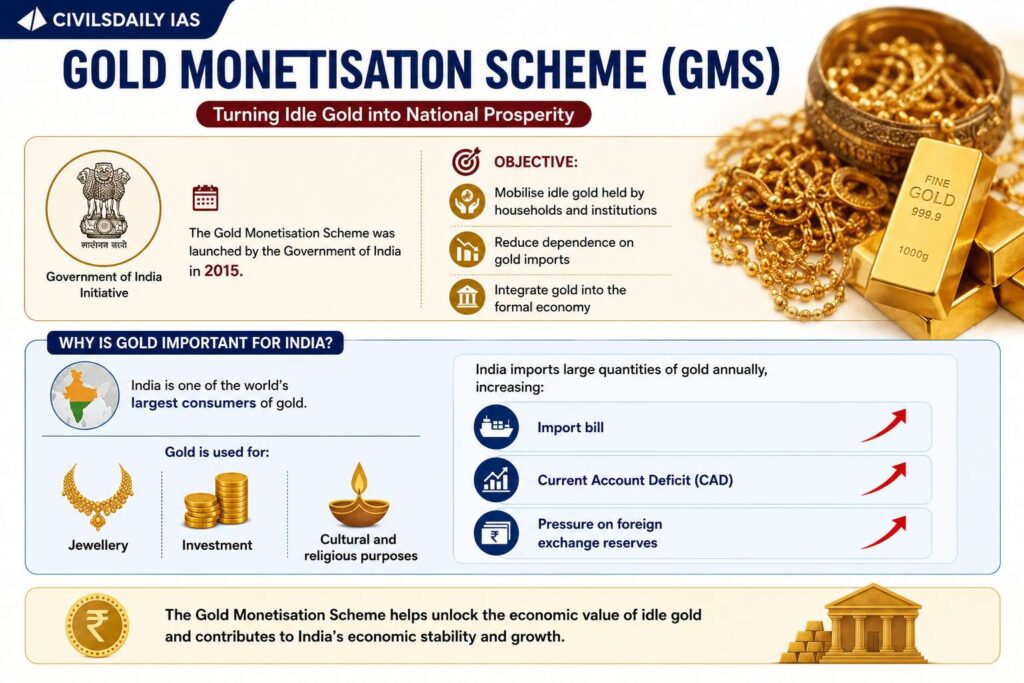
The jewellery industry, led by the All India Gem and Jewellery Domestic Council, has called for revitalising the Gold Monetisation Scheme (GMS) to reduce gold imports and ease pressure on India’s foreign exchange reserves.
About Gold Monetisation Scheme (GMS)
The Gold Monetisation Scheme was launched by the Government of India in 2015
Objective:
Mobilise idle gold held by households and institutions
Reduce dependence on gold imports
Integrate gold into the formal economy
Why is Gold Important for India?
India is one of the world’s largest consumers of gold.
Gold is used for:
Jewellery
Investment
Cultural and religious purposes
India imports large quantities of gold annually, increasing:
Import bill
Current Account Deficit (CAD)
Pressure on foreign exchange reserves
[2016] Which of the following is/are the purpose/purposes of Government’s ‘Sovereign Gold Bond Scheme’ and ‘Gold Monetization Scheme’?: 1. To bring the idle gold lying with Indian households into the economy. 2. To promote FDI in the gold and jewellery sector. 3.To reduce India’s dependence on gold imports. Select the correct answer using the code given below: [A] 1 only [B] 2 and 3 only [C] 1 and 3 only [D] 1, 2 and 3
Prime Minister Narendra Modi recently visited Somnath Temple marking 75 years of its restoration, reviving discussion on the British claim of bringing back the “Somnath Gates” from Afghanistan in 1842.
Somnath Temple
Located at Prabhas Patan near Veraval in Gujarat
One of the 12 Jyotirlingas of Lord Shiva
Repeatedly attacked and rebuilt through history
Mahmud of Ghazni attacked Somnath in 1026 CE and looted the temple.
British “Somnath Gates” (1842)
During the First Anglo Afghan War, British forces captured Ghazni.
Governor General Lord Ellenborough claimed to have recovered the original Somnath temple gates from Afghanistan.
He issued a proclamation stating the British had avenged the “insult” suffered by Hindus centuries ago.
Reality
Later investigations found:
Gates were made of cheap pinewood, not sandalwood
Afghan style design, not Indian
Not connected to Somnath Temple
Presently kept in Agra Fort.
Importance
Example of British “divide and rule” politics
Use of religious symbolism for colonial legitimacy
[2022] The Prime Minister recently inaugurated the new Circuit House near Somanath Temple at Verval. Which of the following statements are correct regarding Somnath Temple? 1. Somnath Temple is one of the Jyotirlinga shrines 2. A description of Somnath Temple was given by Al-Biruni. 3. Pran Pratistha of Somnath Temple (installation of the present-day temple) was done by President S. Radhakrishnan. Select the correct answer using the code given below: [A] 1 and 2 only [B] 2 and 3 only [C] 1 and 3 only [D] 1, 2 and 3