💥UPSC 2026, 2027, 2028 UAP Mentorship (March Batch) + Access XFactor Notes & Microthemes PDF

Search results for: “”

  • Register for Free Live Session on  Important Formulas to Ace CSAT – Quantitative Aptitude & Logical Reasioning|| Limited Slots Available, LINK INSIDE

    Register for Free Live Session on Important Formulas to Ace CSAT – Quantitative Aptitude & Logical Reasioning|| Limited Slots Available, LINK INSIDE

    Most of the aspirants don’t think about CSAT preparation until the fag end of UPSC Prelims only because it’s a qualifying paper. You have to get 33% of total marks i.e 66 marks to be clear Prelims. Failure to do so, will prevent you from writing Mains even if you have scored above 100+ marks in the GS Paper.

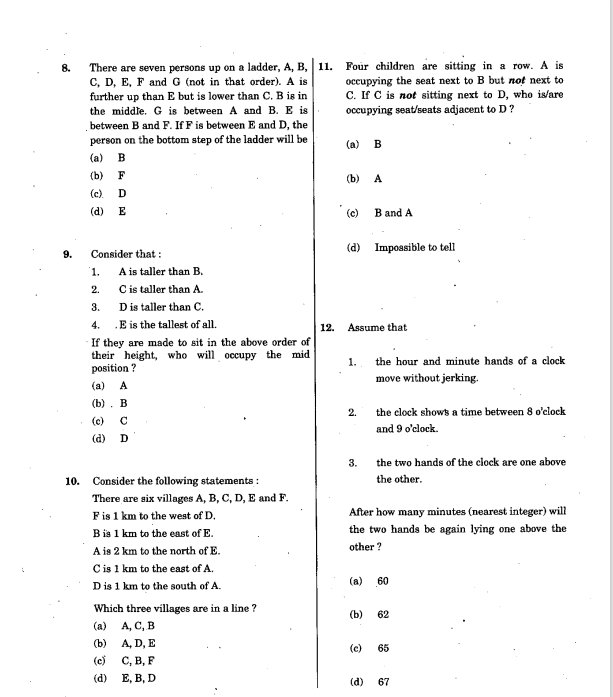
    Since the last two years, the English Comprehension passages are getting lengthier and the Mathematical questions trickier. Let’s take a look at the 2012 CSAT Paper and compare it with the 2021 CSAT paper.

    2014 CSAT Paper

    Here the questions are asked chapter by chapter and are basic-to-moderate. Questions are direct and straightforward without much combination numerals.
    2021 CSAT Paper

    There is no particular order of questions asked. Immediately after LR questions, we have a question on time and distance. Also the questions are moderate-to-advanced. One cannot find out the answer in first glance itself. There is no one-size fits for all approach or a uniform formula by which you can crack the sequential questions.

    Free Open to All CSAT Session by Civilsdaily Mentor Ravi Sir

    If you have to clear the paper, then you have to attempt atleast 50 questions out of 80. Out of these 50 questions, 27 need to be right. There is also negative marking of 1.5 marks for every wrong answer. Hence, for aspirants from a non-mathematics background the challenge lies in practising for CSAT without reducing time for GS Preparation.

    Do you want to know how you can complete both the lengthy comprehension passages and tricky mathematical questions within the stipulated time? Then it’s time you attended Civilsdaily Mentor Ravi sir’s webinar on Sunday.

    Ravi sir has cleared UPSC Prelims six times and attended the Interview round thrice. As a mentor, Ravi sir is a lifelong UPSC aspirant because he daily reads, checks and evaluates the right study materials for his students. On Monday, he will conduct a session on CSAT which is free for every aspirant to attend. All you have to do is register yourself for the session.

    Key Takeaways in the CSAT Session Conducted by Ravi Sir

    1. Topic-wise live demonstration on how to solve problems.

    2. Examples of easy, moderate and advanced questions to solve.

    3. Variety of questions under each topic.

    4. Previous year question paper analysis from 2013 onwards. How to be ready for the new paper pattern.

    5. Books one can refer for CSAT test series practice and to understand the concepts.

    6. How to practice CSAT without compromising on GS paper studies.

    7. Topic-wise weightage in Quantitative Aptitude.

    8. Ravi sir will solve your doubts in a Q&A discussion towards the end of the session.

    Webinar Details

    If you want to know the secrets of finishing the CSAT paper in 2 hours, then this webinar is for you! We hope this webinar will help all 2022 aspirants implement the suggestions of Ravi sir

    Date: 1st April 2022 (Friday)

    Time: 7 P.M.

  • Crisis and sustainability in the face of climate change

    Context

    The footprint of the Covid-19 pandemic across the sectors of the economy has instilled a new reckoning for resilience and sustainability on the economic, social and environmental (ESG) front.

    IPCC reports suggest adaption for resilience

    • The Intergovernmental Panel on Climate Change (IPCC) published its latest report on climate impacts, vulnerability and adaptation last month.
    • The report suggests that adaptation to climate impacts in the near to medium term can help communities and ecosystems become resilient against the threats from current and future levels of warming.
    •  Ecosystem-based adaptation, for instance, is recommended for taking care of communities and social well-being, while restoring forests, lands and marine ecosystems.
    • The report details the variability in projected climate impacts and the vulnerabilities that can be expected across regions the world over due to differences in the range of warming, geographical location, demographics and the unique biophysical, social and cultural contexts.
    • Cost-effective adaptation: It depends on a host of enablers on which global partnerships need to deliver.
    • Enablers include international cooperation, inclusive technology, financial flows, knowledge sharing and capacity building, with institutions and innovations to support policy development and on-ground implementation.

    Gaps in the literature, acknowledge the uncertainties in climate science

    • The IPCC has been consistently drawing attention to the lack of adequate science from and on developing countries.
    • These countries have in turn been asking for the inclusion of what is broadly termed as “grey literature” or non-peer-reviewed literature in the IPCC process.
    • Good science encompasses the formal and the informal, theory and empiricism, the traditional along with the modern.
    • It relies on evolution through acknowledging the gaps and unknowns, the negatives and positives of past knowledge.
    • The understanding of adaptation finance, adaptation costing, and mapping of climate impacts and adaptation needs of communities in geographically remote locations, for instance, could improve with suitable sourcing of information.

    Way forward

    • Sustainable development, inclusive of climate resilience, calls for an ensemble approach — one that places contextually appropriate emphasis on tackling climate change impacts and development needs in a world with growing challenges.
    • The pathway to be adopted is one of an integrated risk assessment approach, where solutions are interventions that impact the immediate, near and medium-term outcomes for developing economies.
    • Striking the right balance is at any time a choice driven as much by enablers (capabilities, lifestyles and values, financial flows, technical know-how) as by constraints (warming levels, poverty, inequality, lack of health and education).

    Conclusion

    The pandemic highlighted the need for balance in nature-people relationships, even as it tested the ability of the developing world.

    UPSC 2022 countdown has begun! Get your personal guidance plan now! (Click here)

  • UPSC 2021 Free Mock Interview [LAST 2 SLOTS] || Unlimited Practice Sessions with India’s Most Experienced & Eminent IAS Interview Panel|| Limited Slots Available, Register Now

    UPSC 2021 Free Mock Interview [LAST 2 SLOTS] || Unlimited Practice Sessions with India’s Most Experienced & Eminent IAS Interview Panel|| Limited Slots Available, Register Now

    After beating lakhs of aspirants to be among the top two thousand UPSC candidiates, you might think the final round would be a breezer and requires no prior preparation. For someone who has prepared current affairs intensively for a year, they feel that they can answer the questions in the interview rounds impromptu.

    However, let’s not forget that though the amount of competition decreases substantially in the interview round so much that you have 50% chances of clearing it, the quality of competition increases. You are set up against those aspirants whose average score in Mains is between 900-1000 marks. Most of the candidates fall in this marks bracket. The only way you can create a difference, is by performing exceeding well in the interview.

    To understand how seriously Civilsdaily conducts its UPSC mock interviews, watch this video.

    Why Mock Interviews Are a Better Way to Practice Than By Yourself or With Your Friends?

    Rahul Reddy AIR 218, 2020 tries his best to answer international crisis issues in a diplamtic way

    So, how can you practice for Interview round before you attend it? Does it have to be with friends or in front of the mirror? Remember, the most effective option is the one where you are simulating an actual UPSC interview enviornment. .

    Casual DAF-II filling can cost you a UPSC attempt and thus, you must start your preparation with DAF II curation. The aspirants who have cleared UPSC Mains 2021 can register for our interview support program without any fee (FREE).

    The purpose of mock interviews is to refine your approach, attitude and aptitude to excel in UPSC’s personality test. Mock interviews must support your quest at excelling in the final interview. You must be ready to tackle unexpected questions with your knowledge. You must have a solid opinion backed by data and facts for any issue.

    That’s why Civilsdaily has brought the free mock interview initiative for all Mains-Qualified aspirants. You can practice as many times you would like before you are perfect. If you want to analyse your performance, we will share the video for your reference.

    Here Are the Distinguished Panellists of Civilsdaily Mock Interview 2022

    AIR 268 Nitish Rajora answers questions on Indian Economy with ease

    One of the major advantages of attending the free mock interviews of Civilsdaily is that you will gain exposure to some of the finest bureaucrats retired as well as working, subject matter experts, psychoanalysts and faculty members. Our panellists have direct experience in recruitment and personality analysis.

    1. Mr. Shankar Agarwal (Chairman)– Retired IAS Officer, 1980 Batch, Uttar Pradesh Cadre. Last held position: Joint Secretary for the Government of India.

    2. Dr. SD Singh – Retired IFoS Officer, 1984 Batch, Uttarkhand Cadre

    3. Mr. Virendra Pratap Singh – Serving IRPS Officer of 2008 Batch, IIT Kharagpur Alumni

    4. Dr. Kulbir Singh – Retired Indian Postal Service Officer, 1981 Batch

    5. Mr. Amin Usta – Professor at Jamia Milia Islamia University.

    6. Mr. Noor Mohammed – Electoral Management Expert at Democracy and Election Management (IIIDEM)

    What Will You Learn From the Eminent Panellists?

    AIR 17 Sarthak Agrawal answers questions on the three farm laws

    1. Understand interviewer’s psychology.

    2. Improve your answering style and body language.

    3. Current Affairs update by experts.

    4. Boost your social quotient and emotional quotient.

    5. A video recorded session for critical self-assessment.

    6. Personal discussion with experts after UPSC Interview Guidance Programme for a critical assessment of his/her performance.

    7. Scientific evaluation of strengths and weaknesses of the candidate by experts.

    8. Individual DAF analysis and summary of UPSC interview questions.

    9. Overall balanced feedback by experts on how one can ace the questions asked in UPSC Interview.

    For more details, Contact Pravin, Mentor Head of Civilsdaily.

    Phone Number: 8668582260

  • Privacy concerns in the Criminal Procedure (Identification) Bill 2022

    Context

    The Union Minister of State for Home Affairs introduced the Criminal Procedure (Identification) Bill 2022.

    Purpose of the introduction of the Bill

    • The Bill aims to replace the Identification of Prisoners Act 1920 that has been in need of amendment for several decades.
    • The criticism and the need for amendment was predominantly in respect of the limited definition of ‘measurements’ as under that Act.
    • Back in the 1980s, the Law Commission of India (in its 87th Report) and the Supreme Court of India in a judgment titled State of U.P. vs Ram Babu Misra had nearly simultaneously suggested the need to amend the statute.

    What are the issues with the provisions in the Bill?

    1] Definition of ‘measurement’ includes analysis of the data

    • The definition of measurements is not restricted to taking measurements, but also their “analysis”.
    • The definition now states “iris and retina scan, physical, biological samples and their analysis, behavio[u]ral attributes including signatures….”
    • It goes beyond the scope of a law that is only designed for taking measurements and could result in indirectly conferring legislative backing for techniques that may involve the collection of data from other sources(For instance, using facial recognition).
    • At present there are extensive facial recognition technology programmes for “smart policing” that are deployed all across the country.
    • Such experimental technologies cause mass surveillance and are prone to bias, impacting the fundamental rights of the most vulnerable in India.

    2] Power of the police and prison officials widened

    • The existing law permits data capture by police and prison officers either from persons convicted or persons arrested for commission of offences punishable with a minimum of one year’s imprisonment.
    • Parallel powers are granted to judges, who can order any person to give measurements where it is in aid of investigation.
    • While the judicial power is left undisturbed, it is the powers of the police and prison officials that are being widened.
    • The law removes the existing — albeit minimal — limitation on persons whose measurements could be taken.
    • It is poised to be expanded to all persons who are placed under arrest in a case.
    • Here, the proposed Bill also contains muddied language stating that a person, “may not be obliged to allow taking of his biological samples”.

    3] Storage and retention of data for a long period

    • The National Crime Records Bureau (NCRB) shall for a period of 75 years from the date of collection maintain a digital record, “in the interest of prevention, detection, investigation and prosecution of any offense”.
    • The provision permits the NCRB to, “share and disseminate such records with any law enforcement agency, in such manner as may be prescribed”.
    • The NCRB already operates a centralised database, namely the Crime and Criminal Tracking Network & Systems (CCTNS), without any clear legislative framework.
    • The existence of such legislative power with a technical framework may permit multiple mirror copies and parallel databases of the “measurements” being stored with law enforcement, beyond a State Police department which will be prosecuting the crime and the NCRB which will store all records centrally.
    • For instance, in response to a Standing Committee of Parliament on police modernisation, Rajasthan has stated that it maintains a ‘RajCop Application’ that integrates with “analytics capabilities in real-time with multiple data sources (inter-department and intra-department)”.
    • Similarly, Punjab has said that the “PAIS (Punjab Artificial Intelligence System) App uses machine learning, deep learning, visual search, and face recognition for the identification of criminals to assist police personnel.
    • Hence, multiple copies of “measurements” will be used by State government policing departments for various purposes and with experimental technologies.
    • This also takes away the benefit of deletion which occurs on acquittal and will suffer from weak enforcement due to the absence of a data protection law.
    •  The end result is a sprawling database in which innocent persons are treated as persons of interest for most of their natural lives.

    Conclusion

    To protect individual autonomy and fulfil our constitutional promises, the Supreme Court of India pronounced the Justice K.S. Puttaswamy judgment, reaffirming its status as a fundamental right. The responsibility to protect it falls to each organ of the government, including the legislature and the union executive.

    UPSC 2022 countdown has begun! Get your personal guidance plan now! (Click here)

  • Areas under AFSPA regime reduced: Home Ministry

    The Union Home Ministry has considerably reduced the “disturbed areas” under the Armed Forces (Special) Powers Act (AFSPA) in Assam, Manipur and Nagaland.

    AFSPA: A Backgrounder

    • The AFSPA, 1958 came into force in the context of insurgency in the North-eastern States decades ago.
    • It provides “special power” to the Armed Forces applies to the Army, the Air Force and the Central Paramilitary forces etc.
    • It has been long contested debate whether the “special powers” granted under AFSPA gives total immunity to the armed forces for any action taken by them.

    Armed Forces (Special Powers) Act, 1958

    • Armed Forces Special Powers Act, to put it simply, gives armed forces the power to maintain public order in “disturbed areas.”
    • AFSPA gives armed forces the authority use force or even open fire after giving due warning if they feel a person is in contravention of the law.
    • The Act further provides that if “reasonable suspicion exists”, the armed forces can also arrest a person without warrant; enter or search premises without a warrant; and ban the possession of firearms.

    What are the Special Powers?

    The ‘special powers’ which are spelt out under Section 4 provide that:

    (a) Power to use force, including opening fire, even to the extent of causing death if prohibitory orders banning assembly of five or more persons or carrying arms and weapons, etc are in force in the disturbed area;

    (b) Power to destroy structures used as hide-outs, training camps, or as a place from which attacks are or likely to be launched, etc;

    (c) Power to arrest without warrant and to use force for the purpose;

    (d) Power to enter and search premises without a warrant to make arrest or recovery of hostages, arms and ammunition and stolen property etc.

    What are the Disturbed Areas?

    • A disturbed area is one that is declared by notification under Section 3 of the AFSPA.
    • As per Section 3, it can be invoked in places where “the use of armed forces in aid of the civil power is necessary”.

    Who can declare/notify such areas?

    • The Central Government or the Governor of the State or administrator of the Union Territory can declare the whole or part of the State or Union Territory as a disturbed area.
    • A suitable notification would have to be made in the Official Gazette.

    Presently ‘Disturbed Areas’

    • AFSPA is currently in force in Assam, Nagaland, Manipur, 3 districts of Arunachal Pradesh, and areas falling within the jurisdiction of 8 police stations in Arunachal Pradesh bordering Assam.
    • In Jammu and Kashmir, a separate law Armed Forces (Jammu and Kashmir) Special Powers Act, 1990 has been in force.

    AFSPA: Is it a License to Kill?

    While the operation of the Section has been controversial in itself, it has attracted much criticism when actions have resulted in the death of civilians.

    • Power to kill: Section 4 of the Act granted officers the authority to “take any action” even to the extent to cause the death.
    • Protection against prosecution: This power is further bolstered by Section 6 which provides that legal can be instituted against the officer, except with the previous sanction of the Central Government.

    Supreme Court’s Observations over AFSPA

    • These extra-judicial killings became the attention of the Supreme Court in 2016.
    • It clarified that the bar under Section 6 would not grant “total immunity” to the officers against any probe into their alleged excesses.
    • The judgment noted that if any death was unjustified, there is no blanket immunity available to the perpetrator(s) of the offense.
    • The Court further noted that if an offense is committed even by Army personnel, there is no concept of absolute immunity from trial by the criminal court constituted under the CrPC.

    Constitutionality of AFSPA

    • Attempts have been made to examine the constitutionality of the Act on the grounds that it is contravention to the:
    1. Right to Life and Personal Liberty (Article 21) and
    2. Federal structure of the Constitution since law and order is a State subject

    Recommendations to repeal AFSPA

    (1) Justice B.P. Jeevan Reddy Commission

    • The 2004 Committee headed by Justice B.P. Jeevan Reddy, the content of which has never officially been revealed by the Government, recommended that AFSPA be repealed.
    • Additionally, it recommended that appropriate provisions be inserted in the Unlawful Activities Prevention Act, 1967 (UAPA) instead.
    • It also recommended that the UAPA be modified to clearly specify the powers of the armed forces and paramilitary forces and grievance cells should be set up in each district where the armed forces are deployed.

    (2) ARC II

    • The Administrative Reforms Commission in its 5th Report on ‘Public Order’ had also recommended that AFSPA be repealed.
    • It recommended adding a new chapter to be added to the Unlawful Activities Prevention Act, 1967.
    • However, the recommendation was considered first and then rejected.

    Other issues with AFSPA

    (1) Sexual Misconduct by Armed Forces

    • The issue of violation of human rights by actions of armed forces came under the consideration of the Committee on Amendments to Criminal Law (popularly known as Justice Verma Committee) set up in 2012.
    • It observed that- in conflict zones, legal protection for women was neglected.

    (2) Autocracy

    • The reality is that there is no evidence of any action being taken against any officer of the armed forces or paramilitary forces for their excesses.

    Caution given by the Supreme Court

    A July 2016 judgment authored by Justice Madan B. Lokur in Extra Judicial Execution Victim Families Association quoted the “Ten Commandments” issued by the Chief of the Army Staff for operations in disturbed areas:

    1. Definite circumstances: The “power to cause death is relatable to maintenance of public order in a disturbed area and is to be exercised under definite circumstances”.
    2. Declaration preconditions: These preconditions include a declaration by a high-level authority that an area is “disturbed”.
    3. Due warning: The officer concerned decides to use deadly force on the opinion that it is “necessary” to maintain public order. But he has to give “due warning” first.
    4. No arbitrary action: The persons against whom the action was taken by the armed forces should have been “acting in contravention of any law or order for the time being in force in the disturbed area”.
    5. Minimal use of force: The armed forces must use only the “minimal force required for effective action against the person/persons acting in contravention of the prohibitory order.”
    6. Empathy with perpetrators: The court said that: the people you are dealing with are your own countrymen. All your conduct must be dictated by this one significant consideration.
    7. People friendliness: The court underscored how the Commandments insist that “operations must be people-friendly, using minimum force and avoiding collateral damage – restrain must be the key”.
    8. Good intelligence: It added that “good intelligence is the key to success”.
    9. Compassion: It exhorted personnel to “be compassionate, help the people and win their hearts and minds. Employ all resources under your command to improve their living conditions”.
    10. Upholding Dharma (Duty): The judgment ended with the final Commandment to “uphold Dharma and take pride in your country and the Army”.

    Conclusion

    • Despite demands by civil society groups and human rights activities, none of the recommendations have not been implemented to date.


    UPSC 2022 countdown has begun! Get your personal guidance plan now! (Click here)

  • Dam Safety Act can end disputes, says Supreme Court

    The Supreme Court has found in the Dam Safety Act of 2021 a panacea to end the “perennial” legal battle between Tamil Nadu and Kerala over the Mullaperiyar dam.

    What is the Dam Safety Act, 2021?

    • The Act comprehensively postulates for surveillance, inspection, operation and maintenance of dams to prevent disasters.
    • Its key features are as follows:
    1. National Committee on Dam Safety (NCDS): It will be constituted and will be chaired by the chairperson, Central Water Commission. Its’ functions will include formulating policies and regulations regarding dam safety standards and prevention of dam failures, analyzing the causes of major dam failures, and suggesting changes in dam safety practices.
    2. National Dam Safety Authority (NDSA): It will be headed by an officer, not below the rank of an Additional Secretary, to be appointed by the central government. The main task of this authority includes implementing the policies formulated by the NCD, resolving issues between State Dam Safety Organisations (SDSOs), or between an SDSO and any dam owner in that state, specifying regulations for inspection and investigation of dams.
    3. State Dam Safety Organisation (SDSO): Its functions will be to keep perpetual surveillance, inspection, monitoring the operation and maintenance of dams, keeping a database of all dams, and recommending safety measures to owners of dams.
    4. Dam Safety Unit: The owners of the specified dams are required to provide a dam safety unit in each dam. This unit will inspect the dams before and after the monsoon session, and during and after any calamity or sign of distress.
    5. Emergency Action Plan: Dam owners will be required to prepare an emergency action plan, and carry out risk assessment studies for each dam at specified regular intervals.
    6. Certain offences: The act provides for two types of offences – obstructing a person in the discharge of his functions, and refusing to comply with directions issued under the proposed law.

    Why in news?

    • Kerala and Tamil Nadu have been trading charges against each other over the safety, operation and maintenance of the Mullaperiyar dam.
    • While Kerala claims the 126-year-old dam is unsafe, badly maintained and a threat to thousands of people living downstream, Tamil Nadu denies it.
    • Kerala is pitching for a new dam in place of the existing one, while Tamil Nadu, which operates and maintains the reservoir, argues that the dam is well-preserved and so strong that the height water level could even be increased to 152 feet.

    What did the SC say?

    • A few days ago, the Supreme Court was in search of an answer to the “perennial problem” between the two neighbours over the dam.
    • It had mooted the idea of extending the powers of its own supervisory committee to take over charge of the safety and maintenance of the structure and its site.
    • The Bench even wondered whether the supervisory committee should now continue as the 2021 Act has made it redundant.
    • However, Kerala said the Centre was yet to appoint specialists to the NDSA.


    UPSC 2022 countdown has begun! Get your personal guidance plan now! (Click here)

  • India to set up Maritime Rescue Co-ordination Centre (MRCC) in Colombo

    India and Sri Lanka have signed an MoU for the Indian public sector Bharat Electronics Ltd (BEL) to set up a state of the art Maritime Rescue Co-ordination Centre (MRCC) in Colombo.

    What is MRCC?

    • MRCCs are part of an international network under the UN’s International Maritime Organisation.
    • They aim to monitor the sea lanes with the objective of swift response to emergencies, such as vessels in distress, rescue and evacuation of people, and prevention of and containing environmental disasters such as oil spills.
    • Each country is responsible for its own Search and Rescue Region (SRR).
    • The work of MRCCs is co-ordinated by the Navy or Coast Guard in each country.
    • In India, the Coast Guard is the co-ordinating agency. In Sri Lanka, it is the Navy.
    • The MRCC will be established with a grant of $6 million from India.

    Benefits offered

    • MRCC enhances co-operation on maritime security between the two countries in a part of the Indian Ocean region where the India-China rivalry has taken centre stage over the last decade.
    • This engagement will augment interoperability and seamless maritime actions like carrying out anti-smuggling operations in the Indian Ocean Region.

    Why such a move by India?

    • Sri Lanka’s SRR is a wide swathe of 1,778,062. 24 sq kms of the Indian Ocean, and nearly 200 ships pass through these waters every day.
    • The MRCC agreement appears to be part of India’s SAGAR (Security and Growth for all in the Region) initiative in the Indian Ocean.

    Issues with MRCC

    • The MRCC has been controversial in Sri Lanka who see every development by India suspicious.
    • Sri Lanka’s Defence Ministry issued a clarification on the MRCC, as well as on recent agreements with India for a naval floating dock and Dornier aircraft.
    • The clarification has provided more details about the agreements than have been in the public domain so far.


    UPSC 2022 countdown has begun! Get your personal guidance plan now! (Click here)

  • Old Pension Scheme vs New Pension Scheme

    Many states are trying to restore Old Pension Scheme and discontinue the National Pension System (NPS).

    What is the Defined Pension Benefit Scheme (old)?

    • The scheme assures life-long income, post-retirement.
    • Usually the assured amount is equivalent to 50% of the last drawn salary.
    • The Government bears the expenditure incurred on the pension.
    • The scheme was discontinued in 2004.

    What is the National Pension System (NPS)?

    • The Union government under PM Vajpayee took a decision in 2003 to discontinue the old pension scheme and introduced the NPS.
    • The scheme is applicable to all new recruits joining the Central Government service (except armed forces) from April 1, 2004.
    • On the introduction of NPS, the Central Civil Services (Pension) Rules, 1972 was amended.

    Features of NPS

    • It is a scheme, where employees contribute to their pension corpus from their salaries, with matching contributions from the government.
    • The funds are invested in earmarked investment schemes through Pension Fund Managers.
    • At retirement, they can withdraw 60% of the corpus, which is tax-free and the remaining 40% is invested in annuities, which is taxed.
    • It can have two components — Tier I and II.
    • Tier-II is a voluntary savings account that offers flexibility in terms of withdrawal, and one can withdraw at any point of time, unlike Tier I account.
    • Private individuals can opt for the scheme.

    What were the changes introduced in 2019?

    • In 2019, the Finance Ministry said that Central government employees have the option of selecting the Pension Funds (PFs) and Investment Pattern in their Tier-I account.
    • The default pension fund managers are the LIC Pension Fund Limited, SBI Pension Funds Pvt. Limited and UTI Retirement Solutions Limited in a predefined proportion.

    Who is the regulatory authority?

    • The Pension Fund Regulatory and Development Authority (PFRDA) is the regulator for NPS.
    • PFRDA was set up through the PFRDA Act in 2013 to promote old age income security by developing pension funds to protect the interest of subscribers to schemes of pension funds.

    What is the subscriber base?

    • As on February 28, there were 22.74 lakh Central government employees and 55.44 lakh State government employees enrolled under the NPS.

    Why in news now?

    • In Feb, Rajasthan CM announced restoration of the old pension scheme for the government employees, who joined the service on or after January 1, 2004.
    • The announcement meant that the National Pension System (NPS) would be discontinued in the State.
    • The center had maintained that restoration of the old system would cause an unnecessary financial burden on the government.

    Cons of NPS

    • Forfeiture of pension: The NPS scheme was created by the Government of India, in order to stop all the defined pension related benefits that it gave to its employees.
    • Withdrawal restrictions: NPS restricts all kinds of withdrawals, before the subscriber reaches the age of 60 years.
    • No tax benefits: The NPS corpus, which the subscriber can use for buying annuity or for drawing pensions, is taxable, when the schemes matures.
    • Limit on investment: The subscriber cannot invest more than 50% of his or her total investment in the NPS account, towards the equities.
    • No guarantee: While NPS is a government scheme, the corpus is created according to the returns, which are generated under the corporate bonds, government securities, and equity.

    Try this PYQ:

    Q.Who among the following can join the National Pension System (NPS)?

    (a) Resident Indian citizens only

    (b) Persons of age from 21 to 55 only

    (c) All-State Government employees joining the services after the date of notification by the respective State Governments

    (d) All Central Governments Employees including those of Armed Forces joining the services on or after 1st April 2004


    Post your answers here.


    UPSC 2022 countdown has begun! Get your personal guidance plan now! (Click here)

  • FASTER digital platform for Judiciary

    ‘FASTER’, an abbreviation of ‘Fast and Secured Transmission of Electronic Records’, a digital platform was formally launched by Chief Justice of India (CJI) N.V. Ramana.

    What is FASTER?

    • The FASTER system proposes transmission of e-authenticated copies of the interim orders, stay orders, bail orders and record of proceedings to the duty-holders for compliance and due execution, through a secured electronic communication channel.
    • These orders may vary from stay of execution of a person to freeze on the demolition of a slum to bail orders for undertrial prisoners.
    • The idea stemmed from a case reported about several prisoners in the Agra Jail forced to remain behind bars for three days after the hard copies of the order had not reached the prison officials.

    Benefits offered

    • FASTER would aid the cause of quick and effortless justice.
    • The timely delivery of the court’s orders to the authorities would also prevent unnecessary arrests and custody of people who have already been granted anticipatory bail.
    • For smooth transmission of court’s orders and effective implementation of Article 21, Right to Life, such a system was the need of the hour.


    Also read:

    [RSTV Archive] Judiciary & Artificial Intelligence


    UPSC 2022 countdown has begun! Get your personal guidance plan now! (Click here)

  • 31st March 2022| Daily Answer Writing Enhancement(AWE)

    Topics for Today’s questions:

    GS-1         History of the world will include events from 18th century such as industrial revolution, world wars, redrawal of national boundaries, colonization, decolonization, political philosophies like communism, capitalism, socialism etc.— their forms and effect on the society.

    GS-2         Bilateral, regional and global groupings and agreements involving India and/or affecting  India’s interests.

    GS-3         Indian Economy, Issues related to growth & development, Employment opportunities

    GS-4       Case Studies

    Question 1)


    Q.1 The Truman doctrine was part humanitarian and part strategic in its objectives and impact. Analyse. (10 Marks)


    Question 2)

    Q.2 India and Australia today represent a partnership with a near-complete convergence of interests and values. Two multicultural, federal democracies are natural partners of the future. Comment. (10 Marks)

    Question 3)

    Q.3 What are the challenges facing chartered accountancy in India? What are the changes introduced through the Bill for amendments to the Chartered Accountants Act,1949? (10 Marks)

    Question 4)  

    Q.4 You are the head of a PSU, which has recently been entrusted with construction of a new airport in a metropolitan city. However, the area in the immediate neighbourhood of the proposed airport runways have large tracts of land occupied by dense slum settlements. If the airport is to be constructed, approximately 75,000 slum families will have to be humanly rehabilitated. The sheer scale of this rehabilitation, almost similar to an urban renewal, has thrown up many challenges. Foremost among these is identifying an appropriate location for rehabilitation of slum dwellers. You are faced with the following options in this regard, each of which have their own merits and demerits: (a) There is no reasonably priced land in close vicinity of the present slums. A vacant parcel of land that you have identified close-by will have to be developed afresh along with all civic amenities, and this will entail huge cost for the PSU. (b) There is another location, which is very far-off where a factory once stood. All the required civic amenities are in place here and the factory can be converted into appropriate houses at little cost to the PSU. However, there will be loss of livelihood on relocation to this area because of its distance from the current slum location. (c) There is yet another site, which can be used for rehabilitation at reasonable cost. Neither is it too far nor will it entail huge monetary cost, but exercising this option involves cutting a large number of trees, which may adversely affect the ecology of the area. This is likely to face resistance from environmental groups. Given the above options and the associated challenges, which of these sites will you choose for rehabilitation of slum dwellers? Provide adequate justification for your choice. (20 Marks)


    HOW TO ATTEMPT ANSWERS IN DAILY ANSWER WRITING ENHANCEMENT(AWE)?

    1. Daily 4 questions from General studies 1, 2, 3, and 4 will be provided to you.

    2. A Mentor’s Comment will be available for all answers. This can be used as a guidance tool but we encourage you to write original answers.

    3. You can write your answer on an A4 sheet and scan/click pictures of the same.

    4.  Upload the scanned answer in the comment section of the same question.

    5. Along with the scanned answer, please share your Razor payment ID, so that paid members are given priority.

    6. If you upload the answer on the same day like the answer of 11th  February is uploaded on 11th February then your answer will be checked within 72 hours. Also, reviews will be in the order of submission- First come first serve basis

    7. If you are writing answers late, for example, 11th February is uploaded on 13th February , then these answers will be evaluated as per the mentor’s schedule.

    8. We encourage you to write answers on the same day. However, if you are uploading an answer late then tag the mentor like @Staff so that the mentor is notified about your answer.

    *In case your answer is not reviewed, reply to your answer saying *NOT CHECKED*. 

    1. For the philosophy of AWE and payment: 

  • Q.4 You are the head of a PSU, which has recently been entrusted with construction of a new airport in a metropolitan city. However, the area in the immediate neighbourhood of the proposed airport runways have large tracts of land occupied by dense slum settlements. If the airport is to be constructed, approximately 75,000 slum families will have to be humanly rehabilitated. The sheer scale of this rehabilitation, almost similar to an urban renewal, has thrown up many challenges. Foremost among these is identifying an appropriate location for rehabilitation of slum dwellers. You are faced with the following options in this regard, each of which have their own merits and demerits: (a) There is no reasonably priced land in close vicinity of the present slums. A vacant parcel of land that you have identified close-by will have to be developed afresh along with all civic amenities, and this will entail huge cost for the PSU. (b) There is another location, which is very far-off where a factory once stood. All the required civic amenities are in place here and the factory can be converted into appropriate houses at little cost to the PSU. However, there will be loss of livelihood on relocation to this area because of its distance from the current slum location. (c) There is yet another site, which can be used for rehabilitation at reasonable cost. Neither is it too far nor will it entail huge monetary cost, but exercising this option involves cutting a large number of trees, which may adversely affect the ecology of the area. This is likely to face resistance from environmental groups. Given the above options and the associated challenges, which of these sites will you choose for rehabilitation of slum dwellers? Provide adequate justification for your choice. (20 Marks)

    Mentor’s Comments-

    • Give a brief background of the case and mention its stakeholders.
    • Discuss the merits and demerits of the given options.
    • State the site you will choose and give reasons for the same.
    • Conclude appropriately.
  • Q.3 What are the challenges facing chartered accountancy in India? What are the changes introduced through the Bill for amendments to the Chartered Accountants Act,1949? (10 Marks)

    Mentor’s comment-
    • https://www.thehindu.com/opinion/op-ed/a-parliamentary-bill-the-icai-needs-to-take-note-of/article65275514.ece
    • In the intro, mention the Bill introduced in the Parliament for amendment in the Chartered Accountants Act,1949.
    • In the body, mention the challenges such as lack of skills to succeed in the corporate world, laxity in disciplining the members, failure to keep pace with the changes in the economy, challenges from AI/ML etc. In the changes by the amendment mention that the disciplinary committee to be headed by non-CA, elected council members will not be in majority, changes in administration and governance by increasing the term of ICAI’s Council to four years from three now, ICAI’s Secretary as its Chief Executive and government will form coordination committee for ICAI etc.
    • Conclude by mentioning the need for implementing the Parliamentary Committee’s suggestion to set up a string of Indian Institutes of Accounting (IIAs) on the lines of the Indian Institutes of Technology (IIT) and the Indian Institutes of Management (IIM).
  • Q.2 India and Australia today represent a partnership with a near-complete convergence of interests and values. Two multicultural, federal democracies are natural partners of the future. Comment. (10 Marks)

    Mentor’s comment-
  • Q.1 The Truman doctrine was part humanitarian and part strategic in its objectives and impact. Analyse. (10 Marks)

    Mentor’s Comments-

    • Introduce by a brief account of the Truman doctrine.
    • Explain how it is part humanitarian and part strategic in its objectives and impact.
    • Conclude on the basis of the above points.
  • The Chartered Accountants, the Cost and Works Accountants and the Company Secretaries (Amendment) Bill, 2021

    Context

    The Lok Sabha has approved a Bill to amend the Chartered Accountants Act, 1949, the law that governs the Institute of Chartered Accountants of India (ICAI).

    What are the changes proposed in the Bill?

    • Introduced in the Lok Sabha on December 17, 2021, and titled the Chartered Accountants, the Cost and Works Accountants and the Company Secretaries (Amendment) Bill, 2021.
    • The key changes it proposes are in the area of discipline and governance and administration.
    • 1] Discipline: The ICAI’s disciplinary committee and board of discipline will be chaired by non-chartered accountants (CA),
    • Its elected council members will no longer be in a majority in them.
    • 2] Governance and administration: The term of the ICAI’s Council will be raised from three to four years, the maximum number of consecutive terms for its elected members will be reduced to two from the current three;
    • The ICAI’s Secretary will replace the ICAI’s president as its chief executive and perform the functions to be specified;
    • The ICAI will appoint its auditor from the Comptroller and Auditor-General of India’s panel of CA firms;
    • The Government will form a coordination committee for the ICAI and the Institutes of Cost Accountants and Company Secretaries of India.
    • The Parliamentary Standing Committee on Finance has endorsed these changes and has further recommended an end to the ICAI’s monopoly in certification.

    Challenges facing Chartered Accountancy and ICAI

    1] Lacking critical thinking and analytical ability

    • Senior industry managers say that many CAs do not have what it takes to succeed in the corporate world, i.e., analytical ability, critical thinking, appreciation of the business context, grasp of technology, and communication and presentation skills.
    • CA students do not have in-class interaction.
    • Also, the coaching is focused on cracking examinations rather than facilitating understanding and application.

    2] Poor record in disciplining members

    • The ICAI’s record in disciplining its members is even more problematic.
    • There have been persistent complaints that the ICAI is lax in acting against errant members.
    •  In 2018, the Government had set up the National Financial Reporting Authority as India’s first independent regulator of accounting and audit.
    • The proposed changes in the composition of the ICAI’s disciplinary arms will further limit its role.
    • As a result, the ICAI will be effectively reduced to an examination board.

    3] ICAI failed to keep pace with changes

    • The ICAI was set up in 1949, largely as the Indian version of the U.K. institute
    •  Much of the work that CAs do and clamour for is a remnant of the licence raj.
    • Many businesses and professions have changed beyond recognition as a result of the economic reforms initiated in 1991.
    •  The demutualised and technology-driven National Stock Exchange of India has transformed stock-broking.
    • Indian IT and pharma companies now compete successfully with the best in the world.
    • In contrast, CA has not kept pace with the changes in India’s dynamic economy and changing society.
    • Overseas accountancy qualifications such as the Association of Chartered Certified Accountants (ACCA) and Chartered Institute of Management Accountants (CIMA) are gaining popularity in India, perhaps because they are recognised worldwide, are more relevant to current and future needs, and are accepted even in India by global companies and global accounting firms.

    4] Challenges posed by technology such as AI/ML

    • Accounting and auditing are more amenable to the replacement of humans by technology.
    • AI, robotics, and other technological advances are likely to reduce the need for human intervention in accounting.
    • Also, recent administrative reforms aimed at enabling ease of doing business and ease of living, such as faceless tax assessment, easy filing of tax returns, prompt refunds, rising threshold for tax audit, and abolition of Goods and Services Tax audit have greatly reduced the availability of captive, government-mandated, make-work business for CAs.

    Way forward

    • Setting IIAs: The Parliamentary Committee’s suggestion to set up a string of Indian Institutes of Accounting (IIAs) on the lines of the Indian Institutes of Technology (IIT) and the Indian Institutes of Management (IIM) is innovative.
    • At one level, they will end the ICAI’s statutory monopoly over certification.
    • More competition should result in better quality and higher standards of conduct.

    Conclusion

    The Bill and the Parliamentary Committee’s report can be seen as efforts to drag the ICAI to the contemporary world. It would be wise to read the proposed changes as a warning and respond maturely.

    UPSC 2022 countdown has begun! Get your personal guidance plan now! (Click here)

  • Significance of India-Australia Economic Cooperation and Trade Agreement

    Context

    Prime Ministers of India and Australis will preside virtually over the signing of a bilateral Free Trade Agreement(ECTA) negotiated in torturous detail over the last decade.

    Background

    • Negotiations for a bilateral Comprehensive Economic Cooperation Agreement began in May 2011.
    • But the negotiations continued in fits and starts, without significant progress or indeed real political direction.
    • In June 2020, as part of the Joint Statement after establishing a Comprehensive Strategic Partnership, it was decided to re-engage on a CECA.
    • Consequently, at the 17th India-Australia Joint Ministerial Commission meeting in September 2021, CECA negotiations were re-launched.
    • During virtual summit in 2022, India-Australia fleshed out areas of cooperation ranging from science and technology to climate change and defence to people-to-people ties, and included possibilities of joint surveillance and real-time intelligence sharing.
    • On the eve of the summit, the Morrison government invested over USD 280 million to give a fillip to cooperation with India; to further grow its economic relationship and support jobs and businesses in both countries; as well as to empower the Indian diaspora.

    About INDAUS-ECTA

    • The INDAUS ECTA (India-Australia Economic Cooperation and Trade Agreement), reflects vision of the essential unity of the two countries.
    • The ECTA deal is apparently fully in compliance with WTO rules and Article 24 of GATT.
    • Article 24 of GATT allows countries to grant special treatment to one another by establishing a free-trade association, provided that “(1) duties and other trade restrictions would be eliminated on substantially all the trade among the participants, (2) the elimination of internal barriers occurred within a reasonable length of time….”
    • The ECTA should give a boost to India’s labour-intensive manufacturing sector, with a considerable leg-up to the pharma, textile, gemstone and jewellery sectors.
    •  Indian students in Australia will find an easier pathway to employment, and there will be greater ease of visa for a range of skilled human capital from India in demand in Australia, including chefs and yoga instructors.
    • Most of the farming and dairy sector seems to have been kept away from the present agreement.
    • Australian coal will probably get relatively unfettered access to India.

    Significance of the ECTA for India-Australia relations

    • The ECTA represents a watershed moment in bilateral relations.
    • ECTA is also a significant turning point for India’s foreign policy — both in terms of geo-strategy as well as geo-economics.
    • Partnership with the convergence of interests: India and Australia today represent a partnership with a near complete convergence of interests and values.
    • Shared concerns over China: Two multicultural, federal democracies that share concerns about stability in the Indo Pacific, are apprehensive about Chinese hegemonic designs, and are increasingly coordinating their policies, are natural partners of the future.

    Conclusion

    The ECTA signals that India’s relations with Australia — two central pivots of the Quad — are as strong and resilient as ever.

    UPSC 2022 countdown has begun! Get your personal guidance plan now! (Click here)

  • Assam-Meghalaya Boundary Dispute Resolution

    Assam and Meghalaya partially resolved a 50-year-old dispute along their 884.9 km boundary.

    What is the news?

    • An agreement was signed between Assam CM and his Meghalaya counterpart in the presence of Home Minister Amit Shah in New Delhi.
    • According to the partial boundary deal, Assam will get 18.51 sq. km of the 36.79 sq. km disputed area while Meghalaya will get the remaining 18.28 sq. km.
    • The agreement is expected to pave the way for resolving disputes in the boundary and similar areas of difference between Assam and three other NE States.

    What is the Assam-Meghalaya Boundary Dispute?

    • Meghalaya, carved out of Assam as an autonomous State in 1970, became a full-fledged State in 1972.
    • The creation of the new State was based on the Assam Reorganisation (Meghalaya) Act of 1969, which the Meghalaya government refused to accept.
    • This was because the Act followed the recommendations of a 1951 committee to define the boundary of Meghalaya.
    • On that panel’s recommendations, areas of the present-day East Jaintia Hills, Ri-Bhoi and West Khasi Hills districts of Meghalaya were transferred to the Karbi Anglong, Kamrup (metro) and Kamrup districts of Assam.
    • Meghalaya contested these transfers after statehood, claiming that they belonged to its tribal chieftains.
    • Assam said the Meghalaya government could neither provide documents nor archival materials to prove its claim over these areas.
    • After claims and counter-claims, the dispute was narrowed down to 12 sectors on the basis of an official claim by Meghalaya in 2011.

    Other boundary disputes in North-East

    The states of the Northeast were largely carved out of Assam, which has border disputes with several states.

    During British rule, Assam included present-day Nagaland, Arunachal Pradesh and Meghalaya besides Mizoram, which became separate state one by one. Today, Assam has boundary problems with each of them.

    • Nagaland shares a 500-km boundary with Assam.
    • In two major incidents of violence in 1979 and 1985, at least 100 persons were killed. The boundary dispute is now in the Supreme Court
    • On the Assam-Arunachal Pradesh boundary (over 800 km), clashes were first reported in 1992, according to the same research paper.
    • Since then, there have been several accusations of illegal encroachment from both sides, and intermittent clashes. This boundary issue is being heard by the Supreme Court.
    • The 884-km Assam-Meghalaya boundary, too, witnesses flare-ups frequently. As per Meghalaya government statements, today there are 12 areas of dispute between the two states.

     How did the two governments go about handling the issue?

    • The two States had initially tried resolving the border dispute through negotiations but the first serious attempt was in May 1983 when they formed a joint official committee to address the issue.
    • In its report submitted in November 1983, the committee suggested that the Survey of India should re-delineate the boundary with the cooperation of both the States towards settling the dispute.
    • There was no follow-up action. As more areas began to be disputed, the two States agreed to the constitution of an independent panel in 1985.
    • Headed by Justice Y.V. Chandrachud, the committee submitted its report in 1987.
    • Meghalaya rejected the report as it was allegedly pro-Assam.
    • In 2019, the Meghalaya government petitioned the Supreme Court to direct the Centre to settle the dispute. The petition was dismissed.

    How was the ice broken?

    • In January 2021, Home Minister urged all the north-eastern States to resolve their boundary disputes by August 15, 2022, when the country celebrates 75 years of Independence.
    • It was felt that the effort could be fast-tracked since the region’s sister-States either had a common ruling party.
    • In June 2021, the two States decided to resume talks at the CM level and adopt a “give-and-take” policy to settle the disputes once and for all.
    • Of the 12 disputed sectors, six “less complicated” areas — Tarabari, Gizang, Hahim, Boklapara, Khanapara-Pilingkata and Ratacherra — were chosen for resolving in the first phase.
    • Both States formed three regional committees, one each for a district affected by the disputed sectors.

    What were the principles followed?

    • These committees, each headed by a cabinet minister, were given “five principles” for approaching the issue.
    • These principles are historical facts of a disputed sector, ethnicity, and administrative convenience, willingness of people and contiguity of land preferably with natural boundaries such as rivers, streams and rocks.
    • The committee members conducted surveys of the disputed sectors and held several meetings with the local stakeholders.
    • This paved the way for the March 29 closure of the six disputed sectors.

    Issues with this settlement

    • Officials in Assam said it was better to let go of areas where they did not have any administrative control rather than “live with an irritant forever”.
    • However, residents in the other six disputed sectors feel the “give-and-take” template could spell disaster for them.
    • The fear is more among non-tribal people who could end up living in a “tribal Meghalaya with no rights”.


    UPSC 2022 countdown has begun! Get your personal guidance plan now! (Click here)

More posts
