India attended the inaugural meeting of the Board of Peace on Gaza as an observer nation but has not joined the initiative.
What is the Board of Peace?
An initiative announced by Donald Trump.
Aimed at redevelopment of the Gaza Strip.
Announced during the second phase of a ceasefire agreement between Israel and Hamas.
Perceived by some as a parallel platform to the United Nations system.
Key Features
U.S. pledged $10 billion to the initiative.
27 member nations including Argentina, Armenia, Azerbaijan, Hungary, Pakistan, Saudi Arabia and UAE.
India participated as observer through its diplomat in Washington DC.
India has not formally joined the Board.
Strategic Context
Gaza Strip located along eastern Mediterranean coast.
Ceasefire phase between Israel and Hamas led to renewed diplomatic efforts.
U.S. attempting multilateral reconstruction framework outside traditional UN mechanisms.
[2022] The term “Levant” often heard in the news roughly corresponds to which of the following regions? (a) Region along the eastern Mediterranean shores
(b) Region along North African shores stretching from Egypt to Morocco
At Mumbai Climate Week 2026, Bela Gram in Bhandara district of Maharashtra was highlighted as the State’s first net zero panchayat, showcasing grassroots climate leadership.
Location
Bela Gram, Bhandara district
Vidarbha region, Maharashtra
What is Net Zero?
Achieving balance between:
Greenhouse gas emissions produced
Emissions removed or offset
Often achieved through renewable energy, afforestation, waste management and energy efficiency.
Key Initiatives in Bela Gram
Plantation of over 90,000 trees during weddings and festivals.
Transition from traditional chulhas to LPG.
Installation of rooftop solar panels in homes, anganwadis and Panchayat offices.
Doorstep waste segregation.
Elimination of single use plastics.
Recipient of Rashtriya Panchayat Puraskar 2024.
Broader Context
Role of Panchayati Raj Institutions in local climate action.
Discussion linked to future global climate negotiations and India’s long term net zero targets.
Emphasis on decentralised, community driven climate solutions.
Related Examples
Perinjanam in Kerala as Solar Gramam with rooftop prosumers.
Use of District Mineral Foundation funds in Jharkhand for water revival and solar irrigation.
Community afforestation and water conservation efforts in Odisha, Bihar and Karnataka.
[2015] The fundamental object of Panchayati Raj system is to ensure which among the following?
1. People’s participation in development
2. Political accountability
3. Democratic decentralization
4. Financial mobilization
Select the correct answer using the code given below.
(a) 1, 2 and 3 only (b) 2 and 4 only (c) 1 and 3 only (d) 1, 2, 3 and 4
Chief of the Army Staff (COAS) Upendra Dwivedi concluded his official visit to Australia from February 16 to 19 to enhance bilateral defence cooperation in the Indo Pacific.
Key Highlights of Visit
Talks with senior leadership of Australian Defence Forces.
Interactions with:
Forces Command (FORCOMD)
Special Operations Command (SOCOMD)
2nd Division of Australian Army
Discussions on:
Force readiness
Operational concepts
Training methodologies
Exercise AUSTRAHIND
Bilateral Army exercise between India and Australia.
Focus on:
Joint operations
Interoperability
Counter terrorism training
Next edition to be held in India later this year.
Strategic Context
India Australia ties elevated to Comprehensive Strategic Partnership in 2020.
Cooperation part of broader Indo Pacific security architecture.
Defence collaboration complements engagement under frameworks like Quad.
[2024] Which of the following statements about ‘Exercise Mitra Shakti-2023’ are correct? 1. This was a joint military exercise between India and Bangladesh.
2. It commenced in Aundh (Pune).
3. Joint response during counter-terrorism operations was a goal of this operation.
4. Indian Air Force was a part of this exercise.
Select the answer using the code given below:
(a) 1, 2 and 3 (b) 1 and 4 (c) 1 and 4 (d) 2, 3 and 4
India has joined the Pax Silica group during the AI Impact Summit, partnering with the United States and other countries to build resilient supply chains for electronics and critical minerals.
What is Pax Silica?
A multilateral initiative aimed at:
Securing electronics supply chains
Reducing over dependence on a single country
Strengthening access to refined rare earth elements
Inaugural summit held in Washington DC.
Member Countries
United States, Canada, Japan, South Korea, European Union, and India
Strategic Context
China dominates refining of rare earth elements.
Concerns over:
Export restrictions
Economic coercion
Weaponisation of supply chains
Initiative promotes supply chain sovereignty and diversification.
Key Concepts for Prelims
Rare Earth Elements: 17 metallic elements essential for electronics, EVs, defence systems.
Critical Minerals: Minerals essential for economic and national security.
Supply Chain Resilience: Diversification to reduce vulnerability to disruptions.
Economic Coercion: Use of trade or economic tools for strategic pressure.
[2025] Consider the following statements: I. India has joined the Minerals Security Partnership as a member.
II. India is a resource-rich country in all the 30 critical minerals that it has identified.
III. The Parliament in 2023 has amended the Mines and Minerals (Development and Regulation) Act, 1957 empowering the Central Government to exclusively auction mining lease and composite license for certain critical minerals.
Which of the statements given above are correct?
(a) I and II only (b) II and III only (c) I and III only (d) I, II and III
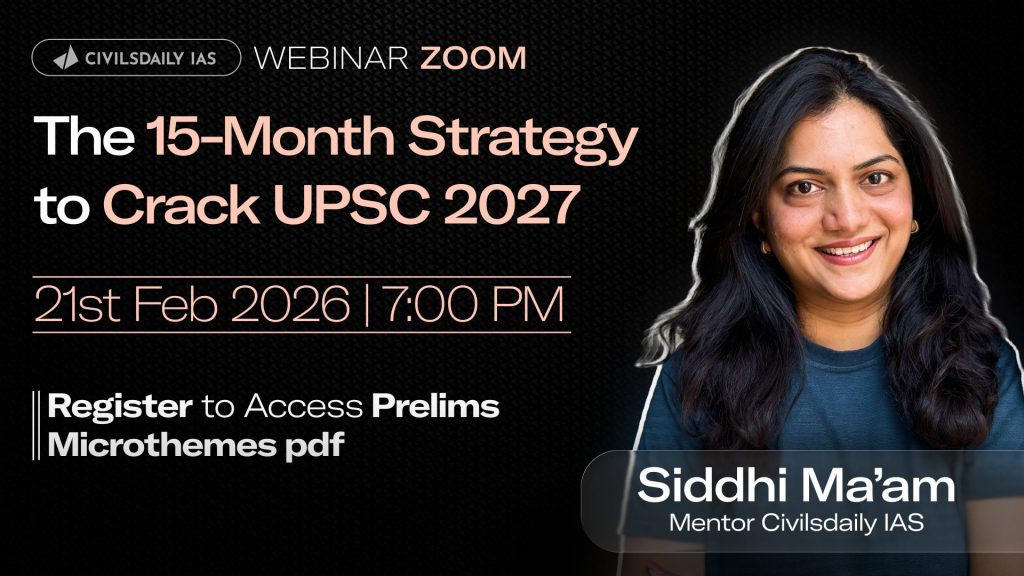
If you are serious about cracking it, the real question is not “Should I start?” It is “Do I have a 15-month plan that actually works?”
Most aspirants prepare year after year without a clear structure. They study hard, but without direction.
In this special live session, I will break down a practical, realistic 15-month strategy to crack UPSC 2027, covering Prelims, Mains, and execution discipline.
Siddhi Ma’am, Mentor, Civilsdaily IAS
What I’ll do in this live session:
1. The 15-Month Preparation Blueprint • How to divide the next 15 months phase-wise • What to focus on in the first 6 months • When to shift to answer writing & test practice • How to integrate Prelims and Mains from Day 1
This is about sequencing preparation properly, not doing everything at once.
2. Building Strong Foundations Early • How to complete core static subjects systematically • How to avoid resource overload • The right way to study current affairs from the beginning • How Microthemes simplify revision
Strong foundations reduce panic later.
3. When & How to Start Writing for Mains • Why waiting until after Prelims is risky • How to build answer-writing stamina gradually • Balancing optional with GS preparation • How to avoid burnout across a long preparation cycle
Consistency beats intensity.
4. The Final Stretch Planning • When to transition fully to Prelims mode • Revision cycles that actually work • Mock test strategy for both stages • Mental discipline for a 15-month marathon
The goal is not just preparation, it is controlled execution.
Who should attend: • Serious UPSC 2027 aspirants • College students planning early preparation • Working professionals aiming for a structured long term plan • Repeaters who want a fresh, disciplined roadmap
It will be a 45 minute session, post which we will open up the floor for all kinds of queries which a beginner must have. No questions are taboo and Siddhi Ma’am is known to be patiently solving all your doubts.
Join us for a Zoom session on 21st Feb at 7 PM. This session is a must attend for you If you are attempting UPSC for the first time or have attempted earlier and now preparing for 2027, then it is going to be a valuable session for you too.
See you in the session”
Register for the session for a complete in-depth UPSC Prep
(Don’t wait—the next webinar/session won’t be until End Feb’26)
These masterclasses are packed with value. They are conducted in private with a closed community. We rarely open these webinars for everyone for free. This time we are keeping it for 300 seats only.
[UPSC 2020] “Recent amendments to the Right to Information Act will have profound impact on the autonomy and independence of the Information Commission”. Discuss.
Linkage: It tests GS-2 (Transparency & Accountability) by examining how RTI amendments can weaken institutional independence and oversight. It directly links to the DPDP-RTI amendment debate, where removal of the public interest override raises concerns about reduced transparency and stronger executive control.
Mentor’s Comment
The amendment to Section 8(1)(j) of the RTI Act through the DPDP Act, 2023 has triggered a constitutional debate on the balance between privacy and transparency. The issue tests the durability of India’s accountability framework in the digital governance era.
Why in the News?
The Supreme Court has referred petitions challenging the amendment to Section 8(1)(j) of the Right to Information (RTI) Act, 2005 introduced through the Digital Personal Data Protection (DPDP) Act, 2023, to a Constitution Bench, citing its constitutional sensitivity.
What is Section 8(1)(j) of the RTI Act, 2005?
Section 8(1)(j) of the RTI Act, 2005 exempts from disclosure personal information that has no relationship to any public activity or interest, or which would cause unwarranted invasion of privacy, unless the Public Information Officer (PIO) is satisfied that a larger public interest justifies it. It balances privacy against transparency, though recent amendments have narrowed its application.
Key Aspects of Section 8(1)(j):
Exemption Scope: Covers information relating to personal details, privacy, and data that, if disclosed, would not benefit public activity.
Public Interest Override: Even if information is personal, it can be disclosed if the CPIO, SPIO, or appellate authority is satisfied that a “larger public interest” outweighs the harm to the individual’s privacy.
Applicability: Applies to “third-party” information and generally refers to individuals rather than institutions or corporate bodies.
Examples of Denied Info: Examples include third-party personal details, such as an employee’s ID or specific confidential files.
Amendment via DPDP Act 2023: The Digital Personal Data Protection Act (DPDPPA), 2023 substituted this clause, broadly removing the “public interest override” and strengthening the prohibition against disclosing personal data.
How has the DPDP Act, 2023 amended Section 8(1)(j)?
Deletion of Override Clause: Removes the phrase allowing disclosure in larger public interest.
Expanded Exemption Scope: Prohibits disclosure of “any information which relates to personal information.”
Blanket Restriction:Eliminates proportionality assessment previously embedded in RTI framework.
Structural Shift: Converts a conditional exemption into near-absolute protection.
Integration with DPDP Framework: Aligns RTI disclosure norms with data protection regime prioritizing consent and privacy safeguards.
What constitutional and governance issues arise from this amendment?
Article 19(1)(a) Impact: Curtails right to information derived from freedom of speech and expression.
Article 21 Protection: Strengthens privacy rights recognized in Justice K.S. Puttaswamy (2017).
Doctrine of Proportionality Concern: Removes balancing test between competing fundamental rights.
State-Citizen Asymmetry: Section 7 of DPDP permits state processing of personal data without consent for official functions.
Accountability Deficit: Restricts citizen scrutiny of public officials’ conduct and financial dealings.
How does the amendment affect journalism and civil society oversight?
Data Fiduciary Classification: Journalists collecting personal data may fall under DPDP compliance obligations.
Financial Penalty Risk: Non-compliance may attract penalties up to ₹250 crore.
Chilling Effect: Limits investigative reporting involving public officials.
Reduced Transparency: Constrains access to procurement, audit, and expenditure records involving personal identifiers.
Institutional Constraint: Weakens RTI as a tool for civil society accountability campaigns.
How does the Indian framework compare with global data protection standards?
EU GDPR Model: Balances privacy with transparency and journalistic exemptions.
Public Interest Safeguards: Allows processing for public interest and accountability purposes.
Indian Divergence: DPDP amendment lacks explicit balancing mechanism within RTI framework.
Regulatory Integration Challenge: Requires harmonization between transparency law and data protection law.
Conclusion
The amendment to Section 8(1)(j) marks a decisive shift in India’s transparency regime. While privacy is a fundamental right, its protection cannot come at the cost of democratic accountability. A constitutionally balanced approach, grounded in proportionality and public interest, is essential to ensure that data protection strengthens, rather than weakens, the foundations of transparent governance.
A three-judge Bench led by Chief Justice of India criticised States for offering free electricity and direct cash transfers ahead of elections while running deficits. It questioned how such schemes are funded and said subsidies must be clearly shown in the budget instead of hiding revenue gaps. The Court noted that Tamil Nadu alone faces a power sector revenue gap of around ₹50,000 crore. The issue raises concerns about fiscal discipline, burden on future generations, and whether such policies serve constitutional goals or electoral politics.
What are Freebies?
Freebies refer to benefits such as free electricity, free water, cash transfers, loan waivers, free transport, or distribution of consumer goods announced by governments, often around elections. They are generally universal or broadly targeted and may not be strictly linked to poverty or vulnerability criteria.
Types of Freebies
Consumption-Based Freebies: Free electricity, water, LPG refills, or public transport. These reduce immediate household expenses but increase revenue burden on the State.
Cash Transfers: Direct cash assistance to specific groups (e.g., women, farmers, unemployed youth) without productive conditions attached.
Loan Waivers: Farm loan waivers or interest subventions. These provide short-term relief but may affect credit discipline.
Goods Distribution: Free laptops, smartphones, bicycles, mixers, or other consumer durables.
Service-Based Freebies: Free pilgrimages, free education kits, or free healthcare schemes not linked to targeted social security design.
Freebies differ from targeted welfare schemes such as MGNREGA or PDS, which are structured, means-tested, and aimed at long-term poverty reduction.
How Do Universal Subsidies Impact Fiscal Federalism and Public Finance Stability?
Fiscal Deficit Expansion: Increases revenue-expenditure gaps and shifts burden to public exchequer; example: Tamil Nadu power sector revenue gap of ~₹50,000 crore.
Intergenerational Burden: Transfers current consumption costs to future taxpayers through debt accumulation.
Budgetary Opacity: Masks real fiscal stress when subsidies are not explicitly budgeted under planned expenditure.
Federal Stress: Limits States’ fiscal space under FRBM constraints.
Do Electoral Freebies Undermine Constitutional Principles of Welfare State and Equality?
Welfare State Commitment: Constitution envisages targeted support for marginalised sections (Directive Principles).
Equality Principle (Article 14): Universal subsidies blur distinction between those capable of paying and those below poverty line.
Appeasement vs Welfare: Court questioned whether non-discriminatory subsidies amount to political appeasement.
Public Interest Doctrine: State must prioritise sustainable development expenditure over short-term populism.
Institutional Accountability: Elected governments remain accountable for fiscal prudence.
What Is the Regulatory Concern in the Power Sector?
Cost-Reflective Tariff Rule: Electricity Amendment Rules, 2024 mandate no revenue gap between approved annual revenue requirement and estimated revenue.
Tariff Pass-Through: Revenue gaps eventually increase consumer tariffs.
Subsidy Accounting Reform: Court suggested inclusion of subsidies in planned expenditure to avoid financial opacity.
Public Utility Viability: Persistent losses weaken State DISCOMs and reduce investment capacity.
Moral Hazard: Free electricity reduces incentive for efficient consumption.
How Does the Judiciary Balance Policy Autonomy with Fiscal Oversight?
Judicial Restraint Principle: Policy decisions fall within executive domain.
Constitutional Guardianship: Court intervenes when fiscal actions affect public interest and economic stability.
Separation of Powers: Remarks do not ban subsidies but question sustainability.
Institutional Dialogue: Encourages reconsideration of policy frameworks rather than direct prohibition.
Democratic Accountability: Final political wisdom rests with elected governments.
Are Freebies Economically Distinct from Welfare Schemes?
Targeted Welfare: Focuses on vulnerable groups (e.g., PDS, MGNREGA).
Universal Freebies: Extend benefits irrespective of income level.
Capital vs Revenue Expenditure: Freebies often reduce fiscal space for capital investment.
Development Trade-off: Excessive distribution hampers infrastructure and human capital formation.
The debate on freebies highlights the tension between welfare obligations and fiscal responsibility in a federal democracy. While the Constitution mandates support for vulnerable sections, such support must be targeted, transparent, and fiscally sustainable. Competitive populism risks weakening public finances, distorting development priorities, and burdening future generations. A balanced approach that strengthens human capital, ensures cost-reflective pricing, and upholds institutional accountability remains essential for long-term economic stability and constitutional governance.
PYQ Relevance
[UPSC 2022] Besides the welfare schemes, India needs deft management of inflation and unemployment to serve the poor and underprivileged sections of the society. Discuss
Linkage: This question links directly to the freebies debate by highlighting that sustainable poverty alleviation requires macroeconomic stability, not just welfare distribution. It brings focus on fiscal discipline, inflation control, and employment generation as structural solutions beyond populist subsidies.
European regulators are examining Nvidia’s dominance in AI GPUs amid concerns of anti-competitive practices and software lock-in through CUDA. The NVIDIA CUDA ecosystem is a comprehensive, proprietary parallel computing platform and programming model that enables GPUs to perform general-purpose computing (GPGPU). Nvidia holds nearly 90% of the discrete AI GPU market, creating high entry barriers. AI training workloads rely on thousands of GPUs operating continuously, raising electricity demand and carbon concerns. The transition from CPU-centric to GPU-centric computing marks a structural shift in global digital infrastructure with strategic and regulatory implications.
Introduction
It is a specialised processor designed to execute large numbers of parallel computations simultaneously. Initially developed for rendering computer graphics, GPUs now form the backbone of artificial intelligence (AI), machine learning, simulations, and high-performance computing.
The Story So Far
1999 Launch: Nvidia marketed GeForce 256 as the first GPU.
Shift in Function: Moved from video game graphics to AI infrastructure.
Current Role: Powers generative AI, data centres, scientific simulations, defence modelling.
GPUs have become foundational to artificial intelligence and modern digital infrastructure. Their dominance raises concerns of market concentration, energy sustainability, and strategic dependence. Effective competition regulation, green computing standards, and domestic semiconductor capacity are essential to ensure technological growth remains inclusive, secure, and sustainable.
PYQ Relevance
[UPSC 2020] What do you understand by nanotechnology and how is it helping in health sector?
Linkage: Both nanotechnology and GPU-based AI fall under GS-3 emerging technologies and test conceptual clarity about hardware-driven technological transformation.
Indian Space Research Organisation will pilot a modified algorithm to better detect farm fire events during the upcoming wheat harvesting season. The move follows discrepancies between satellite detected fires and ground reports flagged by the Commission for Air Quality Management.
Background: Stubble Burning
Paddy stubble generated within a 30 day window in Punjab, Haryana and western UP.
Farmers burn residue due to:
Short gap between harvest and next sowing cycle
Low cost and quick clearance
Burning releases PM2.5 and gaseous pollutants.
During peak season, farm fires can contribute up to 40 percent of Delhi pollution load.
Satellite Monitoring Mechanism
Fire data based on sun synchronous polar orbiting satellites:
NASA Terra and Aqua using MODIS sensor
National Oceanic and Atmospheric Administration Suomi NPP using VIIRS sensor
Issue identified:
Peak burning time shifted from around 1.30 pm in 2020 to nearly 5 pm in 2024.
Late evening fires may escape detection due to fixed satellite overpass timings.
Rabi Season Focus
Wheat harvesting: Late March to May.
2025 data recorded:
Punjab: 10,207 fire events
Haryana: 1,832
NCR districts of UP: 259
For first time, CAQM directing monitoring of summer wheat stubble burning.
[2019] For the measurement/estimation of which of the following are satellite images/remote sensing data used? 1. Chlorophyll content in the vegetation of a specific location
2. Greenhouse gas emissions from rice paddies of a specific location
3. Land surface temperatures of a specific location
Select the correct answer using the code given below:
(a) 1 only (b) 2 and 3 only (c) 3 only (d) 1, 2 and 3
Former Army Chief Manoj Mukund Naravane stated that the unresolved India China boundary is at the core of bilateral tensions and emphasised that India will not tolerate unilateral use of force along the LAC.
Boundary vs Border
India Bangladesh border: Mutually recognised and demarcated.
India China boundary: Not formally demarcated on ground.
The Line of Actual Control is a notional alignment, not a legally settled international boundary.
Line of Actual Control
De facto boundary between India and China.
Divided into:
Western Sector: Eastern Ladakh
Middle Sector: Uttarakhand and Himachal Pradesh
Eastern Sector: Arunachal Pradesh and Sikkim
Frequent face offs due to differing perceptions of LAC alignment.
Galwan Context
Violent clash in Galwan Valley (June 2020) in eastern Ladakh.
Marked major downturn in bilateral ties.
Land Boundary Agreement 2015
Signed between India and Bangladesh.
Involved exchange of enclaves and settlement of long pending boundary disputes.
Demonstrates that complex boundary disputes can be resolved through negotiations.
[2020] Siachen Glacier is situated to the (a) East of Aksai Chin
![🔴[UPSC Webinar for 2027] By Siddhi Ma’am, Mentor, Civilsdaily IAS | The 15-Month Strategy to Crack UPSC 2027 | Join on 21st Feb at 7PM](https://d18x2uyjeekruj.cloudfront.net/wp-content/uploads/2026/02/Siddhi-thumb-1-1568x882.jpg)