A wild tusker named Padayappa has recently damaged vehicles along the Munnar to Marayur route in Kerala during his musth period, reviving debate over human wildlife conflict and relocation demands.
Location
Munnar, Idukki district, Kerala
Roams between Munnar and Devikulam forest ranges
About Padayappa
Approximate age: 60 years
Species: Asian Elephant
Identifiable by:
Limp due to hind leg injury
Unusually long tusks
Named after the Rajinikanth film Padayappa
Known as a tourism icon in Munnar
Recent Developments
Damaged four vehicles this month
Over 20 vehicles damaged during last year’s musth period
Forest Department Rapid Response Team monitoring movements
Officials state aggression linked only to musth, not habitual conflict behavior
Musth (Prelims Concept)
A periodic condition in male elephants
Characterised by:
Increased testosterone levels
Heightened aggression
Temporal gland secretion
Seasonal and temporary phase
[2020] With reference to Indian elephants, consider the following statements: 1. The leader of an elephant group is a female.
2. The maximum gestation period can be 22 months.
3. An elephant can normally go on calving till the age of 40 years only.
4. Among the States in India, the highest elephant population is in Kerala.
Which of the statements given above is/are correct?
(a) 1 and 2 only (b) 2 and 4 only (c) 3 only (d) 1, 3 and 4 only
The Supreme Court of India criticised indiscriminate distribution of “freebies” by States while hearing a petition by Tamil Nadu Power Distribution Corporation Limited challenging Rule 23 of the Electricity Amendment Act, 2024.
Core Issue
Petition challenges Rule 23, which limits the gap between:
Approved Annual Revenue Requirement
Estimated Annual Revenue from tariff to 3%.
Revenue gap, including late payment surcharge carrying cost, must be cleared in three yearly instalments.
TNPDCL argues this may cause tariff shock and strain State finances.
Tamil Nadu reportedly faces an annual power sector gap of about ₹50,000 crore.
Court’s Key Observations
States running revenue deficits continue announcing election time largesse.
Welfare must distinguish between needy and affluent.
Public money should prioritise: Infrastructure, Roads, Hospitals, Schools and Medical colleges
Court stressed fiscal prudence, especially during elections.
Clarified that design of welfare schemes falls within the domain of elected governments.
[UPSC 2024] What is the present world scenario of intellectual property rights with respect to life materials? Although India is second in the world to file patents, still only a few have been commercialised. Explain the reasons behind this less commercialization.
Linkage: This question links with the AI-copyright debate as both concern intellectual property rights, innovation, and the balance between protection and public use of knowledge. It helps analyse how rigid IPR frameworks can limit technological development and commercialization, similar to challenges faced in AI data and copyright regulation.
Mentor’s Comment
The editorial discusses India’s copyright challenge in the age of Artificial Intelligence (AI). It explains that old copyright laws, designed for the print era, are conflicting with AI, data mining, and digital access to knowledge. The article examines historical trends, policy gaps, global comparisons, and governance choices to understand how India can balance creator rights with innovation, accessibility, and public interest.
Why in the News?
The rise of Artificial Intelligence has triggered a major debate on copyright laws because AI systems require large-scale data for training, while existing copyright rules remain restrictive and outdated. India is now at a policy crossroads where balancing creator rights with innovation and public access has become urgent, making the issue highly relevant for governance and digital regulation today.
Introduction
Copyright law historically aimed to reward creators while ensuring eventual public access to knowledge. Over time, however, protections expanded in duration and scope, producing a system described as “copyright maximalism.” The emergence of AI disrupts this balance because machine learning requires extensive data scraping and analysis, challenging traditional definitions of copying, authorship, and creative ownership.
How has copyright law evolved from incentive to over-expansion?
Historical Purpose: Ensures limited monopoly rights for creators to incentivize publishing and dissemination of knowledge; early laws allowed controlled duplication mainly for printing and libraries.
Expansion of Duration: Extends protection for the author’s lifetime plus long posthumous periods, reducing entry into the public domain and restricting reuse.
Shift Toward Maximalism: Expands copyright beyond publication to automatic ownership of every created work, including minor or functional outputs.
Outcome: Restricts free circulation of knowledge despite original intent of encouraging creativity.
Why does AI challenge traditional copyright assumptions?
Data Dependency: Requires large volumes of digital text, images, and media for training; machine learning models process patterns rather than reproduce works directly.
Functional Use vs Creative Use: Treats data as statistical input rather than expressive content, questioning whether it constitutes infringement.
Scale Problem: AI systems must crawl massive portions of the internet, making individual licensing impractical.
Governance Gap: Creates uncertainty for developers, researchers, and innovation ecosystems in absence of clear legal exemptions.
What does global evidence reveal about text and data mining policies?
Comparative Study Findings: Survey across multiple countries showed most jurisdictions lack clear exceptions permitting large-scale AI data mining.
Legal Restriction: Countries such as the Philippines and Sri Lanka largely prohibit unrestricted copying for analysis.
Progressive Models: Japan and Singapore allow broader text and data mining exceptions, enabling technological experimentation.
Policy Implication: Flexible copyright frameworks correlate with stronger AI innovation environments.
Why is India’s current approach seen as a regulatory risk?
Absence of Explicit Exception: Indian copyright law does not clearly permit AI-oriented data mining.
Innovation Uncertainty: Creates legal ambiguity for startups, research labs, and academic institutions.
Comparative Disadvantage: Countries providing explicit exemptions attract advanced AI research and investment.
Governance Concern: Raises institutional accountability questions on balancing creator rights and technological advancement.
How does copyright intersect with accessibility and public interest?
Access to Knowledge: Restrictive copyright historically limited access for visually impaired persons until exceptions were introduced via the Marrakesh framework.
Policy Lesson: Demonstrates that flexible copyright exceptions can advance inclusion without undermining creativity.
Public Interest Principle: Supports constitutional goals of equality and knowledge dissemination.
Institutional Responsibility: Requires regulators to ensure copyright does not hinder socially beneficial technological use.
Should copyright protect jobs or creativity in the AI era?
Technological Transition: Historical innovations eliminated certain roles but created new industries and employment forms.
Policy Perspective: Copyright aims to encourage creativity, not permanently preserve existing occupations.
Institutional Role: Governments may support displaced workers through taxation and social policy instead of restricting innovation.
Outcome: Supports balanced governance between innovation and welfare measures.
What should copyright law protect in an AI-driven future?
Human Contribution: Protects genuine creative expression rather than data patterns or computational processes.
Openness Principle: Encourages collaborative innovation and derivative creativity.
Regulatory Reform: Requires modern exceptions for AI training, research use, and data mining.
Strategic Objective: Aligns copyright with digital economy goals while maintaining creator incentives.
Conclusion
India’s copyright framework stands at a policy crossroads where rigid protection models confront AI-led innovation. A balanced approach that safeguards genuine creativity while enabling data-driven technological development is necessary. Clear legal exceptions, institutional foresight, and alignment with constitutional values of access and innovation can help restore equilibrium between creators, technology, and public interest.
A private member Bill has been introduced in Parliament proposing greater diversity in judicial appointments and the creation of regional benches of the Supreme Court. The issue has gained attention because the collegium system is being questioned for lack of representation of women and marginalised groups, and because access to the Supreme Court remains difficult for people outside Delhi. The debate revives discussions on judicial reform, transparency, and equal access to justice.
How does the Constitution structure judicial appointments and institutional balance?
Article 124 Framework: Ensures appointment of Supreme Court judges by the President after consultation with the Chief Justice of India; establishes constitutional checks.
Article 217 Mechanism: Regulates High Court appointments through consultation involving CJI, Governor and Chief Justice of High Court; supports federal participation.
Article 130 Flexibility: Permits Supreme Court to sit outside Delhi with CJI approval; enables structural decentralisation though rarely utilised.
Institutional Balance: Maintains equilibrium between executive authority and judicial independence in appointments.
Why was the collegium system created and how has it evolved institutionally?
First Judges Case (1981): Allowed executive primacy in appointments; raised concerns over judicial independence.
Second Judges Case (1993): Created collegium system; ensured judicial primacy to safeguard independence.
Third Judges Case (1998): Expanded collegium composition to include senior judges; strengthened internal consultation.
Outcome: Ensures insulation from executive interference but generates criticism regarding opacity and accountability.
Why was the National Judicial Appointments Commission (NJAC) struck down and what institutional concerns remain?
99th Constitutional Amendment (2014): Established NJAC including executive members and civil society representation.
Supreme Court Judgment (2015): Struck down NJAC citing violation of basic structure doctrine and judicial independence.
Institutional Impact: Restored collegium system; highlighted tension between transparency and independence.
Accountability Gap: Continues debate over lack of clear selection criteria and public scrutiny.
What does the proposed Bill indicate about diversity and representational deficits in the higher judiciary?
Social Representation: Less than 20% representation of SC/ST/OBC judges in higher judiciary (as highlighted in article).
Jurisdiction Design: Constitutional matters remain with principal bench; regional benches handle regular appeals
Outcome: Reduces travel costs, improves timely justice, strengthens federal inclusiveness.
What governance reforms are suggested to balance independence, diversity, and accountability?
Collegium Reform: Prioritises social diversity within existing framework; ensures constitutional compatibility.
Broader Consultation: Includes representatives from legislature, bar councils, and academia for inclusive inputs.
Comparative Models: UK and South Africa cited as examples of wider consultative appointment systems.
Institutional Accountability: Strengthens legitimacy without undermining judicial autonomy.
Conclusion
Judicial diversity and accessibility are emerging as central concerns in debates on institutional reform. Any future framework must preserve judicial independence while ensuring representation, transparency, and equitable access to justice. Structural reforms within constitutional limits remain critical for strengthening public trust in the judiciary.
PYQ Relevance
[UPSC 2021] Discuss the desirability of greater representation to women in the higher judiciary to ensure diversity, equity and inclusiveness.
Linkage: This question directly links to the debate on diversity in judicial appointments, highlighting representation as a constitutional and governance concern within the higher judiciary. It connects with current discussions on reforming the collegium system to ensure inclusiveness, institutional legitimacy, and equitable access to justice.
The National Green Tribunal (NGT) has raised concerns over environmental safeguards in the ₹81,000-crore Great Nicobar mega project. The project has drawn attention due to large-scale forest diversion and its strategic significance as a proposed economic and defence hub.
What is the Great Nicobar Island Development Project?
Mega Infrastructure Project: Envisions integrated development of Great Nicobar Island as a strategic economic and defence hub at India’s southernmost tip.
Project Cost: Estimated investment of about ₹81,000 crore aimed at long-term maritime and regional development.
Core Components: Includes a transshipment port at Galathea Bay, a dual-use international airport, a greenfield township, and power infrastructure.
Strategic Objective: Strengthens India’s maritime presence near major Indo-Pacific shipping routes and supports blue economy goals.
Scale of Development: Covers nearly 166 sq km area involving land reclamation and major infrastructure expansion.
Institutional Framework: Implemented through island development planning with environmental clearances subject to regulatory review.
How does the Great Nicobar project reshape India’s strategic and maritime governance priorities?
Strategic Location: Strengthens India’s maritime presence near the Malacca Strait, a key global shipping lane; positions India in Indo-Pacific logistics competition.
Transshipment Capacity: Facilitates cargo transfer from large to smaller vessels; reduces dependence on foreign ports such as Singapore and Colombo.
Defence Integration: Supports dual-use infrastructure with a military-civilian airport near INS Baaz, ensuring enhanced regional surveillance capability.
Economic Hub Objective: Promotes integrated development through shipping, logistics and energy infrastructure to strengthen blue economy outcomes.
Example: Proposed transshipment port at Galathea Bay designed for large-scale maritime trade handling.
What governance challenges arise from large-scale development in ecologically fragile island ecosystems?
Forest Diversion: Involves diversion of approximately 130 sq km of forest land from a 910 sq km island ecosystem.
Deforestation Scale: Requires felling of nearly one million trees, raising compliance concerns under environmental clearance norms.
Land Reclamation: Includes reclamation of around 166 sq km project area for infrastructure expansion.
Institutional Oversight: Raises questions on adequacy of environmental impact assessments and monitoring frameworks.
Example: Expansion activities around Galathea Bay intersect with ecologically sensitive zones.
How does the project test environmental regulatory institutions and accountability mechanisms?
Implementation Risk: High ecological and regulatory costs may delay or reshape execution timelines.
Example: Planned airport area approximately 8.45 sq km and transshipment port around 7.66 sq km.
Conclusion
The Great Nicobar mega project represents a critical governance test where strategic economic ambitions intersect with ecological fragility and constitutional environmental commitments. Its long-term success will depend not merely on infrastructure delivery but on the credibility of regulatory safeguards, ecological accountability and inclusive decision-making mechanisms.
PYQ Relevance
[UPSC 2024] What role do environmental NGOs and activists play in influencing Environmental Impact Assessment (EIA) outcomes for major projects in India? Cite four examples with all important details.
Linkage: This PYQ is directly relevant as the Great Nicobar Island Development Project has faced scrutiny over the adequacy of its Environmental Impact Assessment (EIA) and safeguards. It highlights how environmental activism, regulatory oversight, and institutional accountability influence approval and modification of large infrastructure projects.
The Directorate General of Civil Aviation has proposed amendments to Civil Aviation Requirement provisions to empower airlines to directly impose a flying ban of up to 30 days on unruly or disruptive passengers.
Legal Basis
Proposed under Rule 133A of the Aircraft Rules, 1937
Amends the Civil Aviation Requirement (CAR) framework governing handling of disruptive passengers
Key Provisions of the Proposal
Flying Ban up to 30 Days
Airlines can impose a ban directly.
No need for prior referral to the independent committee.
Database & Reporting
Airlines must maintain a database of banned passengers.
DGCA must be informed of every ban.
Such passengers will NOT be added to the regulator’s official No Fly List.
Objective
Ensure swift action in the interest of passenger and flight safety.
Streamline existing procedures.
What Constitutes Disruptive Behaviour?
The revised definition includes:
Smoking on board
Consumption of alcohol on domestic flights
Tampering with emergency exits
Unauthorized use of life jackets or other safety equipment
Protests or sloganeering inside aircraft
Intoxicated misbehaviour
Screaming or causing annoyance
Kicking or banging seats or tray tables
Existing Mechanism
Cases must be referred to an Independent Committee.
Committee headed by a retired District and Sessions Judge.
Decision required within 45 days before ban enforcement.
Significance for Prelims
DGCA is India’s aviation safety regulator under the Ministry of Civil Aviation.
Rule 133A empowers DGCA to issue directions in public interest and aviation safety.
Distinction between:
Airline imposed temporary ban
Official regulator maintained No Fly List
Safety related regulatory reforms often tested in UPSC under transport and governance.
[2024] Consider the following airports:
1. Donyi Polo Airport
2. Kushinagar International Airport
3. Vijayawada International Airport
In the recent past, which of the above have been constructed as Greenfield projects?
(a) 1 and 2 only (b) 2 and 3 only (c) 1 and 3 only (d) 1, 2 and 3
The Ministry of Tribal Affairs has begun inquiries after the Odisha government directed closure of several Forest Rights Act Cells and removal of staff involved in implementation of the Scheduled Tribes and Other Traditional Forest Dwellers (Recognition of Forest Rights) Act, 2006.
About the Forest Rights Act, 2006
Objective
Recognises historical rights of:
Scheduled Tribes
Other Traditional Forest Dwellers
Over forest land used for habitat and livelihood.
Types of Rights Recognised
Individual Forest Rights
Community Rights
Community Forest Resource Rights
Institutional Mechanism
Gram Sabha is the initiating authority.
Sub Divisional Level Committee
District Level Committee as final authority
What are FRA Cells?
FRA Cells were created to:
Provide technical and clerical support
Maintain records
Digitise forest rights titles
Expedite processing of claims
They were supported under:
DA JGUA Scheme
Dharti Aaba Janjatiya Gram Utkarsh Abhiyan
Launched in 2024
Central scheme
Provides additional human resources to strengthen FRA implementation
Mo Jungle Jami Yojana (Odisha State Scheme)
Mo Jungle Jami Yojana
State initiative to support FRA implementation
Current Issue
Closure of 50 sub divisional FRA Cells.
Direction to clear all pending claims by March end.
Earlier discontinuation of district and tehsil level FRA staff.
Nearly 20 percent of FRA claims pending in the State.
Odisha has:
Second highest number of titles issued after Chhattisgarh.
Sixth highest pendency rate.
[2021] At the national level, which ministry is the nodal agency to ensure effective implementation of the Scheduled Tribes and Other Traditional Forest Dwellers (Recognition of Forest Rights) Act, 2006?
(a) Ministry of Environment, Forest and Climate Change
India did not join a joint statement issued by 85 countries at the United Nations criticising Israel’s latest measures to tighten control over the West Bank.
Context
The joint statement:
Condemned unilateral Israeli decisions in the West Bank.
Opposed any form of annexation.
Rejected measures altering the demographic character of Palestinian territories occupied since 1967, including East Jerusalem.
The statement was endorsed by:
League of Arab States
European Union
BRICS founder members: Russia, China, Brazil, South Africa
Quad partners: Australia, Japan
India stayed out of the statement.
Background: West Bank Issue
The West Bank is a Palestinian territory occupied by Israel since 1967.
Under the Oslo Accords (1993 to 1995):
Area A and Area B are administered by the Palestinian Authority.
Area C remains under Israeli control.
Recent developments:
The Knesset has passed measures to:
Ease land acquisition rules.
Increase checks on land documentation.
Expand administrative control.
These steps are viewed by many countries as amounting to de facto annexation.
India’s Position
India had earlier:
Voted at the UN in October 2025 criticising illegal annexation.
Supported a Palestinian state based on 1967 borders in the January 2026 Delhi Declaration.
Current move seen as:
Diplomatic recalibration.
Possibly linked to high level bilateral engagement with Israel.
Key Concepts for Prelims
Two State Solution
Creation of: Independent Israel and Independent Palestine based on pre 1967 borders
Strategic Autonomy
India’s foreign policy principle of: Maintaining independent decision making and Avoiding bloc alignment
West Bank Areas
Area A: Palestinian civil and security control
Area B: Palestinian civil control, Israeli security control
Area C: Full Israeli control
[2018] The term “two-state solution” is sometimes mentioned in the news in the context of the affairs of (a) China
The Delhi High Court has issued notice to the Union Government on a petition challenging certain provisions of the Digital Personal Data Protection Act, 2023, alleging excessive executive control and violation of constitutional rights.
About the Digital Personal Data Protection Act, 2023
Objective
To regulate processing of digital personal data.
To protect individual privacy while enabling lawful data use.
Key Features
Applies to digital personal data processed in India.
Establishes a Data Protection Board of India.
Provides rights to Data Principals.
Imposes obligations on Data Fiduciaries.
Allows certain exemptions for government agencies.
Grounds of Challenge in the Petition
The plea challenges Sections 17, 18, 19, 20, 21, 23, 29, 30, 36, 37, 39, 40 and 44.
Major Concerns Raised
Unchecked Executive Access
Broad exemptions for the State.
Alleged scope for surveillance.
Blocking Without Hearing
Lack of procedural safeguards.
Absence of Meaningful Consent
Questioning adequacy of consent framework.
Opaque Exemptions
Wide discretionary powers.
Impact on RTI
Alleged dilution of the Right to Information Act, 2005.
Adjudicatory Structure
Data Protection Board under executive control.
Appeals lie before the Telecom Disputes Settlement and Appellate Tribunal.
Section 39 bars jurisdiction of civil courts.
[2024] Under which of the following Articles of the Constitution of India, has the Supreme Court of India placed the Right to Privacy? (a) Article 15
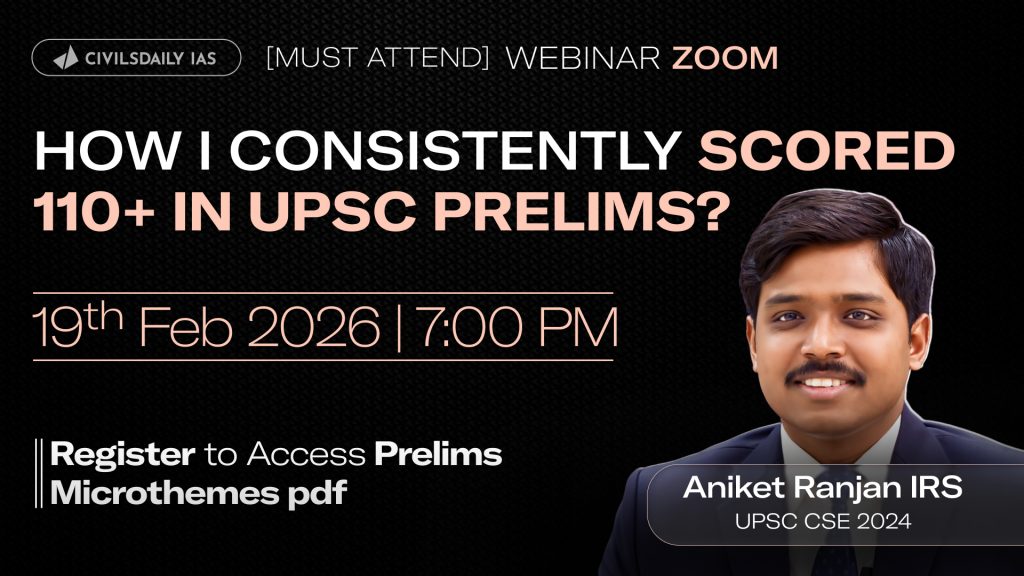
Most aspirants clear Prelims once. Very few score 110+ consistently.
The difference is not luck. It’s not even “extra knowledge.” It’s a repeatable system.
In this live session, I will break down exactly how I consistently crossed the 110+ mark in UPSC Prelims, and how you can build the same scoring stability.
Aniket Ranjan,IRS,UPSC CSE 2024
What I’ll do in this live session:
1. The 110+ Prelims Mindset
• How to think in the exam hall • Why attempt strategy matters more than syllabus completion • The difference between clearing and dominating Prelims
You’ll understand why scoring 90–95 and scoring 110+ require completely different thinking.
2. The Art of Logical Elimination
• How to eliminate options with partial knowledge • How to handle confusing and statement based questions • How to reduce silly mistakes under pressure
This is where most marks are gained ,or lost.
3. Revision That Actually Converts into Marks
• How many revisions are enough? • Static vs current affairs balance • What to revise in the last 60–30–15 days
Because reading more doesn’t always mean scoring more.
4. Accuracy, Risk & Attempt Calibration
• How many questions should you attempt? • How to balance confidence and caution • When to take calculated risks
Consistent 110+ scores come from disciplined decision making, not aggression.
Who should attend:
Aspirants stuck in the 75–85 range
Those clearing mocks but missing consistency
Serious Prelims 2026 candidates aiming for a safe margin
It will be a 45 minute session, post which we will open up the floor for all kinds of queries which a beginner must have. No questions are taboo and Aniket Sir is known to be patiently solving all your doubts.
Join us for a Zoom session on 19th Feb at 7 PM. This session is a must attend for you If you are attempting UPSC for the first time or have attempted earlier and now preparing for 2026/2027, then it is going to be a valuable session for you too.
See you in the session”
Register for the session for a complete in-depth UPSC Prep
(Don’t wait—the next webinar/session won’t be until End Feb’26)
These masterclasses are packed with value. They are conducted in private with a closed community. We rarely open these webinars for everyone for free. This time we are keeping it for 300 seats only.
![🔴[UPSC Webinar for 2026] By Aniket Ranjan IRS, UPSC CSE 2024, | How I Consistently Scored 110+ in UPSC Prelims? | Join on 19th Feb at 7PM](https://d18x2uyjeekruj.cloudfront.net/wp-content/uploads/2026/02/Aniket-Ranjan-IRS-Thumb.jpg-1-1568x882.jpeg)