💥Join UPSC 2027,2028 Mentorship (July Batch) + XFactor Notes & Microthemes PDF

Subject: BilateralXNeighbourhood

  • The Case for Updating the Indus Waters Treaty

    Why in the News?

    India has continued to hold on to the Indus Waters Treaty (IWT) in abeyance, following the terrorist strikes in Pahalgam. This has drawn war threats from Pakistan and revived attention to India’s separate, pending request to renegotiate the 65-year-old treaty. Pakistan has publicly treated the abeyance and the renegotiation notices as a single hostile act. This is despite  India’s actual 2023 and 2024 notices for treaty revision unanswered.

    Why is India’s push to renegotiate the IWT not an unusual or hostile move?

    1. Global norm of treaty revision: At least 250 separate transboundary river-water treaties exist worldwide, covering 113 river systems, as per a 2013 study. Supplementary protocols, amendments and data-sharing arrangements had already taken the total number of agreements to 688 by then.
    2. Continuing growth in revisions: The International Freshwater Treaties database (Oregon State University) now records over 800 such agreements, showing that transboundary treaties are routinely reviewed and updated.
    3. India’s own precedent: India’s 1996 Ganga water-sharing treaty with Bangladesh carries a 30-year validity and is due for renewal this year, showing India itself treats such treaties as time-bound instruments needing renewal.
    4. IWT already permits revision: Article VII allows the Permanent Indus Commissions of both countries to agree on new drainage or engineering works, though this has never been invoked. Article XII allows treaty modification “from time to time” through a fresh government-level treaty: the provision India invoked to serve its 2023 and 2024 notices.
    5. Not a new demand: Pakistani experts and scholars themselves called for review of the IWT well before the present standoff. India’s notices are the first official move by either side, not the first such call.

    What modern water-management elements does the IWT’s design fail to address?

    1. No groundwater provision: The treaty does not mention groundwater resources at all, despite groundwater being connected across borders in the same way as surface water.
    2. No water-quality standards: The treaty sets no requirements for water quality in the shared rivers.
    3. No environmental-flow provision: There is no mechanism to maintain minimum ecological flows in the rivers.
    4. Pakistan’s own grievance illustrates the gap: Pakistan has repeatedly complained that India releases municipal and sewage waste into the eastern rivers, over which India has full control under the treaty, affecting Pakistan’s soil and water health, a complaint the treaty’s silence on water quality leaves unresolved.
    5. Climate change was structurally excluded: No treaty negotiated before the 1990s could have factored in climate change; the IWT (1960) is no exception.
    6. Partition rather than sharing: Most water-sharing treaties guarantee a fixed volume or percentage of flow to each party. The IWT instead allocates entire rivers to one party or the other, making it more a partition agreement than a sharing arrangement, a design that has reduced incentive for joint river-basin management.

    How does the Mekong River Commission show the institutional flexibility the IWT’s commission lacks?

    1. Mekong River Commission (Southeast Asia, established 1995): Functions as a joint river water-management system, not merely a treaty-implementation body.
    2. Power to revise strategies: While it cannot alter the original treaty’s provisions, it is empowered to develop and revise joint basin-management strategies, data-sharing protocols, and water-quality rules.
    3. Contrast with the Permanent Indus Commission (PIC): The PIC, set up under the IWT, functions merely as the treaty’s implementing agency and has so far focused largely on ensuring the treaty’s existing provisions are not violated. It has no comparable mandate to revise or adapt joint management practices.

    Is India’s renegotiation push a technical necessity or an extension of the security standoff?

    1. Pakistan’s conflation: Pakistan organised an “international” conference on the treaty, with ministers and leaders threatening war over any disruption to the Indus basin’s rivers. They treat the abeyance and the renegotiation request as one hostile package.
    2. Selective response: Despite this rhetoric, Pakistan has still not responded to India’s actual 2023 and 2024 notices seeking treaty modification.
    3. Independent climate evidence: A study by researchers Vimal Mishra and Urmin Vegad of IIT Gandhinagar found climate change is affecting the two basins differently.
    4. Divergent basin trends: The eastern river basins have seen a 20% decline in annual rainfall over the last 70 years, while precipitation in the western river basins has remained largely unchanged.
    5. The delinking argument: India’s request to renegotiate the treaty must be seen as separate from its decision to hold it in abeyance. Agreeing to renegotiate, rather than continued brinkmanship, is presented as Pakistan’s most reliable route to ending the abeyance.

    Conclusion

    The Indus Waters Treaty was designed for a 1960 hydrological and political reality. It partitions entire rivers rather than sharing flows, omits groundwater, water-quality and environmental-flow provisions, and gives its joint commission no mandate to revise the treaty. These are the gaps that comparable transboundary arrangements, including the Mekong River Commission, address through built-in review mechanisms. This creates an independent, technical case for updating the IWT. India’s renegotiation request must be evaluated on this basis, delinked from its abeyance decision; Pakistan’s willingness to renegotiate, not further confrontation, is what would end the abeyance.

    PYQ Relevance

    [UPSC 2026] Present an account of the Indus Water Treaty and examine its ecological, economic and bilateral relation.

    Linkage: The PYQ directly asks for an account of the IWT and its bilateral implications. This article supplies the treaty’s institutional design flaws and the current bilateral context directly answering such a question today.
  • India is an age-old friend of Sri Lanka.’ Discuss India’s role in the recent crisis in Sri Lanka the light of the preceding statement.

    India and Sri Lanka share civilizational, cultural, and economic linkages dating back over 2,500 years, rooted in Buddhist ties, maritime trade, and shared colonial history.

    Financial Assistance

    India extended over USD 4 billion in assistance through credit lines, currency swaps, and grants

    Provided a USD 1 billion credit line for essentials such as food, medicines, and fuel.

    Supplied over 400,000 MT of fuel, life-saving drugs, and rice consignments

    USD 400 million currency swap under the SAARC framework and deferred USD 515 million in ACU payments, easing liquidity pressure.

    Support for Debt Restructuring and IMF Assistance

    India became the first country to provide written assurance to the IMF supporting Sri Lanka’s debt restructuring plan, crucial for securing the USD 2.9 billion IMF bailout.

    Advocated for equitable debt treatment among all creditors.

    Trade, Connectivity, and Energy Cooperation

    Advanced the India-Sri Lanka Economic and Technology Cooperation Agreement (ETCA) and Bilateral Investment Treaty (BIT) for economic revival.

    Revived strategic projects such as the Trincomalee Oil Tank Farm modernization and proposed India-Sri Lanka power grid interconnection.

    Symbol of Age-Old Friendship

    Non Reciprocity (Neighbourhood First Policy) – India’s assistance came without strategic strings.

    Embodied the ethos of “Vasudhaiva Kutumbakam”, upholding regional solidarity and stability.

    Reaffirmed India’s role as a trustworthy regional leader and first responder in crises.

    India’s response reflected its “humanitarian diplomacy”-guided by empathy, not conditionality.

  • [10th June 2026] The Hindu OpED: India’s road through Myanmar is one of engagement

    PYQ Relevance[UPSC 2022] India is an age-old friend of Sri Lanka. Discuss India’s role in the recent crisis in Sri Lanka in the light of the preceding statement.Linkage: The PYQ examines India’s approach towards political and economic instability in its neighbourhood. Similar to Sri Lanka, India’s engagement with Myanmar reflects a pragmatic neighbourhood policy that prioritises regional stability, connectivity, and strategic interests despite domestic political challenges.

    Mentor’s Comment

    Myanmar President U Min Aung Hlaing visited India from May 30 to June 3, 2026, marking the first visit by a Myanmar President to India since the 2021 military coup. The visit highlights New Delhi’s preference for pragmatic engagement over diplomatic isolation. The visit gains significance amid China’s growing influence in Myanmar, delays in India’s connectivity projects, instability along the India-Myanmar border, and the strategic importance of Myanmar in the Act East Policy.

    How Does Myanmar Occupy a Central Position in India’s Strategic Calculus?

    1. Geographical Gateway: Connects India directly with Southeast Asia and serves as the land bridge for the Act East Policy.
    2. Shared Border: Shares a 1,643-km border with four Northeastern States of India.
    3. Neighbourhood First Imperative: Ensures stability in India’s immediate strategic environment.
    4. Regional Connectivity: Supports physical, economic, and people-to-people integration with ASEAN.
    5. Strategic Buffer: Limits excessive external influence in India’s eastern neighbourhood.

    Why Has India Chosen Engagement Instead of Isolation?

    1. Pragmatic Diplomacy: Maintains engagement irrespective of Myanmar’s internal political arrangements.
    2. Strategic Necessity: Recognises Myanmar’s importance for connectivity, trade, and security interests.
    3. Policy Continuity: Foreign Secretary Vikram Misri reiterated that India does not intend to comment on Myanmar’s internal political arrangements.
    4. Regional Stability: Ensures sustained communication channels during political transitions.
    5. Counter-Isolation Approach: Prevents strategic vacuum creation in Myanmar.

    How Does China’s Expanding Influence Shape India’s Myanmar Policy?

    1. Strategic Competition: China has expanded engagement with Myanmar after the 2021 coup.
    2. Infrastructure Financing: Beijing filled gaps created by Western disengagement.
    3. Arms Supplies: Increased military cooperation with Myanmar authorities.
    4. Diplomatic Cover: Provides international support to Naypyidaw.
    5. Strategic Concern: Complete Chinese dominance in Myanmar would constrain India’s strategic space.

    Why Are Connectivity Projects Central to India’s Myanmar Engagement?

    Kaladan Multi-Modal Transit Transport Project

    1. Objective: Connects Kolkata to Sittwe Port by sea and further links Myanmar’s inland waterways and roads to Mizoram.
    2. Maritime Component: Operational.
    3. Riverine Component: Operational.
    4. Cargo Milestone: First cargo shipment reached Sittwe in May 2023.
    5. Critical Gap: 109-km Paletwa-Zorinpui Road remains incomplete.
    6. Target Completion: Full operationalisation targeted for 2027.

    India-Myanmar-Thailand Trilateral Highway

    1. Route: Moreh (Manipur) to Mae Sot (Thailand).
    2. Length: Approximately 1,360 km.
    3. Regional Ambition: Planned extensions to Cambodia, Laos, and Vietnam.
    4. Strategic Outcome: Converts Northeast India into a gateway to Southeast Asia.
    5. Implementation Challenge: Missed the original completion target of 2019.

    Significance of IMT for Northeast India

    1. Market Access: Expands export opportunities.
    2. Economic Integration: Facilitates participation in ASEAN supply chains.
    3. Infrastructure Development: Improves logistics and transport efficiency.
    4. Employment Generation: Supports trade-led economic growth.

    What Challenges Continue to Delay Connectivity Projects?

    1. Internal Conflict: Myanmar’s civil conflict has intensified since the 2021 coup.
    2. Territorial Control: Armed groups control large stretches along project corridors.
    3. Construction Disruptions: Security threats increase costs and delays.
    4. Administrative Constraints: Weak governance affects implementation.
    5. Political Uncertainty: Creates investment and operational risks.

    How Does Security Cooperation Influence Bilateral Relations?

    1. Counter-Insurgency Cooperation: Addresses activities of Indian insurgent groups operating from Myanmar.
      1. NSCN-K (National Socialist Council of Nagaland–Khaplang): Historically operated camps in Myanmar’s Sagaing Region and carried out activities in Nagaland, Manipur, and Arunachal Pradesh.
      2. ULFA (Independent): Maintained safe havens in Myanmar after being pushed out of Bangladesh; cadres reportedly used Myanmar’s border areas for training and logistics.
      3. PLA (People’s Liberation Army of Manipur): One of several Meitei insurgent groups that established bases across the border.
      4. UNLF (United National Liberation Front): Operated from Myanmar’s territory for decades before several leaders and cadres were apprehended or surrendered.
      5. PREPAK (People’s Revolutionary Party of Kangleipak) and KYKL (Kanglei Yawol Kanna Lup): Maintained camps in Myanmar’s remote border regions.
    2. Territorial Assurance: Myanmar reiterated that its territory would not be used against India.
    3. Cybercrime Cooperation: Joint efforts target transnational cyber-scam networks.
    4. Rescue Operations: More than 2,400 Indian nationals rescued from scam centres in the last 18 months.
    5. Border Management: Enhances coordination against illegal activities.

    How Can Economic Cooperation Deepen India-Myanmar Relations?

    1. Bilateral Trade: Reached approximately $1.95 billion during 2025-26.
    2. Rupee-Kyat Settlement Mechanism: Reduces dependence on third-country currencies.
    3. Critical Minerals Cooperation: Supports supply chain diversification.
    4. Rare Earth Cooperation: Enhances strategic resource security.
    5. Investment Potential: Strengthens regional economic integration.

    Conclusion

    Myanmar remains central to India’s Act East strategy, border security, and regional connectivity goals. The recent engagement reflects New Delhi’s pragmatic approach that prioritises strategic interests, recognising that sustained cooperation is essential for stability, connectivity, and balancing external influence in the region.

    Value Addition: 

    China’s Key Interests in Myanmar

    1. China-Myanmar Economic Corridor (CMEC): Connects Yunnan province with the Indian Ocean.
    2. Kyaukpyu Port: Provides maritime access bypassing the Malacca Strait.
    3. Energy Security: Facilitates oil and gas pipelines from the Bay of Bengal.
    4. Belt and Road Initiative (BRI): Expands China’s regional footprint.

    Major Ethnic Armed Organisations

    1. Kachin Independence Army (KIA): Active in northern Myanmar.
    2. Arakan Army (AA): Influential in Rakhine State.
    3. Karen National Union (KNU): Active in southeastern Myanmar.
    4. Three Brotherhood Alliance: Significant anti-junta coalition.

    Security Concerns Along the India-Myanmar Border

    1. Insurgency: Provides safe havens for Northeastern insurgent groups such as NSCN-K, ULFA(I), PLA, PREPAK and KYKL, complicating border security and counter-insurgency operations.
    2. Drug Trafficking: Myanmar forms part of the Golden Triangle (Myanmar-Laos-Thailand), one of the world’s largest narcotics-producing regions, facilitating the trafficking of heroin and synthetic drugs into India’s Northeast.
    3. Arms Smuggling: Enables illicit movement of small arms and ammunition through porous borders, strengthening insurgent and criminal networks.
    4. Human Trafficking: Facilitates cross-border trafficking of women, children and migrant workers through informal routes and weak border controls.
    5. Cyber Fraud Networks: Hosts transnational scam centres involved in online fraud, cryptocurrency scams and human trafficking; over 2,400 Indian nationals have been rescued through bilateral cooperation in the past 18 months.
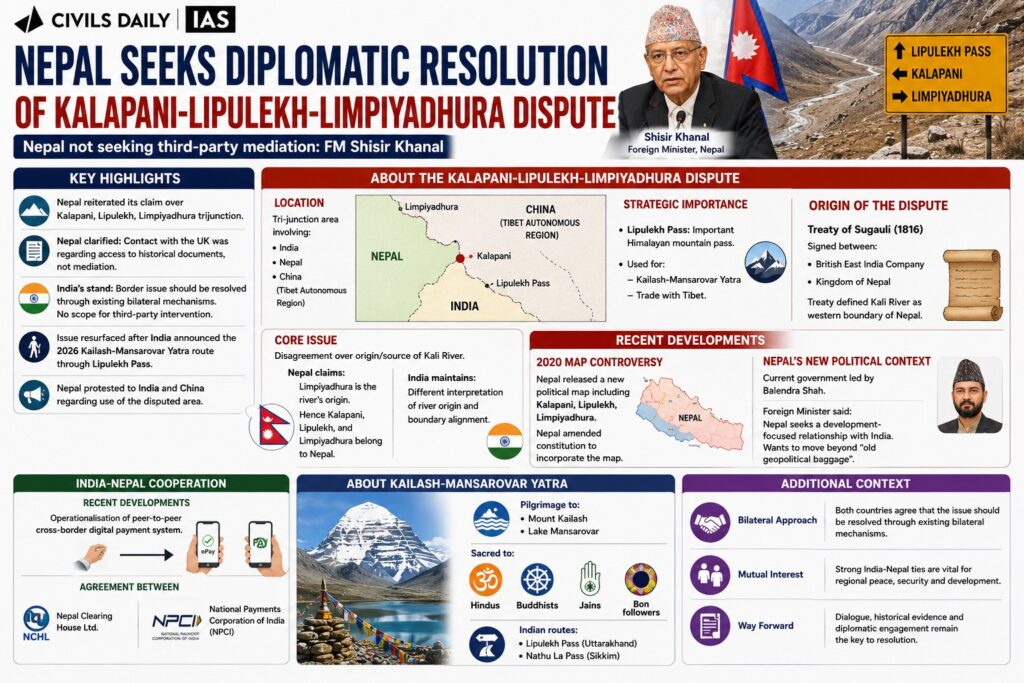
  • Nepal on Kalapani-Lipulekh-Limpiyadhura Dispute

    Why in the news?

    Shisir Khanal, Foreign Minister of Nepal, stated that Nepal seeks resolution of the Kalapani-Lipulekh-Limpiyadhura border dispute with India through diplomatic means and is not seeking third-party mediation.

    Key Highlights

    • Nepal reiterated its claim over the Kalapani, Lipulekh, and Limpiyadhura trijunction.
    • Nepal clarified: Contact with the United Kingdom was regarding access to historical documents, not mediation.
    • India’s stand: Border issue should be resolved through existing bilateral mechanisms. No scope for third-party intervention.
    • Issue resurfaced after India announced the 2026 Kailash-Mansarovar Yatra route through Lipulekh Pass.
    • Nepal protested to India and China regarding use of the disputed area.

    About the Kalapani-Lipulekh-Limpiyadhura Dispute

    • Tri-junction area involving: India, Nepal and China (Tibet Autonomous Region).

    Strategic Importance

    • Lipulekh Pass: An important Himalayan mountain pass.
      • Used for: Kailash-Mansarovar Yatra and Trade with Tibet.

    Origin of the Dispute

    Treaty of Sugauli (1816)

    • Signed between British East India Company and Kingdom of Nepal.
    • Treaty defined Kali River as western boundary of Nepal.

    Core Issue

    • Disagreement over Origin/source of Kali River.
    • Nepal claims Limpiyadhura is the river’s origin. Hence Kalapani, Lipulekh, and Limpiyadhura belong to Nepal.
    • India maintains a different interpretation of river origin and boundary alignment.

    Recent Developments

    2020 Map Controversy

    • Nepal released a new political map including Kalapani, Lipulekh, and Limpiyadhura.
    • Nepal amended constitution to incorporate the map.

    Nepal’s New Political Context

    • Current government led by Balendra Shah.The
    • Foreign Minister said Nepal seeks a development-focused relationship with India. Wants to move beyond “old geopolitical baggage”.

    India-Nepal Cooperation

    • Recent Developments: Operationalisation of Peer-to-peer cross-border digital payment system.
    • Agreement Between: Nepal Clearing House Ltd and National Payments Corporation of India (NPCI).

    About Kailash-Mansarovar Yatra

    • Pilgrimage to Mount Kailash and Lake Mansarovar.
    • Sacred to Hindus, Buddhists, Jains, Bon followers.
    • Indian routes Lipulekh Pass (Uttarakhand) and Nathu La Pass (Sikkim).

    [2020] Consider the following statements:

    1. The value of Indo-Sri Lanka trade has consistently increased in the last decade.
    2.“Textile and textile articles” constitute an important item of trade between India and Bangladesh.
    3. In the last five years, Nepal has been the largest trading partner of India in South Asia.

    Which of the statements given above is/are correct?
    a) 1 and 2 only
    b) 2 only
    c) 3 only
    d) 1, 2 and 3

  • [3rd June 2026] The Hindu OpED: The harvest China wants is one India cannot afford

    PYQ Relevance[UPSC 2017]‘China is using its economic relations and positive trade surplus as tools to develop potential military power status in Asia’. In the light of this statement, discuss its impact on India as her neighbour.Linkage: The PYQ focuses on China’s broader strategy of converting economic, diplomatic, and strategic influence into regional power projection. The article reflects China’s broader strategy of using its growing power to strengthen territorial claims and strategic leverage along the India-China border, particularly through the “Early Harvest” proposal.

    Mentor’s Comment

    India and China have resumed discussions on boundary settlement through the Special Representatives (SR) mechanism after years of tensions following the 2020 Galwan crisis. The significance lies in the reported revival of the idea of an “early harvest” settlement in the Sikkim sector, a proposal first discussed in 2005. 

    What is the Indo-China border?

    The India-China border is defined by a 3,488-kilometre-long frontier known as the Line of Actual Control (LAC).

    Three Sectors of the LAC

    The un-demarcated border is geopolitically divided into three operational sectors:

    1. Western Sector: Covers Ladakh. It features key flashpoints like the Galwan Valley, Pangong Tso, and the Depsang Plains, directly adjacent to the Chinese-controlled Aksai Chin wasteland.
    2. Central Sector: Runs across the peaceful, less contested states of Himachal Pradesh and Uttarakhand.
    3. Eastern Sector: Spans Sikkim and Arunachal Pradesh. It historically follows the McMahon Line, which India recognizes but China disputes by claiming Arunachal Pradesh as “South Tibet“.

    How Have India-China Boundary Negotiations Evolved?

    Phase 1: Historical Boundary Legacy

    1890 Anglo-Chinese Convention

    1. Defined the Sikkim-Tibet boundary.
    2. Mentioned Mount Gipmochi as the starting point.
    3. Introduced the watershed principle.

    Phase 2: Military Confrontation

    1967 Nathu La and Cho La Clashes

    1. Major armed confrontations after the 1962 war.
    2. Demonstrated unresolved border disputes.

    Phase 3: Confidence-Building Era

    1993 Agreement on Peace and Tranquillity

    1. First major agreement to maintain stability along the LAC.
    2. 1996 CBM Agreement: Military confidence-building measures.
    3. 2005 Political Parameters and Guiding Principles: Created framework for final boundary settlement. Envisaged:
      1. Political settlement first.
      2. Delimitation later.
      3. Demarcation afterwards.

    Phase 4: Emergence of the Early Harvest Idea

    2005-2010s

    1. Discussions emerged on resolving easier sectors first.
    2. Sikkim identified as a possible candidate.
    3. India remained cautious about abandoning the package-settlement approach.

    Phase 5: Doklam and Strategic Distrust

    2017 Doklam Standoff

    1. China attempted road construction near the tri-junction.
    2. India intervened.
    3. Highlighted strategic importance of Sikkim-Doklam region.

    Phase 6: Breakdown of Trust

    2020 Galwan Clash

    1. First combat fatalities in decades.
    2. India linked broader bilateral relations to peace on the LAC.

    Phase 7: Renewed Negotiations

    May 2025: Working Mechanism for Consultation and Coordination (WMCC) discussed steps toward boundary delimitation.

    August 2025

    1. 24th Special Representatives Meeting.
    2. Agreement to establish an Expert Group.
    3. China referred to “demarcation” and negotiations in favourable sectors.

    Phase 8: Current Debate

    China’s Preference: Sector-wise or “Early Harvest” settlement.

    India’s Preference

    1. Comprehensive package settlement.
    2. Peace and tranquillity on the LAC as a precondition.
    3. Protection of interests in Eastern Ladakh, Arunachal Pradesh, and the Doklam tri-junction.

    How Do Recent India-China Boundary Talks Indicate a Revival of the “Early Harvest” Approach?

    The Early Harvest Proposal refers to the idea of resolving those sectors of the India-China boundary where agreement is relatively easier, while leaving the more contentious sectors for later negotiations. Under this approach:

    1. India and China would first settle the Sikkim sector, where differences are comparatively limited.
    2. More difficult disputes such as Eastern Ladakh and Arunachal Pradesh would be postponed.
    3. China would obtain a formal settlement in one sector while negotiations continue indefinitely elsewhere.

    Why Does the Revival of the “Early Harvest” Proposal Matter?

    1. Special Representatives Dialogue: India and China held the 24th round of SR talks in August 2025, reviving discussions on boundary settlement.
    2. Expert Group Formation: Both sides agreed to establish an Expert Group to examine boundary delimitation in India-China border areas.
    3. Chinese Terminology Shift: China used the term “demarcation” and referred to launching negotiations in sectors where conditions are favourable.
    4. Strategic Concern: Sector-wise settlements could enable China to secure gains in less disputed regions while retaining leverage in contentious sectors.
    5. Diplomatic Significance: Marks the return of political-level boundary negotiations after prolonged military tensions.

    What Is the Historical Basis of the Sikkim Boundary Dispute?

    1. Nathu La Clashes (1967): Heavy casualties occurred on both sides despite Sikkim’s eventual accession to India.
    2. Convention of 1890: The Anglo-Chinese Convention identified Mount Gipmochi as the starting point of the Sikkim-Tibet boundary.
    3. Watershed Principle: The convention specified that the boundary follows the mountain ridge separating watersheds.
    4. Tri-Junction Dispute: India and Bhutan maintain that the tri-junction lies near Batang La, about 6.5 km north of Gipmochi.
    5. Strategic Geography: The dispute directly affects the location of the India-China-Bhutan tri-junction.

    Why Is the Tri-Junction Location Strategically Important?

    1. Jampheri/Zompelri Ridge: Controls approaches overlooking the Siliguri Corridor.
    2. Siliguri Corridor Security: The narrow corridor connects mainland India with the Northeast.
    3. Chinese Objective: A favourable tri-junction location would provide China greater strategic depth in the Chumbi Valley.
    4. Military Leverage: Enhanced access could improve Chinese observation and operational capabilities.
    5. Territorial Implications: A revised boundary could indirectly legitimise Chinese claims over nearby areas.

    How Does the Doklam Experience Influence India’s Position?

    1. Chinese Consolidation: Since the 2017 Doklam standoff, China has strengthened military infrastructure in western Bhutan.
    2. Road Construction: Expansion of roads and permanent facilities has altered ground realities.
    3. Pressure on Bhutan: Increased Chinese presence creates incentives for Bhutan to negotiate on China’s terms.
    4. Indian Concerns: Any settlement affecting the tri-junction could have direct consequences for India’s security.
    5. Strategic Lesson: Temporary stand-offs do not necessarily prevent long-term territorial consolidation.

    Why Does India Link Boundary Settlement With Peace Along the LAC?

    1. Galwan Legacy: The 2020 clashes fundamentally altered trust levels in bilateral relations.
    2. LAC Stability Principle: India maintains that broader normalization depends on peace and tranquillity along the border.
    3. Military Buildup: Large-scale troop deployments remain in several sectors.
    4. Confidence Deficit: Repeated violations of prior understandings have weakened confidence in incremental agreements.
    5. Negotiation Framework: India seeks restoration of stability before pursuing major political settlements.

    How Has China Altered Ground Realities Along the Border?

    1. Infrastructure Expansion: Construction of roads, airfields, logistics hubs, and border villages.
    2. Military Consolidation: Increased troop presence and deployment capabilities along sensitive sectors.
    3. Administrative Assertion: Renaming locations in Arunachal Pradesh seeks to reinforce territorial claims.
    4. Border Villages Programme: Expansion of settlements near the LAC strengthens administrative presence.
    5. Strategic Messaging: Combines military, political, and infrastructural measures to reinforce claims.

    What Was the Significance of the 2005 Agreement?

    1. Political Parameters Agreement (2005): Established principles for resolving the boundary issue.
    2. Two-Step Process: Envisaged political settlement first, followed by delimitation and demarcation.
    3. Package Settlement Concept: Favoured an overall settlement rather than sector-wise resolution.
    4. Mutual Safeguards: Recognized the need to protect strategic interests of both sides.
    5. Framework Relevance: Continues to provide the most comprehensive basis for negotiations.

    Should India Accept a Sector-Wise Settlement?

    Arguments in Favour

    1. Incremental Progress: Resolves less contentious sectors.
    2. Confidence Building: May improve bilateral atmosphere.
    3. Diplomatic Momentum: Prevents complete stagnation of negotiations.
    4. Administrative Clarity: Reduces ambiguity in settled regions.

    Arguments Against

    1. Loss of Leverage: Settled sectors can no longer be bargaining instruments.
    2. Strategic Risk: May strengthen Chinese positions elsewhere.
    3. Fragmented Resolution: Leaves core disputes unresolved.
    4. Historical Precedent: Past agreements have not always prevented new tensions.
    5. Asymmetrical Benefits: China could secure gains while retaining flexibility in contentious sectors.

    What Principles Should Guide India’s Negotiating Strategy?

    1. Comprehensive Settlement: Prioritises holistic resolution over isolated agreements.
    2. LAC Stability: Makes peace and tranquillity a precondition for progress.
    3. Strategic Reciprocity: Ensures mutual concessions rather than unilateral compromises.
    4. Protection of Core Interests: Safeguards Arunachal Pradesh, Eastern Ladakh, and Siliguri Corridor security.
    5. Ground Verification: Links agreements with verifiable implementation.

    Conclusion

    India’s challenge is not merely to settle a boundary segment but to secure a durable and equitable border framework. Any settlement must preserve strategic interests, maintain stability along the LAC, and avoid creating incentives for future coercion. A comprehensive settlement rooted in the 2005 framework, supported by verifiable peace on the ground, remains more consistent with India’s long-term security and diplomatic objectives than a narrowly defined “early harvest” approach.