💥Join UPSC 2027,2028 Mentorship (July Batch) + XFactor Notes & Microthemes PDF

Subject: Climate Change

  • Behind Europe’s heatwave, cliamte change the culprit

    Why in the News?

    A World Weather Attribution (WWA) study has confirmed climate change as the unequivocal cause of the ongoing European heatwave, which has broken or is forecast to break historic heat-stress records in 45% of 854 cities analysed. The finding sharpens a wider gap between the certainty climate science now offers and the declining political priority accorded to climate action.

    What does the WWA study establish about the causal role of climate change in the current heatwave?

    1. Unequivocal attribution: WWA found climate change, not the El Niño phenomenon or any other factor, responsible for the European heatwave.
    2. Recurrence pattern: This is the third severe heatwave to grip Europe in five years, after 2022 and 2023.
    3. Mortality scale: More than 1,300 excess deaths have been recorded since 21 June; over 1,00,000 people are estimated to have died from extreme heat across 2022 and 2023.
    4. Probability shift: Record-breaking night-time highs are nearly 100 times more likely now than in 2003; daytime peak temperatures are nearly 10 times more likely.
    5. Historical baseline broken: Temperature records being broken were set in 1976; the current daytime and overnight highs would have been virtually impossible to occur as recently as 1976.
    6. ENSO ruled out: The El Niño Southern Oscillation phase played no role in driving the heat during this spell.

    Why has climate attribution science become central to fixing responsibility for extreme weather events?

    1. Definition: Climate attribution is the scientific discipline that determines how much human-caused global warming influences the probability and intensity of specific extreme weather events. It quantifies how much worse or more likely a particular flood, heatwave, or drought has become compared to a hypothetical world without human-driven emissions
    2. Function: Attribution science tests the likelihood of a specific extreme weather event occurring if climate change were not taking place.
    3. Recency: The discipline has developed only over the last two decades.
    4. Speed gain: Assessments earlier took months or years; WWA’s methods now produce findings within days, even while an event is still ongoing.
    5. Purpose: The science removes ambiguity and fixes the exact extent of climate change’s responsibility for an event.
    6. Scientific caution without it: Scientists are otherwise wary of linking any individual extreme weather event to climate change without a dedicated attribution study.
    7. Policy intent: Beyond generating evidence, attribution studies are designed to force policymakers to act faster on climate change.

    Does scientific certainty on climate attribution translate into proportionate political action?

    1. Evidence-action gap: Scientific evidence on climate change is already voluminous and compelling, yet climate change has dropped down the list of global priorities.
    2. Political trigger: The decline has sharpened particularly after Donald Trump took office as US President.
    3. Forum evidence: Recent G7 meetings have carried little or no climate-related agenda or outcomes.
    4. Reversal of salience: Climate change was earlier among the most prominent items at international meetings involving influential leaders; this prominence has receded.
    5. Target abandonment: Scientists maintain the Paris Agreement targets of containing global temperature rise within 1.5°C to 2°C remain achievable, but governments treat them as effectively out of reach.
    6. Reframing of feasibility: Governments are treating the required resource mobilisation as politically impractical rather than scientifically unattainable.

    What risk does the global shift from mitigation to adaptation pose?

    1. Strategic shift: Countries are increasingly choosing to let climate change play out and to adapt to its impacts rather than prevent it.
    2. Scientific objection: Scientists routinely warn against adaptation as a substitute for mitigation.
    3. Inherent limits: Adaptation has limits beyond which impacts cannot be absorbed.
    4. Trend trajectory: Events such as the European heatwave are projected to increase in both frequency and intensity over coming years.
    5. Displacement, not resolution: The shift to adaptation transfers the climate risk from prevention to adaptation capacity rather than resolving it.

    Conclusion

    Climate attribution science has removed the scientific ambiguity once used to avoid linking individual extreme weather events to climate change. The European heatwave attribution exposes a widening gap between scientific certainty and political will, as global climate governance deprioritises mitigation. Countries are substituting adaptation for prevention despite scientists’ warnings that adaptation carries inherent limits. Closing this evidence-action gap is now central to achieving the Paris Agreement targets.

    PYQ Relevance

    [UPSC 2017] ‘Climate Change’ is a global problem. How India will be affected by climate change? How Himalayan and coastal states of India will be affected by climate change?

    Linkage: The PYQ xamines the impacts of climate change and the need for mitigation and adaptation strategies. The article uses the European heatwave as scientific evidence that climate change is intensifying extreme weather events and highlights the growing gap between climate science and political action.
  • Discuss the consequences of climate change on the food security in tropical countries.

    Food security refers to a situation where all people at all times have physical, social and economic access to sufficient, safe and nutritious food (FAO).

    According to the 2025 Global Report on Food Crises (GRFC), over 295 million people faced acute hunger last year, with climate extremes being a primary driver.

    Consequences of climate change on food security in tropical countries

    Decline in Crop Yields – Eg- rice and wheat yields in South Asia may decline by 10-20% by 2050 due to warming.

    Increased Frequency of Droughts affects rain-fed agriculture. Eg- Horn of Africa droughts have caused repeated crop failures and food shortages.

    Extreme Weather Events – Damage to crops and agricultural infrastructure. Eg- flood damage to paddy fields in Bangladesh.

    Heat Stress on Crops reduce photosynthesis and crop growth. Eg- Maize yields in tropical Africa and Latin America are projected to decline by up to 24% by 2030 if current warming trends persist.

    Decline in Fisheries – Eg- Tropical reef-based fisheries in Indonesia and the Philippines have seen a 20% decline in catch potential since 2020 due to coral bleaching.

    Spread of Crop Pests and Diseases – Warmer climates favour pest outbreaks. Eg- 2025-26 Locust swarms in the Horn of Africa and South Asia have devastated over 200,000 hectares of farmland.

    Loss of Arable Land due to sea-level rise and salinisation. Eg- saltwater intrusion in Vietnam’s Mekong Delta impacting rice paddies.

    Reduced Nutritional Quality of Crops – Elevated CO₂ may reduce nutrient content in staples. Eg- declining protein and micronutrient levels in rice and wheat.

    Livestock Productivity Decline – Heat stress affects animal health and milk production.

    Food Price Volatility and Poverty – Climate shocks disrupt supply chains and raise food prices.

    Heatwaves are disrupting the synchronization between flowering plants and their pollinators. Eg- decline in native bee populations in Brazil impacting the yields of high-value tropical fruits and nuts.

    Soil Degradation and Erosion-Intense tropical storms strip away the nutrient-rich topsoil (humus), leading to long-term infertility.

    Way Forward

    Climate-Smart Agriculture (CSA)- Promoting integrated systems that increase productivity and resilience while reducing emissions.

    Diversification of Cropping Systems – Promoting millets, pulses and climate-resilient crops.

    Development of Heat-Tolerant Varieties- Investing in “Scuba Rice” (flood-tolerant) and drought-resistant C4 crops like millets and sorghum.

    Managed Aquifer Recharge (MAR)- Implementing “Sponge Farm” techniques to capture monsoon runoff and recharge groundwater for dry spells.

    Agroforestry and Intercropping- Planting nitrogen-fixing trees alongside crops to provide shade, improve soil moisture, and diversify income.

    Strengthening Cold Chains- Investing in solar-powered refrigerated storage and hermetic bags to reduce post-harvest spoilage.

    Promoting Crop Insurance- Scaling up “Weather-Index Based Insurance” to protect farmers against total financial collapse after a climate disaster.

    Circular Food Systems- Reducing food waste and converting agricultural by-products into biogas or organic fertilizers.

    International Climate Finance- Ensuring that the Loss and Damage Fund (operationalized at COP28/29) is accessible to tropical nations for rebuilding food systems.

    Tropical countries are the “frontline states” in the war against climate-induced hunger. A global commitment to limit warming to 1.5^ C and a radical shift from “exploitative” to “regenerative” food systems is needed.

  • How are climate change and the sea level rise affecting the very existence of many island nations? Discuss with examples.

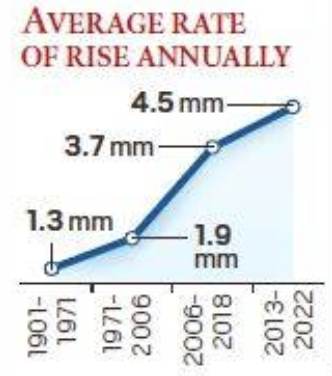
    As per the IPCC, global mean sea level rose by 0.20 m between 1901 and 2018. It has projected a global mean SLR of 1.3 to 1.6 m by 2100 under the high-emission scenario.

    Permanent submergence of land – Eg- Kiribati has already seen two small uninhabited islets (Tebua Tarawa and Abanuea) disappear underwater.

    Coastal erosion – Wave action and storm surges remove shoreline. Eg- Shoreline retreat in the Maldives.

    Salinisation of freshwater lenses – Sea water enters groundwater and contaminates wells leading to drinking water shortage.

    Frequent flooding during high tides and storms can lead to large scale displacement. Eg- “King tide” flooding in Tuvalu.

    Damage to housing and public infrastructure – Eg- Majuro Airport in the Marshall Islands frequently faces flooding

    Loss of agriculture – Salinity affects soil fertility and traditional crops. Eg- Taro cultivation affected in Kiribati and Tuvalu.

    Coral reef degradation – Ocean warming and acidification damage reefs that act as wave barriers. Eg- Coral bleaching in Fiji and Maldives.

    Impact on fisheries – Changes in ocean temperature and reef systems reduce fish catch, impacting livelihood

    Climate-induced migration – Eg- Kiribati purchased land in Fiji for future resettlement.

    Way Forward

    Hard Engineering Measures

    Seawalls to block wave attack.

    Groynes – Trap sand and widen beaches. Eg- Puducherry groyne field.

    Breakwaters – Offshore barriers that reduce wave energy. Eg- Chennai port.

    Revetments – Sloped rock armour to absorb wave impact.

    Soft Engineering Measures

    Mangrove Restoration – Eg- MISHTI-based efforts in Sundarbans.

    Coral and Seagrass Restoration – Eg- Andaman reef rehabilitation.

    Integrated Coastal Zone Management (ICZM)

    Ecosystem-Based Coastal Planning – Combines geomorphology, ecology and socio-economic factors.

    Regulatory Tools (CRZ Norms) – no-development zones and hazard mapping reduce vulnerability.

    Early Warning SystemsINCOIS alerts for timely action.

    Strengthening coastal resilience and climate mitigation is essential to safeguard communities and advance SDG 13 (Climate Action) and SDG 14 (Life Below Water).

    Water