India will be the exclusive partner for European Hydrogen Week in November 2024.
About European Hydrogen Week
European Hydrogen Week is an annual event organized by the European Commission, Hydrogen Europe, and others.
It serves as a platform to discuss the future of hydrogen technologies, policy developments, and their role in decarbonizing Europe’s economy.
It features conferences, exhibitions, and networking opportunities.
It focuses on the development, deployment, and scaling of green hydrogen as part of the European Green Deal and the EU’s climate-neutrality targets for 2050.
Significance of India’s Partnership
Strengthening Green Energy Goals: Aligns India with global initiatives in decarbonizing industries and energy systems, advancing its commitment to the Paris Agreement and Net Zero 2070 target.
Access to Advanced Hydrogen Technologies: Provides India with cutting-edge hydrogen technologies from Europe, enhancing production, storage, and transportation capabilities for Green Hydrogen.
Boosting Technological Innovation: Facilitates collaborative research and development, allowing India to create cost-effective hydrogen solutions and drive domestic innovation in clean energy.
Building Global Leadership: Establishes India as a global leader in the Green Hydrogen sector, reinforcing its commitment to climate change mitigation and sustainable development.
PYQ:
[2019] In the context of proposals to the use of hydrogen-enriched CNG (H-CNG) as fuel for buses in public transport, consider the following statements:
1. The main advantage of the use of H-CNG is the elimination of carbon monoxide emissions
2. H-CNG as fuel reduces carbon dioxide and hydrocarbon emissions.
3. Hydrogen up to one-fifth by volume can be blended with CNG as fuel for buses.
4. H-CNG makes the fuel less expensive than CNG.
Which of the statements given above is/are correct?
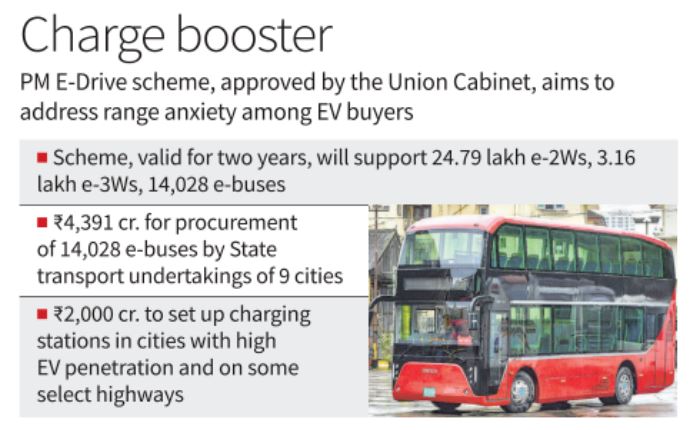
The Union Cabinet approved the PM Electric Drive Revolution in Innovative Vehicle Enhancement (PM E-Drive) Scheme with an outlay of ₹10,900 crore over two years.
About PM E-DRIVE Scheme:
Details
Name
PM Electric Drive Revolution in Innovative Vehicle Enhancement (PM E-DRIVE) Scheme
Total Outlay
₹10,900 crore for two years
Goal
Promote electric mobility, reduce pollution, and enhance fuel security
Reduce range anxiety by providing charging infrastructure in cities and highways.
Incentives
Direct subsidies for e-2Ws, e-3Ws, e-buses, e-ambulances, and e-trucks
Key Components
₹3,679 crore for demand incentives for e-2Ws, e-3Ws, e-ambulances, and e-trucks.
₹500 crore for e-ambulances.
₹4,391 crore for e-buses.
Other components:
E-Vouchers
Aadhaar-authenticated e-voucher for EV buyers;
Signed by both buyer and dealer for claiming incentives.
E-Bus Procurement
₹4,391 crore for 14,028 e-buses in 9 major cities (Delhi, Mumbai, Kolkata, Chennai, Ahmedabad, Surat, Bangalore, Pune, Hyderabad)
Charging Infrastructure
₹2,000 crore for 72,300 public EV charging stations, including fast chargers for e-4Ws, e-buses, e-2Ws, and e-3Ws
Incentivizing E-Trucks
₹500 crore tied to scrapping certificates from MoRTH-approved scrapping centres
Testing and Upgradation
₹780 crore for upgradation of MHI’s test agencies for green mobility technologies
PYQ:
[2019] How is efficient and affordable urban mass transport key to the rapid economic development in India?
The Union Cabinet has approved Phase IV of the Pradhan Mantri Gram Sadak Yojana (PMGSY-IV) to build 62,500 km of all-weather roads, connecting villages across India.
AboutPradhan Mantri Gram Sadak Yojana (PMGSY)
Details
Launch
In 2000 by former PM Late Atal Bihari Vajpayee.
To provide connectivity to unconnected habitations.
Nodal Agency
Ministry of Rural Development
Type
Centrally Sponsored Scheme
Phases
Phase I: Focus on connecting unconnected habitations.
Phase II: Upgrading roads built in Phase I to enhance rural infrastructure.
Phase III: Consolidation of 1.25 lakh km of rural roads connecting habitations to Gramin Agricultural Markets, Higher Secondary Schools, and Hospitals. Cost: ₹80,250 crore (2019-2025). Funding: 60:40 (Centre), 90:10 for North-East and Himalayan States.
Phase IV: Aims at constructing 62,500 km of all-weather roads to provide connectivity to 25,000 unconnected habitations with focus on Left-Wing Extremism (LWE) areas, tribal areas, and remote regions.
Road Length and Coverage
62,500 km of all-weather roads covering 25,000 unconnected habitations.
Benefits of PMGSY-IV
Road Connectivity for 25,000 Villages:All-weather roads will provide reliable access to previously unconnected rural habitations, improving transportation and accessibility.
Socio-Economic Transformation: These roads will act as catalysts for socio-economic development in rural areas, enabling access to government educational institutions, health services, markets, and growth centers.
Enhanced Infrastructure: The construction will adopt international benchmarks and best practices, such as using Cold Mix Technology, Waste Plastic, Full Depth Reclamation, and materials like Fly Ash and Steel Slag, contributing to eco-friendly construction.
PYQ:
[2020] In rural road construction, the use of which of the following is preferred for ensuring environmental sustainability or to reduce carbon footprint?
Copper slag
Cold mix asphalt technology
Geotextiles
Hot mix asphalt technology
Portland cement
Select the correct answer using the code given below:
Last week, PTI reported that the India Meteorological Department (IMD) plans to reintroduce District Agro-Meteorology Units (DAMUs) as part of the Gramin Krishi Mausam Sewa (GKMS) scheme.
Background: In 2018, the IMD set up 199 District Agro-Meteorology Units (DAMUs) in collaboration with the Indian Council of Agricultural Research to provide sub-district level agricultural advisories based on weather data. However, these DAMUs were shut down in March following an order from the IMD.
What are Agro-Meteorological Advisories?
Agro-meteorological advisories provide farmers with critical information about weather conditions that affect agricultural practices. This includes forecasts related to rainfall, temperature, and wind speeds, which are crucial for planning sowing, harvesting, irrigation, and the use of fertilizers and pesticides.
These advisories are particularly important for small and marginal farmers, who make up about 80% of India’s farming community and primarily rely on rain-fed agriculture.
The advisories are disseminated in local languages, ensuring accessibility. They are shared through various channels, including text messages, WhatsApp groups, newspapers, and direct communication from DAMU staff.
By providing timely weather information, these advisories help farmers plan their agricultural activities effectively and ultimately contribute to enhancing crop yields and farmers’ incomes.
Why Did the Government shut down the District Agro-Met Units (DAMUs)?
Agro-meteorological data was automated: The closure of DAMUs was influenced by claims from the NITI Aayog that agro-meteorological data was automated, which undermined the role of DAMU staff in preparing and disseminating agricultural advisories. This misrepresentation led to recommendations for privatization and monetization of the services previously offered for free.
Financial and Administrative Issues: The decision to shut down DAMUs was attributed to ongoing financial challenges, including delayed salary disbursements for DAMU staff, and administrative issues that hampered the program’s effectiveness.
Shift Towards Centralization: The government suggested transitioning to a centralized model for weather data collection and advisory services, which could potentially reduce the localized support that DAMUs provided to farmers.
Way forward:
Re-establish Local Support: Reinstate District Agro-Meteorology Units (DAMUs) to provide localized, targeted weather advisories and support, ensuring that small and marginal farmers receive timely, relevant information.
Improve Data Integration and Communication: Enhance the integration of automated weather data with localized advisory services, and streamline communication channels to reach farmers through various platforms effectively.
The India Status Report on Road Safety 2024 highlights India’s slow progress in reducing road fatalities and stresses the need for tailored approaches to improve road safety.
What does the ‘India Status Report on Road Safety 2024’ state?
The report highlights India’s limited success in reducing road accident fatalities, despite the country’s efforts in other sectors. The report stresses that most Indian States are not on track to meet the UN Decade of Action for Road Safety goal to halve traffic deaths by 2030.
It emphasizes the connection between road construction, mobility, and safety,
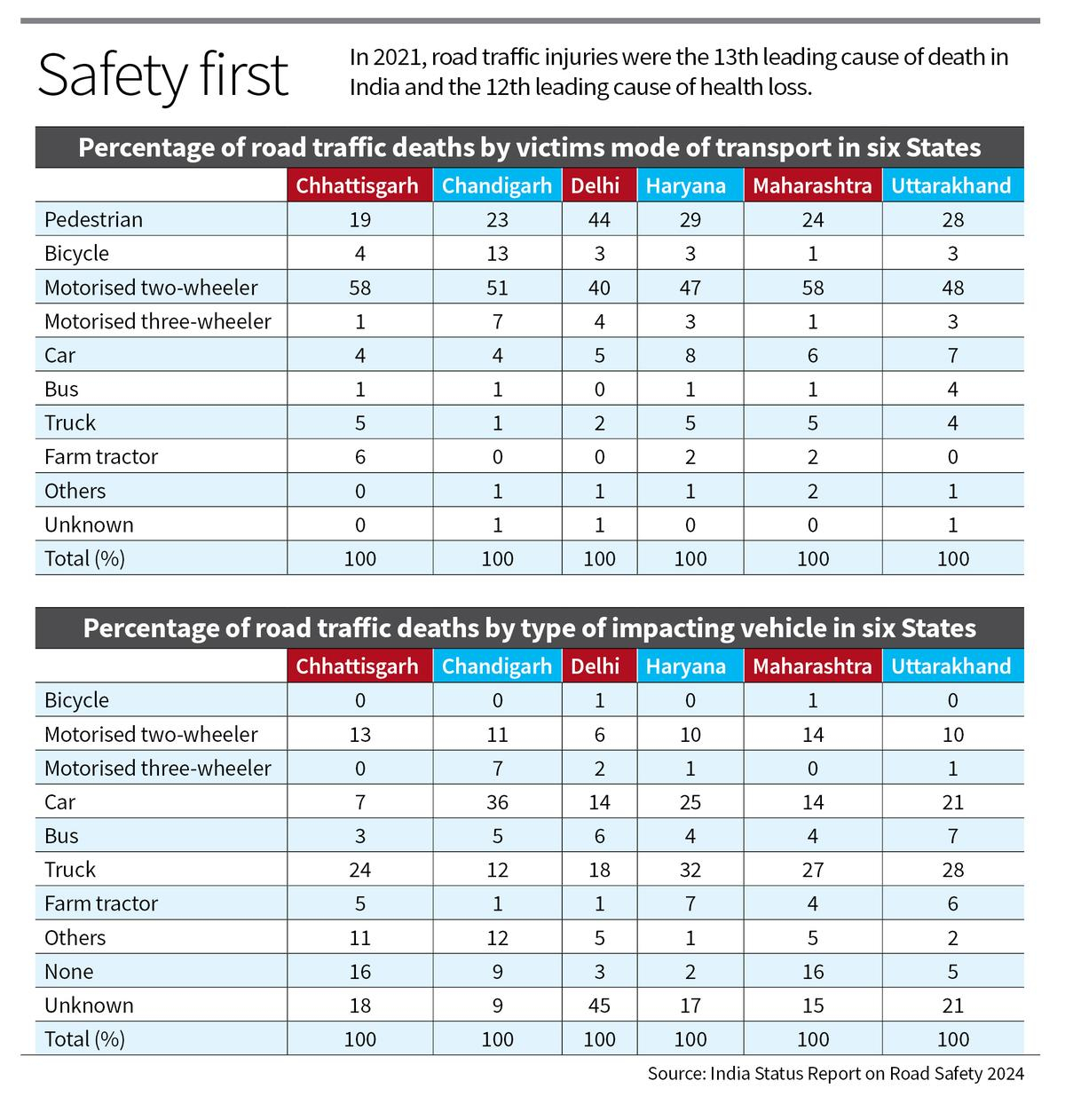
Road traffic injuries remain a significant public health challenge. In 2021, these injuries were the 13th leading cause of death and the 12th leading cause of health loss (measured in Disability-Adjusted Life Years or DALYs).
The report reveals significant disparities in road traffic death rates across Indian States, with vulnerable groups such as motorcyclists and truck-involved crashes being particularly high.
Note: The report used FIR data from six States and audits of State compliance with Supreme Court directives on road safety.
Which States have the lowest rates of road accident deaths?
West Bengal and Bihar have the lowest rates of road accident deaths, with 5.9 per 1,00,000 people in 2021
What is a crash surveillance system?
A crash surveillance system is a national-level database that records detailed data on road accidents, including specific variables like the mode of transport of victims.
India lacks such a system, with current data being aggregated from police station records, limiting the depth of analysis and effectiveness of interventions.
Implementing this system would enhance road safety management and allow for better evaluation of policy interventions.
Way forward:
Establish a National Crash Surveillance System: Implement a comprehensive database for road accidents to enable detailed analysis and improve targeted interventions for road safety. This would enhance data accuracy and guide more effective policies.
Prioritize State-Specific Road Safety Strategies: Tailor interventions to the unique challenges of each State, focusing on vulnerable road users like motorcyclists and improving safety infrastructure, such as helmet usage, traffic calming, and trauma care facilities.
The 54th GST Council meeting, chaired by Union Finance Minister was held recently.
Recommendations from the 54th GST Council Meeting:
GST Rate Changes for Goods
Namkeens and Savory Products
GST on extruded/expanded savoury products reduced from 18% to 12%; 5% GST on un-fried or uncooked snack pellets continues.
Cancer Drugs
GST on cancer drugs like Trastuzumab Deruxtecan, Osimertinib, and Durvalumab reduced from 12% to 5%.
Metal Scrap
Reverse Charge Mechanism (RCM) introduced for metal scrap supplies by unregistered persons; 2% TDS applied on B2B metal scrap supplies by registered persons.
RMPU Air Conditioning Machines
RMPU air conditioning machines for railways classified under HSN 8415, attracting a 28% GST rate.
Car and Motorcycle Seats
GST on car seats (HSN 9401) increased from 18% to 28%, aligning with the rate for motorcycle seats.
GST Rate Changes for Services
Life and Health Insurance
Group of Ministers (GoM) to be constituted to study GST issues related to life and health insurance. Report expected by October 2024.
Transport by Helicopters
GST on passenger transport by helicopters (seat share basis) set at 5%; 18% GST continues for charter helicopter services.
Flying Training Courses
DGCA-approved flying training courses conducted by Flying Training Organizations (FTOs) will be exempt from GST.
Preferential Location Charges
Preferential Location Charges (PLC) in construction services to be taxed as composite supply.
Affiliation Services
Affiliation services provided by boards like CBSE taxable; services provided to government schools by state/central boards will be exempt.
Import of Services by Branches
Import of services by foreign airlines’ branch offices from related persons will be exempt from GST if made without consideration.
Compliance Measures
B2C E-invoicing
Pilot project for B2C e-invoicing introduced to improve business efficiency and environmental sustainability.
Invoice Management System (IMS)
Invoice Management System to allow taxpayers to accept, reject, or keep invoices pending for claiming Input Tax Credit (ITC).
Waiver of Interest/Penalty
Special procedure to waive interest/penalty for tax demands from FY 2017-18, 2018-19, and 2019-20 under section 73 of CGST Act.
Clarifications via Circulars
Clarifications on place of supply for advertising services, ITC on demo vehicles, and place of supply for data hosting services to be issued.
PYQ:
[2018] Consider the following items:
1. Cereal grains hulled
2. Chicken eggs cooked
3. Fish processed and canned
4. Newspapers containing advertising material
Which of the above items is/are exempted under GST (Goods and Services Tax)?
Q Can the strategy of regional-resource-based manufacturing help in promoting employment in India?(UPSC IAS/2019)
Q “Success of the ‘Make in India’ program depends on the success of the ‘Skill India’ programme and radical labour reforms.” Discuss with logical arguments. (UPSC IAS/2015)
Q “While we flaunt India’s demographic dividend, we ignore the dropping rates of employability.” What are we missing while doing so? Where will the jobs that India desperately needs come from? Explain (UPSC IAS/2014)
Prelims: Priority Sector Lending by banks in India constitutes the lending to: (UPSC IAS/2013) (a) Agriculture (b) Micro and small enterprises (c) Weaker sections (d) All of the above
Mentor comment: Chinese smartphone companies dominate the Indian market, holding over 50% share by 2023. Now, the Indian government aims to balance local manufacturing and Chinese investments. However, there are challenges which include the lack of a robust supply chain and ancillary industries in India. To solve this issue at this point in the geopolitical situation, complete self-reliance on smartphones is difficult in the short term period for India. On the same note, today’s editorial discusses the complex relationship between India and Chinese companies, particularly in the context of the “Make in India” initiative.
_
Let’s learn!
Why in the News?
The Indian government is considering allowing certain Chinese investments in high-tech electronics on a case-by-case basis, especially in areas like compressors, display panels, and semiconductors.
According to the International Data Corporation’s WorldwideQuarterly Mobile Phone Tracker, four of the top five best-selling smartphone brands were Chinese at the end of 2023.
The dilemma between ‘Make in India’ and China’s presence:
About ‘Make in India’ Initiative: ◉ The Make in India initiative was launched in 2014 to promote India as a global manufacturing destination. ◉ The initiative aims to increase India’s manufacturing sector’s contribution to GDP to 25% by 2025.
The ‘Make in India’ aimed to represent India’s strength in manufacturing and National pride, but the Chinese smartphone companies have emerged as significant beneficiaries of this initiative, becoming dominant players over the past decade.
The widespread use of Android smartphones in India, with a market share of about 70%, has favored Chinese brands, increasing their consumer base.
Chinese companies have navigated fluctuations in India-China relations, maintaining their market presence until the Galwan Valley incident in 2020.
Initiatives Taken for Indianization in the Economy:
By Private Players: As a contract manufacturer, Tata Electronics has emerged as a key player in the Indian smartphone manufacturing landscape by replacing Wistron (Taiwanese suppliers for Apple).
The company also aims to develop local capabilities and reduce dependency on imports by creating high-precision machinery for smartphone components.
Adaptation of Chinese Companies: Chinese smartphone companies are adapting by complying with Indian government regulations, introducing Indian distributors, and streamlining their operations.
They are teaming up with domestic manufacturers to benefit from the Production Linked Incentive (PLI) scheme and increasingly seeking equity partners to strengthen their presence in India.
Production Linked Incentive Scheme:
◉ It is a form of performance-linked incentive to give companies incentives on incremental sales from products manufactured in domestic units. It is aimed at boosting the manufacturing sector and to reduce imports. ◉ In 2021, the Government announced the PLI scheme for 13 key sectors:Auto components, Automobile, Aviation, Chemicals, Electronic systems, Food processing, Medical devices, Metals & mining, Pharmaceuticals, Renewable energy, Telecom, Textiles & apparel, and white goods. ◉ In Budget 2024-25, these incentives were extended to more sectors, such as the small and medium-sized enterprise (SME) sector to participate in the global market. A portion of incentives could be allocated for skill training and capacity building.
Challenges for complete Indianisation:
Need for Infrastructure Development: Manufacturing all smartphone components in India requires a robust supplier network, technological knowledge-sharing clusters, and improvements in power supply and workforce conditions.
Current Limitations: India currently lacks the necessary infrastructure at scale to support complete local manufacturing of smartphone components.
Technology Sharing Reluctance: Chinese companies are hesitant to share technology without clear equity arrangements, complicating the Indianisation efforts.
Way Forward:
Address Skill Gaps: Collaborate with educational institutions to ensure that the workforce is equipped with relevant skills in engineering, electronics, and automation.
Streamline Regulatory Processes: Provide clear regulatory guidelines to create a business-friendly environment that encourages investment.
Enhance Local Manufacturing Capabilities: Foster innovation and support startups in the electronics sector to create a diverse manufacturing ecosystem and reduce dependency on imports and enhance value addition in smartphone manufacturing.
Attract Foreign Investments: Continue offering incentives, subsidies, and tax breaks to attract foreign smartphone manufacturers to set up operations in India.
Q What were the reasons for the introduction of Fiscal Responsibility and Budget Management (FRBM) Act, 2013? Discuss critically its salient features and their effectiveness. (UPSC IAS/2018)
Q The public expenditure management is a challenge to the Government of India in the context of budget making during the post-liberalization period. Clarify it. (UPSC IAS/2019)
Q How have the recommendations of the 14th Finance Commission of India enabled the States to improve their fiscal position? (UPSC IAS/2021)
Mentor comment: Fiscal deficit is considered a problem in India because it leads to increased government borrowing, which can raise public debt to unsustainable levels. This borrowing often crowds out private investment by driving up interest rates, making it more expensive for businesses to borrow. Additionally, financing the deficit by printing money can lead to inflation, eroding consumers’ purchasing power. It also places a burden on future generations, who will have to pay off the debt. In today’s editorial, we will be having a look on how the high fiscal deficits can undermine investor confidence, potentially resulting in credit downgrades and higher borrowing costs.
_
Let’s learn!
Why in the News?
The FM in the Union Budget of 2024-25 stated that, from 2026-27 onwards, Indian govt will focus to reduce the fiscal deficit each year to ensure that the debt declines as a percentage of GDP.
The speech also says that the Centre’s fiscal deficit would be reduced to 4.5% of GDP in 2025-26 from its budgeted level of 4.9% in 2024-25.
About the Fiscal Deficit: • Fiscal Deficit is excess of total budget expenditure over total budget receipts excluding borrowings during a fiscal year. • Fiscal Deficit = Total Expenditure – (Revenue Receipts + Non-Debt Creating Capital Receipts).
What is the National Debt? • The national debt is the total amount of money that the government owes to its lenders at a particular point in time. It is different from the fiscal deficit. • In simple, it is the amount of debt that has accumulated by the government over many years of running fiscal deficits and borrowing to bridge the deficits.
What are the implications of the Fiscal deficit?
Negative Implications:
Inflationary Pressure: When a country’s government runs a persistently high fiscal deficit, this can eventually lead to higher inflation as the government will be forced to use fresh money issued by the central bank to fund its fiscal deficit.
It also eventually leads to a higher ratio of interest payments to revenue receipts. Hence there will be lower shares for financing non-interest expenditures.
Crowding Out effect: When the government borrows a large portion of available funds from financial markets to finance its deficit, it crowds out private investment with reduced access to credit for businesses and individuals.
This can hinder economic growth and productivity.
Reduced Fiscal Space: A high fiscal deficit limits the government’s ability to respond to economic shocks or crises.
With limited fiscal space, the government may be unable to implement countercyclical fiscal policies such as increased spending or tax cuts to stimulate economic growth during downturns.
Difficulty in borrowing: As a government’s finances worsen, demand for the government’s bonds begins to drop, forcing the government to offer to pay a higher interest rate to lenders.
Positive Implications of Lower Fiscal Deficit:
Improve Credit Ratings: Higher credit ratings make it cheaper for India to borrow in global markets, reducing the cost of external debt.
Enhance the space for development: Less money is diverted to debt servicing while the fiscal deficit is lower, which leaves more funds for development projectslike infrastructure, education, and healthcare.
This can enhance investor confidence,leading to increased foreign and domestic investment.
Improve the Balance of Payment: Lower deficits will be reducing the reliance on foreign borrowing. It will help in stabilizing the exchange rateand the overall current account.
What are the reforms needed?
Infrastructure Finance Reforms: Improving mechanisms for financing infrastructure projects by involving the private sector through public-private partnerships (PPP), infrastructure bonds, and development of finance institutions.
Recommendations: The NK Singh committee in 2017proposed a draft Debt Management and Fiscal Responsibility Bill, 2017 which need to be implemented comprehensively.
Incentivizing Financial Savings: Promoting higher household financial savings through tax incentives on financial products, improving returns on long-term savings schemes, and enhancing financial literacy.
The Public Accounts Committee (PAC) has included a review of SEBI’s performance, amid political controversy surrounding chairperson Madhabi Puri Buch following Hindenburg Research’s allegations.
What are the allegations against SEBI?
Conflict of Interest: SEBI chairperson Madhabi Puri Buch faces conflict of interest allegations due to her past ICICI Bank role amid Adani investigations.
Toxic Work Environment: Reports have surfaced from approximately 500 SEBI employees claiming that the work culture at the regulatory body is “toxic and fearful.” This has led to demands for an impartial inquiry into the alleged workplace issues and the overall management of SEBI.
Response to Allegations: Buch and SEBI have denied wrongdoing, asserting that all necessary disclosures and recusal norms have been followed diligently.
Significance and Functions of the Public Accounts Committee (PAC)
The PAC was introduced in 1921 after its first mention in the Government of India Act, 1919 (Montford Reforms).
Oversight Role: The PAC serves as a parliamentary watchdog for government spending, ensuring accountability and transparency in the use of public funds. It plays a crucial role in auditing the revenue and expenditure of the government.
Review of Regulatory Bodies: The PAC has the authority to review the performance of regulatory bodies established by the Act of Parliament.
Suo-motu subjects: The PAC can select subjects for in-depth examination beyond the standard audit reports, allowing it to address pressing issues that may arise in the public interest, such as the allegations against SEBI’s chairperson.
Advisory Role: While the PAC can make recommendations based on its findings, it does not have the authority to enforce compliance. Its recommendations are advisory in nature.
How SEBI can improve its regulation considering recent challenges? (Way forward)
Enhanced Disclosure Regulations: SEBI has already made progress with the SEBI (Listing Obligations and Disclosure Requirements) Regulations, 2023, but further refinement is needed.
It should focus on clarifying the scope of disclosures required from companies, particularly regarding financial irregularities and conflicts of interest.
Bolstering Whistleblower Protections: SEBI should strengthen its whistleblower protection framework to encourage the reporting of internal issues or malpractices, ensuring accountability and protection for informants.
Improving Internal Governance and Work Culture: SEBI can address concerns about a toxic work environment by conducting independent reviews of its internal governance, improving employee welfare, and fostering a transparent, positive work culture.
Collaborating with Global Regulatory Bodies: SEBI can work more closely with global financial regulators to align with international best practices and enhance cross-border market oversight, ensuring that India’s markets remain resilient and transparent.
The Union Ministry of Textiles has launched India’s first fashion forecasting initiative ‘VisioNxt’.
AboutVisioNxt Initiative
Details
Launched By
National Institute of Fashion Technology (NIFT) in collaboration with the Ministry of Textiles, Government of India.
Objective
To provide India-specific fashion trend insights and reduce dependence on global forecasting agencies.
Significance
India’s first initiative to integrate Artificial Intelligence (AI) and Emotional Intelligence (EI) to forecast fashion trends.
Key Features
Delivers localized fashion trend insights tailored for Indian designers, manufacturers, and retailers.
Provides forecasts reflecting India’s cultural diversity and socio-economic nuances.
Designed to support the Indian fashion and retail market with consumer-focused trend data.
AI Model Used
“DeepVision” – AI-based model that decodes Indian fashion patterns, analyzing attributes like style, color, and regional influences.
Accessibility
Bilingual resources (Hindi and English) through a web portal, making the insights accessible to a broader range of stakeholders in the Indian fashion industry.
Goal
To empower Indian fashion professionals with India-specific data, reducing reliance on international forecasting systems.
PYQ:
[2019] What makes the Indian society unique in sustaining its culture? Discuss.
![[9th September 2024] The Hindu Op-ed: With or without Chinese companies is the question](https://www.civilsdaily.com/wp-content/uploads/2024/09/9-SEP-1-1568x882.jpg)
![[7th September 2024] The Hindu Op-ed: Stick to fiscal deficit as the norm for fiscal prudence](https://www.civilsdaily.com/wp-content/uploads/2024/09/7-SEP-1-1568x882.jpg)