💥Join UPSC 2027,2028 Mentorship (July Batch) + XFactor Notes & Microthemes PDF

Subject: Education

  • Challenge to CBSE Three-Language Rule in Supreme Court

    Why in the News?

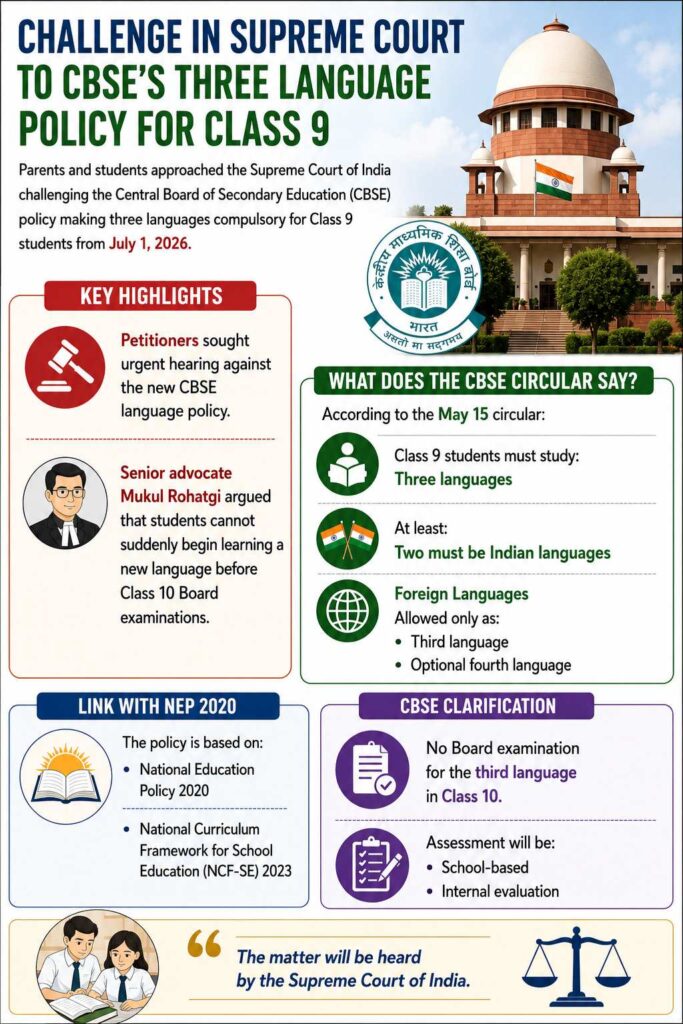
    Parents and students approached the Supreme Court of India challenging the Central Board of Secondary Education (CBSE) policy making three languages compulsory for Class 9 students from July 1, 2026.

    Key Highlights

    • Petitioners sought urgent hearing against the new CBSE language policy.
    • Senior advocate Mukul Rohatgi argued that students cannot suddenly begin learning a new language before Class 10 Board examinations.

    What Does the CBSE Circular Say?

    According to the May 15 circular:

    • Class 9 students must study: Three languages
    • At least: Two must be Indian languages

    Foreign Languages

    • Allowed only as:
      • Third language
      • Optional fourth language

    Link with NEP 2020

    The policy is based on:

    • National Education Policy 2020
    • National Curriculum Framework for School Education (NCF-SE) 2023

    CBSE Clarification

    • No Board examination for the third language in Class 10.
    • Assessment will be:
      • School-based
      • Internal evaluation

    Concerns Raised

    Petitioners argued:

    • Increased academic burden
    • Student stress and peer pressure
    • Difficulty in adapting to a new language at Class 9 stage

    Court Response

    • Chief Justice Surya Kant stated that the matter would be listed before the appropriate Bench next week.

    About the Three-Language Formula

    • Encourages multilingual learning in schools.
    • Originally recommended in earlier national education policies.
    • Aims to promote:
      • Indian languages
      • National integration
      • Linguistic diversity

    [2012] Which of the following provisions of the Constitution of India have a bearing on Education?
    1. Directive Principles of State Policy
    2. Rural and Urban Local Bodies
    3. Fifth Schedule
    4. Sixth Schedule
    5. Seventh Schedule
    Select the correct answer using the codes given below:

    [A] 1 and 2 only

    [B] 3, 4 and 5 only

    [C] 1, 2 and 5 only

    [D] 1, 2, 3, 4 and 5

  • NITI Aayog Report on School Education 

    Why in the News

    NITI Aayog released a report titled “School Education System in India: Temporal Analysis and Policy Roadmap for Quality Enhancement”, highlighting poor student retention and weak learning outcomes in India’s school system.

    Key Findings of the Report

    • Near Universal Primary Access: India has achieved near universal enrolment at the primary level. However, Significant dropouts occur at secondary and higher secondary stages

    Student Dropout Concern

    • Around 4 out of 10 students drop out before completing higher secondary education
    • Reason: Frequent school transitions due to lack of continuous schooling structure.

    Pyramid Structure of Schooling

    The report describes India’s education system as a “sharp pyramid”.

    Statistics

    • Total schools: 14.71 lakh
    • Total students: 24.69 crore
    • Primary schools: 7.3 lakh
    • Higher secondary schools: 1.64 lakh
    [2025] Which of the following statements with regard to recommendations of the 15th Finance Commission of India are correct? 
    I. It has recommended grants of ₹ 4,800 crores from the year 2022-23 to the year 2025-26 for incentivizing States to enhance educational outcomes. 
    II. 45% of the net proceeds of Union taxes are to be shared with States. 
    III. ₹ 45,000 crores are to be kept as performance-based incentive for all States for carrying out agricultural reforms. 
    IV. Its reintroduced tax effort criteria to reward fiscal performance. 
    Select the correct answer using the code given below. 
    [A] I, II and III [B] I, II and IV [C] I, III and IV [D] II, III and IV
  • Global Out of School Population Increased to 273 Million?

    Why in News?

    A UNESCO Report titled 2026 GEM Report Access and Equity Countdown to 2030 revealed that 273 million children, adolescents and youth were out of school globally in 2024, highlighting slow progress toward SDG 4 Education by 2030.

    How Many Children Are Out of School Globally?

    273 million children and youth out of school globally
    • Additional 13 million children excluded in conflict affected countries
    One in six school age children excluded from education
    • Only Two thirds students complete secondary education

    Why Is This Important for SDG 4?

    SDG 4 Goal
    • Inclusive and Equitable Quality Education
    • Lifelong Learning Opportunities
    • Deadline 2030

    Where Does India Stand in the UNESCO 2026 GEM Report?

    The UNESCO 2026 GEM Report does not highlight India among worst performing countries, but India still faces major structural challenges affecting education access, equity and learning outcomes.

    [2011] Consider the following: 
    1 Right to education 
    2 Right to equal access to public service 
    3 Right to food 
    Which of the above is/are Human Right/Human Rights under the “Universal Declaration of Human Rights”? 
    (a) 1 only (b) 1 and 2 only (c) 3 only (d) 1, 2 and 3
  • Medical Shabd Sindhu Initiative

    Why in the News?

    The Union Home Ministry has proposed compiling a standard English medical dictionary titled Medical Shabd Sindhu, which will be translated into 15 Indian languages to support medical education in regional languages under the National Education Policy 2020.

    About the Initiative

    • Led by the Department of Official Language under the Ministry of Home Affairs
    • Compilation of a standard English medical dictionary
    • At least 1,00,000 unique medical terms with explanations
    • Translation into 15 Indian languages in Phase I

    Languages include:

    • Hindi, Telugu, Assamese, Gujarati, Kashmiri, Kannada, Malayalam, Marathi, Odia, Punjabi, Tamil, Bengali, Manipuri, Mizo and Konkani
    • Later expansion to remaining Indian languages

    Institutional Background

    • Commission for Scientific and Technical Terminology under the Education Ministry has translated around 60,000 medical terms into Hindi so far
    • Madhya Pradesh became the first State to offer MBBS in Hindi in 2022
    • Initially, transliterated textbooks were provided in subjects such as anatomy, physiology and biochemistry

    Objectives

    • Promote medical education in mother tongue
    • Remove language barriers in professional courses
    • Strengthen regional language knowledge systems
    • Support NEP 2020 emphasis on multilingual education
    [2024] The Constitution (71st Amendment) Act, 1992 amends the Eighth Schedule to the Constitution to include which of the following languages? 1. Konkani 

    2. Manipuri 

    3. Nepali 

    4. Maithili 

    Select the correct answer using the code given below: 

    (a) 1, 2 and 3 (b) 1, 2 and 4 (c) 1, 3 and 4 (d) 2, 3 and 4

  • [2nd January 2026] The Hindu OpED: Mandating student presence, erasing learning

    PYQ Relevance

    [UPSC 2022] The Right of Children to Free and Compulsory Education Act, 2009 remains inadequate in promoting an incentive-based system for children’s education without generating awareness about the importance of schooling. Analyse.

    Linkage: The question links directly to GS II-Education and Human Resource Development, highlighting the limitations of compulsion-based policy instruments in achieving meaningful learning outcomes. It reinforces the broader UPSC microtheme of quality of education over mere access, aligning with debates on incentive-based, learner-centric education reforms versus coercive administrative approaches.

    Mentor’s Comment

    This article examines the recent Delhi High Court ruling that permits law students to sit for examinations without meeting rigid attendance requirements. The judgment has reopened a long-standing debate on compulsory attendance, academic autonomy, and the purpose of universities in India. The article interrogates whether physical presence ensures learning, or whether coercion undermines intellectual engagement. The discussion is relevant for GS Paper II (Governance, Institutions), GS Paper IV (Ethics in Education), and education reforms in India.

    Introduction

    Compulsory attendance reflects a paternalistic conception of education, rooted in the belief that students must be monitored into learning. Such a framework reduces universities to sites of compliance rather than curiosity. Drawing on decades of classroom experience, coercion produces neither seriousness nor scholarship. Instead, it erodes trust, autonomy, and intellectual responsibility. The High Court ruling disrupts this logic and compels Indian universities to confront a truth long evaded: a classroom that requires force to fill is already pedagogically bankrupt.

    Why in the News

    The Delhi High Court’s affirmation allowing law students to appear for examinations despite not meeting strict attendance thresholds marks a significant departure from entrenched administrative practices in Indian universities. For decades, attendance norms have functioned as instruments of surveillance rather than learning, often barring students from examinations irrespective of academic engagement. The ruling challenges this bureaucratic orthodoxy and reasserts a neglected principle: learning cannot be enforced through coercion

    Does Physical Presence Guarantee Learning?

    1. Attendance as obedience: Attendance functions as a marker of discipline rather than comprehension, measuring compliance instead of engagement.
    2. Learning as internal process: Intellectual growth depends on curiosity, reflection, and dialogue, not bodily presence.
    3. Pedagogical failure indicator: Enforced attendance signals ineffective teaching that fails to attract students voluntarily.
    4. Digital alternatives: Rote knowledge transmission can be accessed more efficiently through digital means, weakening the rationale for compulsory presence.

    Why Is Coercion Incompatible with Education?

    1. Punishment over introspection: Denying examinations penalises students instead of prompting teachers to reassess instructional value.
    2. Loss of trust: Mandatory attendance reflects institutional distrust in students’ intellectual autonomy.
    3. Ethical deficit: Coercion substitutes fear for motivation, undermining the moral foundation of education.
    4. Freirean critique: Education is dialogic and emancipatory, not mechanical deposition of information.

    What Do Exemplary Classrooms Reveal About Learning?

    1. Desire-driven attendance: The most effective classrooms are sustained by interest, not obligation.
    2. Transformative pedagogy: Engagement arises from collective reflection, inquiry, and interpretive openness.
    3. Experiential learning: Outdoor reading, discussion-based interpretation, and reflective inquiry deepen understanding.
    4. Absence made unthinkable: Great teachers render attendance irrelevant by making absence intellectually costly.

    How Has Bureaucratisation Distorted Indian Universities?

    1. Administrative overreach: Universities have shifted from intellectual spaces to regulated bureaucratic shells.
    2. Centralised control: Increasing surveillance has curtailed dissent, debate, and curricular freedom.
    3. Merit erosion: Administrative loyalty increasingly outweighs scholarly merit in institutional hierarchies.
    4. Pedagogical pacification: Attendance mandates function as tools to suppress autonomy and intellectual risk-taking.

    What Does the Judgment Imply for the Future of Teaching?

    1. Pedagogical innovation: Removing coercion compels teachers to create engaging learning environments.
    2. Shift in incentives: Motivation moves from external enforcement to intrinsic intellectual curiosity.
    3. Reframing commitment: Commitment is reflected in engagement, not mere physical presence.
    4. Institutional self-reflection: Universities must reassess whether their systems cultivate thinkers or followers.

    Conclusion

    The Delhi High Court ruling underscores a fundamental distinction: education facilitates discovery; it does not enforce compliance. By decoupling attendance from examination eligibility, the judgment exposes the futility of legislating intellectual engagement. Universities that prioritise presence over participation betray their core mission. The future of higher education depends on recognising that learning flourishes in freedom, not fear.
  • [12th December 2025] The Hindu OpED: The stark reality of educational costs in India

    PYQ Relevance

    [UPSC 2020] National Education Policy 2020 is in conformity with the Sustainable Development Goals-4 (2030). It intended to restructure and re-orient the education system in India. Critically examine the statement.

    Linkage: The article shows how rising education costs hinder NEP 2020’s and SDG-4’s aims of equitable, inclusive, affordable learning. It lets you critique the gap between policy intent and actual access.

    Mentor’s Comment

    The rising cost of education in India, despite constitutional guarantees of free and compulsory schooling, reveals a widening disconnect between policy intent and lived reality. NSS 80th Round data exposes how private schooling, coaching dependence, and high household education spending are reshaping access, equity, and social mobility. 

    Introduction

    Article 21A mandates free and compulsory education for 6-14 years, and NEP 2020 expands this to cover children aged 3-18. Despite this constitutional promise, NSS 80th Round (April-June 2022) on “Comprehensive Education Household Survey” highlights that schooling is becoming increasingly expensive in both urban and rural India. The financial strain has begun to undermine equitable access and intensify class-based educational inequalities.

    Enrolment Trends Reveal Shifting School Preferences

    1. Rising Private School Dependence: NSS shows 28.5% of students in India enrolled in private unaided schools; in urban areas, the share rises to 44.3%.
    2. Gender Disparity Persisting: Urban male enrolment in private schools stands at 44.2% versus 35.6% in rural areas; for girls, the gap remains substantial (41.5% urban vs 29.3% rural).
    3. Low Government School Enrolment: Government school enrolment lowest in urban areas (54.1%), showing preference for private institutions due to perceived quality gaps.
    4. Higher Enrolment in Private Pre-Primary: Shares rise to 37.6% (pre-primary), signalling early shift toward fee-based education.

    Why Are Educational Expenditures Rising?

    1. Higher Private School Fees: Private schools charge ₹7,589/year in rural areas for pre-primary vs much higher figures of ₹33,567 for urban higher secondary.
    2. Urban-Rural Fee Divide: Urban fees for secondary rise sharply to ₹12,021 vs ₹6,157 in rural areas, intensifying inequity.
    3. Coaching Costs Escalate: Households spend monthly on coaching across all classes; 7% rural and 6% urban took paid coaching.
    4. Middle-Income Burden Evident: Private school pre-primary costs equal expenditure of top 5% of households, showing regressive impact.
    5. Hidden Costs Added: Transportation, books, uniforms, and materials raise total expenditure significantly beyond tuition.

    What Does the Survey Reveal About Private Coaching Dependence?

    1. Widespread Coaching Culture: 7% rural and 6% urban students opt for private coaching, an indicator of weak classroom instruction.
    2. Class-Wise Variation: Coaching uptake peaks in higher secondary: 44.6% urban and 30.7% rural.
    3. Fee Escalations: Annual expenditure on coaching is ₹7,708 (urban) and ₹6,063 (rural), adding substantial pressure.
    4. Income-Linked Access: Higher participation among better-off households reinforces achievement gaps.
    5. Shift From School-Based Learning: Coaching becomes parallel schooling for competitive exams and higher education entry.

    How Does Educational Spending Impact Families?

    1. Monthly Financial Strain: Private schooling expenses rise from ₹1,499 (rural primary) to ₹7,297 (rural higher secondary).
    2. Urban Burden Considerably Higher: Urban households pay ₹12,018 for higher secondary on average.
    3. High Share of Household Budget: Poorer households spend disproportionately more on education relative to income.
    4. Limited Access Due to Costs: Low-income families increasingly withdraw or avoid private schooling for affordability reasons.
    5. Prestige and Social Signalling: Private schooling becomes an aspirational commodity symbolising status and mobility.

    Can Strengthened Public Schools Reduce This Inequality?

    1. Better Teacher Availability: Strengthening public schools reduces coaching dependence through improved teaching.
    2. Affordable High-Quality Option: Offers equitable access without catastrophic household expenditure.
    3. Restores Trust in Government Schools: Quality improvements narrow the private-public gap in learning outcomes.
    4. Reduces Social Stratification: Public systems prevent education from becoming a market commodity.
    5. Supports NEP 2020 Vision: Aligns with goal of universal access and foundational literacy-numeracy.

    Conclusion

    There is growing financial, social, and structural inequalities emerging from India’s rising educational costs. As private schooling and coaching dominate, low- and middle-income families face significant strain, threatening the constitutional promise of universal and equitable schooling. Strengthening public education remains the most sustainable path to reducing disparities, rebuilding trust in government schools, and ensuring the education system remains a vehicle of opportunity rather than exclusion.

  • Indian Statistical Institute (ISI) Revamp Bill 

    Why in the News?

    Over 1,500 academics have protested against the Central government’s proposal to repeal the Indian Statistical Institute Act, 1959 and replace it with a new ISI Revamp Bill (Draft ISI Bill 2025). Critics argue that the Bill will erode academic autonomy, alter governance structures, and change the historic character of the ISI.

    About Indian Statistical Institute (ISI)

    • Founded: 1931 by Prasanta Chandra Mahalanobis.
    • Legal Status: Institution of National Importance under ISI Act, 1959.
    • Headquarters: Kolkata (historic location linked to PC Mahalanobis).
    • Centres: Delhi, Bengaluru, Chennai, Tezpur, Giridih, Hyderabad.
    • Academic Strength: ~1,200 students.
    • Fields: Statistics, Mathematics, Quantitative Economics, Computer Science, Cryptology, Library Science, Quality Management, Operations Research.
    • Contributions:
      • Pioneer in sample survey methodology (NSS lineage).
      • Advanced statistical research and public-good-oriented academic model.
      • Free education + stipends ensuring inclusivity.

    Key Features of the Draft ISI Bill 2025

    • Repeals ISI Act, 1959 replaces existing governance and institutional safeguards.
    • Board of Governors gets overriding powers over the Academic Council, reducing the latter to an advisory status.
    • Government-controlled appointment of the Director replaces existing search-cum-selection process.
    • Allows relocation of headquarters from Kolkata raising concerns over institutional heritage.
    • Higher emphasis on revenue generation:
      • Increased student fees.
      • Commercialisation of research outputs.
    • Restructuring of regional centres possible realignment of federal structure.
    Consider the following organizations/bodies in India: 

    1. The National Commission for Backward Classes 

    2. The National Human Rights Commission 

    3. The National Law Commission 

    4. The National Consumer Disputes Redressal Commission 

    How many of the above are constitutional bodies? 

    (a) Only one (b) Only two (c) Only three (d) All four