💥Mains Ready By December. Smash Mains & Smash PYQ Admissions Open

Subject: Energy Security

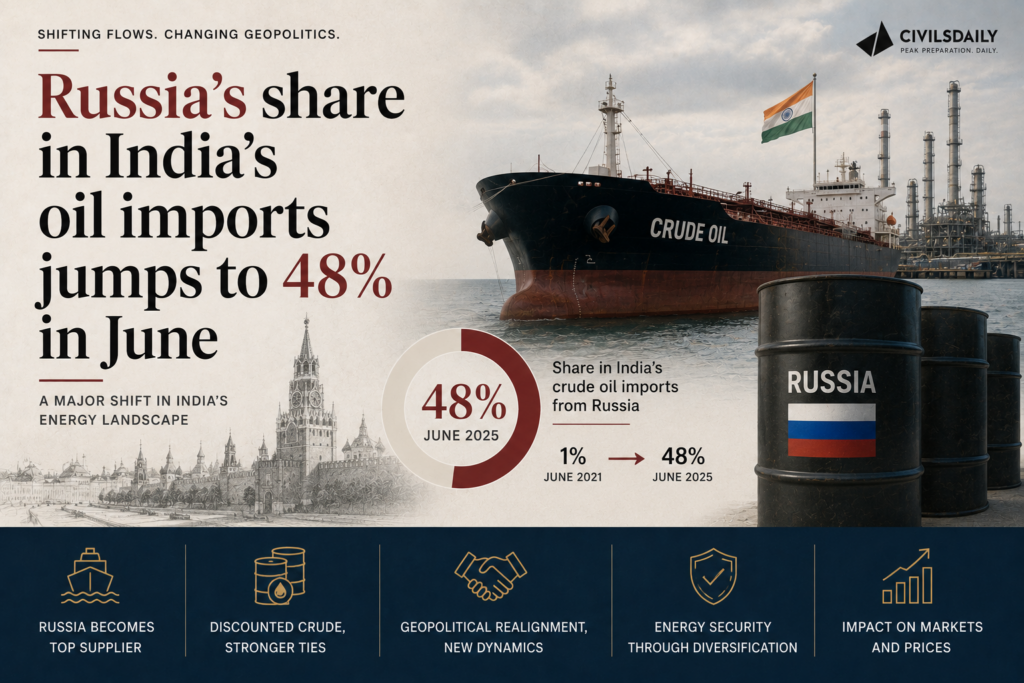
  • Russia’s share in India’s oil imports jumps to 48% in June

    Why in the News

    Russia’s share in India’s crude oil imports rose to an all-time high of 48 percent in June 2026, even as India cut its total crude imports. This comes as the US Senate has passed a bill to levy tariffs of up to 100 percent on the top buyers of Russian oil and gas, placing India’s energy security and its trade exposure to the United States in direct tension.

    What is the Sanctioning Russia and Iran Act of 2026?

    1. Definition: The Lindsey O. Graham Sanctioning Russia and Iran Act of 2026 is a US bill that authorises secondary tariffs of up to 100 percent on countries that continue to buy Russian oil and gas. It targets the largest purchasers of these products from Russia.
    2. Status: The bill was passed by the US Senate and still requires passage by the US House of Representatives before it becomes law.

    What are the tariff triggers under the bill?

    1. Top-buyer test: Tariffs apply to a country that was among the five largest importers of Russian crude oil or natural gas in the 12 months preceding the Act’s enactment.
    2. Continuation test: The tariff applies if that country continues to import Russian oil or gas beyond 30 days after enactment.
    3. Sanctions-evasion clause: Tariffs can also be imposed on countries found to have helped Russia evade sanctions.
    4. India’s exposure: India, alongside China, is one of the top two importers of Russian oil, so it qualifies under these criteria.

    What do the June import figures show?

    1. Fall in total imports: June crude oil imports of 18.2 million metric tonnes (MMT) were 16.5 percent lower than in May 2026 and 13 percent lower than in June the previous year.
    2. Import bill still high: The June oil import bill was 22 percent lower than in May but still 40 percent higher than in June last year, due to elevated crude prices.
    3. Russian purchases held up: India imported 8.7 MMT of Russian oil in June, only 1 percent lower than May and 25 percent higher than a year earlier.
    4. Record Russian share: Russia’s share reached 48 percent by quantity and 48.6 percent by value, rising every month since March.
    5. UAE at a high: The United Arab Emirates (UAE) supplied 17.5 percent of imports by volume and 18 percent by value, its highest share so far.
    6. Concentration: Russia and the UAE together accounted for nearly two-thirds of India’s oil imports in June, the highest combined share from any two countries.
    7. Shrinking discount: The premium Russia charged India rose from a discount as recently as February 2026 to a premium of $10.6 per tonne in June, down from $77.7 per tonne in April.

    How has India pre-empted sanctions exposure?

    1. Ship-to-ship transfers: The Ministry of Petroleum and Natural Gas said exposure was pre-empted through ship-to-ship transfer operations in international waters via the Red Sea route through Yanbu and Fujairah.
    2. Avoiding a single choke point: The aim was to ensure that no single choke point or sanctions regime could halt India-bound cargo.
    3. Refinery flexibility: Indian refineries spent a decade acquiring the flexibility to switch between crude grades and shipping routes when disruption struck.

    Why does the record Russian share expose India?

    1. Energy security dependence: India cannot quickly cut back on Russian oil while supplies through the Strait of Hormuz remain constrained by the West Asia conflict.
    2. Trade and tariff risk: Continued high Russian purchases place India within the top-buyer criteria of the US bill, risking tariffs of up to 100 percent.
    3. Ambiguity on evasion: It is unclear whether India’s ship-to-ship arrangements would be treated as helping Russia evade sanctions.

    Conclusion

    India’s rising dependence on discounted Russian crude has hit a record 48 percent share, secured through diversified shipping routes even as total imports fell. This leaves India balancing its energy security against the risk of secondary tariffs under the US bill. The immediate milestone is the bill’s fate in the US House of Representatives, which will determine whether the tariff threat becomes law.

    Back2Basics:

    Strait of Hormuz

    1. Designation: A narrow strait linking the Persian Gulf to the Gulf of Oman and the Arabian Sea.
    2. Bordering states: Bordered by Iran to the north and Oman and the UAE to the south.
    3. Significance: One of the world’s most critical oil transit choke points, carrying a large share of seaborne crude.

    What is Energy Security? (Foundational Context)

    1. About: Energy security is the uninterrupted availability of energy sources at an affordable price.
    2. Rationale: It matters because India imports the bulk of its crude oil, leaving growth and prices exposed to external supply shocks.
    3. Core dimensions: It rests on availability, affordability, accessibility, and diversification of both sources and supply routes.

    Key Facts about India’s Oil Imports

    1. Import dependence: India imports over 85 percent of its crude oil requirement.
    2. Global standing: India is among the world’s largest crude oil importers and consumers.
    3. Key choke point: The Strait of Hormuz, between the Persian Gulf and the Arabian Sea, carries a large share of India’s West Asian crude.

    Challenges to India’s Energy Security

    1. High import dependence: Reliance on imports for most crude exposes the economy to price and supply shocks.
    2. Geopolitical concentration: A large combined share from Russia and the UAE concentrates supply risk in two sources.
    3. Choke-point vulnerability: Disruption at the Strait of Hormuz can constrain West Asian supply.
    4. Sanctions exposure: Purchases from sanctioned suppliers risk secondary tariffs and financial penalties.
    5. Price volatility: War-driven crude price spikes inflate the import bill and widen the current account deficit.

    Way Forward

    1. Diversify sources: Expand purchases from a wider set of suppliers to reduce concentration.
    2. Build strategic reserves: Enlarge strategic petroleum reserves to cushion supply shocks.
    3. Accelerate clean energy: Scale up renewables, biofuels, and electric mobility to cut import dependence over time.
    4. Secure shipping routes: Maintain logistical flexibility across grades and routes to withstand choke-point disruption.

    PYQ Relevance

    [UPSC 2025] Energy security constitutes the dominant kingpin of India’s foreign policy, and is linked with India’s overarching influence in Middle Eastern countries. How would you integrate energy security with India’s foreign policy trajectories in the coming years?

    Linkage: The PYQ examines the integration of India’s energy security with its foreign policy. India’s record 48% dependence on Russian crude highlights the geopolitical dimension of energy security. The article shows the need to diversify suppliers and routes while balancing ties with Russia, the US and West Asia.
  • Import diversification alone cannot secure India’s energy

    Why in the News?

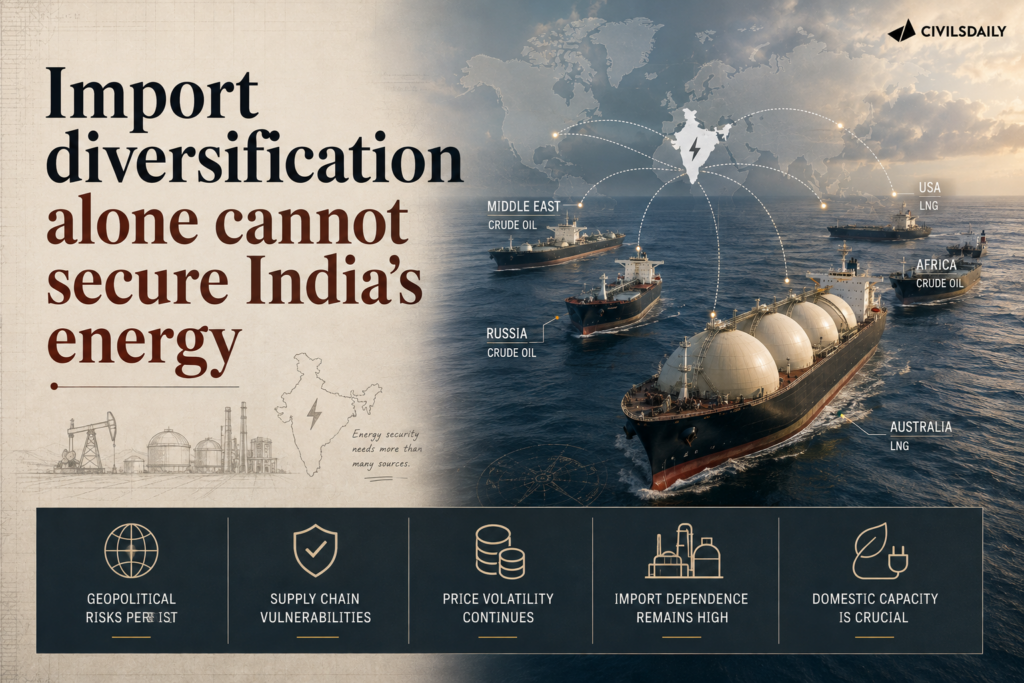
    Diversifying import sources cannot by itself secure India’s energy supply while crude and gas still transit a few chokepoints. The tension is between the visible fix of new suppliers and the hidden vulnerability of the routes those supplies travel.

    What is the energy security problem being described?

    1. Route dependence: India’s crude and Liquefied Petroleum Gas (LPG) flows still pass through a handful of maritime chokepoints.
    2. Supplier shift alone: Adding new source countries does not remove the risk if the shipping route stays the same.

    Which chokepoints concentrate the risk?

    1. Strait of Hormuz: The Gulf’s primary oil export chokepoint, exposed to conflict escalation.
    2. Bab el-Mandeb: The Red Sea gateway threatened by Houthi attacks on shipping.

    How does external policy compound the exposure?

    1. US tariff pressure: Trade measures constrain India’s room to optimise import decisions.
    2. Conflict spillover: West Asia instability raises both price and insurance costs.

    What structural response does the argument imply?

    1. Strategic reserves: Deeper petroleum reserves buffer supply shocks.
    2. Domestic transition: Faster renewable and storage build out reduces import dependence over time.

    Conclusion

    The central idea is that supplier diversification treats the symptom, not the structural route risk. Real energy security needs resilience against chokepoint disruption, not just a longer supplier list.

    PYQ Relevance

    [UPSC 2017] The question of India’s Energy Security constitutes the most important part of India’s economic progress. Analyze India’s energy policy cooperation with West Asian Countries.

    Linkage: The PYQ examines India’s energy security through its dependence on West Asian energy supplies and strategic partnerships. The article highlights how chokepoint dependence and regional instability can undermine India’s energy security despite diversification of suppliers.

  • India cushions energy security against the Strait of Hormuz disruption

    Why in the News?

    India’s Liquefied Natural Gas (LNG) imports rose despite disruption to shipping through the Strait of Hormuz during the West Asia conflict. Imports were diversified to the United States, Nigeria, Oman, and Angola as supply from Qatar collapsed. The Oil and Natural Gas Corporation (ONGC) will also reserve half its Mangaluru facility as a strategic petroleum reserve, exposing the link between supply diversification and physical storage in energy security.

    What is the Strait of Hormuz?

    1. The Strait of Hormuz is the narrow waterway between Iran and Oman connecting the Persian Gulf with the Gulf of Oman and the Arabian Sea. It is a critical energy chokepoint.
    2. Strategic weight: The strait usually carries about a fifth of global oil and LNG shipments. Its disruption during the conflict threatened a large share of India’s gas supply.

    What is Liquefied Natural Gas (LNG)?

    1. Definition: LNG is natural gas cooled to liquid form for transport by ship over long distances. It is regasified at import terminals for use.
    2. India’s dependence: LNG imports meet about half of India’s natural gas requirement. Around 60% of those imports came through the Strait of Hormuz, mainly from Qatar and the UAE.

    How did India cushion the disruption?

    1. Higher overall imports: LNG imports in May-July rose 15.4% year-on-year to 7.08 million tonnes. This followed a near 13% dip in March-April, the first two months of the war.
    2. Supplier diversification: The United States supplied 2.19 million tonnes, up sharply year-on-year. Oman, Nigeria and Angola also rose steeply.
    3. Russian Crude: Russia increased its share to supply roughly 40% of India’s crude imports, bypassing the Hormuz chokepoint entirely.
    4. Collapse of traditional sources: Supply from Qatar plunged 91.3% to 0.23 million tonnes, against a monthly average of 1 million tonnes in 2025. UAE fell 34.4% to 0.55 million tonnes.
    5. Supply over price: India prioritised securing volumes over price to meet demand from city gas, fertiliser, power, and ceramics. LNG prices are expected to stay high, near 19 to 20 dollars per million British thermal units.
    6. Infrastructure Adaptability: West coast terminals like Mundra handled very large crude carriers (VLCCs) from non-Middle Eastern channels.
    7. Ethanol Blending: E20 petrol implementation reduced overall crude import demand by substituting 20% of domestic petrol with local ethanol.

    What is a Strategic Petroleum Reserve?

    1. Definition: A strategic petroleum reserve is a stockpile of crude oil held to cushion supply shocks and price spikes. It is drawn down during import disruptions.
    2. ONGC facility: ONGC is developing a 1.75 million metric tonne facility at Mangaluru. Half of this storage will be reserved as strategic storage, with the rest for commercial operations.
    3. Current buffer: India’s existing crude and petroleum product storage can meet about 74 days of net crude import requirements. The government plans an additional 6.5 million metric tonnes, including at Chandikhol in Odisha and Padur in Karnataka.

    What are the challenges to India’s energy security buffer?

    1. Chokepoint concentration: A single waterway still carries most of India’s Gulf LNG. Any renewed closure of the strait re-exposes this dependence.
    2. Price-driven demand loss: High LNG prices push price-sensitive sectors like industry and power to alternative fuels. This demand destruction undercuts LNG’s role in the energy mix.
    3. Storage gap: A 74-day buffer sits below the 90-day cover the International Energy Agency recommends. Planned reserves are years from completion.
    4. Import dependence: India imports the bulk of its crude and much of its gas. Diversification reduces but does not remove the exposure to external shocks.
    5. Transit workarounds: Some suppliers exported by switching off tanker transponders to evade detection. Such tactics reflect the fragility of normal shipping through the region.

    Conclusion

    India managed the Hormuz disruption by rapidly re-routing LNG procurement to unaffected suppliers rather than cutting imports. The current status is a diversified supplier mix dominated by the United States and Oman, with strategic storage being expanded at Mangaluru and new sites. The next milestone is commissioning the additional 6.5 million tonnes of reserve capacity to lift the buffer toward international norms.

    Back2Basics

    Strategic Petroleum Reserve (SPR)

    1. Definition: A Strategic Petroleum Reserve (SPR) is an emergency crude oil stockpile to protect against supply and price shocks.
    2. Manager: India’s SPR programme is run by Indian Strategic Petroleum Reserves Limited (ISPRL) under the Ministry of Petroleum and Natural Gas.
    3. Phase I sites: Visakhapatnam, Mangaluru, and Padur, with a combined capacity of about 5.33 million metric tonnes.
    4. Global benchmark: The International Energy Agency recommends reserves covering 90 days of net oil imports.
    5. Hormuz significance: The Strait of Hormuz handles roughly a fifth of global oil and LNG trade, making it the world’s most critical oil chokepoint.

    PYQ Relevance

    [UPSC 2025] ‘Energy security constitutes the dominant kingpin of India’s foreign policy, and is linked with India’s overarching influence in Middle Eastern countries.’ How would you integrate energy security with India’s foreign policy trajectories in the coming years?

    Linkage: UPSC recognises energy security as a key determinant of India’s foreign policy and strategic engagement with West Asia. The article shows how supplier diversification, strategic petroleum reserves, and secure maritime supply routes strengthen India’s energy security amid geopolitical disruptions.

  • Clean energy is the order of the day. Describe briefly India’s changing policy towards climate change in various international fora in the context of geopolitics.

    Climate change has emerged as a global security and geopolitical concern. India, 3rd-largest energy consumer, has transitioned from a “climate obstructionist” to a “climate leader and solution provider”

    Clean Energy is the Order of the Day

    Combating Climate Change – Transition to renewables

    Social Benefits – women’s health. (Ujjwala Scheme)

    Economic Benefits – lowering Current Account Deficit (CAD).

    India’s role as a “Vishwaguru of sustainability”

    Geopolitics of Climate Change

    Oil geopolitics (Middle East)

    China’s monopoly in critical minerals (over 90%)

    Green tariffs and carbon taxes. Eg- EU’s Carbon Border Adjustment Mechanism

    North-South Divide and Climate Justice Diplomacy

    Climate-linked Geoeconomics – Eg- G20 Green Development Pact (2023)

    Climate and Security Interlinkages – Climate-induced disasters

    Emerging ‘Energy Identity Politics’

    EU as a “Green Regulatory Power.”

    China as “Green Manufacturing Hub.”

    India as a “Responsible Global South Leader.”

    India’s Changing Policy Towards Climate Change in Various International Fora

    Early Phase -Defensive Stance (Pre-2010)

    Advocated equity and right to development under Kyoto Protocol (1997).

    Opposed binding emission targets for developing countries.

    Supported the principle of CBDR and respective capabilities.

    Shift from defensive to constructive negotiation (2010-2015)

    Copenhagen (2009) & Cancún (2010): Voluntary emission intensity reduction (20-25% by 2020).

    Formation of BASIC bloc (Brazil, South Africa, India, China) to represent emerging economies.

    Leadership Phase (Post-2015 -Present)

    Paris Agreement (2015): India’s NDCs –

    Reduce emission intensity by 33-35% by 2030.

    Achieve 40% non-fossil fuel-based power capacity.

    Create carbon sink of 2.5-3 billion tonnes CO₂ through afforestation.

    COP-26 (Glasgow, 2021): Announced “Panchamrit” commitments -including Net Zero by 2070 and 50% energy capacity from renewables.

    UNFCCC (COP28): Leading Global South demand for loss and damage fund and fair carbon markets.

    Global South Leadership – Eg- FIPIC (Forum for India-Pacific Islands Cooperation)

    International Solar Alliance (ISA, 2015): Jointly launched with France to mobilize solar adoption across 100+ countries.

    Coalition for Disaster Resilient Infrastructure (CDRI, 2019): Focus on climate-resilient infrastructure in developing nations.

    G20 Presidency (2023): Advocated Green Development Pact and Just Energy Transition for Global South.

    Quad Climate Group: Promoting clean hydrogen, green shipping, and resilient supply chains.

    BRICS & SCO: Advocates equitable climate finance, green technology transfer, and multipolar environmental governance.

    India’s other efforts towards climate change and Clean energy

    National Action Plan on Climate Change (NAPCC)

    National Solar Mission (280 GW solar capacity by 2030)

    National Green Hydrogen Mission (5 MMT by 2030)

    One Sun, One World, One Grid (OSOWOG)

    IPEF (Indo-Pacific Economic Framework): Includes clean energy, decarbonisation.

    As per Dhanasree Jayaram (Climate Diplomacy and Emerging Economies) India has evolved from a ‘naysayer’ to a ‘responsible’ player in Climate Diplomacy.

  • “Energy security constitutes the dominant kingpin of India’s foreign policy, and is linked with India’s overarching influence in Middle Eastern countries.” How would you integrate energy security with India’s foreign policy trajectories in the coming years?

    India is the world’s 3rd largest energy consumer, importing over 85% of its crude oil and 55% of natural gas. The Middle East accounts for nearly 60% of India’s crude imports.

    Energy Security is dominant kingpin of India’s foreign policy due to

    India’s energy demand is projected to double by 2040 (IEA). Energy diplomacy is central to India’s economic growth and geopolitical outreach.

    Geopolitical Risks – Instability in West Asia (Iran-Israel tensions, Strait of Hormuz) threatens supply chains.

    Price Volatility – Fluctuating global oil prices widen India’s current account deficit.

    US sanctions on Iran, Venezuela, Russia limit India’s diversification options

    China’s aggressive investments in overseas oilfields and LNG projects crowd out India. Eg- in Africa

    Infrastructure Gaps – Limited strategic petroleum reserves, LNG terminals, and pipelines.

    Integrating Energy Security with India’s Foreign Policy

    A. Short-Term Measures (2025-2030)

    Diversification of Suppliers- Expand sourcing from US, Russia, Africa, and Latin America.

    Expand Strategic Petroleum Reserves capacity from 5.3 MMT to 10 MMT.

    Chabahar & INSTC Connectivity- Use Iran-Central Asia corridor to secure overland energy routes and bypass chokepoints.

    Maritime and Energy Diplomacy- Strengthen cooperation with UAE, Saudi Arabia, and Oman for logistics bases and secure sea lines of communication.

    Financial Resilience- Develop Rupee-based oil trade and local currency settlements to cushion against dollar volatility and sanctions.

    B. Long-Term Measures (2030-2050)

    “Nearshoring” energy supplies and greening the Indian grid under Neighbourhood First policy. Eg- hydropower projects in Nepal

    Review of Civil Liability for Nuclear Damage Act and Atomic Energy Act for FDI in civil nuclear power.

    Green Energy Partnerships-

    Collaborate with Gulf nations on green hydrogen, solar parks, and carbon capture (India-UAE Green Energy Corridor).

    Promote India as a global hub for renewable technology and green financing.

    Energy Investments Abroad-

    Scale ONGC Videsh and IOCL investments in upstream oil and gas fields in Iraq, UAE, Mozambique, and Russia.

    Establish a Sovereign Energy Investment Fund for strategic acquisitions.

    Critical Minerals Diplomacy- Partner with CAR and African nations for lithium, nickel, and cobalt supply chains.

    Institutional Integration- Create an Energy Diplomacy Wing within MEA for coherent foreign policy alignment.

    “Energy security is not just about fuel, it is about strategic autonomy, and India’s foreign policy must secure both.” – M.K.Narayanan