💥Join UPSC 2027,2028 Mentorship (July Batch) + XFactor Notes & Microthemes PDF

Subject: Fundamental Rights,DPSP

1. History + Evolution
2. Features
3. Amendments
4. Basic Structure

  • What is the right to be forgotten? 

    Why in the News?

    The Delhi High Court, ruling on 29 May 2026 in Laksh Vir Singh Yadav v. Union of India, laid down India’s first structured proportionality test for the right to be forgotten. The ruling forces a direct reckoning between an individual’s right to informational privacy and the constitutional commitment to open justice and free speech.

    How did the right to be forgotten emerge, and why did Indian courts arrive at it inconsistently?

    1. Origin in EU jurisprudence: The right originated in 2014 when Mario Costeja González complained to the European Court of Justice that Google continued to display an old notice about the auction of his repossessed house even after the debt was settled.
    2. Codification in General Data Protection Regulation (GDPR): The European Court ruled in his favour. This laid the groundwork for the right to erasure, later incorporated into Article 17 of the EU’s General Data Protection Regulation.
    3. Constitutional anchor in India: The Supreme Court’s judgment in K.S. Puttaswamy v. Union of India (2017) held that privacy is a Fundamental Right under Article 21 of the Constitution of India. This includes the right to informational privacy.
    4. Divergent High Court practice: High Courts adopted inconsistent approaches after Puttaswamy. Some permitted anonymisation in limited cases, such as the Delhi High Court’s masking of names in certain matrimonial and criminal matters.
    5. The unresolved gap: Other courts rejected similar requests on grounds of open justice. No coherent framework existed to balance these competing interests before the May 2026 judgment.

    What test did the Delhi High Court lay down, and what does it require?

    1. The core issue: The Delhi High Court ruled on a batch of over 30 consolidated petitions. The central question was whether informational privacy could justify de-indexing or masking judicial records in a system committed to open justice.
    2. Constitutional source of the right: The court held that the right to be forgotten flows from Article 21’s guarantee of dignity and informational privacy.
    3. The proportionality test: Any restriction must have a legitimate purpose. The harm to privacy must be balanced against the public interest.
    4. Preference for the least intrusive means: Masking names should be preferred over deleting the entire judgment.
    5. Procedural direction: The court prescribed a two-week deadline for legal databases to comply. It clarified that only the parties’ names should be redacted, not the facts of the case.

    Why does the right to be forgotten sit in tension with open justice and free speech?

    1. Not a stand-alone right: The right to be forgotten frequently conflicts with freedom of speech and press under Article 19(1)(a), the principle of open justice, and the public’s right to know.
    2. A high threshold for privacy: A right to privacy must be sacrificed when the public interest is of a high order, particularly in serious cases of crime.
    3. The limiting principle: The digital presence of a case should not destroy a person’s life long after the trial ends.
    4. Selective, not absolute, restriction: Judgments remain publicly accessible by case number or keyword search. Only name-based searches are restricted.
    5. The unresolved concern: For an acquitted person, a name-based search can still surface the original accusation, described as the “shadow of crime,” as the first result a user sees.

    Why does enforcement remain the weakest link in this framework?

    1. Search engine design defeats masking: Search results are still generated at the search-engine level. Removing a court’s own copy does not remove all traces.
    2. Persistence beyond the primary source: Mirrors, archived copies, and social media sharing keep the original content accessible even after a court orders removal.
    3. No coordination mechanism: Effective technical compliance requires coordination among multiple platforms. No such mechanism currently exists.
    4. Consequence for the right’s value: Without platform-level compliance, the right to be forgotten remains largely symbolic rather than enforceable.

    What is the statutory basis for erasure under the Digital Personal Data Protection Act, 2023 (DPDP Act), and why is it inadequate for judicial records?

    1. Limited existing statutory right: The Digital Personal Data Protection Act, 2023 offers a limited right to erasure under Section 12.
    2. Consent-based design: This statutory right is primarily based on consent. It does not explicitly address judicial records.
    3. Scope gap: The Act does not cover public archives, where the need for a right to be forgotten is most acute.
    4. Non-operational status: The Act is deficient because its rules have not been notified.
    5. Missing institution: The data protection board contemplated under the Act has not been established.

    Who should decide erasure requests, and how should that authority be structured?

    1. The efficiency-accountability trade-off: Requiring every request to be decided by a court would create significant bottlenecks. Leaving decisions entirely to technology companies raises concerns about due process and transparency.
    2. A tiered proposal: A more sensible approach would use a tiered system.
    3. First tier: platforms: Straightforward cases could be heard directly by platforms.
    4. Second tier: data protection board: Contested cases would go to the data protection board.
    5. Third tier: courts: Judicial cases, including those with constitutional questions, would be reserved for courts.

    Conclusion

    The Delhi High Court’s ruling gives the right to be forgotten its most structured judicial articulation in India, subordinating deletion to name-masking to protect dignity without eroding open justice. This framework remains judge-made and non-statutory: the DPDP Act does not cover judicial records, the data protection board does not exist, and search engines retain wide discretion over technical compliance. Until the Supreme Court settles the doctrine nationally and a statutory institution is created to adjudicate erasure requests, the right to be forgotten in India will function more as a judicial aspiration than an enforceable entitlement.

    PYQ Relevance

    [UPSC 2024] Right to privacy is intrinsic to life and personal liberty and is inherently protected under Article 21 of the constitution. Explain. In this reference, discuss the law relating to D.N.A. testing of a child in the womb to establish its paternity.

    Linkage: The article similarly examines the Right to be Forgotten as an aspect of informational privacy under Article 21 and its balance with freedom of speech, the public’s right to know and the principle of open justice.
  • [3rd July 2026] The Hindu OpED: The right to a fair trial at the crossroads

    PYQ Relevance[UPSC 2023] The Constitution of India is a living instrument with capabilities of enormous dynamism. It is a constitution made for a progressive society. Illustrate with special reference to the expanding horizons of the right to life and personal liberty.
    Relevance: The PYQ directly covers the expansion of Article 21, including the right to speedy trial, fair procedure and personal liberty. The editorial argues that prolonged incarceration without trial violates the evolving constitutional guarantee under Article 21.

    Why in the News?

    The Supreme Court denied bail to Umar Khalid and Sharjeel Imam in the 2020 Delhi riots case earlier this year, though they have been in pre-trial detention for nearly six years. This has renewed the question of how long an accused can be held without trial, and exposed inconsistency in how courts weigh delay against the gravity of the offence under the Unlawful Activities (Prevention) Act (UAPA), 1967. At stake is whether pre-trial incarceration under anti-terror law is becoming punishment before conviction.

    Why does prolonged pre-trial detention under the UAPA raise a constitutional question of personal liberty?

    1. Delay triggers Article 21 right: The Supreme Court’s own prior judgments hold that an extended trial delay triggers the accused’s right to personal liberty under Article 21.
    2. Statutory conditions cannot override the Constitution: The UAPA’s strict bail conditions cannot override the constitutional right to personal liberty.
    3. Gravity of offence remains an allegation: At the bail stage, the gravity of the offence is only an allegation made by the state, not a proven fact.
    4. Sliding scale of detention: Allowing gravity to override delay creates a sliding scale that keeps certain individuals in jail for years simply because they are accused of grave offences.
    5. Precedent of prolonged wrongful detention: Individuals accused under the UAPA have been held in jail for over two decades before being acquitted, losing the most productive years of their lives.

    Does weighing the gravity of the offence against delay protect due process, or does it convert the trial into the punishment itself?

    1. Judge controls the pace of trial: The judge, not the accused, controls the courtroom and decides the pace of the trial.
    2. Responsibility for delay rests with the judiciary: The judge bears the ultimate responsibility to complete a trial within a reasonable timeframe, regardless of applications filed by either side.
    3. Internal Court criticism: A separate two-judge Bench of the Supreme Court openly criticised the Delhi riots bail rejection as contrary to established precedent.
    4. Reaffirmation of the rule of law: The Bench reiterated that individuals cannot be incarcerated indefinitely without trial under a Constitution committed to the rule of law.
    5. Delay used as a proxy for guilt: Treating an unproven allegation of gravity as sufficient ground to override delay effectively punishes the accused before the trial concludes.

    Why does inconsistency across and within courts on UAPA bail undermine the rule of law?

    1. Referral to a larger Bench: In a related case, the Delhi riots Bench referred the question of how long pre-trial detention can continue to the Chief Justice, for the constitution of a larger Bench.
    2. Unresolved apex court debate: The Supreme Court is now debating whether individuals who have spent over half a decade in jail without trial should be released, and the question remains open even as detention continues to lengthen.
    3. Contrasting High Court rulings: The Delhi High Court granted bail to Kashmiri human rights activist Khurram Parvez after more than four years without trial, weighing the length of detention heavily.
    4. Same judge, opposite outcomes: The judge who granted Khurram Parvez bail had earlier denied bail in the Delhi riots case, where the accused had already spent over four years in jail.
    5. Same facts, different verdicts a year apart: In the Delhi riots case itself, the same judge delivered opposing bail judgments on the same underlying facts within a year.

    What limited international references does the article draw upon to illustrate this concern? 

    1. France, Dreyfus comparison: The article compares the over-five-year detention of the Delhi riots accused to the imprisonment of Captain Alfred Dreyfus, a French political prisoner, without detailing the length or process of the Dreyfus case itself.
    2. United Kingdom and United States, dissent conflated with terrorism: The article cites recent actions in the UK and US against dissent linked to the Israel-Palestine conflict as examples of states blurring political dissent with terrorism, without naming a specific law or institutional mechanism.

    Why does the political character of laws like the UAPA make judicial consistency especially critical?

    1. Political character of anti-terror law: Laws such as the UAPA carry an undeniably political character because they criminalise activities that can also constitute legitimate dissent.
    2. Global pattern of blurring dissent and terrorism: States across the world have repeatedly interpreted anti-terror laws in ways that blur the line between political dissent and terrorism.
    3. Consequence of inconsistency: Repeated inconsistency across cases and courts on a basic issue like pre-trial incarceration damages the rule of law and the cause of fundamental rights.

    What must the judiciary ensure to prevent laws like the UAPA from being weaponised?

    1. Non-negotiable constitutional floor: The state cannot keep people behind bars for years without trial, regardless of how legal interpretation is otherwise contested.
    2. Process as punishment: Allowing incarceration without trial to continue makes a mockery of the rule of law and entrenches the pre-trial process itself as the punishment.
    3. Pending resolution: It remains unclear whether or when the Supreme Court’s larger Bench will resolve the underlying question.
    4. Continuing cost: Umar Khalid and Sharjeel Imam remain in custody as the last two accused student activists in the Delhi riots case, with five years in prison having turned into six.
    5. Rising stakes: The cost of continued detention falls both on the lives of the imprisoned individuals and on the credibility of the rule of law.

    Conclusion

    Judicial inconsistency in weighing delay against the gravity of offence is allowing pre-trial detention under laws like the UAPA to function as punishment before conviction. This threatens the constitutional right to personal liberty under Article 21 and creates space for anti-terror law to be used against political dissent. Until the Supreme Court’s larger Bench settles the doctrine, cases such as that of Umar Khalid and Sharjeel Imam will continue to test the gap between the rule of law and its practice.

  • [16th June 2026] The Hindu OpED: Peace with peace: On preventive detentions

    Mentor’s Comment

    The Allahabad High Court’s ruling in Chander Pal Singh v. State of Uttar Pradesh has revived debate on the misuse of preventive detention and preventive proceedings in India. The judgment is significant because it directly questions the routine use of extraordinary executive powers against citizens without substantive criminal charges.

    Why has the Allahabad High Court judgment become a significant intervention in preventive detention jurisprudence?

    The Allahabad High Court, in Chander Pal Singh, criticized the routine misuse of preventive proceedings by police and executive magistrates in Uttar Pradesh. The Court observed that powers intended to prevent threats to public order were being employed to detain individuals without substantive criminal charges, resulting in unjustified deprivation of personal liberty. The judgment seeks to strengthen accountability mechanisms and reaffirm constitutional safeguards against arbitrary state action.

    1. Judicial Intervention: The Court simultaneously addressed an individual case and a broader systemic problem involving preventive proceedings.
    2. Liberty Concerns: The judgment described the situation as a “highly irresponsible” deprivation of personal liberty.
    3. Structural Reform: It proposed guidelines to regulate preventive powers and strengthen accountability.
    4. Constitutional Significance: It re-emphasized Article 21 protections against arbitrary deprivation of liberty.
    5. First Major Pushback: The ruling attempts to impose personal accountability on officials responsible for unlawful detention, a relatively rare judicial approach.

    How are preventive powers intended to function and how are they allegedly being misused?

    1. Preventive Purpose: Preventive powers allow the State to intervene before a crime occurs when there is reasonable apprehension of threat to public order.
    2. Exceptional Nature: Such powers are intended for extraordinary situations involving potential disturbances.
    3. Routine Application: The Court observed that authorities increasingly employ these powers as routine administrative tools.
    4. Absence of Criminal Charges: Individuals are often detained without substantive criminal accusations.
    5. Minor Disputes: Authorities reportedly invoke preventive proceedings even in neighbourhood and property disputes.
    6. Executive Overreach: Police officers and executive magistrates allegedly use preventive provisions based on weak or speculative apprehensions.

    What constitutional principles are involved in the debate on preventive detention?

    1. Article 21: Ensures protection of life and personal liberty except according to procedure established by law.
    2. Article 22: Provides safeguards against arbitrary arrest and detention while permitting preventive detention under specific circumstances.
    3. Rule of Law: Requires legality, reasonableness and non-arbitrariness in state action.
    4. Natural Justice: Supports fair hearing and procedural safeguards.
    5. Proportionality: Restricts excessive state action beyond legitimate objectives.
    6. Constitutional Morality: Balances public order with civil liberties and democratic dissent.

    What facts in the Chander Pal Singh case exposed systemic concerns?

    1. Petitioner: Chander Pal Singh, a physically challenged Dalit advocate.
    2. Immediate Cause: He was arrested following a petty dispute with a neighbour.
    3. Illustration of Misuse: The Court treated the case as representative of broader misuse of preventive powers.
    4. Administrative Pattern: The judgment highlighted recurring executive reliance on preventive incarceration rather than ordinary criminal procedures.

    How serious is the scale of preventive proceedings highlighted by the Court?

    1. Magnitude: Around 2,500 individuals were reportedly subjected to preventive detention proceedings in Ghaziabad between May 2025 and April 2026.
    2. Policy Failure: These actions occurred despite a 2021 State policy intended to guide and regulate such powers.
    3. Systemic Nature: The data indicates that misuse is not isolated but institutional in scale.
    4. Governance Challenge: The figures suggest preventive provisions may have become a substitute for regular legal processes.

    What reforms and safeguards did the Court seek to introduce?

    1. Executive Justification: Requires executive magistrates to justify preventive detention decisions.
    2. Constitutional Review: Encourages constitutional challenges against unlawful detention.
    3. Appellate Scrutiny: Promotes higher judicial review of compensation mechanisms.
    4. Compensation Framework: Strengthens remedies available to victims of unlawful detention.
    5. Administrative Accountability: Enables recovery of compensation from salaries of responsible magistrates and/or police officers after disciplinary proceedings.
    6. Deterrence Effect: Seeks to discourage arbitrary use of preventive powers.

    How could the ruling affect protest-related and dissent-related detentions?

    1. Communal Tension Claims: The Court criticized reliance on vague references to “communal tensions” to justify incarceration.
    2. Bond Requirements: It questioned the practice of imposing prohibitively expensive bonds for release.
    3. Protection of Dissent: The judgment rejects the notion that maintaining peace can justify silencing dissent.
    4. Sonam Wangchuk Context: Though not directly related to his detention under the NSA, the ruling implicitly critiques similar uses of preventive powers against activists.
    5. Recent Detentions: The principles may apply to persons detained under Sections 126 and 170 of the BNSS without valid grounds.
    6. Democratic Significance: Reinforces that public order cannot become a blanket justification for restricting civil liberties.

    What challenges may hinder implementation of the Court’s directions?

    1. Administrative Reluctance: Governments have historically been hesitant to penalize officials for misuse of authority.
    2. Institutional Incentives: Executive magistrates are part of the State administration and often operate within bureaucratic hierarchies.
    3. Career Pressures: Officials may prioritize maintaining “peace” as defined by the State.
    4. Weak Enforcement: Accountability provisions may remain ineffective without sustained judicial monitoring.
    5. Structural Dependence: The executive and law enforcement apparatus often function in close coordination, reducing internal checks.

    Value Addition

    How does the Constitution regulate preventive detention under Article 22?

    1. Constitutional Architecture: Balances state security concerns with minimum procedural safeguards for personal liberty.
    2. Constitutional Recognition: Article 22(3)-22(7) explicitly permits preventive detention while prescribing safeguards against arbitrary exercise of power.
    3. Exceptional Nature: Preventive detention operates outside ordinary criminal justice procedures because detention occurs based on anticipated threats rather than proven offences.

    Suspension of Standard Criminal Procedure Rights

    1. Exemption from Article 22(1) and 22(2): Preventive detainees do not enjoy certain protections available to ordinary arrestees.
    2. Grounds of Arrest: Authorities are not required to provide immediate disclosure in the same manner as ordinary criminal arrests.
    3. Legal Representation: Detainees do not possess an absolute right to consult a lawyer of their choice at the detention stage.
    4. Magisterial Production: Requirement of production before a magistrate within 24 hours does not apply to preventive detention cases.

    Procedural Safeguards Retained by Detainees

    1. Communication of Grounds: Article 22(5) requires authorities to communicate grounds of detention as soon as possible.
    2. Representation against Detention: Authorities must provide the earliest opportunity to challenge the detention order through representation.
    3. Natural Justice Principle: Ensures minimum procedural fairness despite the exceptional nature of detention.

    State Privilege of Non-Disclosure

    1. Public Interest Exception: Article 22(6) permits withholding information whose disclosure is considered against public interest.
    2. Security Consideration: Protects sensitive intelligence and security-related inputs underlying detention decisions.

    What is the significance of the Advisory Board mechanism under Article 22?

    Advisory Board Review: Provides independent scrutiny of executive detention orders.

    1. Three-Month Limit: Article 22(4) prohibits detention beyond three months unless reviewed by an Advisory Board.
    2. Independent Assessment: Board examines whether sufficient cause exists for continued detention.
    3. Check on Executive Power: Prevents indefinite detention solely on executive discretion.

    Composition of the Advisory Board

    1. Judicial Qualification: Members must be persons who are, have been, or are qualified to be appointed as High Court Judges.
    2. Institutional Safeguard: Introduces legal expertise into preventive detention review.

    Which legislature has the authority to enact preventive detention laws?

    1. Legislative Competence: Divides law-making powers between Parliament and State Legislatures under the Seventh Schedule.

    Exclusive Parliamentary Jurisdiction (Union List – Entry 9)

    1. Defence of India: Parliament alone can legislate on preventive detention related to national defence.
    2. Foreign Affairs: Parliament exclusively regulates detention linked to international relations.
    3. Security of India: National security-related detention laws fall solely within Union competence.

    Concurrent Jurisdiction (Concurrent List – Entry 3)

    1. Security of the State: Both Parliament and State Legislatures may enact laws.
    2. Public Order: Legislatures can provide preventive detention mechanisms to address threats to public order.
    3. Essential Supplies and Services: Laws may prevent activities disrupting critical community supplies and services.

    Which major preventive detention laws operate in India today?

    1. National Security Act (NSA), 1980
      1. National Security: Authorizes detention to prevent activities prejudicial to India’s security.
      2. Public Order: Permits detention for maintaining public order.
      3. Executive Authority: Empowers both Central and State Governments.
    2. Unlawful Activities (Prevention) Act (UAPA), 1967
      1. Counter-Terrorism Framework: Addresses terrorism and unlawful activities.
      2. Stringent Bail Provisions: Restricts bail, resulting in prolonged incarceration during investigation.
      3. Preventive Effect: Functions similarly to preventive detention in certain cases.
    3. Prevention of Blackmarketing and Maintenance of Supplies of Essential Commodities Act, 1980
      1. Economic Security: Prevents activities affecting availability of essential commodities.
      2. Supply Chain Protection: Ensures uninterrupted access to essential goods.
    4. State-Specific Preventive Detention Laws
      1. Public Safety Act (PSA): Operates in Jammu & Kashmir for security-related concerns.
      2. Goonda Acts: Various states use these laws against habitual offenders and perceived threat actors.
      3. Localized Framework: Addresses region-specific law and order challenges.

    What powers does Parliament possess under Article 22(7)?

    Parliamentary Oversight: Determines the outer limits of preventive detention laws.

    1. Maximum Detention Period: Prescribes the maximum duration of detention under specific laws.
    2. Extended Detention Categories: Defines circumstances where detention beyond three months may occur without Advisory Board review.
    3. Advisory Board Procedure: Establishes procedural rules governing Board inquiries and review mechanisms.

    How has the judiciary evolved safeguards against misuse of preventive detention?

    1. Procedural Rigidity: Ensures strict compliance with constitutional safeguards
    2. Technical Compliance: Courts routinely invalidate detention orders for procedural violations.
    3. Delay in Representation: Unreasonable delay in considering detainee representations can render detention unconstitutional.
    4. Burden on State: Authorities must strictly adhere to statutory requirements.

    Subjective Satisfaction Doctrine

    1. Credible Material: Executive authorities must rely on relevant and credible evidence.
    2. Genuine Threat Assessment: Detention must be based on actual apprehension of future harm.
    3. Protection against Arbitrariness: Courts reject detention based on vague suspicions or unsupported allegations.

    Proximity Principle

    1. Live Link Requirement: Past conduct must have a direct and continuing connection with the present threat.
    2. Stale Incidents Insufficient: Old criminal records alone cannot justify fresh detention orders.
    3. Future-Oriented Assessment: Preventive detention must address imminent risks rather than punish past actions.

    Conclusion

    Preventive detention may be constitutionally permissible, but its legitimacy depends on strict procedural safeguards and judicial oversight. The Allahabad High Court’s intervention reiterates that public order cannot come at the cost of personal liberty, and that accountability is essential to preserving the rule of law.

  • [4th June 2026] The Hindu OpED: Preserving the record: On the right to be forgotten

    PYQ Relevance[UPSC 2017] Examine the scope of Fundamental Rights in the light of the latest judgement of the Supreme Court on Right to Privacy
    Linkage: The question examines the expansion of Article 21 and the constitutional status of informational privacy after the Puttaswamy judgment. The Right to be Forgotten is a direct extension of the right to informational privacy, raising questions about balancing privacy with open justice, transparency, and public access to judicial records.

    Mentor’ Comment

    A recent Delhi High Court order on the Right to be Forgotten has revived the debate over whether individuals can seek removal of their names from online court records. The case is significant because it brings into direct conflict two constitutional principles, the right to privacy recognised in the Puttaswamy judgment (2017) and the principle of open justice. This comes at a time when digitisation and search engines have made judicial records permanently accessible and searchable.

    What is the Right to be Forgotten?

    1. The Right to Be Forgotten (RTBF) is the legal concept that empowers individuals to request the removal, erasure, or de-indexing of their personal data from internet searches, databases, and public platforms when that information becomes outdated, irrelevant, or harmful to their reputation
    2. It is built on the principle of informational self-determination, allowing people to reclaim control over their digital narrative and move on from past events without facing lifelong social or professional stigma.

    What is the Open Justice Principle?

    1. The Open Justice Principle is a foundational legal rule stating that judicial proceedings and records must be open to the public and the media to guarantee transparency, fairness, and public trust in the legal system. 
    2. It is summarized by the classic legal maxim: “Justice must not only be done, but must manifestly and undoubtedly be seen to be done.”

    How Has Digitisation Transformed the Debate on Open Justice and Privacy?

    1. Digital Permanence: Court records remain searchable indefinitely through search engines and online legal databases.
    2. Expanded Accessibility: Judicial records are accessible globally to anyone with internet access.
    3. Automated Archiving: Search engines and digital repositories replicate records across multiple platforms.
    4. Enhanced Public Scrutiny: Facilitates public understanding of judicial processes and legal developments.
    5. Persistent Reputational Impact: Allegations may remain associated with individuals even after acquittal or discharge.

    Implication

    The digital environment has transformed court publicity from a temporary consequence into a potentially permanent one

    Why Does the Right to be Forgotten Conflict with the Principle of Open Justice?

    1. Privacy Protection: Enables individuals to exercise control over personal information.
    2. Transparency Requirement: Ensures judicial functioning remains open to public scrutiny.
    3. Historical Record: Judicial decisions form part of the state’s official record.
    4. Democratic Accountability: Open records strengthen public confidence in courts.
    5. Freedom of Expression: Access to information supports informed public discourse.

    Core Constitutional Tension

    Right to PrivacyOpen Justice
    Protects personal dignityEnsures transparency
    Limits unnecessary exposureFacilitates public scrutiny
    Supports informational autonomyPreserves public records
    Prevents perpetual stigmaMaintains historical accuracy

    Why Did the Delhi High Court Favour Greater Privacy Protection?

    1. Search Engine Excerpts: Search engines may display isolated portions of judgments without context.
    2. Name-Based Discovery: Public access does not necessarily require searching cases through an accused person’s name.
    3. Replication Problem: Updating official records may not update copies stored on other websites.
    4. Context Loss: Fragmented information can misrepresent judicial outcomes.
    5. Digital Harm: Continuous association with allegations may affect reputation despite legal exoneration.

    Judicial Concern

    The Court recognized that merely updating records may not adequately protect privacy because digital content often persists across multiple platforms.

    Is Discoverability the Real Problem, or Is It Incomplete Information?

    The core issue is not public access itself but incomplete records.

    1. Acquittal Visibility: Searches should reveal both allegations and subsequent acquittals.
    2. Contextual Accuracy: Complete judicial history should accompany search results.
    3. Information Integrity: Users should receive accurate and updated records.
    4. Balanced Disclosure: Transparency should include final outcomes, not merely initial accusations.
    5. Digital Correction: Records should evolve with judicial developments.

    Example

    If an individual is acquitted, anyone accessing the proceedings should also immediately find the acquittal order instead of only the original accusation.

    Why Are Judicial Records Treated as Public Records of the State?

    1. Official Character: Court records constitute official acts of the State.
    2. Institutional Memory: They preserve the history of judicial administration.
    3. Legal Precedent: Judicial decisions guide future legal interpretation.
    4. Public Accountability: Citizens can assess judicial functioning.
    5. Rule of Law: Transparent records strengthen trust in legal institutions.

    Can Digital Accuracy Offer a Better Solution than Digital Erasure?

    Key Measures

    1. Record Updating: Reflect acquittals, discharges, settlements, and final outcomes prominently.
    2. Database Synchronisation: Ensure legal repositories regularly update records.
    3. Contextual Search Results: Display complete procedural history.
    4. Judicial Oversight: Impose obligations on registries and legal information platforms.
    5. Responsible Indexing: Ensure search engines provide context alongside judicial records.

    Expected Outcome: Protects privacy without undermining transparency or historical recordkeeping.

    How Does the European Experience Inform the Debate?

    The concept gained massive global prominence following the landmark 2014 Google Spain v. AEPD ruling by the Court of Justice of the European Union (CJEU). It is now strictly codified under Article 17 of the General Data Protection Regulation (GDPR) as the “Right to Erasure”

    1. European Origin: RTBF emerged in response to persistent digital records.
    2. Balancing Test: Privacy claims are assessed against freedom of expression and public interest.
    3. Context-Based Approach: No absolute right to deletion exists.
    4. Public Interest Exception: Information relevant to public accountability may remain accessible.
    5. Proportionality Principle: Competing rights are balanced case-by-case.

    Conclusion

    The challenge is not whether judicial records should be accessible, but whether they should remain accurate and complete in the digital age. A balanced approach that preserves open justice while ensuring updated and contextualised records can protect both privacy and transparency, thereby strengthening public trust in the judiciary and the rule of law.

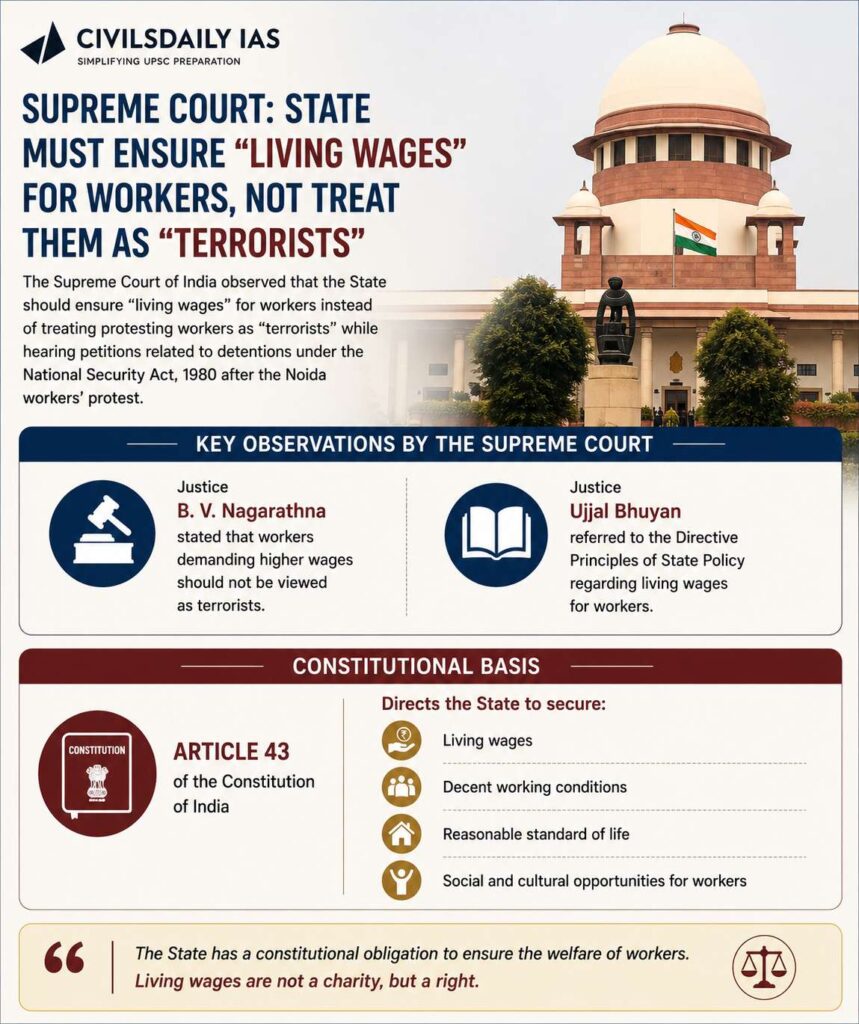
  • Supreme Court on Workers’ Right to Living Wage

    Why in the News?

    The Supreme Court of India observed that the State should ensure “living wages” for workers instead of treating protesting workers as “terrorists” while hearing petitions related to detentions under the National Security Act, 1980 after the Noida workers’ protest.

    Key Observations by the Supreme Court

    • Justice B. V. Nagarathna stated that workers demanding higher wages should not be viewed as terrorists.
    • Justice Ujjal Bhuyan referred to the Directive Principles of State Policy regarding living wages for workers.

    Constitutional Basis

    Article 43 of the Constitution of India

    • Directs the State to secure:
      • Living wages
      • Decent working conditions
      • Reasonable standard of life
      • Social and cultural opportunities for workers

    Issue Before the Court

    • Family members of detained protestors challenged arrests under the NSA.
    • Petitioners alleged:
      • Multiple FIRs based on the same conspiracy
      • No preliminary enquiry
      • Protestors labelled as “left-wing sympathisers”

    Court Directions

    • The Supreme Court ordered production of two detainees from Kasna jail on May 18.
    • Restrained the Uttar Pradesh government from shifting them to police remand.
    • Allegations of custodial torture were also raised before the Court.

    About the National Security Act (NSA), 1980

    • Preventive detention law allowing detention to maintain:
      • National security
      • Public order
      • Essential supplies and services
    • Allows detention without formal charges for a specified period.
    [2017] Which principle among the following was added to the Directive Principles of State Policy by the 42nd Amendment to the Constitution? 
    (a) Equal pay for equal work for both men and women 
    (b) Participation of workers in the management of industries 
    (c) Right to work, education and public assistance 
    (d) Securing living wage and human conditions of work to workers
  • Sabarimala Review Case and Religious Freedom

    Why in the News

    • During the Sabarimala Temple Entry Dispute review hearing, the Union government argued before the Supreme Court that all religious practices are presumed constitutionally protected unless they violate: Public order, Morality, and Health
    • The Centre also questioned the judicially evolved doctrine of “Essential Religious Practices” (ERP).

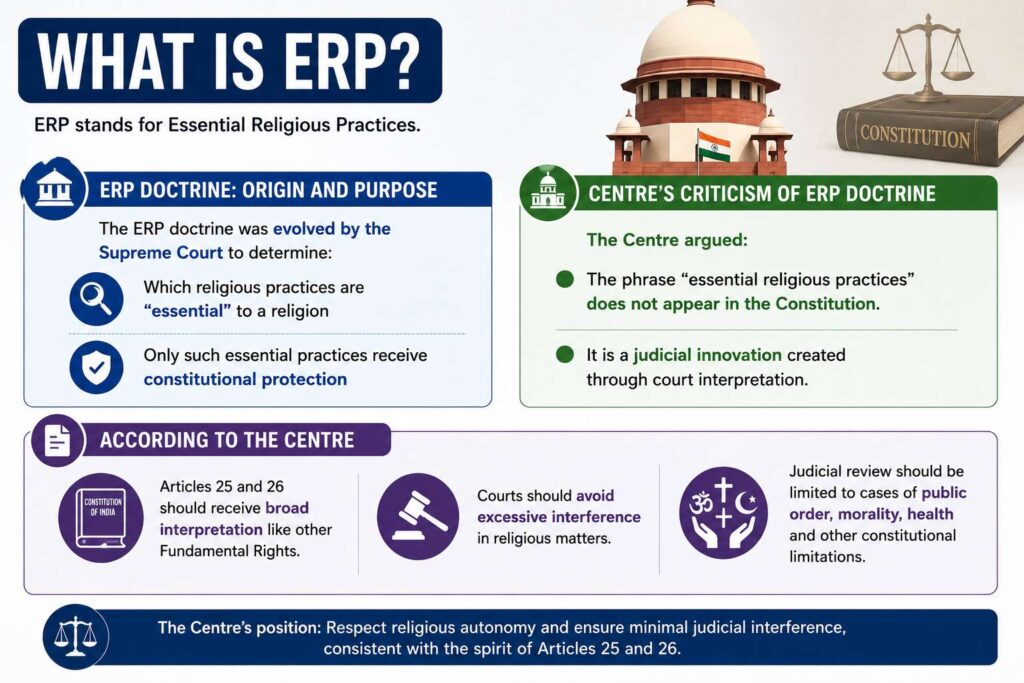
    What is ERP?

    The ERP doctrine was evolved by the Supreme Court to determine:

    • Which religious practices are “essential” to a religion
    • Only such essential practices receive constitutional protection

    Centre’s Criticism of ERP Doctrine

    • The Centre argued:
      • The phrase “essential religious practices” does not appear in the Constitution.
      • It is a judicial innovation created through court interpretation.
    • According to the Centre:
      • Articles 25 and 26 should receive broad interpretation like other Fundamental Rights.
      • Courts should avoid excessive interference in religious matters.

    Supreme Court’s Observations

    • Faith Beyond Rituals: Surya Kant observed:
      • One need not visit temples to be religious.
      • Even lighting a lamp in a hut can express faith.
    • Hinduism as a Way of Life: Justice B. V. Nagarathna remarked:
      • Hinduism is a “way of life”
      • It is not dependent solely on rituals or temple visits

    Related Case Laws

    • Shirur Mutt Case
      • Origin of ERP doctrine
      • Court held religion includes essential practices
    • Indian Young Lawyers Association v. State of Kerala
      • Allowed women of all ages entry into Sabarimala Temple
      • Linked exclusion to constitutional equality
    • Sardar Syedna Taher Saifuddin Case: Upheld denominational autonomy regarding excommunication
    [2020] Consider the following statements: 
    1. The Constitution of India defines its ‘basic structure’ in terms of federalism, secularism, fundamental rights and democracy. 
    2. The Constitution of India provides for ‘judicial review’ to safeguard the citizens’ liberties and to preserve the ideals on which the Constitution is based. 
    Which of the statements given above is/are correct? 
    a) 1 only b) 2 only c) Both 1 and 2 d) Neither 1 nor 2
  • “Medical negligence claims can be pursued against a deceased doctor’s heirs, says SC “

    Why in the News?

    The Supreme Court, in May 2025, ruled that medical negligence proceedings can continue even after the death of the accused doctor if the claim relates to financial loss recoverable from the doctor’s estate. The judgment creates a distinction between personal claims such as pain, suffering, or reputational damage, which extinguish upon death, and pecuniary claims, which survive against legal heirs to the extent of inherited property. The ruling is significant because it modifies the traditional common law principle “actio personalis moritur cum persona” and strengthens consumer rights in healthcare disputes. 

    What constitutional and legal principles govern medical negligence liability in India?

    1. Article 21: The Supreme Court of India interprets the right to life as including the right to health. This mandates that both public and private healthcare providers maintain standards that ensure accessible and accountable care.
    2. Consumer Protection Framework: Treats healthcare as a “service” under consumer law, enabling compensation claims.

    Legal Principles & Tests

    • The Bolam Test: This is the primary standard used by Indian courts. A doctor is not negligent if they acted in accordance with a practice accepted as proper by a responsible body of medical professionals, even if a different body of opinion exists.
    • Jacob Mathew Guidelines: To prevent the harassment of doctors, criminal prosecution for negligence requires a high degree of “gross” negligence. Police cannot arrest a doctor without an independent opinion from a competent medical board.
    • Res Ipsa Loquitur: Meaning “the thing speaks for itself,” this principle is used when the negligence is so obvious (e.g., leaving a surgical tool inside a patient) that the burden of proof shifts to the doctor to prove they were not negligent.
    • Tort Liability: Recognizes compensation for breach of duty causing injury or loss.

    How did the Supreme Court interpret survivability of medical negligence claims?

    1. Pecuniary Liability: Allows continuation of claims involving financial loss against the deceased doctor’s estate.
    2. Personal Claims: Extinguishes claims involving pain, suffering, defamation, or reputational injury upon death.
    3. Estate Accountability: Restricts liability only to the value of property inherited by legal heirs.
    4. Substantive Justice: Prevents procedural termination of compensation claims merely due to death of the accused.
    5. Consumer Protection Continuity: Ensures pending medical negligence complaints remain maintainable under law.

    Why did the Court revisit the common law doctrine “actio personalis moritur cum persona”?

    1. Traditional Principle: Held that personal legal actions die with the person.
    2. Indian Modification: Indian statutes progressively restricted the absolute application of the doctrine.
    3. Legal Representatives Suits Act, 1855: Permitted suits involving monetary losses against estates of deceased persons.
    4. Indian Succession Act, 1925: Section 306 preserved rights to prosecute or defend actions except in strictly personal injuries.
    5. Judicial Modernisation: Adapted colonial common law principles to contemporary consumer rights jurisprudence.

    What statutory provisions formed the basis of the judgment?

    1. Legal Representatives Suits Act, 1855
      1. Monetary Claims: Permits legal proceedings against legal representatives for financial loss caused by the deceased.
      2. Estate Limitation: Restricts recovery to inherited estate and not personal assets of heirs.
    2. Section 306 of Indian Succession Act, 1925
      1. Survival of Actions: Preserves rights to prosecute or defend legal proceedings after death.
      2. Exceptions Clause: Excludes defamation, assault, and purely personal injuries not causing death.
    3. Order XXII of Code of Civil Procedure (CPC)
      1. Substitution Mechanism: Enables replacement of deceased parties with legal representatives.
      2. Procedural Continuity: Prevents automatic abatement where right to sue survives.
    4. Consumer Protection Act
      1. Section 13(7): Applies CPC provisions regarding death of parties to consumer disputes.
      2. Consumer Rights Protection: Facilitates continuation of compensation claims in healthcare disputes.

    How does the judgment strengthen consumer rights in healthcare?

    1. Compensation Continuity: Ensures victims are not denied remedy due to death of the doctor.
    2. Institutional Accountability: Reinforces trust in civil compensation mechanisms.
    3. Access to Justice: Prevents procedural loopholes from defeating substantive claims.
    4. Victim-Centric Jurisprudence: Prioritizes restitution for financial injury suffered by patients.
    5. Legal Certainty: Clarifies ambiguity regarding maintainability of pending negligence claims.

    What concerns emerge from the judgment?

    1. Liability Uncertainty: Creates ambiguity where legal heirs inherit no estate.
    2. Enforcement Challenges: Complicates determination of extent of inherited assets.
    3. Defensive Medicine: May increase risk-averse medical practices in critical care.
    4. Litigation Expansion: Could increase long-pending compensation disputes against estates.
    5. Professional Anxiety: Raises concerns regarding prolonged legal exposure for medical practitioners and families.

    How does the judgment affect the healthcare ecosystem?

    1. Medical Governance: Strengthens accountability standards in healthcare delivery.
    2. Insurance Relevance: Increases importance of professional indemnity insurance for doctors.
    3. Hospital Liability: Encourages institutional compliance and risk-management systems.
    4. Patient Awareness: Expands understanding of legal remedies available in medical negligence.
    5. Judicial Oversight: Enhances role of courts in balancing professional autonomy with patient rights.

    Conclusion

    The judgment strengthens patient rights and accountability in healthcare by allowing pecuniary medical negligence claims to continue against a deceased doctor’s estate. It reflects the expanding scope of Article 21, consumer protection, and substantive justice in India’s healthcare governance framework.

    PYQ Relevance

    [UPSC 2024] In a crucial domain like the public healthcare system, the Indian State should play a vital role to contain the adverse impact of marketisation of the system. Suggest some measures through which the State can enhance the reach of public healthcare at the grassroots level.

    Linkage: The PYQ focuses on State accountability in ensuring accessible and ethical healthcare amid rising commercialization of the sector. The present judgment strengthens patient rights, consumer protection, and medical accountability, linking healthcare governance with Article 21 and professional ethics.

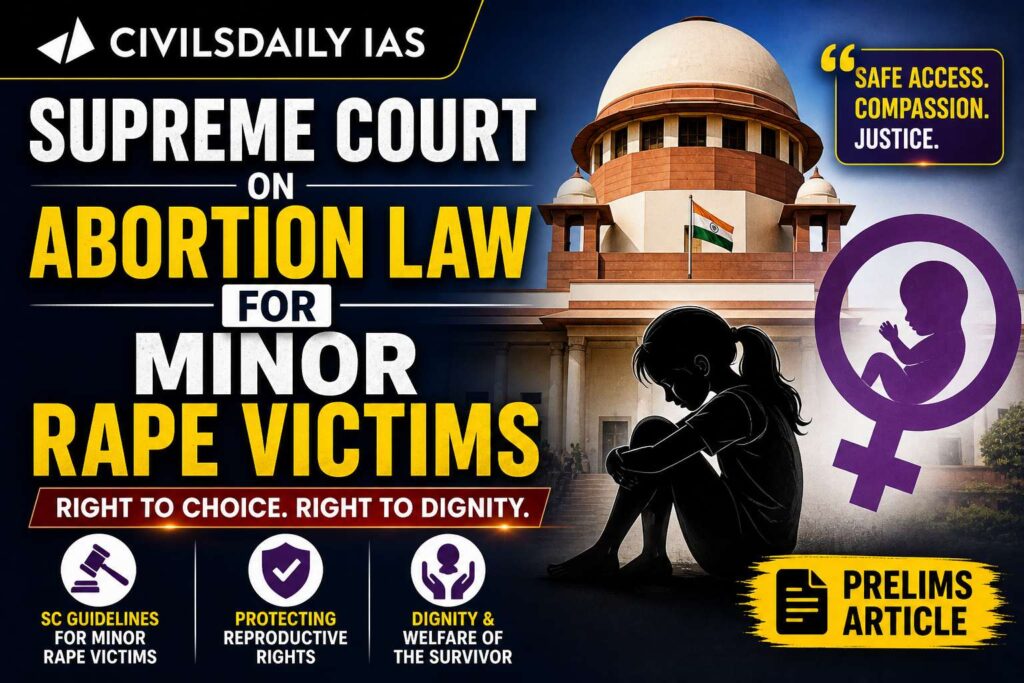
  • Supreme Court on Abortion Law for Minor Rape Victims 

    Why in the News

    The Supreme Court of India has asked the Union government to consider removing the time limit on abortion in cases involving minor rape survivors, while hearing a case allowing termination of a 30 week pregnancy of a 15 year old survivor.

    Background

    • Under the Medical Termination of Pregnancy Act, 1971 (amended in 2021):
      • Abortion allowed up to 24 weeks for special categories
        • Rape survivors
        • Minors
        • Women with disabilities

    Key Observations of the Court

    • State or doctors cannot decide for the survivor
    • Decision should rest with:
      • Survivor
      • Parents or guardians
    • Emphasised reproductive autonomy and dignity
    • Forcing continuation of pregnancy may cause lifelong trauma

    Court’s Suggestions

    • Amend law to:
      • Remove time limit for abortion in minor rape cases
      • Ensure speedy trial (within one week)
      • Provide compensation to victim (including property of accused)

    Legal and Constitutional Aspects

    Article 21

    • Right to life and personal liberty
    • Includes reproductive autonomy and bodily integrity
    • Reproductive Rights: Recognised as part of privacy and dignity

    Key Issues Highlighted

    • Conflict between: Foetal rights vs rights of the survivor
    • Importance of informed consent
    • Role of doctors: Provide medical guidance, not impose decisions

    Important Concepts

    • Medical Termination of Pregnancy (MTP): Legal framework governing abortion in India
    • Reproductive Autonomy: Right of a woman to make decisions about her body and pregnancy
    [2019] Which Article of the Constitution of India safeguards one’s right to marry the person of one’s choice? 
    (a) Article 19 (b) Article 21 (c) Article 25 (d) Article 29
  • Hate speech stems from an ‘us versus them’ mindset

    Why in the News?

    The Supreme Court recently held that hate speech comes from an “us vs them” mindset. It weakens fraternity and social harmony. The Court refused to ask for new laws. It stressed poor enforcement of existing laws as the real problem. This is important because public debate often demands stricter laws. The Court says laws already exist but are not applied well. Petitions showed hate speech continues despite past judgments. This points to a system failure, not a legal gap.

    What is the constitutional and philosophical basis of the Court’s observation?

    1. Fraternity as a constitutional value: Ensures social cohesion and unity in diversity as part of the Preamble.
    2. Moral fabric of society: Strengthens dignity and mutual respect among citizens.
    3. Civilizational ethos: Reflects Vasudhaiva Kutumbakam, emphasizing universal brotherhood.
    4. Antithesis of hate speech: Undermines inclusiveness by promoting exclusion and hostility.

    Why did the Court refuse to mandate new laws on hate speech?

    1. Judicial restraint: Preserves separation of powers by avoiding legislative functions.
    2. Existing legal framework: Includes provisions under IPC/BNS addressing public order and incitement.
    3. Institutional role clarity: Limits judiciary to interpretation and application of law.
    4. Avoidance of overreach: Prevents creation of parallel regulatory regimes.

    What are the existing hate speech laws in India?

    1. Article 19(1)(a): Ensures freedom of speech.
    2. Article 19(2): Allows restrictions for public order and morality.
    3. Bharatiya Nyaya Sanhita (BNS):
      1. Section on promoting enmity: Penalizes speech causing hatred between groups.
      2. Public mischief provisions: Punish rumours leading to fear or violence
    4. Representation of People Act, 1951:
      1. Electoral hate speech: Bars appeals based on religion, caste, etc.
    5. IT Rules and IT Act:
      1. Online regulation: Targets fake news and harmful content.

    What explains the persistence of hate speech despite legal provisions?

    1. Enforcement deficit: Weak implementation by law enforcement agencies.
    2. Administrative failure: Inconsistent application of laws across regions.
    3. Delayed justice delivery: Reduces deterrence effect of existing laws.
    4. Societal normalization: Continued tolerance of divisive narratives.

    How does hate speech threaten constitutional order and public harmony?

    1. Erosion of fraternity: Weakens unity in a diverse society.
    2. Public order disruption: Leads to inter-group hostility and violence.
    3. Institutional strain: Challenges governance and law enforcement credibility.
    4. Democratic decline: Undermines inclusive participation and trust.

    What role should institutions play in addressing hate speech?

    1. Law enforcement agencies: Ensure consistent and unbiased application of laws.
    2. Judiciary: Uphold constitutional values through interpretation.
    3. Legislature: Maintain clarity and adequacy of legal provisions.
    4. Civil society: Promote awareness and counter divisive narratives.

    What broader societal transformation is required?

    1. Mindset shift: Moves from identity-based exclusion to inclusive citizenship.
    2. Ethical reinforcement: Promotes empathy and respect in public discourse.
    3. Educational reforms: Integrates constitutional values into curricula.
    4. Media responsibility: Reduces sensationalism and misinformation.

    Conclusion

    The Supreme Court reframes hate speech as a societal and enforcement issue rather than a legislative gap. Addressing it requires strengthening institutional accountability and nurturing constitutional values of fraternity and inclusiveness.

    PYQ Relevance

    [UPSC 2022] Right of movement and residence throughout the territory of India are freely available to the Indian citizens, but these rights are not absolute. Comment.

    Linkage: This question reflects the idea that Fundamental Rights are subject to reasonable restrictions, similar to Article 19(2) limits on hate speech. The Supreme Court judgment reinforces that free speech is not absolute and must align with public order, dignity, and fraternity.

  • Sabarimala Review and Religious Reform 

    Why in the News

    The Supreme Court of India, while hearing the Sabarimala review case, observed that courts cannot reform religion, even as debates continue on balancing religious freedom and constitutional rights.

    Background of the Case

    • Concerns entry of women aged 10 to 50 years into the Sabarimala Temple
    • 2018 judgment allowed entry, upholding right to worship
    • Review petitions challenge this verdict

    Key Observations by the Court

    • Courts cannot initiate religious reform
    • Reform must come from within religion or society
    • Need to balance:
      • Religious practices
      • Constitutional values

    Arguments Presented

    For Reform (Indira Jaising’s View)

    • Religion must evolve to remain relevant
    • Equality (Article 14) and dignity (Article 21) cannot be subordinate to religion
    • Religious practices must align with constitutional morality

    Concerns Raised by Judges

    • Reforms should not destroy core religious identity
    • Need to avoid excessive interference in doctrinal matters

    Key Constitutional Provisions

    • Article 14: Right to equality before law
    • Article 21: Right to life and dignity
    • Article 25: Freedom of religion and worship

    Important Legal Concepts

    • Essential Religious Practices Test
      • Determines which practices are essential to a religion
      • Only essential practices get constitutional protection
    • Constitutional Morality: Principles like equality, dignity, and justice guide interpretation of laws
    [2019] Which Article of the Constitution of India safeguards one’s right to marry the person of one’s choice? 
    (a) Article 19
    (b) Article 21
    (c) Article 25
    (d) Article 29