💥Mains Ready By December. Smash Mains & Smash PYQ Admissions Open

Subject: Global Groupings and Conventions

Important International institutions, agencies and fora- their structure, mandate.

  • How is the next UN chief being chosen?

    Why in the News?

    The process of selecting the next UN Secretary-General has gained attention amid an unprecedented convergence of crises, deep financial strain, rising geopolitical conflicts, and institutional paralysis within the UN. The election is significant because the organization faces a credibility deficit, with unpaid dues, stalled reforms, and failure to prevent major conflicts like Gaza, Ukraine, and Sudan. 

    Selection Process?

    The UN Secretary-General is appointed by the General Assembly upon the recommendation of the Security Council for a five-year, renewable term. The process involves member state nominations, candidate “informal dialogues,” and, crucially, a secret ballot process by the Security Council, where the five permanent members (P5) can veto, followed by a formal General Assembly vote

    Key Steps in the Selection Process

    1. Nomination (Start of Process): The President of the General Assembly and the President of the Security Council invite candidates, nominated by Member States. Candidates must display high standards of competence, integrity, and diplomatic skill.
    2. Application and Transparency: Candidates are asked to submit a curriculum vitae and a vision statement, with some transparency measures requiring them to be involved in dialogue with UN members.
    3. Security Council Recommendation (The Critical Phase):
      1. The 15-member Council holds closed-door meetings and “straw polls” to discuss candidates.
      2. Voting is conducted using special ballots: “encourage,” “discourage,” or “no opinion”.
      3. The chosen candidate must receive at least nine favorable votes and no vetoes from the P5 members (China, France, Russia, UK, US).
      4. A candidate needs at least 60% of the votes (9 out of 15 members) in the Security Council to be recommended to the General Assembly.
      5. The council then adopts a resolution recommending one candidate to the General Assembly.
    4. General Assembly Appointment: While the General Assembly formally elects the Secretary-General, they have historically rubber-stamped the Security Council’s recommendation.
      1. Once recommended, the candidate must typically receive a simple majority (more than 50%) of the members present and voting in the General Assembly.
      2. Two-Thirds Exception: The General Assembly can decide that the appointment is an “important question,” which would then require a two-thirds majority (approximately 67%).
      3. Acclamation: In practice, the General Assembly usually appoints the recommended candidate by acclamation (unanimous agreement without a formal vote).

    How does the selection process of the UN Secretary-General shape global governance outcomes?

    1. UN Charter Framework: Ensures appointment by the General Assembly on recommendation of the Security Council, giving decisive influence to P5 (US, UK, France, Russia, China).
    2. Security Council Dynamics: Enables veto power to shape outcomes; persistent deadlocks reflect geopolitical rivalries.
    3. Regional Rotation Norm: Promotes equitable representation; current cycle favors Eastern Europe.
    4. Informal Consultations: Facilitates “straw polls” and backdoor negotiations influencing final consensus.
      1. The straw poll is an informal, secret voting mechanism the UN Security Council uses to narrow down candidates and test their viability before a formal vote. It essentially helps members see “which way the wind is blowing” without triggering a public or formal deadlock.
      2. They were first introduced in 1981 to break a deep deadlock between two candidates. Since formal UN vetoes are public and recorded, straw polls allow the P5 to block candidates privately, maintaining diplomatic flexibility.

    Why is the role of the Secretary-General increasingly critical in the current global context?

    1. Chief Administrative Officer: Oversees UN system operations and implementation of mandates.
    2. Global Diplomatic Voice: Represents the UN in crises such as climate change, armed conflicts, and inequality.
    3. Conflict Mediation Authority: Enables appointment of Special Envoys (e.g., West Asia conflict mediation).
    4. Agenda-Setting Power: Shapes priorities such as SDGs, climate action, and human rights.

    What are the key challenges confronting the UN system today?

    1. Financial Crisis: Results from unpaid and delayed contributions by member states.
    2. Conflict Ineffectiveness: Evident in inability to prevent wars in Gaza, Ukraine, Sudan.
    3. Institutional Paralysis: Caused by veto politics in the Security Council.
    4. Humanitarian Strain: Intensified by climate disasters and violations of humanitarian law.
    5. SDG Lag: Only ~15% of targets on track for 2030, indicating systemic underperformance.

    What are the implications of Security Council politics on the final outcome?

    1. Veto Power Dominance: Limits democratic selection despite General Assembly majority.
    2. Geopolitical Rivalries: Intensify stalemates, reducing effectiveness of consensus-building.
    3. Legitimacy Concerns: Raises questions about representativeness of leadership choices.
    4. Reform Stagnation: Weakens prospects for structural changes in global governance.

    Conclusion

    The selection of the next UN Secretary-General represents a critical inflection point for multilateralism. The office must transition from passive administration to active global leadership. Without structural reforms and political consensus, even strong leadership may remain constrained by systemic limitations.

    PYQ Relevance

    [UPSC 2020] Critically examine the role of WHO in providing global health security during the Covid-19 pandemic.

    Linkage: The PYQ tests evaluation of UN-affiliated institutions’ effectiveness, coordination failures, and global governance gaps. It directly links to the article’s theme of UN system credibility crisis and need for stronger leadership by the Secretary-General.
  • UAE leaves OPEC and OPEC+ in huge blow to global oil producers’ group

    Why in the News?

    The United Arab Emirates’ decision to exit the Organization of the Petroleum Exporting Countries (OPEC) marks a significant rupture in the cohesion of one of the world’s most influential oil cartels. It is a major development because the UAE is OPEC’s third-largest producer, and its exit reflects growing internal dissent over production quotas. This move contrasts sharply with OPEC’s traditional unity in managing oil supply to influence global prices. The development gains further significance amid already constrained global oil supplies due to geopolitical tensions, including disruptions in the Strait of Hormuz.

    What is OPEC and OPEC plus?

    Organization of the Petroleum Exporting Countries (OPEC)

    1. Formation: Established in 1960 at Baghdad Conference by five founding members, Iran, Iraq, Kuwait, Saudi Arabia, Venezuela.
    2. Headquarters: Locates secretariat in Vienna, Austria.
    3. Membership: Includes 13 members (variable over time) such as Saudi Arabia, Iran, Iraq, Kuwait, UAE, Nigeria, Angola, Algeria, Libya, Congo, Gabon, Equatorial Guinea, Venezuela (Qatar exited in 2019; UAE exiting).
    4. Objective: Ensures coordination of petroleum policies to stabilize oil markets and secure fair prices for producers and reliable supply for consumers.
    5. Production Quotas: Allocates output limits to control global supply and influence prices.
    6. Market Share: Accounts for ~40% of global oil production and a higher share of proven reserves.

    OPEC+:

    1. Origin: Formed in 2016 in response to dropping oil prices and increased U.S. shale production.
    2. Composition: Includes the original OPEC members plus 10 non-OPEC nations, Azerbaijan, Bahrain, Brunei, Kazakhstan, Malaysia, Mexico, Oman, Russia, South Sudan, and Sudan.
    3. Role: Coordinates production cuts with the core OPEC group to manage the global oil market

    Why has the UAE exited OPEC, and what structural tensions does it reflect?

    1. Production Constraints: Indicates dissatisfaction with OPEC quotas limiting output despite expanded capacity; UAE capable of producing ~5 million barrels/day.
    2. Strategic Autonomy: Prioritizes national economic goals over cartel discipline; seeks flexibility to maximize exports.
    3. Internal Frictions: Reflects weakening cohesion after Qatar’s exit (2019) and tensions with Saudi Arabia over quotas.
    4. Energy Strategy Shift: Aligns with long-term diversification and gradual supply increases based on market demand.

    Reflected Structural Tensions:

    1. Saudi Arabia-UAE Rivalry: The departure highlights the growing rift between Riyadh and Abu Dhabi, undermining Saudi Arabia’s leadership within the cartel.
    2. Weakening of OPEC Influence: The loss of a major producer with significant spare capacity is a major blow to OPEC’s ability to manage global supply,. This signals a potential shift towards a more fragmented, less predictable oil market.
    3. Shift in Global Energy Alliances: The move aligns with the UAE building deeper economic ties with non-traditional partners and potentially improving ties with consumers like the US by increasing supply during market shortages. 

    How does UAE’s exit impact OPEC’s global influence and bargaining power?

    1. Reduced Market Share: Weakens OPEC’s control over supply; currently ~40% global output share.
      1. The departure removes approximately 15% of OPEC’s production capacity.
      2. For the broader OPEC+ alliance , the share is projected to fall from 50% to 45%
    2. Depletion of Spare Capacity: The UAE was one of the few members, alongside Saudi Arabia, with significant spare production capacity; the primary tool for responding to supply shocks.
    3. Downward Price Pressure: Free from quotas, the UAE can eventually add up to 1.6 million barrels per day (mb/d) back to the market once shipping through the Strait of Hormuz  stabilizes.
    4. Declining Coordination: Reduces ability to collectively stabilize prices.
    5. Cartel Fragmentation: Signals erosion of unity, reducing effectiveness of production agreements.

    What geopolitical and economic factors shape this development?

    1. Regional Politics: Reflects strained UAE-Saudi relations on economic and political issues particularly over differing agendas in the Yemen civil war.
    2. Iran Conflict Impact: War disruptions led to closure of Strait of Hormuz, affecting ~20% of global oil trade.
      1. Following the outbreak of war in early 2026, the UAE has been a major target of Iranian drone and missile strikes. 
      2. Abu Dhabi criticized fellow Arab states for a “weak” political and military response, making continued membership in a OPEC alongside Iran politically untenable.
    3. Distancing from Russia (OPEC+): The UAE has grown wary of the OPEC+ alliance, noting that Russia has remained a “steadfast partner” for Iran during the conflict.
      1. Exiting allows the UAE to distance itself from Moscow’s influence and strengthen ties with the U.S
    4. US Production Rise: U.S. output exceeds 13 million barrels/day, reducing reliance on OPEC.
    5. Monetizing Spare Capacity: The UAE has invested billions to reach a production capacity of over 5 million barrels per day.
      1. The National leadership wants to sell this oil now, before global demand peaks, to fund its Vision 2030 diversification into technology, tourism, and renewables.

    What are the implications for global oil markets and prices?

    1. Price Volatility: Reduces coordinated supply management, increasing fluctuations.
    2. Supply Expansion: UAE may increase independent production, adding to global supply.
    3. Market Uncertainty: Weakens predictability of production decisions.
    4. Short-term Stability: Limited immediate impact due to already tight supply conditions.

    What are the implications for India’s energy security and economy?

    1. Import Dependence: India imports ~85% of its crude oil; changes in OPEC dynamics directly affect supply security.
    2. Price Volatility Risk: Increased oil price fluctuations impact inflation, fiscal deficit, and current account deficit.
    3. Diversification Opportunity: Weakening OPEC control enables India to diversify suppliers and negotiate better terms.
    4. Strategic Reserves Use: Necessitates stronger use of Strategic Petroleum Reserves (SPR) during volatility.
    5. Energy Transition Push: Reinforces urgency for renewables and alternative energy to reduce import dependence.
    6. Diplomatic Leverage: Enhances India’s engagement with multiple producers beyond OPEC bloc.

    Does this signal a broader transformation in global energy governance?

    1. Resource Nationalism: Countries prioritize domestic economic gains over collective frameworks.
    2. Decline of Cartels: Traditional supply-control mechanisms lose effectiveness.
    3. Multipolar Energy Order: Influence spreads across US, OPEC, Russia, and emerging producers.
    4. Energy Transition Pressure: Long-term shift toward renewables reshapes oil strategies.

    Conclusion

    The UAE’s exit reflects structural changes in global oil governance, weakening cartel cohesion and reinforcing a shift toward decentralized, nationalistic energy strategies with direct implications for energy-importing countries like India.

    PYQ Relevance

    [UPSC 2023] ‘Virus of Conflict is affecting the functioning of the SCO’. In the light of the above statement point out the role of India in mitigating problems. 

    Linkage: The PYQ highlights challenges within international groupings due to internal conflicts and divergent national interests, similar to fragmentation within OPEC. UAE’s exit reflects weakening multilateral cohesion, reinforcing the need to analyze stability, effectiveness, and India’s strategic positioning in global groupings.

  • BRICS-MENA Meeting on West Asia Conflict 

    Why in the News?

    For the first time as the 2026 BRICS Chair, India convened a meeting of Deputy Foreign Ministers and Special Envoys from BRICS and MENA (Middle East and North Africa) countries to address the escalating U.S.-Israel war against Iran.

    What is BRICS-MENA?

    A specialized consultative platform within the BRICS framework that brings together member states and key regional players from the Middle East and North Africa to coordinate on regional security and diplomacy.

    BRICS Member Countries (2026):

    • Founding: Brazil, Russia, India, China, South Africa.
    • Expanded Members: Egypt, Ethiopia, Iran, Saudi Arabia, United Arab Emirates (UAE), and Indonesia.

    MENA Region Participants:

    Beyond the BRICS members from the region (Iran, Egypt, UAE, Saudi), the MENA delegation includes key regional stakeholders such as:

    • Gulf: Qatar, Kuwait, Oman, Bahrain, Iraq.
    • Levant: Jordan, Lebanon, Palestine, Syria.
    • North Africa: Algeria, Morocco, Tunisia, Libya.
    [2025] Consider the following statements with regard to BRICS; 
    I. 16th BRICS Summit was held under the Chairmanship of Russia in Kazan. 
    II. Indonesia has become a full member of BRICS. 
    III. The theme of the 16th BRICS Summit was Strengthening Multiculturalism for Just Global Development and Security. 
    Which of the statements given above is/are correct? 
    [A] I and II [B] II and III [C] I and III [D] I only
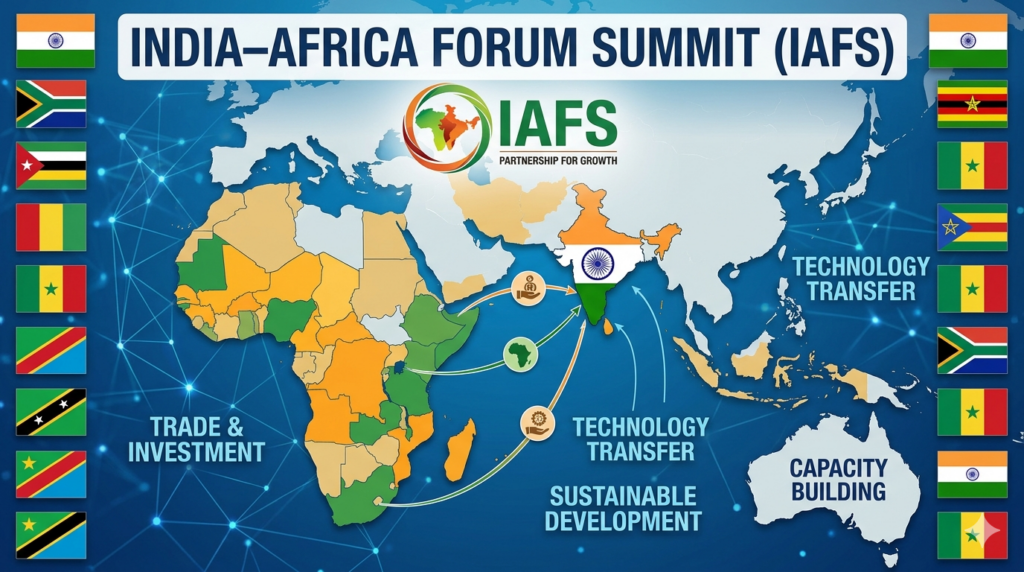
  • India–Africa Forum Summit (IAFS) 2026 

    Why in the News?

    • India will host the Fourth India–Africa Forum Summit (IAFS) 2026 after a gap of more than a decade (last held in 2015).

    What is IAFS

    • A platform for cooperation between India and African countries
    • Brings together: India and Members of the African Union

    Timeline

    • 1st IAFS → 2008 (New Delhi)
    • 2nd IAFS → 2011 (Addis Ababa)
    • 3rd IAFS → 2015 (New Delhi)
    • 4th IAFS → 2026 (New Delhi, upcoming)May 28 to May 31, 2026, in New Delhi, India

    Key Focus Areas (2026)

    1. Development Cooperation

    • Infrastructure projects
    • Capacity building initiatives

    2. Education & Skills

    • Example: IIT Madras campus in Zanzibar

    3. Diplomatic Expansion

    • India has: Opened 16 new missions since 2018
    • Presence now in: 45 African countries

    4. Defence Cooperation

    • Training and security collaboration

    5. Trade & Investment

    • Shift from: Line of Credit (LoC) to Foreign Direct Investment (FDI)
    [2016] Consider the following statements: 
    1 The India-Africa Summit Held in 2015 
    2 was the third such Summit Was actually initiated by Jawaharlal Nehru in 1951 
    Which of the statements given above is/are correct? 
    a) 1 only b) 2 only c) Both 1 and 2 d) Neither 1 nor 2
  • Indian Navy Conducts IMEX TTX 2026 at Kochi

    Why in the News?

    The Indian Navy conducted IMEX TTX 2026 at the Maritime Warfare Centre, Kochi, involving multiple Indian Ocean region countries to address maritime security challenges.

    What is IMEX TTX 2026

    • IMEX: Indian Ocean Naval Symposium Maritime Exercise
    • TTX: Table-Top Exercise
    • Type: Simulated maritime security exercise
    • Location: Maritime Warfare Centre, Kochi
    • Conducted by: Indian Navy
    • This exercise focused on planning and decision-making in maritime security scenarios.

    Participating Countries

    • Countries that participated: Bangladesh, France, Indonesia, Kenya, Maldives, Mauritius, Myanmar, Seychelles, Singapore, Sri Lanka, Tanzania, and Timor-Leste
    • This highlights multinational cooperation in Indian Ocean Region (IOR).

    Why This Exercise is Important

    India Chairs Indian Ocean Naval Symposium (IONS)

    • India assumed IONS Chairmanship (2026–2028)
    • After 16 years
    • IMEX TTX 2026 strengthens India’s leadership role

    About Indian Ocean Naval Symposium (IONS)

    • Multilateral naval cooperation forum
    • Launched in 2008
    • Initiative of Indian Navy
    • Aim: Maritime security cooperation
    [2017] Consider the following in respect of Indian Ocean Naval Symposium (IONS): 1 Inaugural IONS was held in India in 2015 under the chairmanship of the Indian Navy. 2 IONS is a voluntary initiative that seeks to increase maritime co-operation among navies of the littoral states of the Indian Ocean Region. Which of the above statements is/are correct? (a) 1 only (b) 2 only (c) Both 1 and 2 (d) Neither 1 nor 2
  • On scientific collaborations in BRICS

    Why in the News?

    BRICS scientific cooperation has gained renewed attention amid expanding membership and India’s upcoming 2026 presidency, which aims to deepen collaboration in AI, climate tech, and public health.

    How has BRICS evolved as a platform for scientific cooperation?

    1. Multipolar Vision: Establishes an alternative to Western-dominated global governance; aligns with development-oriented global cooperation.
    2. Institutional Expansion: Includes new members (Saudi Arabia, Egypt, UAE, Ethiopia, Indonesia, Iran), increasing diversity and capacity.
    3. Strategic Shift: Moves from basic science to applied domains such as energy, water, health, and environment.
    4. Innovation Focus: Integrates STI into economic development frameworks; promotes technology-enabled ecosystems.

    What institutional mechanisms support Science, Technology, and Innovation (STI) cooperation in BRICS?

    1. BRICS STI Framework (2011): Formalises cooperation in science, technology, and innovation.
    2. BRICS STI Steering Committee: Coordinates joint calls, project approvals, and implementation.
    3. Thematic Working Groups: Focus on priority areas like AI, biotechnology, climate tech, and space.
    4. BRICS Young Scientist Forum: Promotes youth engagement and research collaboration.
    5. BRICS Institute of Future Networks: Advances ICT and emerging technologies.
    6. New Development Bank Linkages: Supports infrastructure and innovation financing.

    What are the major achievements in BRICS scientific collaboration?

    1. Expanded Research Scope: Moves from fundamental science to applied and socially relevant sectors. Ex: COVID-19 vaccines: From basic biology to applied vaccine development & public health systems
    2. Joint Research Projects: Facilitates cross-border innovation through coordinated funding calls.
      1. Ex: BRICS TB Research Network: Enables collaborative innovation in tuberculosis control; e.g., cross-border research on diagnostics, vaccines, and treatment strategies
      2. BRICS energy research cooperation: Structured under the BRICS Energy Research Cooperation Platform (ERCP), it focuses on advancing sustainable, secure, and affordable energy transitions through joint research, technological innovation, and policy exchanges.
    3. Artificial Intelligence Integration: 2025 BRICS Leaders’ Declaration (Brazil Summit-Rio de Janeiro) recognised Artificial Intelligence as a central pillar of STI cooperation, prioritising its use in economic development, governance, healthcare, and climate solutions
    4. Space and ICT Collaboration: Strengthens partnerships in satellite applications and digital technologies.
      1. BRICS Remote Sensing Satellite Constellation: Enables shared satellite data for disaster management, agriculture, and environmental monitoring
      2. BRICS Institute of Future Networks (BIFN): Promotes ICT cooperation in 5G, AI, and next-gen communication technologies.
    5. COVID-19 Response: Enhances cooperation in vaccine research, biosecurity, and public health systems.

    What structural limitations hinder effective STI cooperation?

    1. Funding Constraints: Maintains limited financial resources compared to European Union’s (EU’s) Horizon programmes.
    2. Institutional Weakness: Lacks a permanent secretariat or central coordination mechanism.
    3. Uneven Participation: Shows disparities in engagement levels; newer members less integrated.
    4. Limited Data Systems: Restricts evidence-based policymaking due to weak monitoring frameworks.
    5. Geopolitical Fragmentation: Faces barriers from techno-nationalism and global tensions.

    Why is progress uneven across sectors and members?

    1. Capacity Asymmetry: Reflects disparities in R&D expenditure; China dominates, others lag.
    2. Infrastructure Gaps: Slows progress in mega-science areas like ocean research and polar science.
    3. Diverse Priorities: Creates coordination challenges due to heterogeneity in development goals.
    4. Weak Commercialisation: Limits scaling of innovations into market-ready technologies.

    What are the implications of BRICS expansion for STI cooperation?

    1. Increased Diversity: Expands scientific and economic heterogeneity across members.
    2. Coordination Complexity: Makes consensus-building and priority alignment more difficult.
    3. Opportunity for Scale: Enhances potential for large-scale collaborative innovation networks.
    4. South-South Cooperation: Strengthens development-oriented research and knowledge exchange.

    What reforms are required to strengthen BRICS STI collaboration?

    1. Institutionalisation: Establishes a permanent secretariat for coordination and monitoring.
    2. Funding Enhancement: Increases pooled funding mechanisms for large-scale projects.
    3. Long-term Projects: Promotes mega-science collaborations (e.g., climate modelling, space research).
    4. Governance Integration: Expands STI into treaty negotiations and global governance frameworks.
    5. Data Systems: Develops monitoring frameworks for evidence-based decision-making.

    Conclusion

    BRICS has transitioned into a significant platform for scientific cooperation but remains constrained by weak institutionalisation, limited funding, and uneven participation. Strengthening governance mechanisms, financing, and long-term collaboration frameworks is essential for translating strategic intent into tangible outcomes.

    PYQ Relevance

    [UPSC 2024] Critically analyse India’s evolving diplomatic, economic and strategic relations with the Central Asian Republics (CARs) highlighting their increasing significance in regional and global geopolitics.

    Linkage: The PYQ highlights India’s engagement with regional groupings and extended neighbourhood (like BRICS) in a multipolar geopolitical order. It links to themes of strategic connectivity, energy security, and balancing major powers, core to India’s global partnerships like BRICS.

  • What are gravity bombs which US is planning to shift to Iran

    Why in the News?

    The United States has announced plans to deploy precision gravity bombs against Iranian targets, signalling a shift in military strategy from remote missile strikes to direct aerial bombing operations. Earlier operations relied on stand-off munitions launched from safe distances to avoid Iranian air defence systems. The move toward gravity bombs suggests that the US military believes Iranian air defences have been significantly degraded in recent operations.

    What are gravity bombs and how do they function?

    1. Free-fall munition: Gravity bombs are unguided bombs without propulsion systems, dropped from aircraft and guided by gravity and aerodynamics toward the target.
    2. Trajectory mechanics: The bomb’s path depends on gravity, aerodynamic drag, aircraft speed, altitude, and release angle.
    3. Modern upgrades: The integration of JDAM kits with GPS guidance and steerable fins converts traditional bombs into precision-guided munitions.
    4. Operational evolution: Despite their historical association with World War-era weapons, modern gravity bombs form a core component of contemporary US Air Force strike capability.
    5. Operational theatres: These bombs have been deployed extensively in Iraq, Afghanistan, and Syria and also used in conflicts involving Israel in Gaza and Lebanon.

    Why has the United States relied on stand-off weapons until now?

    1. Stand-off strategy: Long-range munitions allow attacks without entering enemy air defence zones, minimizing pilot risk.
    2. Cruise missile systems: Weapons such as the Tomahawk cruise missile are launched from naval destroyers or stealth aircraft and can strike targets hundreds of kilometres away.
    3. Drone warfare: Systems like the LUCAS drone (Low-cost Unmanned Combat Attack System) provide remote strike capability
    4. Risk mitigation: Stand-off weapons reduce the probability of pilot casualties and aircraft losses.
    5. Air defence challenge: Iran’s layered air defence network previously limited the feasibility of direct bombing missions.

    What are the main types of conventional US gravity bombs?

    1. MK-82 (500-pound bomb): Designed for soft targets such as light vehicles, radar installations, and exposed infantry positions.
    2. MK-83 (1,000-pound bomb): Used against reinforced structures, command posts, and smaller bridges.
    3. MK-84 (2,000-pound bomb): A bunker-buster weapon capable of penetrating deep military complexes or large industrial facilities.
    4. Blast impact: The MK-84 can produce craters up to 50 feet wide and 36 feet deep.
    5. Operational series: Current US operations rely primarily on the Mark-80 series bombs equipped with JDAM kits.

    How do conventional gravity bombs differ from nuclear gravity bombs?

    1. Conventional payload: Standard gravity bombs carry chemical explosive charges and cause destruction through blast and fragmentation.
    2. Nuclear variants: The US arsenal also includes nuclear gravity bombs such as the B61 and B83 series, capable of delivering explosive yields measured in kilotons or megatons of TNT.
    3. Strategic control: Nuclear gravity bombs require explicit authorisation from the US President before deployment.
    4. Escalation risk: Their use would represent a major escalation in global nuclear tensions.

    Why is the US shifting from stand-off missiles to gravity bombs?

    1. Cost efficiency: Cruise missiles cost millions of dollars per strike, while gravity bombs cost approximately $25,000-$30,000 when equipped with JDAM kits.
    2. Operational tempo: Cheaper munitions enable sustained high-volume bombing operations.
    3. Air superiority assumption: Direct bombing missions are viable only if a military has neutralised enemy air defence systems.
    4. Tactical trade-off: Gravity bombs reduce costs but increase risk to pilots and aircraft.
    5. Strategic signalling: The shift suggests that US forces believe Iranian anti-aircraft systems have been weakened.

    Which aircraft platforms can deploy these gravity bombs?

    1. F-15 Strike Eagle: Multi-role fighter capable of precision ground strikes.
    2. F-35 stealth fighter: Provides low-observable penetration of defended airspace.
    3. B-52 Stratofortress: Long-range strategic bomber capable of carrying large payloads of conventional bombs.
    4. Operational flexibility: Gravity bombs can be deployed by fighter jets, stealth aircraft, and heavy bombers, enabling diverse operational strategies.

    Conclusion

    The proposed use of gravity bombs reflects a significant tactical transition in modern warfare, from expensive remote missile strikes toward cost-efficient direct bombardment enabled by precision guidance technologies. This shift indicates confidence in degrading Iranian air defence systems while highlighting the continuing relevance of traditional aerial bombs in the era of advanced precision warfare.

    PYQ Relevance

    [UPSC 2021] How is S-400 air defence system technically superior to any other system presently available in the world?

    Linkage: This question highlights the role of advanced air defence systems in establishing air superiority, a key factor that determines whether direct bombing missions (such as gravity bomb deployment) are feasible. Understanding such systems helps analyse modern warfare dynamics, including missile defence, aerial dominance, and the strategic use of precision air strikes.

  • India and GCC Sign Joint Statement Launching FTA Negotiations

    Why in the News

    India and the Gulf Cooperation Council signed a Joint Statement on February 24, 2026 in New Delhi, formally launching negotiations for an India–GCC Free Trade Agreement. The statement was signed by Piyush Goyal and GCC Secretary General Jasem Mohamed Albudaiwi.

    About the Gulf Cooperation Council

    The GCC is a regional bloc comprising:

    • Saudi Arabia
    • United Arab Emirates
    • Qatar
    • Kuwait
    • Oman
    • Bahrain
    • Established in 1981
    • Combined GDP about 2.3 trillion dollars
    • Population about 61.5 million

    Trade Significance

    • GCC is India’s largest trading partner bloc.
    • Bilateral trade in FY 2024-25: 178.56 billion dollars
      • Exports: 56.87 billion dollars
      • Imports: 121.68 billion dollars
    • Accounts for about 15.42 percent of India’s global trade.
    • Average annual trade growth over last five years: 15.3 percent.

    Key Trade Items

    • India’s Exports to GCC: Engineering goods, Rice, Textiles, Machinery, Gems and jewellery
    • India’s Imports from GCC: Crude oil, LNG, Petrochemicals and Gold

    Investment and Diaspora Linkages

    • GCC investments in India exceed 31.14 billion dollars.
    • Nearly 10 million Indians live and work in GCC countries.
    • Strong people to people ties support economic cooperation.

    Expected Benefits of the FTA

    • Greater trade predictability and certainty.
    • Diversification of exports.
    • Stronger energy security cooperation.
    • Enhanced market access for goods and services.
    • Deeper economic integration amid global uncertainty.
    [2016] Which of the following is not a member of ‘Gulf Cooperation Council’? (a) Iran 

    (b) Saudi Arabia 

    (c) Oman 

    (d) Kuwait

  • India stays out of UN Joint Statement on West Bank

    Why in the News?

    India did not join a joint statement issued by 85 countries at the United Nations criticising Israel’s latest measures to tighten control over the West Bank.

    Context

    • The joint statement:
      • Condemned unilateral Israeli decisions in the West Bank.
      • Opposed any form of annexation.
      • Rejected measures altering the demographic character of Palestinian territories occupied since 1967, including East Jerusalem.
    • The statement was endorsed by:
      • League of Arab States
      • European Union
      • BRICS founder members: Russia, China, Brazil, South Africa
      • Quad partners: Australia, Japan
    • India stayed out of the statement.

    Background: West Bank Issue

    • The West Bank is a Palestinian territory occupied by Israel since 1967.
    • Under the Oslo Accords (1993 to 1995):
      • Area A and Area B are administered by the Palestinian Authority.
      • Area C remains under Israeli control.
    • Recent developments:
    • The Knesset has passed measures to:
      • Ease land acquisition rules.
      • Increase checks on land documentation.
      • Expand administrative control.
    • These steps are viewed by many countries as amounting to de facto annexation.

    India’s Position

    • India had earlier:
      • Voted at the UN in October 2025 criticising illegal annexation.
      • Supported a Palestinian state based on 1967 borders in the January 2026 Delhi Declaration.
    • Current move seen as:
      • Diplomatic recalibration.
      • Possibly linked to high level bilateral engagement with Israel.

    Key Concepts for Prelims

    • Two State Solution

      • Creation of: Independent Israel and Independent Palestine based on pre 1967 borders
    • Strategic Autonomy

      • India’s foreign policy principle of: Maintaining independent decision making and Avoiding bloc alignment
    • West Bank Areas

      • Area A: Palestinian civil and security control
      • Area B: Palestinian civil control, Israeli security control
      • Area C: Full Israeli control
    [2018] The term “two-state solution” is sometimes mentioned in the news in the context of the affairs of (a) China 

    (b) Israel 

    (c) Iraq 

    (d) Yemen

  • Iran briefly closes the Strait of Hormuz amid US nuclear talks

    Why in the News?

    Iran announced a temporary closure of part of the Strait of Hormuz during indirect nuclear talks with the United States in Geneva, marking the first such announcement amid escalating tensions.

    About the Strait of Hormuz

    • Narrow maritime chokepoint between:
      • Iran
      • Oman
    • Connects:
      • Persian Gulf
      • Gulf of Oman and Arabian Sea
    • Around 20 percent of global oil trade passes through it.
    • Critical for exports from:
      • Saudi Arabia
      • United Arab Emirates
      • Iraq and Kuwait

    Background: US–Iran Nuclear Talks

    • Talks held in Geneva through Omani mediation.
    • Discussions focused on:
      • Iran’s nuclear programme
      • Sanctions relief
    • Iran insists it will not give up uranium enrichment.
    • US reportedly seeks to widen talks to include missile capability.
    [2024] Consider the following statements: 

    Statement-I: Sumed pipeline is a strategic route for Persian Gulf oil and natural gas shipments to Europe. 

    Statement-II: Sumed pipeline connects the Red Sea with the Mediterranean Sea. 

    Which one of the following is correct in respect of the above statements? 

    (a) Both Statement-I and Statement-II are correct and Statement-II explains Statement-I 

    (b) Both Statement-I and Statement-II are correct, but Statement-II does not explain Statement-I 

    (c) Statement-I is correct, but Statement-II is incorrect 

    (d) Statement-I is incorrect, but Statement-II is correct