💥Join UPSC 2027,2028 Mentorship (July Batch) + XFactor Notes & Microthemes PDF

Subject: Important Events

  • Beating Retreat Ceremony

    The Beating Retreat ceremony recently took place at Vijay Chowk. The ceremony, which takes place on January 29 every year, marks the culmination of the four-day Republic Day celebrations.

    What is the Beating Retreat function?

    • ‘Beating Retreat’ marks a centuries old military tradition, when the troops ceased fighting, sheathed their arms and withdrew from the battlefield and returned to the camps at sunset at the sounding of the Retreat.
    • The military tradition began in 17th century England, when King James II ordered his troops to beat drums, lower flags and organise a parade to announce the end of a day of combat.
    • The ceremony was then called ‘watch setting’ and took place at sunset after firing a single round from the evening gun.
    • The ceremony is currently held by Armed Forces in the UK, US, Canada, New Zealand, Australia, and India, among others.

    How did it begin in India?

    • Beating the Retreat’ has emerged as an event of national pride when the Colours and Standards are paraded.
    • The ceremony traces its origins to the early 1950s when Major Roberts of the Indian Army indigenously developed the unique ceremony of display by the massed bands.
    • Section D (Ceremonials) at the Ministry of Defence conducts the event.
    • The ceremony consists of musical performances by the bands, who each year play Indian and western tunes.
  • Ethical Veganism

    An employment tribunal in the UK has ruled that “ethical veganism” is a philosophical belief and has to be protected by law against discrimination.

    What’s the issue about?

    • A man was fired from an animal welfare charity for raising concerns about its pension funds’ alleged investment in companies that use animal testing.
    • He for gross misconduct on insisting to ban fox-hunting and other types of recreational hunting in Britain.
    • The tribunal had to determine if ethical veganism fit the criteria of a religious or philosophical belief.
    • The tribunal determined that ethical veganism meets the test required to be a philosophical belief, because of which it is protected under the British Equality Act, 2010.
    • Many vegetarians claimed that they were discriminated at workplace for not eating meat. In his case, the tribunal had dismissed the case, calling his vegetarianism a lifestyle choice.

    Veganism, ethical veganism, and ethical vegetarianism

    • Broadly, a vegan person does not consume meat products and also products that are derived from animals (such as milk, eggs, etc).
    • ‘The Ethical Case for Veganism’ in the Oxford Handbook of Food Ethics, loosely defines veganism as a lifestyle choice to refrain from eating meat as well as products made from or by animals.
    • Ethical veganism, on the other hand, has been defined as the view that attaches a positive ethical valuation to a vegan lifestyle.
    • Significantly, ethical veganism is different from ethical vegetarianism — the latter makes a distinction between products made from animals, such as meat, and products made by animals, such as milk.
    • Ethical vegetarianism is opposed to products made from animals in particular.
    • There is also an ethical omnivorism, which permits the use of some animal products and may restrict the use of others based on some ethical criterion, say the authors of the Food Ethics paper.

    Types of ethical veganism

    • They mention two types of ethical veganism: broad absolutist veganism, under which it is always wrong to use any product made by or from animals, and modest ethical veganism, under which it is typically wrong to use products made from or by a range of animals including cats, dogs, cows, pigs, etc.
    • An example of the former category is a person who would not press a leather button, “even if doing so were necessary in order to avert global nuclear war”.
    • The reasons for adopting veganism as a lifestyle can range from wanting a better and healthier lifestyle, environmental, or religious reasons.

    Britain’s Equality Act

    • The act protects people from discrimination in the workplace and in the wider society in the UK.
    • The Act offers a basic framework of protection against direct and indirect discrimination, harassment, and victimisation in services and public functions, etc.
    • Under the Act, a belief is defined as any religious or philosophical belief.
    • Since the tribunal has ruled that ethical veganism is a philosophical belief, it is a protected characteristic under the Act.
  • Important World Reports & their Organisations | Important for IAS Prelims


    Recently, UPSC has been asking questions on reports published by various international organisations. It is very important to look for reports where India’s performance is less than satisfactory or where the gains have been marginal on an year on year basis.

    Here is a list of a few IAS Prelims questions before we deep dive into some of the very important reports, their issuing agencies and their modern day relevance.

    Prelims 2014:

    Question: Which of the following organizations brings out the publication known as ‘World Economic Outlook’?

    (a) The International Monetary Fund
    (b) The United Nations Development Programme
    (c) The World Economic Forum
    (d) The World Bank

    Answer: (a)

    Prelims 2015:

    Question: Which one of the following issues the ‘Global Economic Prospects’ report periodically?

    (a) The Asian Development Bank
    (b) The European Bank for Reconstruction and Development
    (c) The US Federal Reserve Bank
    (d) The World Bank

    Answer: (d)

    Prelims 2016:

    Question:Which of the following is/ are the indicator/ indicators used by IFPRI to compute the Global Hunger Index Report?

    1. Undernourishment
    2. Child stunting
    3. Child Mortality

    Select the correct answer using the code given below

    1. 1 only
    2. 2 and 3 only
    3. 1,2 and 3
    4. 1 and 3 only

    Answer: C

    Question: India’s ranking in ease of doing Business Index’ is sometimes seen in the news. Which of the following have declared that ranking?

    1. Organization of Economic Cooperation and development (OECD)
    2. World Economic Forum
    3. World Bank
    4. World trade Organization (WTO)

    Answer: C

    Question: ‘Global Financial Stability Report’ is prepared by the

    1. European Central Bank
    2. International Monetary Fund
    3. International Bank for Reconstruction and Development
    4. Organisation for Economic Cooperation and Development

    Answer: B


    Here is a list of important indexes and reports published by various international organisations for quick revision.

    Economics

    Global Economy

    Report name – Asian Development Outlook

    Issuing agency – Asian Development Bank

    Latest in News – Asian Development Bank in Asian Development Outlook 2016 has lowered India’s growth forecast to 7.4 per cent from an earlier estimate of 7.6 per cent for the financial year ending March 31, 2017.


    Report name – World Economic Outlook

    Issuing agency – International Monetary Fund

    Latest in News – According to World Economic Outlook October 2016, global growth is projected to slow to 3.1 percent in 2016 before recovering to 3.4 percent in 2017.


    Report name – Global Economic Prospects

    Issuing agency – World Bank

    Latest in news – The World Bank revised its 2016 global economic growth forecast down to 2.4 percent from the 2.9 percent pace projected in January. The move is due to sluggish growth in advanced economies, stubbornly low commodity prices, weak global trade, and diminishing capital flows.


    Development

    Report name – World Development Report

    Issuing agency – IBRD (World Bank)

    Latest in newsAccording to World Development Report 2016: Digital Dividends, digital technologies have spread rapidly in much of the world. But, digital dividends—that is, the broader development benefits from using these technologies—have lagged behind.


    Report name – Ease of Doing Business

    Issuing agency – IBRD (World Bank)

    Latest in news – India has moved one rank up to the 130th position in the World Bank’s ‘ease of doing business’ ranking for 2017. This marginal improvement came on the back of slight improvement in four indicators — getting electricity, enforcing contracts, trading across borders and registering property. To read in detail about the Ease of Business ranking, click here.


    Report name – Industrial Development Report

    Issuing agency – UNIDO (United Nations Industrial Development Organization)

    Latest in news – Theme of Industrial Development Report 2016: The Role of Technology and Innovation in Inclusive and Sustainable Industrial Development


    Report name – World Investment Report

    Issuing agency – UNCTAD (United Nations Conference on Trade and Development)

    Latest in news – According to the World Investment Report 2016, India has retained its ranking as the 10th highest recipient of foreign direct investment in 2015, receiving $44 billion of investment that year compared to $35 billion in 2014. India also jumped a place in terms of attractiveness as a business destination in 2015, to 6th place, with 14% of the respondents naming it as their destination of choice.


    Report name – Travel and Tourism Competitiveness Report

    Issuing agency – WEF (World Economic Forum)

    Latest in news – India ranks 52 in the World Economic Forum’s 2015 Travel and Tourism Competitiveness Index .The Travel and Tourism Competitiveness Report ranks 141 countries across 14 separate dimensions, revealing how well countries could deliver sustainable economic and societal benefits through their travel and tourism sector.


    Report Name – World Cities Report

    Issuing Agency – UN-Habitat


    Index name – Logistics Performance Index

    Issuing agency – World Bank

    Latest in news – The 2016 Logistics Performance Index (LPI) allows for comparisons across 160 countries. India’s ranking jumped from 54 in 2014 to 35 in 2016. India is ahead of comparatively advanced economies like Portugal and New Zealand.


    Global Financial System

    Report name – Global Financial Stability Report

    Issuing agency – International Monetary Fund

    Latest in news – According to the October 2016 report, the transmission of monetary policy is stronger in economies with larger nonbank financial sectors.


    Report name – Global Financial System Report

    Issuing agency – BIS (Bank for International Settlements)


    Report name – Global Money Laundering Report

    Issuing agency – FATF (Financial Action Task Force)

    Environment

    Report name – India State of Forest Report

    Issuing agency – Forest Survey of India

    Latest in news – The India State of Forest Report released in Dec 2015 showed an increase in India’s forest and tree cover. Click here to read more.


    Report name – Actions on Air Quality

    Issuing agency – UNEP (United Nations Environment Programme)

    Latest in news – As per the 2016 report, with the decline of the global air quality, action in some air quality areas points to political will to tackle this global public health emergency although current efforts still fall short.


    Report name – Global Environment Outlook

    Issuing agency – UNEP (United Nations Environment Programme)

    Latest in news – According to the ‘Global Environmental Outlook (GEO-6): Regional Assessments’, worst impacts of climate change will occur in pacific, south and south-east Asia. By 2050, around 40 million people of India may get affected due rising sea levels, storms, and cyclone. It will affect India, China, Bangladesh coastal regions.


    Report name – The Rise of Environmental Crime

    Issuing agency – UNEP & INTERPOL

    Latest in news – The 2016 report revealed that environmental crime grew up by 26 % larger than previous estimates of 2014. Environmental crime is the world’s 4th largest criminal enterprise after drug smuggling, counterfeiting and human trafficking. Environmental Crime includes the illegal trade in wildlife, corporate crime in the forestry sector, the illegal exploitation and sale of gold and other minerals, illegal fisheries, the trafficking of hazardous waste and carbon credit fraud.


    Report name – Global Assessment Report

    Issuing agency – UNISDR (United Nations Office for Disaster Risk Reduction)

    Latest in news – According to the 2015 report, average annual loss (AAL) from multi-hazard disasters in India is to the tune of $9.8 billion per year as 58.6 per cent of its land is prone to earthquakes and 8.5 per cent vulnerable to cyclone.


    Report name – The Living Planet Report

    Issuing agency – WWF (World Wildlife Fund)

    Latest in news – With wildlife disappearing at an “unprecedented” pace across the world, the Living Planet Report 2016 identifies India as an ecological black spot where around half of the wildlife lives in the danger of being wiped out. The report highlights the pressure on water and land India faces because of unsustainable human activities. Around 70% of surface water is polluted and 60% of ground water will reach critical stage — where it cannot be replenished — in the next one decade,

    Technology and Energy Security

    Report name – Technical Cooperation Report

    Issuing agency – IAEA (International Atomic Energy Agency)


    Report name – Nuclear Technology Review

    Issuing agency – IAEA (International Atomic Energy Agency)


    Report name – Safety Reports

    Issuing agency – ICAO (International Civil Aviation Organization)

    Latest in news – No safety concerns were raised by United Nations watchdog, International Civil Aviation Organisation (ICAO), during its recent safety audit of India’s aviation standards. Indian compliance rates as regards quality control, regulatory framework and in-flight, passenger and cargo security were assessed to be 99.25 per cent against a world average of about 66 per cent.


    Report name – Global Innovation Index

    Issuing agency – Cornell University INSEAD and the World Intellectual Property Organization (WIPO)

    Latest in news – India scored a major improvement in its Global Innovation Index ranking this year, moving up to the 66th place from 81 in 2015. India’s better performance in the latest index readings was due to its strengths in tertiary education, software exports, corporate R&D and market sophistication. Click here to read more.


    Report name – World Energy Outlook (WEO)

    Issuing agency – International Energy Agency

    Latest in news – The World Energy Outlook 2015 (WEO-2015), in light of low energy prices, calls for no complacency on energy security front and sees clear signs that the energy transition is underway, that is, from fossils to renewable. India, which will move to the centre stage of global energy, is the subject of an in-depth focus in WEO-2015.


    Report name – Southeast Asia Energy Outlook

    Issuing agency – International Energy Agency


    Report name – OPEC Monthly Oil Market Report

    Issuing agency – OPEC (Organization of the Petroleum Exporting Countries )


    Report name – World Oil Outlook

    Issuing agency – OPEC (Organization of the Petroleum Exporting Countries)

    Latest in news – As per the 2015 OPEC World Oil Outlook (WOO), oil and gas, combined, are expected to supply around 53 percent of the global energy demand by 2040.


    Report name – World Intellectual Property Report (WIPR)

    Issuing agency – WIPO (World Intellectual Property Organization)

    Latest in news – Overall, India leapt 14 places from the 85th rank last year to the 61st in the 2016 Global Innovation Index (GII). India has also been ranked the world’s top exporter of information and communication technology and the report recommends that India should leverage this lead to innovate in emerging areas where biology and materials sciences intersect with computing.


    Report name – Global Information Technology Report

    Issuing agency – WEF (World Economic Forum)

    Latest in news – India ranks 91 on the Networked Readiness Index (NRI) 2016, a key component of the World Economic Forum’s The Global Information Technology Report 2016. The report assesses the state of networked readiness of 139 economies using the NRI and examines the role of information and communication technologies (ICTs) in driving innovation. The NRI is thus a key tool in assessing a country’s preparedness to reap the benefits of emerging technologies and capitalize on the opportunities presented by the digital transformation.


    Report name – The Energy Report

    Issuing agency – WWF (World Wildlife Fund)


    Social development

    Report name – Global Wage Report

    Issuing agency – ILO (International Labour Organization)

    Latest in news – The Global Wage Report 2014/15 warns of stalled wages in many countries and points to the labour market as a driver of inequality.


    Report name – World Employment and Social Outlook

    Issuing agency – ILO (International Labour Organization)

    Latest in news – The World Employment and Social Outlook – Trends 2015 (WESO) warned that unemployment will continue to rise in the coming years, as the global economy has entered a new period combining slower growth, widening inequalities and turbulence. According to the report, by 2019, more than 212 million people will be out of work, up from the current 201 million.


    Report name – World Social Protection Report

    Issuing agency – ILO (International Labour Organization)


    Report name – Global Hunger Index

    Issuing agency – IFPRI (International Food Policy Research Institute)

    Latest in news – India ranks 97th out of 118 countries in the According to index. Also, according to the report, two out of five children below five years of age are stunted in India. To read more on Global Hunger Index, 2016 click here.


    Report name – World Happiness Report

    Issuing agency – Sustainable Development Solutions Network (SDSN)

    Latest in news – In the World Happiness Report 2016, Denmark took the top spot as the ‘happiest country’ in the world. India is among a group of 10 countries witnessing the biggest happiness decline with a 118th rank in the index.


    Report name – Global Corruption Report (GCR)

    Issuing agency – Transparency International

    Latest in news – India ranks 76th in global corruption index 2016, Denmark is least corrupt country.


    Report name – Levels and Trends in Child Mortality Report

    Issuing agency – UN Inter-agency Group

    Latest in news – According to the 2015 report, child (0-5 years) mortality rates (U5MR) in 2015 have plummeted to less than half of what they were in 1990.


    Report name – The State of the World’s Children reports

    Issuing agency – UNICEF (United Nations Children’s Emergency Fund )

    Latest in news – The 2016 report states that five countries account for more than half of the global burden of under-five deaths. These countries are India (17 per cent), Nigeria (15 per cent), Pakistan (8 per cent), the Democratic Republic of the Congo (7 per cent) and Angola (5 per cent).


    Report name – Report on Regular Resources

    Issuing agency – UNICEF (United Nations Children’s Emergency Fund )


    Report name – The Global Report

    Issuing agency – UNHCR (United Nations High Commissioner for Refugees). To read more about UNHCR, click here and here.


    Report name – State of world population

    Issuing agency – UNFPA (United Nations Population Fund)

    Latest in news – According to State of World Population 2015 Report, more than 100 million people today require humanitarian aid because of natural disasters and violence, more than at any time since World War II. About one-quarter of these people are women of reproductive age.


    Report name – Global education monitoring Report

    Issuing agency – UNESCO (United Nations Educational, Scientific and Cultural Organization)


    Report name – Global Gender Gap Report

    Issuing Agency – World Economic Forum (WEF)

    Latest in news – Out of the 144 countries surveyed, while Iceland topped the Gender Gap Index for the eighth consecutive year in a row, India stood at 87th position, from the 108th position in 2015. Through the Global Gender Gap Report, the World Economic Forum quantifies the magnitude of gender disparities and tracks their progress over time, with a specific focus on the relative gaps between women and men across four key areas, namely health, education, economy and politics.


    Report name – Human Capital Report 2016

    Issuing agency – World Economic Forum

    Latest in news – The Human Capital Index 2016 ranks 130 countries on how well they are developing and deploying their human capital potential. India occupied the 105th position among the 130 countries surveyed in the Index. In 2015, India’s position was 100th among the 124 countries surveyed in the Index. In the Asia-Pacific region, it is placed behind Sri Lanka (50), China (71), Indonesia (72), Iran (85), Bhutan (91) and Bangladesh (104)


    Security Issues

    Report name – World Wildlife Crime Report

    Issuing agency – UNODC (United Nations Office on Drugs and Crime)

    Latest in news – The inaugural report in 2016 highlights how the poaching and illegal trade of thousands of different species across the globe present real environmental dangers.


    Report name – World Drug Report

    Issuing agency – UNODC (United Nations Office on Drugs and Crime)


    Report name – Global Report on Trafficking in Persons

    Issuing agency – UNODC (United Nations Office on Drugs and Crime)


    Report name – Reports on Counterfeiting and Organized Crime

    Issuing agency – UNICRI (United Nations Interregional Crime and Justice Research Institute)


    Report name – Global Money Laundering Report

    Issuing agency – FATF (Financial Action Task Force)

  • Seventh Pay Commission: Insights into the developments

    The Cabinet recently accepted the recommendations of 7th Pay commission. Let’s look into the hikes and sighs of what this brings forth. We will start with the basics of a pay commission and then will top it up with analysis, issues and challenges ahead.

    What is a pay commission?

    • The Pay Commission is an administrative system/mechanism that the government of India set up in 1956 to determine the salaries of government employees. The government constitutes the Pay Commission almost every 10 years to revise the pay scale of its employees and often these are adopted by states after some modifications
    • The First Pay Commission was established in 1956, and since then, every decade has seen the birth of a commission that decides the wages of government employees for a particular time-frame.
    • The second Pay Commission was set up in August 1957, third Pay Commission in April 1970.
    • The recommendations of the Fourth Pay Commission covered the period between 1986 and 1996. The Fifth Pay Commission covered the period between 1996 and 2006.
    • The Union Cabinet approved the setting up of the 6th Pay Commission in July 2006.

    Information about 7th Pay commission

    Seventh pay commission was formed by previous UPA Government. The commission, headed by Justice A K Mathur was formed in February 2014. The other members of the commission are Vivek Rae, a retired IAS officer, and Rathin Roy, an economist. Meena Agarwal is Secretary of the Commission. The committee’s recommendations are scheduled to take effect from 1 January, 2016. Nearly 48 lakh central government employees and 55 lakh pensioners will be benefited by the pay commission.

    Key Recommendations of the 7th Pay commission

    • 55 percent overall hike in salaries, allowances and pension involving an additional burden of Rs 1.02 lakh crore or nearly 0.7 percent of the GDP.
    • Average salary hike includes 14.27 percent increase in basic pay, the lowest in 70 years. The previous 6th Pay Commission had recommended a 20 percent hike which the government doubled while implementing it in 2008.
    • Recommendations to be implemented from January 1, 2016
    • Minimum pay fixed at Rs 18,000 per month; maximum pay at Rs 2.25 lakh
    • The rate of annual increment retained at 3 percent
    • 24 percent hike in pensions
    • The Commission recommends abolishing 52 allowances; another 36 allowances subsumed in existing allowances or in newly proposed allowances
    • Recommendations will impact 47 lakh serving govt employees, 52 lakh pensioners, including defence personnel
    • One Rank One Pension proposed for civilian government employees on line of OROP for armed forces
    • Ceiling of gratuity enhanced from Rs 10 lakh to Rs 20 lakh; ceiling on gratuity to be raised by 25 percent whenever DA rises by 50 percent
    • Cabinet Secretary to get Rs 2.5 lakh as against Rs 90,000 per month pay band currently
    • Financial impact of implementing recommendations in toto will be Rs 1.02 lakh crore – Rs 73,650 crore to be borne by Central Budget and Rs 28,450 crore by Railway Budget
    • Total impact of Commission’s recommendation to raise the ratio of expenditure on salary and wages to GDP by 0.65 percentage points to 0.7 percent
    • Military Service Pay (MSP), which is a compensation for the various aspects of military service, will be admissible to the defence forces personnel only
    • MSP for service officers more than doubled to Rs 15,500 per month from Rs 6,000 currently; for nursing officers to Rs 10,800 from Rs 4,200; for JCO/ORs to Rs 5,200 from Rs 2,000 and for non-combatants to Rs 3,600 from Rs 1,000
    • Short service commissioned officers will be allowed to exit the armed forces at any point in time between 7 to 10 years of service.

    Analysis

    Significance of the 7th Pay commissions recommendations

    1) Boost in demand

    When over one crore government employees and pensioners will receive over a 23-per cent hike in salaries and pensions, it will boost the overall demand scenario in the economy, leading to more expenditure, thus benefitting the country’s gross domestic product (GDP).

    2) Increase in Government Revenue

    Both central and state government revenues are expected to get a boost from the implementation of this award, as a sizeable amount of the outgo in the form of pay will get ploughed back to government coffers in the form of income tax. Besides, with more money in their hands, people are going to spend and this increased consumption will directly add to the excise/VAT collections of central and state governments.

    3) A savior amid global market turmoil

    The seventh pay commission has rendered a much-needed relief to the market, concerned over a spate of issues from Britain’s verdict to leave the European Union, the prospects of US Federal raising interest rates, to concerns over FII outflows due to RBI Chief Raghuram Rajan’s disinterest for the second term.

    4) Increase in saving

    The consumption boost to the economy is estimated to be approximately Rs 61,260 crore (0.39 per cent of GDP) and increased household savings are estimated to be another Rs 40,840 crore (0.26 per cent of GDP). This will add to the savings-to-GDP ratio which, after reaching the peak of 36.8 per cent in 2007-08, declined to 30.1 per cent in 2012-13. This is also important from the point of view of the widening gap between savings-to-GDP and investment-to-GDP ratio which was reflected in the higher current account deficit.

    Challenges

    1) Fiscal deficit may widen

    While the Budget for 2016-17 did not provide an explicit provision for implementation of the 7th Pay Commission, the government had said the once-in-a-decade pay hike for government employees has been built in as interim allocation for different ministries.

    The government’s kitty is likely to have an additional burden of Rs 1.02 lakh crore, or nearly 0.7 per cent of GDP, which may make it troublesome for the government to meet its fiscal deficit target for the current financial year.


    2) Inflation risk

    RBI has repeatedly commented that it sees an upside risk to Consumer Price Inflation index (CPI) inflation on the back of 7th pay commission. Now that the reward is out, all eyes will stare at RBI as to how much spike it estimates on the CPI in its monetary policy review scheduled to be out on August 09


    Do you have more to add? Chat it out in the comment box

  • 5 Important International NGOs which often recur in news

    #1. Amnesty International

    Focus: Human Rights

    source: www.amnestyusa.org
    • Founded: 1961 in London, United Kingdom
    • Role: A worldwide organization for the protection of the rights of prisoners of conscience

    Amnesty International was founded in 1961 by the British lawyer Peter Benenson.

    It was originally his intention to launch an appeal in Britain with the aim of obtaining an amnesty for prisoners of conscience all over the world.

    Amnesty International is a worldwide human rights organization run by its members. It is independent of all governments and all financial players. It is also independent of political convictions and religious faiths.

    Organization’s logo – the lit candle surrounded by barbed wire – from a Chinese proverb,“It is better to light a light than to curse the darkness”.

    #2. Commonwealth Human Rights Initiative

    Focus: Human Rights

    The Commonwealth Human Rights Initiative is an international non-governmental organisation formed to support Human Rights and particularly to support the implementation of the Harare Declaration in the countries of the Commonwealth of Nations.

    What was Harare declaration?

    The Harare Commonwealth Declaration sets the association’s priorities for the 1990’s and beyond. Strengthened emphasis on Commonwealth contribution to democracy, human rights and equality.

    #3. CARE International

    Focus: Multiple Interdisciplinary Projects

    CARE International is a large humanitarian INGO that is committed to fighting poverty. They take a special interest in empowering poor women because “women have the power to help whole families and entire communities escape poverty”. Explicit goals:

    • Strengthening capacity for self-help
    • Providing economic opportunity
    • Delivering relief in emergencies
    • Influencing policy decisions at all levels
    • Addressing discrimination in all its forms

    #4. OXFAM

    Focus: Multiple Interdisciplinary Projects

    Oxfam works on trade justice, fair trade, education, debt and aid, livelihoods, health, HIV/AIDS, gender equality, conflict (campaigning for an international arms trade treaty) and natural disasters, democracy and human rights, and climate change. That’s pretty much everything!

    One would hear a lot about Oxfam in news related to Nepal’s earthquake and regeneration efforts. Latest news – Reuters

    #5. Greenpeace International

    Focus: Environmental concerns

    If you haven’t heard about them, chances are you are living under a rock! India has been on a head on collision for all (right and wrong) reasons with this NGOs. Read India’s war on GreenpeaceGreenpeace India’s registration cancelled

    At CD, we have been doing a story over it at NGOs vs. GoI: The Conflicts and Scrutinies and we have seen a pretty good engagement on that story!

    Anyway, back to Greenpeace –

    • Greenpeace is a non-governmental environmental organization with offices in over forty countries and with an international coordinating body in Amsterdam, the Netherlands
    • It uses direct action, lobbying, and research to achieve its goals.

    Question: What do we mean by “direct action” of an NGO?

    Watch this 3 minute video to know about (pretty interesting) history behind Greenpeace


    If we missed an important NGO, do let us know. It is important to know the area of work, HQ and recent focus of important NGOs for IAS Prelims purposes.

  • History | Gandhiji’s 4 Satyagraha

    After his successful stint in South Africa, it was time for Gandhiji to try his tactics in his homeland, India. He tries to experiment with Satyagraha at a smaller scale before he goes for a mass movement. All his experiments were a huge success and thus lay the foundation of the Non-Cooperation movement which shook the British Raj.

    CLICK:-REGISTER & DISCUSS ETHICS CASE STUDIES & YOUR UPSC PREPARATION WITH CD MENTORS FOR FREE
    1. Champaran Satyagraha – 1917

    Gandhiji was persuaded by Raj Kumar Shukla to study the conditions of the Indigo Plantation workers in Champaran, a district in Bihar.

    The system prevalent in the Indigo Plantations was the Tinkathia System*. In this system, the peasants were required to mandatorily cultivate indigo in 3/20th of their land holdings.

    Gandhiji did his research. At the same time, the Govt. appointed a Commission of Inquiry to go into the whole issue and nominated Gandhiji as one of its members. Needless to say, it found the Planters guilty of exploitation. A compromise was reached and Planters were ordered to refund 25% of the amount they had illegally taken.

    1. Ahmedabad Satyagraha – 1918

    This time Gandhiji was dealing with the workers. Due to plague, the mill owners had increased the pay to 75% to attract workers. However, once the plague conditions subsided, the mill owners wanted to bring down the pay to 20%. The workers didn’t agree with this reduction and wanted 50% of the pay to remain. The logic they sited was that WW1 had increased the prices. Gandhiji didn’t want the interest of the industrialist class to be hurt. He tried hard to persuade Ambalal Sarabhai who was his friend but failed. Left with no option, he asked workers to go on a strike. When Gandhiji saw the strike subsiding, he went on a fast. This put pressure on the mill owners who agreed for the 35% increment.

    1. Kheda Satyagraha – 1918

    This is where Gandhiji teams up with Sardar Vallabhbhai Patel to help the cause of peasants. The peasants were in extreme distress as their crop produce had been 1/4th of the original. As per the revenue code, they were entitled for a full concession. However, the Govt. wasn’t willing to let go of their revenues and kept pressurizing the peasants.

    Gandhiji urged all farmers to fight unto death against this injustice of the British. He appealed the rich farmers to support to the poor farmers by not paying revenues despite having the capability. Later the British came out with a policy asking the rich farmers to pay their due voluntarily. (which backfired as no rich farmer willingly wanted to pay revenue)

    1. Rowlatt Satyagraha – 1919

    British, in the name of curbing terrorist violence, had introduced a Bill that severely curtailed the liberties of the Indians. It had provisions for arrest without warrant and detention for 2 years. Gandhiji called for a nation-wide hartal accompanied by fasting and praying. The Movement went in a different direction than what was expected. There were events of violent outbreaks which feared the Govt.

    The Rowlatt Satyagraha was withdrawn on 18th April, 1919 because of the Jaliawala Bagh Massacre that happened on 13th April 1919.

    Gandhiji called it a ‘Himalayan Blunder’. It should be noted that NCM was not the first Nationwide Movement, it was the Rowlatt Satyagraha.

    CLICK:-REGISTER & DISCUSS ETHICS CASE STUDIES & YOUR UPSC PREPARATION WITH CD MENTORS FOR FREE

    *There were two main systems of indigo cultivation – nij and ryoti. A detailed explanation of the same is given in NCERT.

    Ref : http://www.ncert.nic.in/ncerts/l/hess103.pdf

  • History | Our Legislature through the ages

    What we know as the Parliament today had humble beginnings as the Governor General’s Council.

    Regulating Act of 1773 : The Gov of Bengal was made Gov General of Bengal. He was assisted by 4 people. This 4+1 becomes became Supreme Council of Bengal (source), also known as the GG’s Exec Council.

    Pitt’s India Act of 784 : We see a shrinking of the Council from 4 members to 3 members. Hence 3+1 is the renewed GG’s Executive Council. Can you tell us why? 

    Charter Act of 1833 : Gov General of Bengal became the Gov General of India. The Supreme Council of Bengal became the Council of India. This Act. was the first law to distinguish between the executive and legislative powers of the Gov General. A 4th member was introduced who could only discuss and vote only on legislative matter.

    Council of India = [(3+1) +  1(4th member also called the Law Member)]

    The first such Law Member was Macaulay. This Council of India was, to a certain extent, the Legislature. Strength of the Executive remained 3+1 .

    Charter Act of 1853 : From here on, we see a gradual increase in the membership of the Council and further separation of powers. The 4th member (Law Member)was included as a full-time Member in the GG’s Executive Council. His position was taken by 6 Members referred to as Legislative Councillors.

    Council of India = [(4+1) + 6(Legislative Councillors) + 1 Commander-in-Chief]

    6 Councillors were,

    • 1 Chief Judge of SC of Calcutta.
    • 1 Judge of SC of Calcutta
    • 4 members of the ICS

    Q. Who was the Commander-in-Chief?

    Indian Councils Act of 1861 : After 1861, the Council was called Imperial Legislative Council(ILC) or Indian Legislative Council(ILC). The Executive was further enhanced by 1 member. The Viceroy now had the power to Nominate 6 – 12 Non-Official members in the Legislature who would be holding the office for 2 years.

    ILC = [(5+1) + (Additional Members -> Minimum 6, Maximum 12)]

    The composition of Additional Members was as follows:

    • 50% Nominated Official Members
    • 50% Nominated Non-Official Members

    The Act thus sowed the seed  for the future Legislative as an independent entity separate from the Executive Council.

    Indian Councils Act of 1892 : Due to the excessive demand of the Congress, the Additional Members were increased. Additional Members -> Minimum 10, Maximum 12.

    ILC = [(5+1) + (Additional Members -> Minimum 10, Maximum 16)]

    The composition of Additional Members was as follows:

    • Nominated official members (those nominated by the Governor General and were government officials)
    • 5 Nominated Non-Officials (nominated by the Governor General but were not government officials)
    • 4 Nominated by the Provincial Legislative Councils of Bengal Presidency, Bombay Presidency, Madras Presidency and North-Western Provinces.
    • 1 Nominated by the Chamber of Commerce in Calcutta.

    Indian Councils Act of 1909 : The Morley-Minto reforms. It introduced for the first time the method of election.

    The additional members of the Governor-General Council were  increased from 16 to a maximum of 60.

    The composition of Additional Members was as follows:

    • Nominated official members (those nominated by the Governor General and were government officials)
    • Nominated non-official members (nominated by the Governor General but were not government officials)
    • Elected Members (elected by different categories of Indian people)

    Indian Councils Act of 1919 : The Montagu-Chelmsford Reforms. Central Legislature thereafter called the Indian Legislature was reconstituted on enlarged and more representative character.  It consisted of the Council of State consisted of 60 members of whom 34 members were elected and the Legislative Assembly  consisted of about 145 members, of whom about 104 were elected and the rest nominated.  Of the nominated members about 26 were officials.  The powers of both the Chambers of the Indian Legislature were identical except that the power to vote supply was granted only to the Legislative Assembly.

    The Government of India Act 1935: It marked the next great stride in the evolution of the Legislatures.  The Federal Legislature was to consist of two Houses, the House of Assembly called the Federal  Assembly and the Council of States.  The Federal Assembly was to consist of 375 members, 250 to represent Provinces and 125 to represent the Indian States, nominated by the Rulers.  The representatives of the Provinces were to be elected not directly but indirectly by the Provincial Assemblies. The term of the Assembly was fixed as five years.  The Council of State was to be a permanent body not subject to dissolution, but one-third of the members should   retire   every   three   years.  It was to consist of 260 members.  104 representatives of Indian States, six to be nominated by the Governor-General, 128 to be directly elected by territorial communal constituencies and 22 to be set apart for smaller minorities, women and depressed classes.  The two Houses had in general equal powers but demands for supply votes and financial Bills were to originate in the Assembly.


    • The information has been compiled from various sources, in case you find any discrepancy, please note it in comments.
  • Cornelia Sorabji: India’s First Woman Barrister

    While women in Britain were campaigning for the right to vote, Cornelia Sorabji became the first woman to practise law in India. Here are a few things that you should know about the woman who was a contemporary of Sarojini Naidu.


    In the later 19th century, while a woman was accepted in the field of teaching and medicine was slowly opening up, law was a closed case. In 1894, Cornelia returned home to India after studying law from Oxford. It was only by 1924 that women were officially permitted to practice law in India.

    What was she doing before all the while? Well, she couldn’t practice law in courts so she accepted the invitation of Maharajas who regaled in their trivialities!

    In one such case she was ordered to defend an elephant, against the Maharaja himself. The judge presiding the case? Also the Maharaja.

    Quite an intriguing personality she was!

    She was an Indian whose loyalty to the British Raj never wavered; a passionate advocate of women’s rights whose own career was nearly compromised through her inappropriate relationship with a married man; and, an independent and free-thinking intellectual who depended for work on patronage from an elite circle.

  • The Concept of Currency Devaluation & The Chinese Move: Part #2

    This theme has been covered in 2 parts. Read the Part #1, here.


    Before, we proceed to understand the current move, let’s put some light on the background:

    During 1997, most of East Asian countries witnessed financial crisis. This led China to devalue its currency in order to encourage its exports.

    During 2005-06, China had come back to market-determined exchange rates , but later shifted to managed exchange rates.

    Now, let’s take a look at how the recent events unfolded

    Currently, Chinese economy is witnessing slowdown, due to dip in exports.
    Do keep in mind, that China is export-oriented economy, unlike US which is more of consumption-based economy.


    Now, let’s explore the Chinese move.

    Technically, it is depreciation because China has allowed market forces to operate in determining the exchange rates. This is the reason, you may find at times, newspaper writing depreciation.

    Now, the obvious question, why is it called devaluation ?

    Because, Central Bank of China determines when the market forces will play their role.

    Basically, before the this move, Chinese currency was a managed exchange rates, i.e. Central Bank decided the exchange rates.

    As China knew that its currency will depreciate due to economic slowdown, so it allowed market forces to operate, i.e. China withdrew from currency exchange market.

    Now, let’s dive deep into the issue.

    Few questions, which may surface into your mind, that China could have simply devalued its currency. Why does it want market forces to play a role in determining the exchange rate.

    What are the intentions behind such a move ?

    Since Chinese economy is heavily dependent on exports, therefore China wanted to make its exports cheaper & thereby boost its exports.

    China has been demanding from long time, that its currency Yuan, be made a global reserve currency at IMF.

    Now, why would IMF reject such a demand?

    Actually, IMF is a vocal supporter of free market economy, but, Chinese currency was managed by its Central Bank. Therefore, IMF rejected the demand to include Yuan in SDR.

    This was the reason Chinese central bank allowed market forces to play their role.

    Lets understand, Why would China want Yuan to be included in IMF.

    1. When a currency becomes part of SDR, then every country’s Central Bank would hold those currencies as part of their FOREX.
    2. This makes a Yuan a hard currency.
    3. Politically, a country has a major role to play in IMF, once its currency becomes part of SDR.

    Now let’s come to India, the biggest question, what will be the impact on India.

    • We are losing out in export markets with respect to China, as some common exports on which we are competing with China such as textile are facing the heat.
    • As Chinese products will become cheaper in India too, the industries aligned to domestic markets, will also face the pressure.
    • The indirect impact is that many FPI’s are moving out of India, to China and US.

    Published with inputs from Pushpendra
  • The Concept of Currency Devaluation & The Chinese Move

    This theme will be covered in 2 parts. You are reading the Part 1.

    Recently, China devalued its currency and there was so much hue and cry across the world markets. Let us try to understand these complex processes, and the implications of Chinese move.


    Broadly speaking, what is currency devaluation?

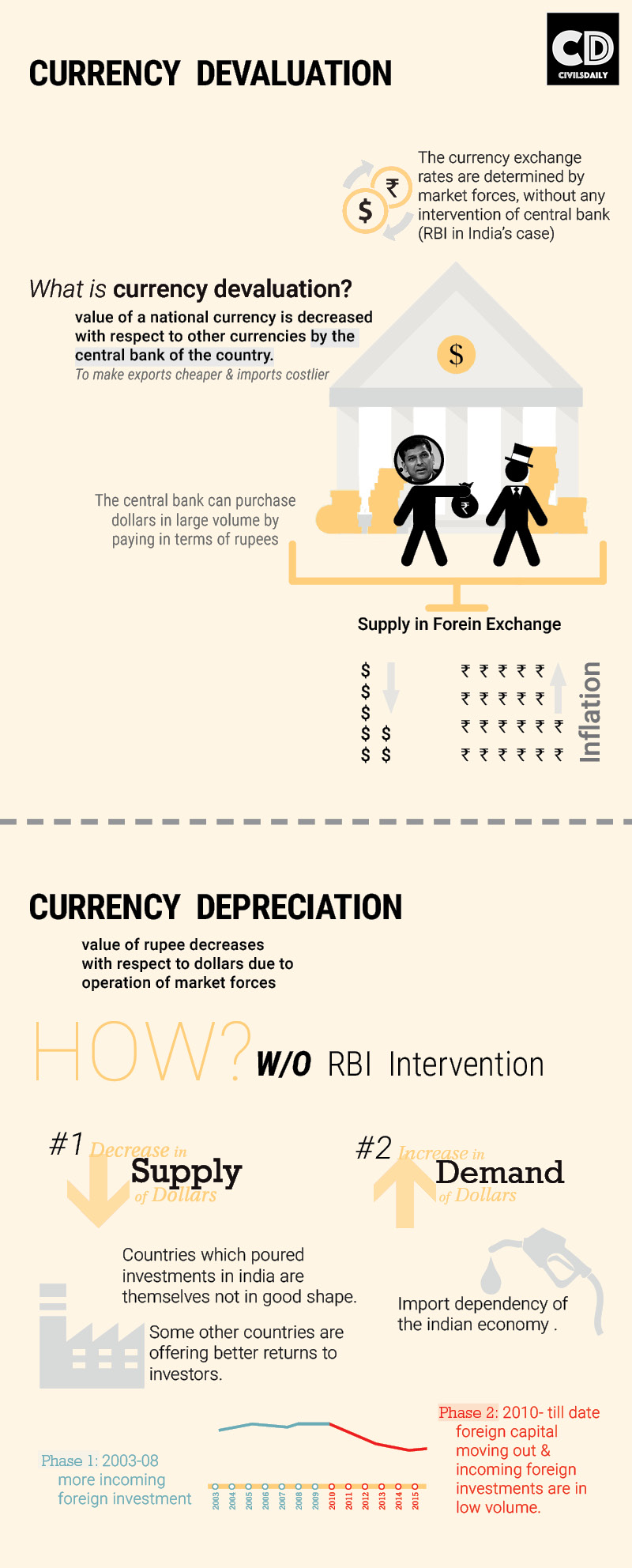
    Under currency devaluation, the value of a national currency is decreased with respect to other currencies by the central bank of the country.

    Before, we delve into the concept of devaluation, lets explore how does currency exchange rates are determined normally. The currency exchange rates are determined by market forces, without any intervention of central bank (RBI in India’s case). <Central Bank and RBI will be used interchangeably in India’s case>


    Now, we will try to understand the process of Devaluation, how it actually happens.

    So, the basic condition for devaluation to happen is that RBI has to become a player in the foreign exchange market.

    Before, we move further, lets explore who all are the players in the forex market. They are importers, exporters, investors & some dealers who deal in foreign exchange (for example exchange banks).

    What will central bank do in the foreign exchange market ?
    The central bank will change the supply of dollars in the market.

    How does it change the supply of dollars in the market?
    The central bank goes to these exchange banks & it will purchase the dollars in large volume by paying in terms of rupees. This will lead to decrease in supply of dollars.

    Now, lets understand the negative implications of such a move.
    As RBI paid in terms of rupees while purchasing dollars, it will increase the money supply in the market, leading to inflation.

    Therefore, devaluation is accompanied with selling of govt. securities.

    RBI can devalue rupee by selling it to purchase dollars in the forex market. It makes exports cheaper & imports costlier & therefore a solution to BOP crisis.


    CURRENCY DEPRECIATION:

    It is a market driven process , determined by market forces.
    Under this, the value of rupee decreases with respect to dollars due to operation of market forces.

    How do the market forces act?

    There are two ways/ causes for currency depreciation :

    #1. Decreases in supply of dollars – without RBI intervention

    This is a very realistic situation that india faced over last few years , when the foreign capital was moving out & foreign investment were not coming in huge volume.

    What could be the reasons? Countries which poured investments in india are themselves not in good shape. Some other countries are offering better returns to investors.

    Phase 1 : 2003-08 – more incoming foreign investment
    Phase 2 : 2010- till date – foreign capital moving out & incoming foreign investments are in low volume.

    #2. Increase in demand of dollars without RBI intervention

    The basic reason behind this is the import dependency of the indian economy .
    This is a traditional reason for depreciation of our currency , since we have been a net import based economy from long time.


    PS: There is another interesting blog on the same topic, written by an economics professor @Civilsdaily – Nursery Rhymes, SDRs and Devaluation of the Yuan

    While you are at it, you might want to read this as well – The Great Fall of China