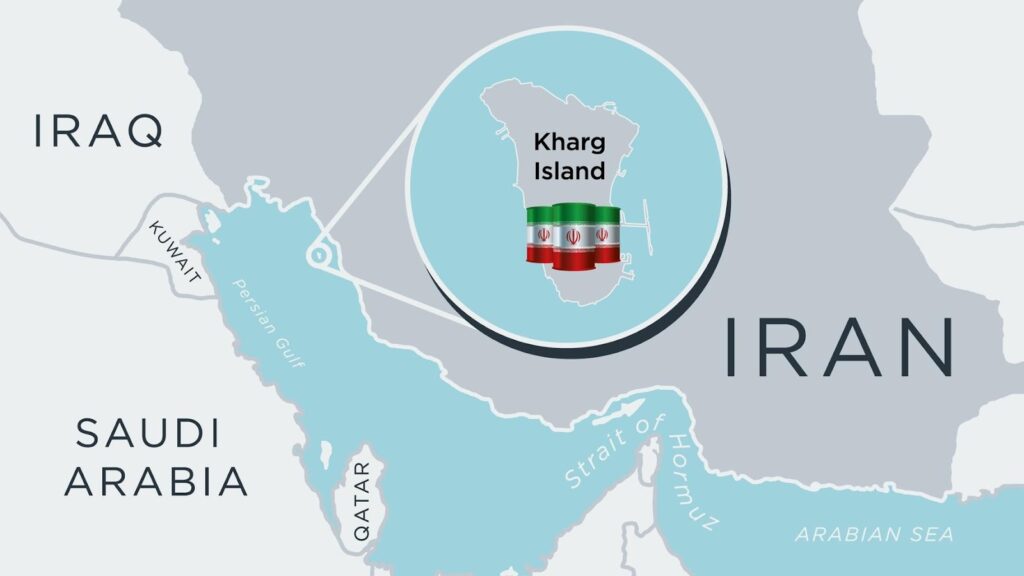
The United States launched airstrikes on military targets on Kharg Island during the ongoing US–Israel conflict with Iran. Although oil infrastructure was not targeted, the attack raises fears of disruption in global oil supply and a potential spike in crude prices.
What is Kharg Island?
A small 8-km-long coral island in the Persian Gulf.
Located about 50 km off Iran’s mainland coast.
Serves as Iran’s primary oil export hub.
Why Kharg Island is Strategically Important
Iran’s Main Oil Export Terminal: About 90% of Iran’s crude oil exports pass through Kharg Island. Pipelines from major Iranian oil fields terminate here before exports.
Massive Oil Infrastructure: Key facilities on the island include:
Falat Iran Oil Company producing around 500,000 barrels per day.
Kharg Petrochemical Company.
Large oil storage and LNG shipping facilities.
Suitable Geography for Large Tankers: Much of Iran’s coastline is too shallow for very large crude carriers (VLCCs). Kharg lies near deep waters, allowing large oil tankers to dock easily.
Oil Trade Through Kharg
Normally ≈1.5 million barrels of oil per day exported through the island.
Iran reportedly increased exports to ≈3 million barrels/day before the strike anticipating conflict.
About 18 million barrels of oil stored there as reserve capacity.
Why the Attack Matters
Impact on Oil Prices: If Kharg’s oil infrastructure were destroyed, 90% of Iran’s exports could stop. Global crude prices could surge towards $150 per barrel.
Strategic Signalling: The U.S. targeted military sites but avoided oil infrastructure, possibly to:
Avoid a major global energy shock.
Signal restraint while warning Iran against disrupting shipping.
Risk to Shipping Routes: The U.S. Navy plans to escort oil tankers through the Strait of Hormuz, which carries a large share of global oil trade.
[2012] To meet its rapidly growing energy demand, some opine that India should pursue research and development on thorium as the future fuel of nuclear energy. In this context, what advantage does thorium hold over uranium? Thorium is far more abundant in nature than uranium. On the basis of per unit mass of mined mineral, thorium can generate more energy compared to natural uranium. Thorium produces less harmful waste compared to uranium. Select the correct answer using the code given below: (a) 1 only (b) 2 and 3 only (c) 1 and 3 only (d) 1, 2 and 3
The Government of India has introduced calibrated changes to its Foreign Direct Investment (FDI) policy for Land Bordering Countries (LBCs) to boost investment in key manufacturing sectors such as electronics components and rare earth magnets.
Background: Press Note 3 (PN3) – 2020
In April 2020, India introduced Press Note 3 (2020).
It mandated prior government approval for investments from countries sharing land borders with India.
Countries Covered
China
Pakistan
Bangladesh
Nepal
Myanmar
Bhutan
Afghanistan
Reason: Prevent opportunistic takeovers of Indian companies during the COVID-19 economic slowdown, particularly by Chinese investors.
Key Changes in the FDI Policy (2026)
Automatic Route for Small Indirect Ownership: Investments will be allowed under the automatic route if beneficial ownership from LBCs is below 10%.
This mainly benefits global private equity and venture capital funds with minor Chinese stakes.
Faster Approval Process: Investment proposals from LBCs in certain sectors must now be processed within 60 days.
Investment in “Specified Sectors”: Allowed sectors include:
Electronic components manufacturing
Electronic capital goods
Polysilicon and wafer manufacturing
Advanced battery components
Rare earth magnets and processing.
However, these investments must ensure Indian majority ownership (at least 51%).
Pakistan Exception: Investments from Pakistan will continue to require government approval and remain restricted.
Why the Policy Was Relaxed
The change follows recommendations from: NITI Aayog and Economic Survey 2023-24.
These reports argued that Chinese capital and technology could help India strengthen export competitiveness, particularly in electronics manufacturing.
Who Benefits?
Global Investment Funds: Funds like private equity and venture capital firms with minor Chinese ownership can invest without lengthy approvals.
Manufacturing Sector: Industries that depend on imported inputs such as: Electronics components, Rare earth magnets, and Semiconductor materials.
Indian Firms: Joint ventures with foreign companies while maintaining majority Indian control.
[2021] Consider the following: Foreign currency convertible bonds Foreign institutional investment with certain conditions Global depository receipts Non-resident external deposits Which of the above can be included in Foreign Direct Investments? (a) 1, 2 and 3 (b) 3 only (c) 2 and 4 (d) 1 and 4
Escalating conflict in West Asia, particularly around the Strait of Hormuz, has raised fears of a global oil supply disruption. The strait is a critical energy chokepoint, and instability threatens oil flows to Asia and Europe. Amid this crisis, Russian crude, earlier stranded due to Western sanctions after the Ukraine war, has regained demand. Estimates indicate Russia earned about $160 million per day in additional oil revenue in 2025 due to market volatility. India, the second-largest buyer of Russian oil after China, has also increased imports despite U.S. pressure, reflecting the tension between energy security and geopolitical alignment.
How has the West Asian conflict reshaped global oil supply dynamics?
Strait of Hormuz disruption: Ensures vulnerability of global oil trade since the strait carries a significant portion of world petroleum exports connecting the Persian Gulf to global markets.
Energy supply uncertainty: Facilitates price volatility due to fears that escalating tensions may block shipping routes or disrupt tanker movements.
Regional instability: Supports supply constraints as attacks on oil infrastructure and shipping vessels increase risk premiums in oil markets.
Strategic chokepoint importance: Strengthens the geopolitical value of maritime corridors that transport energy to Asia and Europe.
Why has Russia emerged as the major beneficiary of the oil supply crunch?
Revenue gains: Generates approximately $160 million per day in additional revenue in 2025, benefiting from volatility linked to Strait of Hormuz disruptions.
Demand recovery: Ensures renewed demand for Russian crude that had earlier accumulated in offshore storage due to sanctions.
Price advantage: Facilitates discounted oil sales that remain attractive to major importers such as India and China.
Sanctions resilience: Strengthens Russia’s ability to maintain export volumes despite restrictions imposed by Western countries after the Ukraine conflict.
How have Western sanctions shaped Russia’s oil trade patterns?
Sanctions restrictions: Limits Russian oil exports through price caps and financial restrictions imposed by the United States and European partners.
Alternative buyers: Encourages Moscow to redirect oil exports toward Asian markets including India and China, which continue purchasing discounted crude.
Shadow fleet expansion: Enables transportation of sanctioned oil through a network of tankers operating outside traditional regulatory systems.
Market reorientation: Strengthens Russia’s dependence on non-Western markets for sustaining energy revenues.
How has India’s oil import strategy evolved amid the crisis?
Import diversification: Supports energy security by purchasing crude from multiple suppliers including Russia, Iraq, Saudi Arabia and the United States.
Russian crude dependence: Facilitates high volumes of imports due to discounted prices offered after sanctions.
Temporary import decline: Ensures partial reduction in Russian imports due to compliance concerns with Western sanctions.
Recent import rebound: Strengthens Russian supply share again as geopolitical disruptions tighten global oil availability.
What risks does the Strait of Hormuz crisis pose to global energy security?
Shipping vulnerability: Increases risk of tanker attacks or blockades in a corridor that carries a large share of global oil shipments.
Price escalation: Drives upward pressure on international crude benchmarks due to perceived supply shortages.
Strategic competition: Intensifies geopolitical rivalry among major powers seeking control over energy routes.
Energy security challenges: Forces importing countries to secure alternative supply chains and maintain strategic petroleum reserves.
Conclusion
The West Asian conflict and disruptions around the Strait of Hormuz have reshaped global energy markets. Instead of weakening Russia, the crisis has enabled Moscow to capitalize on higher prices and renewed demand for its crude oil. For energy-importing countries such as India, the situation highlights the complex balancing act between securing affordable energy supplies and navigating geopolitical pressures.
PYQ Relevance
[UPSC 2018] In what ways would the ongoing US-Iran Nuclear Pact Controversy affect the national interest of India? How should India respond to this situation
Linkage: The current Strait of Hormuz tensions and Russia’s oil resurgence similarly highlight how West Asian geopolitical conflicts affect India’s energy security, oil imports, and foreign policy balancing.
A KC‑135 Stratotanker crashed in western Iraq, killing all six crew members during the ongoing regional conflict.
Incident Details
The aircraft belonged to the United States Air Force.
The crash occurred during operations linked to Operation Epic Fury.
A second aircraft involved in the mission landed safely.
About the KC-135 Aircraft
Introduced over 60 years ago for aerial refuelling missions.
Typical crew: pilot, co-pilot, and boom operator.
Can carry additional crew or up to 37 passengers depending on the mission.
Plays a key role in extending the operational range of fighter and bomber aircraft.
[2025] With reference to India’s defence, consider the following pairs: Dornier-228: Maritime patrol aircraft IL-76: Supersonic combat aircraft C-17 Globemaster III: Military transport aircraft How many of the pairs given above are correctly matched? (a) Only one (b) Only two (Dornier-228 and C-17 Globemaster III are correctly matched) (c) All the three (d) None
PYQ Relevance[UPSC 2022] How will I2U2 (India, Israel, UAE and USA) grouping transform India’s position in global politics?Linkage: The question examines India’s participation in West Asian minilateral groupings and its shift toward multi-alignment with the U.S., Israel, and Gulf countries. It connects with the debate on whether India’s evolving West Asia policy reflects strategic autonomy or growing alignment with the U.S.-led regional framework.
Mentor’s Comment
West Asia is currently facing a major geopolitical crisis involving Israel, Iran, and the United States. India has traditionally maintained a balanced approach in the region based on strategic autonomy and multi-alignment, maintaining relations with all sides. However, recent developments, such as India’s response to Israeli actions, its engagement with Iran, and participation in the India-Middle East-Europe Economic Corridor (IMEC), have raised questions about whether India’s West Asia policy is gradually moving closer to the United States.
The debate has gained attention in the context of the Israel-Hamas conflict, U.S.-Israel strikes on Iran, rising oil prices, and the safety of nearly 10 million Indians living in the Gulf region, making India’s diplomatic approach in West Asia strategically significant.
Why Has India Traditionally Maintained Strategic Balance in West Asia?
Strategic Autonomy: India historically avoids aligning fully with any single power bloc to maintain independent foreign policy decision-making.
Energy Dependence: West Asia supplies a significant share of India’s crude oil imports, making stability in the region vital for economic security.
As of early 2026, despite India diversifying its energy imports to include more Russian oil, West Asia remains a critical backbone for India’s energy needs, accounting for approximately 49% to 55% of India’s total crude oil imports
Diaspora Protection: Approximately 10 million Indian citizens reside in Gulf countries, contributing substantially to remittance inflows.
Economic Partnerships: India maintains strong trade relations with Israel, Iran, Saudi Arabia, and the UAE simultaneously, necessitating balanced diplomacy.
Connectivity Projects: India supports initiatives such as Chabahar Port and broader regional connectivity to Central Asia and the South Caucasus.
Does India’s Response to the Israel-Iran Conflict Indicate Strategic Alignment with the U.S.?
Diplomatic Silence: India avoided strong criticism of Israeli and U.S. military actions against Iran, reflecting cautious diplomatic signalling.
Prime Ministerial Engagement: The warm diplomatic engagement between Prime Minister Narendra Modi and Israeli Prime Minister Benjamin Netanyahu reinforced perceptions of closer political alignment.
Security Cooperation: Israel remains a major supplier of defence and security technology to India.
Strategic Calculations: Security partnerships sometimes outweigh broader national interests, creating concerns about perceived diplomatic bias.
Why Do Gulf Countries View the Conflict Primarily as Defensive?
Defensive Framing: Gulf countries describe their actions as defensive measures rather than offensive military campaigns.
Regional Stability Concerns: Gulf states aim to prevent the conflict from escalating into a regional war involving Iran.
Air Defence Measures: Active interception of Iranian drones and missiles indicates defensive security responses rather than offensive alignment.
Avoidance of Strategic Alignment: Direct participation in strikes against Iran would signal joining the Israel-U.S. military coalition, which Gulf states seek to avoid.
Why Is India’s Relationship with Iran Strategically Significant?
Connectivity Gateway: Iran provides India with access to Central Asia and the South Caucasus, bypassing Pakistan and Afghanistan.
Chabahar Port Project: The port facilitates India’s trade and connectivity strategy in Eurasia.
Economic Cooperation: Bilateral trade with Iran has historically remained strong despite sanctions.
Strategic Leverage: Engagement with Iran strengthens India’s ability to maintain multi-alignment diplomacy in West Asia.
How Much Does the United States Influence India’s West Asia Policy?
Personal Diplomacy: Close political relations between U.S. President Donald Trump and Israeli leadership influenced regional diplomatic dynamics.
Economic Pressure: U.S. sanctions and tariffs have previously forced India to adjust oil imports and financial transactions involving Iran.
Diplomatic Expectations: The United States expected India to publicly credit Washington for brokering the India-Pakistan ceasefire, reflecting influence attempts.
Strategic Autonomy Challenge: Balancing U.S. strategic expectations while maintaining independent diplomacy remains a core challenge.
What Are the Economic and Strategic Consequences of the West Asia Crisis for India?
Energy Price Shock: Conflict-driven oil price increases threaten India’s energy import bill and inflation stability.
Economic Vulnerability: Rising energy costs risk triggering broader economic stress for developing economies.
Trade Corridor Uncertainty: Instability affects the viability of connectivity initiatives like the India-Middle East-Europe Economic Corridor (IMEC).
Human Security Risk: Escalating conflict threatens the livelihoods of millions of Indians working in the Gulf region.
Can India Play a Diplomatic Role in De-escalating the West Asia Conflict?
Dialogue Facilitation: West Asia lacks an effective regional security dialogue platform.
Track-1.5 Engagement: Government-to-government and expert dialogues can facilitate conflict mediation and confidence-building.
Middle-Power Diplomacy: Countries such as India, China, Russia, Indonesia, Malaysia, and Vietnam possess diplomatic credibility to facilitate dialogue.
Constructive Neutrality: India’s balanced relations with all parties position it as a potential mediator
Conclusion
India’s West Asia policy continues to operate within the framework of strategic autonomy and balanced engagement. However, evolving geopolitical alignments, U.S. influence, and deepening India-Israel ties have created perceptions of strategic tilt. Sustaining credibility as an independent diplomatic actor will require careful balancing of strategic partnerships with long-standing regional relationships, particularly with Iran and Gulf countries.
India co-sponsored a resolution at the United Nations Security Council calling for the immediate cessation of attacks by Iran on Gulf countries amid the ongoing West Asia conflict.
Key Points of the Resolution
The resolution was backed by 134 countries.
13 members of the UNSC voted in favour, while Russia and China abstained.
It demands that Iran stop attacks against Gulf Cooperation Council (GCC) countries.
GCC Countries Mentioned
The resolution refers to members of the Gulf Cooperation Council, including: Bahrain, Kuwait, Oman, Qatar, Saudi Arabia, United Arab Emirates, and Jordan (partner country).
Maritime Security Concern
The resolution also condemns attempts by Iran to interfere with navigation through the Strait of Hormuz, a crucial route for global energy supplies.
India’s Position
According to the Ministry of External Affairs:
India prioritises the safety of all civilians in the conflict.
The GCC region is important because:
Around 10 million Indians live and work there.
The region supplies about 50% of India’s crude oil imports and around 90% of LPG imports.
Criticism of India’s Stance
Some former diplomats argued that:
India condemned Iran’s actions but did not explicitly criticise strikes by the United States and Israel against Iran.
Critics say diplomacy should recognise the complexity of the conflict rather than blame a single side.
[2016] Which of the following is not a member of ‘Gulf Cooperation Council’? (a) Iran (b) Saudi Arabia (c) Oman (d) Kuwait
The International Energy Agency announced a record release of 400 million barrels of oil from strategic reserves to stabilise global markets after oil prices surged due to the US-Israel war with Iran.
Key Points
Largest Release Ever
IEA’s 32 member countries agreed to release 400 million barrels of oil.
This is the largest coordinated release in the agency’s history.
It is the sixth emergency release since the IEA was created in 1974 after the oil crisis.
India is not a full member of the IEA.
Reason for the Decision
The conflict disrupted oil supply routes in the Middle East.
Tanker movement through the Strait of Hormuz has been blocked or restricted.
Around 20 million barrels per day of oil flows are affected.
Contribution by Countries
Member countries will release oil based on their national circumstances.
Japan plans to release about 80 million barrels from its reserves.
Market Reaction
Oil prices initially fell but rebounded later.
Markets doubt whether the release will offset the large supply disruption caused by the conflict.
Comparison with Earlier Crisis
During the Russia–Ukraine War, IEA countries released 182.7 million barrels, previously the largest coordinated action.
Strategic Oil Reserves
IEA member countries collectively hold over 1.2 billion barrels in emergency reserves.
An additional 600 million barrels are held by industry under government obligations.
Significance
Aims to stabilise global oil prices and supply.
Demonstrates international coordination during energy crises.
Highlights global vulnerability to disruptions in key energy transit routes like the Strait of Hormuz.
In the context of global oil prices, “Brent crude oil” is frequently referred to in the news. What does this term imply? It is a major classification of crude oil. It is sourced from the North Sea. It does not contain sulphur. Which of the statements given above is/are correct?(a) 2 only (b) 1 and 2 only (c) 1 and 3 only (d) 1, 2 and 3
Gabon is negotiating with the International Monetary Fund for a new loan programme to stabilise its finances after political instability and economic challenges.
Background of the Crisis
Gabon has faced political instability including: A military coup, A contentious election and Four Finance Ministers in three years
This instability has weakened fiscal management and reduced investor confidence.
Purpose of IMF Assistance
Gabon wants an IMF programme to:
Stabilise public finances
Improve transparency and fiscal discipline
Unlock international funding and investor capital
An IMF programme often acts as a signal of credibility for global investors.
Regional Impact
Gabon is part of the Central African Economic and Monetary Community.
Several CEMAC countries are also considering IMF assistance due to a regional funding crunch.
Therefore, Gabon’s IMF programme could influence financial stability across the region.
Challenges to Securing the Loan
Experts highlight several concerns:
Debt transparency issues
Weak availability of economic data
Need for difficult fiscal reforms
Government’s expansionary fiscal policies
Gabon’s previous IMF programme (approved in 2021) went off-track after one year, increasing scepticism.
[2022] “Rapid Financing Instrument” and “Rapid Credit Facility” are related to the provisions of lending by which one of the following? (a) Asian Development Bank (b) International Monetary Fund (c) United Nations Environment Programme Finance Initiative (d) World Bank
Amid supply disruptions caused by the West Asia conflict, officials say India is turning to new sources of natural gas such as the United States and Norway to address the current shortage of cooking gas (LPG).
Key Developments
India is facing a temporary shortage of LPG and LNG supplies.
The government has increased domestic LPG production by about 10%.
Oil refineries have been directed to prioritise propane and butane for LPG production.
This directive was issued by the Ministry of Petroleum and Natural Gas.
Diversifying Gas Imports
India is exploring imports from: United States and Norway
Earlier, a major share of LNG imports came from Qatar.
Price Changes
Earlier LNG price: $6–8 per MMBtu
Current price: around $15 per MMBtu
At higher prices, imports from distant suppliers become economically viable despite longer shipping distances.
Supply Challenges
Shipping LNG from the U.S. or Norway can take about two months.
This may cause a short-term supply gap before new cargoes arrive.
However, officials expect the shortage to be temporary.
Government Priority
The government has prioritised domestic LPG supply for households over commercial users.
To address concerns of hotels and restaurants, a committee of oil marketing companies (OMCs) has been set up to review requests for commercial LPG supplies.
Key Terms
LPG (Liquefied Petroleum Gas)
Mainly composed of propane and butane.
Used widely as cooking fuel in households.
LNG (Liquefied Natural Gas): Natural gas (mostly methane) cooled to −160°C to transport it in liquid form.
Significance for India
India imports a large share of its energy requirements.
Disruptions in West Asia affect fuel supply, prices, and energy security.
Diversifying suppliers helps reduce dependence on a single region.
[2012] In India the overall Index of Industrial Production, the Indices of Eight Core Industries have combined weight of 37.90%. Which of the following are among those Eight Core Industries? 1. Cement 2. Fertilizers 3. Natural Gas 4. Refinery products 5. Textiles Select the correct answer using the code given below: (a) 1 and 5 only (b) 2, 3 and 4 only (c) 1, 2, 3 and 4 only (d) 1, 2, 3, 4 and 5
PYQ Relevance[UPSC 2018] In what ways would the ongoing US-Iran Nuclear Pact controversy affect the national interest of India? How should India respond to this situation?Linkage: The Iran war and broader West Asian instability directly affect India’s energy security, diaspora safety, and strategic balancing between major powers. The article reflects the same theme, how geopolitical conflicts involving Iran reshape India’s foreign policy choices and regional diplomacy.
Mentor’s Comment
The escalating conflict involving Iran, Israel, and the United States represents a major geopolitical turning point in West Asia. Unlike previous limited confrontations, the current escalation reflects an attempt to reshape the ideological, military, and strategic balance of the region. For India, which maintains deep economic, diaspora, and energy ties with Gulf states, the crisis introduces complex strategic dilemmas. The conflict has implications for regional stability, energy security, maritime trade routes such as the Strait of Hormuz, and the evolving power rivalry between the United States, China, and Russia.
Why is the conflict being framed as an attempt to eliminate Iran’s ideological influence?
Ideological confrontation: Targets the ideological framework that drives the Iranian regime’s regional strategy rather than merely its nuclear capability.
Regime change objective: Seeks weakening of the political order in Iran rather than only military deterrence.
Proxy warfare network: Iran supports non-state actors such as Hezbollah, Hamas, and the Houthis, expanding its influence across Lebanon, Gaza, and Yemen.
Regional destabilisation: Iranian proxies have influenced political processes in Lebanon and Yemen, demonstrating Tehran’s ability to shape regional politics indirectly.
How has Iran expanded its asymmetric strategy in response to military pressure?
Decentralised governance: Iran dispersed decision-making structures across multiple institutions anticipating targeted assassinations of leadership.
Expansion of conflict geography: Conflict widened beyond U.S. bases in the Gulf to broader strategic targets.
Political war dimension: Iran turned the war into a regional political confrontation, highlighting vulnerabilities of the American security system.
Energy security threat: Potential disruptions in Gulf energy supplies place multiple economies at risk.
Why do the strategic objectives of Israel and the United States diverge?
Israel’s military priority: Focuses on sustained military operations to eliminate threats regardless of political fallout.
American political constraints: The United States seeks a political settlement to avoid prolonged military engagement and domestic opposition.
War termination dilemma: The United States cannot withdraw without stabilising the region, while Israel prioritises eliminating Iranian capabilities.
How does the war expose weaknesses in U.S. regional strategy?
Security umbrella vulnerability: Gulf states appear exposed despite American military presence.
Mixed signalling: Washington alternates between escalation and de-escalation, creating uncertainty among allies.
Policy inconsistency: U.S. leadership attempts quick regime change strategies similar to earlier interventions in Venezuela, Syria, and Cuba.
How could the conflict reshape the global geopolitical balance?
Strategic distraction: U.S. focus on West Asia reduces attention on Asia-Pacific security.
China’s strategic opportunity: China gains space to strengthen its case regarding Taiwan.
Russia’s economic benefit: Rising oil prices strengthen Russia’s war economy amid the Russia-Ukraine War.
Emerging multipolar order: Regional powers such as Türkiye, Saudi Arabia, and Pakistan could gain greater strategic autonomy.
Why does the crisis create complex diplomatic challenges for India?
Energy dependence: India imports a significant share of crude oil from Gulf countries.
Diaspora presence: Millions of Indian workers live across Gulf states.
Regional balancing: India maintains strong relations with Israel, Iran, and Arab Gulf countries simultaneously.
Strategic uncertainty: Growing rivalry between the U.S. and China constrains India’s diplomatic space.
Conclusion
The escalating conflict involving Iran marks a significant shift in the strategic landscape of West Asia, transforming a regional confrontation into a broader geopolitical contest involving major powers. The crisis exposes the fragility of existing security arrangements in the Gulf, threatens global energy stability, and accelerates the emergence of a multipolar regional order. For India, whose economic, energy, and diaspora interests are deeply intertwined with the region, the conflict underscores the need for a calibrated and balanced foreign policy. Maintaining strategic autonomy, strengthening diplomatic engagement with all stakeholders, safeguarding maritime and energy interests, and enhancing regional partnerships will be crucial for India to navigate the evolving geopolitical turbulence in West Asia.