The 18th Lok Sabha will convene its first session very soon. A new Speaker of the House will be elected during this session.
Until the election of the new Speaker, a pro-tem Speaker will be appointed to administer the oath to the new Members of Parliament.
Who is a Pro-tem Speaker?
The Speaker of the Lok Sabha oversees the day-to-day proceedings of the House.
According to Article 94 of the Indian Constitution, the outgoing Speaker continues in office until the first meeting of the new Lok Sabha.
A pro-tem Speaker is appointed temporarily to manage certain duties until the new Speaker is elected.
The Constitution does NOT mention explicitly about the post.
However, the ‘Handbook on the Working of the Ministry of Parliamentary Affairs provides guidelines on the appointment and duties of the Speaker pro-tem.
Functions:
The primary duty of the pro-tem Speaker is to administer oaths to the new MPs, as mandated by Article 99 of the Constitution.
Appointment of the Pro-tem Speaker
When the Speaker’s post is vacant before the new Lok Sabha convenes, the PRESIDENT appoints a Member of the House as the Speaker pro-tem.
The President administers the oath to the Speaker pro-tem at the Rashtrapati Bhawan.
Generally, three other elected members of the Lok Sabha are also appointed by the President to assist in the oath-taking process.
The SENIORMOST members, in terms of years of service, are usually chosen for this role, though there can be exceptions.
Process of Administering Oaths
The Legislative I Section of the Government of India prepares a list of the seniormost Lok Sabha members after the formation of the new government.
This list is submitted to the Minister of Parliamentary Affairs or the Prime Minister, who identifies the Speaker pro-tem and the three other members for oath-taking.
After the Prime Minister’s approval, the consent of the selected members is obtained by the Minister of Parliamentary Affairs, usually over the telephone.
The Minister then submits a note to the President seeking approval for the appointments and the date and time for the swearing-in ceremony.
Upon the President’s approval, the Ministry informs the Speaker pro-tem and the other members about their appointments.
The Speaker pro-tem then administers the oath to the other three members in the Lok Sabha.
PYQ:
[2024] With reference to the Speaker of the Lok Sabha, consider the following statements :
While any resolution for the removal of the Speaker of the Lok Sabha is under consideration
He/She shall not preside.
He/She shall not have the right to speak.
He/She shall not be entitled to vote on the resolution in the first instance.
Which of the statements given above is/are correct?
Q The size of the cabinet should be as big as governmental work justifies and as big as the Prime Minister can manage as a team. How far is the efficacy of a government then inversely related to the size of the cabinet? Discuss.(UPSC IAS/2014)
Q To what extent, in your view, the Parliament is able to ensure accountability of the executive in India? (UPSC IAS/2021)
Mentor comment: In a parliamentary democracy, the Prime Minister (PM) is the head of government, responsible for running the country and implementing policies. Chosen from the majority party in parliament, the PM leads the executive branch, oversees the cabinet, and represents the government domestically and internationally. The PM must maintain the confidence of the parliament to remain in power.
Why in the News?
On June 7, 2024, Prime Minister Narendra Modi surprised the nation by paying his respects to the Constitution of India at the Alliance meeting.
This move was probably in response to the accusations by the opposition who alleged the threat of ‘changing’ the constitution.
Role of the Prime Minister in a Parliamentary Democracy
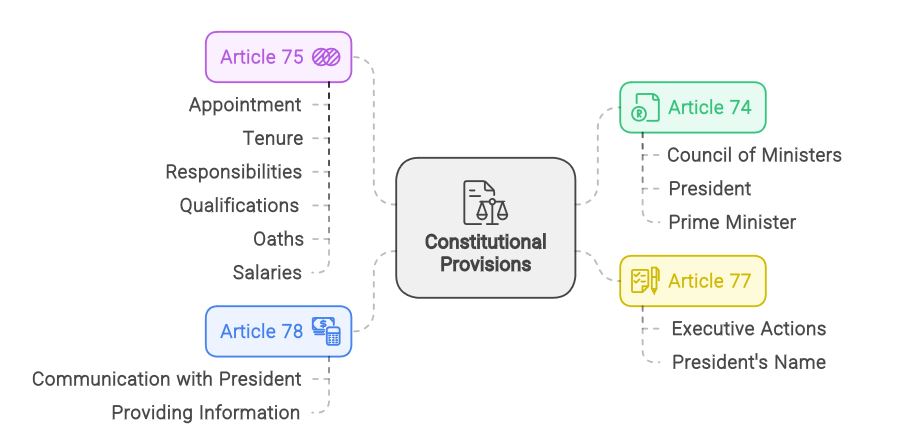
Head of the Council of Ministers: The Prime Minister is the head of the Council of Ministers.
Constitutional Mandate: Article 74 of the Constitution mandates that the Prime Minister advises the President in their functions.
Choice of System: B.R. Ambedkar and the framers chose the parliamentary system over the presidential system to ensure greater responsibility of the executive to the Legislature and the electorate.
Row over Immediate Actions
Oath of Office: On June 9, 2024, Mr Modi and his Cabinet Ministers took the oath of office administered by the President of India.
Pre-emptive Financial Sanction: On June 10, the Prime Minister pre-emptively cleared a significant financial sanction of PM-KISAN without the formal allocation of ministerial portfolios, raising questions about the constitutional validity of such actions.
Optics over Procedure
Cabinet Meeting Decisions: The first cabinet meeting, without allocated portfolios, approved significant welfare measures like the Pradhan Mantri Awas Yojana.
Procedural Concerns: Questions arise about the initiation, circulation, and approval process of these decisions, suggesting a focus on optics rather than constitutional procedure.
Extended Tenures: Mr. Modi extended the tenures of key officials without reconstituting the Cabinet Committee, relying on the old Appointments Committee, raising further procedural concerns.
Coalition Dharma and Constitutional Morality
Disregard for Norms: These actions reflect a disregard for coalition principles and constitutional norms.
Dr. Ambedkar’s Emphasis: B.R. Ambedkar emphasized the need for constitutional morality and the cultivation of democratic sentiments, which appear to be lacking in the current scenario.
Article 77: It provides for the President to make rules for government business transactions, ensuring ministerial accountability, which seems undermined by the centralization of power in the PMO.
Current Government’s functioning
Shift in Power: There is a noticeable shift towards an extraordinary accumulation of power in the Prime Minister’s Office, contrary to the principles of collective responsibility.
Business Rules: The Government of India (Allocation of Business) Rules designate business to specific ministries and departments, not the PMO.
Cabinet Secretariat: The Cabinet Secretariat’s role is to provide secretarial assistance, but recent actions suggest a breakdown of this framework.
Role of opposition in parliamentary democracy
Accountability and Oversight: The opposition scrutinizes government actions and policies, ensuring transparency and preventing abuses of power.
Alternative Policies: It offers constructive criticism and proposes alternative solutions to address national issues and improve legislation.
Representation of Diverse Interests: The opposition voices the concerns and interests of various segments of society, ensuring a balanced and inclusive democratic process.
Way forward
Strengthen Institutional Checks: Implement stricter enforcement of constitutional mandates and parliamentary procedures to ensure balanced power distribution and prevent centralization in the PMO.
Enhance Opposition Collaboration: Foster a cooperative environment where the opposition can effectively scrutinize government actions, propose constructive alternatives, and represent diverse societal interests, promoting a more transparent and accountable government.
Madras HC upheld the ‘Right to Report’ serious incidents of sexual harassment a time, rejecting the 3-month deadline under the Sexual Harassment of Women at Workplace (Prevention, Prohibition, and Redressal) Act (POSH), 2013.
Long-term emotional and psychological damage on victims underscored the need for a broader application of the law.
Right to Report under POSH Act, 2013
Case Background: The decision came while addressing a police officer’s petition to quash an enquiry report for alleged sexual assault against a female colleague.
Madras HC Reasoning: Serious allegations leading to “grave mental trauma” and “stress” constitute a “continuing offence” under POSH, allowing victims to report and investigate at any time.
Notable Observations: the Madras HC distinguished between isolated incidents and serious allegations like assault or molestation.
Isolated Incidents: Must adhere to strict deadlines under POSH.
Serious Allegations: Treated as continuous misconduct until addressed, allowing flexibility in reporting timelines due to fear of victimisation.
What is the POSH Act?
The Sexual Harassment of Women at Workplace (Prevention, Prohibition and Redressal) Act was passed in 2013.
It defined sexual harassment, laid down the procedures for a complaint and inquiry, and the action to be taken.
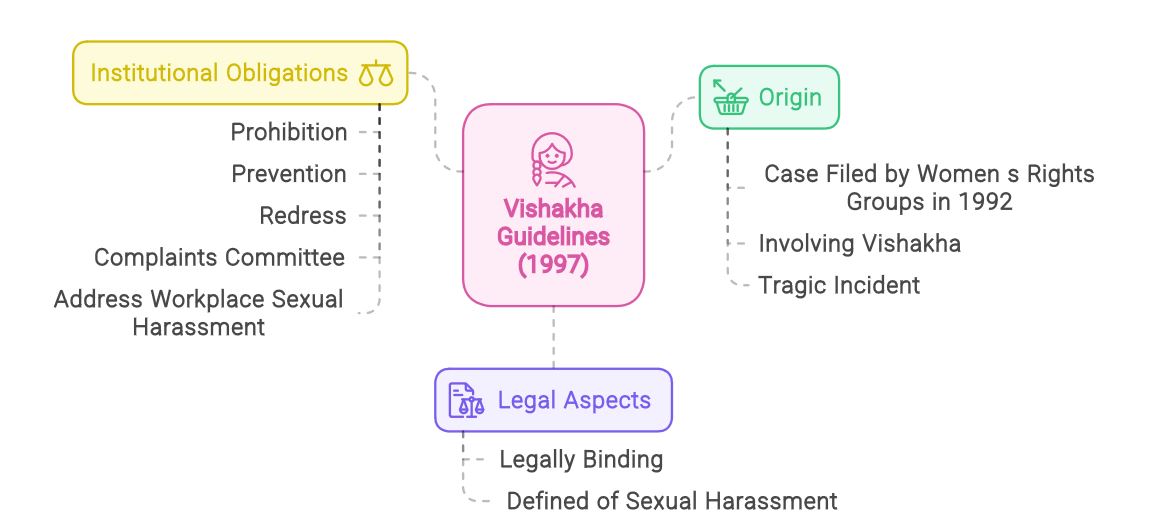
It broadened the Vishakha Guidelines, which were already in place.
The POSH Act broadened these guidelines:
It mandated that every employer must constitute an Internal Complaints Committee (ICC) at each office or branch with 10 or more employees.
It lays down procedures and defines various aspects of sexual harassment, including the aggrieved victim, who could be a woman “of any age whether employed or not”, who “alleges to have been subjected to any act of sexual harassment”.
This meant that the rights of all women working or visiting any workplace, in any capacity, were protected under the Act.
Definition of Sexual Harassment
Under the 2013 law, sexual harassment includes “any one or more” of the following “unwelcome acts or behaviour” committed directly or by implication:
Physical contact and advances
A demand or request for sexual favours
Sexually coloured remarks
Showing pornography
Any other unwelcome physical, verbal or non-verbal conduct of a sexual nature.
The Ministry of Women & Child Development has published a Handbook on Sexual Harassment of Women at the Workplace with more detailed instances of behaviour that constitutes sexual harassment at the workplace. These include, broadly:
Sexually suggestive remarks or innuendos; serious or repeated offensive remarks; inappropriate questions or remarks about a person’s sex life
Display of sexist or offensive pictures, posters, MMS, SMS, WhatsApp, or emails
Intimidation, threats, blackmail around sexual favours; also, threats, intimidation or retaliation against an employee who speaks up about these
Unwelcome social invitations with sexual overtones, commonly seen as flirting
Unwelcome sexual advances.
Unwelcome behaviour
The Handbook says “unwelcome behaviour” is experienced when the victim feels bad or powerless; it causes anger/sadness or negative self-esteem.
It adds unwelcome behaviour is one which is “illegal, demeaning, invading, one-sided and power based”.
Circumstances amounting to SHW
The Act mentions five circumstances that amount to sexual harassment implied or explicit:
The promise of preferential treatment in her employment
The threat of detrimental treatment
Threat about her present or future employment status
Interference with her work or creating an offensive or hostile work environment
Humiliating treatment likely to affect her health or safety
Procedure for complaint
Description
Filing a complaint
The aggrieved victim has the option to file a complaint with the ICC, but it is not compulsory for the ICC to act.
Assistance in filing a complaint
Any member of the ICC must provide reasonable assistance to the victim in filing a written complaint.
Filing a complaint on behalf of the victim
If the victim is unable to file a complaint due to incapacity, death, or other reasons, her legal heir may file it on her behalf.
The time limit for filing a complaint
The complaint must be made within 3 months from the date of the incident
Extension of time limit
ICC has the authority
Monetary settlement and conciliation
Yes. It is possible.
Forwarding complaint or initiating an inquiry
Must be completed within 90 days.
Confidentiality of information
The act ensures the confidentiality of the woman’s identity, respondent’s identity, inquiry details, recommendations, and actions taken
Requirements imposed on employers
Description
Internal Complaints Committee (ICC)
Employers with more than 10 employees must establish an ICC to address sexual harassment complaints.
Composition of ICC
The ICC must include women employees, another employee, and a third-party member familiar with sexual harassment issues.
Local Committee (LC) for smaller organizations
Organizations with fewer than 10 employees must create an LC to receive complaints from the informal sector.
Complaint filing process
Women can file written complaints to either the ICC or LC within three to six months of the incident.
Resolution methods
The Act provides two resolution methods: conciliation between the parties involved or conducting an inquiry by the committee.
Annual audit report
Employers must file an annual audit report on sexual harassment complaints and take responsibility for conducting workshops, awareness programs, and orientation for ICC members.
Non-compliance penalties
Non-compliance with the Act can result in penalties, including fines.
PYQ:
[2019] What are the continued challenges for Women in India against time and space?
[2014] We are witnessing increasing instances of sexual violence against women in the country. Despite existing legal provisions against it, the number of such incidences is on the rise. Suggest some innovative measures to tackle this menace.
[2010] Two of the schemes launched by the Government of India for Women’s development are Swadhar and Swayam Siddha. As regards the difference between them, consider the following statements:
Swayam Siddha is meant for those in difficult circumstances such as women survivors of natural disasters or terrorism, women prisoners released from jails, mentally challenged women etc.,whereas Swadhar is meant for holistic empowerment of women through Self Help Groups.
Swayam Siddha is implemented through Local Self Government bodies or reputed Voluntary Organizations whereas Swadhar is implemented through the ICDS units set up in the states.
Which of the statements given above is/are correct?
(a) 1 only
(b) 2 only
(c) Both 1 and 2
(d) Neither 1 nor 2
Q The concept of cooperative federalism has been increasingly emphasised in recent years. Highlight the drawbacks in the existing structure and the extent to which cooperative federalism would answer the shortcomings. (UPSC IAS/2015) Q How far do you think cooperation, competition and confrontation have shaped the nature of federation in India? Cite some recent examples to validate your answer. (UPSC IAS/2020)
Mentors’ comment: Federalism is crucial as it balances power between national and regional governments, fostering a diverse and inclusive governance structure. It allows regions to address local needs effectively while maintaining national unity. By promoting cooperation and accommodating diversity, federalism enhances democratic participation, prevents centralization of power, and ensures more equitable resource distribution, supporting overall stability and development.
Let’s learn_ _
Why in the news?
On June 4, 2024, the BJP fell short of a Lok Sabha majority, relying on regional partners. This coalition governance could curb the BJP’s dominance and revitalize India’s federal structure, damaged over the past decade.
Undermine the Federalism in last decade before the 2024 election
Centralisation of Power: Under the current administration, there has been a significant shift towards centralising power at the expense of state autonomy, moving away from the principle of cooperative federalism.
Use of Investigative Agencies: Regulatory and investigative agencies like the Enforcement Directorate, Central Bureau of Investigation, and Income-Tax agencies have been used to clamp down on political opponents from regional parties, thereby undermining state authority and autonomy.
Imposition of Hindi: Efforts to impose Hindi on non-Hindi speaking southern states have been part of a broader strategy to homogenize the nation, disregarding the linguistic and cultural diversity of states.
Unilateral Decision-Making: Key decisions, such as imposing a nationwide lockdown during the COVID-19 pandemic, were made unilaterally by the central government without consulting the states, exemplifying a top-down approach.
Fiscal Manipulation: The financial autonomy of states has been undermined by the central government through mechanisms like levying cesses on various items, which are not shared with states, disrupting the balance of fiscal federalism.
The concerns of the Southern States
Financial Disparity: Southern states recognize the necessity of correcting regional imbalances but are concerned about disproportionate financial allocations favoring less-performing northern states. For example, Uttar Pradesh received ₹25,069 crore in tax devolution, more than the combined total for all five southern states.
Potential Political Disenfranchisement: There is anxiety over the potential political dominance of northern states like Uttar Pradesh and Bihar, particularly concerning the upcoming delimitation exercise. These states, with their larger populations, could outweigh the southern states’ influence in the Lok Sabha.
Measures to resolve the concerns of southern States
Need for Equitable Redistribution: Southern leaders emphasise the importance of equitable redistribution and representation, advocating for a balanced approach that does not financially persecute the high-performing southern states.
Coordination Among Southern Leaders: Southern chief ministers are likely to collaborate to address the threat of political disenfranchisement, recognising that their collective interests are at stake in maintaining a fair federal structure.
Why Need to Revive the Inter-State Council?
Potential for Effective Deliberation: Although the Council has the potential to be a formidable forum for decision-making and dispute resolution, it has become ineffective under the control of the Ministry of Home Affairs.
Independent Arena for Coordination: Reviving the Council would provide an independent space for consultation, decision-making, and dispute resolution, ensuring better coordination between states and various governmental departments on issues affecting states.
Accommodating Diversity: In a diverse country like India, fostering a sense of common belonging while respecting the developmental differences among states is crucial. The Council can help in creating policies that are inclusive and considerate of these differences.
Preventing Fragmentation: Ensuring that all states feel that their common nationhood is beneficial helps in maintaining national unity. Without proper forums for dialogue, regional, religious, and linguistic tensions could escalate.
Addressing Inequitable Power Dynamics: The statement “We have more people, so we will have more money and power” threatens to disrupt the delicate balance of federalism. The Council can help address these power imbalances and promote equitable development across all states.
Conclusion: To strengthen India’s federalism, revitalizing the Inter-State Council is crucial, ensuring it operates independently for effective consultation and decision-making. Equitable fiscal practices, respect for state autonomy, and promotion of cultural diversity will foster cooperative governance and prevent centralization, thereby balancing regional needs with national unity.
The Central Information Commission (CIC) upheld Rashtrapati Bhavan’s response to an RTI query regarding the number of times former President Kovind returned decisions by the Prime Minister/Union Council of Ministers for reconsideration.
The President’s Secretariat stated that no information was available on record regarding such returns.
Back2Basics: Right to Information (RTI)
The RTI Act of 2005 grants Indian citizens the right to access government-held information, with exceptions.
Its goal is to enhance transparency and accountability in public authorities.
This Act replaced the earlier Freedom of Information Act of 2002.
RTI aligns with Freedom of Speech and Expression (Article 19) in India’s Constitution.
About Central Information Commission (CIC)
Details
Establishment
Set up under the Section 12 of the Right to Information Act, 2005.
Function
Oversees implementation of RTI Act in Central Government and Union Territories.
Resolves complaints and decides appeals related to the Act.
Headquarters
New Delhi
Composition
Chief Information Commissioner (CIC)
Up to 10 Information Commissioners (IC), (appointed by President on recommendation of PM-led Committee consisting Leader of Opposition and Cabinet Ministers.)
Qualifications
CIC and IC must be persons of eminence in public life with wide knowledge and experience in: Law, Science and Technology, Social Service, Management, Journalism, Mass Media, Administration, and Governance.
NON-ELIGIBLITY: Members of Parliament or Legislature of any State or Union Territory, hold any office of profit, be connected with any political party, or carry on any business or profession.
Tenure
CIC and IC hold office for such term as prescribed by Central Government or until they attain age of 65 years, whichever is earlier.
NO Reappointment.
IC can be appointed as Chief Information Commissioner, but total tenure including term as IC should not exceed 5 years.
Removal
President can remove CIC or IC on grounds like insolvency, conviction for moral turpitude, engaging in another office of profit, etc.
Removal for misbehaviour requires Supreme Court enquiry and recommendation.
Salary & Conditions
Salary, allowances, and service conditions determined by Central Government, cannot be varied to their disadvantage during service (After RTI Amendment Act,2019)
How RTI amendment, 2019 has changed CIC?
Before the 2019 amendment to the RTI Act, ICs at the CIC held a 5-year fixed term and were considered equal in status to the Chief Election Commissioner and Supreme Court judges.
The 2019 amendments granted the Centre the power to alter these terms at its discretion.
Functions
Receives and inquires into complaints related to RTI Act violations, including non-appointment of Public Information Officer, refusal or delay in information, unreasonable fees, incomplete or false information.
Submits annual report on Act’s implementation to Central Government, presented to Parliament.
Powers
Can suo-moto order inquiries, summon persons, enforce oaths, access and inspect documents, receive evidence on affidavit, requisition public records, summon witnesses, and enforce compliance of decisions.
Can direct public authorities on information access, officer appointments, record management, training, and impose penalties or compensation for non-compliance.
PYQ:
[2018] The Right to Information Act is not all about citizens’ empowerment alone, it essentially redefines the concept of accountability. Discuss. (150 words)
[2019] There is a view that the Officials Secrets Act is an obstacle to the implementation of RTI Act. Do you agree with the view? Discuss.
[2020] “Recent amendments to the Right to Information Act will have a profound impact on the autonomy and independence of the Information Commission”. Discuss.
The President of India has rejected a Mercy Petition to pardon a Pakistani terrorist.
The accused was one among the Lashkar-e-Tayyeba terrorists who attacked the Red Fort in 2000, killing two soldiers and a civilian guard.
What is the process of Mercy Petition?
Step 1: The convict facing a death sentence can file a mercy petition within 7 days of the Supreme Court dismissing their appeal.
Step 2: The convict or their relative submits a written petition to the President or governor, citing grounds such as sole breadwinner, physical/mental health, perceived harshness of the law, or judicial errors.
Step 3: The petition is forwarded to the Ministry of Home Affairs for assessment and recommendations, including consultation with the relevant State government.
Step 4: Based on Home Ministry recommendations and the Council of Ministers’ advice, the President can accept or reject the mercy pleawithout a specified time limit.
Step 5: While governors cannot pardon death sentences, they can commute, remit, or reprieve sentences under their state’s executive powers for offences against state laws.
Judiciary on Mercy Petitions:
Bachan Singh v. State of Punjab (1980): The Supreme Court, upheld the death penalty but set the stringent criteria. It emphasized that the death penalty should be awarded only in the “rarest of rare” cases when all mitigating circumstances are considered.
In Maru Ram v. Union of India (1981), the Supreme Court ruled that the power to grant pardons under Article 72 of the Constitution must be exercised based on the advice of the Council of Ministers.
In Kehar Singh vs Union of India (1989) case, the court asserted that presidential pardon is an act of grace, not a right that can be claimed. The exercise of this power is purely administrative and not subject to judicial review.
In the Dhananjoy Chatterjee vs State of West Bengal (1994) case, the Supreme Court clarified that the pardoning powers under Articles 72 and 161 of the Constitution can only be exercised by the Central and State Governments, respectively, and not autonomously by the President or Governor.
In Epuru Sudhakar & Anr. v. Government of Andhra Pradesh (2006), the Supreme Court ruled that the clemency powers of the President and Governor under Article 72 and Article 161 are subject to judicial review.
In Shatrugan Chauhan v. State of U.P. (2014), the appex court has also commuted the death sentence in cases of inordinate delay in deciding mercy petitions. The court commuted the sentence of one Gurmeet Singh after he spent 27 years in custody (and 21 years on death row).
In Mohd. Afzal Guru vs State of Delhi (2014)case, the court-mandated a minimum 14-day gap between the rejection of a mercy petition and the execution of a death penalty, ensuring adequate time for legal recourse.
Report of the 262nd Law Commission (2015): Recommended abolishing the death penalty for all crimes except terrorism-related offenses and waging war.
In April 2023, the Supreme Court upheld the Mumbai High Court’s decision to commute the death sentence of a woman and her sister due to significant delays in deciding their mercy petitions.
About Presidents’ Pardoning Powers under Article 72
According to Article 72, the President of India has the power to grant pardons, reprieves, respites, or remissions of punishment or to suspend, remit, or commute the sentence of any person convicted of any offense: In cases where the punishment or sentence is by a Court Martial;
According to Article 161, the Governor of a State has the power to grant pardons, reprieves, respites, or remissions of punishment or to suspend, remit, or commute the sentence of any person convicted of any offence against any law relating to matters under the executive power of the State.
In the recent Supreme Court Ruling of 2021, the apex court held that the Governor of a state can pardon prisoners, including those on death row, even before they have served a minimum of 14 years of their prison sentence.
Did you know?
Pardon means completely absolving the person of the crime and letting him go free. The pardoned criminal will be like a normal citizen.
Commutation means changing the type of punishment given to the guilty into a less harsh one, for example, a death penalty commuted to a life sentence.
Reprieve means a delay allowed in the execution of a sentence, usually a death sentence, for a guilty person to allow him some time to apply for a Presidential Pardon or some other legal remedy to prove his innocence or successful rehabilitation.
Respite means reducing the quantum or degree of the punishment to a criminal in view of some special circumstances, like pregnancy, mental condition etc.
Remission means changing the time period of the punishment without changing its nature, for example reducing twenty years of rigorous imprisonment to ten years.
Cases as specified by Art. 72
In all cases where the punishment or sentence:
is by a court-martial.
is for an offence against any law relating to a matter to which the executive power of the Union extends.
is a sentence of death.
Nature of the Pardoning Power
The pardoning power of the president is not absolute.
At a procedural level, the apex court in Epuru Sudhakar & Anr. v. Government of Andhra Pradesh (2006) has held that the President’s power must be exercised based on the aid and advice of the Council of Ministers and can be challenged on multiple grounds including that relevant material was not considered, the power was exercised based on political considerations, or there was no application of mind.
This has not been discussed by the Constitution but is the practical truth. Further, the constitution does not provide for any mechanismto question the legality of decisions of presidents or governors exercising mercy jurisdiction.
PYQ:
[2014] Instances of President’s delay in commuting death sentences have come under public debate as denial of justice. Should there be a time specified for the President to accept/reject such petitions? Analyse.
Q Discuss the role of the Election Commission of India in the light of the evolution of the Model Code of Conduct.(UPSC IAS/2022)
Q Simultaneous election to the Lok Sabha and the State Assemblies will limit the amount of time and money spent in electioneering but it will reduce the government’s accountability to the people’ Discuss. (UPSC IAS/2017)
Mentors’ Comment: In an impressive speech (one of many he has delivered), RSS chief Mr Bhagwat has effectively outlined a road map for the newly reinstated government and proposed a model code of conduct, a role typically expected of the Election Commission of India (ECI) during the 2024 general election. The common thread between the two lies in what remains unspoken. While the ECI subtly warned the party, the RSS leader delivered a directive to ‘whomsoever it may concern.’ Mr. Bhagwat’s message is clear and direct, in contrast to the ECI’s subdued and carefully crafted communication. Both messages aim to hit their mark without explicitly identifying the target.
Let’s learn.
Why in the News?
Rashtriya Swayamsevak Sangh (RSS) chief Mohan Bhagwat’s strategic address outlines a governance roadmap, similar to the ECI’s muted directive, both subtly guiding political conduct.
Key Implications of 2024 General Elections:
No more Charisma: The party’s reliance on single personal charisma may have reached its limit, with diminishing returns evident in the election results. Local Issues Matter: The party’s disconnect from local issues in key states like Uttar Pradesh, Maharashtra, and West Bengal contributed to electoral setbacks. Role of RSS (Rashtriya Swayamsevak Sangh): The party underestimated the importance of the RSS in grassroots mobilization and support, which affected its electoral performance. Dalit Voters Cannot Be Taken for Granted: Attempts by leaders to discuss changes to reservation policies backfired, leading to significant losses among Dalit and OBC (Other Backward Classes) voters. Importance of Opposition Alliances: The success of opposition alliances, particularly the INDI Alliance, highlighted the necessity for the Congress and other parties to forge effective alliances to consolidate non-NDA votes.
Bhagwat’s Strategic Speech
Roadmap for Government: Bhagwat’s speech laid out a roadmap for the government and a model code of conduct, akin to the expectations of the Election Commission of India (ECI) during the 2024 general election.
Clear Message: Bhagwat’s message was clear and direct, while the ECI’s was more muted.
Issue Addressing: Both messages aimed to address issues without directly targeting any party.
Election Commission’s Actions
Complaint Examination: The ECI examined complaints, asked political parties for explanations, and issued mild reprimands.
Impartial Justice: The ECI aimed to deliver impartial justice, risking its image but believing it was repaired by the efficient conduct of the 2024 general election.
Bhagwat’s Post-Election Message
Post-Mortem of Election: Bhagwat’s address came after the general election results, suggesting a post-mortem of election conduct.
‘Mishap’ and ‘Maryada’: He implied that the ‘mishap’ was losing the majority, caused by ‘unnatural’ violations of decorum during the campaign by both sides.
Key Words and Their Importance
‘Maryada’ and ‘Ahankar’: Bhagwat emphasized ‘Maryada’ (dignity) and ‘Ahankar’ (arrogance).
True Workers: He stated that true workers maintain dignity without arrogance, linking ‘Maryada’ to Lord Ram and suggesting a model code of conduct.
RSS Vision and Humility
The metaphor of Growth: The RSS website uses the metaphor “Great oaks from little acorns grow,” applying it to the growth of the organization and its volunteers.
Importance of Humility: Bhagwat stressed the importance of humility among swayamsevaks (volunteers).
Treating Political Opponents
Respect for Opponents: Bhagwat highlighted treating opponents with respect after the contest is over.
‘Pratipaksh’ (Opposition): He used the term ‘pratipaksh’ to emphasize the democratic need for inclusivity and respect for opposing views.
Inclusivity and Consensus
Call for Inclusivity: Bhagwat called for inclusivity and building consensus, placing the onus on the ruling party.
Responsibility of Power: He stressed that the responsibility lies with those in power to diminish societal divisions and alleviate minority apprehensions.
India’s Diversity
Mutual Respect: Bhagwat acknowledged India’s diversity and the need for mutual dependence and respect among different communities.
Condemnation of Division Exploitation: He condemned those who exploit divisions for political gains and called for leaders to foster harmony.
Conclusion: Mohan Bhagwat’s address serves as a strategic guide, emphasizing dignity, humility, and inclusivity to strengthen India’s democratic foundations and societal harmony. His message calls for mutual respect, the acknowledgement of diverse perspectives, and the importance of a strong, united foundation for stable governance.
In May 2024, the Supreme Court clearly stated its stance in two important rulings that affect the rights of individuals accused of crimes.
About Supreme Court’s Decision on Detention:
Custody Not Necessary Before Charge Sheet: The Supreme Court ruled that the custody of an accused is not mandatory before filing a charge sheet in certain criminal cases.
Relief for Investigating Agencies: This decision, if adhered to by lower courts, could alleviate pressures on investigating agencies.
Filing of Charge Sheet:Siddharth v. State of Uttar Pradesh and Another (2021)
Non-obligatory Arrest: Section 170 of the CrPC does not require investigating officers (IOs) to arrest every accused at the time of filing the charge sheet.
Acceptance of Charge Sheet: Courts cannot refuse to accept charge sheets solely because the accused is not in custody if the accused has been cooperating and is unlikely to abscond.
Practical Issues: Despite the ruling, IOs face challenges in filing charge sheets due to court practices and logistical constraints, such as the absence of all accused or arbitrary limits on the number of charge sheets accepted daily.
Grounds of Arrest:
1. Pankaj Bansal v. Union of India and Others (2023):
Written Notification Required: Grounds of arrest must be provided in writing to the accused to comply with constitutional and statutory mandates, specifically under Section 19(1) of the PMLA.
2. Prabir Purkayastha v. State (NCT of Delhi):
Application to UAPA: The requirement for written grounds of arrest under PMLA applies equally under UAPA.
Formal vs. Personal Grounds: Differentiates between formal reasons for arrest and personal grounds, necessitating detailed written reasons for arrest.
3. Criminal Procedure Code (CrPC):
Section 50(1) Compliance: Requires that every police officer inform the arrested person of the full particulars of the offence and grounds of arrest.
Arrest Memo: While arrest memos detail charges and are signed by the IO and the accused, there is no legal requirement to provide a copy to the accused.
Recommendation for Amendment: To comply with constitutional rights, it is suggested to amend the law to provide a copy of the arrest memo to the accused, enhancing transparency and legal support.
Conclusion: The Supreme Court’s decisions regarding the necessity of detention before charge sheet filing and the requirements for informing an accused of the grounds of arrest, highlight the implications for legal and procedural practices in India.
Mains PYQ:
Q Human right activists constantly highlight the fact that the Armed forces (Special Powers) Act, 1958 (AFSPA) is a draconian act leading to cases of human right abuses by security forces. What sections of AFSPA are opposed by the activists. Critically evaluate the requirement with reference to the view held by Apex Court. (UPSC IAS/2015)
Bihar Chief Minister Nitish Kumar has renewed the State’s persistent call for special category status from the Centre, which would boost the State’s share of tax revenues from the Central government.
How does the ‘Special Category’ Status benefit the states like Bihar?
Increased Central Funds: States with special category status receive a higher share of central funds for government schemes, typically 90% from the Centre, compared to 60%-80% for other states.
Tax-Related Concessions: These states enjoy various tax concessions that can attract investments and boost economic development.
Financial Aid for Development: The additional funds can be used to address developmental gaps, improve infrastructure, and support welfare programs.
Criteria for Special Category status:
Geographic Disadvantages: States with challenging terrains such as hilly or difficult terrain.
Low Population Density or High Tribal Population: States with a considerable proportion of tribal population or low population density.
Economic and Social Backwardness: States that are economically and socially disadvantaged.
Strategic Location: States that share international borders or have strategic significance.
Why has Bihar’s demand been a long-standing issue?
Economic Backwardness: Bihar has one of the lowest per capita incomes in India and lags behind in several human development indicators.
Fiscal Challenges: The bifurcation of the state leading to the formation of Jharkhand, frequent natural disasters, and insufficient water resources for irrigation have adversely affected Bihar’s fiscal situation.
Political Reiteration: Successive Bihar governments have continuously demanded special status to help the state’s development.
What are the political implications of granting ‘Special Status’ to Bihar?
Increased Bargaining Power: Granting special status could enhance Bihar’s political leverage with the central government, especially in coalition politics.
Precedent for Other States: Granting special status to Bihar could lead to similar demands from other states, potentially creating financial burdens for the Centre.
Electoral Promises and Alliances: Political parties may use the promise of special status as an electoral tool to gain or maintain power, as seen with the Congress party’s manifesto promise in 2024.
Centre-State Relations: The decision could impact the dynamics of center-state financial relations and influence the federal structure of revenue distribution in India.
Conclusion: The Central government should establish a transparent and well-defined framework for granting special category status, taking into account various economic, geographic, and social parameters. This framework should be periodically reviewed to ensure it remains relevant and fair to all states.
Mains PYQ:
Q To what extent is Article 370 of the Indian Constitution, bearing marginal note “Temporary provision with respect to the State of Jammu and Kashmir”, temporary? Discuss the future prospects of this provision in the context of Indian polity. (UPSC IAS/2016)
President Droupadi Murmu administered oaths to the Central Council of Ministers (CoM) of the new NDA government, comprising a larger team compared to the previous term.
The Council includes 30 cabinet ministers, five Ministers of State (Independent Charge), and 36 Ministers of State, with the Prime Minister leading the team.
About Central Council of Ministers
The Central CoM is a crucial part of India’s governance system.
Members: It consists of the Prime Minister (Head), Cabinet Ministers, Ministers of State, and Deputy Ministers.
History:
Portfolio System: The system of the CoM finds its roots in the Indian Councils Act of 1861, introduced by Lord Canning going parallel with the British Parliamentary System.
Constitutional Provisions
Articles 74 to 78 in Part V of the Indian Constitution broadly deal with the Central Council of Ministers.
Union Executive: The Union Executive encompasses the President, Vice-President, Prime Minister, Union Council of Ministers, and Attorney General of India, collectively responsible for the country’s administration.
Role of the Prime Minister
The Prime Minister is the head of the Central Council of Ministers, exercising executive authority and decision-making powers on key policy issues and unallocated portfolios.
Responsibilities: Prime Minister Modi oversees critical ministries such as Personnel, Public Grievances, Pensions, Department of Atomic Energy, and Department of Space, while also leading government bodies like the Cabinet Secretariat and NITI Aayog.
Functions and Duties of CoM
1. Policy Formulation and Implementation:
Formulating Policies: The Council of Ministers, particularly the Cabinet, is tasked with formulating policies crucial for the nation’s development and welfare.
Policy Coordination: It ensures coordination among various government departments and agencies for effective policy implementation.
2. Executive Functions:
Real Executive Authority: The Council of Ministers acts as the real executive authority, exercising executive powers on behalf of the President.
Administration: It oversees the day-to-day administration of the country, ensuring the smooth functioning of government affairs.
Emergency Powers: During emergencies, the Council of Ministers advises the President on the exercise of emergency powers and crisis management.
3. Legislative Functions:
Bills and Legislation: Ministers actively participate in the legislative process by introducing bills, piloting them through Parliament, and ensuring their passage.
Policy Advocacy: They advocate for government policies and bills in Parliament, engaging in debates and discussions to garner support.
Budgetary Process: The Council of Ministers prepares and presents the annual budget, guiding fiscal policies and financial allocations.
4. Financial Management:
Budget Preparation: It plays a significant role in preparing the national budget, and outlining revenue and expenditure plans for the fiscal year.
Financial Administration: The Council oversees financial administration, ensuring compliance with budgetary provisions and efficient resource utilization.
Taxation and Fiscal Policy: Ministers propose taxation measures and formulate fiscal policies to promote economic growth and stability.
Who are the Cabinet Ministers?
The Cabinet Ministers are senior members of the Central Council of Ministers who head key government departments or ministries.
Typically, Cabinet Ministers are appointed by the Prime Minister and are part of the Cabinet, which is the core decision-making body in the government.
Each Cabinet Minister typically manages a specific portfolio aligned with the government’s priorities and responsibilities.
Examples: Minister of Finance, Minister of Home Affairs, Minister of Defence, Minister of External Affairs, Minister of Health, Minister of Education, and others.
The term ‘Cabinet’ was inserted in Art. 352 of the Constitution by the 44th Amendment Act 1978.
It did not find a place in the original text of the Constitution.
Difference between Ministers of State (Independent Charge) and Ministers of State:
Ministers of State (Independent Charge)
Ministers of State
Authority
Have independent portfolios
Assist Cabinet Ministers
Reporting Structure
Directly report to PM/President
Report to and assist Cabinet Ministers
Accountability
Fully responsible for their departments
Assist Cabinet Ministers in tasks
Protocol Status
Equivalent to Cabinet Ministers in status
Lower protocol status
Attendance in Cabinet Meetings
May attend if their portfolios are discussed
Not regular attendees
PYQ:
[2013] Consider the following statements:
The Council of Ministers in the Centre shall be collectively responsible to the Parliament.
The Union Ministers shall hold the office at the pleasure of the President of India.
The Prime Minister shall communicate to the President about the proposals for legislation.
Which of the statements given above is/are correct?
(a) 1 only
(b) 2 and 3 only
(c) 1 and 3 only
(d) 1, 2 and 3
[2007] Assertion (A): The Council of Ministers in the Union of India is collectively responsible both to the Lok Sabha and Rajya Sabha.
Reason (R): The Members of both the Lok Sabha and the Rajya Sabha are eligible to be the Ministers of the Union Government.
Choose the correct Code:
(a) Both A are R are true and R is the correct explanation of A
(b) Both A and R are true but R is not a correct explanation of A
![[18th June 2024] The Hindu Op-ed: Constitutional respect should not be reduced to optics](https://www.civilsdaily.com/wp-content/uploads/2024/06/18-June-1568x882.jpg)
![[15th June 2024] The Hindu Op-ed: Reimagining Indian federalism](https://www.civilsdaily.com/wp-content/uploads/2024/06/15-June-1568x882.jpg)
![[14th June 2024] The Hindu Op-ed: The message in the RSS chief’s Speech](https://www.civilsdaily.com/wp-content/uploads/2024/06/14-June-1568x882.jpg)