💥Mains Ready By December. Smash Mains & Smash PYQ Admissions Open

Subject: Polity

  • [op-ed of snap] The four phases of constitutional interpretation

    Context

    The ways in which the Constitution of India is interpreted has undergone changes through four phases.

    Constitution-An Ambitious political experiment

    • Indian Constitution was an ambitious political experiment for the following reasons-
      • Universal Adult Franchise: India began its journey with the universal adult franchise.
      • Federalism: Federalism in a region consisting of over 550 princely States.
      • The promise of Equality: The Constitution was a sort of social revolution in a deeply unequal society with the promise of equality.
      • Unique constitutional design: it was equally a unique achievement in terms of constitutional design.

    The first phase of interpretation-Focus on text

    • A textualist approach-focusing on the plain meaning of the words: In its early years, the Supreme Court adopted a textualist approach, focusing on the plain meaning of the words used in the Constitution.
      • K. Gopalan v. State of Madras (1950) was one of the early decisions in which the Court was called upon to interpret the fundamental rights under Part III.
      • The leader of the Communist Party of India claimed that preventive detention legislation under which he was detained was inconsistent with Articles 19 (the right to freedom), 21 (the right to life) and 22 (the protection against arbitrary arrest and detention).
      • Fundamental rights separate from each other: The Supreme Court decided in A. K. Gopalan case that each of those articles covered entirely different subject matter, and were to be read as separate codes rather than being read together.
    • Unlimited Amendment Power: In its early years, the Court read the Constitution literally, concluding that there were no limitations on the Parliament’s power to amend the Constitution.

    The second phase of interpretation-Focus on ‘basic structure’

    • Appeals to the structure and coherence: Appeals to the text of the Constitution were gradually overtaken by appeals to the Constitution’s overall structure and coherence.
      • Limited Amendment Power-Kesavananda Bharati case: In the leading case of Kesavananda Bharati v. State of Kerala(1973), the Court concluded that Parliament’s power to amend the Constitution did not extend to altering its “basic structure”.
      • What is the “Basic Structure”: The basic structure is an open-ended list of features that lie within the exclusive control of the Court.
      • When Parliament attempted to overturn this decision by amending the Constitution yet again, the Court, relying on structuralist justifications, decisively rejected that attempt.
    • Key takeaways from Kesavananda Bharati case
      • Limited Amendment Power: In this case, the Court pronounced that Parliament’s power to amend the Constitution is not unlimited.
      • Fundamental rights as a cohesive bill of rights: In this phase, the Court also categorically rejected the Gopalan approach in favour of a structuralist one.
      • Maneka Gandhi v. Union of India (1978):  Through decision, in this case, the Court conceived of the fundamental rights as a cohesive bill of rights rather than a miscellaneous grouping of constitutional guarantees.
      • Incremental interpretation of Right to Life: The right to life was incrementally interpreted to include a wide range of rights such as clean air, speedy trial, and free legal aid.
      • Courts playing role in governance: The incremental interpretation of Article 21 paved the way for the Supreme Court to play an unprecedented role in the governance of the nation.
    • What was common in the first two phases?
      • Interpretation done by Constitutional Benches: That significant decisions involving the interpretation of the Constitution were entrusted to Constitution Benches (comprising five or more judges of court) and were carefully (even if incorrectly) reasoned.
      • Little scope for precedential confusion: There was limited scope for precedential confusion, since matters which had been decided by Constitution Benches and which demanded reconsideration were referred to larger Constitution Benches.

    Third Phase of interpretation-Eclecticism

    • Different opinions on the same issues: In the third phase the Supreme Court started to give different opinions on the same issues-i.e. it engaged in eclecticism.
      • Lesser reasoning: The Court often surrendered its responsibility of engaging in a thorough rights reasoning of the issues before it.
      • Two factors underpinned this institutional failure.
    • First-Change in the structure of the SC: The changing structure of the Court, which at its inception began with eight judges, grew to a sanctioned strength of 31; it is currently 34.
    • It began to sit in panels of two or three judges, effectively transforming it into a “polyvocal” group of about a dozen sub-Supreme Courts.
    • Second-expansion of own role by the SC-The Court began deciding cases based on a certain conception of its own role -whether as a sentinel of democracy or protector of the market economy.
    • The focus of the judgement on the result rather than reason: This unique decision-making process sidelined reason-giving in preference to arriving at outcomes that match the Court’s perception.
    • Consequences of the eclecticism
      • Rise of doctrinal incoherence and inconsistency: The failure to give reasons contributed not only to methodological incoherence but also to serious doctrinal incoherence and inconsistency across the law.
      • Conflicting decisions and interpretations: This approach can be best described as panchayati eclecticism, with different Benches adopting inconsistent interpretive approaches based on their conception of the Court’s role, and arriving at conclusions that were often in tension with one another.
      • Decision detached from precedents and established methods: The imagery that panchayati eclecticism is meant to invoke is that of a group of wise men and women (applying the analogy, sub-Supreme Courts), taking decisions based on notions of fairness that are detached from precedent, doctrine and established interpretive methods.

    Fourth phase- based on the purpose

    • Purpose of enactment of the Constitution as critical: In the fourth phase, the Court has acknowledged as critical to its interpretive exercise the purpose for which the Constitution has been enacted.
    • The realisation of revolutionary and transformative potential: The Court is now beginning to interpret the Constitution in accordance with its revolutionary and transformative potential.
      • Renaissance in decisions: With about a dozen significant Constitution Bench decisions from the Supreme Court since September 2018, there has been a renaissance in decision-making by Constitution Benches.
      • The most important decisions of this period include-
      • Court’s decisions striking down Section 377 and the criminal offence of adultery.
      • And including the office of the Chief Justice of India within the scope of the Right to Information Act.

    Conclusion

    With the interpretation process entering in the fourth phase-realising the purpose of enactment of the Constitution- Indian judiciary is on the right track, however, facets of phase 3 continue to linger on it. The Supreme Court must avoid getting in phase three mode to in order to realise the purpose it was entrusted with.


  • De-criminalization of Politics


    The Supreme Court has agreed to examine a proposition made by the Election Commission (EC) to ask political parties to not give a ticket to those with criminal antecedents.

    Cleansing of Political Parties

    • The judgment had urged Parliament to bring a “strong law” to cleanse political parties of leaders facing trial for serious crimes.
    • The ruling concluded that rapid criminalisation of politics cannot be arrested by merely disqualifying tainted legislators but should begin by “cleansing” the political parties.
    • The court had suggested that Parliament frame a law that makes it obligatory for political parties to remove leaders charged with “heinous and grievous” crimes like rape, murder and kidnapping, only to a name a few, and refuse ticket to offenders in both parliamentary and Assembly polls.
    • It had also issued guidelines, including that both the candidate and the political party should declare the criminal antecedents of the former in widely-circulated newspapers.

    Why such move?

    • 46% of Members of Parliament have criminal records.
    • A move to steer politics away from the denizens of the criminal world would definitely serve national and public interest.
    • The EC had tried several measures to curb criminalisation of politics but failed.
  • Explained: The Kashmir Pandit tragedy


    It is 30 years since the “exodus” from the Valley of its minority Hindu Kashmiri Pandit community.

    The run-up: 1980s to 1990

    • Sheikh Abdullah had died in 1982, and the leadership of the National Conference passed on to his son Farooq Abdullah, who won the 1983 election.
    • But within two years, the Centre broke up the NC, and installed dissident Ghulam Mohammed Shah as Chief Minister. This led to huge disaffection and political instability.
    • The Jammu & Kashmir Liberation Front (JKLF) stepped up its activities, and the hanging of the militant leader Maqbool Bhat in 1984 added to the sense of foreboding.
    • In 1986, after the Rajiv Gandhi government opened the Babri Masjid locks to enable Hindus to offer prayers there, ripples were felt in Kashmir too.
    • In Anantnag, the constituency of then Congress leader Mufti Mohammad Sayeed, there was a series of attacks on Hindu temples, and shops and properties of Kashmiri Pandits, blamed on separatist and secessionists.
    • Pandits had begun to be targeted. Eminent persons of the community were being shot dead.

    The night of January 19, 1990

    • Matters came to a head on January 19. By then, the Farooq Abdullah government had been dismissed and Governor’s Rule imposed.
    • According to accounts published by many eminent Kashmiri Pandits, there were threatening slogans over loudspeakers from mosques, and on the streets.
    • Speeches were made extolling Pakistan and the supremacy of Islam, and against Hinduism. Finally, the Kashmiri Pandit community decided to leave.

    The Gawkadal Massacre

    • On January 20, the first stream began leaving the Valley with hastily packed belongings in whatever transport they could find. A second, larger wave left in March and April, after more Pandits were killed.
    • On January 21, the CRPF gunned down 160 Kashmiri Muslim protesters at the Gawkadal Bridge, which has come to be known as the worst massacre in the long history of the conflict in Kashmir.
    • The two events — the flight of the Pandits and the Gawkadal massacre — took place within 48 hours.

    How many Pandits left?

    • According to some estimates, notably by the Kashmiri Pandit Sangharsh Samiti (KPSS), of 75,343 Kashmiri Pandit families in January 1990, more than 70,000 fled between 1990 and 1992 and continued until 2000.
    • The KPSS has placed the number of Kashmiri Pandits killed by militants from 1990 to 2011 at 399, the majority during 1989-90.
    • Some 800 families have remained in the Valley through these three decades.

    Role of the administration

    • The other contentious question about the exodus is the role played by the administration, and more specifically that of the J&K Governor, Jagmohan.
    • Newly appointed, he had arrived in Srinagar on January 19.
    • The Kashmiri Muslim view of the exodus is that he encouraged the Pandits to leave the Valley and thus gave a communal colour to what was until then a non-religious Kashmiri cause.
    • The Kashmiri Hindu view is that this is a disingenuous interpretation.
    • They believe that Kashmiri Muslims, with whom they had lived amicably for centuries, drove them out with a vengeance in a frenzy of Islamism that they could not have imagined even months earlier.
    • The truth, many commentators have concluded, may have been somewhere in the middle.

    The question of return

    • Those who had means rebuilt their lives elsewhere in the country — Delhi, Pune, Mumbai and Ahmedabad have Pandit populations, also Jaipur and Lucknow — or went abroad.
    • The fleeing Pandits did not think they would never return to the Valley. But as the situation in Kashmir spiraled into a full-blown militancy, return began to look remote if not impossible.
    • The longing to return to the Valley did not diminish over the years, though it may have become more an idea than a real ambition.
    • Successive governments have promised that they will help this process, but the situation on the ground in Kashmir has meant this remains only an intention.
    • There is an acute realization in the community that the Valley is no longer the same that they left behind in 1990.
    • In many cases, their properties were either immediately vandalised or sold quickly by the owners to Kashmiri Muslims. Many fell into disrepair.
  • Democracy Index 2019


    The latest edition of the Democracy Index spells gloom for India. The world’s biggest democracy slipped 10 places in the 2019 global ranking to 51st place.

    Democracy Index

    • The report is published by The Economist Intelligence Unit — the research and analysis division of The Economist Group, which is the sister company to The Economist newspaper.
    • It records how global democracy fared, analysing 165 independent states and two territories.
    • The 2019 survey attributes the primary cause of “the democratic regression” to “an erosion of civil liberties in the country”.

    India’s performance

    • India’s overall score fell from 7.23 to 6.9, on a scale of 0-10, within a year (2018-2019) — the country’s lowest since 2006.
    • India was graded in electoral process and pluralism (8.67), government functioning (6.79), political participation (6.67), political culture (5.63) and civil liberties (6.76).
    • In the Asia and Australasia region, India ranks eighth, behind Taiwan and Timor-Leste.
    • The report talks about the repeal of both Article 370 and Article 35A and various restrictions such as house arrests, internet shutdowns and excessive use of forces.

    India: A flawed democracy?

    The Index also categorizes India under “flawed democracies”, i.e. countries that hold free and fair elections and where basic civil liberties are respected, but have significant weaknesses in aspects of democracy, such as problems in governance, an underdeveloped political culture and low levels of political participation.

  • Three capitals for Andhra Pradesh — its logic and the questions it raises


    The Andhra Pradesh Assembly passed The Andhra Pradesh Decentralisation and Equal Development of All Regions Bill, 2020, paving the way for three capitals for the state.

    Three capitals concept in Andhra Pradesh

    • Three cities serve as capitals of the country– Pretoria (executive), Cape Town (legislative), and Bloemfontein (judicial).
    • This arrangement was a result of the Second Boer War (1899-1902) in which Britain annexed the two Afrikaner speaking states -– the Orange Free State and the South African Republic (also called Transvaal Republic).
    • Cape of Good Hope then remained in the British Empire, becoming self-governing in 1872, and uniting with three other colonies to form the Union of South Africa in 1910.

    What are the other examples of multiple capital cities?

    • Several countries in the world have implemented the concept.
    • In Sri Lanka, Sri Jayawardenepura Kotte is the official capital and seat of national legislature, while Colombo is the de facto seat of national executive and judicial bodies.
    • Malaysia has its official and royal capital and seat of national legislature at Kuala Lumpur, and Putrajaya is the administrative centre and seat of national judiciary.
    • Among Indian states, Maharashtra has two capitals– Mumbai and Nagpur (which holds the winter session of the state assembly).
    • Himachal Pradesh has capitals at Shimla and Dharamshala (winter).
    • The former state of Jammu & Kashmir had Srinagar and Jammu (winter) as capitals.

    Reasons behind such considerations

    • According to the government, decentralisation was the central theme in recommendations of all major committees that were set up to suggest a suitable location for the capital of Andhra Pradesh.
    • It had been agreed in the November 16, 1937 Sri Bagh Pact (between leaders of coastal Andhra and Rayalaseema) that two university centres should be established in Waltair (Visakhapatnam) and Anantapur in Rayalaseema, and that the High Court and Metropolis should be in the coastal districts and Rayalaseema respectively.
    • In December 2010, the Justice B N Srikrishna Committee, set up to look into the demand for a Telangana state, said Rayalaseema and North Coastal Andhra were economically the most backward, and the “concentration of development efforts in Hyderabad is the key reason for demand of separate states”.
    • In August 2014, the K Sivaramakrishnan Committee appointed to identify locations for the new capital of AP said the state should see decentralised development, and that one mega capital city was not desirable.

    Major practical problems

    • The government argues that the Assembly meets only after gaps of several months, and government Ministers, officers, and staff can simply go to Amaravati when required.
    • However, coordinating between seats of legislature and executive in separate cities will be easier said than done, and with the government offering no specifics of a plan, officers and common people alike fear a logistics nightmare.
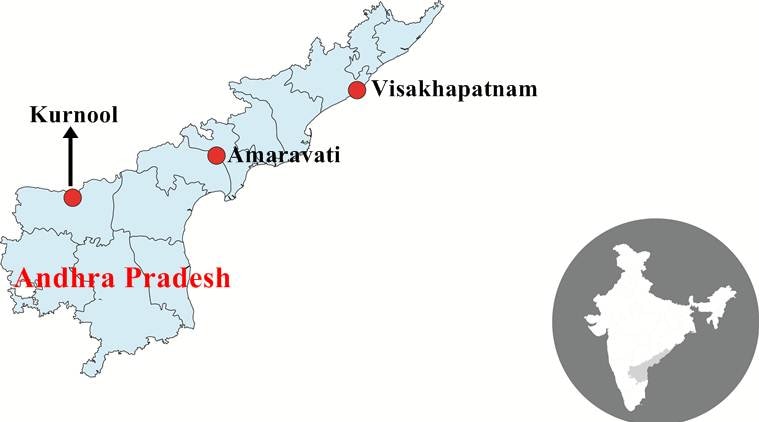
    • The distances in Andhra Pradesh are not inconsiderable. Executive capital Visakhapatnam is 700 km from judicial capital Kurnool, and 400 km from legislative capital Amaravati.
    • The Amaravati-Kurnool distance is 370 km. The time and costs of travel will be significant.
    • The AP Police are headquartered in Mangalagiri, 14 km from Vijayawada, and senior IPS officers who may be required to visit the Secretariat will have to travel 400 km to Visakhapatnam.
    • Likewise, government officers who may have to appear in the High Court will have to travel 700 km to Kurnool, which does not have an airport.
    • All officers and Ministerial staff who may have to be at hand to brief Ministers when the Assembly is in session, will probably have to stay put in Amaravati, leaving behind their other responsibilities in Visakhapatnam.
  • Death Penalty in India (Annual Statistics Report 2019)

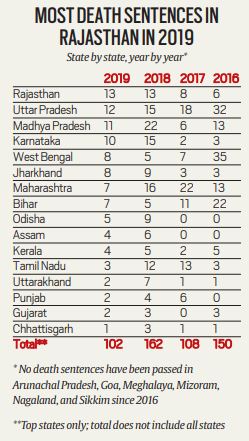
    Trial courts in India delivered 102 death sentences in 2019, over 60% fewer than the 162 death sentences passed in 2018.

    Highlights of the Report

    • In 2019, fewer death sentences overall were delivered.
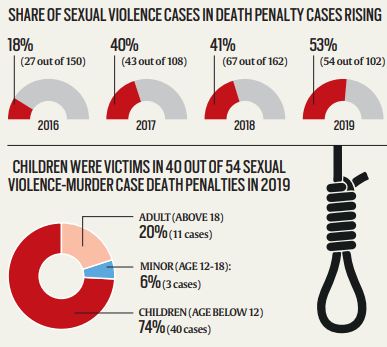
    • 1 out of 2 sentences for sexual violence-murder; in 3 out of 4 sexual violence-murder death sentences, children were the killer’s victims.
    • The courts were, however, especially unforgiving of murders that involved sexual violence — the proportion of death sentences imposed for murders involving sexual offences was at a four-year high in 2019 at 52.94%.
    • 2019 also saw the highest number of confirmations by High Courts in four years; 17 out of the 26 confirmations (65.38%) were in offences of murder involving sexual violence.
    • The Supreme Court, primarily during the tenure of the previous CJI Gogoi, listed and heard 27 capital cases, the most in a year since 2001.

    Project 39A

    • These are the headline findings in the fourth edition of The Death Penalty in India: Annual Statistics, published by Project 39A at the National Law University (NLU), Delhi.
    • Project 39A is a research and litigation initiative focussed on the criminal justice system, and especially issues of legal aid, torture, death penalty, and mental health in prisons.
    • The report tracked news of death sentences awarded by trial courts published online by news organisations in English and Hindi.
    • It checked these numbers against judgments uploaded to websites of High Court and district courts.
  • Explained: Article 131, on which Kerala has based its challenge to the CAA

    • The Kerala government moved the Supreme Court against the Citizenship (Amendment) Act becoming the first state to challenge the law.
    • It filed a petition under Article 131 of the Constitution and asked for the law to be declared unconstitutional and in violation of Articles 14 (equality before law), 21 (protection of life and personal liberty) and 25 (freedom of conscience and free profession, practice, and propagation of religion).

    What is Article 131 of the Constitution?

    • The Article vests the Supreme Court with original jurisdiction over disputes occurring between states or between states and the Centre.
    • The original jurisdiction of a court means the power to hear a case for the first time, as opposed to appellate jurisdiction, in which the court reviews the decision of a lower court.
    • Unlike the original jurisdiction under Article 32 (which gives the top court the power to issue writs, etc.), the jurisdiction in Article 131 is exclusive, meaning it is only the Supreme Court which has this authority.
    • Under Article 226, the High Courts too have the power to issue writs, directions etc.

    Original jurisdiction

    • Article 131 reads, “Original jurisdiction of the Supreme Court. — Subject to the provisions of this Constitution, the Supreme Court shall, to the exclusion of any other court, have original jurisdiction in any dispute —

    (a) between the Government of India and one or more States; or
    (b) between the Government of India and any State or States on one side and one or more other States on the other; or
    (c) between two or more States,
    if and in so far as the dispute involves any question (whether of law or fact) on which the existence or extent of a legal right depends:

    • The said jurisdiction shall not extend to a dispute arising out of any treaty, agreement, covenant, engagement, sanad, or other similar instrument which, having been entered into or executed before the commencement of this Constitution.
    • However they continue in operation after such commencement, or which provides, that the said jurisdiction shall not extend to such a dispute.

    What kinds of disputes are covered under Article 131?

    • In ‘State of Rajasthan vs Union of India’, 1977, the Supreme Court ruled that the existence or extent of a legal right is a precursor before a suit under Article 131 is entertained. But mere wrangles between governments have no place in the scheme of that Article.
    • Similarly, in the 1978 case, ‘State of Karnataka vs Union of India’, which involved the Centre’s authority to order an inquiry into a state Chief Minister’s conduct, jurisdiction under Article 131 was held valid.
    • In the present case filed by Kerala, central legislation (CAA) is being challenged. In 2011, a two-judge Supreme Court Bench in ‘Madhya Pradesh v Union of India’ had held such a suit was not maintainable.
    • Later in 2013, another two-judge Bench in ‘State of Jharkhand v State of Bihar and Another’ disagreed with the previous verdict and referred the matter to a larger Bench. Kerala’s plaint relies on the 2013 verdict.