💥Join UPSC 2027,2028 Mentorship (July Batch) + XFactor Notes & Microthemes PDF

Subject: Science and Technology

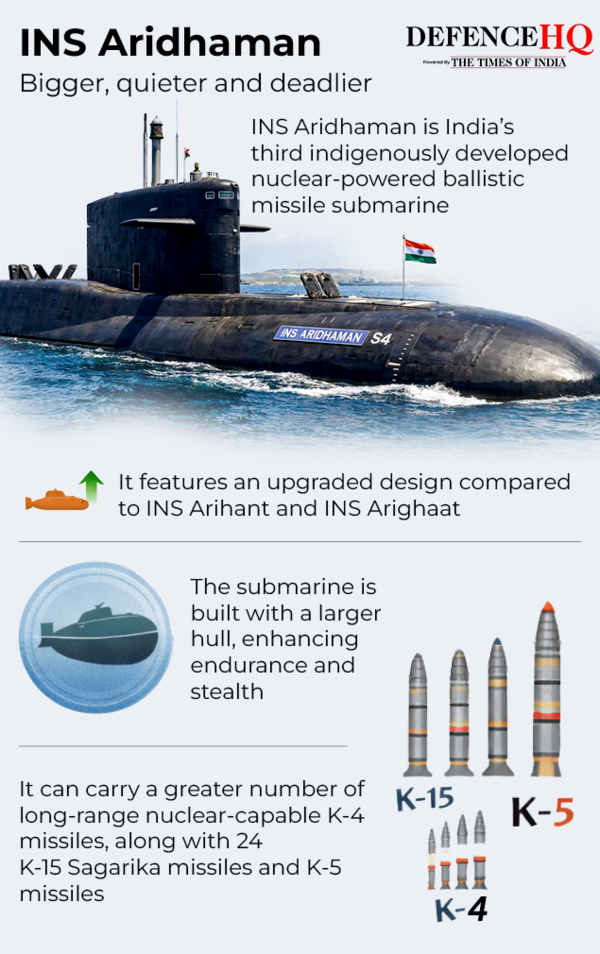
  • INS Aridhaman

    Why in the News

    The Indian Navy has indicated that INS Aridhaman, India’s third nuclear powered ballistic missile submarine (SSBN), will be inducted soon.

    About INS Aridhaman

    • Second submarine of the Arihant class SSBNs
      • Developed under the Advanced Technology Vessel (ATV) project
      • Built at Ship Building Centre, Visakhapatnam
      • Strengthens India’s nuclear triad with credible sea based deterrence.

    Strategic Significance 

    • Enhances deterrence posture under No First Use policy
      • Consolidates India’s position as a blue water navy
      • Increases maritime security presence in the Indian Ocean Region

    Note: A blue water navy is a maritime force that can operate far beyond its own coastal waters and project power across the deep oceans of the world.

    Consider the following statements: (2023)

    1. Ballistic missiles are jet-propelled at sub-sonic speeds throughout their flights, while cruise missiles are rocket-powered only in the initial phase of flight. 

    2. Agni-V is a medium-range supersonic cruise missile, while BrahMos is a solid-fuelled intercontinental ballistic missile. 

    Which of the statements given above is/are correct? 

    (a) 1 only (b) 2 only (c) Both 1 and 2 (d) Neither 1 nor 2

  • WHO Issues Global Guidelines on GLP-1 Drugs for Obesity 

    Why in the News?

    The World Health Organization (WHO) has released its first global guidelines (Dec 1, 2025) supporting the use of GLP-1 (Glucagon-Like Peptide-1) drugs as long-term treatment for obesity in adults, alongside diet and exercise.
    These guidelines emphasise equitable access, affordability, and caution about long-term safety.

    What are GLP-1 Drugs?

    • GLP-1 = Glucagon-Like Peptide-1 receptor agonists
    • Originally developed for type 2 diabetes
    • Now widely used for medically supervised weight loss
    • Examples: Semaglutide, Tirzepatide, Liraglutide
    • Mechanism:
      • Reduce appetite
      • Slow gastric emptying
      • Improve insulin sensitivity

    Key WHO Recommendations

    Conditional approval for adults

    • GLP-1 drugs may be used for long-term obesity management
    • Excluded: pregnant women
    • Reason for “conditional” status:
      • Limited long-term efficacy & safety data
      • Uncertainty about outcomes after discontinuation
      • High cost and global inequity in access

    Must be combined with lifestyle interventions

    • Balanced diet + regular physical activity remain essential
    • Drugs cannot replace behavioural changes

     Equity and affordability

    • WHO urges:
      • Generics development
      • Insurance coverage
      • Lower pricing
    • Obesity’s global economic cost projected to reach $3 trillion by 2030
    A company marketing food product advertises that its items do not contain trans-fats. What does this campaign signify to the customers? (2011)

    1. The food products are not made out of hydrogenated oils. 

    2. The food products are not made out of animal fats/oils. 

    3. The oils used are not likely to damage the cardiovascular health of the consumers. 

    (a) 1 only (c) 1 and 3 only (b) 2 and 3 only (d) 1, 2 and 3

  • Understanding concerns around Sanchar Saathi

    Introduction

    The Department of Telecommunications (DoT) has instructed smartphone manufacturers and importers to pre-install the Sanchar Saathi application on all new mobile devices. The app is designed to combat digital fraud, trace stolen devices, and prevent misuse of SIMs. But its mandatory installation has raised widespread concerns about privacy, surveillance, user consent, and constitutional rights. The government later clarified that the app is “optional,” but the directive mandating its pre-installation has created ambiguity.

    Why in the news

    Sanchar Saathi’s mandatory pre-installation order marks a major shift because devices in India have never required a state-controlled app by default. This reversal from voluntary to mandatory installation has generated concerns about surveillance risks, access to sensitive data, and violation of user consent. The scale is significant as India is the world’s second-largest smartphone market; even small changes affect millions. Legal experts view it as a possible infringement of the fundamental right to privacy.

    What the Government’s App Actually Does

    1. Blocking & Tracking: Allows blocking or locating lost/stolen phones anywhere in India using IMEI-based tracing.
    2. User Option to Block IMEI: Enables users to prevent stolen devices from being activated.
    3. Support to Law Enforcement: Assists police in identifying counterfeit devices and preventing black-market circulation.
    4. Fraud Prevention: Helps report fraudulent calls, messages, and online scams via unified channels.

    Why Has Sanchar Saathi Triggered Concerns?

    1. Ambiguity Around Consent
      1. Unclear Mandate: Pre-installation directive contradicts the Minister’s statement that the app is optional.
      2. User Autonomy: Mandatory installation affects user ability to choose, delete, or disable the app freely.
    2. Expanded State Power
      1. Exceptional Move: First time the government mandated a wide-scale state app on all devices.
      2. Precedent Risks: May normalise future mandates for state surveillance tools.
    3. Privacy Risks
      1. Data Access: App uses Android’s Mobile Security Framework enabling access to call logs, camera, SMS, and unique device identifiers.
      2. Opaque Permissions: Apple devices require permissions for photos, files, and camera.
      3. Potential Misuse: Centralised data collection may heighten misuse & monitoring risks.

    What Data Does Sanchar Saathi Collect?

    1. IMEI Data: Unique identifier used to block stolen devices.
    2. Call Logs & SMS Data: Access allowed when reporting fraud or using suspicious call detection features.
    3. Camera Access: Needed for uploading barcodes of mobile equipment (IMEI verification).
    4. Personal Information: Includes phone numbers, Aadhaar-linked data, and registration details.
    5. Problem: The app’s privacy policy bans sharing identifiable information except when required by law, but the phrase “required by law” remains broad and open-ended.

    Constitutional & Legal Concerns

    1. Lack of Consent: Forced Pre-installation undermines voluntary, informed consent, a core component upheld under the Puttaswamy judgment (2017).
    2. Three-fold Privacy Test: Experts argue mandatory pre-installation fails:
      1. Legality: No explicit statutory backing for a nationwide mandate.
      2. Necessity: No demonstrated need requiring compulsory installation.
      3. Proportionality: Data access far exceeds the minimum required for fraud detection.
    3. Surveillance & “Function Creep”
      1. Risk of Expansion: Potential to expand into unrelated data surveillance functions.
      2. No Independent Oversight: Absence of clear audit mechanisms, grievance redressal, or limits on retention periods.

    Way Forward 

    1. Clarity of the mandate: Issue a clear written policy stating the app’s status to remove confusion.
    2. Addressing Privacy Risks: Limit data permissions to essential functions and publish regular audit reports.
    3. Ensuring Consent & User Autonomy: Provide a visible and fully functional uninstall or disable option.
    4. Preventing Surveillance Overreach: Create independent oversight to monitor misuse and restrict function creep.
    5. Building Trust Through Transparency: Disclose data flows, retention rules, and access logs in the public domain.

    Conclusion

    Sanchar Saathi addresses real concerns of digital fraud and misuse of mobile devices. However, its mandatory pre-installation, broad data permissions, unclear safeguards, and inconsistent communication have created concerns about state overreach and privacy violations. The app’s utility must be balanced with constitutional guarantees, transparent policy design, and robust data protection mechanisms.

    PYQ Relevance

    [UPSC 2024] Right to privacy is intrinsic to life and personal liberty and is inherently protected under Article 21 of the constitution. Explain. In this reference, discuss the law relating to D.N.A. testing of a child in the womb to establish its paternity.

    Linkage: This PYQ links directly to debates on privacy, consent, and proportionality governing state access to sensitive personal data. It shows how intrusion into bodily or digital autonomy must meet strict constitutional tests.

  • [2nd December 2025] The Hindu OpED: The new action plan on AMR needs a shot in the arm

    PYQ Relevance

    [UPSC 2014] Can overuse and free availability of antibiotics without Doctor’s prescription, be contributors to the emergence of drug-resistant diseases in India? What are the available mechanisms for monitoring and control? Critically discuss the various issues involved.

    Linkage: This PYQ directly mirrors the article’s focus on antibiotic misuse, OTC access, and weak regulatory control driving AMR. It lets you use NAP-AMR 2.0 to show gaps in surveillance, stewardship, and One Health governance, exactly what the exam tests.

    Mentor’s Comment

    AMR is now a major threat to India’s health, food systems, and environment. Resistance has moved beyond hospitals into water, soil, and livestock. NAP-AMR 2.0 is timely and shows a stronger, more accountable approach. This analysis helps you clearly understand what worked, what failed, and what must change.It also builds GS2 and GS3 depth through governance, science, environment, and One Health linkages.

    Introduction

    India has released its National Action Plan on Antimicrobial Resistance (NAP-AMR 2.0) for 2025-29, signalling a renewed commitment to containing AMR, a challenge that affects human health, livestock, agriculture, the environment, and food systems. Unlike the first plan (2017), which saw uneven adoption across States, the second plan attempts structural reform through higher accountability, stronger surveillance, private-sector engagement, multi-departmental integration and One Health alignment.

    Why in the news?

    The launch of NAP-AMR 2.0 marks a significant turning point because AMR has now expanded beyond hospitals into soil, water, livestock, markets and food systems, making it a full-spectrum health and environmental challenge. 

    How did the first NAP-AMR evolve and where did it fall short?

    1. Significant early progress: Brought AMR into national consciousness, encouraged multi-sectoral participation, improved laboratory networks, and strengthened stewardship.
    2. One Health recognition: Placed AMR within the interface of human health, animals and environment.
    3. State-level stagnation: Most States undertook only individual activities; only a few (Kerala, MP, Delhi, AP, Gujarat, Sikkim, Punjab) created formal AMR action plans.
    4. Weak institutional execution: Multisectoral One Health structures were missing in most States.
    5. Uneven governance: Human health, veterinary systems, pharmaceuticals and waste management lie under different jurisdictions, causing weak coordination.
    6. Monitoring deficiencies: Surveillance, regulatory oversight, environmental contamination monitoring and antibiotic stewardship remained fragmented.

    What makes NAP-AMR 2.0 more mature and implementation-focused?

    1. Shift to national priorities: Moves beyond intent; outlines clear responsibilities across levels of governance.
    2. Private sector engagement: Recognises that a major share of India’s health care and veterinary services is provided privately.
    3. Scientific strategy: Emphasises innovation, rapid diagnostics, alternatives to antibiotics, and improved environmental monitoring.
    4. One Health deepening: Stronger coordination across food safety, waste management, agriculture, environment and human/animal health.

    What new governance mechanisms does the NAP-AMR 2.0 introduce?

    1. Higher accountability: Greater role for national supervision through a dedicated Coordination and Monitoring Committee.
    2. State-level innovation: Recommends every State establish a One Health inter-ministerial AMR committee, along with State AMR cells.
    3. Integrated reporting framework: Aligns State reporting with national structures for uniform monitoring.
    4. Technical backbone: Calls for a national follow-up mechanism and a multi-departmental coordinating structure.

    Where do administrative and operational gaps persist?

    1. Funding limitations: NITI Aayog’s earlier financial grant-based system did not generate adequate incentives.
    2. Weak incentive design: No system for rewarding State performance or penalising poor progress.
    3. Fragmented responsibility: Human health, veterinary systems, agriculture, pharmaceuticals and waste sectors work under separate ministries and State departments.
    4. Lack of real-time accountability: No statutory notification requiring States to inform the Centre of AMR progress.
    5. Dependence on central push: States often wait for Union-level initiatives rather than proactively building AMR infrastructure.

    What financial and institutional reforms does the article highlight as essential?

    1. Mandatory funding channels: Conditional grants through the National Health Mission (NHM) for surveillance and laboratory systems.
    2. Administrative energy: Once funding becomes compulsory, States respond faster.
    3. Scientific backbone: Need for a sustainable, long-term national centre for AMR control and accountability.
    4. International relevance: Without a Centre-backed national AMR programme, India cannot engage in meaningful global AMR governance.

    Conclusion

    The NAP-AMR 2.0 offers an opportunity to anchor India’s AMR response on a stronger scientific and institutional foundation. But success will require coordinated State participation, financial backing, and accountable governance, not just policy intention. A central AMR Centre, integrated surveillance, and enforceable incentives could finally convert national plans into ground-level action across health systems, veterinary services, agriculture, food safety and environmental management.

  • [1st December 2025] The Hindu OpED: India needs research pipelines

    PYQ Relevance

    [UPSC 2024] What is the present world scenario of intellectual property rights with respect to life materials? Although India is second in the world to file patents, still only a few have been commercialized. Explain the reasons behind this less commercialization.

    Linkage: India’s weak research pipelines, unpredictable R&D funding, and poor industry-university linkages directly explain why patent filings do not translate into commercialization, making this PYQ highly relevant for GS-III themes of IPR, innovation ecosystem, GERD gaps, and research-industry translation.

    Mentor’s Comment

    India stands at a decisive moment where research capacity, funding predictability, and university-industry linkages.  It will determine whether it becomes a global knowledge leader or remains a low spender on R&D. This translates a critical national issue, India’s missing research pipelines, into a structured UPSC Mains-ready analysis.

    Introduction

    India’s ambition to innovate and lead in emerging technologies is constrained by irregular research outlays, limited campus-industry linkage, low GERD (0.65% of GDP), and absence of predictable pipelines that convert lab innovations into products, patents, and industry deployment. In sharp contrast, countries that succeeded, such as the U.S., China, and advanced economies, matched corporate R&D efforts with stable campus-strengthening investments, enabling a steady rise in innovation intensity. India now aims to transition from isolated research islands to structured, industry-driven, multi-university research pipelines.

    Why in the News? 

    India’s research ecosystem is under scrutiny because GERD remains stagnant at 0.65% of GDP, despite corporates like Tata Motors, Dr. Reddy’s, Reliance, Sun Pharma and Bharat Electronics posting strong R&D numbers in FY24. A major contrast is visible: India has global-scale labs and talent but lacks predictable, industry-linked research pipelines, unlike countries that institutionalised grant mechanisms, co-funded platforms, and competitive university partnerships. This mismatch between capability and structure is now a policy priority and a turning point for India’s innovation ambitions.

    What global benchmarks reveal about successful research ecosystems?

    1. Stable research outlays: Countries that scaled innovation kept firm-level R&D spending steady for years; they aligned CSR-type funding to predictable pipelines supporting labs and doctoral cohorts.
    2. Corporate-university integration: The U.S. NSF’s Industry-University Cooperative Research Centers and Semiconductor Research Corporation link firms with competitive research consortia.
    3. High corporate R&D leadership: Firms like Meta invested ~$44 billion in 2024; Alphabet, Amazon, Apple, IBM and Microsoft anchor multibillion-dollar R&D programmes.
    4. Translation into partnerships: U.S. universities booked ~$692 billion of domestic R&D payments; ratio of industry contracting rose sharply in 2022.

    Where does India stand in corporate R&D performance?

    1. High-intensity corporate R&D: Tata Motors posted ₹44,381 crore revenue and ₹29,398 crore R&D in FY24 (6.7% intensity).
    2. Sectoral R&D patterns: Sun Pharma invested 6.7%; Dr. Reddy’s spent ₹2,29 billion (8.2% of sales).
    3. Strategic spending: Bharat Electronics Ltd. invested 2.64% of turnover; Reliance Industries spent over ₹4,100 crore on R&D in FY24-25.
    4. Emerging partnerships: Marlabs Research Park hosts more than 200 companies near faculty labs, creating a daily flow of industry ideas.

    What structural gaps weaken India’s research pipeline?

    1. Low GERD-to-GDP ratio: GERD at 0.65% of GDP remains below advanced economies.
    2. Irregular funding cycles: HEIs face unpredictable, short-term grants; lack of multi-year financial visibility disrupts research continuity.
    3. Weak measurable outcomes: Absence of instruments like patent targets, standards contributions, and milestone-linked funding.
    4. Fragmented labs: Universities operate as isolated research islands instead of multi-university shared platforms.

    What policy directions does the article propose?

    1. Three-year R&D-to-sales norms: Electronics, pharma, defence and space firms must agree on rising year-on-year ratios supported by market-linked export expectations.
    2. Shared campus facilities: Co-funded platforms where industry uses HEI labs for multi-year projects with open data deliverables.
    3. Deadline industry-relevant KPIs: Universities must maintain structured performance indicators tied to outcomes.
    4. Credit for collaborative research: Benefit firms that hire PhDs, invest in accredited labs, or co-supervise doctoral research.
    5. Strengthening university research culture: Indian universities sit near dynamic markets; they must channel their knowledge traditions into technology breakthroughs.

    How can India build future-ready research pipelines?

    1. Predictable funding architecture: Move from ad-hoc grants to structured multiyear timelines and tendered project pipelines.
    2. National mission pipelines: Semiconductor Mission’s startup and research integration via IDEX and AIMTOP serve as replicable templates.
    3. Multi-university shared centres: These can pool equipment, modernise test instruments, and convert research into measurable outputs.
    4. Industry-ready researchers: Create dual-track PhD programmes aligned with corporate rotations, job assignments, and real field tasks.
    5. Publicise R&D metrics: Annual reporting by listed companies on R&D intensity and HEI contributions to enhance transparency.

    Conclusion

    India possesses the labs, talent and markets, yet the absence of predictable research pipelines denies it the innovation momentum achieved by global peers. With structured outlays, measurable outputs, co-funded facilities, multi-university centres, and industry-linked doctoral programmes, India can transform research from a sporadic activity into a national innovation supply chain. This shift is essential for scaling Indian R&D and creating sustained technological competitiveness.

  • Project 17A | Delivery of ‘Taragiri’  

    Why in the News?

    • Taragiri, the fourth Nilgiri-class (Project 17A) indigenous stealth frigate, was delivered to the Indian Navy on 28 Nov 2025 by Mazagon Dock Shipbuilders Ltd (MDL), Mumbai.

    About Taragiri (Yard 12653)

    • Third P17A ship built by MDL.
    • Named after the erstwhile INS Taragiri (Leander-class), which served 1980–2013.
    • Represents major strides in Aatmanirbhar Bharat, with 75% indigenous content.
    • Over 200 MSMEs involved; employment generated:
      • ~4,000 direct, 10,000+ indirect.

    Project 17A (P-17A) 

    • Follow-on of P17 Shivalik-class frigates.
    • Total ships: 7
      • 4 at MDL, 3 at GRSE.
    • Aim: Advanced stealth, multi-mission, blue-water capability.
    With reference to Agni-IV Missile, which of the following statements is/are correct? (2014)

    1. It is surface-to-surface missile. 

    2. It is fuelled by liquid propellant only. 

    3. It can deliver one-tonne nuclear warheads about 7500km away. 

    Select the correct answer using the code given below: 

    (a) 1 only (b) 2 and 3 only (c) 1 and 3 only (d) 1, 2 and 3 only

  • Samudrayaan Mission 

     Why in the News?

    • Key tests for Samudrayaan, India’s first manned deep-ocean submersible, have been delayed due to the late procurement of syntactic foam cladding from France. The crucial 500-metre test dive is now expected by mid-2025 (around April).

    What is syntactic foam? 

    • A special composite material made of hollow micro-balloons embedded in resin. Provides high buoyancy & resistance to extreme pressure → essential for deep-sea vehicles.

    About Samudrayaan

    • Part of India’s Deep Ocean Mission (DOM) under the Ministry of Earth Sciences (MoES).
    • Developed by the National Institute of Ocean Technology (NIOT), Chennai.
    • Aim: Conduct manned exploration of deep-sea resources and collect soil & rock samples from the ocean floor.

    Features of the Manned Submersible (MATSYA-6000)

    • Capacity: 3 persons
    • Maximum Depth: 6,000 metres
    • Hull Material: Titanium sphere (final version)
    • Buoyancy: Achieved using syntactic foam
    • Purpose:
      • Deep-sea mineral exploration
      • Study of polymetallic nodules
      • Geological and biological sample collection

    Depth Significance

    • Only a few countries (USA, Russia, China, Japan, France) have undertaken comparable manned dives.
    The term ‘IndARC’, sometimes seen in the news, is the name of (2015)

    (a) an indigenously developed radar system inducted into Indian Defence 

    (b) India’s satellite to provide services to the countries of Indian Ocean Rim 

    (c) a scientific establishment set up by India in Antartic region 

    (d) India’s underwater observatory to scientifically study the Arctic region

  • MH-60R Seahawk Follow-On Support Deal

     Why in the News?

    India on 28 November 2025 signed a ₹7,995-crore follow-on support package with the United States for the Indian Navy’s fleet of 24 MH-60R Seahawk helicopters. The deal comes amid recent tensions after the U.S. imposed 50% tariffs on Indian goods.

    Key Highlights of the Deal

    • Signed under: U.S. Foreign Military Sales (FMS) programme.
    • Documents signed: Letters of Offer and Acceptance (LOAs).
    • Duration: 5 years.
    • Purpose: Long-term sustainment support for MH-60R helicopters.

    What the Sustainment Package Includes

    • Provisioning of spares, support equipment, training, technical support.
    • Repair and replenishment of components.
    • Setting up of intermediate-level component repair and periodic maintenance inspection facilities in India.
    • Improved operational availability and maintainability of the fleet.

    About MH-60R Seahawk

    • Manufacturer: Lockheed Martin.
    • Type: Maritime variant of the Black Hawk helicopter.
    • Features:
      • All-weather capability
      • Advanced avionics and sensors
      • Multi-mission: ASW, anti-surface warfare, surveillance, search & rescue, logistics.
    Consider the following statements: (2009)

    1. INS Sindhughosh is an aircraft carrier.

    2. INS Viraat is a submarine.

    Which of the statements given above is/ are correct?

    (a) 1 only (b) 2 only (c) Both 1 and 2 (d) Neither 1 nor 2

  • Aloe vera Compounds as Potential Alzheimer’s Inhibitors  

    Why in the news?

    A new study (Current Pharmaceutical Analysis, 2025) suggests that common plant molecules from Aloe vera—especially Beta sitosterol—may inhibit key enzymes associated with Alzheimer’s disease (AD). Findings are based entirely on in silico (computer simulation) techniques.

    What is Computer Simulation (In Silico Research)?

    • Computer simulation, often called in silico research, refers to the use of computational tools and algorithms to model biological, chemical, or physical processes.
    • It allows scientists to predict molecular interactions, drug behavior, and biological outcomes without physical experiments.

    Alzheimer’s Disease (AD) 

    • Most common form of dementia.
    • Characterised by:
      • Memory loss
      • Cognitive decline
      • Accumulation of beta-amyloid plaques and tau tangles
      • Loss of acetylcholine, a neurotransmitter linked to learning and memory.
    • Enzymes involved in acetylcholine breakdown:
      • Acetylcholinesterase (AChE)
      • Butyrylcholinesterase (BChE)
    • Current drugs (e.g., donepezil, rivastigmine) work by inhibiting these enzymes but do not stop disease progression.

    Why Aloe vera?

    • Used for 3000+ years in traditional medicine.
    • Contains bioactive compounds such as Beta sitosterol, Succinic acid, polysaccharides, and phenolics.

    Major Findings

    • Beta sitosterol showed strong binding affinity to both enzymes:
      • AChE: −8.6 kcal/mol
      • BChE: −8.7 kcal/mol
    • The binding strength is higher than that of other screened compounds like Succinic acid.
    • ADMET results suggest:
      • Good absorption
      • Low toxicity
      • Favourable pharmacokinetic profile
    Which one of the following is the context in which the term “qubit” is mentioned? (2022)

    (a) Cloud Services 

    (b) Quantum Computing 

    (c) Visible Light Communication Technologies 

    (d) Wireless Communication Technologies

    This PYQ is chosen because it tests a fundamental concept related to the cutting edge of computational power and modelling, which is the operational domain of computer simulation.

  • Vitamin B12 Deficiency & Skin Manifestations 

    Why in the news?

    According to a study published in Canad­ian Family Physician, Vitamin B12 deficiency often shows early dermatological symptoms—such as pigmentation, dryness, and inflammation—before neurological or hematological complications appear.

    What is Vitamin B12?

    • Water-soluble vitamins are essential for: Red blood cell formation, Nerve function, DNA synthesis and Cell growth and repair

    Why Skin Shows Early Signs?

    • B12 deficiency → reduced RBC production → low oxygen delivery to skin → visible skin changes.
    • Weak immunity and impaired nerve function further worsen dermatological issues.
    High-Risk Groups

    More prone to Vitamin B12 deficiency:

    • Vegetarians/vegans
    • Adults > 50 years
    • Individuals with:
      • Gastritis, Crohn’s disease, celiac disease
    • Those taking:
      • Antacids (PPIs/H2 blockers)
      • Metformin
    • People with poor nutrient absorption
    Consider the following pairs: Vitamin : Deficiency disease (2014)

    1. Vitamin C : Scurvy 

    2. Vitamin D : Rickets 

    3. Vitamin E : Night Blindness 

    Which of the pairs given above is/are correctly matched? 

    (a) 1 and 2 only (b) 3 only (c) 1, 2 and 3 only (d) None