💥Join UPSC 2027,2028 Mentorship (August Batch) + XFactor Notes & Microthemes PDF

Subject: Space ProgramsXIntl

  • Fast X-ray Transients (FXTs)

    Why in the news?

    Astronomers from the Indian Institute of Astrophysics have traced the likely origin of a rare Fast X-ray Transient (FXT) event, EP241107a, detected by the Einstein Probe in November 2024.

    Key Findings

    • FXTs are energetic, non-repeating flashes of X-rays lasting from a few minutes to several hours.
    • They are a recently discovered class of transient cosmic events whose origin has remained uncertain.
    • Researchers identified a radio counterpart of FXT EP241107a using the Karl G. Jansky Very Large Array.
    • Follow-up observations were conducted using:
      • Himalayan Chandra Telescope
      • GROWTH India Telescope
      • Upgraded Giant Metrewave Radio Telescope

    Likely Origin

    • The event was probably caused by: Collapse of a massive star leading to a supernova and gamma-ray burst (GRB), or Merger of two neutron stars.
    • Researchers concluded that EP241107a is most likely an “orphan afterglow”:
      • A gamma-ray-burst-like explosion whose gamma rays were not directly detected.
      • Represents a lower-energy member of the GRB population.

    Fast X-ray Transients (FXTs)

    • Sudden flashes of low-energy X-rays.
    • Non-repeating and short-lived.
    • Fade rapidly after detection.
    • Associated with highly energetic cosmic explosions.

    Proposed Sources

    • Core-collapse supernovae.
    • Binary neutron star mergers.
    • Magnetars (highly magnetized neutron stars).
    • Tidal disruption events involving white dwarfs and black holes.
    • Gamma-ray bursts (GRBs).

    Gamma-Ray Bursts (GRBs)

    • Most energetic explosions known in the Universe.
    • Emit intense gamma radiation for a few milliseconds to several minutes.
    • Associated with the collapse of massive stars (Long GRBs) and Neutron star mergers (Short GRBs).
    • Followed by multi-wavelength “afterglows” in X-ray, optical, and radio bands.

    Neutron Star

    • Extremely dense remnant of a massive star after a supernova.
    • Mass ≈ 1.4-2 solar masses compressed into a sphere about 20 km across.
    • Composed mainly of neutrons.

    [2023] Consider the following pairs: Objects in space : Description
    1. Cepheids : Giant clouds of dust and gas in space
    2. Nebulae : Stars which brighten and dim periodically
    3. Pulsars : Neutron stars that are formed when massive stars run out of fuel and collapse
    How many of the above pairs are correctly matched ?

    [A] Only one

    [B] Only two

    [C] All three

    [D] None

  • 12 Years of India’s Scientific Transformation

    Why in the news?

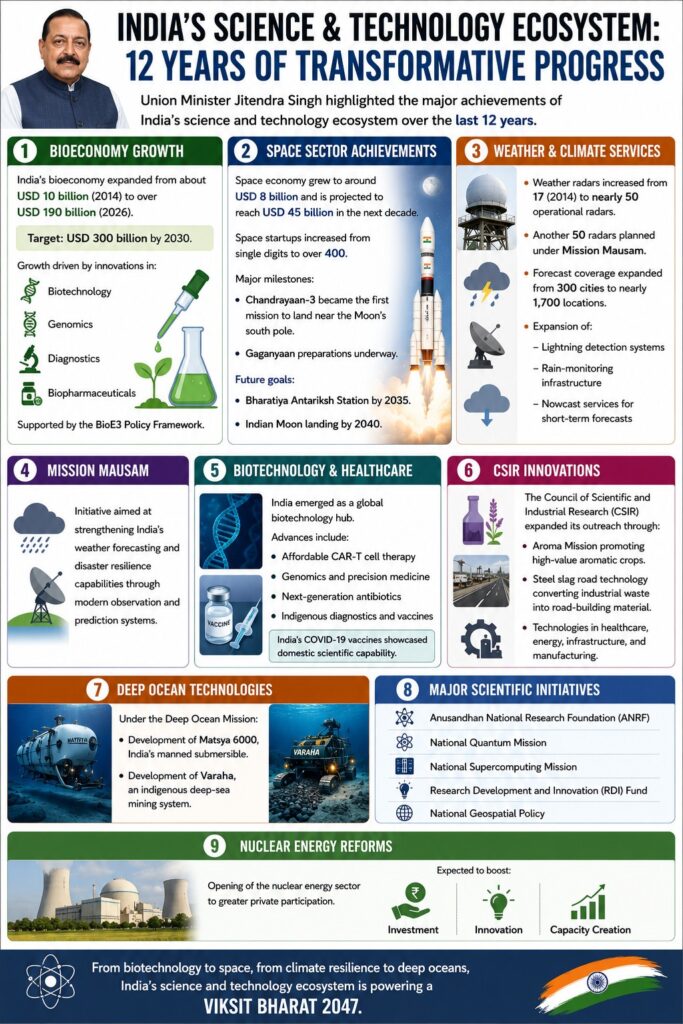
    Union Minister Jitendra Singh highlighted the major achievements of India’s science and technology ecosystem over the last 12 years.

    Bioeconomy Growth

    • India’s bioeconomy expanded from about USD 10 billion (2014) to over USD 190 billion (2026).
    • Target: USD 300 billion by 2030.
    • Growth driven by innovations in Biotechnology, Genomics, Diagnostics, and Biopharmaceuticals.
    • Supported by the BioE3 Policy Framework.

    Space Sector Achievements

    • Space economy grew to around USD 8 billion and is projected to reach USD 45 billion in the next decade.
    • Space startups increased from single digits to over 400.
    • Major milestones: Chandrayaan-3 became the first mission to land near the Moon’s south pole. Gaganyaan preparations underway.
    • Future goals: Bharatiya Antariksh Station by 2035. Indian Moon landing by 2040.

    Weather and Climate Services

    • Weather radars increased from 17 (2014) to nearly 50 operational radars.
    • Another 50 radars planned under Mission Mausam.
    • Forecast coverage expanded from 300 cities to nearly 1,700 locations.
    • Expansion of Lightning detection systems, Rain-monitoring infrastructure, and Nowcast services for short-term forecasts.
    • Mission Mausam: Initiative aimed at strengthening India’s weather forecasting and disaster resilience capabilities through modern observation and prediction systems.

    Biotechnology and Healthcare

    • India emerged as a global biotechnology hub.
    • Advances include Affordable CAR-T cell therapy, Genomics and precision medicine, Next-generation antibiotics, and Indigenous diagnostics and vaccines.
    • India’s COVID-19 vaccines showcased domestic scientific capability.

    CSIR Innovations

    The Council of Scientific and Industrial Research (CSIR) expanded its outreach through:

    • Aroma Mission promoting high-value aromatic crops.
    • Steel slag road technology converting industrial waste into road-building material.
    • Technologies in healthcare, energy, infrastructure, and manufacturing.

    Deep Ocean Technologies

    • Development of Matsya 6000, India’s manned submersible.
    • Development of Varaha, an indigenous deep-sea mining system.

    Major Scientific Initiatives

    • Anusandhan National Research Foundation (ANRF)
    • National Quantum Mission
    • National Supercomputing Mission
    • Research Development and Innovation (RDI) Fund
    • National Geospatial Policy

    Nuclear Energy Reforms

    • Opening of the nuclear energy sector to greater private participation.
    • Expected to boost Investment, Innovation, and Capacity creation.

    [2022] Which one of the following is the context in which the term “qubit” is mentioned?

    [A] Cloud Services

    [B] Quantum Computing

    [C] Visible Light Communication Technologies

    [D] Wireless Communication Technologies

  • Webb Telescope Captures Weather on Exoplanet WASP-94A b

    Why in the news?

    Scientists using the James Webb Space Telescope observed weather patterns on the exoplanet WASP-94A b located nearly 700 light years away from Earth.

    Key Highlights

    • The study was published in the journal Science on May 21, 2026.
    • Scientists detected:
      • Cloud formation
      • Atmospheric circulation
      • Dynamic weather cycles on the exoplanet.
    • The exoplanet studied is:
      • WASP-94A b.

    About WASP-94A b

    • It is a Gas giant exoplanet.
    • Nearly Twice the size of Jupiter.
    • It has about half Jupiter’s mass.
    • Completes one revolution around its star in Four days.

    What are Hot Jupiters?

    • “Hot Jupiters” are Massive gas giant exoplanets orbiting very close to their host stars.
    • Characteristics:
      • Extremely high temperatures
      • Tidally locked rotation
      • One side permanently facing the star.

    Tidally Locked Planets

    A tidally locked planet has:

    • Rotation period equal to revolution period.
    • As a result:
      • One side remains permanently day side.
      • The other side remains permanently night side.

    Weather on WASP-94A b

    Scientists observed:

    • Morning side: Clouds of magnesium silicate, iron and magnesium sulphide.
    • Evening side: Relatively clear skies.

    Clouds form on the cooler night side and move towards the hotter day side through powerful winds before dissipating.

    How Were the Atmospheres Studied?

    Scientists used:

    • Spectroscopy
    • Transit method

    Spectroscopy

    • Light from the host star is split into wavelengths.
    • Atmospheric gases absorb specific wavelengths.
    • This helps identify chemical compounds present in the atmosphere.

    Transit Method

    • The exoplanet passes in front of its host star.
    • The atmosphere absorbs part of the starlight.
    • Scientists analyse these changes to study atmospheric composition.

    About the James Webb Space Telescope (JWST)

    • Launched: December 2021.
    • Joint project of:
      • NASA
      • ESA
      • CSA.
    • Purpose:
      • Study the early universe
      • Exoplanets
      • Infrared astronomy.

    About Extremely Large Telescope (ELT)

    • Being built by the European Southern Observatory.
    • Location: Northern Chile.
    • Importance: May help discover more Earth like exoplanets and planetary systems.

    [2017] What is the purpose of ‘evolved Laser Interferometer Space Antenna (eLISA)’ project?

    [A] To detect neutrinos

    [B] To detect gravitational waves

    [C] To detect the effectiveness of missile defence system

    [D] To study the effect of solar flares on our communication systems

  • What is the Galileo Project which has been in news recently

    What is the Galileo Project which has been in news recently?

  • Selene-1, the lunar orbiter mission, belongs to which one of the following

    Selene-1, the lunar orbiter mission, belongs to which one of the following?

  • Which one of the following is a spacecraft

    Which one of the following is a spacecraft?

  • What is the purpose of the US Space Agency’s Themis Mission, which was recently in the news

    What is the purpose of the US Space Agency’s Themis Mission, which was recently in the news?

  • ISRO successfully conducted a rocket test using cryogenic engines in the year 2007. Where is the test-stand used for the purpose, located

    ISRO successfully conducted a rocket test using cryogenic engines in the year 2007. Where is the test-stand used for the purpose, located?

  • Which of the following pairs is/are correctly matched

    Which of the following pairs is/are correctly matched ?
    Spacecraft Purpose
    1. Cassini-Huygens : Orbiting the Venus and transmitting data to the Earth.
    2. Messenger : Mapping and investigating.
    3. Voyager 1 and 2 : Exploring the outer solar system.
    Select the correct answer using the code given below.

  • What is ‘Greased Lightning-10 (GL-10)’, recently in the news

    What is ‘Greased Lightning-10 (GL-10)’, recently in the news?