Why in the News
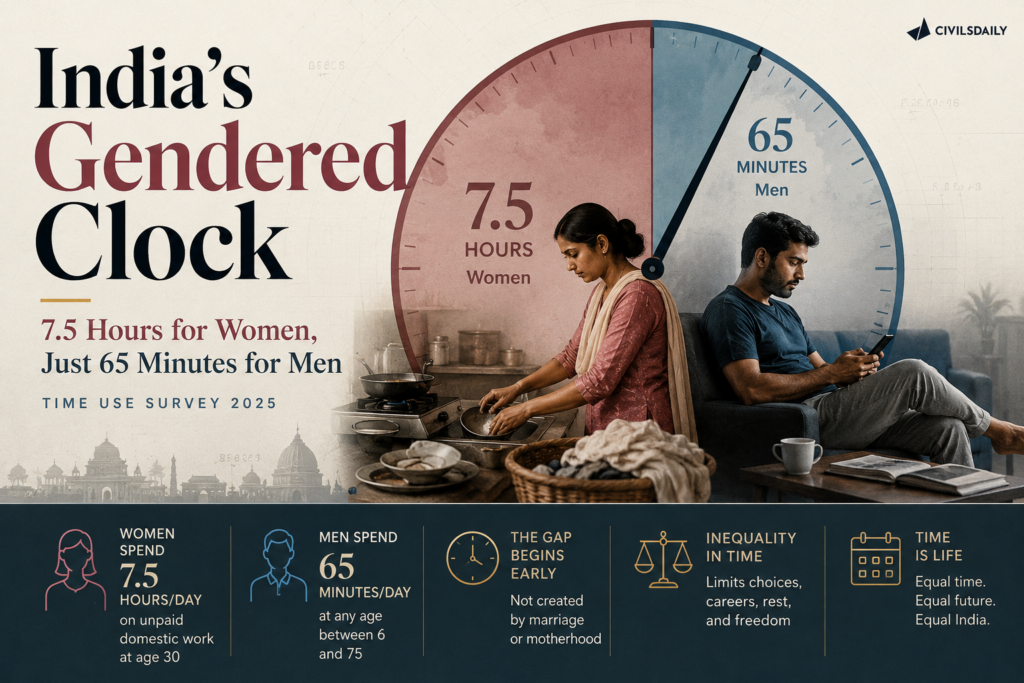
India’s Time Use Survey (2025) shows the time women spend on housework rising from about age 10 to a peak of nearly 460 minutes a day, over 7.5 hours, around age 30, while the male curve never crosses 65 minutes at any age between six and 75. The gap is not created by marriage or motherhood, it is assembled in childhood, which places it outside the reach of policies aimed at adult women.
What is the Time Use Survey?
- About: The Time Use Survey is a national household survey conducted by the National Statistics Office under the Ministry of Statistics and Programme Implementation, which records how members of a household allocate their 24 hours across activities on a reference day.
- What it captures: It measures activities that no other survey counts, including unpaid domestic services, unpaid caregiving, learning, leisure, self care and volunteer work, alongside paid employment.
- Why it exists: Employment surveys count only work inside the production boundary, so time spent cooking or caring for a child disappears from official statistics unless a time use survey records it.
What is unpaid domestic and caregiving work?
- About: Unpaid domestic and caregiving work covers cooking, cleaning, laundry, shopping, collection of water and fuel, minor repairs, and the care of children, the sick and the elderly performed for one’s own household without payment.
- Its statistical treatment: These services are produced by households for their own consumption and fall outside the production boundary of the System of National Accounts, so they contribute nothing to measured Gross Domestic Product despite being economically essential.
What is the Periodic Labour Force Survey?
- About: The Periodic Labour Force Survey (PLFS) is the National Statistics Office’s regular survey of employment and unemployment, which estimates the labour force participation rate, worker population ratio and unemployment rate.
- Its relevance here: It records the reason given for staying outside the labour force, which is where unpaid domestic responsibility appears as a measured cause of women’s non participation.
What does the lifetime housework curve show?
- The female curve: Time spent on housework begins to rise around age 10, continues through the late teens and twenties, and peaks at nearly 460 minutes a day, over 7.5 hours, around age 30.
- The male curve: It never crosses 65 minutes at any age between six and 75, so there is no stage of the male life cycle at which domestic work becomes a substantial claim on time.
- Timing of the peak: The peak falls in the prime working years, which is precisely when paid work, promotion and enterprise building compete for the same hours.
- The continuity point: Adolescence is not separate from adulthood in this data, it is the stage at which the adult pattern begins to take shape.
How early does the gender gap in domestic work open?
- Parity at age six: Indian boys and girls both spend about five minutes a day on domestic and care work at age six, and their trajectories remain close through early childhood.
- The girls’ curve: Girls spend about 15 minutes a day at age 10, 75 minutes at 15, and around 130 minutes by 17.
- The boys’ curve: Boys move from roughly five minutes at age six to only about 17 minutes by the end of childhood.
- The widening ratio: The girl to boy ratio in unpaid work rises from 1.6 among children aged 6 to 9, to 4.5 among those aged 10 to 14, and to 7.5 among adolescents aged 15 to 17.
- The divergence point: The curves separate sharply from around age 10, which is the same age at which the adult female housework curve begins its climb.
Why is leisure, not schooling, the real cost?
- The trade off is usually framed wrongly: The cost of girls’ domestic work is normally argued as a trade off with schooling and education, and the data does not support that framing.
- Girls are not losing study time: Girls spend slightly more time on learning than boys at most ages, so they remain in school while carrying the additional work.
- Leisure absorbs the burden: Between ages six and 17, girls’ housework rises by roughly 124 minutes a day while their leisure time falls by around 115 minutes a day.
- The boys’ pattern: For boys the decline in leisure is much smaller and the time spent on housework changes relatively little.
- Why leisure is not residual: Sport, friendships, rest and exploration are how children build confidence, social networks, physical capability and a sense of agency, all of which shape later career trajectories.
- The measurement blind spot: School enrolment and learning outcome data register no problem at all, because the loss is entirely in discretionary time.
Why does cooking sit at the centre of the divergence?
- Participation gap in cooking: Among adolescents aged 15 to 17, 42.4 percent of girls report cooking, against only 2.9 percent of boys.
- Time gap in cooking: Girls in this age group spend close to an hour cooking, while boys spend just two minutes.
- Other gendered tasks: Cleaning and laundry also become increasingly gendered through adolescence, with wide gaps in both participation and time spent.
- Where boys match or exceed girls: The only tasks are farm work and shopping, which are outward facing towards the field and the market rather than inward facing into the kitchen.
- The full task set measured: Participation is recorded across childcare, cleaning, cooking, farm work, laundry, repairs, shopping and collection of water and fuel, and the inward facing tasks are the ones that carry the gap.
- What the allocation trains: Girls are being trained for the household and boys for the world outside, which is how the pattern later appears as an efficient gendered allocation of household work.
How does childhood conditioning surface in the labour market?
- The stated reason for non participation: In the 2025 PLFS, childcare and domestic responsibilities were the single most cited reason women gave for staying out of the labour force.
- The urban and rural split: The reason was reported by 52.5 percent of urban women and 40 percent of rural women.
- The male comparison: Less than 1 percent of men gave the same reason, so the constraint is not a household constraint but a gendered one.
- The field observation behind the data: Among rural women in Haryana aspiring to become entrepreneurs, the biggest practical constraint on doing more paid work was time tied up in cooking and household chores, and their daughters rather than their sons were already sharing that burden.
Why do current policy interventions arrive too late?
- Where policy currently intervenes: Most interventions address women’s unpaid work in adulthood, through childcare services, community kitchens, safe mobility infrastructure, flexible work and social protection.
- What that misses: The unequal assignment of domestic work between boys and girls has already been completed before any of these instruments touch a woman’s life.
- The correct objective: The aim is not to remove domestic work from children’s lives, but to remove its gender assignment.
- The school as the instrument: Schools can give every child, boy or girl, equal opportunity to learn practical life skills, from cooking and home management to stitching, carpentry and financial management.
- The gap in India’s own success: India has invested heavily in keeping girls in school and improving their educational outcomes, and paid no comparable attention to what happens to their time outside school.
Challenges to removing the gender assignment of domestic work
- Norms are transmitted inside the household, where policy has no instrument: No scheme reaches the daily decision about which child is called into the kitchen. e.g. mothers in rural Haryana who identified their own time poverty still passed the chores to daughters rather than sons.
- The burden is invisible in every headline indicator: Enrolment, learning outcomes and even attendance stay unaffected while leisure collapses. e.g. girls in the survey spend slightly more time learning than boys even while doing seven times the domestic work at 15 to 17.
- Infrastructure deficits convert directly into girls’ time: Where water, fuel and sanitation are distant, the collection task falls on girls. e.g. households without piped water where fetching water is a daily pre school chore.
- School curricula reinforce the split rather than break it: Vocational and life skill options remain gender typed in practice. e.g. home science and tailoring offered to girls while carpentry, electrical work and workshop practice fill with boys.
- Measurement is infrequent: Time use data arrives too rarely to evaluate whether an intervention shifted the allocation. e.g. India ran a pilot time use survey in 1998 to 1999 and its first full national round only two decades later.
- Care substitutes are absent for adolescent siblings: Where creche and elder care services are missing, the eldest daughter becomes the default carer. e.g. adolescent girls withdrawn from leisure and play to mind younger siblings while parents do wage work.
- Employment law does not reach unpaid household work: No labour statute assigns rights, hours or rest to domestic work performed inside one’s own home. e.g. maternity and creche entitlements under labour law apply to formal employment, covering a small minority of working women.
Conclusion
The gender gap in unpaid work is not a marriage effect or a motherhood effect, it is set in place between the ages of 10 and 17 and simply expands afterwards to 7.5 hours a day by age 30. The price girls pay is measured in leisure rather than schooling, which is why India’s success in keeping girls in school has concealed it. Policy instruments built for adult women arrive after the allocation is fixed. The intervention point is the childhood assignment of domestic tasks, and schools that teach cooking, home management, carpentry and financial management to every child are the instrument available now.
[2024, GS1, 10 marks] Distinguish between gender equality, gender equity and women’s empowerment. Why is it important to take gender concerns into account in programme design and implementation?