
💥Join UPSC 2027,2028 Mentorship (August Batch) + XFactor Notes & Microthemes PDF

Type: op-ed snap

  • [19th August 2026] The Hindu OpED: Education must change to account for AI

    Question (2023, GS3): “Introduce the concept of Artificial Intelligence (AI). How does AI help clinical diagnosis? Do you perceive any threat to privacy of the individual in the use of AI in healthcare?
    Linkage: This is the foundational question on AI awareness. Adapting education to AI requires first understanding its core concepts and cross-sectoral applications, which are now being integrated into school and higher education curricula.

    Mentor Comment:

    Artificial Intelligence (AI) is reshaping work in the sectors where India holds comparative advantage, including generic drugs, biosimilars and vaccine manufacture, and will eliminate a large share of entry level positions while leaving deep domain expertise in demand. This exposes a conflict between an education system built to load ever more content before entry into the workforce and an economy that now requires selection, synthesis, judgement and adaptation instead.

    What is the National Education Policy’s four year undergraduate structure?

    1. What it is: The National Education Policy, 2020 replaced the three year undergraduate degree with a flexible four year undergraduate programme offering multiple entry and exit points.
    2. Exit ladder: A certificate after one year, a diploma after two years, a bachelor’s degree after three years and a bachelor’s degree with research after four years.
    3. The research pathway: The fourth year is designed as a research pathway in which a student undertakes a supervised project rather than additional taught coursework.
    4. Credit portability: Credits earned at each exit point are deposited in the Academic Bank of Credits, allowing a student to re-enter and complete the degree later.
    5. Why it matters here: The four year structure with a research final year is the closest institutional equivalent to apprenticeship that the system already possesses.

    What is vibe coding?

    1. What it is: Vibe coding is the practice of producing working software by describing the desired outcome in natural language to an AI system, which generates and iterates on the code, rather than by writing the code line by line.
    2. Effect on work: It removes the routine coding task that has historically been the entry level rung in software employment.

    What are biosimilars?

    1. What they are: Biosimilars are biological medicines highly similar to an already approved reference biologic, with no clinically meaningful difference in safety, purity or potency.
    2. Why they differ from generics: A biosimilar is produced in living cells and cannot be copied exactly, so approval requires comparative analytical, non clinical and clinical evidence rather than simple bioequivalence.

    What is an automated fill finish line?

    1. What it is: A fill finish line is the final stage of pharmaceutical manufacture in which the bulk drug substance is filled into vials or syringes, stoppered, sealed, inspected and labelled under sterile conditions.
    2. Effect of automation: Robotic and isolator based fill finish removes human presence from the sterile core, which raises throughput and sterility assurance while eliminating operator roles.

    How is AI changing the nature of work itself?

    1. Change is rapid and unpredictable: The nature of work is changing at every level, and the direction of that change cannot be forecast with confidence.
    2. Routine work is the first casualty: Vibe coding threatens to render much routine coding obsolete, which removes the task that entry level employees have traditionally performed.
    3. Important work also becomes routine: With wisely configured agents and other tools, even important work can be made routine, so the change is not confined to low skill tasks.
    4. Employment shifts to oversight: Fewer employees remain, and their function becomes careful oversight of systems rather than execution of the task.
    5. No settled timeline: Assessments of when superintelligence arrives range from a few years to many years, so institutions cannot plan against a fixed date.

    How will AI reshape the sectors of Indian strength?

    1. Generic drugs and biosimilars: AI is reshaping molecule screening and formulation in generic drugs and biosimilars.
    2. Synthesis and quality control: Robotics and machine vision will increasingly handle synthesis and quality control in the same sectors.
    3. Vaccine design: AI can help design antigens and predict immune responses, changing the research stage of vaccine development.
    4. Vaccine manufacture: Robotic bioreactors, automated fill finish lines and AI managed logistics will make production faster, cleaner and more precise.
    5. Corporate adaptation is assumed: Indian industry will pivot to meet these changes and companies may survive and prosper, so the disruption falls on employment rather than on firms.

    Why does the disappearance of entry level jobs create a skills paradox?

    1. Two requirements point in opposite directions: Employers will still need people with deep domain expertise, and the entry level positions through which such expertise was historically acquired will disappear.
    2. Expertise cannot be front loaded: Deep domain expertise cannot be acquired at the point of entry, so it cannot simply be added to a degree programme as more coursework.
    3. Employee profiles change, not employer demand: Companies will prosper while their employee profiles change dramatically, so the market signal to students is ambiguous rather than absent.
    4. Oversight requires the expertise it displaces: The remaining employees must supervise systems whose outputs only an expert can evaluate, so the skill required is higher precisely where the training ladder has been removed.
    5. The gap is institutional, not individual: No individual can resolve a missing apprenticeship rung by studying harder, which is why the response has to come from the design of education.

    Why has the strategy of extending years of education run out of road?

    1. The historical pattern: Earlier technological revolutions were met by extending education, from basic literacy to primary school, then high school, then college, and increasingly professional master’s degrees.
    2. What each transition demanded: Every transition asked people to acquire and retain more knowledge before entering the workforce.
    3. Why the pattern breaks now: As AI systems advance, the comparative advantage no longer lies in humans storing ever more information in their heads.
    4. What replaces storage: The requirement is to know what must be understood deeply, what can be retrieved when needed, and how to learn quickly in unfamiliar situations.
    5. Adding material makes it worse: A future that cannot be predicted cannot be prepared for by adding ever more material to the curriculum.

    What kind of rigour must replace content coverage?

    1. Two apparently contradictory tasks: Education must thin out what it teaches while providing far more opportunities to learn on the fly.
    2. Not less rigour: The objective is a different kind of rigour rather than a reduction of it.
    3. The four capacities named: That rigour consists of selection, synthesis, judgement and adaptation.
    4. How it is built: Students need repeated experience of confronting problems whose answers are not in the syllabus, finding the relevant knowledge and applying it with judgement.
    5. The system’s starting condition: India’s higher education system contains isolated pockets of excellence embedded in a large undifferentiated mass that is difficult to reform as a whole.

    How can the four year undergraduate structure deliver apprenticeship at scale?

    1. The ideal model and its limit: The ideal way to train an expert is apprenticeship, one student working closely with one teacher or practitioner, and that model cannot be provided at scale at present.
    2. The available substitute: The National Education Policy’s four year undergraduate structure already provides a research pathway in the final year, the closest institutional equivalent available.
    3. What blocks it in practice: Residual coursework crowds out the immersion the policy intends, so the final year reverts to taught classes.
    4. The proposed fix: Universities should allow any remaining essential coursework to be completed online, freeing the year for immersion.
    5. Where students should be placed: Students should spend that year embedded in industry, university laboratories or national laboratories.
    6. What the placement teaches: Working alongside people solving real problems lets students encounter uncertainty and learn to acquire knowledge as it becomes necessary.

    Challenges to reorienting education for AI

    1. Faculty shortage and capacity: Immersion requires supervisors who themselves work on live problems, and Indian universities carry large vacancies in teaching posts, e.g. central universities have reported vacancy levels around one third of sanctioned teaching positions.
    2. Absence of industry placement capacity: There are not enough laboratories and firms willing to host a full cohort for a year, e.g. the National Apprenticeship Promotion Scheme has consistently engaged far fewer apprentices than its annual targets.
    3. Regulatory rigidity on credits: University statutes tie degrees to classroom contact hours, which blocks substitution of a year of placement for taught credits, e.g. many State universities still require minimum attendance percentages that a workplace year cannot satisfy.
    4. Assessment mismatch: Examination systems reward recall, which is the exact capacity AI has made least valuable, e.g. the majority of Indian undergraduate examinations remain terminal written papers rather than project defences.
    5. Digital access inequality: Moving residual coursework online assumes reliable connectivity and devices, which a large share of students lack, e.g. only about 57 percent of women have independent internet access against 72 percent of men.
    6. Employability and credential signalling: Employers screen on degree names and marks rather than on demonstrated judgement, so students resist a less legible qualification, e.g. campus recruitment for information technology services has long been anchored to aggregate marks thresholds.
    7. Uneven institutional quality: Reform designed for research capable institutions cannot be transplanted into colleges with no research infrastructure, e.g. a large majority of Indian undergraduate students study in affiliated colleges rather than in universities.
    8. Financing the transition: Placement years, laboratory access and supervision cost money that public institutions do not currently receive, e.g. public expenditure on education remains near 4.6 percent of gross domestic product against the National Education Policy’s 6 percent target.

    Conclusion

    The core problem is not that AI will destroy work but that it removes the entry level rung through which deep expertise was formed, while continuing to demand that expertise. Adding more content to the curriculum cannot answer this, and the response is to thin the syllabus and use the National Education Policy’s four year structure to place students inside industry and laboratories for a full year. That requires moving residual coursework online and treating immersion, not coursework, as the final year’s substance.
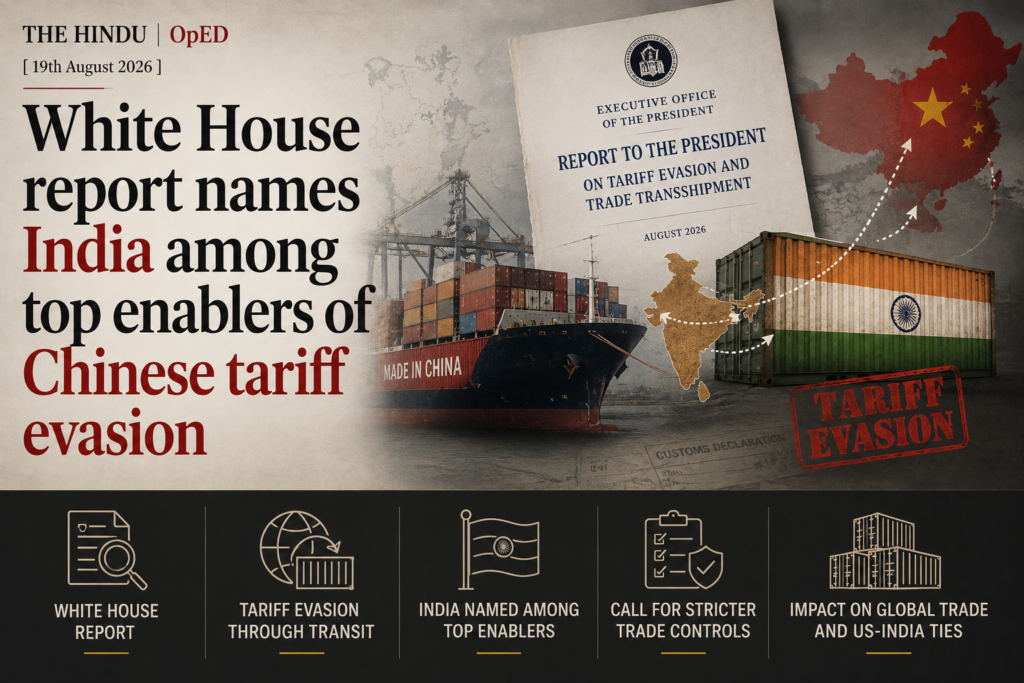
  • [19th August 2026] The Hindu OpED: Time to push back: On India and the continuing U.S. pressure

    Question (2025, GS2): “What are the challenges before the Indian economy when the world is moving away from free trade and multilateralism to protectionism and bilateralism? How can these challenges be met?
    Linkage: This is the most direct parallel. The US tariffs on China and the subsequent report accusing India of “enabling” evasion are prime examples of the move toward protectionism and the resulting challenges for India’s trade policy.

    Mentor Comment

    A recent White House report naming around 40 countries places India among the top enablers of China’s evasion of United States tariffs. The charge lands at the moment when the composition of India’s imports from China is shifting from finished products to intermediate goods, which points to genuine domestic assembly rather than cosmetic relabelling. India’s record of granting tariff concessions ahead of negotiations is what makes the accusation consequential.

    What is the tariff evasion India is accused of enabling?

    1. The alleged route: The accusation is that India and the other named countries import Chinese goods, make minor modifications to them, and re-export them to the United States.
    2. The gain being alleged: Goods routed this way enter the United States at lower tariffs than Chinese origin goods would have faced.
    3. Why origin matters: A minor modification does not change the country of origin of a good, so the practice is treated as circumvention rather than manufacturing.
    4. Status of the charge: The United States has not yet announced punitive action on the basis of this assessment.

    What are intermediate goods?

    1. Definition: Intermediate goods are inputs, parts and components bought by a producer and used up in making a finished good, rather than sold directly to the final consumer.
    2. What their share signals: A rising share of intermediate goods in imports indicates that the assembly and manufacturing stages are happening domestically, since the buyer is importing parts and not products.

    What is the e-commerce inventory model?

    1. Definition: Under the inventory model, an online retail platform owns the stock it sells and sells it directly to consumers, in contrast to the marketplace model where the platform only connects third party sellers to buyers.
    2. The Indian restriction: Foreign direct investment in the inventory based model of e-commerce was long barred in India, and that restriction was diluted recently.

    What does the White House report allege, and how wide is its net?

    1. Scale of the exercise: The report names around 40 countries in all, so the finding is a global mapping of tariff circumvention rather than a charge framed against India alone.
    2. India’s placement: India is placed among the top enablers of Chinese evasion of United States tariffs within that list.
    3. The economic stake: The accusation has the potential to be the most harmful to the Indian economy among the recent charges levelled, because it targets export access rather than a single product line.
    4. Escalation risk: Punitive action based on the assessment is a conceivable next step, and the absence of action so far is not an assurance.

    Why does the changing composition of India’s imports from China cut against the accusation?

    1. The dependence is not disputed: Chinese imports form a significant pillar of Indian manufacturing, and the government itself has admitted they are an important part of the Make in India story.
    2. The composition has shifted: India is moving away from importing finished products, making cosmetic changes and selling them.
    3. What is rising instead: The share of intermediate goods in Indian imports from China has been steadily rising.
    4. What that means in practice: India is doing much of its own assembly and manufacturing in several sectors, relying on China and other countries only for the parts required.
    5. Direction of travel: This shift is a step towards full scale manufacturing in India, which is the opposite of the relabelling the report describes.

    What does India’s record of tariff concessions to the United States show?

    1. High end motorcycles, first cut: After criticism of India’s tariffs during the first term of the United States President, India cut these tariffs to 50 percent in 2018 from the earlier band of 60 percent to 75 percent.
    2. High end motorcycles, second cut: India cut the same tariff further to 40 percent in February 2025, before trade deal talks had even started.
    3. Shrimp feed: Import duties on shrimp feed and its components were slashed in the February 2024 Budget, a key ask of the United States.
    4. Poultry: Tariffs on frozen duck and turkey were reduced in the same way.
    5. E-commerce: Allowing foreign direct investment in the inventory model of e-commerce met a demand that a large American platform had lobbied for over a decade, and diluted a long held Indian position.

    How did the punitive tariffs reshape India’s oil sourcing?

    1. The instrument: Punitive United States tariffs of 50 percent were imposed on India, and the pressure pushed India to diversify away from Russian oil.
    2. The measured shift: Russia’s share in India’s oil imports fell below 20 percent in January 2026, from nearly double that level when the tariffs were imposed six months earlier.
    3. What was set aside: The shift happened despite India’s strident claims of energy sovereignty and despite the discount it was receiving on Russian crude.
    4. A prior instance: The same pattern had played out with Venezuelan oil in 2019.
    5. The partial reversal: The West Asia crisis and a temporary United States reprieve are what turned India back towards Russian oil, not a change in the underlying pressure.

    Why does each concession make the next demand more likely?

    1. The concessions were rational in isolation: The United States can wield immense pressure, which makes each individual concession understandable on its own terms.
    2. The cumulative effect runs the other way: That record of accommodation has emboldened the United States to make increasing demands.
    3. Pre-emptive timing compounds it: Cutting motorcycle tariffs before trade talks had started surrendered a bargaining chip without obtaining anything in exchange.
    4. The present charge is the test: A charge aimed at India’s manufacturing imports would, if conceded, hit the input base of Indian industry rather than a single tariff line.
    5. The required break: India needs to start pushing back, since resisting on this issue is what stops the sequence of concessions from continuing.

    Challenges to India resisting United States trade pressure

    1. Export market concentration: The United States is India’s largest single export destination, so retaliation carries asymmetric cost. e.g. gems and jewellery and textile exporters in Surat and Tiruppur face immediate order cancellations when tariffs move.
    2. Input dependence on China: Resisting the transshipment charge while deepening reliance on Chinese parts is politically difficult. e.g. solar cell and module assembly in India still draws heavily on imported Chinese cells and wafers.
    3. Weak rules of origin enforcement: Establishing that value addition is genuine requires documentation Indian exporters often cannot produce. e.g. the Customs (Administration of Rules of Origin under Trade Agreements) Rules, 2020 were introduced precisely because origin claims under trade agreements were being made without supporting cost data.
    4. Energy exposure: Oil sourcing decisions can be reversed by sanctions pressure faster than supply contracts can be rewritten. e.g. Russia’s share of India’s oil imports fell below 20 percent by January 2026 within six months of the punitive tariffs.
    5. Limited retaliation capacity: India’s counter tariff options are small relative to the size of the American market. e.g. India’s retaliatory duties on American apples and almonds were eventually withdrawn as part of a dispute settlement.
    6. Multilateral fallback weakened: The dispute settlement route is unavailable while the appellate mechanism remains non functional. e.g. the World Trade Organization Appellate Body has been without a quorum since December 2019.
    7. Investment signalling: A public trade confrontation can deter the foreign investment India is simultaneously courting for manufacturing. e.g. electronics assembly investment decisions track tariff certainty as closely as they track incentive outlays.

    Conclusion

    The transshipment charge misreads a real change in India’s trade with China, since the rising share of intermediate goods shows domestic assembly rather than cosmetic modification of finished Chinese products. The deeper problem is India’s record of conceding on motorcycles, shrimp feed, poultry, e-commerce and oil sourcing ahead of or under pressure, which has invited larger demands each time. Conceding on manufacturing inputs would strike at the base of domestic production itself, and that is where the pattern has to stop.

    Foundational Context: India United States Trade

    1. Scale of the relationship: The United States is India’s largest trading partner in goods and its single largest export destination, and India has run a goods trade surplus with it for many years.
    2. Composition: India’s exports are concentrated in engineering goods, gems and jewellery, pharmaceuticals, textiles and petroleum products, while imports are led by crude oil, aircraft, machinery and defence equipment.
    3. Services and remittances: The relationship extends beyond goods into information technology services exports and the largest single source of inward remittances to India.
    4. Preference withdrawal: India was removed from the United States Generalised System of Preferences in 2019, ending duty free access for a set of Indian exports.
    5. Structural asymmetry: India’s dependence on the American market for demand is larger than the American economy’s dependence on Indian supply, which sets the bargaining balance.

    Laws and Rules Governing India’s Trade Policy and Origin Rules

    1. Foreign Trade (Development and Regulation) Act, 1992: Empowers the Central government to make provisions for the development and regulation of foreign trade and to formulate the Foreign Trade Policy.
    2. Directorate General of Foreign Trade: Created under this Act as the authority that issues import and export authorisations and notifies policy changes.
    3. Customs Act, 1962: Provides the framework for levy and collection of customs duty, valuation, and confiscation for misdeclaration of goods.
    4. Customs Tariff Act, 1975: Carries the tariff schedules and the enabling provisions for anti dumping, countervailing and safeguard duties.
    5. Customs (Administration of Rules of Origin under Trade Agreements) Rules, 2020: Place the burden on the importer to hold and produce origin and value addition information when claiming preferential duty under a trade agreement.
    6. Foreign Exchange Management Act, 1999: Governs the foreign direct investment regime, including the conditions applicable to e-commerce entities.

    Back2Basics: Make in India

    1. Launched: 25 September 2014, as a national programme to raise the share of manufacturing in output and employment.
    2. Nodal agency: The Department for Promotion of Industry and Internal Trade (DPIIT) under the Ministry of Commerce and Industry.
    3. Original coverage: 25 sectors spanning automobiles, electronics, defence manufacturing, textiles, pharmaceuticals and renewable energy.
    4. Stated objective: Raising the manufacturing share of Gross Domestic Product to 25 percent and creating large scale industrial employment.
    5. Four pillars: New processes through ease of doing business, new infrastructure through industrial corridors, new sectors opened to foreign direct investment, and a new mindset treating government as a facilitator.
    6. Second phase: Make in India 2.0 extended the programme across 27 sectors, covering both manufacturing and services.

    Government Initiatives

    1. Production Linked Incentive schemes: Outlay linked incentives on incremental sales across sectors including electronics, pharmaceuticals, automobiles and solar modules, targeted at domestic and export oriented manufacturers.
    2. Remission of Duties and Taxes on Exported Products (RoDTEP): Refunds embedded central, State and local duties that are not otherwise rebated, available to exporters across most tariff lines.
    3. Districts as Export Hubs: Identifies a product with export potential in each district and builds an institutional mechanism to support producers there.
    4. Trade Infrastructure for Export Scheme (TIES): Funds export linked infrastructure such as testing laboratories, cold chains and border haats through State agencies.
    5. Interest Equalisation Scheme: Provides a subvention on pre and post shipment rupee export credit, targeted at labour intensive sectors and micro, small and medium enterprises.
    6. PM Gati Shakti National Master Plan: A multimodal connectivity plan intended to reduce logistics cost, which is a direct determinant of export competitiveness.

    Key Facts about India’s Trade Architecture

    1. Foreign Trade Policy 2023: Notified without a fixed end date, replacing the earlier five year policy cycle.
    2. World Trade Organization: India is a founding member from 1 January 1995 and was earlier a contracting party to the General Agreement on Tariffs and Trade from 1948.
    3. Appellate Body paralysis: The World Trade Organization’s Appellate Body has been unable to hear appeals since December 2019 for want of quorum.
    4. Generalised System of Preferences: India’s beneficiary status under the United States programme was withdrawn in 2019.
    5. Rules of origin: Preferential origin under India’s trade agreements is normally established through a combination of change in tariff heading and a minimum domestic value addition requirement.

    Challenges in India’s External Trade

    1. Narrow export basket: A few sectors carry a disproportionate share of export earnings. e.g. petroleum products, gems and jewellery and pharmaceuticals together account for a large share of merchandise exports.
    2. High logistics cost: Delivered cost erodes tariff advantages won at the negotiating table. e.g. turnaround time at Indian ports remains higher than at Singapore or Colombo transshipment hubs.
    3. Non tariff barriers abroad: Standards and certification requirements block market access even at zero duty. e.g. European Union restrictions on Indian shrimp and basmati consignments over residue limits.
    4. Trade deficit with China: Manufacturing growth deepens the input dependence that the deficit reflects. e.g. active pharmaceutical ingredient imports from China underpin India’s own formulation exports.
    5. Currency and commodity exposure: Import bills move with global oil and gold prices regardless of export performance. e.g. gold imports of $71.98 billion in 2025-26 widened the current account pressure.
    6. Weak participation in global value chains: India remains outside the large regional production networks that set input sourcing rules. e.g. India stayed out of the Regional Comprehensive Economic Partnership in 2019.

    Way Forward

    1. Document value addition: Build a verifiable, firm level record of domestic value addition in export sectors so that transshipment allegations can be answered with data rather than assertion.
    2. Negotiate rather than pre-empt: Hold tariff concessions until a reciprocal commitment is on the table, since unilateral cuts before talks forfeit bargaining value.
    3. Deepen component manufacturing: Extend incentives from final assembly to components and sub assemblies so that the intermediate goods share shifts from imports to domestic supply.
    4. Diversify export destinations: Use the concluded trade agreements to shift a measurable share of exports away from a single dominant market.
    5. Strengthen origin administration: Equip customs with certification and audit capacity under the origin rules so that genuine Indian manufacturing is distinguishable from routing.
    6. Secure energy optionality: Maintain diversified term contracts for crude so that sourcing decisions are not dictated by tariff threats.

    “[2025, GS3, 10 marks] What are the challenges before the Indian economy when the world is moving away from free trade and multilateralism to protectionism and bilateralism? How can these challenges be met?”

  • Legal aid defence needs reform, not retreat

    Why in the News

    The National Legal Services Authority (NALSA) directed that contracts of Legal Aid Defence Counsel (LADC) engaged by legal services institutions across India not be renewed, following representations from Bar Associations in Punjab, Haryana, Himachal Pradesh and Chandigarh. The Bar’s claim is that a salaried public defence cadre is displacing private criminal practice, while the caseload data shows LADCs handling about 1.6 per cent of criminal cases instituted in a year. A scheme created by a statutory body is therefore being wound down without any national assessment of what it achieved.

    What is the Legal Aid Defence Counsel system?

    1. About: The LADC system is India’s experiment with a full time public defender office, staffed by salaried lawyers engaged by legal services institutions to defend accused persons who cannot afford a private lawyer.
    2. Purpose: It provides quality legal representation in criminal cases at every stage, from first production and remand through bail, trial and appeal.
    3. Structure: Each district office is headed by a Chief Legal Aid Defence Counsel supported by deputy and assistant counsel who work only on legal aid matters.
    4. Difference in accountability: Counsel work under institutional oversight with fixed remuneration, monitoring and case reporting rather than as empanelled private practitioners paid per case.
    5. Coverage in the last cycle: The NALSA dashboard records 4,86,354 cases assigned to LADCs in the 2025 to 2026 year, including 1,88,878 bail cases.

    What is the National Legal Services Authority?

    1. About: NALSA is the apex statutory body constituted under the Legal Services Authorities Act, 1987 to provide free legal services to eligible persons and to organise Lok Adalats.
    2. Structure: It works through State Legal Services Authorities, District Legal Services Authorities and Taluk Legal Services Committees, and it frames the schemes those bodies implement.

    What is the National Judicial Data Grid?

    1. About: The National Judicial Data Grid is the public database of pending and disposed cases across district and High Courts, updated from court software in near real time.
    2. Use here: It supplies the denominator of criminal cases instituted, against which the legal aid caseload is measured.

    What do the Bar Associations argue against the scheme?

    1. Parallel criminal bar: Bar Associations argue that a salaried defence cadre creates a parallel criminal bar inside the court system.
    2. Independence of the profession: They argue that lawyers paid and supervised by a state funded institution weaken the independence of the legal profession.
    3. Livelihood of practitioners: They argue that the scheme takes away work from advocates who depend on criminal briefs at the district level.
    4. Where the representations came from: The direction followed representations from Bar Associations in Punjab, Haryana, Himachal Pradesh and Chandigarh.
    5. The institutional response: NALSA acted on those representations by directing non renewal of LADC contracts across India, not only in the States from which the objection came.

    What do the caseload figures show about displacement?

    1. Cases assigned to LADCs: 4,86,354 cases were assigned in the 2025 to 2026 year as recorded on the NALSA dashboard.
    2. Bail work within that: 1,88,878 of those were bail cases, the stage at which delay translates directly into custody.
    3. Monthly institution of criminal cases: The National Judicial Data Grid records 24,68,339 criminal cases instituted in a single month.
    4. Annual criminal caseload: That translates to roughly 2.96 crore criminal cases instituted in a year.
    5. The resulting share: The 4.86 lakh cases assigned to LADCs represent approximately 1.6 per cent of criminal cases instituted.
    6. What the ratio establishes: A cadre handling one case in sixty cannot be the cause of a livelihood crisis in criminal practice.

    How does the LADC model differ from the assigned counsel system?

    1. Assigned counsel model: Private lawyers are empanelled and paid per case by the legal services institution to appear for indigent accused.
    2. Recorded weaknesses of that model: It has been criticised for missed hearings, delayed applications and complaints over the fees paid by the state.
    3. Why LADCs became popular: Many LADCs appear promptly at production and remand hearings, which is where an unrepresented accused is most exposed.
    4. Quality of filings: LADCs file appropriate and timely petitions challenging violations of procedural law and protecting the client’s rights.
    5. The reframing: Treating a more competent legal aid service as a threat to private practice converts an opportunity to raise professional standards into a demand to remove the comparison.
    6. What the Bar could take from it: The diligence that made LADCs effective is a benchmark for the assigned counsel system rather than a case against it.

    Why does the interim arrangement worry criminal justice practitioners?

    1. What replaces the cadre: Legal aid matters revert to young and relatively inexperienced lawyers assigned through the empanelment route.
    2. What criminal defence actually requires: Case preparation, cross examination, bail and remand advocacy, trial strategy and navigation of the criminal justice system.
    3. Where inexperience costs most: Bail and remand decisions are taken in minutes and determine months of custody, and 1,88,878 of the assigned cases were bail matters.
    4. Who bears the risk: Persons unable to afford private lawyers become the group on whom an untested arrangement is tried.
    5. Effect on pending matters: Ongoing cases change hands mid trial, breaking continuity of representation at the stage where evidence is being recorded.

    Whose interest should prevail when the livelihood of the Bar meets the fair trial right of the accused?

    1. Two genuine claims: Advocates have a legitimate interest in the volume and value of criminal briefs, and the accused has an enforceable constitutional right to competent representation.
    2. Asymmetry of voice: Bar Associations are organised and can make representations to a statutory authority, while indigent accused persons have no comparable channel.
    3. Asymmetry of consequence: A lawyer loses a share of a brief pool, an accused person loses liberty pending trial.
    4. The constitutional tilt: Article 39A and Article 21 place free and competent legal aid as a duty of the State, not as a welfare option to be balanced against professional interest.
    5. What the numbers settle: At 1.6 per cent of criminal institutions, the displacement claim is not supported by the caseload, so the two claims do not actually collide.
    6. What remains unresolved: Even a scheme that survives this objection needs a fair remuneration structure for the wider Bar, which the debate has not addressed.

    Why is the absence of any national assessment the central failure?

    1. No evaluation exists: There has been no national assessment of the LADC system since it was introduced.
    2. What an assessment would measure: Bail success rates, timeliness of appearance, conviction and acquittal patterns and client feedback against the assigned counsel baseline.
    3. The procedural objection: A scheme duly adopted and implemented by a statutory body is being stalled without an evaluation of its impact on ongoing cases.
    4. Evidence displaced by representation: The decision rests on submissions from professional associations rather than on outcome data from the scheme itself.
    5. The correct response to a working model: Where dedicated lawyers, institutional oversight and accountability improve defence quality, the response is to learn from the model rather than dismantle it.

    Challenges to the Legal Aid Defence Counsel system

    1. Contractual insecurity of counsel: Engagement on renewable contracts leaves the cadre vulnerable to a single administrative direction. e.g. the present non renewal order ends the engagement of counsel across India at once.
    2. Remuneration and parity: Salaries have to compete with private practice to retain experienced criminal lawyers. e.g. senior criminal advocates in metropolitan district courts earn multiples of the fixed LADC remuneration.
    3. Case overload per counsel: A small cadre carrying nearly five lakh cases limits time per client. e.g. 1,88,878 bail matters in a year across district offices leaves minutes of preparation for each.
    4. Resistance from the organised Bar: Institutional hostility can block access to court infrastructure and listings. e.g. Bar Associations in four northern States and Union Territories triggered the present direction.
    5. Uneven coverage across districts: The model has not been staffed uniformly, so quality of aid depends on the district. e.g. legal aid uptake remains far weaker in districts without a functioning prison legal aid clinic.
    6. Absence of outcome monitoring: Without published performance data the scheme cannot defend itself. e.g. no national assessment of the LADC system exists even after the scheme completed multiple years.
    7. Awareness deficit among the accused: Many undertrials do not know that free representation is available at remand. e.g. undertrials form about three quarters of India’s prison population, and a large share remain unrepresented at first production.

    Conclusion

    The case against the LADC system rests on a displacement claim that the caseload data does not support, since the cadre handled about 1.6 per cent of criminal cases instituted in a year. The decision to stop renewals was taken on professional representations without any national assessment of what the scheme delivered on bail, timeliness or trial quality. The immediate cost falls on indigent accused persons whose matters revert to inexperienced assigned counsel in the middle of ongoing trials. Reform of remuneration, cadre structure and Bar relations is the answer that the evidence supports, and withdrawal is not.

    What is Free Legal Aid?

    1. About: Free legal aid is the provision of legal services at state expense to persons who cannot afford them, so that access to justice does not depend on ability to pay.
    2. Rationale: An adversarial system delivers a fair result only where both sides are competently represented, and the criminal process places the individual against the resources of the State.
    3. Constitutional basis: Article 39A directs the State to secure equal justice and free legal aid, and the Supreme Court has read it into the fair procedure guarantee of Article 21.
    4. Who is eligible: Women, children, members of Scheduled Castes and Scheduled Tribes, victims of trafficking, persons with disabilities, industrial workmen, persons in custody and those below the prescribed income ceiling.
    5. Delivery structures: Legal aid is delivered through panel advocates, retainer lawyers, front office and legal aid clinics, Lok Adalats and the Legal Aid Defence Counsel system.

    Key Concerns Regarding Free Legal Aid

    1. Quality over availability: The system counts lawyers assigned rather than outcomes achieved, so representation can be nominal.
    2. Late entry into the case: Aid frequently begins after remand, when the most consequential decision on liberty has already been taken.
    3. Low remuneration for panel lawyers: Fees paid per case are modest and delayed, which affects the seniority of lawyers willing to take the work.
    4. Weak monitoring: Legal services institutions have limited capacity to audit the quality of representation their panels provide.
    5. Awareness gap: Eligible persons, especially undertrials and rural litigants, often do not know the entitlement exists.
    6. Fragmented data: Case level outcome data across States is not published in a comparable form, which prevents evaluation of any model.

    Constitutional Framework Governing Free Legal Aid

    1. Article 14: Guarantees equality before the law and equal protection of the laws, the basis for equal access to the courts.
    2. Article 21: Guarantees life and personal liberty through fair procedure, read to include the right to free legal aid for an indigent accused.
    3. Article 22(1): Guarantees the right of an arrested person to consult and to be defended by a legal practitioner of choice.
    4. Article 39A: Directs the State to secure equal justice and to provide free legal aid through suitable legislation or schemes.
    5. Article 32 and Article 226: Provide the remedies through which denial of competent representation is challenged.
    6. Article 38: Directs the State to promote a social order in which justice, social, economic and political, informs all institutions.

    Laws and Rules Governing Legal Aid in India

    1. Legal Services Authorities Act, 1987: Constitutes NALSA, State and District Legal Services Authorities and provides for free legal services and Lok Adalats.
    2. Landmark provision under the 1987 Act: Section 12 lists the categories entitled to legal services as of right, irrespective of income in specified cases.
    3. Legal Services Authorities (Amendment) Act, 2002: Created Permanent Lok Adalats for pre litigation conciliation in public utility services.
    4. NALSA (Free and Competent Legal Services) Regulations, 2010: Prescribe empanelment standards, monitoring committees and the duty to provide competent and not merely nominal representation.
    5. Bharatiya Nagarik Suraksha Sanhita, 2023: Requires the court to assign a pleader at state expense where the accused has no means to engage one.
    6. Advocates Act, 1961: Governs enrolment, professional conduct and the disciplinary jurisdiction of Bar Councils over advocates.
    7. Mediation Act, 2023: Institutionalises pre litigation mediation and links it to the legal services framework.
    8. Arbitration and Conciliation Act, 1996: Provides the wider alternative dispute resolution framework within which Lok Adalats operate.

    Back2Basics: Legal Services Authorities Act, 1987

    1. Enactment and commencement: Passed in 1987 and brought into force on 9 November 1995.
    2. Administering ministry: The Department of Justice under the Ministry of Law and Justice.
    3. Apex body: NALSA, with the Chief Justice of India as Patron in Chief and the second senior most judge of the Supreme Court as Executive Chairman.
    4. State level: State Legal Services Authorities are headed by the Chief Justice of the High Court as Patron in Chief, with a sitting High Court judge as Executive Chairman.
    5. District and taluk level: District Legal Services Authorities are headed by the District Judge, and Taluk Legal Services Committees by a senior civil judge.
    6. Lok Adalats: The Act gives a Lok Adalat award the status of a civil court decree, which is final and not appealable.
    7. Supreme Court level: The Supreme Court Legal Services Committee provides legal aid for matters before the Supreme Court.

    Government Initiatives

    1. Legal Aid Defence Counsel System: Introduced by NALSA in 2022 to create a salaried public defence office in district legal services authorities.
    2. Tele Law: Connects citizens at Common Service Centres to panel lawyers through video conferencing for pre litigation advice.
    3. Nyaya Bandhu: A pro bono legal services programme linking volunteer advocates to registered applicants through a mobile application.
    4. Legal aid clinics: Village and community level clinics, and clinics inside prisons, staffed by para legal volunteers and panel lawyers.
    5. Under Trial Review Committees: District committees that review the cases of undertrial prisoners eligible for release on bail or on completion of maximum custody.
    6. Designing Innovative Solutions for Holistic Access to Justice (DISHA): The Department of Justice scheme integrating tele law, pro bono services and legal awareness.
    7. Pan India Legal Awareness and Outreach Campaign: NALSA’s nationwide campaign to inform citizens of legal entitlements at the panchayat level.

    Key Facts about Legal Aid in India

    1. National Legal Services Day: Observed on 9 November, the day the Legal Services Authorities Act, 1987 came into force.
    2. Reach of eligibility: Roughly 80 per cent of India’s population is eligible for free legal aid under the income and category criteria of Section 12.
    3. Landmark ruling on state funded defence: Hussainara Khatoon v State of Bihar (1979) held free legal aid to be part of a fair procedure under Article 21.
    4. Landmark ruling on assignment of counsel: Khatri v State of Bihar (1981) held that the right arises at the first production before the magistrate.
    5. Lok Adalat scale: National Lok Adalats dispose of crores of cases in a single sitting day, mostly pre litigation and compoundable matters.
    6. Custody context: Undertrials form about three quarters of India’s prison population, which is the primary constituency of the LADC system.
    7. Caseload in 2025 to 2026: LADCs were assigned 4,86,354 cases, including 1,88,878 bail cases.

    Challenges in Delivering Free Legal Aid

    1. Representation at the first hearing: Many accused persons face remand without counsel. e.g. prison legal aid clinics do not exist in every district jail, so first production frequently proceeds unrepresented.
    2. Quality of panel advocates: Empanelment is often by seniority or availability rather than by demonstrated competence in criminal defence. e.g. the assigned counsel system has been criticised for missed hearings and delayed applications.
    3. Delayed and low remuneration: Panel fees are modest and payment is slow. e.g. complaints regarding fees paid by the state are a standing feature of the assigned counsel model.
    4. Institutional resistance from the Bar: Reform of the delivery model is contested by organised professional bodies. e.g. Bar Associations in Punjab, Haryana, Himachal Pradesh and Chandigarh triggered the non renewal of LADC contracts.
    5. Absence of outcome measurement: No comparative evaluation exists between delivery models. e.g. no national assessment of the LADC system has been conducted since it began.
    6. Awareness and access: Eligible litigants in rural and tribal areas do not know of the entitlement or how to claim it. e.g. Tele Law was created precisely because pre litigation advice was unavailable at the village level.
    7. Prison overcrowding as the downstream cost: Weak bail advocacy translates into custody. e.g. Indian prisons operate well above sanctioned capacity, driven mainly by undertrial numbers.

    Way Forward

    1. Assess before deciding: Commission a national assessment of the LADC system measuring bail outcomes, appearance timeliness and disposal rates against the assigned counsel model.
    2. Protect ongoing matters: Continue existing engagements until each pending case reaches a natural stage, so representation does not break mid trial.
    3. Give the cadre statutory footing: Convert the LADC office into a permanent public defender structure with secure tenure and a defined career path.
    4. Reform assigned counsel in parallel: Raise panel fees, pay them promptly and empanel on demonstrated criminal defence competence to address the Bar’s underlying grievance.
    5. Cap caseloads: Set a maximum active caseload per counsel so that preparation time per client is protected.
    6. Publish performance data: Release district level legal aid outcome data so that the effectiveness of each model is verifiable.
    7. Guarantee representation at first production: Station legal aid counsel at every remand court and prison so that no accused person is produced unrepresented.

    Matching Previous Year Question

    “[2023, GS2, 10 marks] Who are entitled to receive free legal aid? Assess the role of the National Legal Services Authority(NALSA) in rendering free legal aid in India.”

  • The rupee’s borrowed breathing space

    Why in the News

    Banks mobilised $52.3 billion in foreign currency inflows between 8 June and 13 August under the Reserve Bank of India (RBI) special swap facility, with Foreign Currency Non Resident Bank, or FCNR(B), deposits accounting for the bulk of the funds. The RBI closed the swap window a month earlier than scheduled, and the rupee fell to a 17 day low of 95.61 against the dollar the same day. A country can defend its currency by earning dollars or by borrowing them, and this stabilisation belongs to the second kind.

    How does the RBI special swap facility for FCNR(B) deposits work?

    1. The deposit: FCNR(B) deposits let non resident Indians hold foreign currency with Indian banks, free of rupee risk, with tax free interest and full repatriation.
    2. Step one, raising the money: Banks raise fresh deposits of three to five year maturity in foreign currency.
    3. Step two, the swap: Banks swap those dollars with the RBI in exchange for rupees.
    4. Step three, the subsidy: The central bank absorbs the hedging cost of that swap, which is the cost banks would otherwise pay to protect themselves against currency movement.
    5. The result for the depositor: Once the cost is lifted, banks can offer dollar rates near 6 to 7.5 per cent, and some add leverage of 9 to 19 times.
    6. The nature of the transaction: For a wealthy depositor borrowing abroad and placing the proceeds in India at a protected high yield, this is a carry trade with the currency risk removed by someone else.

    What is a carry trade?

    1. About: A carry trade is borrowing in a currency where interest rates are low and investing in an asset that pays a higher return, keeping the difference between the two rates.
    2. The risk it normally carries: The lender bears the exchange rate risk, since a fall in the investment currency can wipe out the interest gain.
    3. What is different here: The currency risk is removed by the central bank absorbing the hedging cost, so the investor keeps the yield without the exposure that usually pays for it.

    What is a hedging cost in a currency swap?

    1. About: A currency swap exchanges one currency for another today with an agreed reversal at a future date and a pre agreed rate.
    2. The cost: The hedging cost is the price of that future certainty, set mainly by the interest rate difference between the two currencies and by expectations of depreciation.
    3. Who pays it here: The RBI absorbs it, which is why the transaction is a subsidy rather than a market clearing price.

    What is an asset liability mismatch?

    1. About: An asset liability mismatch arises when a bank’s borrowings and its lending differ in currency, maturity or interest rate basis.
    2. The form it takes here: Banks raise three to five year foreign currency money and lend against it in rupees on different terms, so repayment obligations and asset returns do not move together.

    What did the swap window actually mobilise?

    1. The headline number: Banks mobilised $52.3 billion in foreign currency inflows between 8 June and 13 August under the facility.
    2. The composition: FCNR(B) deposits accounted for the bulk of the funds raised.
    3. Early closure: The RBI closed the FCNR(B) swap window a month earlier than originally scheduled.
    4. The immediate market reaction: The rupee depreciated 0.2 per cent to close at a 17 day low of 95.61 against the dollar, the worst performing currency in Asia that day despite a softer dollar.
    5. The added pressure: A rise in crude oil prices to nearly $90 a barrel compounded the fall, with importers rushing to take forward cover and exporters holding back dollar sales.
    6. The intervention: Intervention by the central bank prevented a sharper slide.

    Why did the money need such inducement?

    1. The prior position: Confidence had already left, since the rupee was Asia’s worst performing currency in the financial year 2025 to 2026.
    2. The portfolio exit: Foreign portfolio investors had pulled out billions from Indian markets over that period.
    3. The partial return: They turned net buyers in July, bringing in about $2.1 billion, a modest reversal relative to the scale of the preceding exodus.
    4. The reading that follows: It is too early to read this as investors rediscovering India.
    5. The revealing detail: The money recorded a sharp fall as soon as the inducement was withdrawn, which measures the incentive rather than belief in Indian assets.

    Why does a subsidy work when good data does not?

    1. The nature of currency markets: Currency markets move not only on fundamentals but on expectations about future movement.
    2. The trap of one way expectations: Once investors believe depreciation is one way, good data stops persuading them.
    3. The mechanism that breaks the loop: The way to break that loop is to make the bet against the rupee expensive, which is what the FCNR(B) window does.
    4. The price of the fix: Flows surged only after the subsidy appeared, so the pace of mobilisation measures the incentive.
    5. The conclusion drawn: Confidence that materialises only after the price is raised is not confidence, it is a purchase.

    What has India actually bought?

    1. The two ways to defend a currency: A country can earn more dollars or it can borrow them, and the two look alike when the money arrives.
    2. The category this falls into: India’s latest external sector stabilisation largely falls into the borrowing kind.
    3. What was purchased: India has bought time, and a quiet transfer of risk.
    4. The repayment obligation: These deposits will mature, and every dollar arriving now must be repaid in three to five years.
    5. The correct classification: The surge is best viewed as a balance of payments stabiliser rather than a durable source of dollars.
    6. The accounting reality: FCNR(B) deposits are ultimately a form of external borrowing and create future repayment and rollover obligations.

    Where does the risk actually sit?

    1. The scheme does not remove risk: The facility does not make the rupee’s risk disappear, it relocates it.
    2. The first relocation: When the RBI absorbs hedging costs, the exposure moves onto the public balance sheet.
    3. The second relocation: When banks raise three to five year money and lend against it, the risk resurfaces as an asset liability mismatch.
    4. The transformation over time: A visible currency problem today can become a less visible banking problem tomorrow.
    5. Who ultimately holds it: The depositor keeps a protected yield, and the currency exposure that yield was compensating for sits with the central bank and the banking system.

    What is genuinely not in crisis?

    1. Reserves: India’s foreign exchange reserves are large, giving the central bank room to intervene in the spot and forward markets.
    2. Invisible earnings: Services exports and remittances cushion the external account against a goods trade deficit.
    3. External factors: Part of the rupee’s weakness reflects the strength of the dollar rather than a domestic failure.
    4. The correct qualification: Being out of crisis is not the same as being secure.
    5. The deterioration that matters: India slipped into a current account deficit in May, which is the backdrop against which the FCNR(B) surge must be read.

    What should India do with a window it has paid to open?

    1. Treat it correctly: Treat the period as a purchased pause and spend it well, rather than as evidence that the external problem has been solved.
    2. Build export surplus sectors: Develop sectors that earn a durable dollar surplus rather than relying on capital inflows to balance the account.
    3. Attract foreign direct investment: Draw investment that takes a lasting stake, since it does not carry a fixed repayment date the way a deposit does.
    4. Cut energy import dependence: Reduce the largest single item of the import bill, which is also the most exposed to geopolitical shocks.
    5. Treat tourism as a foreign exchange industry: Recognise inbound tourism as an export earning activity and plan for it accordingly.
    6. The blunt limit: If India earns too few dollars, no better way of borrowing will solve it.

    Challenges in managing India’s external sector

    1. Rollover risk on maturing deposits: Large foreign currency deposits raised in one window fall due together and must be repaid or renewed at whatever rate then prevails. e.g. the $34 billion of FCNR(B) deposits raised under the 2013 swap window created a concentrated redemption in 2016 that the RBI had to manage in advance.
    2. Oil price exposure: India imports the overwhelming share of its crude oil, so the trade deficit moves with a price it does not set. e.g. crude near $90 a barrel in August 2026 directly widened the import bill and pressured the rupee.
    3. Gold import demand: Household demand for gold converts savings into imports and worsens the current account. e.g. gold has repeatedly been the second largest item in India’s import bill after crude oil.
    4. Volatility of portfolio flows: Foreign portfolio investment can reverse within weeks on a change in global interest rates. e.g. the taper announcement of 2013 triggered an exit that took the rupee past 68 to the dollar.
    5. Narrow export basket and market concentration: A few products and a few destinations carry a large share of merchandise exports. e.g. tariff action by a single large trading partner can hit textiles, gems and jewellery and shrimp exports simultaneously.
    6. Rising import intensity of exports: Electronics and refined petroleum exports require heavy imported inputs, so gross export growth adds less net foreign exchange. e.g. smartphone exports rely on imported displays, camera modules and cells.
    7. Sterilisation cost of intervention: Defending the rupee by selling dollars injects rupee liquidity that must then be absorbed at a cost. e.g. the RBI uses open market operations and the standing deposit facility to drain the liquidity created by intervention.
    8. External debt servicing: A rising stock of short term external debt raises the share of reserves committed to repayment. e.g. short term debt on residual maturity has at times exceeded a fifth of foreign exchange reserves.

    Conclusion

    The $52.3 billion mobilised under the swap window is borrowed rather than earned, and the currency risk that made it attractive has been moved onto the public balance sheet and into bank balance sheets. The central bank acted decisively and bought time, and every dollar of that time must be repaid within three to five years. What remains unresolved is the underlying position, since India slipped into a current account deficit in May and the flows arrived only after the price was raised. Rupee stability now rests increasingly on liabilities the country has paid to attract and must one day repay.

    What is the Balance of Payments?

    1. About: The balance of payments is the systematic record of all economic transactions between residents of a country and the rest of the world over a period.
    2. Rationale: It exists to show whether a country is paying its way through what it earns, or financing consumption and investment through borrowing and asset sales.
    3. Current account: Records trade in goods and services, primary income such as investment income, and secondary income such as remittances.
    4. Capital and financial account: Records foreign direct investment, portfolio investment, external commercial borrowing, banking capital including non resident deposits, and reserve movements.
    5. Errors and omissions: The residual balancing entry that reconciles the two accounts, since the sources for each side differ.
    6. The accounting identity: A current account deficit must be financed by a surplus on the capital account or by drawing down reserves.

    Key Concerns Regarding India’s External Sector Position

    1. Deficit financed by volatile capital: A current account deficit funded by portfolio flows and non resident deposits is more fragile than one funded by foreign direct investment.
    2. Dependence on invisibles: Services exports and remittances mask a persistent and large merchandise trade deficit.
    3. Reserve adequacy measured wrongly: A large absolute reserve stock can still be thin when measured against short term external liabilities on a residual maturity basis.
    4. Commodity price pass through: Oil, gold and fertiliser prices are set abroad, so a large part of the external position is outside domestic policy control.
    5. Rupee internationalisation lag: Almost all of India’s trade is invoiced in dollars, so every trade shock passes directly into demand for foreign exchange.
    6. Contingent liabilities of intervention: Forward market intervention creates future dollar delivery obligations that do not appear in the headline reserve figure.

    Statutory Framework Governing Foreign Exchange and External Borrowing

    1. Entry 36 of the Union List: Places currency, coinage and legal tender, and foreign exchange, exclusively with Parliament.
    2. Entry 37 of the Union List: Covers foreign loans, the constitutional basis for regulating external borrowing.
    3. Section 3 of the Foreign Exchange Management Act, 1999: Prohibits dealing in foreign exchange except through authorised persons.
    4. Section 6 of the Foreign Exchange Management Act, 1999: Governs capital account transactions, including non resident deposits and external borrowing.
    5. Section 47 of the Foreign Exchange Management Act, 1999: Empowers the RBI to make regulations to carry out the provisions of the Act.
    6. Sections 17 and 33 of the Reserve Bank of India Act, 1934: Govern the business the RBI may transact and the assets backing the note issue, including foreign securities.
    7. Preamble to the Reserve Bank of India Act, 1934: States the objective of operating the currency and credit system to the country’s advantage and maintaining price stability.

    Laws and Rules Governing Non Resident Deposits

    1. Reserve Bank of India Act, 1934: Establishes the central bank and its powers over currency, reserves and monetary operations.
    2. Section 45ZB: Provides for the Monetary Policy Committee, which sets the policy rate that shapes the interest differential behind a swap.
    3. Foreign Exchange Management Act, 1999: Replaced the Foreign Exchange Regulation Act, 1973 and shifted the regime from control to management of foreign exchange.
    4. Foreign Exchange Management (Deposit) Regulations, 2016: Govern the operation of Non Resident External, Non Resident Ordinary and FCNR(B) accounts.
    5. Banking Regulation Act, 1949: Governs the conduct of banking companies, including the reserve and liquidity requirements applicable to these deposits.
    6. Foreign Exchange Management (Borrowing and Lending) Regulations, 2018: Govern external commercial borrowing and the terms on which residents may borrow abroad.
    7. Prevention of Money Laundering Act, 2002: Applies customer due diligence and reporting requirements to non resident deposit accounts.
    8. Income Tax Act, 1961: Provides the exemption that makes interest on FCNR(B) and Non Resident External deposits tax free for a non resident.

    Back2Basics: Non Resident Deposit Accounts in India

    1. FCNR(B) account: A term deposit held in a permitted foreign currency with an Indian bank, with maturity from one to five years.
    2. Currency risk on FCNR(B): The deposit is denominated in foreign currency, so the depositor faces no rupee depreciation risk and the bank or the central bank carries it.
    3. Non Resident External (NRE) account: A rupee denominated account funded from abroad, fully repatriable, with tax free interest in India.
    4. Non Resident Ordinary (NRO) account: A rupee account for income earned in India such as rent, pension or dividends, with limited repatriation and taxable interest.
    5. Regulatory basis: All three are governed by the Foreign Exchange Management (Deposit) Regulations, 2016 under the Foreign Exchange Management Act, 1999.
    6. Policy use: The RBI periodically relaxes interest rate ceilings and reserve requirements on these deposits to attract dollar inflows when the rupee is under pressure.
    7. Balance of payments classification: Non resident deposits are recorded as banking capital under the capital account, not as current account earnings.

    Government and RBI Initiatives on External Stability

    1. Special swap facility for FCNR(B) deposits: Absorbs the hedging cost of bank dollar deposits to attract diaspora funds during periods of currency pressure.
    2. Special Rupee Vostro Accounts: Allow settlement of international trade in rupees with partner countries, reducing dollar demand for those transactions.
    3. Gold Monetisation Scheme: Brings idle domestic gold into the financial system to cut fresh import demand.
    4. Sovereign Gold Bonds: Provide a paper substitute for physical gold, reducing the import component of gold demand.
    5. Liberalised Remittance Scheme: Sets the annual limit within which resident individuals may remit funds abroad, a control on outflows.
    6. External Commercial Borrowing framework: Sets maturity, cost ceiling and end use conditions for corporate borrowing abroad.
    7. Foreign exchange reserve management: Reserves are held in foreign currency assets, gold, Special Drawing Rights and the reserve tranche position with the International Monetary Fund.

    Key Facts about India’s External Sector

    1. Reserve composition: India’s foreign exchange reserves comprise foreign currency assets, gold, Special Drawing Rights and the reserve tranche position with the IMF.
    2. Remittance rank: India is the largest recipient of inward remittances in the world.
    3. Services strength: India is among the top ten exporters of commercial services globally, led by software and business services.
    4. Import composition: Crude oil and gold are consistently the two largest items in India’s merchandise import bill.
    5. The 2013 precedent: A similar concessional swap window in 2013 raised about $34 billion through FCNR(B) deposits and bank capital during that year’s currency crisis.
    6. Exchange rate regime: India follows a managed float, where the rate is market determined and the RBI intervenes to contain volatility rather than to defend a level.
    7. Convertibility status: The rupee is fully convertible on the current account and only partially convertible on the capital account.

    Way Forward

    1. Sequence the repayment: Publish a maturity profile of the deposits raised and build forward cover ahead of the redemption window rather than at it.
    2. Shift the financing mix: Prioritise foreign direct investment and long term equity flows over interest sensitive deposits as the source of external financing.
    3. Expand export capability: Target sectors with high domestic value addition so export growth adds net foreign exchange rather than gross turnover.
    4. Reduce energy import intensity: Accelerate renewable capacity, ethanol blending and electrification of transport to shrink the crude oil bill.
    5. Widen rupee trade settlement: Extend Special Rupee Vostro arrangements to more trade partners so a larger share of trade avoids dollar intermediation.
    6. Treat tourism as an export sector: Fund visa facilitation, connectivity and destination infrastructure with the same seriousness as merchandise export promotion.
    7. Report the contingent position: Disclose the forward book and swap obligations alongside headline reserves so the true net position is visible.

    Matching Previous Year Question

    “[2015, GS3, 12.5 marks] Craze for gold in Indians have led to a surge in import of gold in recent years and put pressure on balance of payments and external value of rupee. In view of this, examine the merits of Gold Monetization Scheme.”