đŸ’„Join UPSC 2027,2028 Mentorship (June Batch) + XFactor Notes & Microthemes PDF

Type: PIB

  • Make in India: Challenges & Prospects

    [pib] NATRAX: Asia’s longest and world’s fifth longest High-Speed Track

    Note4Students

    From UPSC perspective, the following things are important:

    Prelims level: NATRAX

    Mains level: Auto sector updates

    Minister of Heavy Industries and Public Enterprises has inaugurated the 11.3 km NATRAX- the High-Speed Track (HST) in Indore which is the longest such track in Asia.

    NATRAX

    • NATRAX, developed in an area of 1000 acres of land is a one-stop solution for all sorts of high-speed performance tests for the widest categories of vehicles from 2 wheelers to heavy tractor-trailers.
    • It has multiple test capabilities like measurements of maximum speed, acceleration, constant speed fuel consumption.
    • It can conduct emission tests through real road driving simulation, high-speed handling and stability evaluation during manoeuvred such as lane change, high-speed durability testing, etc.
    • Also, it is a Centre of excellence for Vehicle Dynamics.

    Features of the HST

    • The vehicle can achieve a max speed of 375 Kmph on curves with steering control and it has less banking on ovals making it also one of the safest test tracks globally.
    • It is the one-stop solution for all sorts of high-speed performance tests, being one of the largest in the world.
    • It can cater to the widest category of vehicles; say from two-wheelers to the heaviest tractor trailers

    Its significance

    • HST is used for measuring the maximum speed capability of high-end cars like BMW, Mercedes, Audi, Ferrari, Lamborghini, Tesla and so forth which cannot be measured on any of the Indian test tracks.
    • Being centrally located in Madhya Pradesh, it is accessible to most of the major OEMs.
    • Foreign OEMs will be looking at NATRAX HST for the development of prototype cars for Indian conditions.
    • At present, foreign OEMs go to their respective high-speed track abroad for high-speed test requirements.
  • Food Processing Industry: Issues and Developments

    [pib] PMFME Scheme

    Note4Students

    From UPSC perspective, the following things are important:

    Prelims level: PMFME Scheme

    Mains level: Not Much

    The centrally sponsored Pradhan Mantri Formalization of Micro food processing Enterprises (PMFME) Scheme, launched under the Aatmanirbhar Bharat Abhiyan marks the completion of its one year.

    PMFME Scheme

    • The PMFME Scheme is a centrally sponsored scheme that aims to enhance the competitiveness of existing individual micro-enterprises in the unorganized segment of the food processing industry.
    • It aims to enhance the competitiveness of existing individual micro-enterprises in the unorganized segment of the food processing industry and promote formalization of the sector,
    • It further aims to promote formalization of the sector and provide support to Farmer Producer Organizations, Self Help Groups, and Producers Cooperatives along their entire value chain.
    • The scheme envisions to directly assist the 2,00,000 micro food processing units for providing financial, technical, and business support for upgradation of existing micro food processing enterprises.

    Major component of the scheme

    One District One Product

    • Under the One District One Product (ODOP) component of the PMFME Scheme, the Ministry of Food Processing Industries approved ODOP for 137 unique products.
    • The GIS ODOP digital map of India has been launched to provide details of ODOP products of all the States and UTs.
    • The digital map also has indicators for Tribal, SC, ST, and aspirational districts.
    • It will enable stakeholders to make concerted efforts for its value chain development.
  • Fertilizer Sector reforms – NBS, bio-fertilizers, Neem coating, etc.

    [pib] India to become self-reliant in Phosphatic Fertilizers

    Note4Students

    From UPSC perspective, the following things are important:

    Prelims level: Fertilizers

    Mains level: Fertilizer subsidies in India

    The Department of Fertilisers is ready with an Action Plan to make India Aatmanirbhar in Rock Phosphate, the key raw material of DAP and NPK Fertilizers.

    What are Phosphatic Fertilizers?

    • Phosphorus is the eleventh most abundant element on the earth. Commercial phosphate fertilizers are manufactured using phosphate rock.
    • Approximately two-thirds of the world’s phosphate resources are derived from sedimentary and marine phosphate rock deposits.
    • Ground rock phosphate has been used as a source of phosphorous for soils in the past.
    • However, due to the low concentration of phosphorous in this native material, high transportation costs, and small crop responses, the usage of rock phosphate has reduced considerably in agriculture.
    • On the other hand, the usage of phosphorous based fertilizers has grown significantly.

    Which are the most common Ph fertilizers?

    • The most commonly used phosphatic fertilizers are Diammonium Phosphate (DAP), Monoammonium Phosphate (MAP), NPKs, and SSP.
    • DAP is the world’s most widely used phosphorus fertilizer. It is popular due to its relatively high nutrient content and its excellent physical properties.
    • DAP is an excellent source of phosphorus (P) and nitrogen (N) for plant nutrition.
    • It provides the correct proportion of phosphorous and nitrogen for the farming of grains such as wheat, barley, fruits, and vegetables.
    • NPKs, also called compound fertilizers, are fertilizers that contain all three nutrients, nitrogen, phosphorus, and potassium in different proportions.

    Also read

    [pib] Nutrient Based Subsidy (NBS) for Phosphatic & Potassic (P&K) Fertilizers

    Why need Phosphorus?

    • Phosphorus is an essential nutrient required for plant growth. It helps in root development, plant maturation, and seed development.
    • If soils are deficient in phosphorus, food production becomes restricted, unless the nutrient is added in the form of fertilizers.
    • Hence, to increase food production, an adequate amount of phosphorus is required.
    • Along with nitrogen and potassium, phosphorus is one of the most important elements for plant life.
    • Soil gets depleted of phosphorus due to several reasons including being washed away by rain. Therefore, modern farming is reliant on the use of phosphorus-based fertilizers.

    Consumption in India

    • Rock Phosphate is the key raw material for DAP and NPK fertilisers and India is 90% dependent on imports.
    • Volatility in international prices affects the domestic prices of fertilisers and hinders the progress and development of the agriculture sector in the country.

    Answer this PYQ in the comment box:

    Q.What are the advantages of fertigation in agriculture? (CSP 2020)

    1.Controlling the alkalinity of irrigation water is possible.
    2. Efficient application of Rock Phosphate and all other phosphatic fertilizers is possible.
    3. Increased availability of nutrients to plants is possible.
    4. Reduction in the leaching of chemical nutrients is possible.

    Select the correct answer using the code given below:
    (a) 1, 2 and 3 only

    (b) 1,2 and 4 only

    (c) 1,3 and 4 only

    (d) 2, 3 and 4 only

  • Urban Transformation – Smart Cities, AMRUT, etc.

    [pib] 6 years of Urban Transformation

    Note4Students

    From UPSC perspective, the following things are important:

    Prelims level: Various schemes mentioned

    Mains level: Urban transformation

    The Ministry of Housing and Urban Affairs (MoHUA) has commemorated 6 years of the three transformative Urban Missions vis. Smart Cities Mission (SCM), Atal Mission for Urban Rejuvenation and Urban Transformation (AMRUT) and Pradhan Mantri Awas Yojana-Urban (PMAY-U). All these missions were inaugurated in 2015.

    [A] Pradhan Mantri Awas Yojana – Urban (PMAY)

    • PMAY is an initiative in which affordable housing will be provided to the urban poor with a target of building 2 crore (20 million) affordable houses by 31 March 2022.
    • It has two components: for the urban poor and also for the rural poor.
    • This scheme is converged with other schemes to ensure houses have a toilet, Saubhagya Yojana electricity connection, Ujjwala Yojana LPG connection, access to drinking water, and Jan Dhan banking facilities, etc.

    [B] Atal Mission for Rejuvenation & Urban Transformation (AMRUT)

    • AMRUT was launched with the focus to establish an infrastructure that could ensure adequate robust sewage networks and water supply for urban transformation by implementing urban revival projects.
    • The components of the AMRUT consist of capacity building, reform implementation, water supply, sewerage and septage management, stormwater drainage, urban transport, and the development of green spaces and parks.
    • During the process of planning, the Urban Local Bodies (ULBs) will strive to include some smart features in the physical infrastructure components.
    • Rajasthan was the first state in the country to submit State Annual Action Plan under Atal Mission for Rejuvenation and Urban Transformation (AMRUT).

    [C] Smart Cities Mission

    • National Smart Cities Mission is an urban renewal and retrofitting program by the Government of India with the mission to develop smart cities across the country, making them citizen-friendly and sustainable.
    • The Union Ministry of Urban Development is responsible for implementing the mission in collaboration with the state governments of the respective cities.
    • All the participating cities from West Bengal have withdrawn from the Smart Cities Mission.
    • Mumbai and Navi Mumbai from Maharashtra have also been withdrawn from the Smart Cities Mission.
  • Bhutan’s Tax Inspectors Without Borders (TIWB) Programme

    Note4Students

    From UPSC perspective, the following things are important:

    Prelims level: TIWB Programme

    Mains level: Not Much

    Tax Inspectors Without Borders (TIWB) programme has been recently launched.

    TIWB Program

    • TIWB is a joint initiative of the United Nations Development Programme (UNDP) and the Organization for Economic Cooperation and Development (OECD).
    • India was chosen as the Partner Jurisdiction and has provided the Tax Expert for this programme.
    • It aims to aid Bhutan in strengthening its tax administration by transferring technical know-how and skills to its tax auditors, and through sharing of best audit practices.
    • The focus of the programme will be in the area of International Taxation and Transfer Pricing.
    • This programme is another milestone in the continued cooperation between India and Bhutan and India’s continued and active support for South-South cooperation.
  • Services Sector

    [pib] Guidelines for Other Service Providers (OSP)

    Note4Students

    From UPSC perspective, the following things are important:

    Prelims level: Other Service Providers (OSPs), Sectors of economy

    Mains level: Not Much

    The Union Minister for Electronics & Information Technology has further liberalized the guidelines for Other Service Providers (OSPs).

    Do you remember quaternary and quinary sectors of Economy from NCERTs?

    What are OSPs?

    • These entities are business process outsourcing (BPO) organizations giving Voice based services, in India and abroad.
    • The term Business Process Outsourcing or BPO as it is popularly known, refers to outsourcing in all fields.
    • A BPO service provider usually administers and manages a particular business process for another company.
    • BPOs either use new technology or apply an existing technology in a new way to improve a particular business process.
    • India is currently the number one destination for business process outsourcing, as most companies in the US and UK outsource IT-related business processes to Indian service providers.

    Main features of the liberalized guidelines

    • Distinction between Domestic and International OSPs has been removed. A BPO centre with common Telecom resources will now be able to serve customers located worldwide including in India.
    • EPABX (Electronic Private Automatic Branch Exchange) of the OSP can be located anywhere in the world. OSPs apart from utilising EPABX services of the Telecom Service Providers can also locate their EPABX at third Party Data Centres in India.
    • With the removal of the distinction between Domestic and International OSP centres, the interconnectivity between all types of OSP centres is now permitted.
    • Remote Agents of OSP can now connect directly with the Centralised EPABX/ EPABX of the OSP/ EPABX of the customer using any technology including Broadband over wireline/ wireless.
    • No restriction for data interconnectivity between any OSP centres of same company or group company or any unrelated company.
  • e-Commerce: The New Boom

    [pib] Amendments to the Consumer Protection (E-commerce) Rules, 2020

    Note4Students

    From UPSC perspective, the following things are important:

    Prelims level: Consumer Protection (E-commerce) Rules, 2020

    Mains level: Not Much

    For the purposes of preventing unfair trade practices in e-commerce, the Central Government had notified the Consumer Protection (E-Commerce) Rules, 2020 with effect from 23 July 2020.

    Consumer Protection (E-commerce) Rules, 2020

    The proposed amendments aim to bring transparency in the e-commerce platforms and further strengthen the regulatory regime to curb the prevalent unfair trade practices.

    The proposed amendments are as follows:

    (a) Chief Compliance Officer

    • To ensure compliance of the rules, the appointment of Chief Compliance Officer, a nodal contact person for 24×7 coordination with law enforcement agencies, officers to ensure compliance to their orders and Resident Grievance Officer for redressing of the grievances of the consumers on the e-commerce platform, has been proposed.
    • This would ensure effective compliance with the provisions of the Act and Rules and also strengthen the grievance redressal mechanism on e-commerce entities.

    (b) Registration of e-coms

    • Putting in place a framework for registration of every e-commerce entity with the DPIIT for allotment of a registration number which shall be displayed prominently on the website as well as invoice of every order placed by the e-commerce entity.
    • This would help create a database of genuine e-commerce entities and ensure that the consumers are able to verify the genuineness of an e-commerce entity before transacting through their platform.

    (c) Prohibition of miss-selling

    • The goods and services entities selling goods or services by deliberate misrepresentation of information have been prohibited.

    (d) Expiry dates

    • This would ensure that consumers are aware of the expiry date of the products they are buying on the e-commerce platform.
    • It compels all sellers on marketplace e-commerce entities and all inventory e-commerce entities to provide the best before or use before the date to enable consumers to make an informed purchase decision.

    (e) Fair and equal treatment

    • It has been provided that where an e-commerce entity offers imported goods or services, it shall incorporate a filter mechanism to identify goods based on country of origin and suggest alternatives to ensure fair opportunity to domestic goods.

    (f) Fall-back liability

    • This would ensure that consumers are not adversely affected in the event where a seller fails to deliver the goods or services due to negligent conduct by such seller in fulfilling the duties and liabilities.

    Why need such an amendment?

    It was observed that there was an evident lack of regulatory oversight in e-commerce which required some urgent action.

    • Manipulating search results: Moreover, the rapid growth of e-commerce platforms has also brought into the purview the unfair trade practices of the marketplace e-commerce entities engaging in manipulating search result to promote certain sellers.
    • Preferential treatment: This includes preferential treatment to some sellers, indirectly operating the sellers on their platform, impinging the free choice of consumers, selling goods close to expiration etc.
    • Flash sales: Certain e-commerce entities are engaging in limiting consumer choice by indulging in “back to back” or “flash” sales. This prevents a level playing field and ultimately limits customer choice and increases prices.

    Check this PYQ from CSP 2012:

    Q. With reference to consumer’s rights / privileges under the provision of law in India which of the following statements correct?

    1. Consumer are empowered to take samples for food testing
    2. When consumer fi les a complaint in any consumer forum, no fee is required to be paid.
    3. In case of death of consumer, his/her legal heir can file a complaint in the consumer forum on his/her behalf.

    Select the correct answer using the codes given below:

    (a) Only 1

    (b) 2 and 3 only

    (c) 1 and 3 only

    (d) 1, 2 and 3

  • Modern Indian History-Events and Personalities

    [pib] Flag Satyagraha

    Note4Students

    From UPSC perspective, the following things are important:

    Prelims level: Flag Satyagraha

    Mains level: Not Much

    The Minister of State (IC) for Culture and Tourism has organized to observe the Flag Satyagraha in Jabalpur to commemorate the Jhanda Satyagraha of the year 1923.

    Flag Satyagraha

    • Flag satyagrahas were one of the most common acts of defiance during the nationalist rebellions led by Gandhi and the Indian National Congress throughout the struggle.
    • It is a campaign of peaceful civil disobedience during the Indian independence movement.
    • It was against the defiance of laws prohibiting the hoisting of nationalist flags and restricting civil freedoms.
    • Flag Satyagrahas were conducted most notably in the city of Jabalpur and Nagpur in 1923 but also in many other parts of India.

    Answer this PYQ in the comment box:

    Q.The ‘Swadeshi’ and ‘Boycott’ adopted as methods of struggle for the first time during the:

    (a) Agitation against the Partition of Bengal

    (b) Home Rule Movement

    (c) Non-Cooperation Movement

    (d) Visit of the Simon Commission to India

    Course of the movement

    • The arrest of nationalist protestors demanding the right to hoist the flag caused an outcry across India especially as Gandhi had recently been arrested.
    • Nationalist leaders such as Sardar Vallabhbhai Patel, Jamnalal Bajaj, Chakravarthi Rajagopalachari, Dr. Rajendra Prasad, and Vinoba Bhave organized the revolt.
    • Thousands of people from different regions including as far south as the Princely state of Travancore traveled to Nagpur and other parts of the Central Provinces to participate in civil disobedience.
    • In the end, the British negotiated an agreement with Patel and other Congress leaders permitting the protestors to conduct their march unhindered and obtaining the release of all those arrested.
  • Renewable Energy – Wind, Tidal, Geothermal, etc.

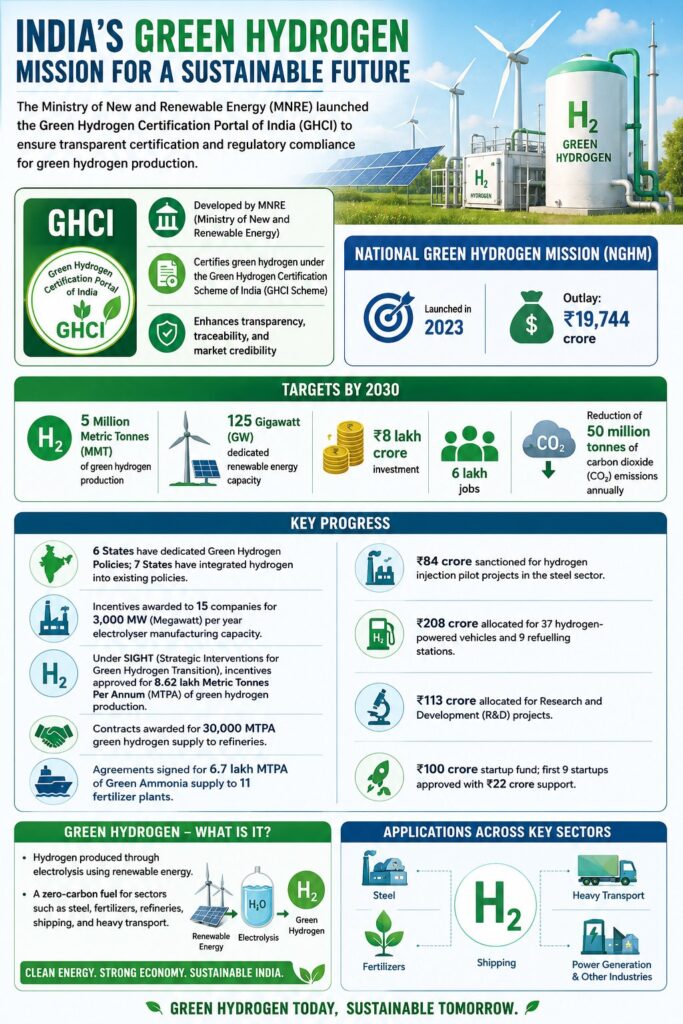
    Green Hydrogen

    Note4Students

    From UPSC perspective, the following things are important:

    Prelims level: Green Hydrogen, BRICS

    Mains level: NA

    India is all set to host a two-day summit on Green Hydrogen initiatives involving the BRICS nations.

    What is Green Hydrogen?

    • Hydrogen, when produced by electrolysis using renewable energy is known as Green Hydrogen which has no carbon footprint.
    • This gives hydrogen the edge over other fuels to unlock various avenues of green usage.
    • However, challenges lie in terms of technology, efficiency, financial viability, and scaling up which the summit will aim to address.

    Answer this PYQ in the comment box:

    Q.With reference to ‘fuel cells’ in which hydrogen-rich fuel and oxygen are used to generate electricity, consider the following statements:

    1. If pure hydrogen is used as a fuel, the fuel cell emits heat and water as by products.
    2. Fuel cells can be used for powering buildings and not for small devices like laptop computers.
    3. Fuel cells produce electricity in the form of Alternating Current (AC).

    Which of the statements given above is/are correct?

    (a) 1 only

    (b) 2 and 3 only

    (c) 1 and 3 only

    (d) 1, 2 and 3

    Applications of green hydrogen

    • Green hydrogen has innumerable applications.
    • Green Chemicals like ammonia and methanol can directly be utilized in existing applications like fertilizers, mobility, power, chemicals, shipping among others.
    • Green Hydrogen blending up to 10 percent may be adopted in CGD networks to gain widespread acceptance.
    • Further scaling up with greening of hard to abate sectors like steel and cement through hydrogen is to be explored.
    • Many countries have brought out their strategies and defined targets and roadmaps based on their resources and strengths.

    Back2Basics: BRICS Countries

    • BRICS is an acronym for the grouping of the world’s leading emerging economies, namely Brazil, Russia, India, China and South Africa.
    • To be clear, BRICS was not invented by any of its members.
    • In 2001, Goldman Sachs’ Jim O’Neill authored a paper called “Building Better Global Economic BRICs”, pointing out that future GDP growth in the world would come from China, India, Russia and Brazil.
    • Significantly, the paper didn’t recommend a separate grouping for them, but made the case that the G-7 grouping, made up of the world’s most industrialized, and essentially Western countries, should include them.
    • O’Neill also suggested that the G-7 group needed revamping after the introduction of a common currency for Europe, the euro, in 1999.
    • In 2003, Goldman Sachs wrote another paper, “Dreaming with BRICs: Path to 2050”, predicting that the global map would significantly change due to these four emerging economies.
    • In 2006, leaders of the BRIC countries met on the margins of a G-8 (now called G-7) summit in St. Petersburg, Russia, and BRIC was formalized that year.
  • Pharma Sector – Drug Pricing, NPPA, FDC, Generics, etc.

    [pib] Indian Certification of Medical Devices (ICMED) Plus Scheme

    Note4Students

    From UPSC perspective, the following things are important:

    Prelims level:  ICMED 13485 PLUS

    Mains level: NA

    The Quality Council of India (QCI), and the Association of Indian Manufacturers of Medical Devices (AiMeD) have added further features to the ICMED Scheme for Certification of Medical Devices.

     ICMED 13485 PLUS

    • The ICMED 13485 PLUS, as the new scheme has been christened, will undertake verification of the quality, safety and efficacy of medical devices.
    • It was first launched in 2016.
    • It has been designed to integrate the Quality Management System components and product-related quality validation processes through witness testing of products with reference to the defined product standards and specifications.
    • This is the first scheme around the world in which quality management systems along with product certification standards are integrated with regulatory requirements.
    • This scheme will be an end-to-end quality assurance scheme for the medical devices sector in India.

    Details of the scheme

    • This scheme provides the much-needed institutional mechanism for assuring product quality and safety.
    • It will go a long way in assisting the procurement agencies to tackle the challenges relating to the menace of counterfeit products and fake certification.
    • This will also help in eliminating the circulation and use of sub-standard medical products or devices of doubtful origin that could prove to be serious health hazards.