💥Join UPSC 2027,2028 Mentorship (July Batch) + XFactor Notes & Microthemes PDF

Day: October 12, 2017

  • Railway Sector in India

    Indian Railways (IR) have been the prime movers to the nation and have the distinction of being the second largest railway system in the world under single management. IR has historically played an important integrating role in the socio-economic development of the country. Its role in economic development assumes importance due to its innate advantage as a mode of surface transport being more energy efficient and environment friendly than other transport modes.

    Indian Railways: Segments

    Railway Segments

    Importance of Railways

    Railways Development in India: A Snapshot

    Growth Drivers for Railways

    Revenue Growth for Indian Railways


    Revenue Breakup for Railways

    Subsidiaries of Indian Railways

    Public Private Partnership in Indian Railways


    By
    Himanshu Arora
    Doctoral Scholar in Economics & Senior Research Fellow, CDS, Jawaharlal Nehru University
  • Government Policy Support for the Energy Sector


    Renewable Energy: A rising Source

    1. Wind energy is the largest source of renewable energy in India; it accounts for an estimated 64.77 per cent of total installed capacity (24.7 GW). There are plans to double wind power generation capacity to 20 GW by 2022.
    2. Biomass is the 2nd largest source of renewable energy, accounting for ~12 per cent of total installed capacity in renewable energy. There is a strong upside potential in biomass in the coming years.
    3. In May 2017, India’s solar power tariffs fell to a new low of US$ 0.038 per unit during the auction of a 250-megawatt capacity at Bhadla in Rajasthan. This bid was placed by South Africa’s Phelan Energy Group and Avaada Power to win contracts to build capacities of 50MW and 100MW, respectively, at Adani Renewable Energy Park Rajasthan Ltd.
    4. In February 2017, low solar tariffs tendered in India at auction, is expected to catalyse green investments and help in reducing the dependency on fossils fuels.
    5. On account of anticipated decline in solar panel prices, due to supply glut in international market, solar power prices in India are estimated to fall by 2018.
    6. In March 2017, the Power Ministry has launched an application named – GARV-II, to provide real time data related to rural electrification regarding all un-electrified villages in India.
    7. Declining solar power prices as compared to thermal power has prompted the government to switch to the renewable energy resources. Three coal power projects have been shelved in Odisha, Gujarat and Uttar Pradesh due to low rate of renewable solar energy at US$0.038 / kWh.


    Nuclear Energy in India: Recent Trends

    1. Currently, the country has net installed capacity of 5.8 GW, using nuclear fuels, across 20 reactors. Of the 20 reactors, 18 are Pressurised Heavy Water Reactors (PHWR) and 2 are Boiling Water Reactors (BWR)
    2. The government aims to quadruple India’s nuclear power generation capacity to 20 GW by 2020;
    3. Nuclear Power Corporation of India Limited (NPCIL) plans to construct 5 nuclear energy parks with a capacity of 10,000 Mwe
    4. The Kudankulam Atomic power project, Tamil Nadu, by NPCIL is expected to start operating by 2016-17 with an installed capacity of 1000 MW.
    5. Unit II of Kudankulam plant has started functioning in May 2016 with an installed capacity of 1000 MW. The Kudankulam nuclear power plant’s 2nd unit attained criticality on 10th July, 2016.

    By
    Himanshu Arora
    Doctoral Scholar in Economics & Senior Research Fellow, CDS, Jawaharlal Nehru University
  • Energy and Power Sector

    Executive Summary


    India’s Power Sector: Evolution


    World’s Leading Electricity Producer’s


    Sources of Power in India’s Installed Capacity

    Energy Security in India: Recent Developments


    By
    Himanshu Arora
    Doctoral Scholar in Economics & Senior Research Fellow, CDS, Jawaharlal Nehru University


  • Port sector in India

    Ports in India

    A common characteristic of the fast-growing East and South East Asian countries has been the rapid growth of trade during their high growth period. A higher share of trade in the economy contributes to the attainment of higher efficiency. A country improves its resource allocation by exporting those goods where it exhibits competitive advantage and imports those where it does not. As its comparative advantage changes, so does the composition of its exports and imports.

    Thus, in order to achieve higher economic growth and higher efficiency levels, the trade-GDP ratio needs to increase substantially. Improvement in the efficiency of ports and expansion of their capacity is essential for promoting the growth of trade and export competitiveness.

    Ports in India: A brief Profile


    Categorisation of Indian Ports


    Major Ports of India


    Capacity of Major Ports


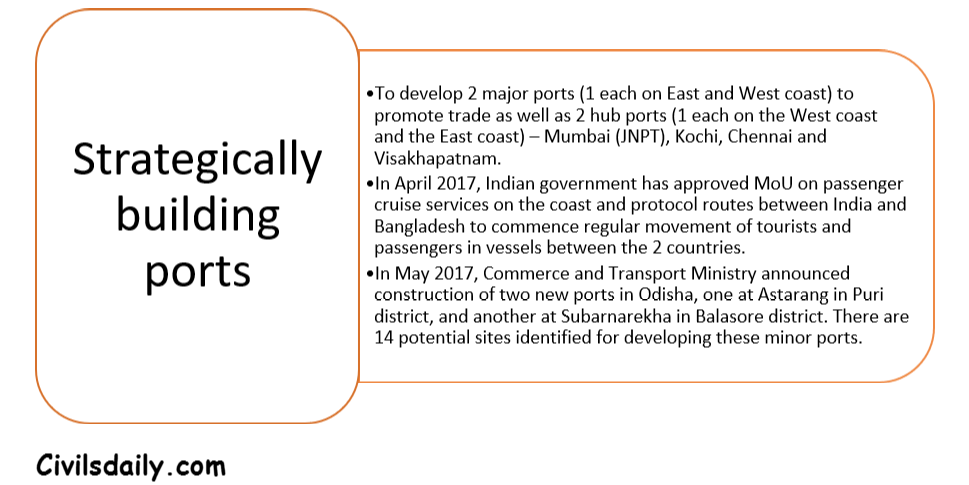
    Recent Development & Strategies for Port Sector


    Growing External Trade and Ports Expansion

    National Maritime Agenda, 2010-2020.


    Sagar Mala Project

    Need for such a project


    Objectives of the project

    Suggested recommendations under the project

    National Sagarmala Apex Committee (NSAC)

    Six megaports are planned under Sagarmala project


    By
    Himanshu Arora
    Doctoral Scholar in Economics & Senior Research Fellow, CDS, Jawaharlal Nehru University
  • Notable Initiatives of Indian Telecom Sector


    Policy Support by Government to the Telecom Sector


    National Telecom Policy, 2012


    Mobile Application Market in India


    By
    Himanshu Arora
    Doctoral Scholar in Economics & Senior Research Fellow, CDS, Jawaharlal Nehru University
  • Telecommunication Sector in India

    Telecommunication Sector

    The substantial progress made in telecommunications since the early 1990s is a success story. The number of telephone lines has grown by 25-30 per cent each year throughout the 1990s.

    The telecommunication sector witnessed revolutionary change in the recent years and the Indian Telecom network is now the second largest in the World after China. From only 76 million subscribers in 2004, the number has increased to more than 1200 million in 2016. The increased has been entirely due to spectacular increase in wireless connections or mobile phones. The number of mobile connections rose from 35 million in 2004 to 1150 million in 2016. Tele density an important indicator of telecom penetration increased from 7 percent in 2004 to 93 percent in 2016.

    Telecommunication Reforms

    1. Reform in the telecommunications sector began in 1992-93 with the opening of value added services to the private sector. Subsequently, after intensive deliberation within the Government and outside, the National Telecom Policy (NTP 1994) announced the opening of basic telecom services to competition, and the initiation of cellular mobile services.
    2. Private initiative was to complement public sector efforts to raise additional resources through increased internal generation and the adoption of innovative means like leasing, deferred payments, build-operate transfer, and the like.
    3. The NTP 1994 also envisaged the provision of a public telephone becoming available for every 500 persons in urban areas and at least one in every village.
    4. The method employed for inducing the private sector into both basic and cellular services was through the auction of licence fees, consistent with what has been followed by many other countries. The consequence was that the auction process elicited excessively high bids, even from bidders who had no previous history of substantive telecom experience, or even any other experience. Once the licences had been awarded, and operations had begun, inevitable complaints arose about the licence fees being too high and uneconomic.
    5. Since various developments had taken place in the telecom sector and new issues had arisen, a New Telecom Policy (NTP 1999) was announced. The issues that had arisen during this period related to:
    • Perception of the original licence fee bids having been excessive
    • Inadequate competition resulting from the existence of only two operators in each circle
    • Continuing changes in technology
    • The emergence of India as a significant player in the IT industry
    1. Under the NTP 1999, a package for migration from fixed licence fee to revenue sharing was offered in July 1999 to the existing cellular and basic service providers.
    2. The MTNL was allowed as a third operator to provide cellular services to promote competition. Government opened national long-distance services to private operators without any restriction on the number of operators and with moderate entry fees.
    3. International Long Distance Services were then opened in 2001, also with no limit on the number of operators and moderate entry fees. Both are subject to licence fees being paid as revenue sharing. Thus significant competition was introduced in the Indian telecom market starting in 2000-2001.
    4. The consequence has been dramatic: cellular mobile tariffs have fallen by about 90 per cent since 1999, and long distance tariffs, both domestic and international, fell by 75 per cent between 2000 and the end of 2012.
    5. Corresponding organisational changes also took place during 2000-01. The two service providing departments of the telecom sector were corporatised, viz., Department of Telecom Services (DTS) and Department of Telecom Operations (DTO).
    6. A new public sector company ‘Bharat Sanchar Nigam Limited’ (BSNL) was given all service providing functions of these two departments with effect from October 2000. A fourth cellular operator in all the circles was permitted.
    7. With the introduction of effective competition in the cellular mobile services sector, the Telecom Regulatory Authority of India (TRAI) made cellular mobile tariffs free from regulation while reserving the right to intervene in the case of any malpractice such as the offer of predatory tariffs.

    Telecommunication in India: Recent Developments


    The Telecom Market Segments


    Telecom subscriber base expansion


    Wireless Subscription dominates the Indian Markets


    Market Share of Wireless Service Providers


    Fixed Line/Land Line Segment


    Internet Subscription is on the Rise


    By
    Himanshu Arora
    Doctoral Scholar in Economics & Senior Research Fellow, CDS, Jawaharlal Nehru University


  • Recent Initiatives by the Railways

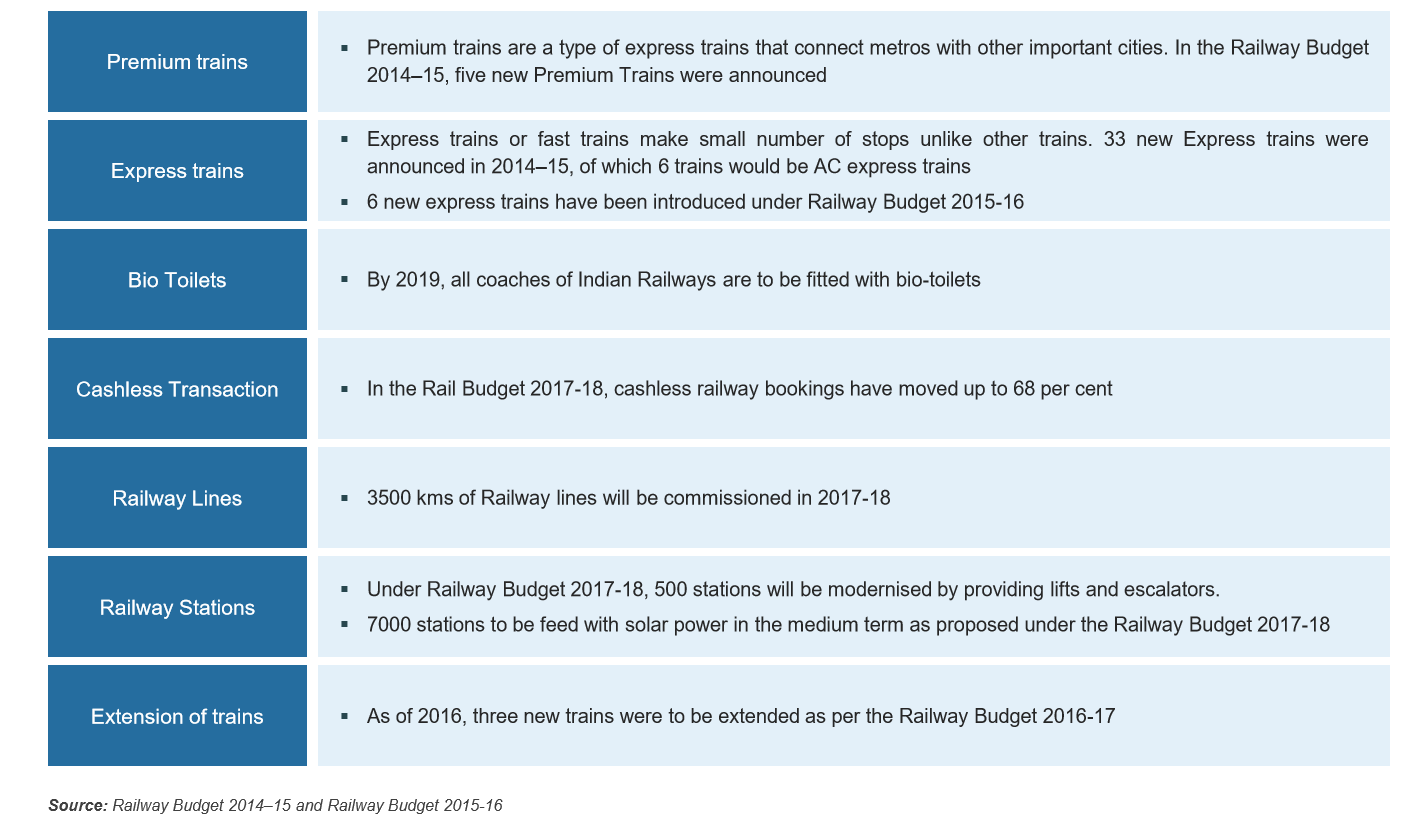
    Announcement Made in Railway Budget

    Dedicated Freight Corridor


    DFC Objectives


    Dedicated Freight Corridor: Projections


    Modernisation of Railways


    Policy Support by the Government


    Automobile Freight Train Operator Scheme 2013:


    Wagon investment scheme


    Participative models for rail connectivity and capacity augmented projects

    Key modernisation initiatives

    1. Introduced ‘Operation 5 minutes’ scheme for passengers travelling unreserved, which provides the passengers the time to purchase tickets within 5 minutes
    2. Installing Bio–toilets by 2016. So far (till October 2016), Indian Railways have installed more 49,000 Bio–toilets in passenger coaches, extension of built-in dustbin facility has been approved for non-AC coaches. Setting up of 5-year safety plan
    3. Introducing 24/7 All – India helpline number through which passengers could address their problems on a real – time basis. Toll free number, 138 has been launched as 24/7 All-India helpline number and availability of Toll – free number, 182, for security related complaints
    4. Moving towards paperless ticketing and charting by development of multi–lingual E–ticketing portal. In the coming years, SMS on mobiles would be taken as proof instead of tickets promoting paperless tickets throughout India.
    5. Train protection warning system and train collision avoidance system have been installed on selective routes
    6. Setting up a new department that would ensure the railway stations and trains are kept clean. Improving North-East and J&K connectivity.
    7. In an initiative to decarbonize rail transport, Indian Railways will be collaborating with various public-sector enterprises to speed up the process of electrification of railway tracks
    8. As of June 2017, the Indian Railways is preparing to acquire 25 E5 Shinkasen series bullet trains from Japan for an estimated cost of US$743.71 million. The high speed corridor will have urinals, western style toilets with hot water and washing closet seat facility, separate washrooms for men and women equipped with triple mirrors for make-up and many other facilities.


    By
    Himanshu Arora
    Doctoral Scholar in Economics & Senior Research Fellow, CDS, Jawaharlal Nehru University
  • 12 Oct 2017 | Prelims Daily with Previous Year Questions & Tikdams

    Q.1) Recently, Sample Registration Survey (SRS) has revealed that states from the east and northeastern part of the country have registered a significant drop in Infant Mortality Rate (IMR). The SRS bulletin is published by the
    a) Registrar General of India
    b) Comptroller and auditor general of India
    c) Ministry of Women and Child Development
    d) Central Statistics Office (CSO)

    Q.2) ) The Purchasing Managers’ Index(PMI) is based on
    1. New orders
    2. Inventory levels
    3. production
    4. Supplier deliveries
    5. Employment environment
    Select the correct answer using the codes given below.
    a) 1, 2, 3, 4 and 5
    b) 2, 3 and 4 only
    c) 1, 2 and 5 only
    d) 1, 2, 4 and 5 only

    Q.3) Which of the followig Department/Ministry/Tribunal deals with the matter related to Anti-Dumping?
    a) Department of Industry Policy and Promotion(DIPP)
    b) Minsitry of Finance
    c) Customs, Excise and Service Tax Appellate Tribunal (CESTAT)
    d) None of the above

    Q.4) Consider the following statements regarding FDI and FPI:
    1. FPI tends to involve establishing more of a substantial, long-term interest in the economy of a foreign country.
    2. FDI is an equity investment with a shorter time frame for investment return
    Which of the above is/are correct?
    a) 1 only
    b) 2 only
    c) Both 1 and 2
    d) Neither 1 nor 2

    Q.5) Which of the following organizations is a partner in the Global Nutrition Report?
    a) Generations United
    b) CARE
    c) World Health Organisation
    d) Food and Agriculture Organisation

    Q.6) Which one of the following is the best description of ‘INS astradharini’ that was in the news recently?(CSE: 2016)
    a) amphibious warfare ship
    b) nuclear -powered submarine
    c) torpedo launch and recovery vessel
    d) nuclear – powered aircraft carrier

    Q.7) What is ‘Greased lightning-10 (Gl-10) recently in the news? (CSE: 2016)
    a) electric plane tested by NASA
    b) solar powered two seater aircraft designed by japan
    c) Space observatory launched by china
    d) reusable rocket designed by ISRO

    Q.8) With reference to ‘initiative for nutritional security through intensive millets promotions’, which of the following statements is/are correct?(CSE: 2016)
    1.This initiative aims to demonstrate the improved production and post-harvest technologies, and to demonstrate value addition techniques ,in an integrated manner with cluster approach
    2.Poor, small, marginal and tribal farmers have larger stake in this scheme
    3.an important objective of the scheme is to encourage farmers of commercial crops to shift to millet cultivation by offering them free kits of critical inputs of nutrients and micro irrigation equipment .
    Select the correct answer using the above
    a) 1 only
    b) 2 and 3 only
    c) 1 and 2 only
    d) 1,2 and 3


    IMPORTANT STUFF: 

    1. Daily newscards have been enriched with back2basics and note2students – Make notes daily

    2. Join Full Year Prelims TS – prelims.civilsdaily.com

    3. Solutions will be uploaded at 11.30 p.m. Click here for Solutions

    4. For attempting previous Prelims Daily Questions – Click here