💥Join UPSC 2027,2028 Mentorship (July Batch) + XFactor Notes & Microthemes PDF

Year: 2016

  • International Org. | Part 8 | Gulf Cooperation Council (GCC)

    The Gulf Cooperation Council (GCC) is a regional political organisation comprising the energy rich Gulf monarchies – Bahrain, Kuwait, Oman, Qatar, Saudi Arabia, and the United Arab Emirates.
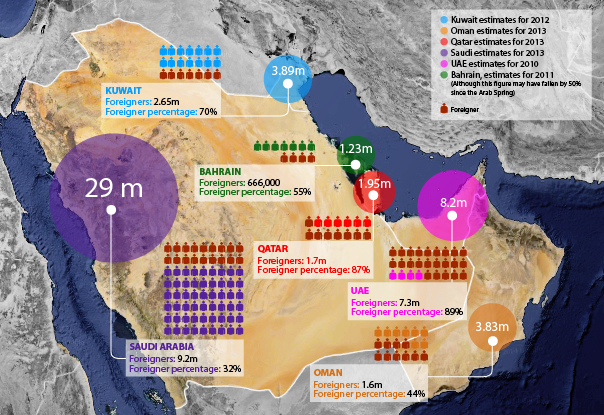
    source: middleeasteye


    When and why was it founded?

    • Establishment in Abu Dhabi in 1981 | HQ in Riyadh
    • The founding charter focused more on issues of social and cultural cohesion, environmental and scientific coordination and economic cooperation
    • Recently, Morocco and Jordan have applied for the GCC membership which is currently being studied by the GCC Expert Committee

    India and GCC: Contours of cooperation

    • The Gulf constitutes the “immediate” neighborhood of India separated only by the Arabian Sea
    • The Gulf, as the principal source of India’s energy requirements, is central to our energy security interests: it meets 75% of our oil needs at present; as our demand increases in coming years, India’s dependence will go up to 90% by 2035.
    • GCC is India’s largest trading partner as an economic grouping, with two-way trade being more than our ties with the European Union, ASEAN and North America
    • Four GCC countries figure in India’s top 10 trade partners.
    • We also have an eight-million strong community in the GCC that remits annually $35 billion to the national exchequer
    • The India-GCC Free Trade Agreement which is in under negotiation could usher in a new era of trade


    Although India and the GCC countries share a strong economic relationship, there is much progress to be achieved on the political front. Let’s have a close look at some of the important dimensions –

    #1. Defence Diplomacy

    India’s defence diplomacy with countries of the GCC is well reputed.

    • India has signed a military protocol with Oman which has facilitated joint military exercises
    • India has also signed a defence cooperation agreement with the UAE
    • Our new naval diplomacy document increases our focus on west asian countries. Click to read more about it here.

    #2. Counter Terrorism

    The meteoric rise of the Islamic State of Iraq and the Levant (ISIS) in neighbouring countries like Iraq and Syria pose a huge threat to the peace and stability of the GCC countries.

    #3. Maritime Security

    Primary maritime security threats include piracy at sea, smuggling of narcotics and arms and the imminent threat of maritime terrorism.

    • These threats pose major challenges to the Sea Lines of Communication (SLOCs) that India depends heavily on to carry out trade by sea
    • India’s international trade by sea amounts to about 90% of the foreign trade, and it takes place through 13 major ports and several minor ports
    • In recent times the term “Indo Pacific era” has gained currency. You would do well to read this post on – Indian maritime challenges and its diplomatic dimensions

    #4. Culture & Diaspora

    • We have an eight-million strong community in the GCC that remits annually $35 billion to the national exchequer
    • Minor concerns – If you remember, in 2013 Saudi Arabia issues a Nitaqat Law – The ‘Nitaqat’ law makes it mandatory for local companies to hire one Saudi national for every 10 migrant workers
    • There had been widespread perception that the new policy will lead to denial of job opportunities for a large number of Indians working there.
    • India had back then proactively conveyed concerns to the Saudi government


    Want to read more?

  • हिंदी संपादकीय और विचार: 12 अप्रैल

    आज के लिंक:

    1. राष्ट्र की दृष्टि से उचित नहीं है किराना को बचाना

    लिंक: http://blogs.navbharattimes.indiatimes.com/nbteditpage/government-needs-to-save-employment-not-grocery/

    (एक अच्छा आलेख. ज़रूर पढ़ा जाना चाहिए. अंग्रेजी वालों को भी. इस आलेख में आप जानेंगे कि सरकार को चिंता है कि ई-रिटेल कंपनियों द्वारा भारी डिस्काउंट दिए जाने से नुक्कड़ की किराना दुकानों का धंधा चौपट हो जाएगा, करोड़ों लोग बेरोजगार हो जाएंगे। सरकार की चिंता वाजिब है, परंतु यह समस्या तमाम रोजगार भक्षक आधुनिक तकनीकों में निहित है)

    2. प्राकृतिक आपदाओं के कारण फसलों के भारी नुकसान के बावजूद 2014-15 में 252.02 मिलियन टन अनाज उत्पादन की तुलना में 2015-16 में अनाज उत्पादन बढ़कर 253.16 मिलियन टन हुआ

    लिंक- http://pib.nic.in/newsite/hindirelease.aspx

    (11 अप्रैल को पीआइबी पर प्रकाशित कृषि मंत्रालय की इस विज्ञप्ति में आप जानेंगे कि सरकार द्वारा 2016-17 के बजट में किसानों की आय दोगुनी करने की जो घोषणा की गई थी, उस लक्ष्य को प्राप्त करने के लिए सरकार किन सात बिन्दु पर कार्य करने का विचार कर रही है)

  • Consolidated government schemes under one umbrella

    We have been putting concentrated efforts in finishing off the important GOI schemes of 2015-16. All of them have been compiled and put under the collection of – https://www.civilsdaily.com/collection/government-schemes-programs/

    Click to review all of them and let us know if we have missed on any important one.

  • Indian maritime challenges and its diplomatic dimensions

    Scope of discussion

    • Maritime challenges & Our new Maritime Security Strategy
    • Geopolitical aspects of maritime challenges – Fodder for Mains & Essay
    • Indian maritime agencies – Fodder for Prelims
    • Diplomatic dimensions – Fodder for Prelims & Interview
    • Challenges ahead? Mains & Interview

    Indian Maritime challenges

    India’s maritime geographical position is both an advantage and a challenge. The close proximity of international shipping lanes to India’s coasts attracts other powerful countries too to try to dominate and, thus, create the potential situation of confrontation with India.

    India’s own strategic interests made it pay attention to waters beyond its immediate proximity. Late 2015, we released our new edition of Maritime Security Strategy. Contrast the aggressiveness vis a vis the older strategy document released in 2007:

    • 2015 – Ensuring Secure Seas
    • 2007 – Freedom to Use the Seas
    source: nausena-bharti.nic.in

    This is the third maritime guidance document since 1998 and the most comprehensive account of India’s nautical imperatives, challenges, strengths and opportunities. Here’s why we say so:

    #1. India has accepted the concept of “Indo-Pacific” in India’s maritime security. This essentially brings the Indian Ocean and the Western Pacific – theaters of geo-political competition  into one strategic arc and broadens our focus.

    #2. The latest Maritime Security Strategy (2015) enhanced its definition of primary & secondary areas of maritime interest – 

    • Primary – Coastal areas, islands, EEZ, the Arabian Sea, Bay of Bengal, Andaman Sea, their littorals, Persian Gulf, Gulf of Oman, Gulf of Aden, Red Sea, various choke points and their littorals, SLOCs and energy and resource interests

    • Secondary – Various seas outside the Indian Ocean Region

    South-west Indian Ocean and the Red Sea were formally under the secondary area of interest. In defining the areas of interest, the navy’s intention is to outline the geographic extension of its strategic influence and give an indication of its involvement in those areas.

    #3. Aim to become the “net security provider” to island states in the Indian Ocean. What does that mean?

    As per the document, the term net security describes the state of actual security available in an area, upon balancing against the ability to monitor, contain, and counter all of these.

    #4. The strategy emphasises the importance of maintaining freedom of navigation and strengthening the international legal regime at sea, particularly UNCLOS.


    Geopolitical aspects of maritime challenges

    1. Indian strategists are, naturally, paying attention to developments practically in all waters due to the country’s growing international profile
    2. Their growing concern is regarding tensions rising in the East China Sea, the South China Sea and the Mediterranean
    3. The Indian Ocean remains largely peaceful but has an unstable littoral
    4. Pakistan has declared its intention to put its nuclear weapons at sea which raises the prospect of nuclear weapons falling into the hands of Jihadis
    5. We face a mix of the ‘traditional’ and ‘non-traditional’ challenges – IT, biotechnology, race for natural resources etc.

    To read more on how India has evaluated its prospects in Indian ocean, read this article on Blue Economy


    Indian maritime agencies

    #1. Indian Navy – It aims to be the ‘net security provider’ in the maritime neighbourhood, including deployments for anti-piracy, maritime security, NEO (Non-combatant Evacuation Operations) and HADR (Humanitarian Assistance and Disaster Relief) operations

    #2. Coast Guard – The Coast Guard protects India’s EEZ (Exclusive Economic Zone) from criminals, pirates, smugglers, poachers, human-traffickers and foreign subversion.

    #3. Coastal police – The role of the coastal police gained prominence following the Mumbai terror attacks of November, 2008. confines its activities to largely coastal waters up to 24 nautical miles.

    #4. Ocean affairs – Ministry of Earth sciences (2006) is responsible for development of technology for exploitation and exploration of marine resources, weather services, climate change and geo-hazards


    Diplomatic dimensions

    1. India has cooperated well in anti-piracy operations, played a key role in IORA (Indian Ocean Rim Association), launched IONS (Indian Ocean Naval Symposium, 2008) and shaped BIMSTEC and MGC (Click to read)
    2. Prime Minister’s articulation of India’s ‘Security and Growth for All in the Region’ (SAGAR), on 12 March, 2015, highlights both security framework for the Indian Ocean as well as regional integration with emphasis on Ocean Economy
    3. Japan’s inclusion into the MALABAR exercises
    4. Navy has also carried out Non-combatant Evacuation operations in Libya (2011), Kuwait (2014) and Yemen (2015)
    5. Humanitarian Assistance and Disaster Relief (HADR) operations such as cyclone relief (in 2007, 2008, 2013 and 2014)

    Did you know: In August 2013, a dedicated communications satellite for the navy, GSAT-7, was launched for surveillance purposes


    What are the challenges ahead?

    1. The navy’s fleet is ageing, with an estimated 60% of vessels reported to have reached various stages of obsolescence
    2. The Scorpene-class submarine is the first to be acquired in 16 years, in an attempt to stabilise the fleet’s fast-dwindling numbers
    3. The navy is 16% below strength in officer ranks and 11% below strength in non-commissioned ranks
    4. In August 2013, the navy suffered its worst peacetime accident when an ex-Russian Kilo-class conventional submarine sank in Mumbai’s naval dockyard, killing 18 personnel


    Questions for you

    1. Since we are talking about maritime security, comment on the point of convergence and divergence of Project Mausam & Project Sagarmala
    2. “Net security provider” – This term would have crossed your reading sphere in our dealings with US (defence ties) as well. Is India showing promising signs in becoming one? What has been our progress on this front (land, air, sea)
    3. Since we revised our maritime document very recently and increased the ambit of Primary & Secondary areas of interest – find & locate them on the world map (for Prelims’ sake!)
    Sources: Ref1 | Ref2 | Ref3
  • Pharma Jan Samadhan


    Aim: Redressal of grievances of consumers related to drug pricing and availability of medicines


    Key facts:

    • The scheme is a web-enabled system created by National Pharmaceutical Pricing Authority (NPPA)
    • It seeks to serve as a robust E-governance tool for protection of interests of consumers through effective implementation of the price of drugs
    • The scheme will provide consumers with an online facility to redress their complaints related to over-pricing of medicines, non-availability of medicines and refusal of supply for sale of any medicine without good and sufficient reason
    • After receiving the complaint, NPPA will initiate action on any complaint within 48 hrs
    • The scheme also seeks to create awareness among the people and act as a deterrent against black-marketing, spurious medicines and inflated cost of drugs by creating phama-literacy initiative

    To read more on the related topic, visit the news on this story –

    Published with inputs from Swapnil
  • Technology Acquisition and Development Fund (TADF)

    Union Government has launched TADF the  under the National Manufacturing Policy (NMP), 2011

    Key facts:

    • TADF will facilitate Micro, Small & Medium Enterprises (MSME) to acquire clean, green and energy efficient technologies
    • It will also catalyse the manufacturing growth in MSME sector with an aim to contribute to ‘Make in India’ initiative
    • Implementation: The scheme will be implemented through Global Innovation and Technology Alliance (GITA) which is a joint venture company of CII and Department of Science & Technology
    • GITA was launched in 2007-08 to stimulate private sector’s investment in Research and Development
    • Direct Support for Technology Acquisition: Proposals will be invited for reimbursement of 50 per cent or up to 20 lakh rupees of technology transfer fee from Indian industry
    • In-direct Support for Technology Acquisition through Patent Pool: TADF will provide financial support to MSME’s to acquire patent from across the world based on applications
    • Patent/Technology would be licensed to selected MSME’s and they will get a subsidy of 50 per cent of mutually agreed value or upto 20 lakh rupees
    • Technology/Equipment Manufacturing Subsidies: TADF will support manufacturing of equipment for reducing energy consumption, controlling pollution and water conservation
    • In this regard, subsidy of up to 10 per cent of capital expenditure and machinery will be provided to the manufacturing units subjected to a maximum of 50 lakh rupees
    • Green Manufacturing–Incentive Scheme: TDAF seeks to facilitate resource conservation activities in industries located in National Investment and Manufacturing Zone (NIMZ)
    • In this regard, financial support for under incentive or subsidy schemes will be provided for construction of green buildings, energy or water audits and implementation of waste treatment facilities

    Published with inputs from Swapnil
  • Role of border states in India’s Foreign Policy

    Scope of discussion

    • 2003-05-15: Our focus on Look East – Act East
    • Other Regional Cooperation groupings – Preilms fodder & General gyan
    • The concept of Buffer zone – Factoids
    • Policy imperatives for NE region wrt border states – Mains & Interview


    Following is an excerpt from the Distinguished lecture series organised by MEA. The talk was given by Amb (Retd) Shyam Saran and extensively touches upon our interactions with neighbouring states and evolution in our foreign policy wrt them. Quick timeline check –

    2003

    Prime Minister Atal Bihari Vajpayee proposes the establishment of a South Asian Economic Union, based on –

    • South Asian Free Trade Agreement (SAFTA),
    • a Customs Union and
    • a common currency
    • Also puts forward the idea of a South Asian Parliament

    2005

    Prime Minister Dr. Manmohan Singh extols the virtue of a free flow of goods, people and ideas across national borders while respecting the political realities at ground

    2014

    In comes PM Modi, inviting the heads of state from all the South Asian countries to his swearing in ceremony – quickly followed by his visits to some of these countries to deepen the relationship

    But why such a huge thrust forward?

    India is today the fastest growing emerging economy in the world and can become an engine of growth for all our neighbours

    Our border states will have an opportunity to benefit from the growing economic and commercial exchanges with our neighbouring countries provided appropriate policies are adopted

    Strategically – India’s North-East, which shares borders with 5 of our neighbours, namely China, Nepal, Bhutan, Bangladesh and Myanmar has a huge potential to leverage cross border economics

    What are some of the other regional cooperation groups in Asia Pacific where India has vested interest for its growth?

    #1. The Bangladesh-Bhutan-India-Nepal (BBIN) sub-regional cooperation

    Source: Live Mint

    • India’s North-East constitutes a major component of BBIN
    • A sub-regional power grid is beginning to emerge –
      • India supplying power to Bangladesh and to Nepal and
      • Bhutan supplying power to India

    There is a recent report on an additional 100 MW of power from Tripura being committed by India to Bangladesh in exchange for the latter leasing 10 GBPS internet bandwidth for use in India’s North-East

    There is a plan to reconnect the countries through the revival and development of riverine transport

    The natural outlet for the North East historically was Chittagong port, now in Bangladesh. As per the BBIN cooperation, this port may once be made available

    #2. BIMSTEC – Bay of Bengal Initiative for Multi-Sectoral Technical and Economic Cooperation

    We have covered this extensively here – Click to read.

    #3. Strategic partner at ASEAN

    • India and ASEAN already have a free trade, investment and services agreement
    • Ongoing negotiations on a Regional Comprehensive Economic Partnership (RCEP) which includes –
      • 10 ASEAN member countries
      • China, Japan, the Republic of Korea, Australia and New Zealand

    To read more on ASEAN & EAS (East Asia Summit), click here to read our explainer

    Please note that EAS is a larger grouping which includes not only those represented in the RCEP but also the U.S. and Russia

    #4. Asia-Pacific Economic Cooperation (APEC) group

    India has applied to become a member

    APEC is not yet a free trade grouping but it is nevertheless an important forum for expanding economic and trade relations

    APEC could also become basis for a larger Asia-Pacific Free Trade Area (APFTA) which has been proposed by China


    Discuss: The answer to these two questions would be more or less the same. UPSC has a knack of testing aspirant’s clarity with simple/ complex approaches

    Simple question – The success of India’s Act East Policy is integrally linked to the role of India’s North East as a bridge between India and its extended eastern neighbourhood.

    Complex worded question – Borders should not be looked upon as impenetrable walls that protect us from the outside world but rather as “connectors” which bring us together with our neighbouring countries.


    Negative mindset with regard to national boundaries also impacts upon how we look at the role of our border states. How has this been historically true?

    In the period of British colonial rule various parts of the country were designated as Buffer Zones

    These being areas on the periphery of British Empire as distinct from its heartland

    Border regions were deliberately left undeveloped or under developed and access to these areas was restricted as a matter of policy

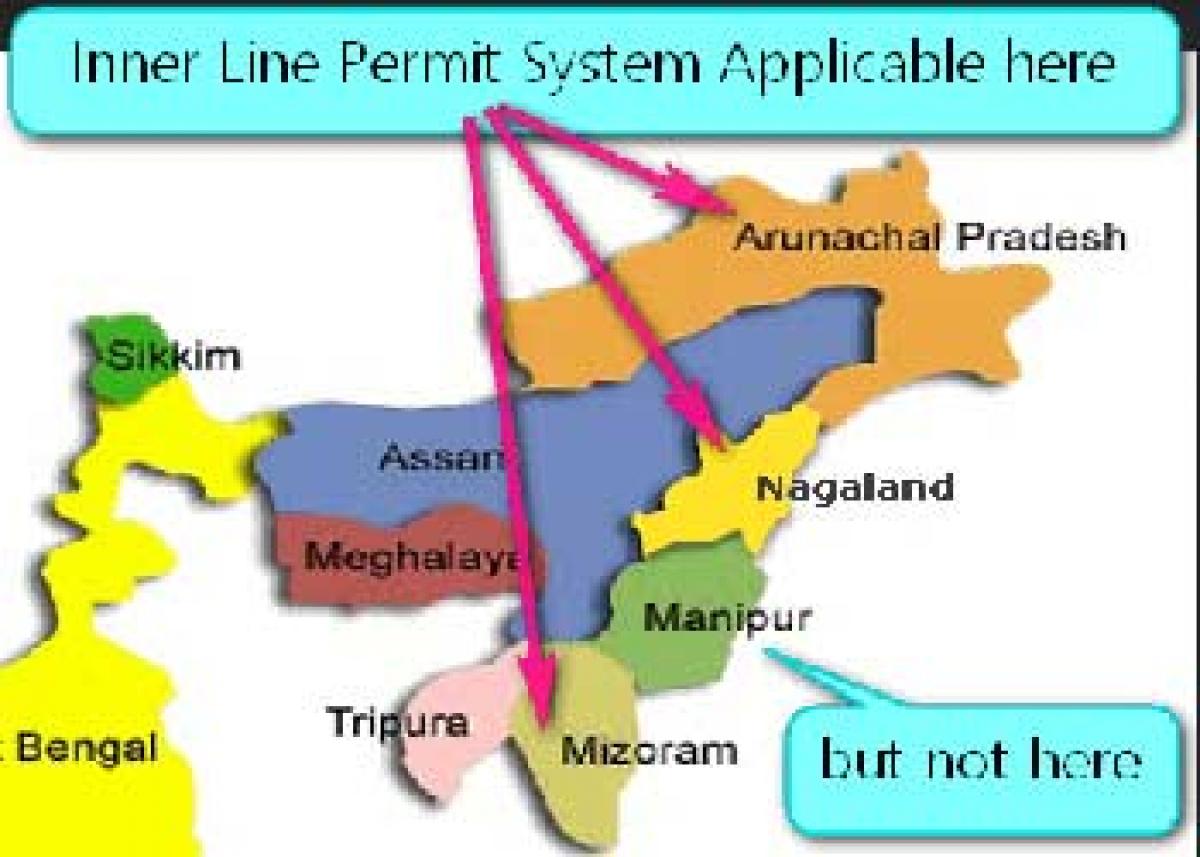
    This is the genesis of so-called Inner Line Permit regime which continues to apply in several parts of North East. What is that?

    Inner Line Permit is required for Indian citizens to enter Arunachal Pradesh, Nagaland and Mizoram. Inner Line Permit is issued under the Bengal Eastern Frontier Regulation, 1873.

    Impacted states – Arunachal Pradesh, Mizoram, Nagaland


    However, after India became independent – such distinctions between the heartland and the periphery became irrelevant. The Indian Constitution does not recognize any differential status among the States which constitute the territory of India.

    Arguments in favour of Buffer Zones – 

    For reasons of defense and security it may be necessary to limit the development of our border areas to only that which is necessary from the defense point of view. BUT – Persisting with this approach can lead to a sense of alienation among the population of border States and dilute their sense of being part of national mainstream.


    What should be the policy imperatives for the development of North East region?

    #1. Develop the Chicken’s neck

    source: The Diplomat

    The Siliguri Corridor, also called as India’s Chicken’s neck

    While the Siliguri corridor looks narrow on the map, it is 22-km wide and there is no reason why additional rail and road links cannot be laid in this corridor

    The feasibility of additional rail and road links needs to be examined on an urgent basis

    #2. North East intra-connectivity plan 

    At present there are no efficient transport linkages among the North East States themselves

    In this connection special attention needs to be paid to the revival of riverine linkages and water transport

    #3. Connectivity across Indian borders

    • The ongoing India-Myanmar-Thailand trilateral project
    • The Kaladan Multi-modal transport project which links Myanmar’s Rakhine province and its port of Sittwe with Mizoram
    • With China, there is a trade route in place through the Nathula Pass in Sikkim

    Read more on news and stories relevant to this theme?

    Bringing development to the north east

    Ensuring Peace in the Northeast

  • हिंदी संपादकीय और विचार: 11 अप्रैल

    गत सप्ताह हमने हिंदी संपादकीय और विचार के तहत आपको कुछ महत्वपूर्ण पठनीय सामग्री उपलब्ध कराने की शुरुआत की थी. आपमें से कई साथियों ने इसे जारी रखने के लिए कहा. यदि आपके पास भी कुछ परीक्षा की दृष्टि से महत्वपूर्ण सामग्री हो तो आप भी पोस्ट करें या आप कुछ पूछना चाहते हों या किसी विषय पर कुछ पढ़ना चाहते हों तो हमें कमेंट में ज़रूर बताएं, हम मदद करने की पूरी कोशिश करेंगे.

    आज के लिंक-

    1. बहुवाद और सहिष्णुता हमारी सभ्यता का नमूना है; विविधता में निहित है भारत की शक्तिः राष्ट्रपति

    लिंक- http://pib.nic.in/newsite/hindirelease.aspx

    (9 मार्च को पीआइबी पर प्रकशित इस विज्ञप्ति में राष्ट्रपति द्वारा कुछ महत्वपूर्ण बातें कहीं गई हैं. निबंध के दृष्टिकोण से पढ़ा जाना चाहिए)

    2. लैब में बन सकेगा ‘ब्लड प्लेटलेट्स’!

    लिंक- http://www.bbc.com/hindi/international/2016/04/160409_huge_leap_to_produce_platelets_cj

    (शरीर में प्लेटलेट्स बनाने वाली चीज़ को प्रयोगशाला में किस तरह से तैयार किया जा सकता है, इसकी खोज ‘एनएचएस’ और कैंब्रिज़ यूनिवर्सिटी की टीम ने की है. इस परीक्षण के विषय में आप बीबीसी के उपरोक्त लिंक पर क्लिक कर जानकारी हासिल कर सकते हैं)

    3. व्यापार-व्याधि

    लिंक- http://hindi.business-standard.com/storypage.php?autono=117529

    (देश का निर्यात लगातार 15 महीने से गिरावट पर है। इस अवधि में औसत(साल दर साल) मासिक गिरावट 16 फीसदी रही। क्यों हो रहा है ऐसा, कैसे निपटा जाए इससे, यह सब आप उपरोक्त लिंक पर पढ़ सकते हैं)

  • SAHAJ: Online LPG Connection

    Union Government has launched SAHAJ scheme for online release of new LPG connections for the consumers as parts of its consumer friendly initiative


    Key facts:

    • Under the scheme, people can apply online for new LPG connection and they need not visit to the LPG distributors for it
    • SAHAJ facility will enable the customers to post online request for a new connection by filing Know Your Customer (KYC) form by uploading bank account details and photographs
    • After submitting the details, customer will receive the registration number to know the new connection status
    • Later, customer can opt for offline or online mode of payment for the new connection
    • Once payment is done, electronic subscription voucher will be mailed to the new customer
    • Later distributor will do physical delivery of the Gas cylinder, regulator with hose pipe

    Phases:

    • Initially, the scheme has been launched in twelve cities across the country
    • In near future, this scheme will be extended to other parts of the country
    • Twelve cities are Ahmedabad, Bhubaneswar, Bengaluru, Bhopal, Chennai, Chandigarh, Kolkata, Hyderabad, Lucknow, Patna, Mumbai and Pune

    Published with inputs from Swapnil | Image: Dailyhunt
  • Blue Revolution: 3000 crore scheme for fisheries sector

    • An umbrella scheme for integrated development and management of fisheries
    • Approved by Cabinet Committee on Economic Affairs (CCEA)
    • It is Central Sector Scheme on Blue Revolution
    • Will be implemented at an outlay of Rs. 3000 crore for a period of five years in all the states including North East States and Union Territories


    Key facts:

    • The scheme will cover will cover multi-dimensional activities for development and management of inland fisheries, aquaculture and marine fisheries
    • All activities under ambit of it would be undertaken by the National Fisheries Development Board (NFDB) towards realizing Blue Revolution
    • The scheme aims at development and management of fisheries and aquaculture sector to ensure a sustained annual growth rate of 6-8%
    • It focuses mainly on increasing productivity and production from aquaculture and fisheries resources both inland and marine keeping in view the overall sustainability, bio-security and environmental concerns

    Components of Scheme:

    1. National Fisheries Development Board (NFDB) and its activities
    2. Development of Inland Fisheries and Aquaculture
    3. Development of Marine Fisheries, Post-Harvest Operations and Infrastructure
    4. Strengthening of database and Geographical Information System (GIS) of the Sector
    5. Institutional Arrangement for Sector
    6. Monitoring, Control and Surveillance (MCS) and other need-based Interventions

    Convergence:

    • It provides for suitable convergence and linkages with the Sagarmala Project of the Ministry of Shipping, Rashtriya Krishi Vikas Yojana (RKVY), MGNREGA, National Rural Livelihoods Mission (NRLM) etc.
    • It also encourages increasing entrepreneurship development, private investment, Public Private Partnership (PPP) and better leveraging of institutional finance for Fisheries Sector

    Published with inputs from Swapnil | Image: Source