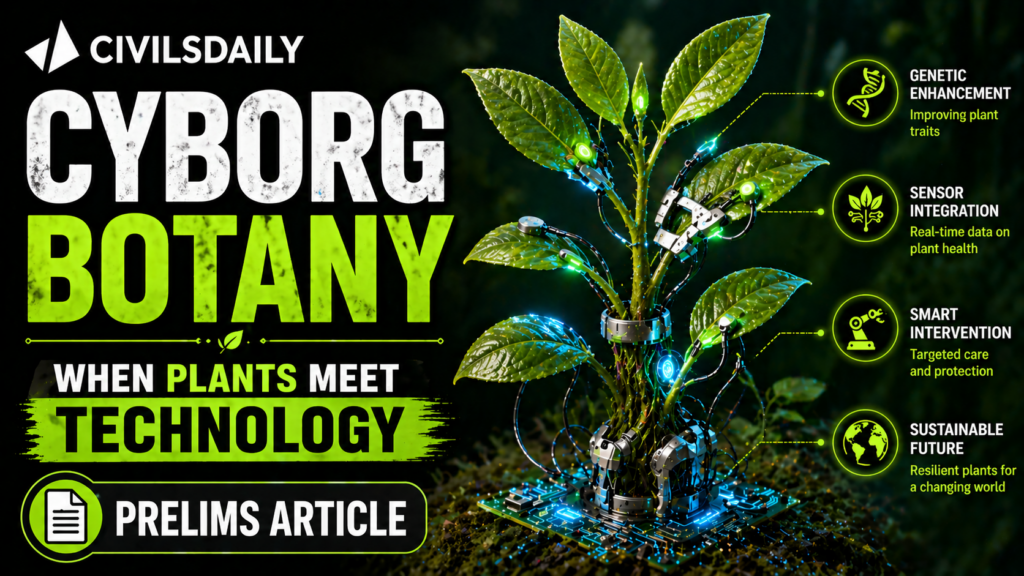
Why in the News
Recent research across global institutions is advancing the field of Cyborg Botany, where scientists are transforming plants into living electronic systems capable of sensing and transmitting data.
What is Cyborg Botany
- A hybrid system integrating living plants with electronic components
- Combines:
- Biology
- Materials Science
- Engineering
- Derived from the term “cyborg” (cybernetic organism)
- Aim: Merge natural plant processes with artificial electronic functions
How it Works
Embedding Nanowires and Transistors
- Inserted into plant cell walls
- Act as biosensors
- Detect biochemical changes in real time
Conductive Polymers (Living Wires)
- Example: PEDOT (Poly 3,4 ethylenedioxythiophene)
- Functions as electrical pathways inside plant tissues
- Transmits signals from plant cells to external devices
Key Concept
- Biosensor: A device that uses biological material to detect changes and produce signals
Types of Plant Stress (Important for Prelims)
- Biotic Stress
- Caused by living organisms
- Example: pests, diseases
- Abiotic Stress
- Caused by environmental factors
- Example: drought, temperature extremes
Significance
- Enables early detection of crop stress before visible symptoms
- Helps in precision agriculture
- Reduces water and chemical usage
- Improves crop productivity and sustainability
- Supports climate resilient agriculture
| [2020] With reference to carbon nanotubes, consider the following statements: 1 They can be used as carriers of drugs and antigens in the human body. 2 They can be made into artificial blood capillaries for an injured part of human body. 3 They can be used in biochemical sensors. 4 Carbon nanotubes are biodegradable. Select the correct answer using the code given below: (a) 1 and 2 only (b) 2, 3 and 4 only (c) 1, 3 and 4 only (d) 1, 2, 3 and 4 |
