Why in the News?
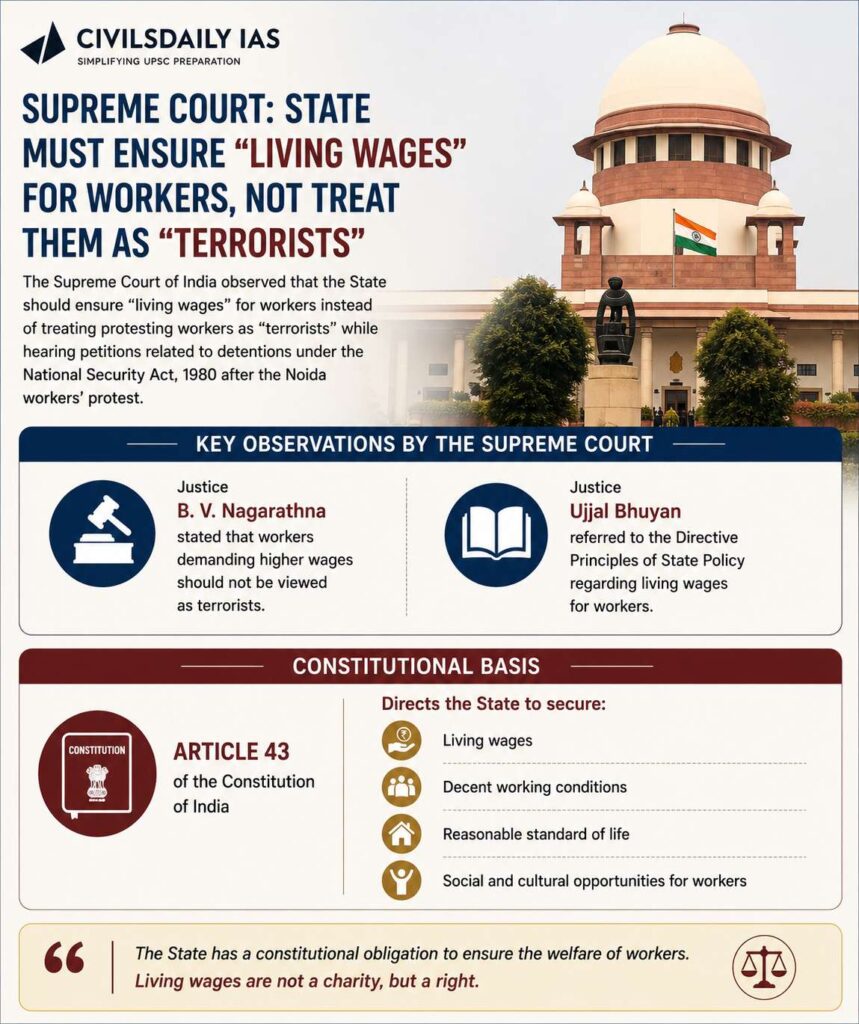
The Supreme Court of India observed that the State should ensure “living wages” for workers instead of treating protesting workers as “terrorists” while hearing petitions related to detentions under the National Security Act, 1980 after the Noida workers’ protest.
Key Observations by the Supreme Court
- Justice B. V. Nagarathna stated that workers demanding higher wages should not be viewed as terrorists.
- Justice Ujjal Bhuyan referred to the Directive Principles of State Policy regarding living wages for workers.
Constitutional Basis
Article 43 of the Constitution of India
- Directs the State to secure:
- Living wages
- Decent working conditions
- Reasonable standard of life
- Social and cultural opportunities for workers
Issue Before the Court
- Family members of detained protestors challenged arrests under the NSA.
- Petitioners alleged:
- Multiple FIRs based on the same conspiracy
- No preliminary enquiry
- Protestors labelled as “left-wing sympathisers”
Court Directions
- The Supreme Court ordered production of two detainees from Kasna jail on May 18.
- Restrained the Uttar Pradesh government from shifting them to police remand.
- Allegations of custodial torture were also raised before the Court.
About the National Security Act (NSA), 1980
- Preventive detention law allowing detention to maintain:
- National security
- Public order
- Essential supplies and services
- Allows detention without formal charges for a specified period.
| [2017] Which principle among the following was added to the Directive Principles of State Policy by the 42nd Amendment to the Constitution? (a) Equal pay for equal work for both men and women (b) Participation of workers in the management of industries (c) Right to work, education and public assistance (d) Securing living wage and human conditions of work to workers |
