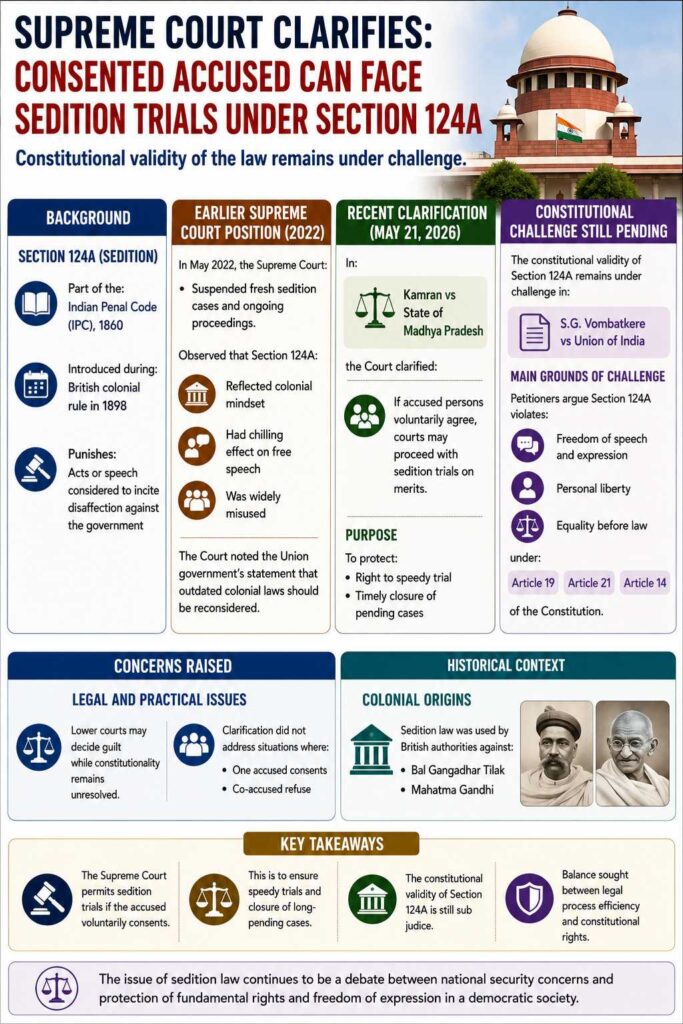
Why in the News?
The Supreme Court of India clarified that accused persons who voluntarily consent can continue to face proceedings under Section 124A (sedition), even though the constitutional validity of the law remains under challenge.
Background
Section 124A (Sedition)
- Part of the: Indian Penal Code (IPC), 1860
- Introduced during: British colonial rule in 1898
- Punishes: Acts or speech considered to incite disaffection against the government
Earlier Supreme Court Position (2022)
In May 2022, the Supreme Court:
- Suspended fresh sedition cases and ongoing proceedings.
- Observed that Section 124A:
- Reflected colonial mindset
- Had chilling effect on free speech
- Was widely misused
The Court noted the Union government’s statement that outdated colonial laws should be reconsidered.
Recent Clarification (May 21, 2026)
- Kamran vs State of Madhya Pradesh.
- The Court clarified: If accused persons voluntarily agree, courts may proceed with sedition trials on merits.
Purpose
- To protect:
- Right to speedy trial
- Timely closure of pending cases
Constitutional Challenge Still Pending
- The constitutional validity of Section 124A remains under challenge in S.G. Vombatkere vs Union of India
Main Grounds of Challenge
Petitioners argue Section 124A violates:
- Freedom of speech and expression
- Personal liberty
- Equality before law
- under Article 19, Article 21, and Article 14 of the Constitution.
Concerns Raised
Legal and Practical Issues
- Lower courts may decide guilt while constitutionality remains unresolved.
- Clarification did not address situations where:
- One accused consents
- Co-accused refuse
Historical Context
- Colonial Origins: Sedition law was used by British authorities against:
- Bal Gangadhar Tilak
- Mahatma Gandhi
[2025] “Sedition has become my religion” was the famous statement given by Gandhiji at the time of:
(a) The Champaran Satyagraha
(b) publicly violating Salt Law at Dandi
(c) attending the Second Round Table Conference in London
(d) the launch of the Quit India Movement
