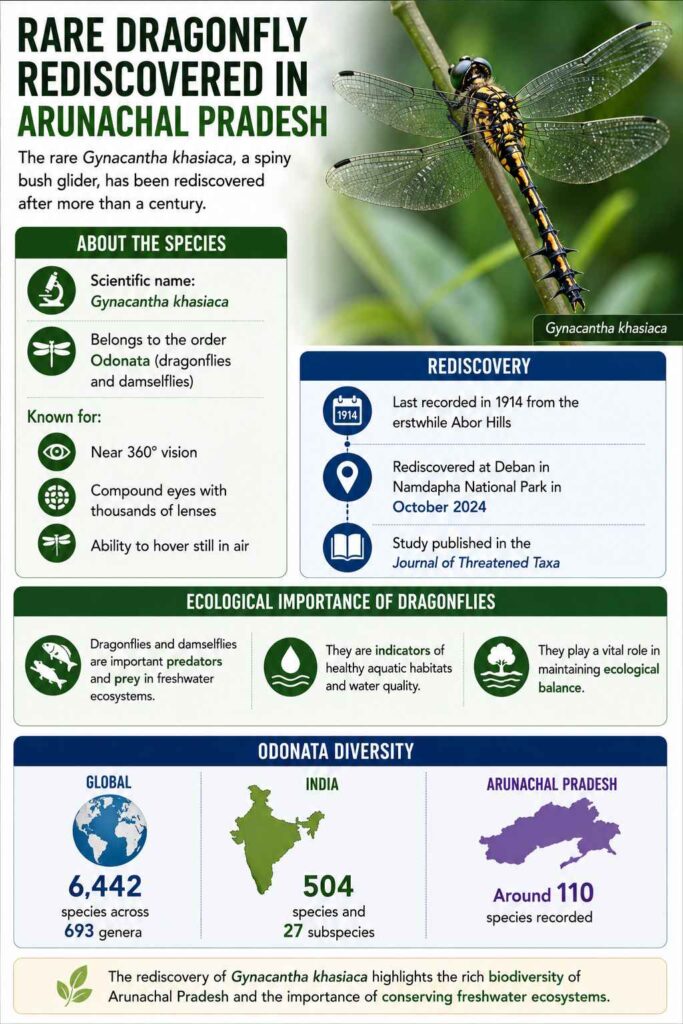
Why in News?
A rare dragonfly species, the Long-tailed Duskhawker, has been rediscovered in Arunachal Pradesh after 110 years in Namdapha National Park and Tiger Reserve.
About the Species
- Scientific name: Gynacantha khasiaca
- Belongs to the order Odonata (dragonflies and damselflies)
- Known for:
- Near 360° vision
- Compound eyes with thousands of lenses
- Ability to hover still in air
Rediscovery
- Last recorded in 1914 from the erstwhile Abor Hills
- Rediscovered at Deban in Namdapha National Park in October 2024
- Study published in the Journal of Threatened Taxa
Ecological Importance of Dragonflies
Dragonflies and damselflies are:
- Predators and prey in freshwater ecosystems
- Indicators of healthy aquatic habitats
- Important for ecological balance
Odonata Diversity
- Global: 6,442 species across 693 genera
- India: 504 species and 27 subspecies
- Arunachal Pradesh: Around 110 species recorded
Distribution of Long-tailed Duskhawker
Apart from Arunachal Pradesh, reported from:
- Assam
- Maharashtra
- Meghalaya
- Uttarakhand
- West Bengal
Significance of Rediscovery
- Highlights rich biodiversity of Northeast India
- Emphasises habitat protection and biodiversity monitoring
- Shows importance of citizen science in conservation
About Namdapha National Park
- Located in Changlang district, Arunachal Pradesh
- One of India’s largest protected areas
- Known for tropical rainforests and rich wildlife diversity
[2017] Due to some reasons, if there is a huge fall in the population of species of butterflies, what could be its likely consequence/consequences?
1. Pollination of some plants could be adversely affected.
2. There could be a drastic increase in the fungal infections of some cultivated plants.
3. It could lead to a fall in the population of some species of wasps, spiders and birds.
Select the correct using the code given below:
[A] 1 only
[B] 2 and 3 only
[C] 1 and 3 only
[D] 1, 2 and 3
