Why in the news?
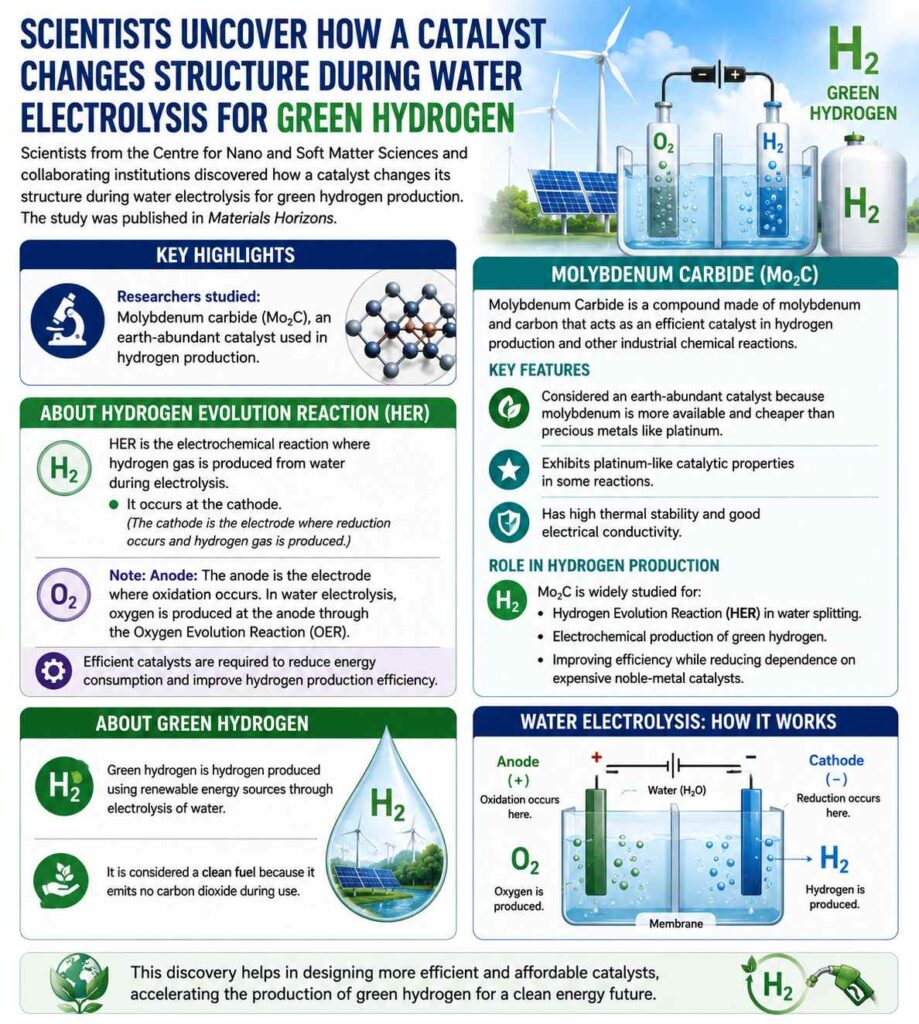
Scientists from the Centre for Nano and Soft Matter Sciences and collaborating institutions discovered how a catalyst changes its structure during water electrolysis for green hydrogen production. The study was published in Materials Horizons.
Key Highlights
- Researchers studied:
- Molybdenum carbide (Mo₂C), an earth-abundant catalyst used in hydrogen production.
- Molybdenum Carbide is a compound made of molybdenum and carbon that acts as an efficient catalyst in hydrogen production and other industrial chemical reactions
- Key Features
- Considered an earth-abundant catalyst because molybdenum is more available and cheaper than precious metals like platinum.
- Exhibits platinum-like catalytic properties in some reactions.
- Has high thermal stability and good electrical conductivity.
- Role in Hydrogen Production
- Mo₂C is widely studied for: Hydrogen Evolution Reaction (HER) in water splitting.
- Electrochemical production of green hydrogen.
- Improving efficiency while reducing dependence on expensive noble-metal catalysts.
About Hydrogen Evolution Reaction (HER)
- HER is the electrochemical reaction where hydrogen gas is produced from water during electrolysis.
- It occurs at the cathode. (The cathode is the electrode where reduction occurs and hydrogen gas is produced.)
- Note: Anode: The anode is the electrode where oxidation occurs. In water electrolysis, oxygen is produced at the anode through the Oxygen Evolution Reaction (OER).
- Efficient catalysts are required to reduce energy consumption and improve hydrogen production efficiency.
About Green Hydrogen
- Green hydrogen is hydrogen produced using renewable energy sources through electrolysis of water.
- It is considered a clean fuel because it emits no carbon dioxide during use.
[2023] With reference to green hydrogen, consider the following statements:
1. It can be used directly as a fuel for internal combustion.
2. It can be blended with natural gas and used as fuel for heat or power generation.
3. It can be used in the hydrogen fuel cell to run vehicles.
How many of the above statements are correct?
[A] Only one
[B] Only two
[C] All three
[D] None
