IMD defines cloudburst as an extreme weather event involving very high-intensity rainfall (often >100 mm/hour) over a small geographical area (20-30 sq. km.) within a short duration.
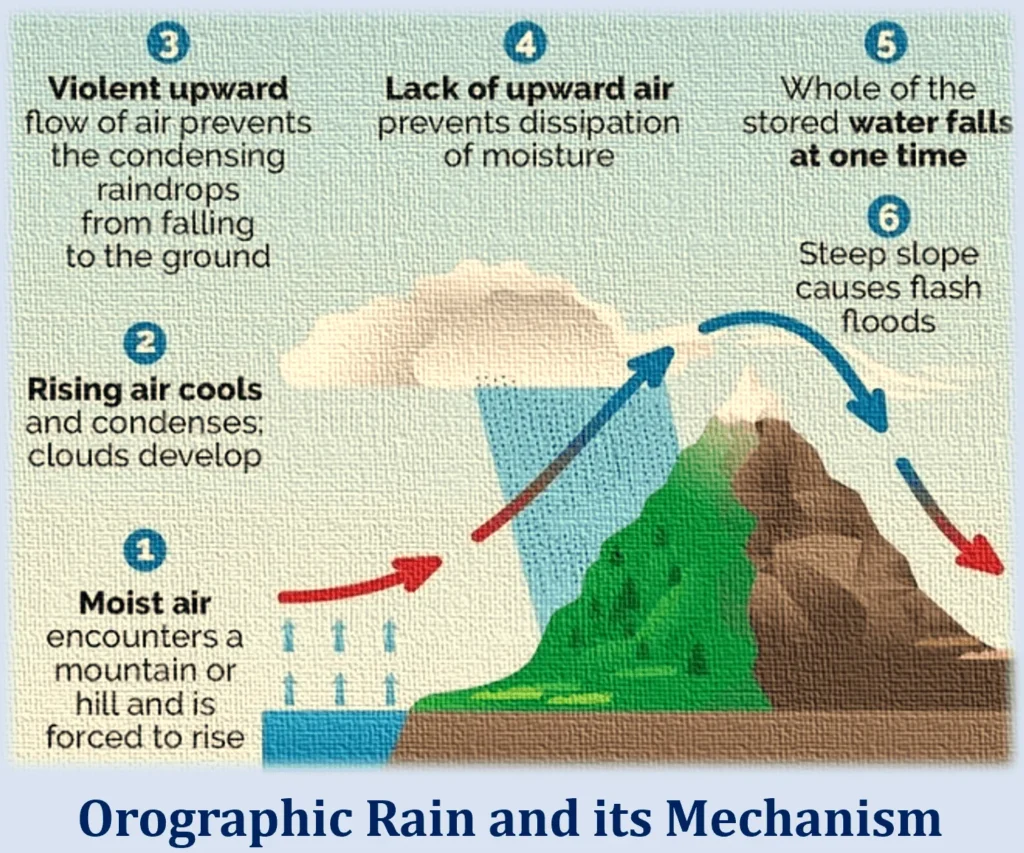
Orographic Uplift
Moist air masses are forced to rise abruptly when they encounter steep mountain slopes.
Rapid ascent causes condensation and release of latent heat, intensifying convection.
Strong Convective Clouds (Cumulonimbus) up to 12-15 km.
Moisture Supply from Monsoon Systems enhances instability.
When updrafts weaken, large volumes of accumulated rainwater are released at once, causing cloudburst-like rainfall.
Occurrence of cloudburst in the Indian Subcontinent
Himalayan and Western Ghat Topography – Steep slopes promote rapid vertical uplift.
Monsoon Dynamics – High atmospheric moisture during June-September.
Climate Change – Rising temperatures increase atmospheric moisture-holding capacity. Eg- every 1°C rise lets air hold ~7% more moisture.
Land-Use Changes – Deforestation, slope cutting, and urbanisation increase runoff and disaster impact.
Mitigation measures
Structural
Engineering solutions – Retaining walls, slope drainage, rock bolting, geo-textiles,
Nature based solutions – Afforestation in himalaya
Non-Structural
Expansion of multi-hazard insurance
Disaster resilient urban planning (Mishra committee on Joshimath crisis)
The Sendai Framework’s proactive approach is essential for making Bharat a ‘weather-ready and climate-smart’ nation.