Why in News?
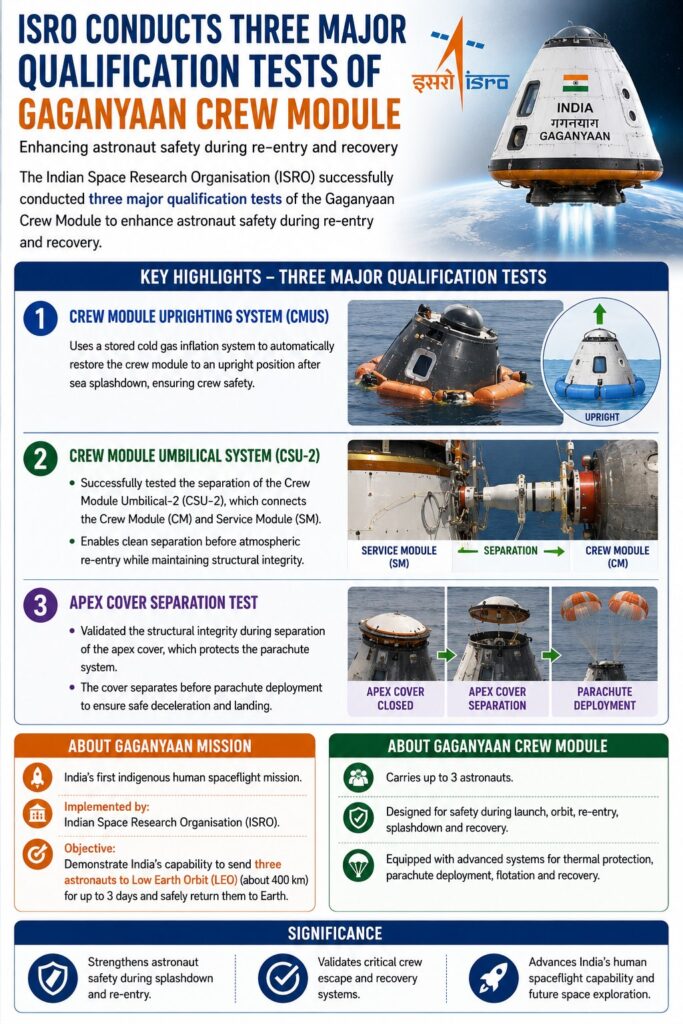
The Indian Space Research Organisation (ISRO) successfully conducted three major qualification tests of the Gaganyaan Crew Module to enhance astronaut safety during re-entry and recovery.
Key Highlights
- Crew Module Uprighting System (CMUS): Uses a stored cold gas inflation system to automatically restore the crew module to an upright position after sea splashdown, ensuring crew safety.
- Crew Module Umbilical System (CSU-2): Successfully tested the separation of the Crew Module Umbilical-2 (CSU-2), which connects the Crew Module (CM) and Service Module (SM).
- Enables clean separation before atmospheric re-entry while maintaining structural integrity.
- Apex Cover Separation Test: Validated the structural integrity during separation of the apex cover, which protects the parachute system.
- The cover separates before parachute deployment to ensure safe deceleration and landing.
- Note: Parachute systems are deployed to slow descents through the atmosphere or space.
About Gaganyaan Mission
- India’s first indigenous human spaceflight mission.
- Implemented by: Indian Space Research Organisation (ISRO).
- Objective: Demonstrate India’s capability to send three astronauts to Low Earth Orbit (LEO) (about 400 km) for up to 3 days and safely return them to Earth.
Significance
- Strengthens astronaut safety during splashdown and re-entry.
- Validates critical crew escape and recovery systems.
- Advances India’s human spaceflight capability and future space exploration.
[2025] Consider the following space missions:
I. Axiom-4
II. SpaDeX
III. Gaganyaan
How many of the space missions given above encourage and support microgravity research?
[A] Only one
[B] Only two
[C] All the three
[D] None