Why in News?
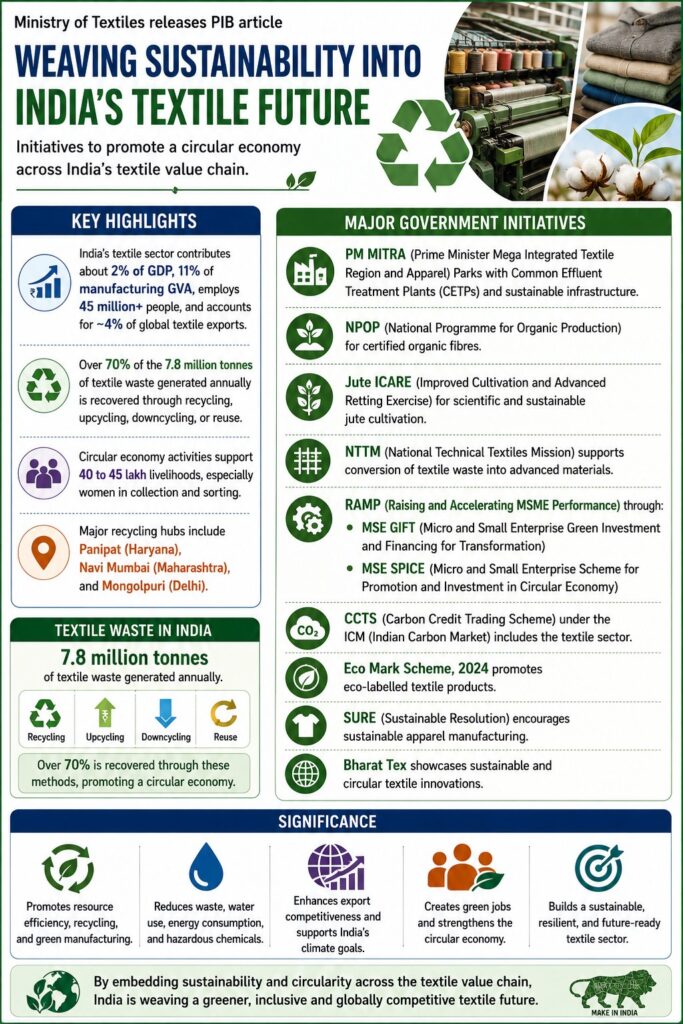
The Ministry of Textiles released a PIB article, “Weaving Sustainability into India’s Textile Future”, highlighting initiatives to promote a circular economy across India’s textile value chain.
Key Highlights
- India’s textile sector contributes about 2% of GDP, 11% of manufacturing Gross Value Added (GVA), employs 45 million+ people, and accounts for ~4% of global textile exports.
- Over 70% of the 7.8 million tonnes of textile waste generated annually is recovered through recycling, upcycling, downcycling, or reuse.
- Circular economy activities support 40 to 45 lakh livelihoods, especially women in collection and sorting.
- Major recycling hubs include Panipat (Haryana), Navi Mumbai (Maharashtra), and Mongolpuri (Delhi).
Major Government Initiatives
- PM MITRA (Prime Minister Mega Integrated Textile Region and Apparel) Parks with Common Effluent Treatment Plants (CETPs) and sustainable infrastructure.
- NPOP (National Programme for Organic Production) for certified organic fibres.
- Jute ICARE (Improved Cultivation and Advanced Retting Exercise) for scientific and sustainable jute cultivation.
- NTTM (National Technical Textiles Mission) supports conversion of textile waste into advanced materials.
- RAMP (Raising and Accelerating MSME Performance) through:
- MSE GIFT (Micro and Small Enterprise Green Investment and Financing for Transformation)
- MSE SPICE (Micro and Small Enterprise Scheme for Promotion and Investment in Circular Economy)
- CCTS (Carbon Credit Trading Scheme) under the ICM (Indian Carbon Market) includes the textile sector.
- Eco Mark Scheme, 2024 promotes eco labelled textile products.
- SURE (Sustainable Resolution) encourages sustainable apparel manufacturing.
- Bharat Tex showcases sustainable and circular textile innovations.
Significance
- Promotes resource efficiency, recycling, and green manufacturing.
- Reduces waste, water use, energy consumption, and hazardous chemicals.
- Enhances export competitiveness and supports India’s climate goals.
- Creates green jobs and strengthens the circular economy.
[2025] Consider the following statements:
Statement I: Circular economy reduces the emissions of greenhouse gases.
Statement II: Circular economy reduces the use of raw materials as inputs.
Statement III : Circular economy reduces wastage in the production process.
Which one of the following is correct in respect of the above statements?
[A] Both Statement II and Statement III are correct and both of them explain Statement I
[B] Both Statement II and Statement III are correct but only one of them explains Statement I
[C] Only one of the Statements II and III is correct and that explains Statement I
[D] Neither Statement II nor Statement III is correct
